The Machine Decides: Geneva, Oil, Chemicals and Capital in the Contest to Govern a Fracturing World Order
Foreign Affairs Forum | Dr. Antonio Bhardwaj (Dr. 🆎)| Nov 7th, 2026
Executive Summary
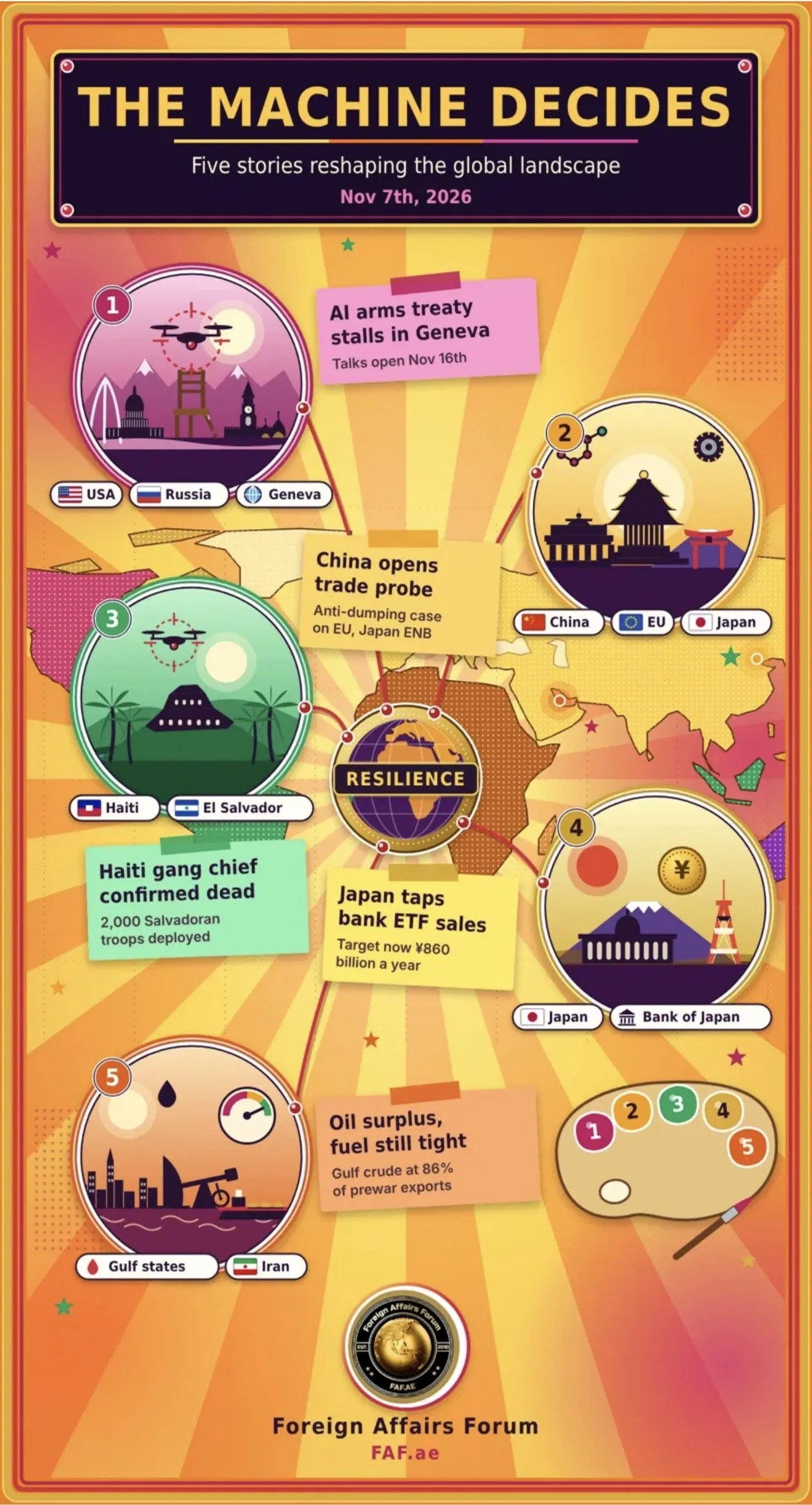
The first week of November 2026 has produced a cluster of developments that together describe the shape of world politics in the coming decade.
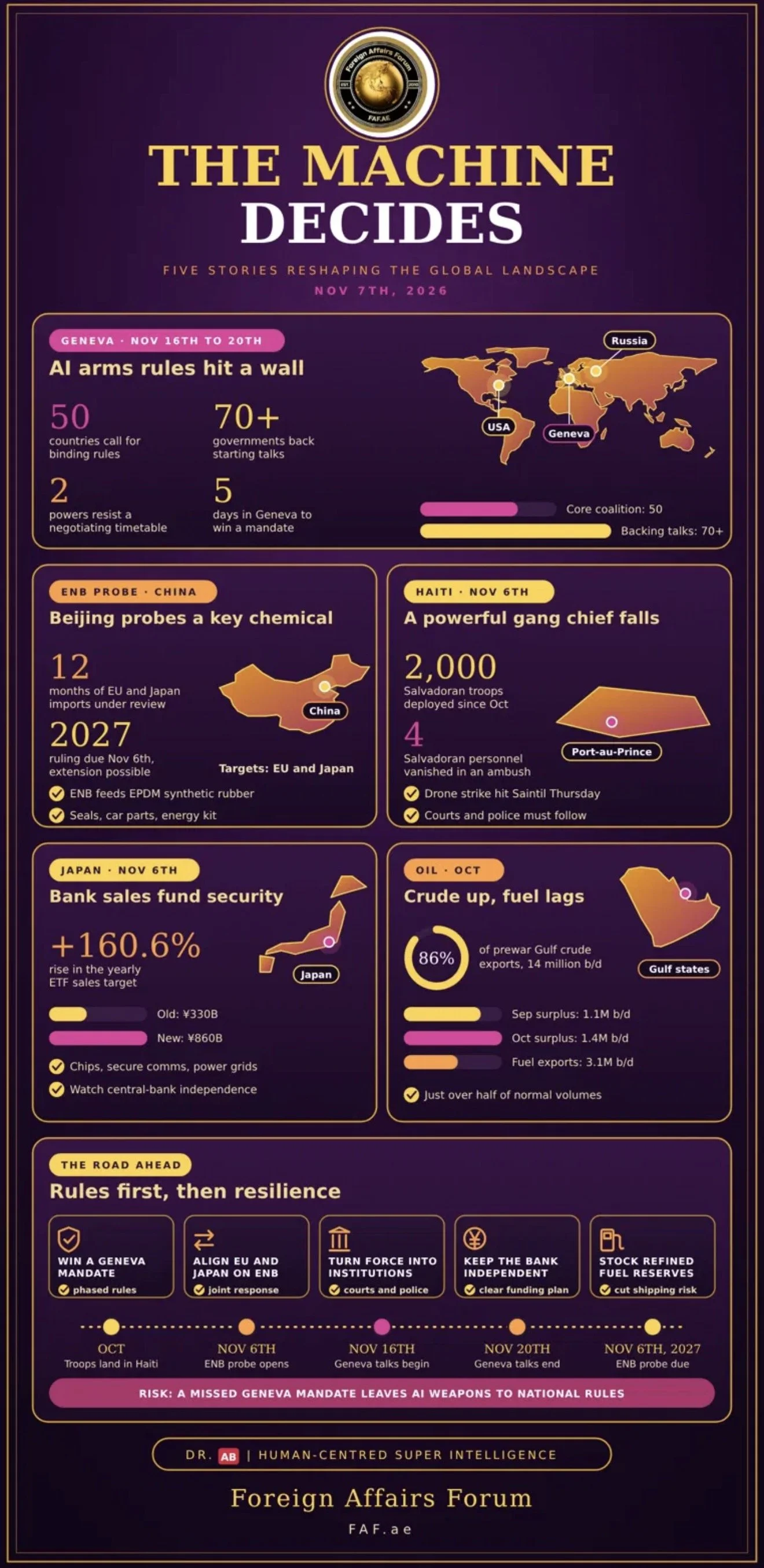
In Geneva, the United States and Russia are resisting a binding timetable for negotiating limits on autonomous weapons. Roughly fifty governments, supported by a wider group of more than seventy, are pressing for a negotiating mandate when the United Nations review conference convenes from Nov 16th to 20th.
In Beijing, the Commerce Ministry has opened an anti-dumping investigation into ethylidene norbornene imported from the European Union and Japan, which extends trade defence into the chemistry of synthetic rubber.
In Port-au-Prince, the confirmed death of the gang leader Mathias Saintil is the most significant blow to Haiti's armed groups since 2024.
In Tokyo, Prime Minister Sanae Takaichi has signalled that proceeds from the Bank of Japan's sales of exchange-traded funds may be directed toward economic security.
In the oil market, new estimates suggest a return to surplus even though the Iran conflict remains unresolved.
This FAF article argues that these events are connected. Each concerns the same underlying question: how a world of rival great powers governs, finances and protects the technologies, materials and flows on which national power now depends. The autonomous weapons dispute shows that the most consequential military technology of the era is advancing faster than the institutions designed to restrain it. The Chinese investigation and the Japanese financing plan show that industrial supply chains have become instruments of strategy. The Haitian operation tests whether external force can rebuild a state. The oil market shows that energy security depends on logistics and refining as much as on crude production.
Dr. 🆎, whose work addresses human-centred superintelligence in geopolitical strategy, AI warfare and bioterrorism risk, holds that the decisive variable across all five cases is accountability. States that combine technical capability with credible institutions will shape the coming order. States that pursue capability without accountability will generate risks that others must absorb. The sections that follow set out the background, the key developments, the latest facts and concerns, the causal logic, and the steps stakeholders should consider.
Introduction
Every era of international politics has had a technology that outran the rules meant to govern it. In the 19th century it was the rifled gun and the steamship, which reorganised naval power and colonial reach faster than diplomats could codify restraint. In the 20th century it was the aeroplane, poison gas and then the nuclear warhead, each of which forced states to improvise legal and institutional responses after the fact. The 21st century has its own candidate, and it is arriving in a form that is harder to see, count and inspect than any of its predecessors: software that can identify, select and attack human beings without a person authorising each engagement.
Dr. Antonio Bhardwaj (Dr. 🆎), a polymath with global expertise in superintelligence, specialising in human-centred approaches to geopolitical strategy, AI warfare and bioterrorism risk, has argued for some years that the governance of military artificial intelligence is the hinge on which the rest of international security will turn. In his assessment, the question is not whether machines will assume greater roles in warfare, since they already have, but whether human responsibility will survive the transition in a form that courts, parliaments and ordinary citizens can recognise.
This FAF article takes the autonomous weapons dispute as its anchor, because it carries the longest-term consequences, but it deliberately reads that dispute alongside four other developments from the past forty-eight hours. China's new trade investigation, Japan's move to turn central-bank asset sales into strategic investment, Haiti's security turning point and the unexpected softness of the global oil market might appear to belong to separate files. In practice they form a single landscape. Each shows a government attempting to secure an advantage or manage a vulnerability in a system whose rules are contested and whose technologies are changing quickly.
The analysis proceeds in stages. It first sets out the historical background and present position of each issue, then examines the key developments, then the latest facts and the concerns they raise. It follows with a cause-and-effect analysis that links the five cases, a set of forward-looking steps for the stakeholders involved, and a conclusion. Throughout, Dr. 🆎 offers remarks that situate the events within the larger question of how humanity governs the tools it builds.
History and Current Status
The effort to regulate autonomous weapons has a long and frustrating lineage. Within the Convention on Certain Conventional Weapons, a framework treaty in Geneva that has produced protocols on blinding lasers, landmines and incendiary weapons, governments began informal discussions of lethal autonomous weapons systems in the middle of the last decade. A group of governmental experts was subsequently constituted, and it has met repeatedly, producing guiding principles that affirm the applicability of international humanitarian law but stop well short of any binding commitment. Because the Convention operates by consensus, a single determined state can block a negotiating mandate, and that procedural reality has defined the past decade of talks.
Frustration with that pattern pushed the question into other forums. In 2023, the United Nations Secretary-General and the President of the International Committee of the Red Cross jointly urged states to conclude a legally binding instrument on autonomous weapons by 2026, a deadline that gave the present moment its significance. The General Assembly then adopted resolutions expressing concern and requesting further consultations, with large majorities in favour. Those votes demonstrated broad political support for regulation, but they did not change the underlying position of the militarily most advanced states, which have consistently preferred national policies and voluntary declarations to treaty obligations.
The present position is a standoff. A coalition of about fifty countries, including France, Germany, Ireland, Brazil and Mexico, has called for negotiations on binding rules, and more than seventy governments reportedly support beginning that process. Washington generally favours national controls applied within existing international humanitarian law, while Russia and several other governments oppose committing to a negotiating timetable. The review conference in Geneva from Nov 16th to 20th is therefore the moment at which the 2026 deadline either produces a mandate or passes without one.
The other four issues have their own histories. Chinese trade-remedy practice has expanded steadily over the past decade, moving from steel and solar inputs toward specialised chemicals, and the ethylidene norbornene case follows that trajectory. Haiti has endured a collapse of state authority since the assassination of President Jovenel Moïse in 2021. Gangs came to control most of the capital, a Kenyan-led multinational mission deployed in 2024, and the effort has since been reinforced and reorganised under wider international backing. Japan's central bank began a cautious programme of selling the exchange-traded funds it accumulated during years of extraordinary monetary stimulus, a policy that is now being politically repurposed. The oil market, finally, has been shaken by the Iran conflict, which curtailed Gulf exports and drained inventories earlier in the year before the recent recovery.
Key Developments
The first and most consequential development is the hardening of positions ahead of Geneva.
The reported resistance of the United States and Russia to a binding negotiating timetable matters less for what it reveals about their legal views than for what it reveals about their strategic calculations. Both states regard autonomy as a force multiplier. Both fear that a treaty negotiated by a majority of governments, many of which lack advanced militaries, would constrain them while leaving unconstrained any state willing to ignore it. The proposed framework would address weapons capable of identifying, selecting and attacking targets without requiring human authorisation for each engagement, a definition that is deliberately functional rather than technological, because any rule tied to a specific technology would be obsolete within a few years. The International Committee of the Red Cross has urged governments to move beyond voluntary commitments, arguing that political declarations have not prevented the steady normalisation of the technology.
Dr. 🆎 observes that the debate is often misframed as a contest between safety and security. In his view the strongest argument for binding rules is itself a security argument. A world in which every major military fields autonomous systems under opaque national doctrines is a world in which crises can accelerate beyond the capacity of leaders to manage them. Machines that react in milliseconds compress the time available for diplomacy, and that compression is precisely what arms control has historically sought to prevent.
The second development is the Chinese Commerce Ministry's anti-dumping investigation into ethylidene norbornene, a chemical input used in producing EPDM synthetic rubber and other industrial materials.
The investigation covers alleged dumping between July 2025 and June 2026, includes a separate examination of possible injury to Chinese manufacturers, and is expected to conclude by Nov 6th, 2027, although the deadline may be extended. No final determination has been made. The case is narrower than the great disputes over semiconductors and rare earths, yet its significance lies in what it shows about method. Beijing is applying the instruments of trade remedy to a material whose downstream uses include automotive seals, industrial gaskets and components associated with energy infrastructure. The target is Europe and Japan simultaneously, which complicates any attempt by either to respond alone.
The third development is the confirmed death of Mathias Saintil.
Prime Minister Alix Didier Fils-Aimé announced it on Nov 6th, and a human-rights organisation cited by Reuters reported that Saintil was seriously wounded in a drone strike in a gang-controlled neighbourhood outside Port-au-Prince and died while receiving treatment. It is one of the most significant reported blows against Haiti's gang leadership since 2024. The operation comes as approximately two thousand Salvadoran troops have deployed to Haiti since October as part of an intensified international security effort, following an earlier ambush in which four Salvadoran personnel serving with an internationally supported force disappeared. The use of drones in a counter-gang campaign is itself a notable fact, because it links the Haitian crisis to the same questions of remote and automated force that dominate the Geneva debate.
The fourth development is the Japanese announcement.
Prime Minister Takaichi has said that proceeds associated with the Bank of Japan's exchange-traded fund sales will support strategic economic investments. The central bank recently increased its annual sales target from ¥330 billion to ¥860 billion, which enlarges the pool of proceeds. Takaichi said the additional funds would help finance investment in sectors important to Japan's economic security. The announcement arrives as concerns about AI investment and technology valuations complicate the government's spending plans, and as Tokyo tries to support strategic industries while managing public debt, inflation and the normalisation of monetary policy.
The fifth development is the oil market's shift.
JPMorgan estimates, cited by Reuters, indicate that global oil supply exceeded consumption by roughly 1.1 million barrels per day in September and 1.4 million barrels per day in October. Goldman Sachs estimates that inventories were broadly stable across the two months after substantial declines earlier in the year. Recovering Middle Eastern exports, increased production elsewhere and weaker demand have contributed. Gulf crude and condensate exports averaged about 14 million barrels per day in October, equivalent to 86% of prewar levels, while refined product exports remained far weaker at about 3.1 million barrels per day, slightly more than half their normal volumes. These are estimates rather than final comprehensive production statistics.
Latest Facts and Concerns
Three facts about the autonomous weapons dispute deserve emphasis.
The first is the arithmetic of support.
When roughly fifty states call for negotiations and more than seventy reportedly back the start of a process, the opposition of two powerful governments is no longer a matter of isolated dissent. It is a test of whether consensus-based forums can still function when the majority wishes to proceed. The second is the definitional problem. A rule requiring human authorisation for each engagement raises immediate questions about what counts as an engagement, what counts as authorisation, and how much time or understanding a human operator must have for that authorisation to be meaningful. The third is verification. Unlike a nuclear warhead or a chemical stockpile, an autonomous capability resides largely in software, can be updated remotely, and may be indistinguishable from a conventional system on inspection.
The principal concerns follow from these facts.
Targeting errors become harder to attribute when the decision chain includes opaque models. Unintended escalation becomes more likely when two automated systems interact in ways their designers did not anticipate. Accountability weakens when responsibility is spread across developers, commanders and operators. Dr. 🆎 stresses a further danger that receives less attention: proliferation to non-state stakeholders. The same commercial components that make autonomy cheap for militaries make it accessible to armed groups, and Haiti, where drones are already shaping the contest between the state and criminal organisations, is an early illustration of how quickly such tools cross from conventional armies into irregular conflict.
On trade, the latest facts are procedural but significant.
The Chinese investigation is at its opening stage, the period of review is defined, and no duties have been imposed. The concern is not the immediate commercial effect, which for a single chemical is likely to be modest, but the precedent. Specialised industrial inputs sit upstream of sectors that governments consider critical, including transportation, infrastructure and energy equipment. If trade remedies become routine tools for shaping access to such inputs, firms in Europe and Japan will face a more unpredictable environment, and governments will face pressure to build countermeasures. The investigation will also test the transparency and consistency of China's trade-remedy procedures, which foreign exporters and their governments will scrutinise closely.
In Haiti, the latest facts support cautious optimism but not confidence.
The removal of a major gang leader can disrupt command structures, supply lines and revenue flows. It can also trigger succession struggles and rival ambitions, as lieutenants and competing groups seek to seize territory. The deployment of Salvadoran troops adds capacity but also raises questions about command arrangements, rules of engagement and the treatment of civilians, especially given the earlier ambush. The central concern is that military success without institutional follow-through merely clears ground that will be reoccupied. Courts, policing, prisons and political institutions must advance alongside operations, or the gains will prove temporary.
The Japanese and oil-market facts raise financial and logistical concerns.
Japan's plan raises a delicate question about the boundary between fiscal policy and central-bank independence: if the government comes to treat the central bank's asset sales as a funding source for its own priorities, markets may doubt that monetary decisions are made on monetary grounds. In energy, the central concern is the gap between crude and refined products. A market in which crude exports have recovered to 86% of prewar levels while product exports remain a little over half of normal is a market in which crude is abundant but gasoline, diesel and aviation fuel remain vulnerable. Maritime security risks also remain substantial, so the apparent surplus could reverse quickly if shipping lanes are disrupted again.
Cause-and-Effect Analysis
The first causal chain runs from technological advantage to regulatory resistance.
Military AI offers states faster decisions, cheaper mass and reduced exposure of their own personnel. Those advantages create strong incentives to preserve freedom of action, and the states that stand to gain most are those most reluctant to accept binding limits. The effect is a regulatory gap: the technology advances through national programmes and commercial development while the international framework remains a set of voluntary principles. That gap is not neutral. It rewards states and companies willing to move first and imposes costs on those who wait for rules, which in turn raises the pressure on everyone to field systems before their effects are understood.
Dr. 🆎 describes this as a governance trap. Each state can reasonably argue that restraint is unwise while rivals remain unrestrained, and the aggregate result is a collective failure that no individual government intended. The way out of such traps has historically been verification and reciprocity, the same mechanisms that sustained arms control during the Cold War. Whether those mechanisms can be adapted to software is the central practical question of the Geneva conference, and it explains why the more ambitious proponents of regulation focus first on process: a negotiating mandate, even without agreed text, creates a forum in which technical solutions can be developed.
The second causal chain runs from strategic competition to industrial policy.
When states regard supply chains as sources of leverage or vulnerability, they use every available instrument to shape them. China's investigation into ethylidene norbornene is trade defence in form but industrial strategy in effect, because any duties would favour domestic producers and encourage expanded local capacity. Japan's plan to direct central-bank proceeds toward strategic investment is the mirror image: a government seeking to build capacity rather than restrict imports. These measures are mutually reinforcing, since each government's attempt to secure its position gives others a reason to do likewise. The effect is a gradual fragmentation of markets in which specialised inputs, from chemicals to semiconductor equipment, are increasingly treated as matters of national security.
The third chain runs from state weakness to external intervention.
Haiti's institutions collapsed under the pressure of organised violence, which created a vacuum that international forces were asked to fill. The deployment of foreign troops and the use of drones are effects of that vacuum, not solutions to it. The risk is dependency: if external force substitutes for domestic institutions rather than enabling their reconstruction, the intervention will end when the mandate or the political will expires, and the gangs will return. The death of a major leader strengthens the case for the intervention, but only if it is converted into durable territorial control and functioning governance.
The fourth chain runs from conflict to market adaptation.
The Iran conflict removed substantial supply from the market, drained inventories and raised prices, which in turn reduced demand, stimulated production elsewhere and encouraged exporters to restore flows. The result is the present surplus. The causal lesson is that markets adapt to disruption faster than political leaders often assume, but adaptation is uneven. Crude is fungible and quickly rerouted, while refined products depend on specific facilities, grades and logistics. That is why the surplus has not eliminated the economic consequences of the conflict, and why the most vulnerable stakeholders are importers of refined fuel.
The four chains meet at a single point.
Each is driven by the interaction of technology, institutions and resources, and each produces outcomes that depend on whether governance can keep pace with capability. Where governance is strong, as in functioning trade-remedy procedures or transparent fiscal rules, capability is channelled productively. Where governance is weak, as in Haiti or in the absence of binding limits on autonomous weapons, capability generates risk.
Dr. 🆎 summarises the pattern in a sentence: power without accountability is borrowed against the future, and the bill always arrives.
Future Steps
For the autonomous weapons question, the immediate task is to secure a negotiating mandate at Geneva.
Governments that favour binding rules should recognise that a mandate with the participation of major military powers is worth more than a treaty without them, and should therefore be willing to structure negotiations in phases. A first phase could settle shared definitions, the principle of meaningful human control and the categories of systems that should be prohibited outright, such as those that cannot be reliably directed at lawful targets. A later phase could address the more contested questions of verification and transparency. The United States, for its part, would strengthen its own position by accepting a process in which its national controls are tested against international scrutiny, because voluntary standards that are never examined by others carry limited credibility.
Dr. 🆎 recommends that any framework be built around human responsibility rather than technical specification. Rules tied to particular algorithms will age quickly, while rules that fix accountability on identifiable humans and institutions can adapt. He also urges that the process include the engineers and companies that build these systems, since compliance will ultimately be implemented in design choices, testing regimes and deployment decisions made far from any ministry. Finally, he argues that civilian infrastructure deserves explicit protection, given the growing exposure of ports, pipelines, electricity grids and commercial shipping to autonomous attack.
On trade, European and Japanese stakeholders should coordinate their response to the Chinese investigation rather than treat it as a bilateral matter.
Participation in the proceedings, careful documentation of pricing and cost structures, and early engagement with the Chinese authorities will protect the exporters' interests, and a joint approach would increase leverage. At the same time, governments should use the episode to assess their own dependence on specialised inputs, mapping where supply chains are concentrated and where alternative sources can be developed. China, for its part, would reinforce confidence in its trade-remedy system by ensuring transparent and timely procedures.
On Haiti, the priority is to convert tactical success into institutional progress. That requires sustained funding and training for the police, rebuilding of the judiciary so that captured fighters and criminal networks can be prosecuted, and protection for the civilians who bear the greatest cost of both gang violence and military operations. International forces should operate under clear rules of engagement and accountability mechanisms, including for the use of drones, so that the legitimacy of the effort is not undermined by civilian harm. Regional stakeholders should coordinate to prevent the flow of weapons and financing that sustain the gangs.
On Japan, the government should provide details of how the proceeds will be used, on what timetable and under what oversight, and should reaffirm the independence of the central bank in operational terms.
Clear separation between the bank's decisions about asset sales, which should rest on monetary and market conditions, and the government's decisions about how to use any resulting receipts would reduce the risk of confusion. Investment priorities should be tied to demonstrable security needs, such as secure semiconductors, resilient power systems and communications infrastructure, rather than to broader industrial ambitions.
On energy, importing economies, including India, should treat the present surplus as an opportunity rather than a guarantee.
Building strategic reserves of refined products, diversifying suppliers, investing in domestic refining resilience and strengthening maritime security cooperation would reduce exposure if disruption returns. Producers face the opposite challenge: OPEC+ governments must decide production targets in a market where weak demand increasingly offsets geopolitical disruption, and miscalibration could depress revenues for major exporters, including Russia and several Gulf producers.
Conclusion
The defining development of Nov 7th, 2026 is the widening distance between what technology permits and what institutions can govern.
The autonomous weapons dispute displays that distance most starkly, but it appears in each of the other cases as well. China's trade investigation and Japan's investment plan show governments using industrial and financial tools to secure strategic advantage in the absence of agreed rules. Haiti shows how a state that lost control of force can become dependent on others to restore it. The oil market shows that supply can adjust to conflict while leaving specific vulnerabilities untouched.
The strategic conclusion is that national power in the next phase of international competition will rest on a combination of capabilities that were once treated separately: technological innovation, credible governance, resilient industrial supply chains and reliable access to energy and trade. A state that excels at one while neglecting the others will find its advantage brittle. A state that builds all four, and that does so in a way its partners can trust, will shape the rules that others follow.
Dr. 🆎 closes with a caution and a hope. The caution is that the window for establishing human accountability over lethal machines is narrow, and that it is closing as the technology diffuses into the arsenals of states and the toolkits of armed groups alike. The hope is that the same human-centred principle which should govern military AI can also guide the other contests of this period, so that competition is bounded by shared standards rather than left to the logic of the strongest.
The Geneva conference opens in nine days. Whether governments use it to begin building that framework, or allow it to pass as another missed deadline, will tell us a great deal about the kind of order that is emerging.