Why the AI Boom Is Changing the Trade Wars
Executive Summary
A year and a half ago, President Donald Trump set out to cut back globalisation. He called trade deficits a national emergency and put heavy tariffs on imports.
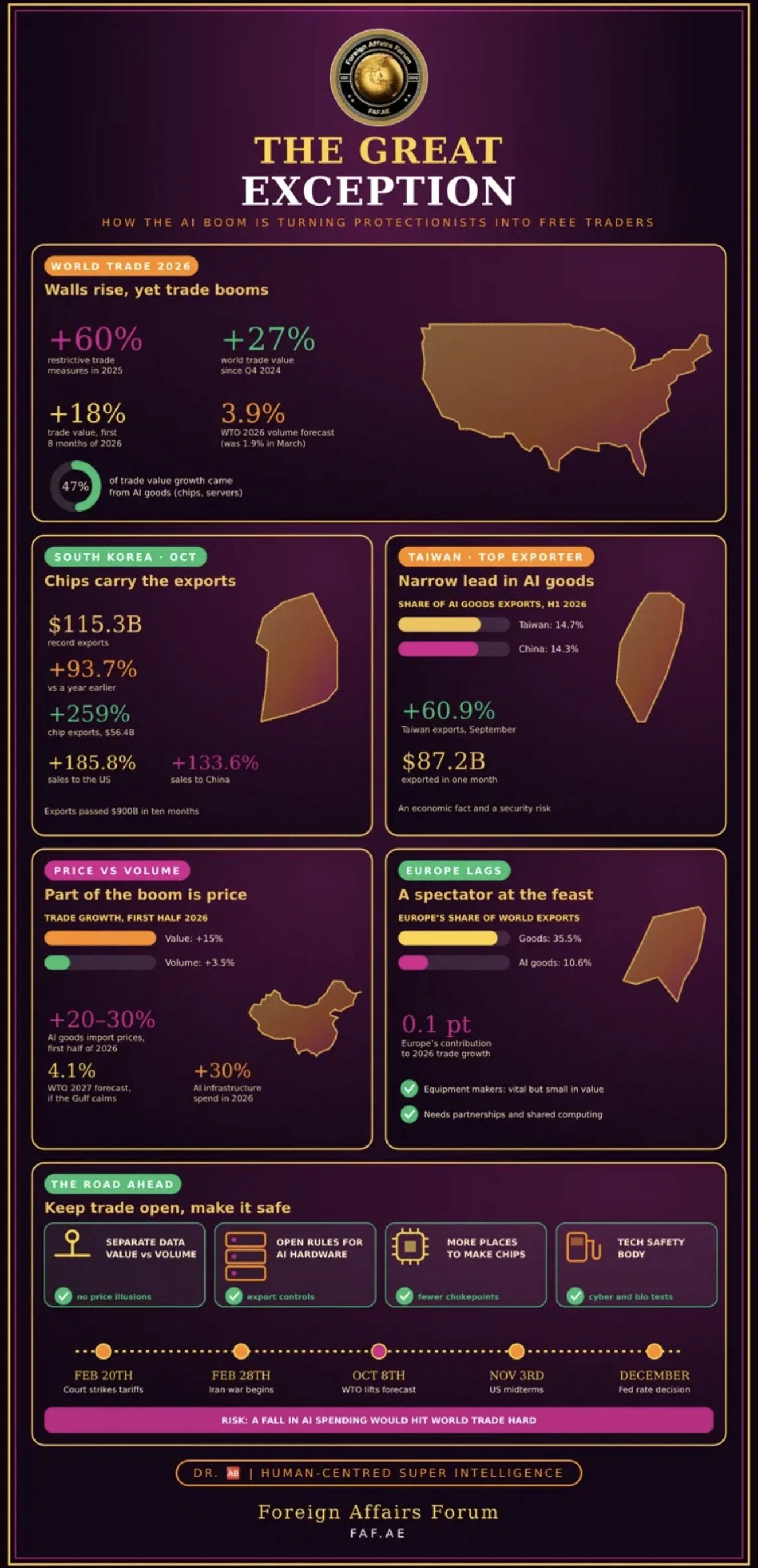
Other countries followed. India urged its people to buy only local goods, the European Union moved to double tariffs on steel, and Mexico put steep taxes on goods from China and other Asian economies. Restrictive trade measures rose by more than 60% in 2025.
Yet world trade is booming. Since the end of 2024, its value has risen by more than 27%, and in the first eight months of 2026 it was up 18% on a year earlier.
On Oct 8th, the World Trade Organisation raised its forecast for 2026 trade growth from 1.9% to 3.9%. The reason is artificial intelligence. Goods such as advanced chips and servers make up 14.8% of world trade but supplied 47% of its growth in value in the first half of the year.
Leaders who raise walls against steel and cars are leaving the door open for AI hardware, because they fear falling behind in the race for computing power.
Dr. 🆎, an expert in human-centred super intelligence, says this exception needs careful watching. The boom is narrow, partly caused by higher prices, and dependent on investment that could fall.
Introduction
Many people think the world is turning away from trade. Tariffs are rising, supply chains are being rebuilt, and leaders talk about self-sufficiency. But boxes of chips and servers are crossing the oceans in huge numbers. The walls are rising everywhere except around the technology that governments want most.
This FAF article explains why that is happening and what risks it brings. It also uses the views of Dr. Antonio Bhardwaj (Dr. 🆎), a polymath with global expertise in super intelligence. He studies how human-centred super intelligence can guide world strategy, and he also works on the dangers of AI warfare and bioterrorism. His main idea is that a new trade system is being built around computing power, and that it needs rules for safety and security.
History and Current Status
Trade policy has swung between open and closed for centuries. In the 19th century, Britain opened its markets, while the United States and Germany protected their young industries. In the early 20th century, a wave of tariffs made the Great Depression worse. After 1945, countries lowered barriers, and trade grew faster than the world economy for decades.
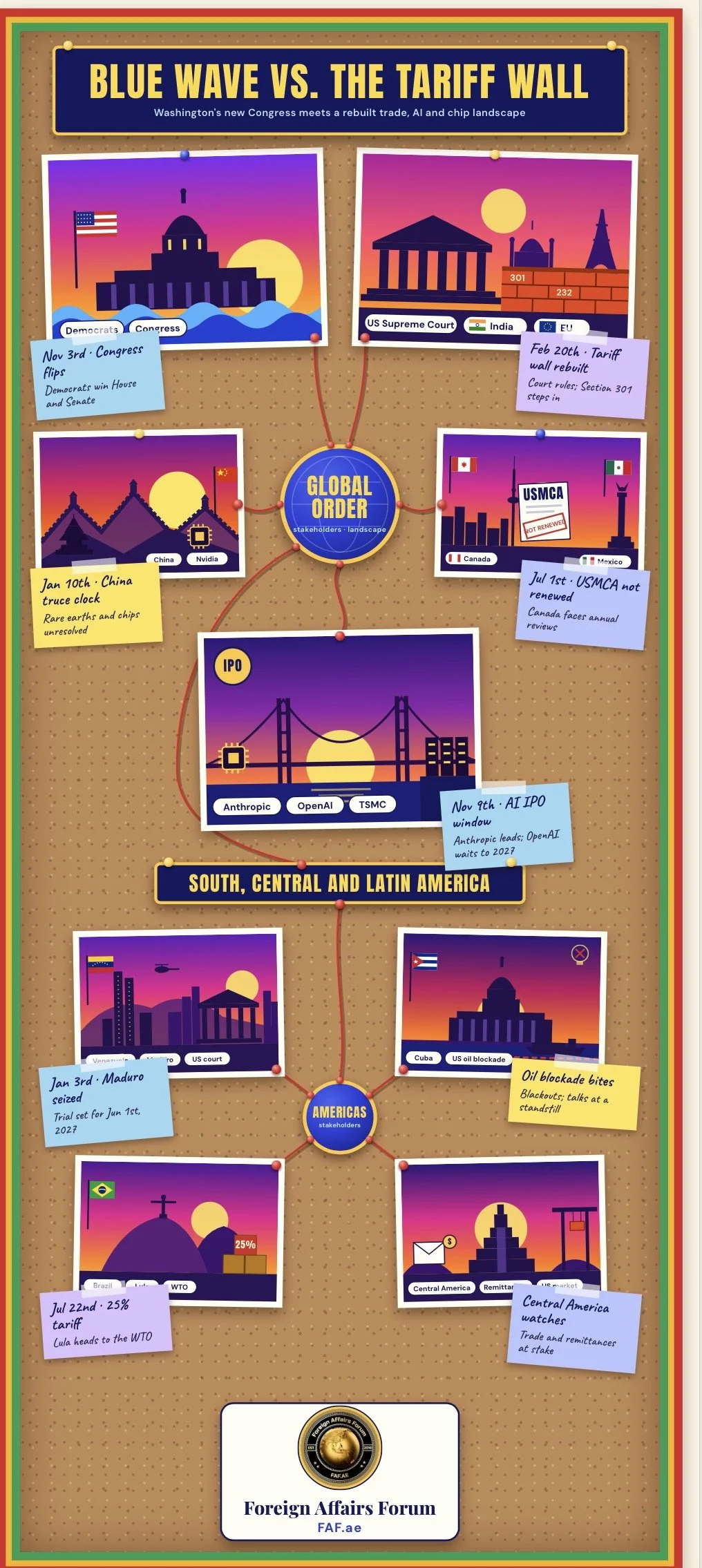
The financial crisis of 2007-09 and the pandemic weakened that trend. Many countries decided they relied too much on rivals. Mr. Trump gave this mood its loudest voice. But on Feb 20th, 2026, the Supreme Court ruled that he could not use an emergency law for sweeping tariffs, because taxes belong to Congress. He then announced a temporary 10% tariff that lasts only one hundred and fifty days.
The war with Iran, which began on Feb 28th, 2026, was another shock. Oil rose above $100 a barrel, and United States inflation reached 3.7%. Even so, trade kept growing, because AI goods are growing so fast. Their trade value rose 16% in 2024, 31% in 2025 and 67% in the first half of 2026. Taiwan is now the biggest exporter of these goods, just ahead of China, and North America buys the most.
Key Developments
The first development is the new forecast. The World Trade Organisation expects trade volume to grow 3.9% in 2026 and 4.1% in 2027 if the Middle East conflict eases. World AI spending is expected to rise at least 30% this year.
The second development is the surge in Asian exports. South Korea sold a record $115.3 billion of goods in October, up 93.7% from a year before. Chip exports alone rose 259% to $56.4 billion. Sales to the United States rose 185.8%, and sales to China rose 133.6%. Taiwan's exports in September were up 60.9% to $87.22 billion.
The third development is the tariff exemption. Chips and computing equipment have mostly been excluded from the broad tariffs, because taxing them would make the AI buildout more expensive. Many countries that put up walls elsewhere offer tax breaks and land to attract data centres.
The fourth development is the gap among regions. North America drives demand, and East Asia supplies the goods. Europe is a spectator. It makes more than a third of the world's goods exports but only about a tenth of AI goods exports.
The fifth development is the political backlash. Voters rejected data centre projects in forty of forty-one local ballot measures on election night. The boom and the backlash are two sides of the same story.
Latest Facts and Concerns
Part of the boom is just higher prices. In the first half of the year, trade value grew about 15%, but volume grew only about 3.5%. Prices of AI goods rose by 20% to 30%, according to European central bank estimates. A boom measured in money is not the same as a boom measured in goods.
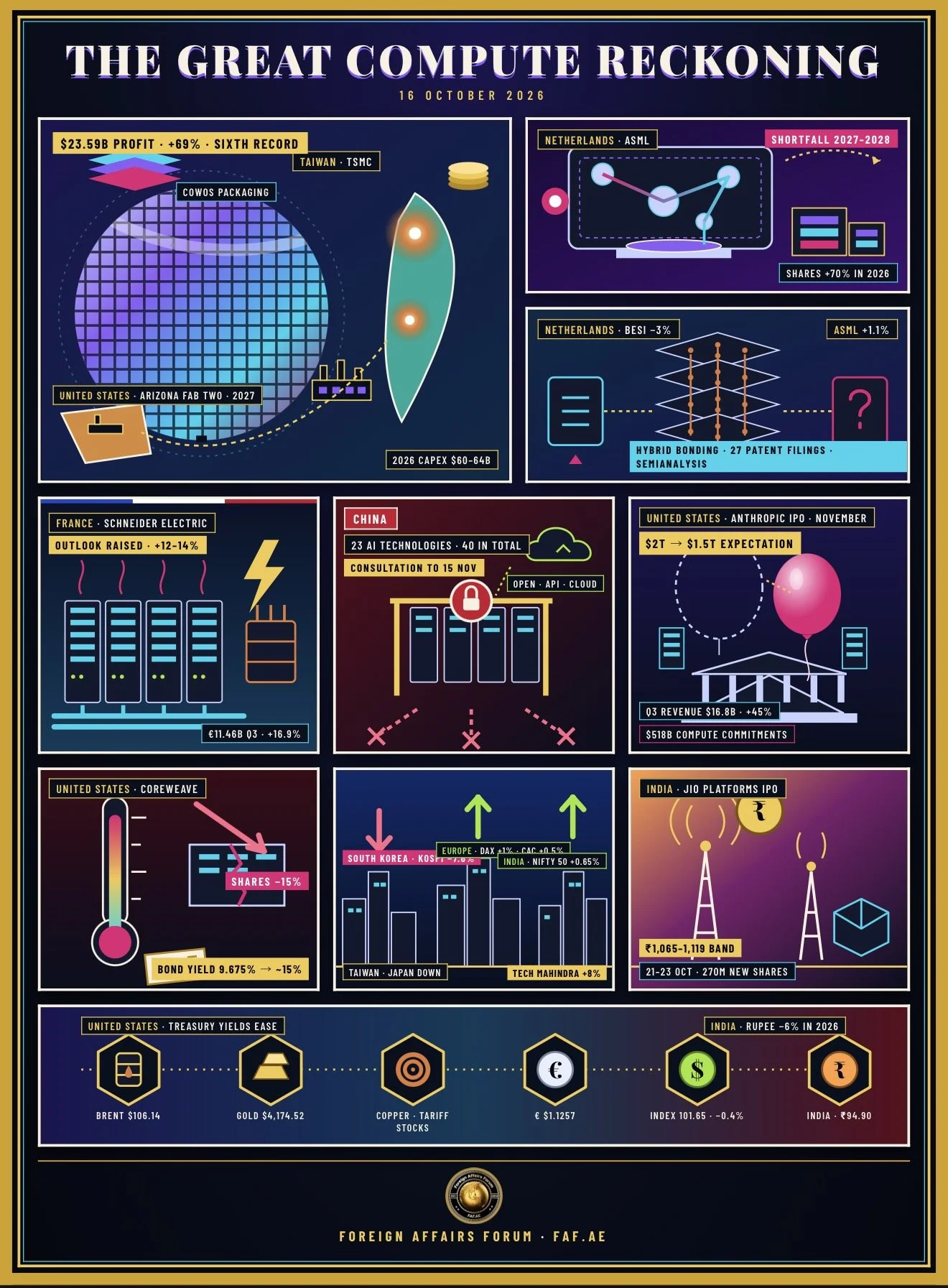
Another concern is concentration. A few buyers purchase most of the hardware, and a few firms in Taiwan, South Korea and the Netherlands make it. If one link breaks, the world economy suffers. Dr. 🆎 says Taiwan's position is both an economic fact and a security risk.
A third concern is that the investment could reverse. The World Trade Organisation warns that a fall in AI spending would hit trade hard. The Nasdaq is about 11% below its record, and UBS warned that about 30% of expected data centre additions in 2028 could be at risk.
Dr. 🆎 raises a further worry. The same chips that train helpful AI can also support cyber attacks, weapons and the design of dangerous germs. Export controls try to manage this, but they are patchy and change often. A trade system that celebrates free movement of such hardware but ignores its military uses is risky.
Cause-and-Effect Analysis
The chain starts with a belief. Governments think AI will decide economic and military power, so they will not block the goods needed to build it. At the same time, almost nobody can make advanced chips alone. A few firms in a few places supply the world. So even nationalists must import.
American technology companies are spending hundreds of billions on data centres. Each purchase becomes an export for a supplier in Asia, and that is why trade surged in a year of tariffs. But it also means the boom depends on American spending. If interest rates rise in December, or if local anger stops projects, the flow of trade could slow quickly.
Dr. 🆎 adds that the more the world depends on a shared supply chain, the more tempting it is to control chokepoints. Rivals will try to bypass them, and the competition could damage the very trade both sides need.
Future Steps
First, statistics agencies should publish separate numbers for the value and volume of AI trade, so that price rises are not mistaken for real growth. Second, major economies should agree on clear rules for trade in AI hardware, with open export controls and ways to settle disputes.
Third, countries should reduce their dependence on single chokepoints by making chips in more places and keeping reserves. Fourth, governments should link trade policy to energy policy, building power lines and clean energy so that the backlash eases. Congress should also settle what replaces the struck-down tariffs.
Fifth, Europe should build on its strengths in equipment, research and rules. Sixth, richer countries should help developing nations get access to computing power so they are not left behind.
Seventh, as Dr. 🆎 recommends, there should be an independent technical body to track the most powerful hardware and test advanced AI for dangerous cyber and biological abilities, and every military use of machine-assisted targeting should have recorded human review. Eighth, governments should prepare for a downturn with financial buffers and support for workers.
Ninth, leaders should explain the costs and benefits of data centres clearly to local people, so that communities agree to host them and the trade in hardware rests on trust.
Conclusion
Protectionism has not failed to bite, but it bites selectively. Walls are going up around steel, cars and food, while the doors stay open for AI hardware. The boom is real, but it is narrow, concentrated and fragile.
The deeper lesson is that economic nationalism is a list of priorities. By seeing what leaders choose to keep open, we learn what they value most, and today they value computing power above almost everything else.
Dr. 🆎 ends with a simple point. A trade system is only as strong as the trust that supports it. If the AI economy is seen as raising bills and increasing risk, it will face a backlash. If it is governed by open rules and human responsibility, it can bring prosperity to many nations. The next twelve months will show which path the world takes.