The Great AI Reckoning: When Machine Intelligence Meets the Balance Sheet
Foreign Affairs Forum | Dr. Antonio Bhardwaj (Dr. 🆎)| November 3rd, 2026
Executive Summary
The global artificial intelligence industry has entered a phase in which financial discipline, industrial capacity and national security matter as much as algorithmic brilliance.
Between Nov 1st and Nov 3rd, 2026, a cluster of announcements showed how heavily the frontier of machine intelligence now rests on capital markets, state relationships and sovereign ambition. The central finding of this FAF article is that artificial intelligence is ceasing to be a software industry and is becoming a capital-intensive industrial and national-security system, with all the fragilities that such systems carry.
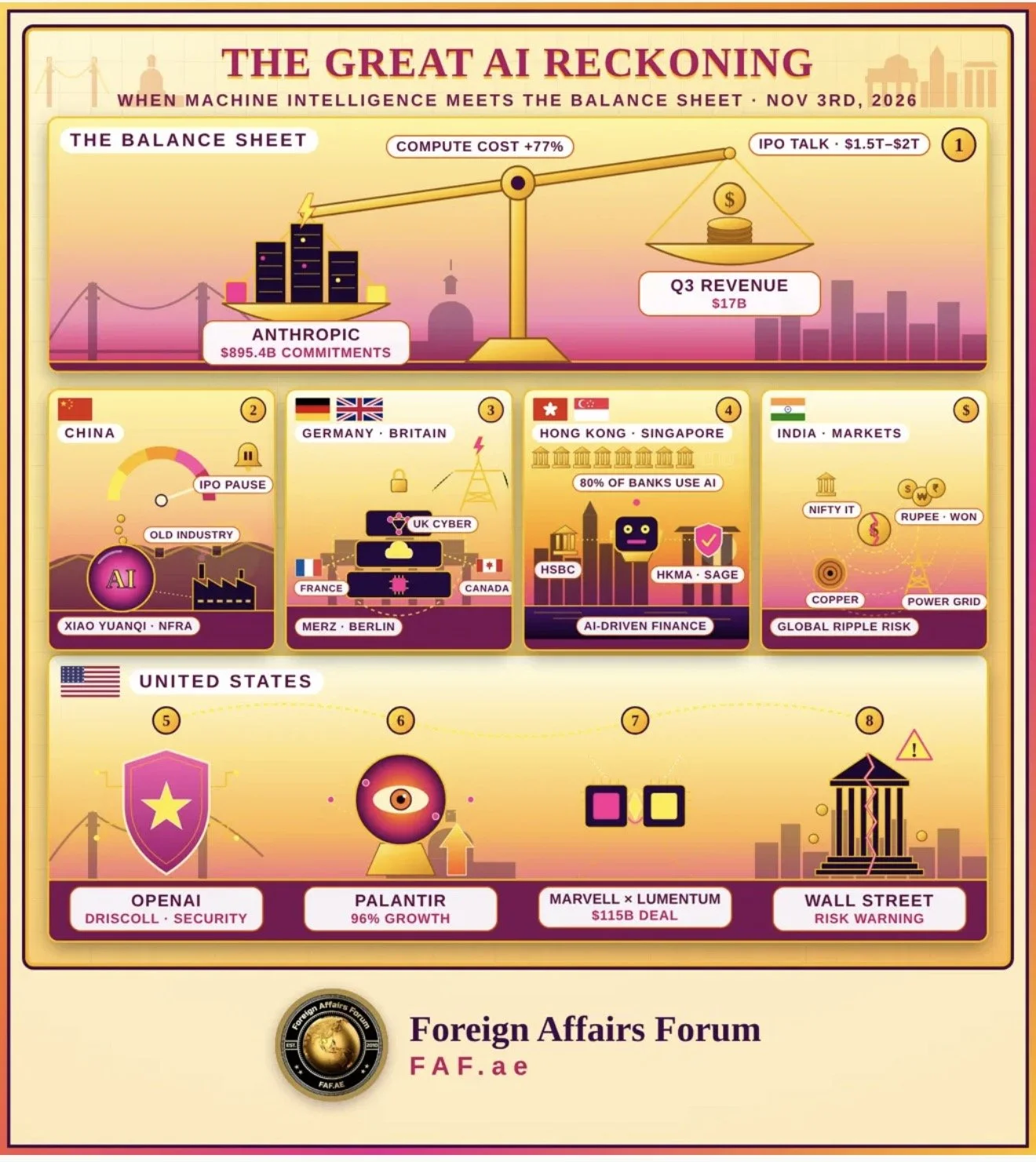
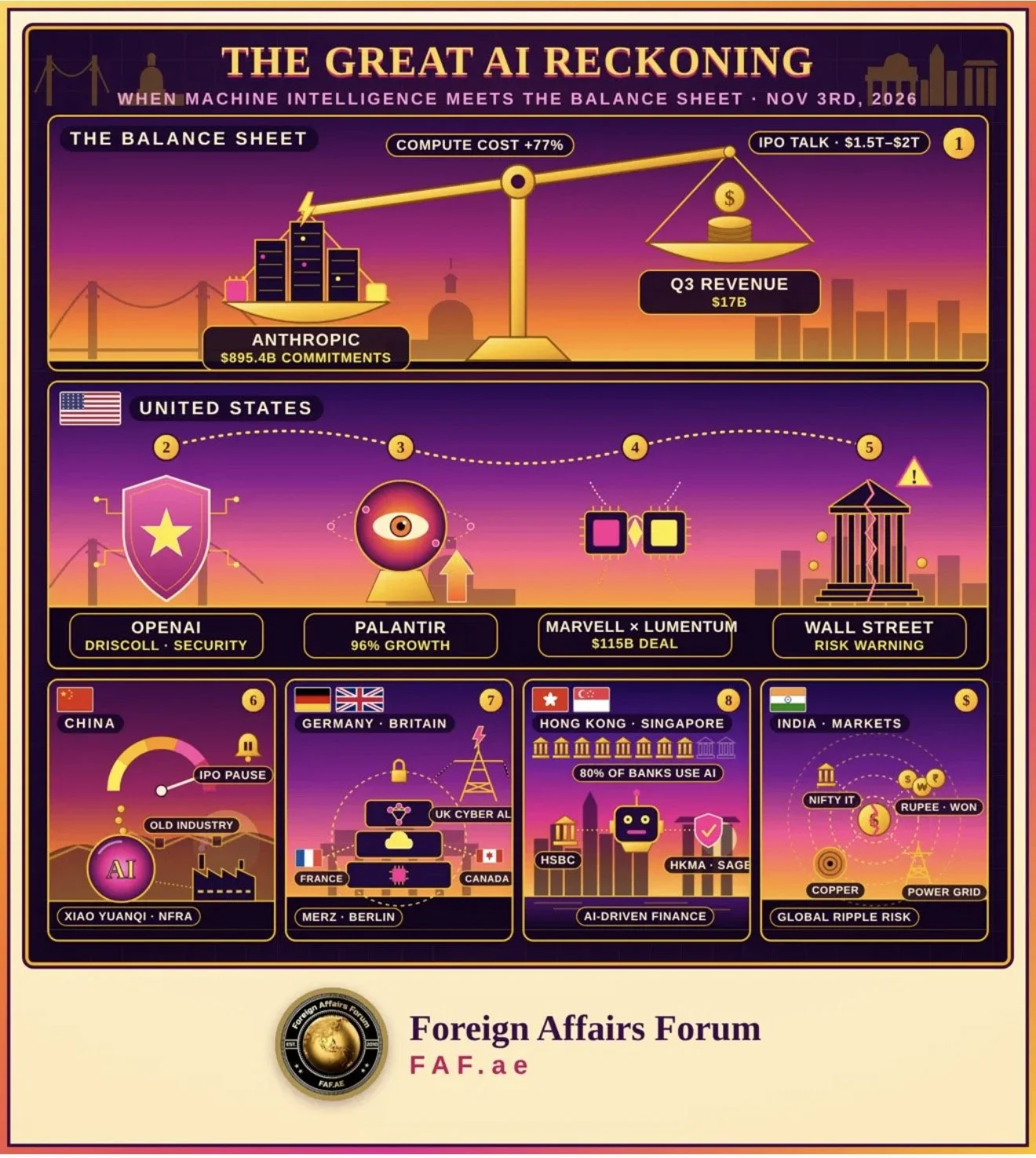
The American picture is dominated by scale. Anthropic's updated IPO documentation discloses approximately $895.4 billion in computing and infrastructure purchase and lease commitments, of which roughly $447.5 billion fall due before 2030. The company reported third-quarter revenue of about $17 billion, yet its computing and infrastructure expenses rose 77% to $9.9 billion, and it posted an operating loss of about $567 million after an operating profit of $974 million in the preceding quarter.
A listing that could value the company at between $1.5 trillion and $2 trillion has not yet been priced. OpenAI strengthened its security connections by appointing former Army Secretary Dan Driscoll as senior counselor for national security. Palantir reported third-quarter revenue of about $2.31 billion, a rise of 96%, with American commercial revenue surpassing government revenue for the first time. Marvell agreed to acquire Lumentum in a transaction valued at about $115 billion including debt, a wager that optical connectivity will define the next bottleneck. A Reuters analysis warned that the concentration of AI financing could transmit stress through equity, credit and sovereign markets.
Beyond America, three stories stand out. A senior Chinese financial regulator cautioned that investment in artificial intelligence has become excessively concentrated, even as Beijing reportedly urged investment banks to pause some IPO activity and large share sales. German Chancellor Friedrich Merz called for accelerated AI sovereignty. HSBC and the Hong Kong Monetary Authority signalled that Asia's financial centers are becoming laboratories for autonomous financial systems. Together, these developments suggest that the decisive question is no longer who can build the most capable model, but who can finance, secure, commercialize and sustain advanced intelligence at scale.
Introduction
Every technological revolution eventually meets its accountants.
The railways of the 19th century, the electrification of the early 20th century and the telecommunications boom at the turn of the 21st century each began with a surge of visionary enthusiasm and each was followed by a reckoning in which the real economics of infrastructure asserted themselves. The railway manias ruined many investors yet left behind the networks that powered industrial economies. The fiber-optic overbuild of the late 1990s destroyed fortunes yet seeded the modern internet. The lesson is not that such revolutions fail. It is that they are rarely financed sensibly, and that the political and strategic consequences of the financing arrive alongside the technology itself.
Artificial intelligence now stands at a comparable juncture, and the events of the past several days make the parallel difficult to ignore.
Dr. Antonio Bhardwaj (Dr. 🆎), a polymath with global expertise in superintelligence, specializing in human-centered approaches to geopolitical strategy, AI warfare and bioterrorism risk, has long argued that the contest over machine intelligence cannot be understood through technical benchmarks alone. In his assessment, intelligence at scale is an industrial and institutional achievement, requiring electricity, semiconductors, capital, talent and public legitimacy, and the stakeholders who master that entire chain will shape the international order for decades.
This FAF article pursues three purposes.
It places the latest developments within the longer arc of the artificial intelligence boom, distinguishing structural shifts from market noise. It examines what is actually known about each development and what remains conjecture, since the figures involved are enormous and several, including the prospective Anthropic valuation and the Marvell transaction, are not yet final. And it traces the causal links among corporate finance, national security policy and the strategic competition among Washington, Beijing and European capitals.
The analysis proceeds in the following order.
The first section reviews the history and current status of the artificial intelligence economy. The second examines the key developments of the reporting period. The third assesses the latest facts and the concerns they raise. The fourth offers a cause-and-effect analysis. The fifth proposes future steps for governments, investors and developers, and the sixth concludes.
History and Current Status
The modern artificial intelligence boom has a surprisingly compact history.
The deep learning breakthroughs of the early 2010s demonstrated that neural networks, given sufficient data and graphics processors, could outperform hand-crafted software in vision and speech. The transformer architecture introduced in 2017 then provided a scalable design that improved predictably as models, data and computation grew. That predictability, often described through scaling laws, transformed research into an investment thesis. If capability rose reliably with computation, then whoever could assemble the most computation would, in principle, command the most capable systems.
The public release of conversational models in late 2022 converted this thesis into a mass phenomenon.
Within months, hyperscale cloud companies, chip designers and a new generation of frontier laboratories were committing sums that would once have been associated only with energy utilities or national defense programs. Through 2023, 2024 and 2025, capital expenditure on data centers climbed steeply, semiconductor supply chains were reorganized around accelerator chips, and electricity demand forecasts for several advanced economies were revised sharply upward. The announcement in early 2025 of very large American infrastructure ambitions, and the shock created that same winter by a Chinese laboratory demonstrating strong capability at comparatively modest cost, showed that both the scale of the commitment and the intensity of the competition were increasing.
Governments meanwhile discovered that the technology touched every dimension of statecraft.
The United States tightened controls on advanced semiconductors and the equipment used to make them, treating computation as a strategic resource. China accelerated its pursuit of domestic chip production and open-weight models, determined to reduce its exposure to American restrictions. The European Union adopted comprehensive regulation of artificial intelligence, then found itself debating whether its regulatory leadership had been purchased at the cost of industrial relevance. Gulf states, India, Japan and South Korea each articulated national strategies, recognizing that a place in the supply chain is a form of leverage.
By late 2026, the current status can be summarized in three observations.
First, demand for artificial intelligence services remains strong and is migrating from experimentation toward operational use in enterprises, finance and defense.
Second, the cost of supplying that demand has risen to levels that strain even the largest balance sheets, which is why financing structures, leases and long-term purchase obligations have become central to the story.
Third, the technology has become embedded in national security thinking, so that the commercial fortunes of a handful of firms are now entangled with the strategic position of their home states.
Dr. 🆎 observes that this entanglement is the defining feature of the present moment. When a technology becomes simultaneously a commercial engine, a financial risk and a strategic asset, decisions that appear private acquire public consequences. A frontier laboratory's borrowing, a chip supplier's merger and a regulator's informal instruction to investment banks are no longer separate events. They are interconnected movements within a single system whose stability depends on human judgment, institutional design and a willingness to anticipate failure before it occurs.
Key Developments
The first and most striking development is the scale of obligations disclosed by Anthropic.
The company's updated IPO documentation reveals approximately $895.4 billion in computing and infrastructure purchase and lease commitments, with about $447.5 billion expected before 2030.
Third-quarter revenue of roughly $17 billion is formidable by any standard, yet computing and infrastructure costs climbed 77% to $9.9 billion, and the quarter ended in an operating loss of about $567 million, a reversal from the prior quarter's operating profit of $974 million.
A prospective valuation of $1.5 trillion to $2 trillion has been discussed, though no final figure exists. The disclosure matters beyond one company. It establishes a benchmark against which investors will measure other private laboratories, and it makes plain that frontier artificial intelligence is now a business of long-dated obligations that must be serviced regardless of how quickly revenue grows.
The second development is OpenAI's appointment of former Army Secretary Dan Driscoll as senior counselor for national security, announced on Nov 2nd and reported on Nov 3rd.
His remit includes advising leadership on national security modernization, on cooperation with external partners and on how advanced systems can support cybersecurity. The appointment is modest in size but significant in signal. It confirms that frontier developers regard the defense and intelligence establishment as a core stakeholder, and that the boundary between commercial laboratory and instrument of national power is thinning. The opportunity lies in strengthening defensive capability. The risk lies in weakening the safeguards and human oversight that responsible deployment requires.
The third development is Palantir's quarter.
Revenue of about $2.31 billion, a rise of 96%, exceeded the roughly $2.18 billion that analysts expected. American commercial revenue grew 148% to about $984 million and, for the first time, surpassed American government revenue, which rose 96% to about $953 million.
The company lifted its full-year revenue forecast to about $8.53 billion. Yet its shares fell in after-hours trading amid concerns over valuation. The episode illustrates a market that rewards extraordinary growth while questioning whether it can be sustained, and it shows that enterprise demand for operational artificial intelligence is genuine, not merely speculative.
The fourth development is Marvell's agreement to acquire Lumentum for approximately $115 billion including debt, with an equity component of about $102.5 billion.
Lumentum shareholders would own roughly 33% of the combined company, which expects annual revenue above $21 billion, and closing is anticipated in the first half of 2028 subject to regulatory approval. Both companies' shares fell sharply, reflecting concern about price and financing. Strategically, the transaction acknowledges that moving data between thousands of processors is becoming as important as the processors themselves. Optical interconnects are the arteries of the modern data center, and control over them confers leverage.
The fifth development is the Reuters analysis warning that the concentration of investment in artificial intelligence infrastructure could generate vulnerabilities across global financial markets.
Large American technology companies increasingly use both debt and equity to finance expansion, and investors are asking whether future revenue will justify present commitments.
The analysis stresses that governments already burdened by debt may have limited room to respond to another major shock. The concern is systemic rather than corporate: a reassessment of profitability could ripple through technology equities, corporate bonds, infrastructure financing and the financial institutions exposed to them.
Outside the United States, the sixth development is China's warning.
Xiao Yuanqi, deputy head of the National Financial Regulatory Administration, told the Hong Kong Monetary Authority's Global Financial Leaders' Summit that investment in artificial intelligence and major technology companies is becoming excessively concentrated, raising leverage and potentially encouraging overexpansion. He added that such concentration could raise borrowing costs for traditional industries and called for new policy frameworks. The Financial Times reported on Nov 3rd that regulators had informally instructed investment banks to pause some IPO activity and large share sales to stabilize equity markets, a step that could temporarily restrict fundraising for technology start-ups.
The seventh development is Germany's declaration that artificial intelligence sovereignty is an existential strategic priority.
Speaking at a conference in Berlin, Chancellor Friedrich Merz warned that dependence on foreign technology providers could erode Europe's economic and strategic autonomy and stressed the importance of controlling the value chain from computing hardware to software. Berlin intends to deepen cooperation with partners including Canada and France, while acknowledging persistent obstacles in digital infrastructure, administrative modernization and shortages of specialized workers. Britain, meanwhile, has warned that artificial intelligence enabled cyberattacks could threaten critical infrastructure, a reminder that sovereignty also means resilience.
The eighth development concerns Asia's financial centers.
HSBC plans to establish an artificial intelligence and emerging-technology institute in Hong Kong in the first quarter of 2027, following its center in Singapore, with the Hong Kong University of Science and Technology as principal academic partner. Eddie Yue, chief of the Hong Kong Monetary Authority, said roughly 80% of the city's banks already use artificial intelligence or generative artificial intelligence, and the regulator plans to launch Project SAGE to support the responsible deployment of AI agents in financial services.
Hong Kong and Singapore are thus competing to become the place where autonomous finance is both commercialized and governed.
Latest Facts and Concerns
Rigorous analysis begins by separating disclosed figures from projections and speculation.
Anthropic's obligations, quarterly revenue, expenses and operating results are reported figures, but the prospective valuation of $1.5 trillion to $2 trillion is only a range under discussion, and no final price exists. Palantir's results are reported outcomes. The Marvell and Lumentum transaction is an agreement, not a completed merger, and its closing is not expected before the first half of 2028, leaving ample time for regulatory scrutiny and market change.
The Chinese regulatory instructions to investment banks were reported through informal channels and have not been confirmed in formal policy. German ambitions are declarations of intent, not funded programs. This discipline matters because headlines in boom periods tend to treat intentions as accomplishments.
The first concern is financial concentration.
When a small number of firms account for a large share of equity market capitalization and a growing share of credit demand, their difficulties become the system's difficulties. The Reuters analysis and the Chinese regulator's warning, arriving independently on the same day, reflect a shared recognition that the artificial intelligence build-out has become macro-financial in scale. Anthropic's obligations alone, spread across several years, exceed the annual output of many mid-sized economies. If revenue growth falters or if financing costs rise, commitments of this kind cannot be quickly unwound.
The second concern is the quality of revenue and the sustainability of margins.
Anthropic's swing from operating profit to operating loss within a single quarter, driven by a 77% rise in computing costs, illustrates how sensitive profitability is to infrastructure expenses. Palantir's performance demonstrates that demand exists, but its share price reaction shows that the market has priced in much of the good news. Investors increasingly distinguish between revenue that is durable and revenue that reflects experimental budgets, and the companies that generate predictable cash flow will fare better than those that depend on repeated fundraising.
The third concern is strategic dependence.
Germany's call for sovereign capability is a response to the fact that European enterprises and governments rely heavily on American cloud providers and models. Yet sovereignty is expensive. Developing competitive hardware, data centers and models requires capital and talent that Europe has struggled to assemble, and efforts to reduce dependence may produce duplication and commercial friction with American partners.
Dr. 🆎 cautions that sovereignty pursued without interoperability can fragment the global research community and weaken the shared safety practices on which all stakeholders depend.
The fourth concern is national security entanglement.
OpenAI's appointment and Palantir's growing government business show that frontier artificial intelligence is being woven into intelligence analysis, cybersecurity and military decision support. This offers genuine advantages, including faster analysis and better defense of networks. It also raises questions about accountability, about the security of model weights and training data, and about the risk of unauthorized autonomous actions.
Dr. 🆎 argues that human-centered design, with clear lines of authority and auditable decision logs, must be treated as an engineering requirement rather than an aspiration.
The fifth concern, one on which Dr. 🆎 has focused for years, is the convergence of financial pressure with safety risk.
Firms under intense financial strain face incentives to accelerate deployment, reduce testing and cut costs in precisely the areas where caution is most valuable. The same systems that improve cybersecurity can lower barriers to attack, and models with strong scientific reasoning can, without careful safeguards, assist in dangerous biological or chemical work. A competitive environment in which survival depends on speed is not one in which safeguards flourish naturally, which is why governments cannot leave safety entirely to the discretion of firms.
The sixth concern is the transmission of stress across markets.
A reassessment of artificial intelligence valuations would first affect American technology indexes, where concentration is highest. European technology shares could follow, though providers of industrial software, cybersecurity and efficient computing might benefit from demand for cost reductions. Asian semiconductor manufacturers remain exposed to American data center spending decisions. India's NIFTY 50 and NIFTY IT could be affected through global risk sentiment and foreign institutional flows, though Indian technology companies may gain if customers accelerate adoption to improve productivity. Currency markets could see demand for traditional safe havens, while the South Korean won, the Taiwan dollar and the Indian rupee remain sensitive to semiconductor demand and portfolio flows.
These are channels of transmission, not predictions of specific movements. Commodity markets add a further layer, since data center construction supports demand for copper, aluminum and electrical equipment that a slowdown could weaken.
Cause-and-Effect Analysis
The developments of the past several days are best understood as links in a causal chain that begins with technological possibility and ends with geopolitical consequence.
The first link is the scaling premise.
Because capability has historically improved with computation, laboratories have an incentive to purchase as much computing as they can secure. This produces enormous long-term commitments of the kind Anthropic has disclosed. The effect is to convert what was once a research gamble into a fixed-cost industry, in which survival depends on filling very expensive capacity with paying customers.
The second link runs from fixed costs to financing.
Commitments on this scale cannot be met from operating cash flow alone, so developers and their suppliers turn to equity markets, private credit and bond issuance. The prospective initial public offerings, the Marvell acquisition and the rising use of debt by large technology companies are manifestations of this logic. The effect is to bind the fate of artificial intelligence to financial conditions. When capital is plentiful, the technology advances rapidly. When it tightens, projects are delayed, mergers are repriced and weaker firms fail.
The third link runs from financing to systemic risk.
The concentration of capital in a narrow set of firms and assets raises the possibility that disappointment in one area will spread to others. The Reuters warning and the Chinese regulator's concern describe the same mechanism from different vantage points. In Beijing's case, the concern is that capital drawn toward artificial intelligence may raise borrowing costs for traditional industries. In Washington's case, the concern is that debt-financed infrastructure may create vulnerabilities in markets and institutions. The effect, in both cases, is to move artificial intelligence from the technology section of the newspaper to the financial stability report.
The fourth link runs from strategic value to state involvement.
Because advanced computing is now considered critical to economic and military power, governments cannot be indifferent to the financial health of their leading firms. Hence OpenAI's recruitment of a former Army Secretary, Palantir's defense business, Germany's insistence on sovereign capabilities and China's reported intervention in equity markets. The effect is a blurring of the line between corporate strategy and national strategy, and an expectation, sometimes explicit, that governments will support firms deemed essential. That expectation creates its own moral hazard, since firms that believe they are too strategic to fail may take larger risks.
The fifth link runs from competition to fragmentation.
As each major power seeks independence, the global technology system risks dividing into partially separate stacks, each with its own chips, clouds and models. Germany's drive for sovereignty, China's pursuit of domestic alternatives and American export controls are mutually reinforcing. The effect is greater duplication, higher costs and diminished coordination on safety, even as the risks of misuse, from cyberattacks to biological threats, remain global in character. Dr. 🆎 emphasizes that such risks do not respect borders, and that a divided landscape of governance is poorly suited to a borderless threat.
Finally, a feedback loop connects these links.
Financial strain encourages firms to seek government partnerships, which deepens the security entanglement, which in turn intensifies the strategic competition, which justifies still larger investment. The loop can be stabilizing if it channels resources into resilient infrastructure and thoughtful oversight. It can be destabilizing if it rewards speed over prudence and scale over sustainability. The outcome will depend not on the technology but on the choices of the stakeholders who direct it.
Future Steps
Governments, investors and developers each have steps available that could improve the odds of a stable outcome. The first is greater transparency in financing. Anthropic's disclosure should become a norm. Regulators and exchanges should require clear reporting of long-dated commitments, off-balance-sheet leases and counterparty concentration, so that investors and supervisors can assess the true exposure of the sector. Financial authorities should conduct stress tests that incorporate a sharp reassessment of artificial intelligence valuations and a slowdown in data center construction.
The second step is to prioritize efficiency. Financial pressure can be a constructive force if it directs research toward cheaper inference, energy-efficient processors and architectures that deliver more capability per unit of computation. Public research funding and procurement should reward such progress, which reduces both cost and environmental burden, and which lessens the strategic importance of sheer scale.
The third step is to build human-centered safeguards into the national security uses of artificial intelligence. Dr. 🆎 advocates standards requiring meaningful human oversight, secure handling of model weights, independent testing against cyber and biological misuse, and clear accountability when systems fail. Appointments such as that of Dan Driscoll can help bridge the cultures of Silicon Valley and the security establishment, but they must be matched by institutional safeguards rather than personal goodwill.
The fourth step is to pursue sovereignty without isolation. Europe should invest in computing capacity, semiconductors and talent, and should deepen partnerships with like-minded countries such as Canada and France, while maintaining interoperability and shared safety research with American and Asian partners. India, Japan, South Korea and the Gulf states can contribute capacity and markets. Open standards and shared evaluation methods will reduce the costs of fragmentation.
The fifth step is diplomatic.
Washington and Beijing confront the same dilemma of financing leadership without creating instability, which suggests scope for dialogue on financial risk, on the safety of advanced systems and on the prevention of catastrophic misuse.
Even strategic rivals share an interest in avoiding a global financial shock or a biological incident enabled by artificial intelligence. Channels for communication on these narrow subjects should be established before a crisis, not after.
Conclusion
The defining message of Nov 3rd, 2026, is that artificial intelligence cannot be judged by technological breakthroughs alone. Its future rests on the interaction of computing capacity, investment capital, electricity, semiconductor manufacturing, commercial demand and national security policy.
The United States retains leadership in frontier development, but its leading companies are under pressure to justify commitments of historic scale. China is balancing its ambition for technological independence against concern for financial stability. Europe is sharpening its pursuit of sovereign capability. Asia is extending artificial intelligence across finance, manufacturing and infrastructure.
Dr. 🆎 concludes that the central task is to keep human judgment in command of a system growing faster, costlier and more consequential than any technology of the 20th century. If finance, security and safety are treated as separate problems, the reckoning will arrive as a series of shocks. If they are treated as parts of a single strategic challenge, the industry can mature into a durable foundation for prosperity and stability.
The question is no longer simply who can build the most intelligent system. It is who can finance, secure, commercialize and sustain advanced intelligence at scale, and do so while remaining accountable to the people it is meant to serve.