Power at the Chokepoints: How Seas, Energy and Legitimacy Are Redrawing the World Order
Foreign Affairs Forum | Dr. Antonio Bhardwaj (Dr. 🆎)| October 21st 2026
Executive Summary
The international system is entering a phase in which geography, energy and institutional credibility have fused into a single instrument of national power.
Between October 19th-21st October, 2026, 10
developments across four continents illustrated this fusion with unusual clarity.
A drone strike on a market in the disputed Abyei region has raised the prospect that Sudan's civil war will cross an international frontier.
Washington and New Delhi continue to negotiate the first tranche of a trade agreement while Secretary of State Marco Rubio is on the subcontinent. Iran's calculations about timing, shaped by the American midterm elections, prolong uncertainty over the Strait of Hormuz.
American and Ukrainian officials are exploring a renewed diplomatic framework, while China's coast guard continues to normalize its presence around the Pratas Islands.
NATO is reinforcing its surveillance of the Black Sea, Europe is turning its attention to the Arctic, and Canada and Turkey are exploring a partnership that reflects the hedging instincts of middle powers.
Brazil's election and a heated debate over electoral administration in India remind observers that democratic legitimacy is now a strategic asset.
The central argument of this analysis is that these events are not separate stories.
They are expressions of one structural shift, in which control over maritime passage, reliability of energy supply, continuity of trade and the credibility of domestic institutions reinforce or erode one another in a chain. When one link weakens, the others bear the strain.
Dr. 🆎 argues that the technologies now being deployed along this chain, from autonomous drones to algorithmic surveillance, make the human judgment exercised at each link more consequential, not less.
The practical conclusion is that stakeholders who invest simultaneously in military deterrence, energy diversification, diplomatic channels and institutional transparency will fare better than those who treat any one of them as sufficient.
Introduction
Every era of international politics has its defining anxiety. For the generation that came of age during the Cold War, it was the missile silo.
For the generation that followed, it was the failed state and the terrorist cell.
The anxiety of the present moment is more diffuse and, in some respects, more difficult to manage, because it attaches to things that ordinary commerce depends upon: a narrow strait, a pipeline, a port, a data cable, a voter roll. The contemporary struggle for power is waged less over capitals than over conduits.
This is the context in which Dr. Antonio Bhardwaj (Dr. 🆎), a polymath with global expertise in superintelligence and a specialist in human-centered approaches to geopolitical strategy, AI warfare, and bioterrorism risk, has urged policymakers to read the news differently. He argues that analysts often treat each crisis as a discrete event with its own causes and remedies, when a more instructive exercise is to look for the connective tissue between them.
A drone that destroys fuel trucks in Abyei, a coast guard cutter loitering off an atoll in the South China Sea and a contested electoral roll in the world's most populous democracy appear to belong to different universes. They do not.
Each is a contest over who may move, who may trade and who may claim legitimacy.
The ten developments examined here were reported over a three-day window.
Several remain unconfirmed, and several diplomatic initiatives are at an early stage.
FAF analysis therefore proceeds with caution about what is known and what is merely alleged. It first sets out the historical background and current status of the principal files, then examines the key developments in detail, turns to the latest facts and the concerns they raise, offers a cause-and-effect reading of how the files interact, proposes practical steps for the months ahead, and closes with an assessment of what the pattern implies for the distribution of power in the coming decade.
History and Current Status
The geopolitical landscape of October 2026 rests on foundations laid over the preceding several years, and understanding its present shape requires a brief return to those foundations.
Begin with the Gulf.
In late February 2026, the United States and Israel launched a joint offensive against Iran, and the conflict that followed turned the Strait of Hormuz from a theoretical vulnerability into a daily operational problem.
Shipping through the strait was severely disrupted, Tehran asserted authority over passage and at one stage sought to impose tolls, and Washington responded with a maritime blockade and periodic threats of larger strikes.
A memorandum of understanding reached in June, intended to end the fighting, collapsed in early July, in part because the two sides read its provisions on the waterway in opposite ways. Washington maintained that the text required Iran to reopen the strait. Tehran maintained that it preserved Iranian authority over traffic.
In August, mediation by Oman, with the involvement of Qatar, Saudi Arabia and Pakistan, produced talk of a 60-day interim arrangement and the clearing of mines from the central shipping lane.
What followed was a long, uneasy period of negotiation by signals, in which public statements from Washington and Tehran frequently contradicted one another.
The latest reporting suggests that Iranian officials are weighing the timing of any engagement with Washington against the calendar of the American midterm elections.
Turn next to the Horn of Africa.
Sudan's civil war between the army and the Rapid Support Forces, which began in 2023, has repeatedly threatened to spill across the border into South Sudan.
In December 2025, drones struck a United Nations logistics base at Kadugli, killing six Bangladeshi peacekeepers serving with the mission responsible for Abyei, and the Rapid Support Forces captured the Heglig and Babanusa oil fields, which are vital to the export economy of South Sudan.
By July 2026, the United Nations mission had recorded at least 196 security incidents, 58 fatalities and 69 injuries in the Abyei area within six months.
Abyei itself has been contested since South Sudan became independent in 2011, and the agreed mechanisms for joint administration of the territory have never functioned as intended.
In Eastern Europe, the war that began in February 2022 has passed through several phases of negotiation.
In January 2026, trilateral talks in Abu Dhabi involving American, Ukrainian, and Russian representatives, including military officers, produced a security-guarantees document that President Volodymyr Zelensky described as ready for signature, pending ratification by the American Congress and the Ukrainian parliament.
Separate discussions contemplated a reconstruction program of roughly $800 billion.
No comprehensive settlement has emerged, and the fundamental positions of Kyiv and Moscow on territory remain far apart.
In the Indo-Pacific, China's pressure on Taiwan has increasingly taken the form of coast guard and survey activity rather than overt military action.
The Pratas Islands, a Taiwanese-controlled atoll more than 400 kilometers from the main island and defended by the coast guard rather than the army, have become a favored pressure point.
In January, a Chinese reconnaissance drone briefly overflew the atoll. Standoffs between coast guard vessels followed in late May and early June, and in June Taiwan reported what it described as the first coordinated operation by a Chinese coast guard ship and a survey vessel.
Taiwan's minister responsible for the coast guard has said publicly that seizing the Pratas would carry considerable strategic significance for Beijing.
Trade relations between Washington and New Delhi have been strained over the past two years by tariff disputes, including an additional duty linked to India's purchases of Russian oil.
A provisional framework published earlier this year reportedly lowered the additional American duty on Indian goods from 25% to 18%, and both governments have since described a first-phase agreement as close.
Mr. Rubio traveled to India this week, and discussions with External Affairs Minister S. Jaishankar took place in Mumbai on October 20th.
Dairy access remains the largest obstacle, and American trade officials have cautioned that a deal is not imminent.
These histories supply the baseline against which the latest events must be read.
In each case the trajectory is not one of sudden rupture but of slow accumulation, in which incremental pressure changes the conditions of normal life before any formal threshold is crossed.
Key Developments
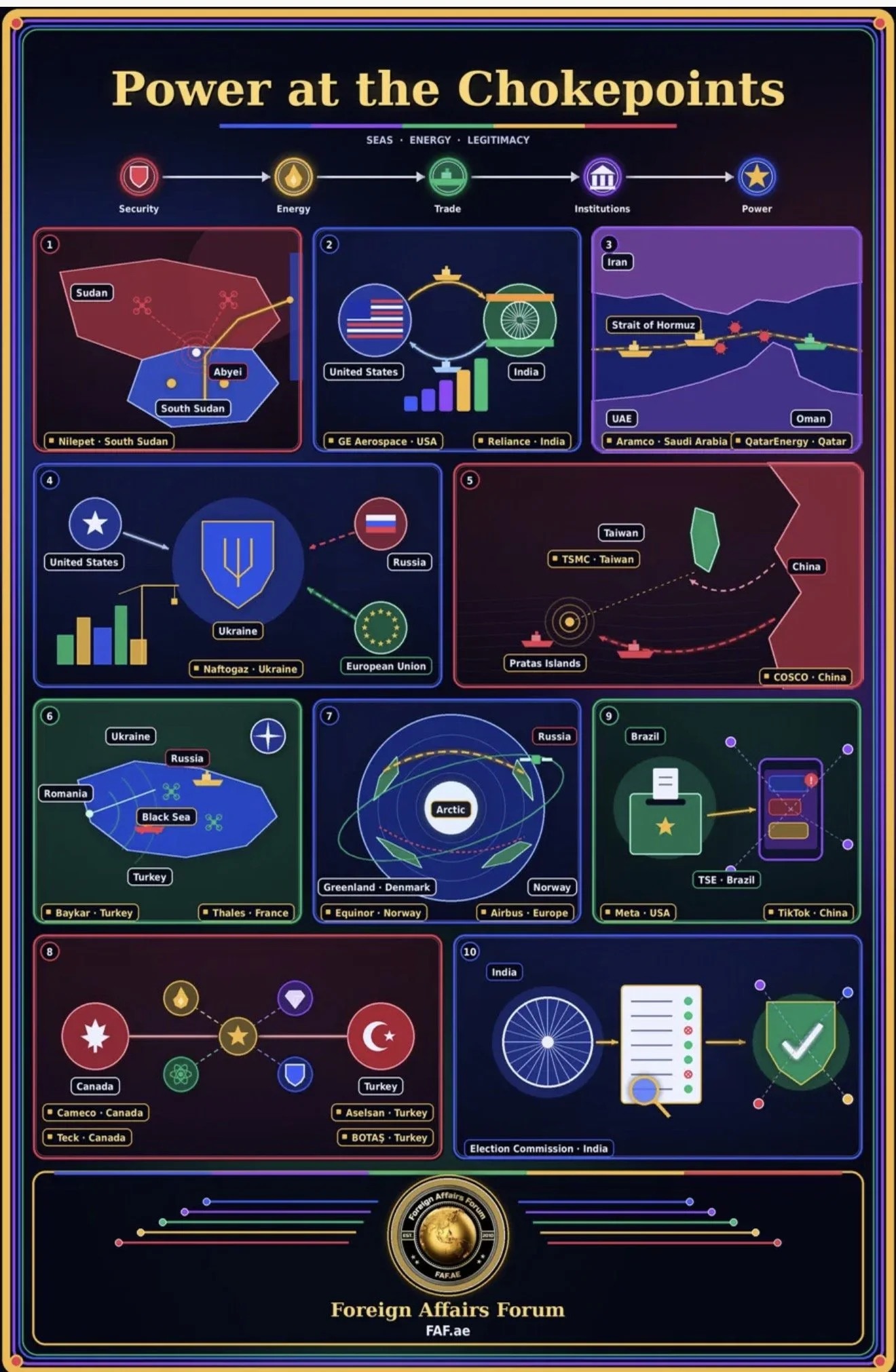
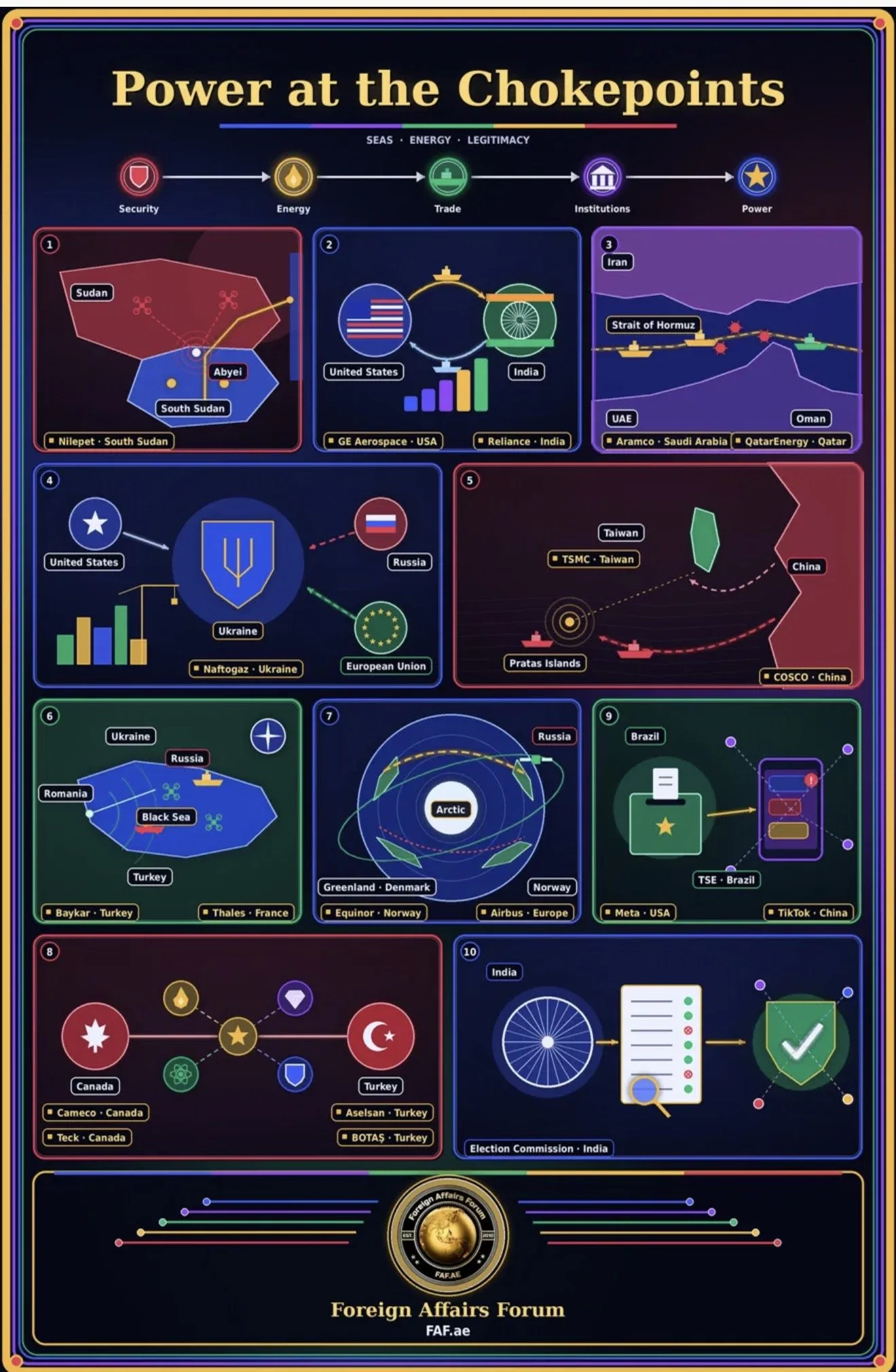
The first and gravest development of the past three days is the drone strike in the Abyei region.
On October 19th, drones suspected to belong to the Sudanese army struck the Al-Naam market, also referred to in some reports as the Amiet market, north of Abyei town.
The attack reportedly targeted fuel depots and trucks carrying fuel from South Sudan towards Darfur.
Unofficial reports put the number of civilian dead at 73, though no official toll has been confirmed. South Sudan's foreign ministry summoned the Sudanese ambassador in Juba the same day and warned that the attack threatened civilian security and the area's stability.
The market is a major commercial hub through which fuel, food, building materials, and medicine flow to Kordofan and Darfur. A strike on such a place is simultaneously a humanitarian catastrophe, an economic blow and a political message.
The second development concerns the ongoing diplomacy between Washington and New Delhi.
Reports indicate that Mr. Rubio and Mr. Jaishankar discussed progress toward a bilateral trade agreement, along with cooperation on defense, technology, and energy. The significance extends beyond tariff schedules.
For New Delhi, a stable arrangement would improve its position in supply chains that are being rearranged away from concentrated dependence on a single manufacturing power.
For Washington, a closer commercial relationship would reinforce a partnership that is central to its Indo-Pacific strategy.
The reported surge in India's merchandise exports, up 23% in September to $44.4 billion, indicates considerable underlying economic momentum. However, a final agreement has not been confirmed.
Third, the Iranian dimension has acquired a distinctly political tempo.
Reports suggest that Tehran regards the American midterm elections as relevant to the timing of any concession, a calculation that rewards patience and punishes haste.
The Strait of Hormuz remains central to this calculus. As long as the waterway remains uncertain, Iran retains leverage far beyond what its conventional forces would otherwise provide, and every maritime incident could disturb the global price of petroleum.
Fourth, Washington and Kyiv are reportedly exploring a renewed diplomatic framework that would combine security guarantees, reconstruction financing, and a cautious path toward engagement with Moscow.
No comprehensive peace agreement exists. The difficulty is structural: Ukraine requires guarantees credible enough to deter a renewed offensive, while Russia seeks outcomes that would, in effect, ratify its territorial gains. A framework that satisfies one is likely to alarm the other.
Fifth, China has increased maritime pressure around the Pratas Islands.
Chinese coast guard activity there is part of a pattern that tests Taiwanese responses, accustoms the international community to Chinese law-enforcement language in contested waters, and gradually blurs the line between peacetime presence and wartime encirclement.
Taiwan has also raised concerns about foreign information operations and possible interference in its democratic institutions, reminding the world that coercion at sea is paired with coercion in the information space.
Sixth, NATO members are discussing additional maritime patrols, radar coverage and unmanned surveillance in the Black Sea, following reports of attacks on commercial vessels.
The alliance faces the delicate task of protecting civilian shipping without creating the conditions for confrontation with Russian forces.
Seventh, European policymakers are placing greater emphasis on the Arctic, including satellite monitoring, the protection of undersea infrastructure and maritime surveillance.
Russian military capability in the high north and Chinese interest in northern transport routes are the considerations driving this attention, and the melting of Arctic ice is steadily enlarging the stakes.
Eighth, Canada and Turkey are exploring closer cooperation in defense technology, liquefied natural gas, nuclear energy and critical minerals. The discussions are a textbook illustration of how middle powers hedge against dependence on any single patron or supplier.
Ninth and tenth, two large democracies are grappling with questions of legitimacy.
Brazil's presidential election has intensified scrutiny of digital campaigning, online political influence and the role of social-media platforms in democratic competition.
In India, protests over electoral administration and voter-list revisions have drawn domestic controversy and international attention. At the same time, authorities maintain that procedures and law-enforcement measures remain within established legal frameworks.
Both cases show that the credibility of electoral institutions has become part of a nation's standing abroad.
Latest Facts and Concerns
Several of the facts established over the past seventy-two hours deserve emphasis, because they are more concrete than the surrounding commentary.
The Abyei strike is the clearest example.
It is a verified event in the sense that South Sudan's government has formally protested it, but its casualty figures remain unconfirmed, and attribution rests on suspicion rather than proof.
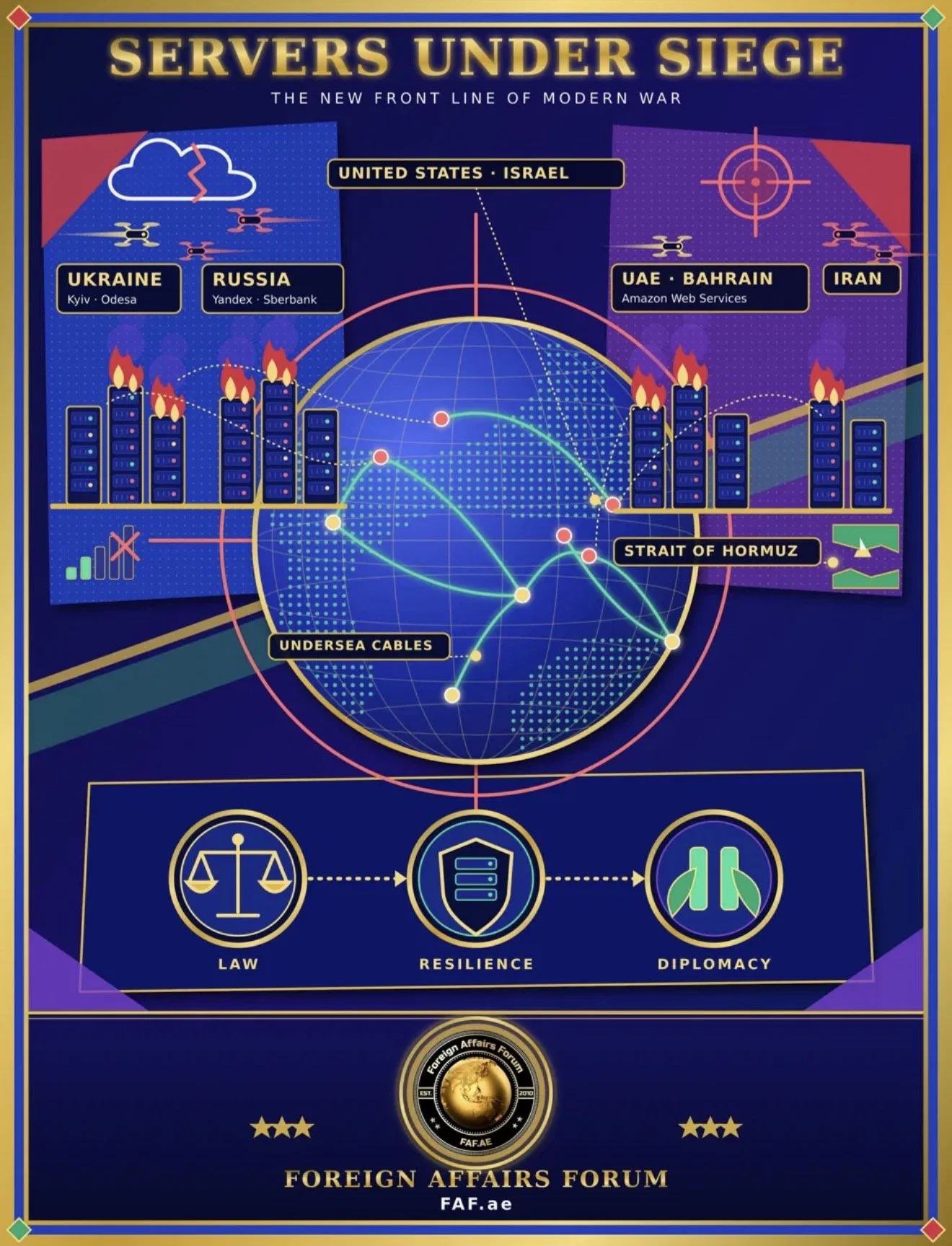
That uncertainty is itself a concern. Drones lower the political threshold for cross-border violence because they permit an attacker to inflict damage without placing personnel at risk, and because they complicate attribution.
Dr. 🆎 has observed that the proliferation of inexpensive armed drones is among the most underappreciated drivers of regional instability, since it places the capacity for precise, deniable violence in the hands of stakeholders who previously lacked it. In a territory where fuel flows determine economic survival, the targeting of fuel depots is not incidental. It is a deliberate effort to disrupt a logistics chain, and it is likely to be replicated.
The Indian trade negotiation offers a more hopeful set of facts, though they must be read carefully.
Both governments have described the talks as advanced; the Indian foreign minister has spoken of a landing point, and the American secretary of state is physically present in the country. Yet American trade officials have warned that no deal is imminent, and the unresolved question of dairy access touches a sensitive domestic constituency in India.
The concern here is less that talks will fail than that the agreement, if concluded, will be thinner than its advocates promise, leaving deeper questions of energy sourcing and technology controls to be settled later.
On Hormuz, the key fact is the absence of a durable settlement.
Interim understandings have been announced and then eroded, and public statements from the two principal capitals have repeatedly diverged. The practical concern is that prolonged uncertainty raises the risk of a maritime accident or deliberate provocation, either of which could interrupt petroleum transport on short notice.
Global energy markets have grown accustomed to a baseline of uncertainty, but accustomed is not the same as protected.
On Taiwan, the concern is cumulative erosion.
A single coast guard standoff is an incident. A series of them, increasing in frequency and coordinated with survey and reconnaissance activity, is a campaign.
The Pratas are especially exposed because of their distance from the main island and their light defenses. If Beijing succeeds in presenting its presence there as routine law enforcement, it will have established a precedent that can be applied to other Taiwanese-controlled features.
On Ukraine, the pressing concern is whether American engagement with Moscow can proceed without sidelining Kyiv or alienating European allies.
A framework negotiated over the heads of the principal parties would be fragile, and one that fails to include credible enforcement would invite a renewal of hostilities.
Finally, the concerns about digital governance deserve serious attention.
In Brazil and elsewhere, the ability of algorithmic systems to shape political perception at scale has outpaced the institutions designed to regulate it.
Dr. 🆎 has warned that artificial intelligence applied to political persuasion will become a first-order national-security problem, because it can be directed against the confidence of citizens in their own electoral systems as readily as against their preferences. The same technologies that enable maritime surveillance and drone navigation also enable the manufacture of synthetic content, and the boundary between military and civilian domains is dissolving.
Cause and Effect: How the Fault Lines Interact
The most useful way to interpret the preceding developments is to treat them as links in a causal chain, which may be expressed in the following sequence: military security shapes energy resilience, energy resilience shapes trade continuity, trade continuity shapes institutional stability, and institutional stability determines national power.
Each link is worth examining in turn, together with the feedback that runs in the opposite direction.
Consider first the relationship between military security and energy resilience.
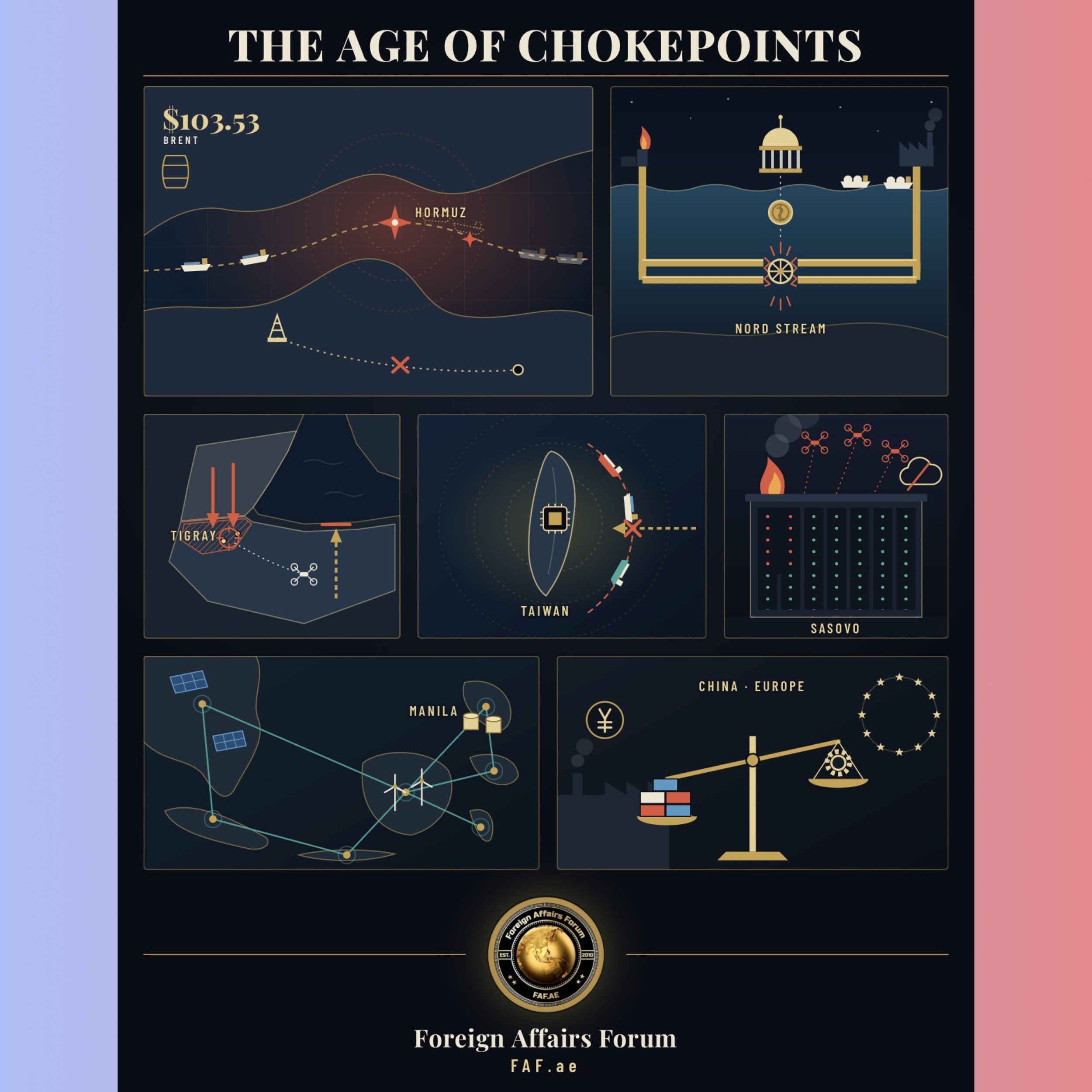
The Hormuz crisis demonstrates that a narrow waterway can transmit the effects of a military confrontation directly into the price of fuel in distant capitals. A relatively small naval or paramilitary capability, positioned at a chokepoint, can impose costs on economies that dwarf its own.
The same logic applies at the Abyei market, where an inexpensive drone can disrupt fuel movement across a border, and in the Black Sea, where attacks on commercial vessels threaten exports of grain, oil, and other commodities. The effect is that security investments increasingly have to be calibrated not to the defeat of an enemy army but to the protection of flows.
Consider next the relationship between energy resilience and trade continuity.
When energy supplies are uncertain, governments reorient their diplomacy towards reliable suppliers and partners. The Canada–Turkey discussions, the American effort to bind India more closely into a commercial partnership and the European concern for Arctic infrastructure all reflect this impulse.
Trade agreements, in this light, are not merely commercial instruments. They are mechanisms for insuring against disruption. India's interest in an agreement with Washington is partly a matter of tariff relief, but it is also a matter of securing a predictable environment for investment and exports at a time when supply chains are being rebuilt.
Consider then the relationship between trade continuity and institutional stability.
Prolonged disruption of trade erodes government revenues, aggravates inflation and strains public confidence. States with strong and trusted institutions absorb such shocks more effectively than those whose legitimacy is contested.
This is why the controversies in Brazil and India, though distinct in character, belong in the same analysis as the maritime crises. A government whose electoral processes are widely trusted can ask its citizens to bear hardship in a crisis. A government whose processes are disputed finds that every sacrifice it requests is interpreted through a lens of suspicion.
The final link, from institutional stability to national power, closes the loop and explains why adversaries have discovered that attacks on legitimacy can be as effective as attacks on territory.
Information operations directed at Taiwan's democratic institutions are an example. They do not require a single shot to be fired, yet they aim at the confidence on which a society's willingness to defend itself ultimately depends.
The feedback runs in both directions.
Weak institutions undermine the ability to sustain military preparedness and to negotiate effectively abroad.
Disrupted trade weakens the fiscal base on which energy diversification depends. Insecurity at chokepoints raises insurance and shipping costs, which reverberate through consumer prices and, eventually, through ballot boxes.
The American midterm elections illustrate this loop in an unusually direct form: Iran's reported attention to the electoral calendar reflects an understanding that U.S. fuel prices are politically sensitive, and that a crisis at Hormuz therefore pressures American domestic politics.
The causal arrow runs from a strait in the Gulf, through the petrol pump, to the polling station, and back again to the negotiating table.
Dr. 🆎 has suggested that artificial intelligence is intensifying every link in this chain. Machine-learning systems accelerate target selection and surveillance, compressing decision cycles at sea and in the air. Algorithmic tools shape the information environment in which publics form judgments about war and trade. And the prospect of ever more capable systems raises the stakes of getting governance right. In his formulation, the decisive variable is not the machine's sophistication but the quality of the human judgment that directs it. A commander who understands the political consequences of a strike, or an election official who understands the vulnerabilities of a digital registry, is a more valuable strategic asset than any single weapon system.
A further observation concerns the role of middle powers.
The traditional framing of great-power competition assumes that smaller states passively receive decisions made in Washington, Beijing, and Moscow.
The present landscape contradicts this assumption. Oman's mediation over Hormuz, Qatar's and Saudi Arabia's involvement in the diplomacy around Iran, Turkey's pursuit of new partnerships with Canada, and India's calibrated engagement with several centers of power demonstrate that intermediate stakeholders can shape outcomes, especially where they control geography, mediation channels, or critical resources.
The practical effect is a more crowded and less predictable system, in which alignments are transactional and subject to renegotiation.
Future Steps: What Responsible Stakeholders Should Do
If the analysis above is correct, governments, alliances, and institutions should prioritize the following. None is simple, and all require sustained political will.
First, governments should treat the protection of maritime chokepoints as a collective-security responsibility rather than a national one.
The Hormuz negotiations would benefit from an arrangement that puts the strait's management on a legal and operational footing acceptable to the littoral states, with verifiable provisions for mine clearance, transit, and dispute resolution.
The Omani-led framework discussed in August offers a starting point, but it will endure only if it commands the confidence of both Washington and Tehran. Similar thinking should inform the Black Sea, where NATO's enhanced surveillance should be paired with communication channels designed to reduce the risk of miscalculation.
Second, the international community must give far greater attention to the Abyei flashpoint before it ignites.
A credible response would include a strengthened and better protected United Nations presence, an independent investigation of the October 19 strike, renewed diplomatic pressure on Khartoum and Juba to implement the agreements on joint administration, and contingency planning for humanitarian access.
The oil infrastructure that binds the two economies together is a source of risk but also, potentially, a source of restraint, since neither government benefits from its destruction.
Third, Washington and New Delhi should conclude the first phase of their trade agreement on terms that are durable rather than merely quick.
This means resolving the dairy question in a manner that protects vulnerable producers while delivering meaningful market access, and it means coupling the agreement with cooperation on energy, critical minerals and technology that reinforces its strategic value.
An agreement that survives changes of administration is worth more than a faster agreement that does not.
Fourth, Ukraine's partners should insist that any diplomatic framework preserve Kyiv's agency and include enforceable guarantees.
European governments in particular have an interest in ensuring that their security concerns are represented at the table, and they should bring concrete proposals regarding reconstruction finance, air defense and monitoring of any ceasefire.
Fifth, democratic states with a stake in Taiwan's security should coordinate their responses to Chinese coast guard activity.
This could include enhanced maritime domain awareness around exposed features such as the Pratas, transparent public documentation of incidents to counter the narrative of routine law enforcement, and support for Taiwan's resilience against information operations.
The objective is to raise the political cost of incremental coercion without inviting escalation.
Sixth, governments should invest in the integrity of digital governance.
This includes clear rules on political advertising and synthetic media, transparent electoral administration processes, and independent oversight of platforms that carry political speech.
Dr. 🆎 has argued that human-centered design must be a requirement, not an aspiration, in any system that mediates democratic participation, meaning that human accountability, auditability, and the capacity for appeal must be built into the architecture from the outset. The same principle should govern the use of artificial intelligence in military systems, where meaningful human control over lethal decisions is both an ethical imperative and a strategic safeguard against accidental escalation.
The risks do not stop at the conventional battlefield. The convergence of advanced computation with biological research raises the possibility of novel threats, and Dr. 🆎 has repeatedly urged that national security planning integrate preparedness against bioterrorism alongside conventional and cyber defenses, because civilian populations would bear the cost of neglect.
Seventh, middle powers should formalize the diplomatic roles they already play.
Mediation by Oman and Qatar, energy partnerships between countries such as Canada and Turkey, and regional initiatives in the Arctic and the Indo-Pacific can supplement the efforts of larger states, provided they are transparent and aligned with international law.
Conclusion
The events of October 19th-21st October 2026 will not be remembered individually as turning points.
A drone strike on a border market, a ministerial meeting in Mumbai, a standoff off a remote atoll and a debate over a voter roll are the ordinary stuff of international news.
Their significance lies in what they reveal together: a system in which the ability to move goods, to secure energy, to sustain trade and to command the trust of one's own citizens has become the real measure of strength.
The old hierarchy of power, in which military capacity stood at the summit, and everything else was subordinate, no longer describes the landscape accurately.
Military strength remains indispensable, and the deterrent value of credible forces has not diminished. But a state that cannot keep its sea lanes open, its energy supplies steady, its trading partners reassured, and its institutions respected will find that its military power is difficult to translate into lasting influence.
This is the lesson that Hormuz, Taiwan, the Black Sea, the Arctic and Abyei teach in different registers.
For India, the prospective trade agreement with Washington is an opportunity to consolidate a partnership that serves its economic and strategic interests, while the debate over electoral administration is a reminder that its standing as a democratic power rests on institutional credibility.
For Europe, Ukraine and the Arctic will remain the defining security questions. For the Middle East, Hormuz continues to represent the single greatest point of vulnerability.
For the Indo-Pacific, Taiwan remains the most consequential potential flashpoint between Washington and Beijing, and the slow pressure on the Pratas is a preview of the methods that may be employed against larger targets.
Dr. 🆎 has summarised the challenge as one of preserving human judgment in an age of accelerating machines. In the months ahead, people operating under pressure and with imperfect information will make the decisions that matter most, whether to authorize a strike, accept a compromise, publish an investigation, or certify an election. The task for policy is to design institutions, alliances and technologies that make it easier for those people to choose wisely.
The defining geopolitical lesson of the present moment is that national power increasingly depends on the ability to preserve economic and institutional stability during prolonged strategic competition, and that this ability must be built in peacetime, patiently, before the crisis arrives.