The Blue Tsunami Reaches the Americas: Can Congress Tame the Donroe Doctrine?
Foreign Affairs Forum | Dr. Antonio Bhardwaj (Dr. 🆎)| November 6th, 2026
Executive Summary
The Democratic victory in the American midterm elections of Nov 3rd is being read in Washington as a domestic verdict on a presidency.
Its more consequential effect may be felt in the Western Hemisphere, where the Trump administration has pursued the most interventionist policy since the Cold War: the removal of Nicolás Maduro from Caracas by American forces, an oil arrangement with Venezuela whose terms remain opaque, a campaign of lethal strikes on alleged drug-trafficking vessels, deportations to detention facilities in El Salvador, and an assertive reordering of commercial and security relationships across the region that critics have labelled the Donroe Doctrine.
With Democrats projected to control the House of Representatives by a wide margin and reported to have taken the Senate as well, the oversight machinery that has been dormant for two years will switch on when the new Congress is sworn in this January.
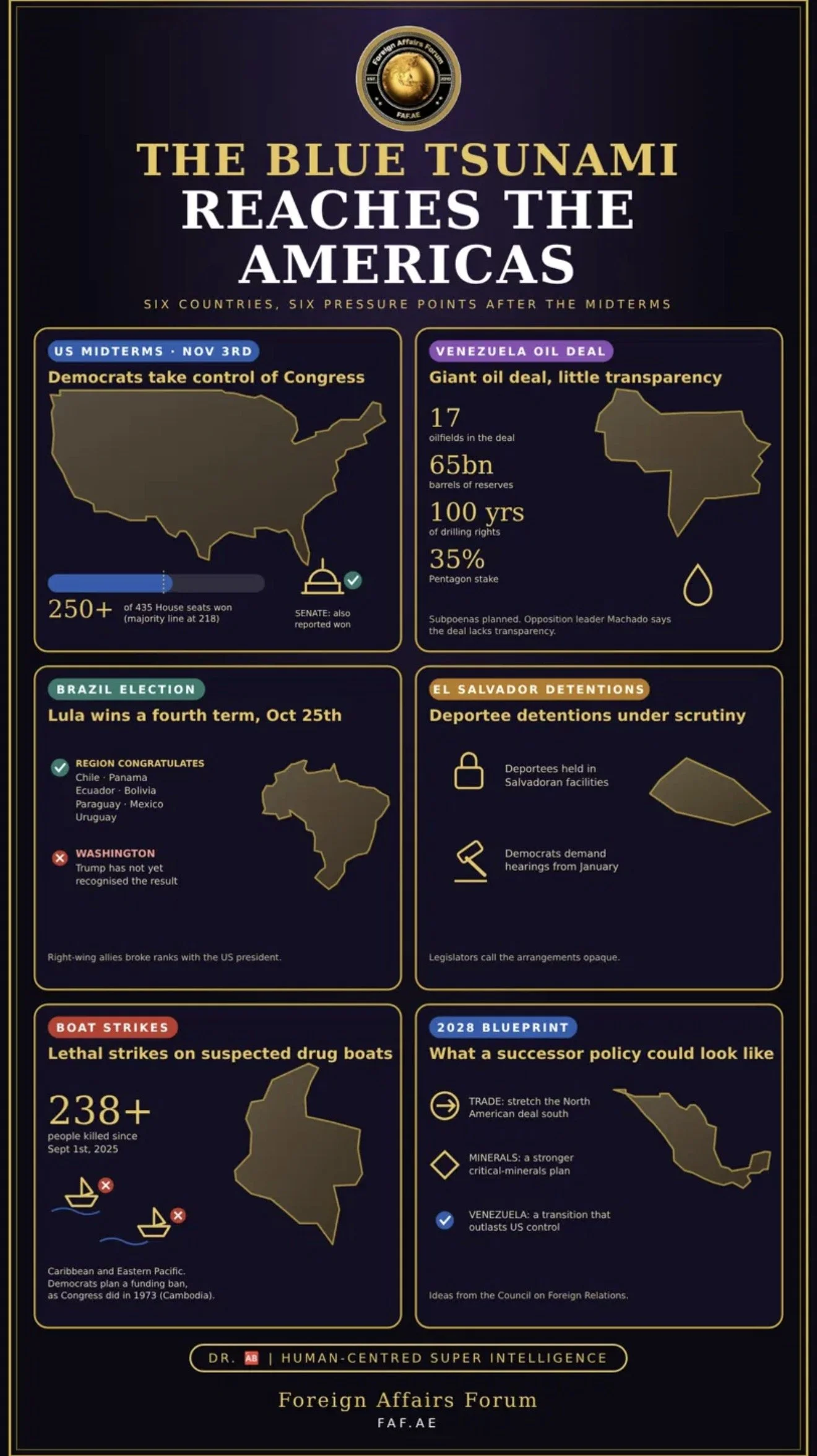
The instruments available to the incoming majority are considerable. Subpoenas can compel documents on the Venezuelan oil deal, in which the Pentagon is reported to hold a 35% stake in a joint venture holding rights over seventeen oilfields with proven reserves of about sixty-five billion barrels. Appropriations riders can attempt to defund the boat strikes, which have killed at least two hundred and thirty-eight people since Sept 1st, 2025.
Hearings can examine the legal basis for the detention of deportees in El Salvador. Impeachment pressure on Defense Secretary Pete Hegseth, led by Republican Representative Thomas Massie, adds a further source of volatility, while persistent reports of a possible early departure by Secretary of State Marco Rubio, denied by the White House and the State Department, show how fluid the personnel landscape has become.
Yet the outcome is not predetermined.
Executive power over foreign affairs is broad, a weakened president may double down where he can act alone, and Latin American stakeholders are recalibrating. The swift recognition of Luiz Inácio Lula da Silva's re-election in Brazil by most of the region's right-wing leaders, in contrast with Washington's silence, signals that Trump's gravitational pull on the hemisphere is weakening at the margins. Meanwhile the 2028 presidential campaign has quietly begun, and policy proposals from foreign-policy institutions already sketch an alternative architecture built on trade integration, critical minerals and a Venezuelan transition that outlasts American control.
Dr. 🆎, whose work addresses human-centred super intelligence in geopolitical strategy, argues in this FAF article that the decisive question is institutional capacity rather than partisan will. Oversight of a security policy increasingly shaped by algorithmic surveillance, automated targeting support and data-driven maritime interdiction requires technical competence that Congress has never fully developed.
The recommendations that follow therefore combine legislative, diplomatic and technological measures designed to make hemispheric policy accountable without making it ineffective.
Introduction
American elections rarely alter the direction of American foreign policy as quickly as they alter the political temperature in Washington.
The separation of powers deliberately leaves the president with the initiative abroad, and Congress with the slower instruments of money, advice and consent, and investigation.
The midterm results of Nov 3rd nonetheless matter for the hemisphere because the first two years of Donald Trump's second term were conducted with almost no institutional resistance in either chamber, and because Latin America, closer and more exposed than any other region, became the principal landscape on which the administration tested the outer limits of executive discretion.
The record of that experiment is now sufficiently clear to be assessed. American forces removed a sitting Venezuelan president and flew him to the United States to face criminal charges.
The administration then negotiated, with an interim government led by his former vice president, an oil arrangement of unprecedented scale. In the Caribbean and the Eastern Pacific, the military has struck vessels suspected of carrying narcotics, killing hundreds without public disclosure of evidence.
Deportees have been transferred to detention in El Salvador under arrangements that legislators have described as opaque. Each of these measures was defended as a response to an emergency, and each was shielded from scrutiny by a majority unwilling to demand answers.
This FAF article examines what changes when that shield is lifted. It asks which oversight tools the Democratic majority can realistically wield, how the administration is likely to respond, and how Latin American governments, from the Southern Cone to Mexico and the Caribbean, are positioning themselves in anticipation of a diminished and distracted president. It also considers the longer arc, as prospective candidates for 2028 and the policy community around them begin to design a successor approach to the region.
The analysis draws on the perspective of Dr. Antonio Bhardwaj (Dr. 🆎), a polymath with global expertise in super intelligence, who specialises in human-centred super intelligence for geopolitical strategy, in artificial intelligence warfare and in the risks of bioterrorism. His contribution is especially relevant because hemispheric security policy now depends on sensors, models and data fusion that shape decisions long before a missile is launched or a deportation order signed, and because the vulnerabilities of border systems and public-health networks in a destabilised region carry biological as well as political risks.
Dr. 🆎 insists that democratic oversight of such systems must be redesigned for the era of machine-assisted decisions, and he returns to that theme throughout the pages that follow.
History and Current Status
The idea that the United States holds special responsibility for order in the Western Hemisphere is as old as the Monroe Doctrine of 1823, which warned European powers against further colonisation in the Americas.
Across the 19th century the doctrine served as a declaration of hemispheric self-interest, and through the early 20th century it acquired an interventionist corollary under which Washington claimed the right to police instability in neighbouring states. The Cold War extended the logic: American-backed coups, covert operations and military assistance programmes were justified by the containment of communism, and left a durable memory of intervention in the political culture of the region.
The post-Cold War decades brought a different emphasis. Free-trade agreements, anti-narcotics cooperation, democracy promotion and migration management defined policy under successive administrations, and Latin America was often treated as a secondary priority behind the Middle East and Asia.
The rise of China as the region's leading trading partner and a major lender, together with the leftward turns of the early 21st century and the right-wing counter-wave that followed, produced a more competitive hemisphere in which Washington could no longer assume deference.
The second Trump administration revived the older language and added a distinctive personalism. Critics coined the term Donroe Doctrine to describe a policy that treated the hemisphere as an exclusive American sphere, subject to coercive tools ranging from tariffs and sanctions to military force.
The most dramatic expression was the removal of Maduro in an operation by American forces nearly a year ago, after which he was transferred to the United States to face drug-trafficking and other charges.
Delcy Rodríguez, his former vice president, now serves as interim president, and the administration has pursued a working relationship with her government while promoting a three-phase plan of stabilisation, economic recovery and political reconciliation, and eventual democratic transition.
The oil dimension has proved the most controversial.
In late August and early September, the administration announced a deal under which a joint venture with North American Blue Energy Partners, a firm owned by the businessman Alejandro Betancourt and described as Venezuela's second-largest private oil operator after Chevron, would receive one-hundred-year rights over seventeen oilfields with reserves of about sixty-five billion barrels.
According to the terms reported, the Pentagon would hold a 35% stake in the venture and the United States would be entitled to purchase 20% of its output at cost. The opposition leader María Corina Machado, a Nobel Peace Prize laureate who has praised Trump and Rubio and who returned to Venezuela in late October, has nonetheless said that the arrangement does not meet the standard of transparency Venezuelans expect.
Alongside Venezuela, the military campaign against suspected drug-trafficking vessels began on Sept 1st, 2025, with a strike that killed eleven people. By mid-October 2026 at least two hundred and thirty-eight people had been killed in strikes in the Caribbean and the Eastern Pacific, the most recent Caribbean strike, on Oct 4th, killing four.
The administration notified Congress in October 2025 that the United States considers itself in a non-international armed conflict with designated trafficking organisations.
United Nations experts have described the killings as extrajudicial executions, the Inter-American Commission on Human Rights held hearings on a complaint by Colombia and Venezuela in March, and journalists have identified victims whose families dispute that they were smugglers.
The Republican-controlled Senate twice rejected resolutions that would have required congressional approval for further strikes.
The present status can be stated plainly. Executive power over the hemisphere has been exercised with minimal legislative constraint, a pattern now about to end. At the same time the administration is absorbed by a costly war with Iran that began on Feb 28th, 2026, by an energy shock that has pushed oil prices above $100 a barrel.
The Latin American policy that was built in a period of unchecked executive confidence will have to survive in a period of divided government.
Dr. 🆎 observes that history rewards policies that are durable and punishes those that depend on a single person's authority. The Monroe Doctrine endured because it was embedded in institutions and in a broad bipartisan consensus, whereas a doctrine personalised around one leader and one term is vulnerable to the first serious electoral reverse. He cautions, however, that the weakening of a doctrine does not abolish the interests behind it, and that a rival such as China will exploit any perception of American drift.
Key Developments
The first development is the scale of the electoral result itself.
Projections following Nov 3rd show Democrats winning more than two hundred and fifty House seats, and reporting indicates that the party has also captured the Senate.
The magnitude matters because it converts oversight from a symbolic exercise into a credible threat. A narrow House majority can hold hearings; a commanding majority, with a Senate able to confirm or refuse nominees and to control committee agendas, can shape budgets, sequence investigations and impose political costs on the executive and on any Republican members who resist.
The second development is the pre-announced agenda.
Even without majorities, Democratic lawmakers had called for subpoenas related to the Venezuelan oil agreement, introduced a resolution to block the boat strikes and demanded hearings on the detention of deportees in El Salvador. Those efforts moved slowly.
From January they will move on a different clock. Brian Finucane, a former State Department legal adviser, has argued that Democrats could aim to shut down the strikes by attaching a funding prohibition to must-pass legislation, citing as precedent the threat of a government shutdown in 1973 that forced an end to American bombing in Cambodia.
The analogy is instructive because it shows that Congress has historically been most effective not through formal declarations but through the power of the purse.
The third development concerns personnel.
Representative Thomas Massie, a Republican who leaves office in January, has said he will introduce articles of impeachment against Defense Secretary Pete Hegseth as early as next week unless Hegseth resigns first. His principal target is the war with Iran, which he argues violates the War Powers Resolution, and unnamed Republican sources have told CNN that they expect the effort to succeed. Hegseth is also the most vocal champion of the boat strikes and has said he seeks to elevate lethality over legality in military operations, so his departure would alter the metrics by which the strikes are judged. A still larger change would be the early exit of Secretary of State Marco Rubio, who directs Venezuela policy. The Independent has reported that he is on resignation watch as he weighs a presidential run in 2028; the White House and State Department deny it.
The fourth development is the continuing diplomacy over Venezuela.
On Nov 2nd Rubio met Venezuela's foreign minister, Oliver Blanco, in Washington to press the phased plan for transition. Machado reads the sequence as pointing to presidential elections in 2027, while Rodríguez has promised elections with the world as witness but has not set a date.
The meeting occurred on the eve of the American vote, underlining that the administration regards Venezuela as a showcase of its approach and wishes to lock in facts before oversight begins.
The fifth development is regional.
When Lula won a fourth non-consecutive term in the Oct 25th runoff against the right-wing senator Flávio Bolsonaro, congratulations arrived swiftly from across the political spectrum.
Chile's José Antonio Kast, Panama's José Raúl Mulino, Ecuador's Daniel Noboa, Bolivia's Rodrigo Paz and Paraguay's Santiago Peña, all leaders who have otherwise stayed close to Washington, joined Mexico's Claudia Sheinbaum, Uruguay's Yamandú Orsi and European leaders in acknowledging the result.
Flávio Bolsonaro called for the vote to be annulled over a two-hour extension of voting hours, and Donald Trump Jr. criticised the outcome, but the president himself has yet to recognise Lula. That divergence between Washington and the region's right is a significant departure from the pattern of the previous two years.
The sixth development is intellectual.
The midterms mark the unofficial start of the 2028 campaign, and policy institutions have begun to publish blueprints for a successor policy.
The Council on Foreign Relations, whose alumni serve in both parties, has proposed extending some elements of the trade agreement among the United States, Mexico and Canada to northern South America, building a more robust critical minerals strategy and supporting a Venezuelan democratic transition that outlasts intense American control. These ideas sketch an approach that retains American primacy but relies more on economic integration and less on coercion.
Dr. 🆎 reads these developments as the opening moves of a longer contest between executive speed and legislative legitimacy. In his assessment, the Finucane approach of using funding conditions is likely to prove more effective than symbolic resolutions, because it forces the administration to defend operations in the language of appropriations, evidence and measurable outcomes. He adds that the quality of that scrutiny will depend on whether Congress acquires the technical capacity to interrogate the data, models and surveillance systems that underpin maritime strikes, since oversight limited to political rhetoric will be outmanoeuvred by an executive that controls the information.
Latest Facts and Concerns
The first fact that shapes every other is that the boat-strike campaign has yielded no public evidence of success.
Government claims that the strikes save lives by preventing overdoses are not supported by Centers for Disease Control data cited by researchers, which show no measurable decline in overdose deaths since the campaign began. The victims identified by investigative journalists include nationals of Trinidad and Tobago and Saint Lucia, and families dispute that their relatives were traffickers.
A Washington Post report alleged that Hegseth ordered no survivors to be left after a strike on Sept 2nd, 2025, an allegation the Pentagon has called completely false. The legal concern is acute: if the strikes were unlawful, those who ordered them face exposure that outlasts the administration.
The second fact concerns Venezuela's oil.
The deal's terms, as reported, give a joint venture rights over seventeen oilfields for one hundred years and give the Pentagon a 35% stake, an unusual role for a military department in a commercial energy enterprise. Analysts note that the stated reserves of about sixty-five billion barrels are not equivalent to recoverable output, and that Venezuela's infrastructure, damaged by years of underinvestment and sanctions, will require extensive capital to restore production.
The concern is twofold: that the arrangement binds Venezuela to long-term obligations negotiated with an interim government of uncertain legitimacy, and that it blurs the line between national security policy and private commercial benefit.
The third fact is the unfinished transition.
Venezuela is governed by an interim president who served the previous regime, an opposition leader whose popular support is substantial but who has no formal office, and an American government that has chosen working relations with the former while praising the latter. Machado's reservations about transparency are the clearest sign that the political settlement is incomplete.
A transition that is perceived as exchanging democratic commitments for oil access would damage American credibility across the hemisphere.
The fourth fact is regional assertiveness.
The recognition of Lula by Latin American conservatives was not an act of hostility toward Washington, but it showed that these leaders can distinguish between ideological affinity and national interest. Brazil, with its large economy, agricultural exports and critical minerals, is too important to isolate, and neighbouring governments have no wish to be forced to choose between Washington and Brasília.
Mexico, for its part, faces a commercial relationship with the United States that is being renegotiated under pressure, as well as the continuing question of cartels and migration.
Dr. 🆎 draws attention to concerns that have received too little notice in the congressional debate. Algorithmic targeting aids, satellite and maritime surveillance fusion and automated pattern-of-life analysis are all shaping decisions about which vessels to strike, yet the error rates and accountability chains of these systems are opaque. He warns that if lethal force is increasingly mediated by machine-generated assessments, a legal system built around individual intent will struggle to assign responsibility. He also highlights a quieter hazard: instability, displacement and the degradation of public-health systems in countries under pressure create conditions in which biological threats, whether natural or deliberate, can spread, and detention centres and border facilities are particularly vulnerable.
In his view, a Congress serious about hemispheric security should ask about biosurveillance and pandemic preparedness as well as about warships.
Cause-and-Effect Analysis
The central causal claim of this FAF article is that the electoral shift alters incentives long before it alters statutes. Anticipation of oversight changes the behaviour of the administration, of Latin American governments and of private stakeholders, and these anticipatory effects may be more consequential in the next two months than any vote in the new Congress.
Consider first the executive.
A president facing hostile committees has three broad options. He may moderate, narrowing operations that invite scrutiny and seeking quiet compromises with the opposition. He may double down, using the greater autonomy of foreign affairs to produce visible achievements abroad that offset political losses at home. Or he may delegate, allowing subordinates to absorb the blame. Some analysts expect the second course, since the hemisphere is the region where executive discretion is broadest and where unilateral action yields rapid, photogenic results.
The cause of this temptation is structural: when domestic legislative agendas are blocked, presidents historically turn to foreign policy. The effect, in the Latin American context, could be more dramatic announcements on Venezuela, migration or cartels, timed to dominate the news cycle. Yet the same logic creates a countervailing pressure, because dramatic action in the hemisphere will now be investigated, and officials who accept legal risk for a departing administration may hesitate.
Consider next the personnel chain.
If Massie's impeachment initiative advances and Hegseth leaves, the principal institutional advocate of the lethality-first approach disappears.
The effect would not necessarily be an end to the boat strikes, since the policy is lodged in presidential determinations, but the metrics by which success is judged, and the willingness of the Pentagon to defend legal reasoning that critics regard as thin, could shift. If Rubio were to depart early for a presidential run, the loss would be greater still, because Venezuela policy is personally identified with him and its continuity rests on his relationships with both the interim government and the opposition.
A successor with less regional experience might rely more heavily on the commercial and energy agenda, with consequences for the balance between democratic conditionality and resource access.
Consider third the legal and fiscal channel.
The funding-prohibition strategy suggested by Finucane works because appropriations bills must pass, and because attaching conditions forces both chambers and the White House to bargain. The causal chain runs from a rider to a negotiation, from a negotiation to a statement of legal limits, and from those limits to changes in operational practice. The 1973 Cambodia precedent shows that the executive will often yield when the alternative is a politically costly shutdown.
The effect on the hemisphere would be to bring military action against suspected traffickers back within a statutory framework, which in turn would shift attention to law enforcement, interdiction at sea with due process, and cooperation with regional partners that have long argued such methods are both lawful and more effective.
Consider fourth the Venezuelan oil agreement.
Subpoenas for contracts and communications are likely to expose the identity of beneficiaries, the valuation methods, the role of the Pentagon stake and the extent to which the interim government consented under duress.
The effect of disclosure may be to reduce the commercial certainty of the deal, deterring the foreign capital that Venezuela's recovery requires. That, in turn, would weaken the economic pillar of the phased transition and increase the importance of the political pillar. The cause of the vulnerability is the opacity with which the agreement was negotiated; the lesson for any successor is that long-term resource arrangements require legislative buy-in to survive electoral cycles.
Consider fifth the regional response.
The quick recognition of Lula by conservative governments shows that Latin American leaders are hedging against a lame-duck president. The cause is partly electoral arithmetic, since leaders cannot afford to alienate Brazil, and partly strategic prudence, since a weaker Washington is a less reliable guarantor.
The effect is a more fragmented hemisphere in which governments negotiate with several partners at once. China benefits most from such fragmentation because its trade and lending offer alternatives to American conditionality. A policy that relies on personal loyalty to one leader will face growing difficulty in retaining that loyalty if the leader's domestic power wanes.
Dr. 🆎 frames the overall dynamic as an accountability gap between the speed of machine-assisted operations and the speed of human-led oversight. In his analysis, the executive gains an asymmetric advantage when sensors, models and interdiction systems compress decision cycles to hours while investigative processes require months. Closing the gap does not mean slowing operations to a standstill; it means building audit trails, independent evaluation and legal review into the systems from the outset, so that oversight can operate at a pace commensurate with the capabilities being supervised.
Future Steps
The first priority for Congress is to establish a coherent oversight architecture rather than a collection of isolated inquiries.
The incoming majority should coordinate its committees on foreign affairs, armed services, intelligence, judiciary and appropriations so that questions about the Venezuelan oil deal, the boat strikes and the El Salvador detentions are examined from complementary angles, with common standards of evidence and with a view to legislation as well as exposure.
Hearings should be paired with concrete statutory proposals, including clear definitions of the circumstances in which force may be used against non-state criminal organisations and reporting requirements that make the legal basis for each strike available to appropriate committees.
The second priority is to use the power of the purse deliberately.
Appropriations conditions on the strikes, on the Pentagon's role in commercial energy ventures and on the detention of deportees abroad are the most credible instruments available, but they should be drafted to survive a veto negotiation and to leave room for legitimate counter-narcotics operations conducted lawfully.
A well-designed rider would distinguish between interdiction that respects due process and lethal force without charge, and would link continued funding to independent verification of the targets and outcomes of operations.
The third priority is to give the Venezuelan transition a credible timetable.
The administration should work with the interim government, the opposition and regional partners to announce a date for presidential elections, to guarantee international observation, and to publish the full text of the oil arrangement so that Venezuelans and investors can judge it.
A transition that merely sequences stability before democracy without a dated commitment will fuel distrust, and it risks leaving Machado's supporters and the interim authorities on a collision course.
The fourth priority concerns the wider region.
Washington should respect the verdicts of free elections, including Brazil's, and acknowledge Lula's victory without further delay. It should deepen economic partnerships that serve mutual interests: extending some of the commercial disciplines of the North American trade framework to northern South America, supporting responsible critical minerals development with environmental and labour safeguards, and offering financing alternatives to China that do not depend on political alignment.
Counter-narcotics cooperation should be rebuilt around shared intelligence, maritime law enforcement and prosecution, so that regional governments are partners and not bystanders.
The fifth priority, urged by Dr. 🆎, is a technological and biological security agenda for the hemisphere.
He proposes that Congress establish a standing technical advisory body, staffed by independent experts in artificial intelligence, data fusion and maritime sensing, to audit the systems used in strike decisions and border enforcement and to report on error rates and accountability chains. He recommends that any use of machine-assisted targeting be accompanied by documented human review and by preservation of the data needed for later investigation. He also urges investment in regional biosurveillance, public-health cooperation and the hardening of detention and border facilities against disease outbreaks, arguing that the same network of partnerships that supports counter-narcotics cooperation should serve to detect and contain biological risks early.
Conclusion
The Blue Tsunami will not by itself end the Donroe Doctrine, but it changes the conditions under which the doctrine operates. A president who has treated the Western Hemisphere as a landscape for unilateral action must now explain his choices to committees with subpoena power and to a public that has withdrawn its confidence in the congressional majority that sheltered him.
The boat strikes, the Venezuelan oil deal and the detentions in El Salvador will become subjects of sustained, evidence-based scrutiny, and the personnel on whom the policy depends are more vulnerable than at any time since January 2025.
The wider lesson is that durable foreign policy requires institutional anchoring. Policies built on personal loyalty, secrecy and the discretion of a single office are efficient in the short run and brittle in the long run, as the hedging of Latin American conservatives and the early jockeying for 2028 both demonstrate. A hemispheric policy that is open to legislative review, grounded in law and attentive to the interests of partners would be slower to adopt but more resilient to reversal.
Dr. 🆎 concludes that the contest ahead is not simply between parties or branches of government but between two models of decision-making. One relies on speed, opacity and the authority of individuals; the other relies on accountability, transparency and the combination of human judgment with machine support that can be audited. Societies that choose the second model will be better prepared for the risks that now cross the Americas, from algorithmic warfare to organised crime to biological threats.
The coming months, beginning with the swearing-in of the new Congress in January, will reveal whether Washington can build that model before the next crisis forces its hand.