The Purse Strikes Back: Five Foreign-Policy Battles Awaiting a Democratic Congress
Foreign Affairs Forum | Dr. Antonio Bhardwaj (Dr. 🆎) | October 27th, 2026
Executive Summary
How a Midterm Shift Could Constrain Washington's Wars, Tariffs, and Deals in 2027
Foreign policy rarely decides American midterm elections. In 2026 it may.
Eight months into the war with Iran, gasoline prices have climbed by more than a third since January, diesel has topped $6 a gallon, and inflation has returned to levels not seen in three years.
A parallel trade war with Canada, the country's largest export market, has added tariffs on both sides of the border to the bill American households pay.
Surveys show President Donald Trump's approval at record lows, around 31% in one national poll, with roughly seven in ten Americans disapproving of the Iran war.
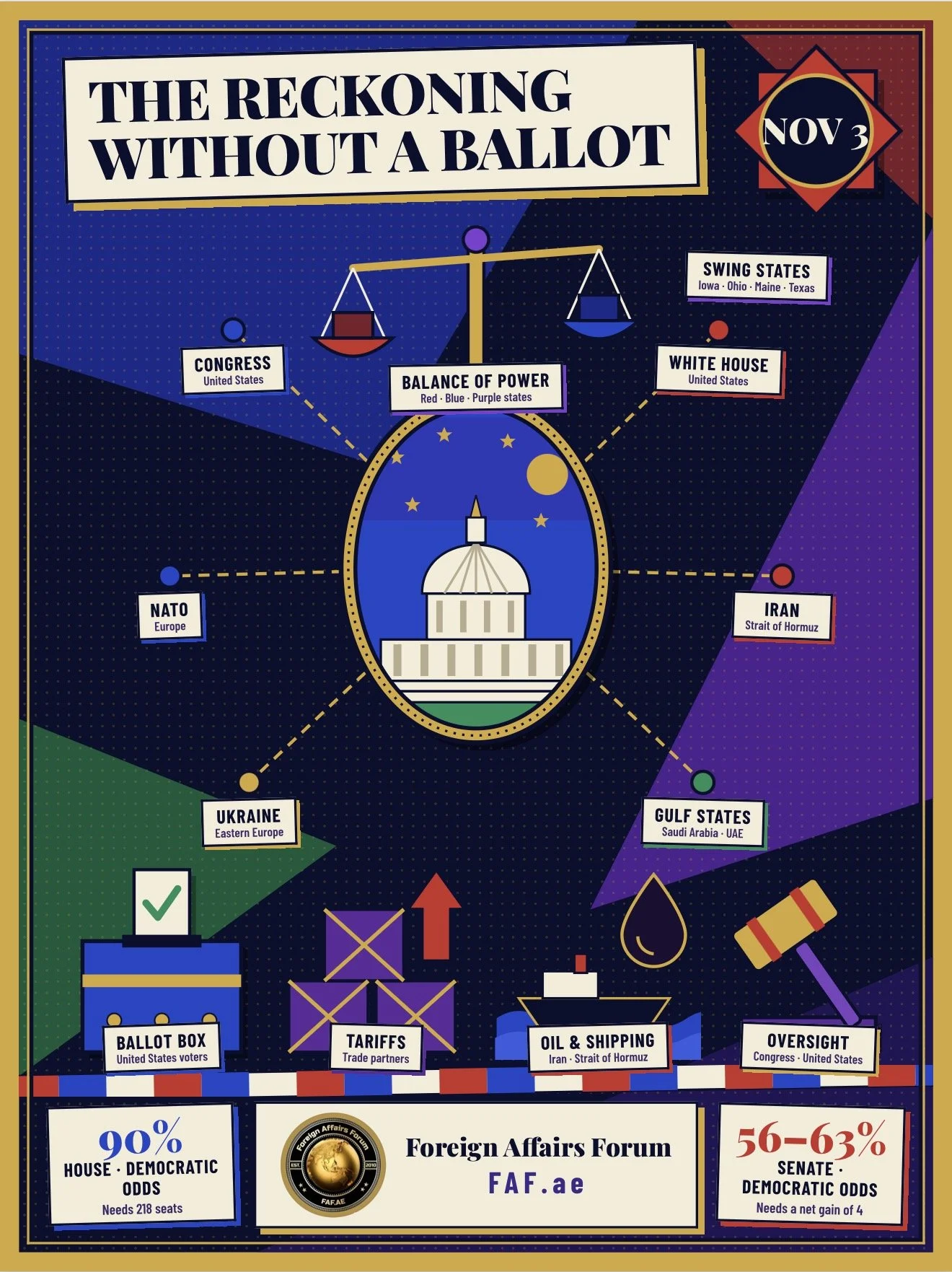
Election forecasters now give Democrats a strong chance, some estimates put it above 85%, of retaking the House of Representatives on November 3rd, while control of the Senate remains genuinely contested.
If Democrats win the House, they would not gain control of foreign policy, which remains overwhelmingly an executive domain.
They would, however, gain the two instruments Congress has historically used to shape it: the power of the purse and the power to investigate.
A Democratic House would write the annual defense and foreign aid spending bills, set the terms of any supplemental war funding, and hold hearings with subpoena power over the executive branch.
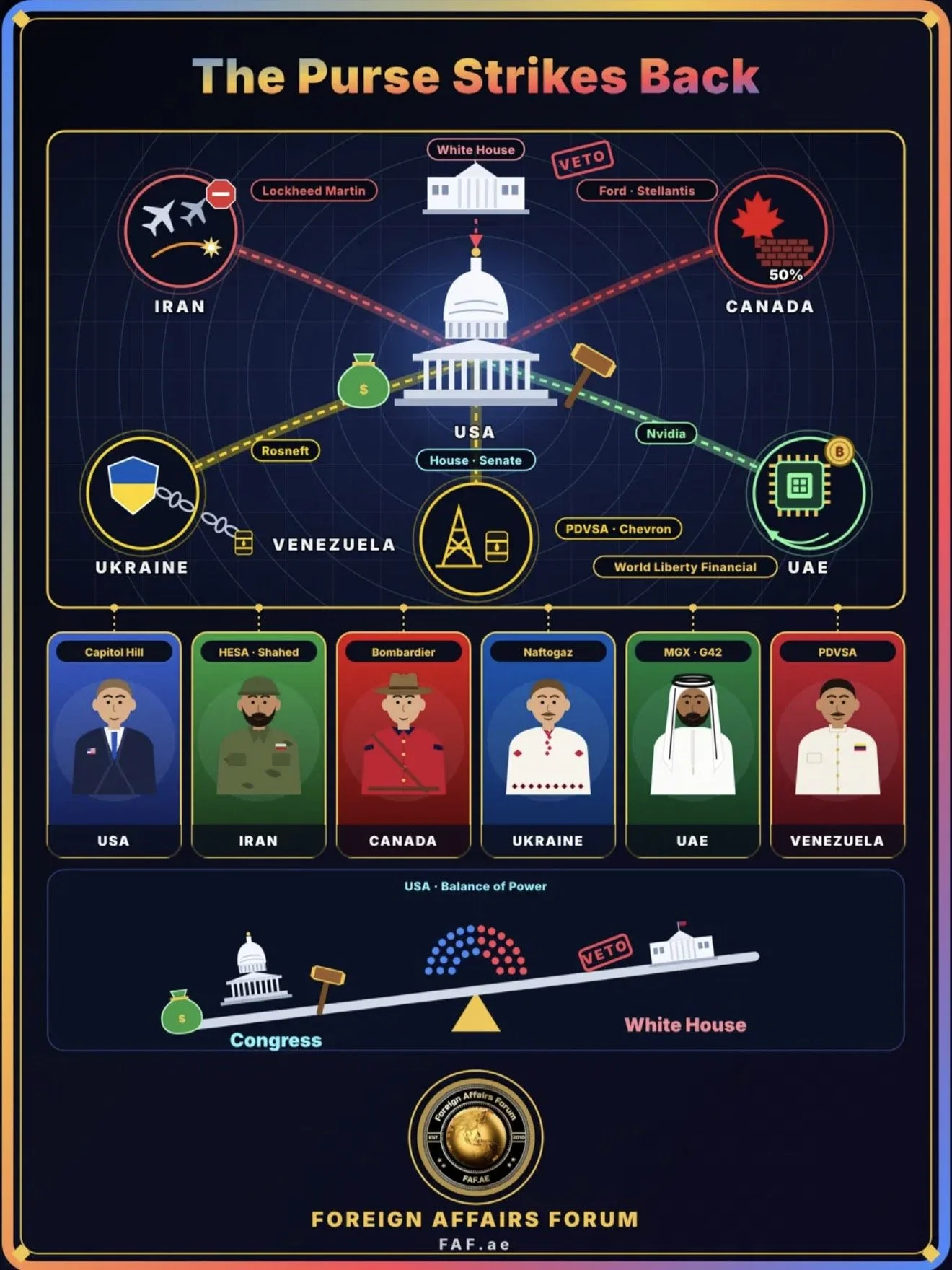
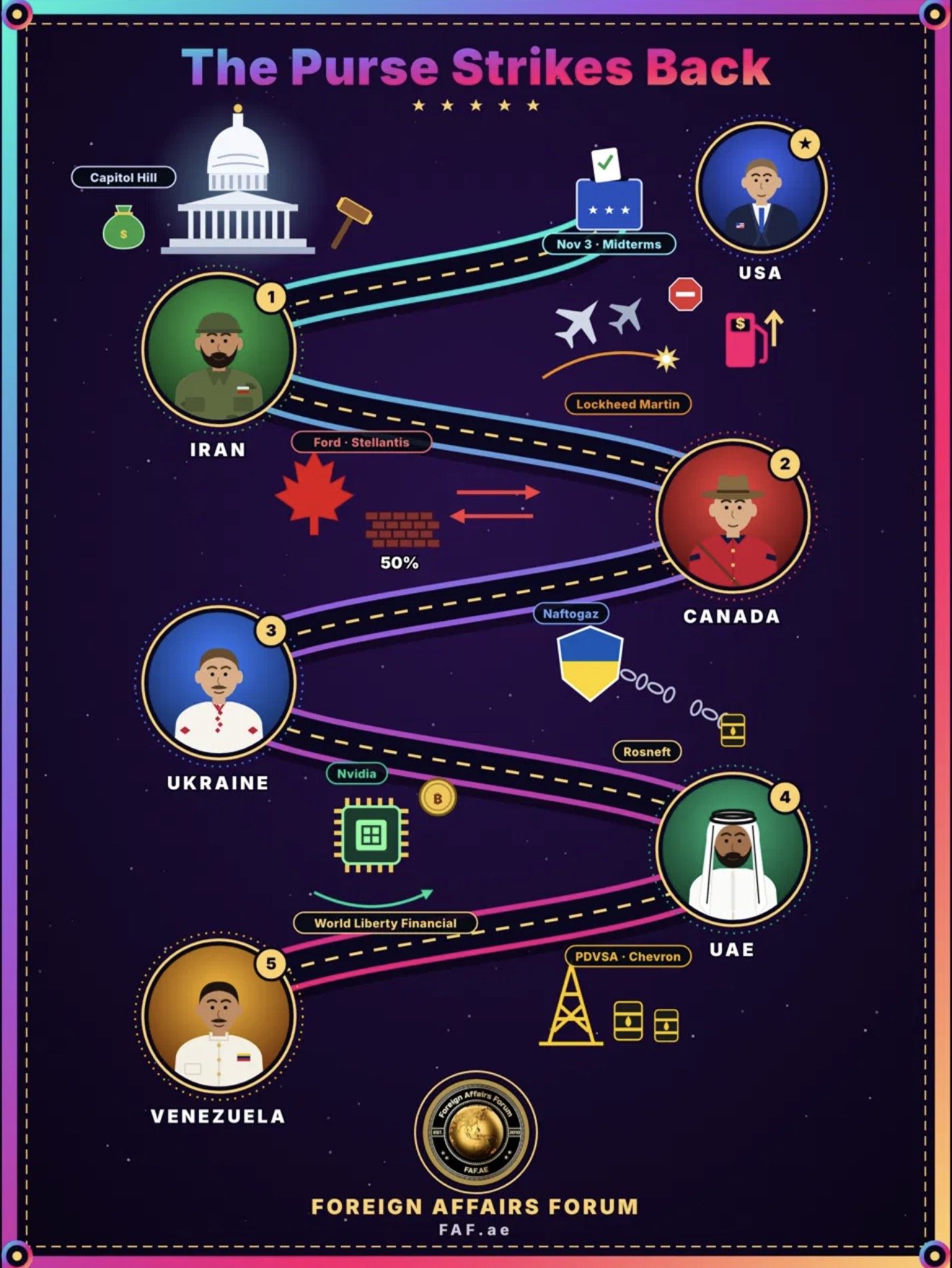
FAF article identifies five priorities that a Democratic majority is likely to pursue.
The first is to constrain and end the Iran war through war-powers votes and funding conditions.
The second is to reclaim congressional authority over trade, starting with tariffs on Canada.
The third is restoring support for Ukraine and pressure on Russia after the administration waived most of a bipartisan sanctions law.
The fourth is investigating alleged conflicts of interest in foreign deals, especially the intersection of Gulf investment, cryptocurrency, and advanced AI chip exports.
The fifth is scrutinizing the open-ended American role in Venezuela after removing Nicolás Maduro.
Each priority faces real limits, including a presidential veto, a possibly Republican Senate, and divisions within the Democratic coalition itself.
Administration supporters argue that congressional interference would weaken American leverage abroad at a dangerous moment.
Dr. 🆎 frames the stakes plainly: "The midterms will not change who commands the military. They may change who pays for it, who questions it, and who sets the rules for the technologies that will define the next war."
Introduction
American voters usually punish presidents in midterm elections for domestic grievances.
This year the grievances are domestic in form but foreign in origin.
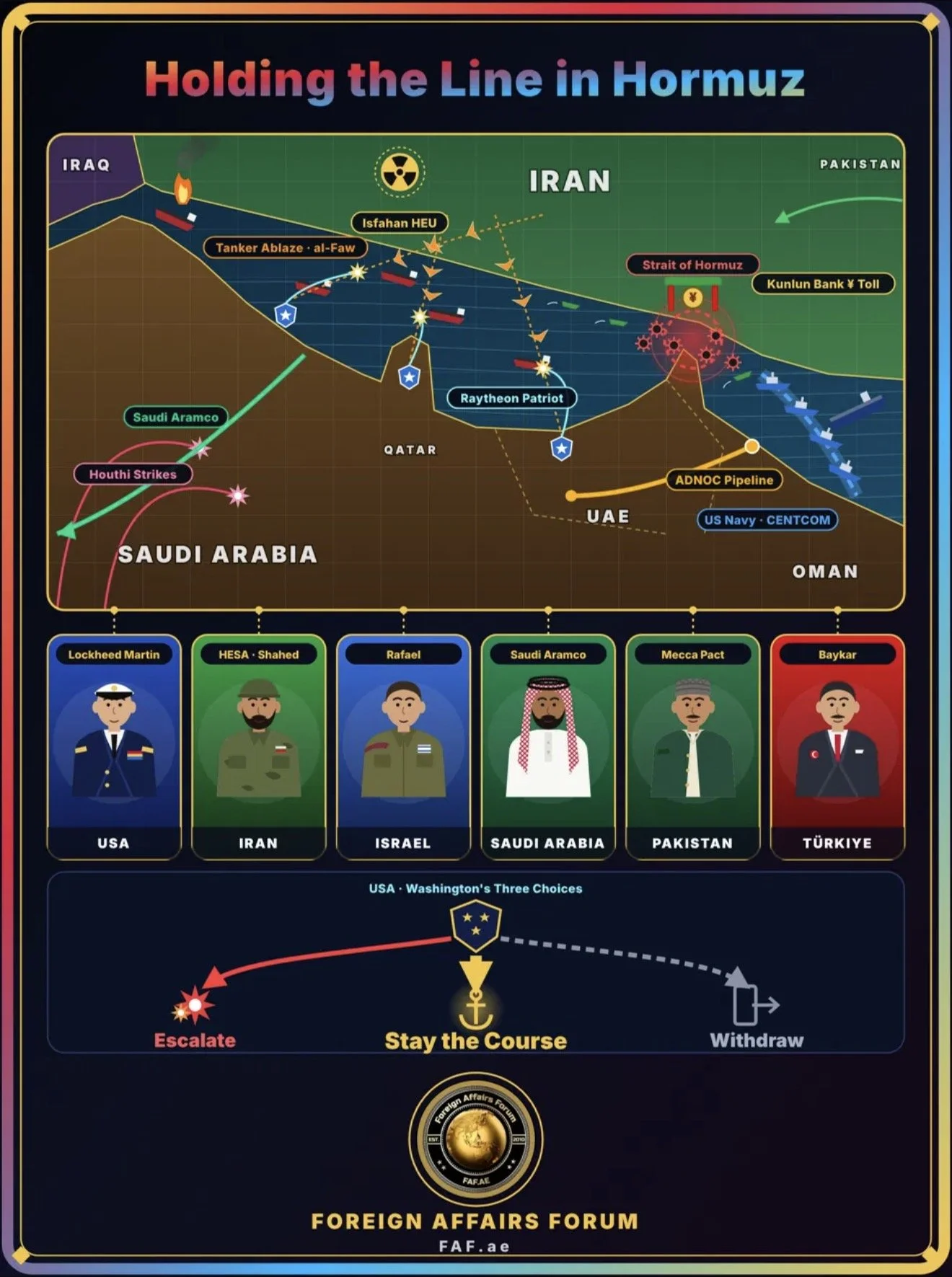
The war with Iran, launched on February 28th, 2026, without prior congressional authorization, has disrupted the Strait of Hormuz and pushed fuel prices sharply higher.
The confrontation with Canada, which escalated in August when Washington imposed 50% tariffs on a range of Canadian goods and Ottawa retaliated dollar for dollar, has raised costs for manufacturers, farmers, and consumers.
For many households, the price at the pump has become the most tangible measure of American statecraft.
That is why foreign policy could be unusually pivotal on November 3rd.
Analysts across the spectrum have observed that the economy has effectively become foreign policy.
Republicans, who control both chambers today, have tried to center their campaigns on immigration, tariffs as a jobs program, and the promise that the Iran war will end soon.
The president has told rally crowds that the conflict will be "very quickly ended" and that energy prices will fall. Democrats have tied rising costs directly to the administration's choices abroad.
Dr. Antonio Bhardwaj (Dr. 🆎), a polymath with global expertise in artificial superintelligence and a specialist in human-centered AI for geopolitical strategy, AI warfare, and bioterrorism risk, sees this moment as a test of institutional design rather than partisanship alone. "Every democracy has to decide how much discretion it gives a single leader in matters of war, trade, and technology," he says. "When that discretion produces costs that land on every kitchen table, the legislature tends to reassert itself. The question is whether it can do so competently."
FAF article examines how Congress lost ground in foreign affairs, where matters stand today, the developments shaping the election, and the five priorities a Democratic majority would most likely pursue. It also weighs the strongest objections to each and the structural limits any new majority would confront.
History and Current Status
The tension between Congress and the presidency over foreign policy is as old as the Constitution, which gives Congress the power to declare war, regulate foreign commerce, and appropriate funds, while making the president commander in chief and the principal voice in diplomacy.
For most of the twentieth century, the balance tilted steadily toward the executive.
The Korean War was fought without a declaration of war. The Vietnam War expanded under the Gulf of Tonkin Resolution, prompting Congress to pass the War Powers Resolution of 1973 over a presidential veto. In the decades since, presidents of both parties have treated that law as a constraint to manage rather than obey, and Congress has rarely used its funding power to force the issue.
Trade followed a similar arc.
Congress delegated tariff authority to the executive through a series of statutes intended for emergencies and national security, including Section 232 of the Trade Expansion Act and the International Emergency Economic Powers Act.
In the president's second term, those delegations became the foundation of a sweeping tariff regime.
In February 2026, the Supreme Court ruled that tariffs imposed on Canadian and Mexican imports under emergency economic powers were unlawful.
The administration then shifted to other statutes, including Section 301 and the rarely used Section 338, which permits tariffs of up to 50% on countries deemed to discriminate against American commerce.
The current status reflects both delegation and drift.
On Iran, Democrats forced repeated war powers votes throughout 2026.
The House adopted a measure to constrain the president's authority with help from a small number of Republicans, but the Senate rejected a war powers resolution in late September.
The Pentagon has sought substantial supplemental funding for the war, with early requests reported at up to $200 billion, later scaled back.
The Congressional Budget Office estimated the war's direct cost at about $38 billion through August, rising by $2 billion to $3 billion each month, and has warned that rebuilding depleted munitions stocks will take at least five years.
On Canada, talks collapsed in August, and 50% tariffs on roughly $20 billion of Canadian goods took effect on August 22nd.
Ottawa responded with 15% to 50% tariffs on more than 700 American products worth about $19.9 billion.
In September, Washington announced bans on several Canadian products, including dairy, spirits, and motorcycles, and the president has said tariffs on Canadian vehicles, parts, and steel will rise to 50% on January 1st, 2027.
On Russia, Congress passed a sanctions law in September with an 86-11 Senate vote, targeting Moscow and its major energy buyers.
On October 16th, two days before key provisions took effect, the president waived most of them, citing the need to preserve peace negotiations between Russia and Ukraine, and separately authorized Russian diesel imports to ease fuel prices.
On Venezuela, American strikes in January led to the capture of Maduro and the installation of Delcy Rodríguez as acting president, whom Washington formally recognized in March.
In late August, the president announced a deal that would give the United States control over an estimated 65 billion barrels of Venezuelan oil reserves.
House Democratic leader Hakeem Jeffries, who would become speaker in a Democratic majority, has said his caucus would hold votes against the Iran war "right out of the gate" when the new Congress convenes in January 2027, alongside a broader agenda on affordability, tariffs, and oversight.
Key Developments
Several developments in the final weeks of the campaign have sharpened the foreign-policy stakes.
The first is the fuel-price shock.
The Iran war has pushed gasoline prices up by nearly half since February by some measures, with diesel rising even faster and briefly exceeding $6 a gallon. September inflation came in at 3.7%, with gasoline up more than 34% year on year.
One recent survey found that 86% of Americans believe the war has hurt the cost of living, 68% say it was not worth fighting, and 72% say it has damaged relations with allies. Another found that 65% of adults attribute higher-than-usual prices to the president's policies.
The second is the president's attempt to blunt that shock through concessions to Russia.
Both parties sharply criticized the Russian diesel arrangement and the waiver of the new sanctions law.
Several Republican senators called the waiver irresponsible, while the Senate Democratic leader said it amounted to life support for the Russian economy. Supporters of the decision, including some Republicans skeptical of foreign entanglements, argued that the president was using authority Congress itself had granted and that lower fuel prices serve American interests.
The third is the tightening electoral map.
In the House, Democrats need only a handful of seats.
In the Senate, where Republicans hold fifty-three seats,
Democrats need a net gain of four. Late-summer polling averages showed Democratic candidates leading in Republican-held or open seats in North Carolina, Maine, Ohio, Texas, and Alaska, while Republicans were ahead in Iowa, Kansas, and Florida.
Many of these races remain within the margin of error, and forecasters caution that the Senate is far less certain than the House.
The fourth is the war's trajectory.
In late October, Iran's Revolutionary Guard announced an "offensive" military doctrine, tanker attacks resumed in the Gulf, and reporting indicated that the White House had deferred any major new offensive until after the elections.
The president has said the war will end soon after November 3rd. Whether that occurs through escalation or negotiation will shape the agenda a new Congress inherits.
The fifth is the growing controversy over foreign money and technology.
Reporting earlier this year revealed that a firm linked to Sheik Tahnoon bin Zayed Al Nahyan, the national security adviser of the United Arab Emirates, acquired a 49% stake in World Liberty Financial, a cryptocurrency venture co-owned by Trump family entities and envoy Steve Witkoff, for about $500 million shortly before the 2025 inauguration.
The administration later approved large exports of advanced Nvidia AI chips to the Emirates. World Liberty, the White House, and the president's representatives have denied any link between the investment and chip policy. Democrats have called for investigations but lack the majority to compel them.
Dr. 🆎 argues this latest development may prove most consequential over time. "Wars end, and tariffs get renegotiated," he says. "But decisions about who receives frontier compute shape the balance of power for a decade. If those decisions are made opaquely, with private financial interests nearby, the damage to trust, at home and among allies, is structural."
Latest Facts and Concerns
A Democratic House would convene on January 3rd, 2027. Its practical authority would rest on a few concrete levers. It would control the House Appropriations Committee and, therefore, draft the defense, State Department, and foreign operations spending bills. It would chair the Armed Services, Foreign Affairs, Intelligence, and Oversight committees, giving it subpoena power and the ability to set the public agenda through hearings. It would also shape the annual National Defense Authorization Act, which sets Pentagon policy.
Those levers are real but bounded.
The president can veto any bill, and overriding a veto requires a two-thirds vote in both chambers, a threshold no plausible Democratic majority would reach. If Republicans keep the Senate, they could block Democratic legislation, confirm the president's nominees, and ratify or reject treaties without House involvement.
Government funding requires agreement among both chambers and the White House, so spending conditions become bargaining chips rather than commands. Analysts familiar with the administration suggest that an electoral defeat alone is unlikely to change the president's approach.
Concerns also exist within the Democratic coalition.
Progressive members, organized in the Congressional Progressive Caucus under Representative Greg Casar, favor aggressive constraints on the Iran war, deeper scrutiny of military aid to Israel, and a skeptical posture toward Gulf arms and nuclear deals.
Centrist members of the New Democrat Coalition, which Representative Nikki Budzinski is poised to lead, are more cautious about appearing to undermine American forces in wartime or abandon regional partners.
Leadership has tried to bridge these camps by pairing a progressive and a centrist to lead each policy working group. Foreign policy may test that formula more than any domestic issue.
Republicans and administration officials also raise substantive objections.
They argue that congressional micromanagement during an active conflict sends Tehran a message of division, which officials say is already timing its pressure to the American electoral calendar.
They contend that tariffs on Canada are a legitimate response to trade practices that disadvantage American dairy, lumber, and manufacturing, and that reversing them would surrender leverage before talks conclude. They describe the Russia waivers as a diplomatic tool, not a concession. And they characterize Democratic investigations as partisan exercises that would distract from governing. Some note that Democrats themselves have called for impeachment proceedings in the past, and the president has warned supporters that a Democratic House would pursue impeachment. Jeffries has said that impeachment is neither on nor off the table.
Dr. 🆎 urges both sides to separate legitimate oversight from performance. "Hearings that produce clips are cheap. Hearings that produce facts are rare and valuable," he says. "A new majority will be judged by whether it can tell the public what the Iran war has actually cost, what munitions remain, and how technology export decisions are made. Those are questions any serious legislature should answer, regardless of party."
Cause-and-Effect Analysis
The prospect of a Democratic House did not arise in a vacuum. It resulted from identifiable causal chains, and those chains will shape what the majority can realistically do.
The first chain runs from unilateral war to domestic cost.
The president launched the Iran campaign without congressional authorization and with a public expectation of a short conflict. When Iran closed the Strait of Hormuz, energy prices rose, inflation followed, and real wages stalled.
Voters who might have tolerated a distant military operation became far less tolerant once it reached their fuel tanks and grocery bills. The effect is a mandate, if Democrats win, framed around cost rather than ideology. That framing will push a new majority toward oversight of war spending and toward conditions on supplemental funds, rather than toward an abrupt cutoff that could be portrayed as abandoning troops in the field.
The second chain links delegated trade authority to economic friction with allies.
Because Congress handed the executive broad tariff powers, a single decision could escalate a dispute with Canada into a full trade war within days.
The Supreme Court's February ruling narrowed one avenue, but the administration found others.
The effect is a bipartisan appetite, visible even among some Republicans from agricultural and border states, for restoring congressional approval over major tariffs. A Democratic House could pass such legislation quickly, but without the Senate and over a veto it would serve mainly as a signal.
The third chain connects energy prices to geopolitical trade-offs.
Seeking relief at the pump, the administration turned to Russian diesel and waived sanctions Congress had overwhelmingly passed. That decision eased one pressure while intensifying another: allied concern in Europe and Kyiv that Washington is trading strategic leverage for short-term price relief.
The effect is to give a Democratic House an opening to revive support for Ukraine with some Republican backing, since the sanctions law itself was bipartisan.
Representative Jim Himes, the senior Democrat on the House Intelligence Committee, has argued that a Democratic Congress would move Ukraine assistance in "nine days or nine weeks," not nine months.
The fourth chain runs from personal financial ties to policy credibility.
Whatever the merits of the specific allegations, the overlap between foreign investment in Trump-linked ventures and decisions on chip exports has created a perception problem.
Allies weighing whether to align their own export controls with Washington's, and competitors probing for weakness, both notice when policy appears transactional.
As a result, oversight of foreign deals becomes both a national security and an ethics matter. A Democratic majority would almost certainly use its subpoena power here, and the administration would almost certainly resist, setting up prolonged legal battles over executive privilege.
The fifth chain concerns precedent.
Each time a president acts without Congress and suffers no institutional consequence, the next president inherits a broader range of unchecked action.
Together, the Venezuela operation, the Iran war, and the tariff regime represent an unusually expansive use of executive power.
As a result, a Democratic majority's choices in 2027 will matter beyond this administration. If it uses its tools carefully and consistently, it may restore some balance that future presidents of either party will have to respect. If it uses them selectively, it will reinforce the view that war powers and trade authority are merely partisan weapons.
Dr. 🆎 adds a technological dimension to this analysis. "We are entering an era in which AI systems will compress decisions about targeting, escalation, and economic retaliation into minutes," he observes. "If legislatures cannot keep up with human-speed decisions today, they will be irrelevant to machine-speed decisions tomorrow. The institutional habits Congress builds now, around transparency, reporting, and authorization, are the foundation for governing AI-enabled warfare later."
Future Steps: Five Priorities for a Democratic Majority
The priority is to constrain and end the war in Iran.
Jeffries has pledged early votes, and a Democratic House would likely pass a war powers resolution in its opening weeks.
The more consequential tool would be the appropriations process.
Democrats could attach conditions to any supplemental war funding, requiring the administration to report on the war's objectives, costs, munitions stocks, and casualties, and to seek specific authorization for any expansion of operations, such as ground deployments or strikes aimed at regime change.
Hearings on whether the military was prepared for Iran's closure of the strait, and on the depletion of interceptors that could be needed in the Pacific, would likely follow.
Supporters of the war argue that such conditions would tie hands and’ hands and signal weakness to Tehran during sensitive negotiations. A prudent majority would distinguish between restricting new escalation and undermining forces already deployed, a line that will be politically difficult to hold.
Dr. 🆎 suggests that oversight should extend to the technologies driving the conflict. "Congress should ask how AI-assisted targeting decisions are reviewed, how civilian harm is assessed, and how cheap autonomous drones are being countered," he says. "Those are not partisan questions. They are the questions that determine whether America can sustain any long war without bankrupting its arsenal."
The second priority is reclaiming trade authority, beginning with Canada.
House Democrats have proposals ready to reverse or require congressional approval for major tariffs.
The most likely first step would be legislation requiring Congress to approve tariffs imposed under national security or discrimination statutes within a fixed period, or they would lapse.
Hearings on the economic toll of the Canada dispute, including its effects on border-state industries and on the planned 50% vehicle tariffs scheduled for January 2027, would aim to build Republican support in the Senate.
Tariff advocates counter that pressure on Canada is necessary to correct longstanding trade imbalances in sectors like dairy and that congressional constraints would weaken the administration's hand in the upcoming review of the North American trade agreement. Whether any reform becomes law will depend on the Senate and on whether enough Republicans from trade-exposed states break ranks.
The third priority is restoring pressure on Russia and support for Ukraine, alongside repairing alliances.
A Democratic House could move Ukraine aid packages more quickly, fund weapons purchases through allied mechanisms, and hold hearings on the decision to waive most of the September sanctions law. Because that law passed with strong bipartisan support, Democrats may find Republican allies in the Senate willing to restore its provisions or limit future waivers.
A related effort would focus on NATO, where the president's criticism of allies over the Iran war and his repeated claims on Greenland have unsettled partners. Democrats would likely use hearings and resolutions to reaffirm commitments to the alliance.
Critics argue that the October energy ceasefire between Russia and Ukraine shows the value of the president's flexibility and that renewed sanctions could derail fragile diplomacy. Supporters of renewed pressure reply that waivers without reciprocal Russian concessions reward aggression.
The fourth priority is to investigate foreign-policy conflicts of interest and set rules for AI chip exports.
Jeffries has tasked senior Democrats on the Oversight and Judiciary committees with preparing investigations into the president, his family, and his administration. In foreign policy, the likely focus would be the Emirati stake in World Liberty Financial, the subsequent approval of advanced chip exports to the Gulf, and broader questions about how export licenses for frontier AI hardware are granted.
Beyond investigations, a Democratic House could pursue legislation requiring congressional notification of large AI chip exports, similar to existing rules for major arms sales, and stronger safeguards against diversion to China.
The administration and the companies involved deny wrongdoing, and Republicans argue that chip exports to Gulf partners strengthen American influence in a region contested by Beijing. These investigations would likely provoke court battles over subpoenas and executive privilege that could last well into 2028.
Dr. 🆎 views export governance as the most durable legacy any new majority could leave. "Compute is the new enrichment," he argues. "We built elaborate international regimes to track uranium because it could produce catastrophic weapons. Frontier AI chips can accelerate cyberweapons, autonomous systems, and, in the wrong hands, biological design. A notification and review process for large transfers is the minimum a serious democracy should demand, whoever is president."
The fifth priority is scrutinizing the American role in Venezuela and the wider hemisphere.
The January operation that removed Maduro, the subsequent recognition of an acting government, and the August deal granting the United States control over vast oil reserves raise questions Congress has barely examined.
A Democratic House would likely seek details on the operation's legal basis, the terms of the oil arrangement, the presence of American personnel, and the timeline for elections in Venezuela.
Supporters of the administration describe the operation as a counternarcotics and security success that removed an indicted leader and opened the country's oil sector. They note the restoration of diplomatic relations and the resumption of commercial flights.
Critics worry that the arrangement resembles an open-ended protectorate without public debate. Hearings could also extend to the use of military force against criminal groups elsewhere in the region, an issue on which some Republicans share concerns about executive overreach.
Across all five priorities, the majority's makeup will determine the outcome.
A narrow House majority with a Republican Senate would produce mostly hearings, messaging votes, and leverage in funding negotiations. A larger House majority paired with a Democratic Senate would allow binding legislation, though it would still be subject to a veto.
In either case, the most effective tool would likely be the annual spending process, where the need to keep the government open forces negotiation.
Conclusion
The midterm elections of 2026 are, in large part, a referendum on foreign policy, reflected in the prices Americans pay for fuel, food, and goods.
If Democrats win the House, as forecasters expect, they will inherit a war without congressional authorization, a trade conflict with America's closest neighbor, a contested approach to Russia, unresolved questions about foreign money and frontier technology, and an open-ended commitment in Venezuela. They will gain the power to fund, condition, and investigate, but not to command.
That limitation is also an opportunity.
Congress has rarely used its constitutional foreign-affairs powers consistently.
A majority that pursues evidence-based oversight, applies the same standards it would to a president of its own party, and seeks bipartisan allies on issues like Russia sanctions and chip exports could restore some institutional balance that has eroded over decades. A majority that treats foreign policy mainly as a campaign weapon would deepen the very polarization that has allowed executive power to expand.
Republicans will argue, with some force, that divided government during wartime carries risks of its own, and voters will judge whether the new majority strikes the right balance.
Dr. 🆎 offers a closing perspective that transcends the partisan contest. "Power in the coming decade will flow to those who govern speed, compute, and energy wisely," he says. "Whichever party holds the gavel, the test is whether American institutions can make hard decisions about war and technology in public, with accountability, before machines and markets make those decisions for us."
The ballots cast on November 3rd will not end the Iran war or the tariff dispute.
They will decide whether those questions return, at last, to the branch of government the Constitution first entrusted with them.