Europe Under Pressure: Three Tests Before the Winter
Executive Summary
Europe is facing three big problems at the same time. The first is the war in Ukraine, where new peace talks are about to begin. The second is a shortage of energy caused by a war in the Gulf. The third is a growing trade fight with China. This FAF article explains each in simple words.
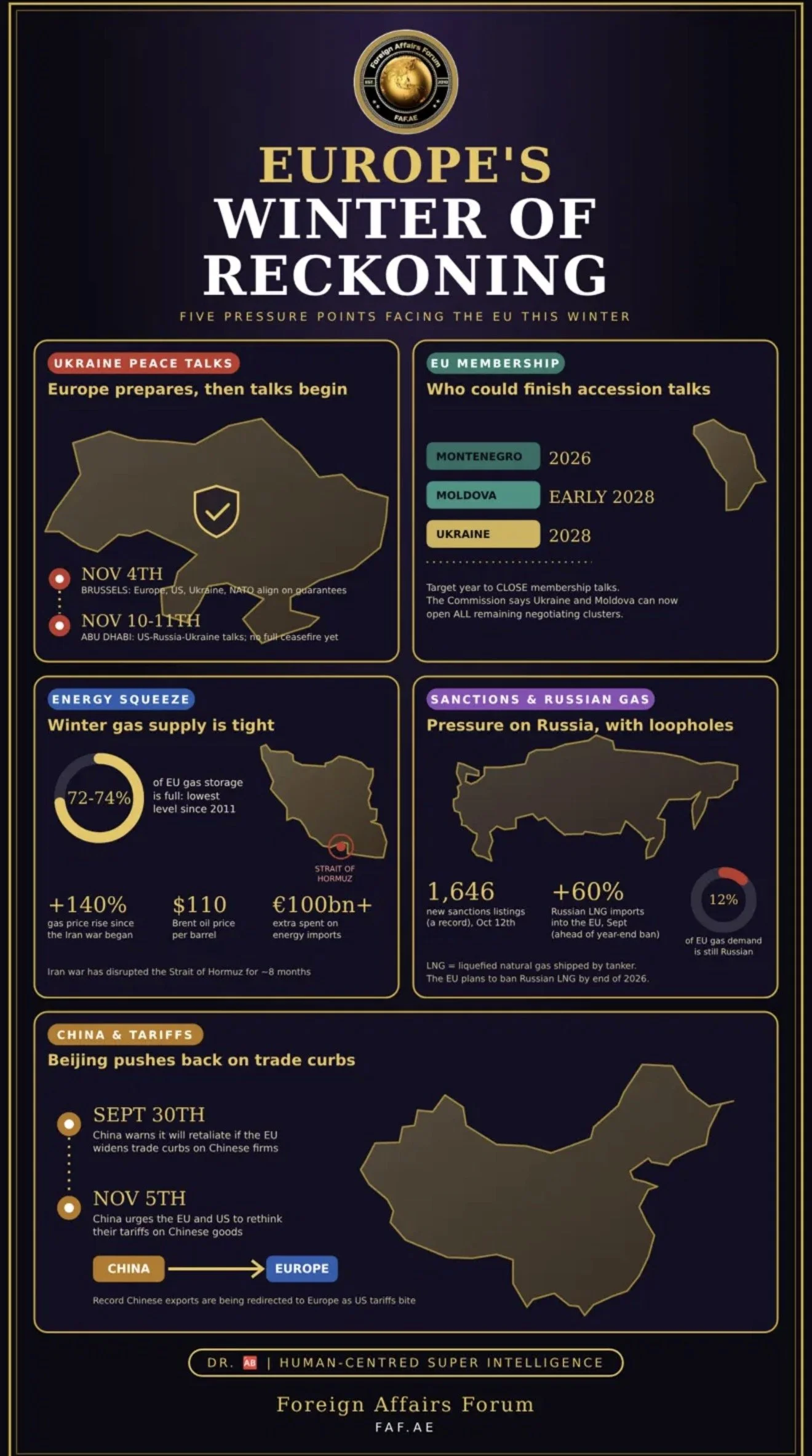
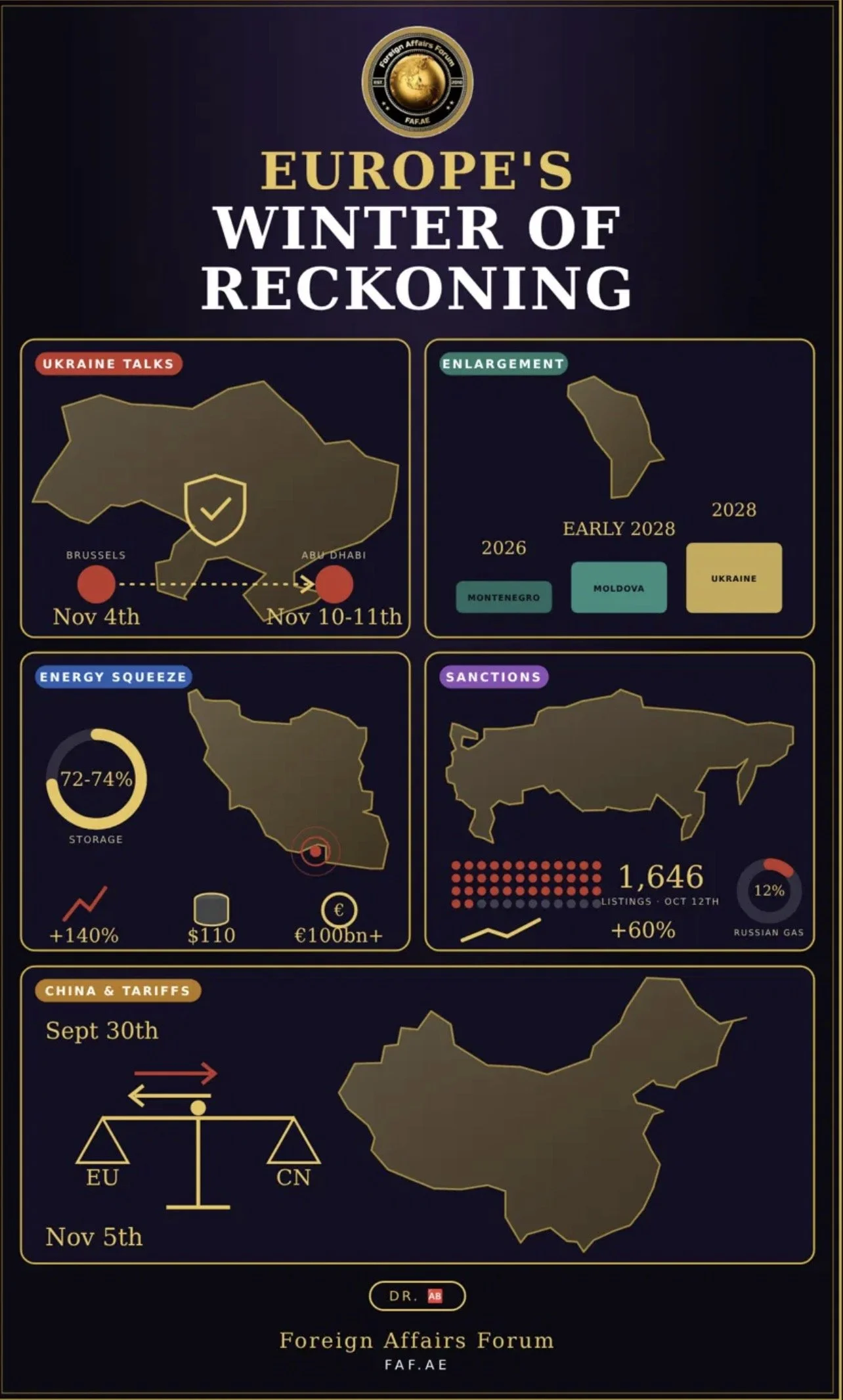
On Nov 4th, the European Commission brought together officials from Ukraine, the United States, France, Germany, the United Kingdom, NATO and the World Bank. They talked about how to protect Ukraine after the war and how to rebuild it. The same day, the Commission said that Ukraine and Moldova are ready to open all the remaining parts of their membership talks. Peace talks between the United States, Russia and Ukraine are planned for Nov 10th and 11th in Abu Dhabi.
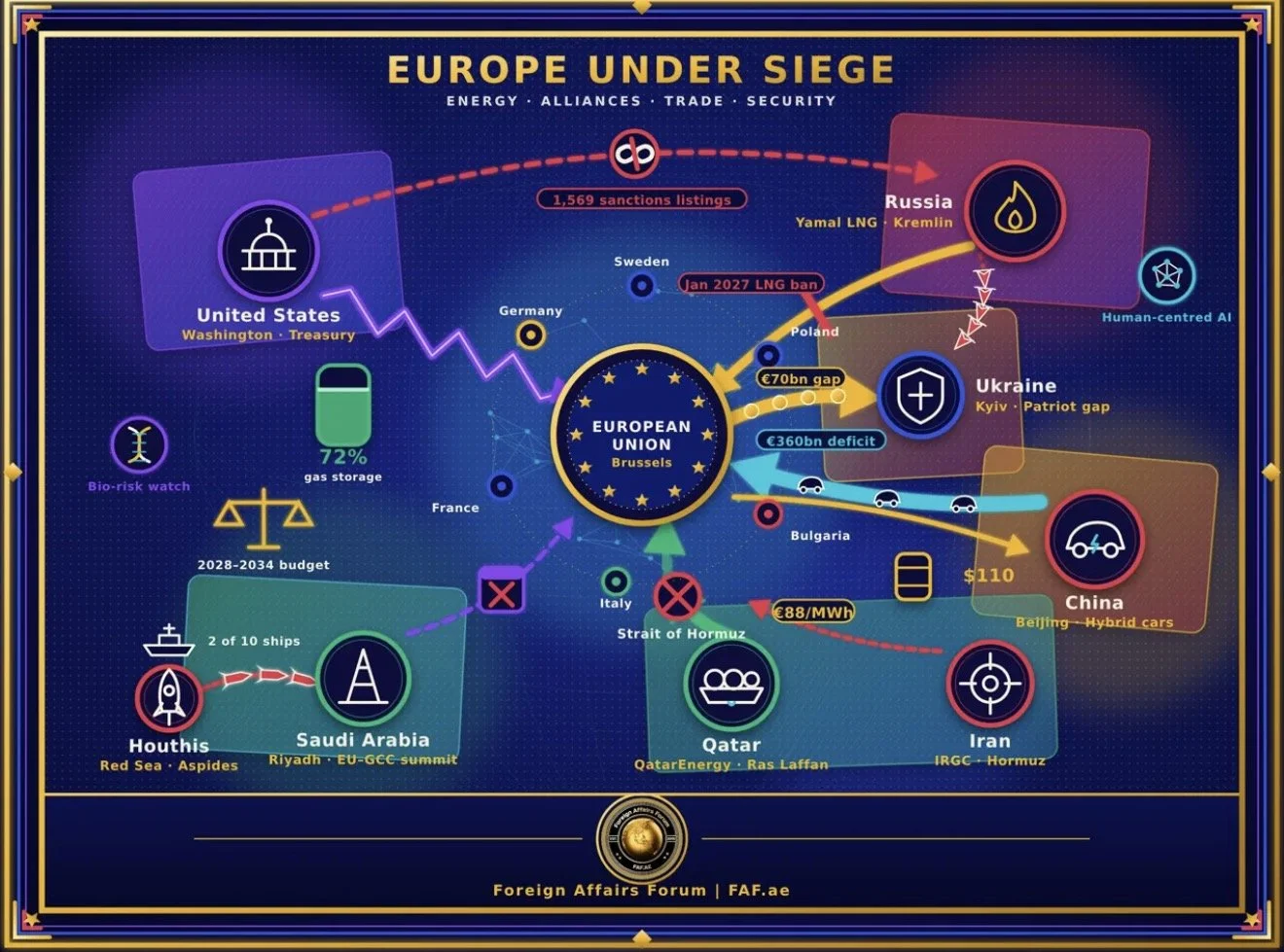
At home, Europe is worried about gas. Storage tanks were only about 72% to 74% full in late October, the lowest level for this time of year since 2011. Gas prices are up about 140% since the war on Iran began, and Europe has paid more than €100 billion extra for energy.
Dr. 🆎 warns that Europe must also protect itself from cyber attacks, false information and biological dangers, because a stressed continent is an easier target.
Introduction
In this FAF article we look at what has happened in the last few days and why it matters. We also use the views of Dr. Antonio Bhardwaj (Dr. 🆎), a polymath with global expertise in super intelligence. He studies how human-centred super intelligence can help with geopolitical strategy, and he also works on the dangers of AI warfare and bioterrorism. His main message is easy to understand: smart machines should help people make better decisions, but people must stay in charge.
History and Current Status
For many years, Europe believed that trading with Russia would keep the peace. It bought large amounts of Russian gas and oil because they were cheap and close. That belief ended on Feb 24th, 2022, when Russia invaded Ukraine. Since then, Europe has sent money and weapons to Ukraine, placed many sanctions on Russia and promised to stop buying Russian energy.
Then a second war changed everything. On Feb 28th, 2026, the United States and Israel attacked Iran. Ships have had trouble passing through the Strait of Hormuz, a narrow sea route that carries about one fifth of the world's oil and gas. The problem has lasted almost eight months. Europe has had to buy energy from other places at much higher prices. Russia, by selling its own energy at those higher prices, is estimated to have earned about €31 billion extra in six months.
Key Developments
The first big event was the meeting in Brussels on Nov 4th. European officials wanted to agree on a common position before the talks in Abu Dhabi. The main topics were security guarantees for Ukraine, which means promises that Ukraine will not be attacked again, and a prosperity plan to rebuild its economy. An earlier attempt to hold talks in October failed because Russia refused to attend. Russia still says it does not want a full ceasefire, and it still demands that Ukraine give up the Donbas region.
The second event was the enlargement package, also on Nov 4th. The Commission said that Ukraine and Moldova have done enough reforms to open every remaining part of their membership talks. It hopes to finish the talks with Moldova by early 2028 and with Ukraine by the end of 2028. Montenegro may finish its talks this year, and Albania hopes to finish in 2027. Serbia, Georgia and Bosnia and Herzegovina, however, are making little or no progress. The Commission also suggested a new idea called gradual integration. Countries could join parts of the Union, such as energy, transport and digital policy, before they become full members.
The third event is about sanctions. On Oct 12th, the Council added one thousand six hundred and forty-six people and companies to its sanctions list, the largest group ever. Most of them help Russia make weapons, especially missiles. This is meant to cut off the supply of parts and money that keep the war machine running.
The fourth event is about trade. On Nov 5th, China asked both the United States and Europe to rethink their tariffs, which are taxes on imported goods. It also said it would buy more American farm products if both sides lowered those taxes. Earlier, on Sept 30th, China warned that it would hit back if Europe adds more limits on Chinese businesses.
Latest Facts and Concerns
The most worrying fact is the gas storage level. At about 72% to 74%, Europe has less gas stored than at any time in this season since 2011. Experts warn that in a very cold winter, Europe could be short by 12% to 15%. The Commission says Europe is better prepared than in 2021 and 2022, but that does not mean safe.
Russian gas is still part of the picture. It makes up about 12% of Europe's gas use. Some countries, such as Hungary and Slovakia, still depend on Russian pipelines, and both have taken the Union to court over the phase-out. Slovakia has also asked Europe to ease sanctions, but the top foreign policy official, Kaja Kallas, said no. Imports of Russian liquefied natural gas fell sharply in August but then rose about 60% in September as buyers rushed to buy before the ban. Because of this, some experts think Europe might miss its own deadline.
Dr. 🆎 points out dangers that are easy to overlook. New weapons that use artificial intelligence are making wars faster. False videos and stories can be created cheaply and can be used to turn people against their governments. Cyber attacks can switch off power or gas systems at the worst time. He also warns that biological threats are a serious risk when hospitals, borders and emergency services are already under strain. He believes Europe should prepare for these dangers together with its winter plans, not separately.
Cause-and-Effect Analysis
It helps to follow the chain of causes. The war in the Gulf made energy more expensive. Higher prices gave Russia more money, which weakened the effect of Europe's sanctions. Higher prices also made some European countries want to delay the ban on Russian gas. So a war that Europe did not start has made it harder for Europe to deal with another war. The record sanctions on Oct 12th were partly a response. They hurt Russia's weapons industry without costing Europe much.
Europe's rules for making decisions are another cause of trouble. Many big decisions need all twenty-seven member countries to agree, and a single country can slow things down.
Dr. 🆎 calls this a problem of decision speed. If it takes too long to turn a warning into action, the delay itself becomes a weakness. He thinks well-designed super intelligence tools, always supervised by people, could prepare clear options in advance so that leaders can choose faster.
Future Steps
First, Europe must get through the winter safely. It should agree on clear, fair rules for using less energy if needed, so that families and key industries are protected. It should keep buying gas together, share storage information and stay ready to release oil reserves with its partners. It should also keep the ban on Russian liquefied natural gas on schedule, because backing away now would send the wrong message.
Second, Europe should speak with one voice before and during the Abu Dhabi talks. Its leaders should agree on their main limits, such as respect for Ukraine's borders and the order in which sanctions might be lifted. They should also explain exactly what a security guarantee means in terms of troops, money and legal promises, because vague promises can be tested and broken.
Third, as Dr. 🆎 recommends, Europe should build safety into everything it does. He suggests a permanent crisis team that looks at energy, cyber, biological and information risks together, with people clearly responsible for each decision.
Conclusion
Europe's problem is not one huge threat but several medium-sized ones that make each other worse. The meeting in Brussels, the enlargement plan, the gas shortage, the new sanctions and the dispute with China are parts of one story. The question is whether Europe can act together, quickly and with a clear purpose.
There are reasons for hope. Since 2022, Europe has shown that it can change course, support Ukraine for years and build strong sanctions. Its new idea of gradual integration is smart and practical. But hope is not a plan. The low gas storage, the rise in Russian gas imports and the differences between governments show how little room for error remains.
Dr. 🆎 ends with a simple lesson. The most important thing is the quality and speed of human judgment under pressure. Leaders who use good tools, keep people in charge, prepare for energy, cyber and biological dangers together and focus on a few clear priorities can turn a hard winter into a stronger Europe.
Leaders who treat each crisis as separate may find that their rivals have already linked them. The next few weeks, starting with Abu Dhabi on Nov 10th and 11th, will show which path Europe has chosen.