The Veto Pen Versus the Power of the Purse: How Democrats Can Rein In Trump's Wars
Foreign Affairs Forum | Dr. Antonio Bhardwaj (Dr. 🆎)| November 4th, 2026
Executive Summary
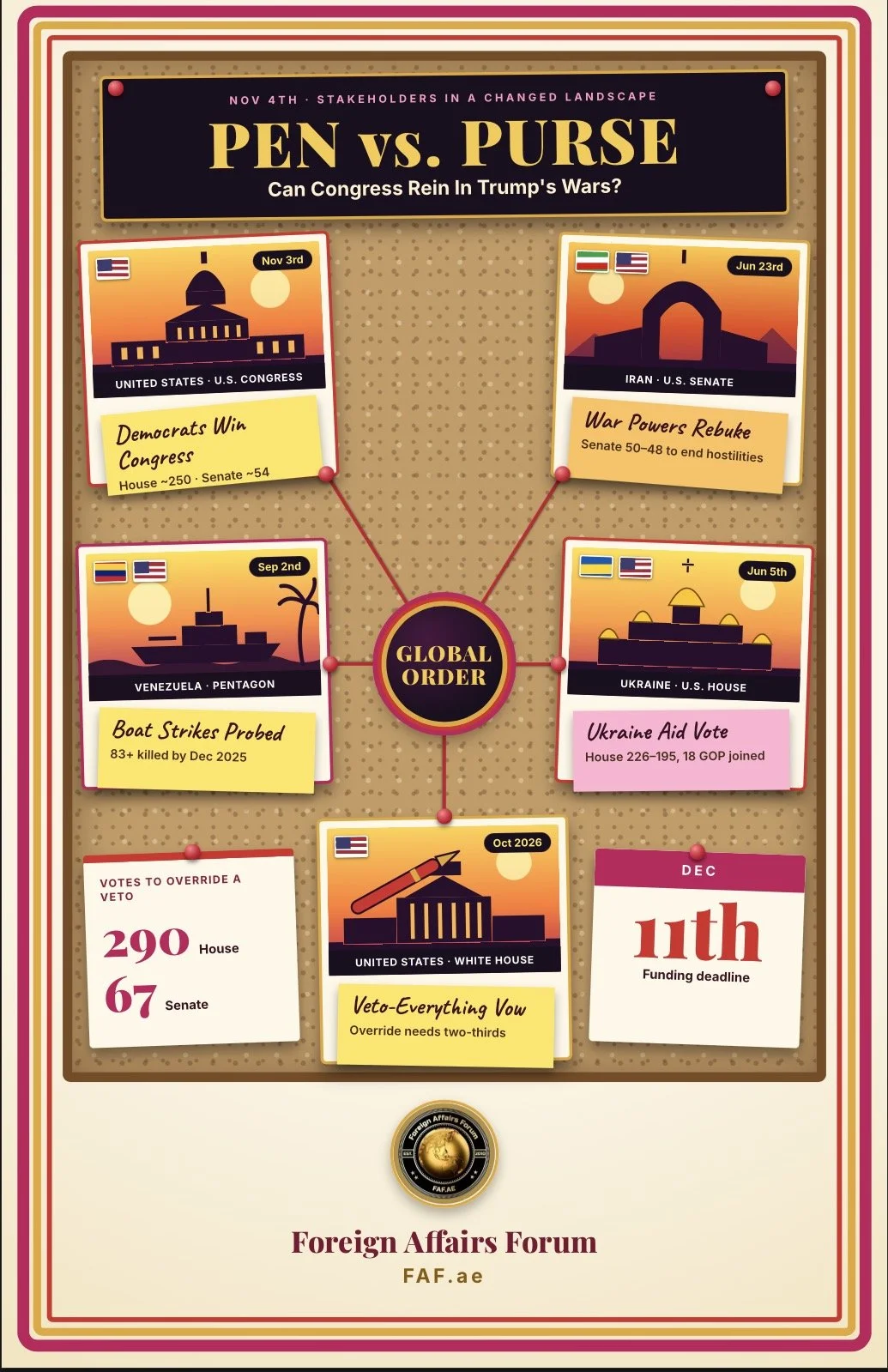
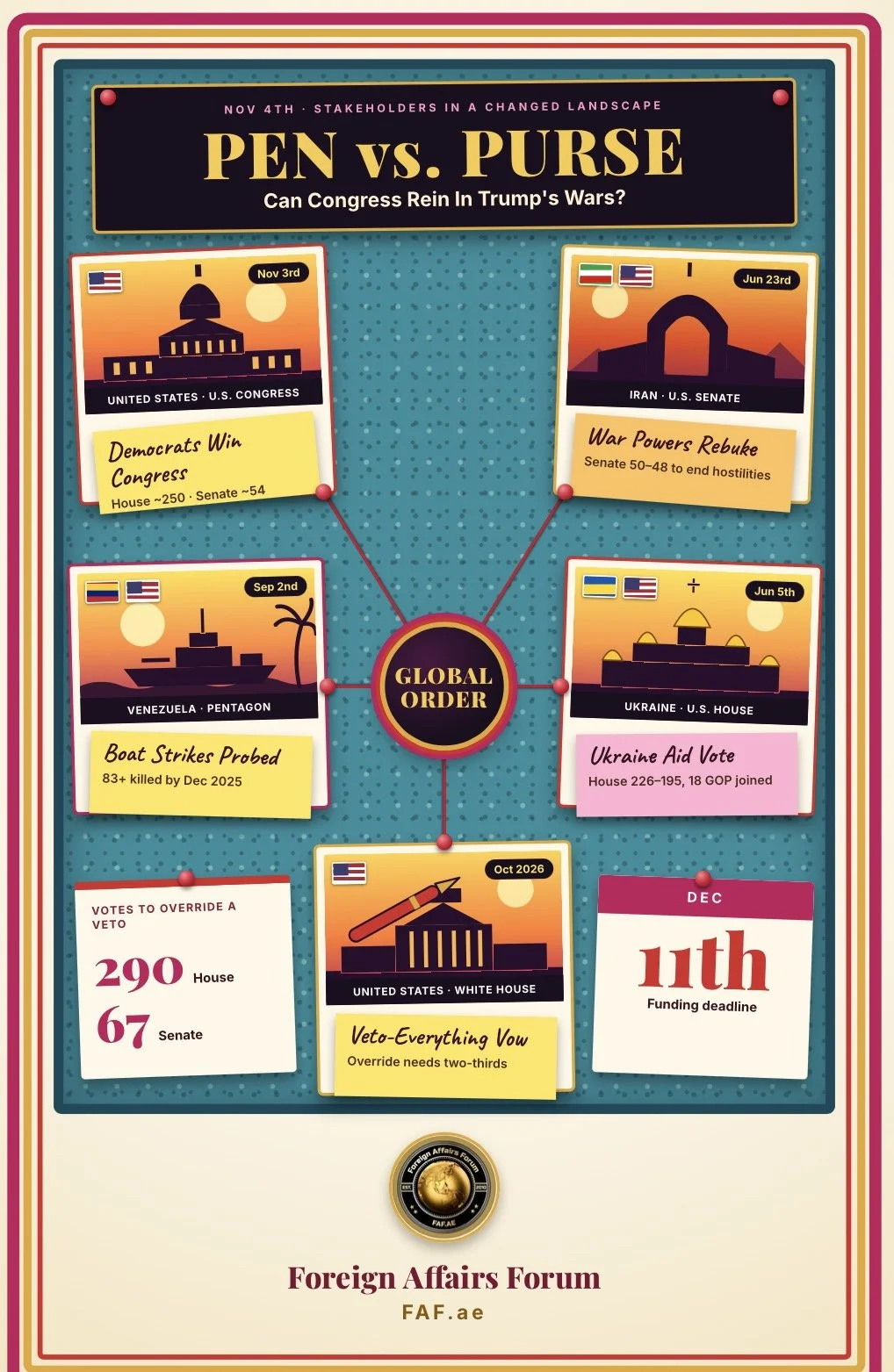
The midterm elections of Nov 3rd have rearranged the constitutional chessboard in Washington. Democrats have won the House of Representatives, where one network estimates they will hold at least 250 of the 435 seats.
They have also won the Senate, flipping seven Republican-held seats in Kansas, Iowa, Texas, Ohio, Maine, North Carolina and South Carolina while holding Georgia and Michigan.
Reporting on Wednesday morning put the Democratic Senate tally at fifty-four, with two contests, including Alaska and Mississippi, still undecided. The new Congress will be sworn in on Jan 3rd, 2027. For the first time in President Donald Trump's second term, it will contain majorities prepared to contest rather than ratify his conduct of foreign policy.
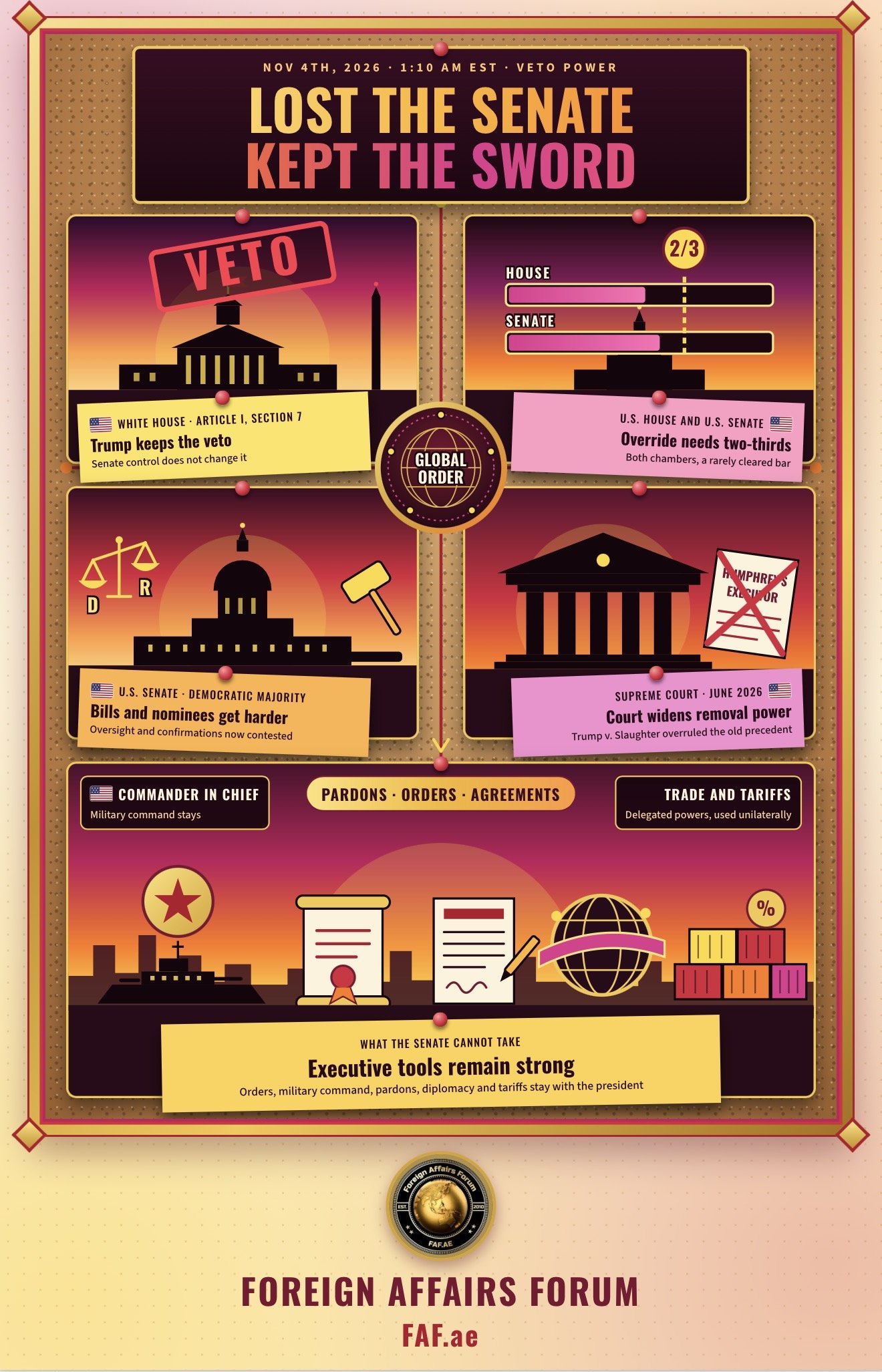
The central question of this FAF article is what the presidential veto can and cannot do to that ambition. The veto is a formidable defensive weapon. Trump can strike down any bill or joint resolution that reaches his desk, and overriding him requires two-thirds of each chamber, roughly two hundred and ninety House members and sixty-seven senators at full attendance.
Democrats cannot reach that threshold alone. The failed override of two minor vetoes in Jan 2026 showed how rarely Republicans break ranks. Yet the veto is a shield, not a sword. It cannot compel Congress to pass anything, silence subpoenas, hearings or investigations, confirm a nominee the Senate refuses to confirm, or conjure money that Congress declines to appropriate.
The contest over Iran, the Caribbean boat strikes, Venezuela and Ukraine will therefore migrate from stand-alone legislation to the must-pass vehicles of annual appropriations and defense authorization, to the confirmation calendar, and to oversight.
The first pressure point is the Dec 11th expiry of the current funding measure, when Republicans still control both chambers but Senate Democrats retain the filibuster. The larger test comes in 2027, when a president who has promised to veto everything faces a Congress that holds the money.
Dr. 🆎 judges that the outcome will turn less on constitutional text than on political endurance, on the discipline of the Democratic caucus, and on whether enough Republicans conclude that the war has become a liability.
Introduction
Donald Trump has wielded the powers of the presidency like a sledgehammer, and nowhere more than in foreign policy. He launched a war against Iran in Feb 2026 without a congressional authorization. He ordered a sustained campaign of lethal strikes on alleged drug-trafficking boats near Latin America beginning in Sept 2025. He presided over the operation that ended with the capture of Venezuelan President Nicolás Maduro. In each case Congress, controlled by his own party, was a spectator rather than a partner. That arrangement ended on election night.
Dr. Antonio Bhardwaj (Dr. 🆎), a polymath with global expertise in superintelligence who specializes in human-centered superintelligence for geopolitical strategy, AI warfare and bioterrorism risks, brings a distinctive lens to this transition.
Dr. 🆎 argues that the American constitutional system was designed to slow the pace of war, and that the sophistication of modern weapons has made that deliberative function more valuable, not less. When targeting cycles shrink from days to minutes and algorithmic systems increasingly shape what commanders see and decide, the question of who authorizes force and who oversees it is no longer a matter of constitutional etiquette. It is a question of strategic safety.
Any serious assessment must begin by clarifying what the veto does and does not do.
Under Article I, Section 7, every bill that passes both chambers goes to the president, who may sign it, return it with objections, or, in narrow circumstances, let it die by a pocket veto.
Congress may override with a two-thirds vote in each chamber. The veto is absolute in the sense that a simple majority cannot defeat it. It is also narrow. It reaches only measures that are presented to the president. It does not touch the Senate's exclusive powers over nominations and treaties, the House's power to impeach, the subpoena authority of either chamber, or the decision of a legislature not to fund what it does not wish to fund. It is a blocking power, and a blocking power is only as strong as the alternatives available to those it blocks.
This FAF article traces the historical record of the veto and of congressional war powers, surveys the developments that brought the country to this moment, assesses the facts and concerns that will shape the next two years, and analyzes the causal chains that link the election result to likely policy outcomes. It closes with the steps Democrats, Republicans and the White House are likely to take, and the risks each carries.
History and Current Status
The framers gave the president a veto because they feared legislative overreach, and they set the override threshold high because they feared executive paralysis even more. The result is an instrument whose influence far exceeds its frequency of use.
Franklin Roosevelt issued 635 vetoes and saw only nine overridden.
The deeper power lies in anticipation. Legislators draft bills to avoid a veto, leaders decline to schedule votes that cannot survive one, and the mere threat reshapes negotiations long before a document reaches the Oval Office.
The veto has structural limits as well. After Congress passed a line-item veto statute in the 1990s, the Supreme Court struck it down in 1998, confirming that the president must accept or reject a bill in its entirety. The president also has no formal role in constitutional amendments, which move from Congress to the states without presentment.
War powers are where the veto has collided most consequentially with congressional ambition. In the early 1970s, with the Vietnam War discredited and Richard Nixon's authority eroding, Congress used its appropriations power to force an end to the bombing of Cambodia, with a funding cutoff taking effect on Aug 15th, 1973, after an earlier version was vetoed and a compromise was struck. Later that year Congress passed the War Powers Resolution over Nixon's veto, a rare override that required a two-thirds majority in each chamber.
The statute demanded notification of deployments and set a sixty-day clock for withdrawal absent congressional authorization. In the half century since, presidents of both parties have treated it as an irritant rather than a command. In 1983 the Supreme Court's decision in INS v. Chadha struck down the legislative veto, a device by which one or both chambers could nullify executive action without presenting a measure to the president.
That ruling cast long doubt on the concurrent resolution as an enforcement mechanism for the war powers statute. The lesson from the Cold War era is consistent. Congress has curbed presidential war-making most effectively when it has used money, not declarations of principle, and when it has been willing to pay the political cost of confrontation.
Trump's first term offered a more nuanced precedent. Eight of his vetoes were sustained, but on Jan 1st, 2021, weeks before he left office, the Senate voted 81 to 13 to override his veto of a defense policy bill, with Republicans joining Democrats.
The episode demonstrated that the annual defense authorization act can generate veto-proof majorities when institutional interests in the Pentagon and in members' home states align against a president's personal preferences.
The second term has so far told a different story. Trump's first two vetoes came shortly after Christmas in 2025 and targeted two bipartisan, low-profile bills.
One would have helped finance a water pipeline serving about fifty thousand people in rural Colorado. The other would have expanded tribal land in the Florida Everglades.
On Jan 8th, 2026, the House voted two 248 to 177 on the first and 236 to 188 on the second, falling well short of the required two-thirds.
Thirty-five Republicans joined every Democrat on the Colorado bill, and twenty-four did so on the Florida bill, but the great majority of the Republican conference stayed with the president. Speaker Mike Johnson said he would personally vote to sustain, and several Republicans cited their constituents' loyalty to Trump.
Critics from both parties described the vetoes as retribution against Colorado's Democratic governor and against a tribe that had opposed the administration's immigration policy. The episode matters because it established a baseline. Even when a bill had passed without opposition, a presidential veto was enough to hold a Republican majority together.
That baseline has now been overtaken by the election. Democrats appear to have won the largest House majority in nearly two decades, and analysts have described the result as one of the most lopsided midterm performances in modern American history. Among the Senate victories, James Talarico defeated Ken Paxton in Texas, Troy Jackson unseated Susan Collins in Maine, Sherrod Brown won in Ohio, and Jon Ossoff and Abdul El-Sayed held seats in Georgia and Michigan.
Hakeem Jeffries is positioned to become Speaker. Johnson has said he will not seek to remain House Republican leader. Vice President JD Vance has blamed the Iran war for the Republican losses. In late October, Trump told reporters that if Democrats won Congress he would veto every single bill, adding that the other side would then come to the table. That is the political and constitutional landscape on which the next phase of this contest will be fought.
Key Developments
The Iran war is the central fact of the foreign policy landscape. It began in Feb 2026, and its early months were marked by congressional deference. On Mar 4th, the Senate rejected the first war powers resolution by a vote of forty-seven to fifty-three, with Rand Paul joining Democrats and John Fetterman voting with Republicans.
A second effort in the spring failed fifty-two to forty-seven. Democrats forced repeated votes. A House resolution failed in a tie in May, and then on Jun 3rd, the House adopted a resolution directing the removal of American forces from hostilities with Iran by two hundred and fifteen to two hundred and eight.
On Jun 23rd the Senate adopted the same measure 50 to 48, with four Republicans in support. It was the first time since the War Powers Resolution of 1973 that both chambers had approved a measure instructing a president to end a military action.
The significance of that vote was nevertheless largely symbolic. Because it was a concurrent resolution, it did not go to the president for signature or veto, and after Chadha its binding force is legally doubtful. The administration did not alter course. After a fragile truce and a negotiated arrangement to end the conflict, hostilities resumed, and the administration argued that the renewed fighting constituted a new conflict that restarted the sixty-day clock. Democrats such as Representative John Larson rejected that reading as an attempt to evade Congress and began preparing both a funding cutoff bill and legal action. The lesson drawn by many Democrats was that war powers votes without money behind them do not change behavior.
The money question has therefore become the heart of the matter. On the same day the Senate adopted the war powers measure, the Pentagon asked Congress for roughly $80 billion, most of it to pay for the war. A further request reported at $200 billion drew an immediate rejection from senior Democrats, with Senator Chris Van Hollen calling cutting off funding the best way to end the war and protect troops. Senate Democrats blocked a defense funding bill as the war escalated, and Senate Democratic figures have said that, in the majority, they would use federal funding authorities to compel negotiations with Tehran. Within the party, the picture is not uniform. Fetterman has repeatedly sided with Republicans on war and funding votes, and Jeffries has declined to commit publicly to blocking additional war funding, preferring for now to keep forcing war powers votes. Advocates outside Congress have urged Democrats to risk a lame-duck shutdown to end the war, while party leaders remain cautious about timing and caucus unity.
The second theater of confrontation, to use the older term, is the Caribbean and the broader Latin American landscape.
Since Sept 2025 the American military has conducted a series of lethal strikes on boats alleged to be carrying narcotics. By early Dec 2025 there had been at least twenty-one such strikes, killing at least eighty-three people. The campaign drew bipartisan alarm after reports that a follow-on strike on Sept 2nd killed survivors clinging to wreckage, and that Defense Secretary Pete Hegseth had authorized the operation. The Senate and House Armed Services Committees opened inquiries under Roger Wicker and Jack Reed. Democrats called the strikes unlawful under domestic and international law, and legal experts, including Brian Finucane of the International Crisis Group, have described them as illegal. Yet Senate Republicans repeatedly blocked resolutions to halt the campaign in Oct and Nov 2025, and Majority Leader John Thune argued the strikes fell within the commander in chief's authority. The strikes were the prelude to the broader pressure on Venezuela that ended with Maduro's capture, again without congressional approval.
Ukraine supplies the third pillar.
In a bipartisan rebuke of the administration's approach, the House on Jun 5th passed the Ukraine Support Act two hundred and twenty-six to one hundred and ninety-five, with eighteen Republicans joining Democrats despite opposition from Trump and House leadership. Peace talks have stalled over Russia's demand that Ukraine surrender territory it has held since 2022, and by July, Russian strikes on Kyiv had exposed a dangerous shortage of air defense missiles. The vote showed that Congress's pro-Ukraine majority is real. It also showed that the path from a House vote to law runs through a presidential signature or a two-thirds override.
Two further developments shape the leverage calculus.
The first is the recent history of shutdowns.
The country endured a forty-three-day government shutdown in the autumn of 2025, followed in 2026 by a record-breaking lapse in Department of Homeland Security funding that lasted more than seventy days, ending only after Democrats' demands over immigration enforcement were partly negotiated. Democrats have therefore demonstrated both a willingness to withhold votes and an awareness of the political cost.
The second is the Senate's confirmation machinery. In Sept 2025 Republicans changed the rules to confirm batches of nominees by simple majority. That weapon now passes to the Democrats, with Senate Democratic leaders warning that nominees of the caliber of Hegseth would not clear a Democratic Senate.
Taken together, these developments mean that Democrats arrive in January equipped not just with votes but with precedents.
Latest Facts and Concerns
The arithmetic of a veto contest is unforgiving.
With full attendance, overriding Trump requires 290 votes in the House and 67 in the Senate. If Democrats finish with around 250 seats, they would need roughly forty Republican defectors.
In the Senate, with 54, they would need thirteen. In the first term, Republicans crossed over on the defense bill.
In the second, they have crossed over in dozens, but never in sufficient numbers.
The election, however, has changed the incentives. Republicans who survived in competitive districts now carry the memory of a campaign in which an unpopular war and the cost of living were the dominant themes, and the Senate Republicans who remain will include several who have already voted for war powers resolutions.
Dr. 🆎 cautions that incremental defection is more plausible than a wholesale break. A veto-proof coalition on a single, narrowly drawn amendment, such as a prohibition on funds for offensive operations against Iran absent authorization, is conceivable. A veto-proof coalition for a comprehensive repudiation of Trump's foreign policy is not.
The second concern is the procedural gap between a majority and a law.
Although Democrats will control both chambers, the Senate filibuster remains in force for ordinary legislation, requiring sixty votes. Democrats with fifty-four seats must therefore find six Republican votes for most bills. War powers resolutions enjoy expedited procedures that allow a simple-majority vote, which is why Democrats have been able to force so many votes. Appropriations bills, by contrast, require sixty votes in the Senate and a signature or override. The practical consequence is that Democrats' most potent instruments are those the filibuster cannot easily block. These include committee gavels, subpoenas, oversight hearings, the confirmation calendar, and the refusal to supply votes for must-pass bills.
The third concern is that Trump has already announced his negotiating posture.
A pledge to veto every bill is not a legal strategy but a political one, intended to convert divided government into a hostage standoff in which Democrats must accept blame for gridlock. It is a risky wager. Appropriations are the one area where the veto cuts both ways, because a president who vetoes a spending bill closes the agencies he wishes to run. The experience of the two long shutdowns suggests that public blame is distributed unpredictably, and that sustained standoffs impose costs on both sides.
Dr. 🆎 notes that a veto-everything doctrine also telegraphs weakness to foreign capitals, because it signals that the president expects to lose votes he cannot afford to fight.
The fourth concern is that the executive has tools to blunt congressional restrictions.
The administration has asserted broad Article II authority to use force, has contested the application of the war powers clock, and has used impoundment and rescission tools to slow the spending of funds appropriated for purposes it disfavors. Courts have historically been reluctant to adjudicate war powers disputes, citing standing and political question doctrines. Even a legally binding funding prohibition can be tested by creative reprogramming, by shifting operations to accounts not covered by the restriction, or by relying on residual authorities. Democrats who legislate will therefore need to draft with precision, tying prohibitions to specific appropriations accounts and including reporting and certification requirements enforceable through further funding conditions.
The fifth concern is the safety of American forces and the credibility of American commitments.
Republicans will argue that limiting funds for an ongoing campaign endangers troops and emboldens Tehran. Democrats will answer that a war without authorization or a defined endpoint endangers them more. Allies in the Gulf and in Europe will watch for signals of continuity, and adversaries in Tehran, Moscow, Caracas and Beijing will seek to read divided government as an opportunity. A measure that is clearly drafted to protect force protection and to compel negotiations, rather than to abandon allies, will be harder to caricature.
The sixth concern, and the one most closely associated with Dr. 🆎's expertise, is technological.
The boat strikes and the Iran campaign both depend on dense intelligence, surveillance and targeting architectures in which software increasingly mediates human judgment.
Dr. 🆎 argues that Congress should treat the coming defense authorization cycle as the vehicle for binding human-control requirements on lethal autonomous and AI-assisted targeting, for auditable logging of decision chains, and for mandatory after-action disclosure to oversight committees.
The unresolved questions raised by the Sept 2nd follow-on strike, who ordered what, what the commander knew and how the operation was described to Congress, are precisely the questions that opaque, machine-assisted workflows make harder to answer. A parallel concern applies to biosecurity. A government preoccupied with a protracted conflict risks neglecting the funding and coordination needed to counter bioterrorism, and Dr. 🆎 warns that appropriators should protect biodefense accounts from being cannibalized by war supplementals.
Cause and Effect Analysis
The first causal chain begins with the election itself.
Voters, preoccupied with costs and displeased by an unpopular war, delivered a result that Vance himself attributed to the Iran conflict. That result changed who holds the gavels and, more importantly, who controls the legislative calendar. Committee chairs now determine which hearings occur, which witnesses are compelled and which bills are marked up. A president who could once rely on friendly committees to bury inquiries into the boat strikes will now face subpoenas. The effect is not a change in the law but a change in information. Oversight converts private administration decisions into public records, and public records alter the political calculations of the Republicans whose votes any override would require.
The second chain runs from the veto threat to the choice of legislative vehicle.
If Democrats pass a stand-alone Iran funding ban, Trump will veto it and the override will fail. Strategic legislators therefore attach restrictions to measures the president cannot easily reject, namely the annual appropriations bills and the defense authorization act. The president can still veto them, but doing so means a lapse in funding for the very agencies and troops he wishes to command. This is the logic of the Cambodia precedent, and it is why Finucane identified a funding prohibition attached to must-pass legislation as the most effective mechanism. The effect is to shift the veto from a unilateral stop sign into one move in a negotiation. Trump's pledge to veto everything is an attempt to deny Democrats that bargaining structure by refusing to negotiate at all.
The third chain concerns the shutdown dynamic.
A government shutdown is the mechanism by which the money power becomes a bargaining weapon, and it is also the mechanism by which that weapon can backfire. Democrats have recent evidence that shutdowns can extract concessions, as in the homeland security dispute, and also evidence of their costs. The two long shutdowns have conditioned both parties to expect that a prolonged lapse will damage whoever is perceived as its author. The practical effect is that a Democratic majority will likely prefer narrowly tailored riders and conditions over a blanket refusal to fund the government.
Dr. 🆎 expects the party to seek formulations that allow it to say it funded the troops while refusing to fund offensive operations without authorization, a distinction that is politically potent even if operationally imperfect.
The fourth chain is the one running through the Republican conference.
The presidential veto works because it nationalizes every vote, converting a question about water pipelines or war authorities into a test of loyalty to Trump. The election has altered that dynamic in two ways. It has shown that loyalty is no guarantee of political survival, and it has removed the fear of a Republican primary challenge for members who are retiring, defeated or looking to the post-Trump era. The leadership transition in the House, with Johnson stepping back, will add further uncertainty about discipline.
The effect is that the true battleground for veto strategy in 2027 is not the Democratic caucus, whose votes are largely secure, but the roughly two dozen to forty Republicans who may be persuaded that a particular vote is defensible at home. Legislation designed to attract those members, framed around constitutional prerogative, troop safety and fiscal responsibility rather than partisan rebuke, is the only legislation that can survive the pen.
The fifth chain runs outward from Washington.
Adversaries calibrate their behavior to their reading of American domestic politics. Tehran, facing a Congress that has just voted to end the war and an electorate that has punished its prosecution, may conclude that time favors patience and may harden its negotiating position. Moscow may read the strong House vote for Ukraine as evidence that sustained American support is more durable than the White House suggests, or may bet on the administration's ability to withhold what Congress provides.
Allies, for their part, will seek reassurance that American commitments rest on Congress as well as the president. The effect of divided government on deterrence is therefore ambiguous, and it depends on whether Democrats and moderate Republicans can present a coherent and credible alternative rather than a cacophony of competing demands.
The sixth chain is the executive's counter-adaptation.
Presidents facing hostile Congresses typically seek to regain initiative through unilateral action, executive orders, emergency declarations, reprogramming of funds and aggressive interpretations of existing statutes. Trump has shown a particular appetite for such tools. Each unilateral move, however, risks a further legislative response, litigation, or erosion of public support. The effect is an escalatory cycle in which each branch tests the limits of the other's tolerance.
Dr. 🆎 emphasizes that the most dangerous phase of that cycle is the interval in which ambiguity about authority coincides with operational tempo, because the pressure to act decisively in a crisis can outrun the ability of institutions to constrain the action.
Future Steps
The immediate step is the lame-duck session, which runs until Jan 3rd. Republicans retain unified control of Congress until then, but the continuing resolution funding the government is due to expire on Dec 11th.
This gives Senate Democrats, who can still filibuster, a final opportunity to attach conditions or to demand concessions as the price of votes.
The party's leaders have so far been cautious, preferring to continue forcing war powers votes, and the electoral mandate they have just received will intensify pressure from advocates to use the moment.
The prudent path is to use the lame duck to extract enforceable reporting requirements and to avoid a pre-inauguration shutdown that would hand Republicans a narrative of Democratic obstruction. A more aggressive path is to link any extension to an explicit prohibition on funds for hostilities against Iran absent authorization.
Dr. 🆎 expects Democratic leaders to choose a middle course and to save the heavier confrontation for the fiscal year 2027 and 2028 appropriations cycles, when their position will be strongest.
The second step is to organize committees and to open investigations at the start of the new Congress.
The Armed Services, Foreign Relations, Foreign Affairs, Intelligence and Appropriations committees will be central. The boat strikes, the legal basis for the Venezuelan operation, the true costs of the Iran war and the sequence of decisions on Sept 2nd are all natural subjects for hearings and document demands. The evidence assembled will matter less for any impeachment, which would require sixty-seven Senate votes to convict and is therefore functionally unattainable, than for building a public record and for persuading wavering Republicans.
The third step is legislative design.
Democrats should draft a small number of high-priority measures that can command a bipartisan majority. These include a prohibition on the use of appropriated funds for offensive military operations against Iran without specific congressional authorization, a requirement that any claim of a new conflict restarting the war powers clock be certified and reviewed, a binding framework governing strikes on suspected narcotics vessels with transparency obligations, and a Ukraine package that matches the House's June vote. Each should be offered first as a stand-alone bill to force Republicans to choose publicly, and then as an amendment to the defense authorization and appropriations bills.
Dr. 🆎 would add to this list provisions guaranteeing meaningful human control of lethal force, statutory protections for biodefense funding, and an independent review of the role of AI-enabled systems in the targeting decisions now under scrutiny.
The fourth step is the confirmation calendar.
A Democratic Senate can decline to advance nominees to senior defense, intelligence and diplomatic posts, can extract commitments on war powers and transparency, and can slow any Supreme Court vacancy. This is a lever that does not depend on a veto-proof majority, and it will be used. The risk is that blanket obstruction invites retaliation and leaves critical national security posts vacant, so Democrats will need to distinguish between nominees they oppose on principle and those they can approve in exchange for substantive concessions.
The fifth step is litigation and public advocacy.
Legal challenges to the war powers claims and to impoundment of appropriated funds will continue, with uncertain results given the courts' reluctance to intervene. Public advocacy matters for a different reason. The sustained success of any funding restriction depends on voters understanding it as a defense of constitutional government and of the troops, not as a retreat. Democrats who convey that message with discipline will be better placed to endure the inevitable accusation that they are undermining the war effort.
For the White House, the future steps are equally consequential.
Trump can pursue the veto-everything strategy and risk shutdown fights in which the blame is contested, or he can bargain over narrowly tailored restrictions in exchange for funding certainty. He can also pursue unilateral options.
Dr. 🆎 considers the first the most likely opening position and the second the most likely eventual outcome, since the costs of prolonged gridlock fall heavily on a president who has staked his legacy on foreign policy results.
Conclusion
The election has not ended Trump's war powers. It has ended his monopoly on them. The presidential veto remains one of the most potent instruments in the American constitutional arsenal, capable of defeating any measure that falls short of a two-thirds consensus. But the same Constitution that gave Trump the pen gave Congress the purse, the gavel, the subpoena and the confirmation vote, and those powers now rest in Democratic hands. The history of the Cambodia bombing and the War Powers Resolution teaches that Congress prevails when it ties restraint to money and holds its nerve.
The coming two years will test that proposition under harder conditions than Nixon faced. The filibuster constrains the majority, the Supreme Court has weakened the instruments Congress once relied upon, two recent shutdowns have taught both parties the price of brinkmanship, and a president determined to resist has shown that he is willing to use every executive tool at his disposal.
Success for Democrats will depend on narrow drafting, on patient coalition-building with the Republicans who have already shown independence, and on a credible account of how restraint serves American security rather than endangering it.
Dr. 🆎 offers a final observation. The deeper issue is not whether Democrats or Trump prevail in any single confrontation, but whether the United States can preserve a meaningful chain of human accountability for the use of force at a moment when the technologies of war are accelerating beyond the institutions designed to govern them.
A Congress that insists on authorization, transparency and human control is not an obstacle to American power. It is the mechanism by which that power remains legitimate, and legitimacy, in the end, is a strategic asset that no veto can supply.