Hackers Warm the Fridges: What Europe's Supermarket Cyberattacks Teach Us
Introduction
What Happened
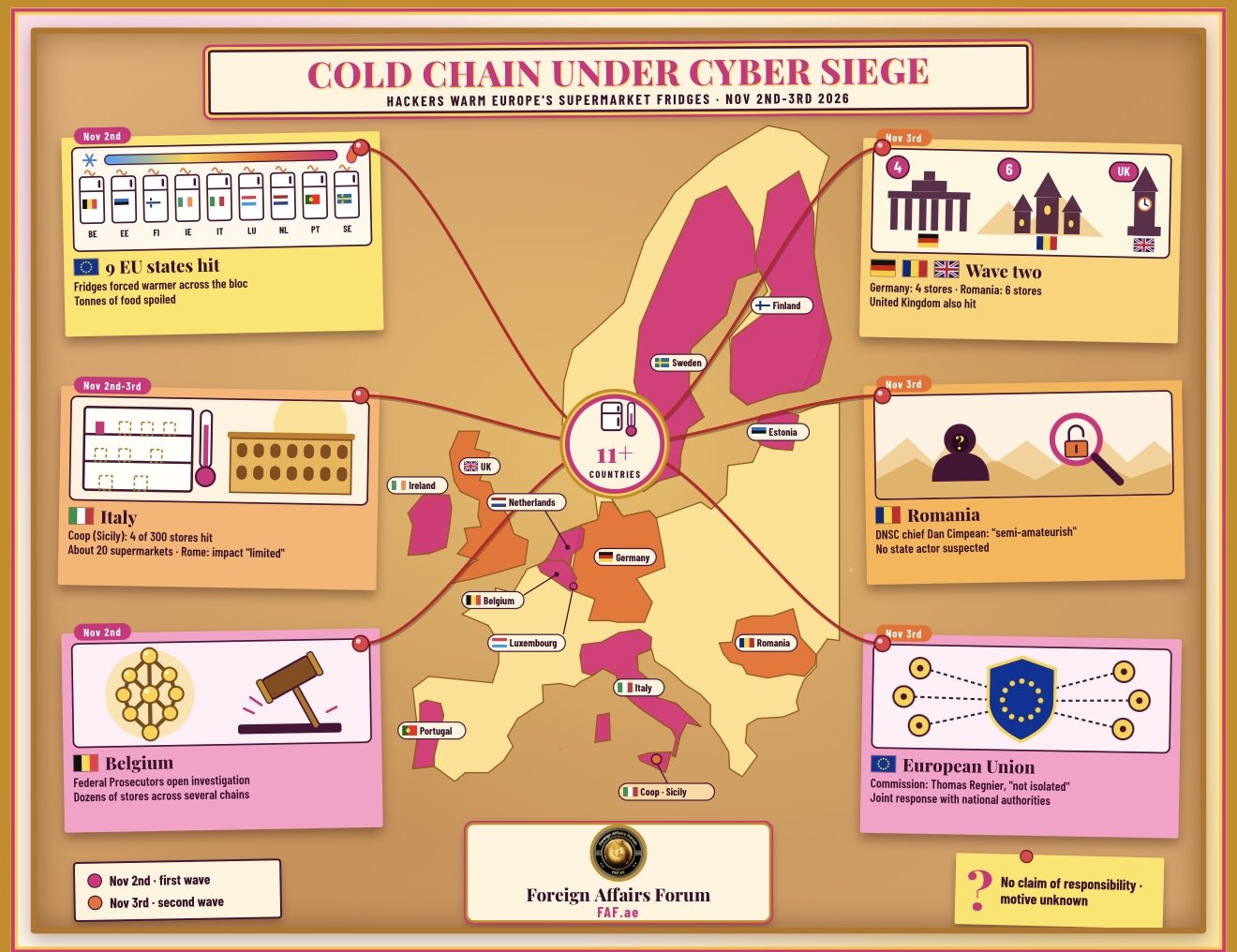
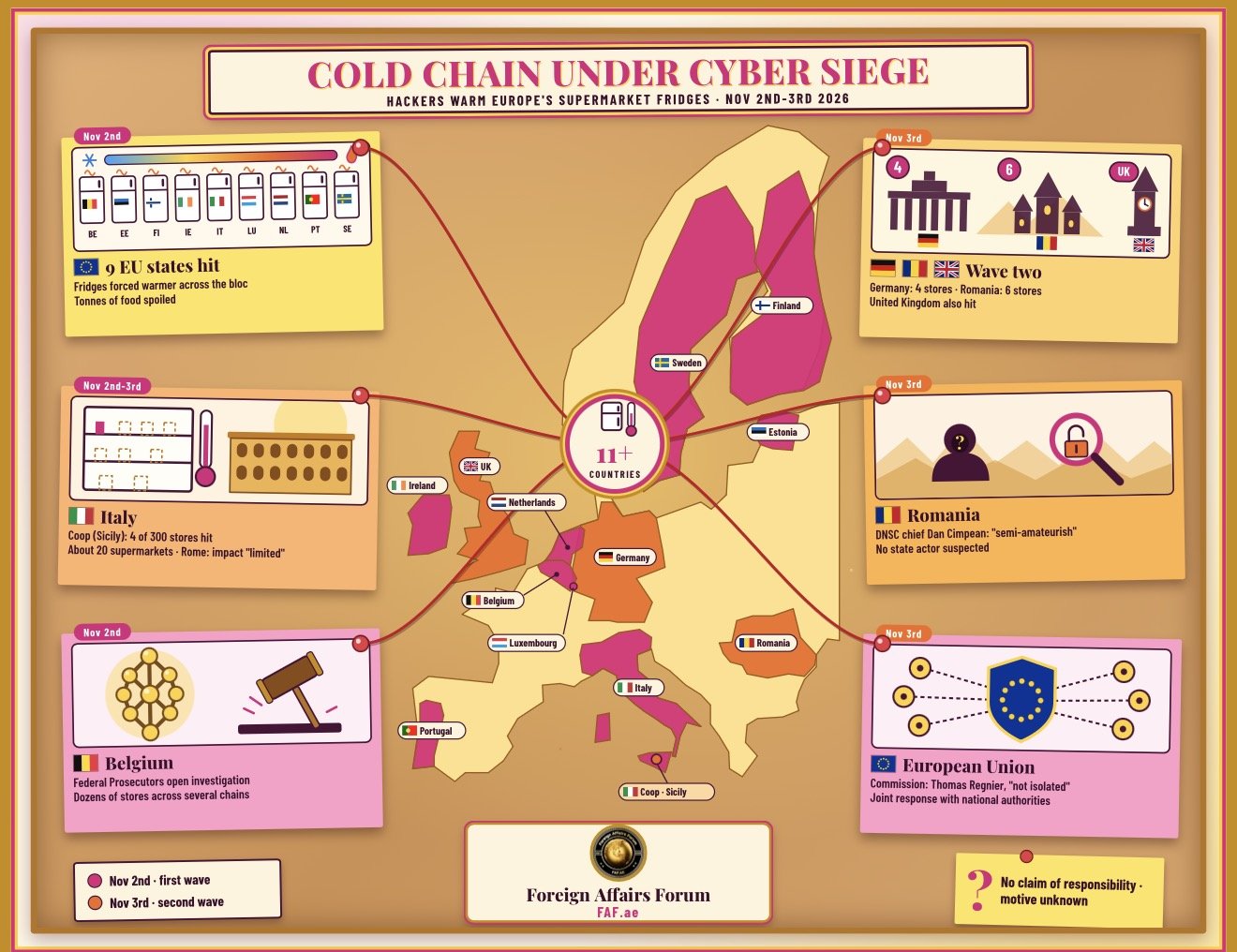
On Monday, Nov 2nd, supermarkets across Europe found that their fridges and freezers were getting warmer instead of colder.
Officials now say hackers broke into the computer systems that control the cooling equipment and raised the temperatures.
Food that needs to stay cold began to spoil, and tonnes of it had to be thrown away.
At first, nine countries in the European Union reported problems: Belgium, Estonia, Finland, Ireland, Italy, Luxembourg, the Netherlands, Portugal and Sweden.
On Tuesday, Nov 3rd, Germany and Romania said they had been hit too. Four supermarkets in Germany and six in Romania were affected.
The United Kingdom, which is not in the European Union, also reported attacks. In total, at least eleven countries have now been touched by the hacking spree.
Nobody has said they did it. Nobody has said why.
That makes this event hard to understand, and it makes many people nervous.
How Bad Was It?
Belgium suffered a great deal.
Dozens of stores from several different supermarket chains reported that their fridges had failed. Belgian prosecutors, who are lawyers working for the government, have started a criminal investigation.
In Italy, about twenty supermarkets were affected. One manager of a group that runs Coop supermarkets in Sicily said that four of his three hundred stores were hit. He told a newspaper that they had to throw everything away and that the shelves were empty. The damage cost thousands of euros.
The Italian government held meetings with its spies and its cyber experts. The Prime Minister's office said the effect was limited and that people should not be alarmed, though everyone involved is staying on high alert.
Who Did It?
This is the big question, and so far there is no clear answer.
A top cybersecurity official in Romania named Dan Cimpean said the attack looked semi-amateurish. He said he does not think a government was behind it under any circumstances. In other words, he believes the hackers may not be very professional.
The European Union did not name anyone. Its spokesperson, Thomas Regnier, said these are not isolated incidents and that Europe must be prepared and strong together. He said the union's agencies are talking to national authorities to plan a joint response.
Dr. Antonio Bhardwaj (Dr. 🆎), an expert in human-centered artificial intelligence and global security, says we should be careful here.
Dr. 🆎 explains that an attack can look simple and still serve a clever purpose. A country that wants to test how Europe reacts might make its work look clumsy on purpose. So, Dr. 🆎 says, it is wise to wait for proof before pointing a finger.
Why Does This Matter?
Supermarkets work like a long chain.
Food travels from farms to factories to trucks to shops, and it has to stay cold along the way.
Experts call this the cold chain. If the chain breaks, food can go bad or even become unsafe to eat.
The hackers did not steal money or private data this time. They attacked the equipment itself.
That is a new and worrying step, because it shows that computer attacks can cause damage in the real world. A hacker thousands of kilometers away can ruin food in a shop just by changing a number on a screen.
Another reason for worry is that so many countries were hit at almost the same time.
That suggests the hackers may have found one weak point that many stores share.
For example, many supermarkets hire outside companies to manage their cooling systems from far away. If one of those companies has weak passwords or poor security, many stores can be harmed at once.
What Are the Main Worries?
The first worry is food safety. If food gets warm and then cold again, it may look fine but still be dangerous. Stores must be careful to throw away anything that might be unsafe.
Dr. 🆎, who studies threats to public health, says the difference between wasted food and unsafe food is very small. If attackers also switched off the warning alarms, people could get sick without anyone knowing why.
The second worry is trust. When people see empty shelves, they begin to doubt that companies and governments can protect them. Officials who say there is nothing to worry about need to back it up with honest information.
The third worry is copycats. If the attack worked once and nobody was caught, others might try the same thing. The longer weak systems stay unprotected, the greater the chance of a second wave.
The fourth worry is money. Stores lose food and sales. Insurance companies must decide whether they will pay for this kind of loss. Many people are asking whether the damage counts as a cyber event, a physical event or something in between.
How Did We Get Here?
Cyberattacks on real-world systems are not new.
In 2010, a computer worm called Stuxnet damaged machines in Iran.
In 2015, hackers cut power to many homes in Ukraine. In 2017, a virus named NotPetya spread around the world and cost companies billions of dollars. In 2021, a ransomware attack on a pipeline in the United States caused fuel shortages, and a software attack the same year forced hundreds of Coop supermarkets in Sweden to close because their tills stopped working.
In 2025, attacks on British shops and on an airport software supplier showed how a single weak link can disturb many businesses.
Europe has written new laws to protect important services, including food.
These laws ask companies to manage risks, report problems and check the security of their suppliers. But many companies, especially medium-sized ones, are still catching up.
Fridges used to be simple machines with a dial.
Now they connect to the internet, and many shops have not yet learned to protect them like they protect their cash registers.
What Should Be Done?
Experts and officials suggest several steps.
The first is to find out exactly how the hackers got in and to share that information quickly with every store and supplier in Europe.
The second is to change passwords, limit who can connect remotely and use separate temperature sensors that hackers cannot control from the internet.
The third is to find out which companies supply the cooling systems to many stores and to make sure they follow strong security rules.
The fourth is to make sure the new European laws are really enforced, with checks on big retail chains.
The fifth is to create fast and trusted ways for shops and governments to warn each other across borders.
The sixth is to work out how insurance should deal with attacks like this one.
The seventh is to train shop staff, because the people who look after the fridges are often the first to notice that something is wrong.
The eighth is to tell the public clearly what is happening, including how to spot unsafe food and recall notices.
Finally, Europe should practice for worse situations. If an attack on food were combined with problems in transport or electricity, the effects would be much bigger.
Running practice exercises with governments, shops, truck companies and health services would show where the gaps are before a real enemy finds them.
The Role of Artificial Intelligence
Today's attack seems to use fairly simple methods. But Dr. 🆎 warns that artificial intelligence will soon make such attacks faster and easier. Smart programs may be able to search the internet for weak machines, guess passwords and attack many places at once. The good news is that artificial intelligence can also help defenders. It can notice strange changes, such as a fridge suddenly set to a warmer temperature, and raise the alarm.
Dr. 🆎 stresses that people must stay at the center. A computer can spot a problem, but a trained person must decide what to do. The best defense, Dr. 🆎 says, is a system where machines help and humans stay in charge.
What Does It All Mean?
This attack may turn out to be the work of amateurs, as the Romanian official suspects.
Even so, it shows that Europe's everyday life depends on systems that can be reached from the internet. It also shows that causing serious trouble no longer needs great skill.
The European Union was right not to blame anyone too quickly.
Wrong accusations can cause new problems. But waiting for answers is not the same as doing nothing. Many of the best protections, like stronger passwords and better supplier checks, can be put in place right away.
A cold chain is really a chain of trust.
Farmers trust shops, shops trust their suppliers, and shoppers trust that the food they buy is safe. When hackers warm a few fridges, they test that trust.
Europe has received a cheap warning, and the real test is whether it acts before the next attack arrives.