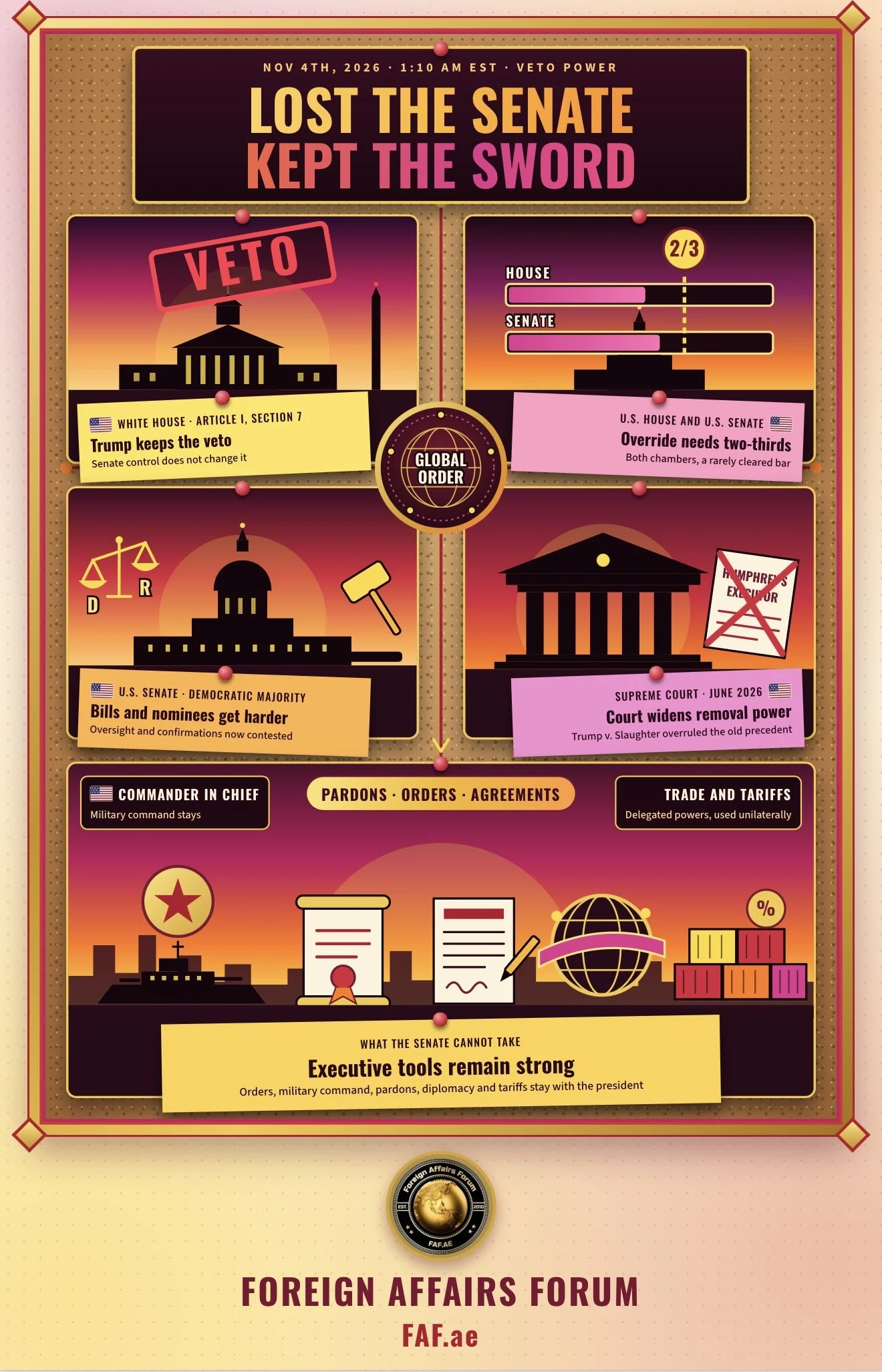
Can Trump Still Say No? Why the Veto Survives a Lost Senate
Summary
The Big Question
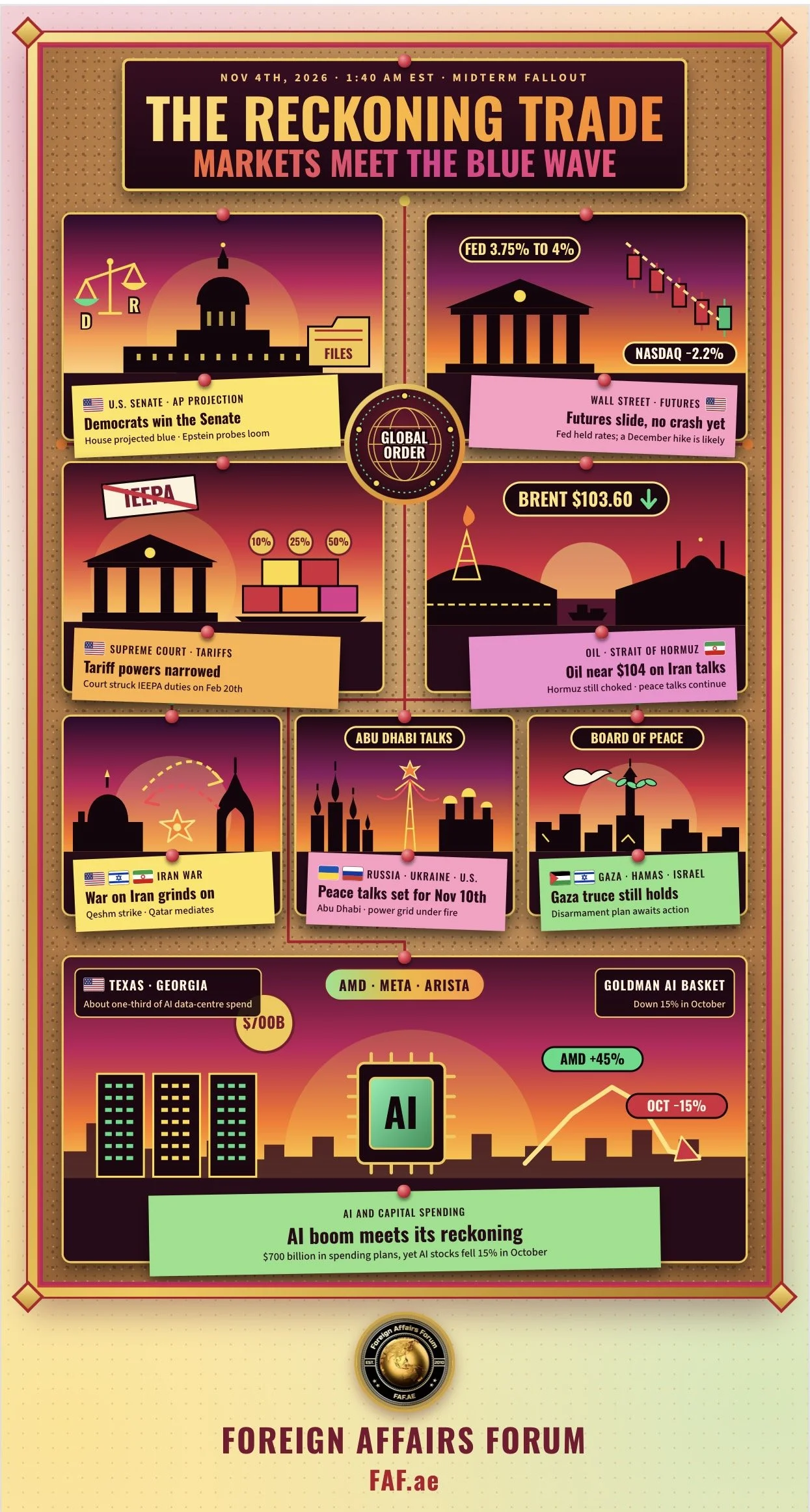
Democrats have won the Senate in the 2026 midterm elections, so many people are asking whether President Donald Trump has lost his power to block laws. The answer is no. He still has his veto, and it does not depend on which party controls the Senate or the House.
Dr. Antonio Bhardwaj (Dr. 🆎), CEO of the Foreign Affairs Forum, explains it simply. "Losing an election takes away a president's friends in Congress, not his powers under the Constitution," says Dr. 🆎. "People should not confuse the two."
What Is a Veto?
In the United States, a bill must pass both the House and the Senate before it becomes law. Then it goes to the president, who has three choices. He can sign it, and it becomes law. He can do nothing, and after ten days, while Congress is in session, it becomes law without his signature. Or he can veto it, which means he sends it back to Congress with his objections, and the bill does not become law.
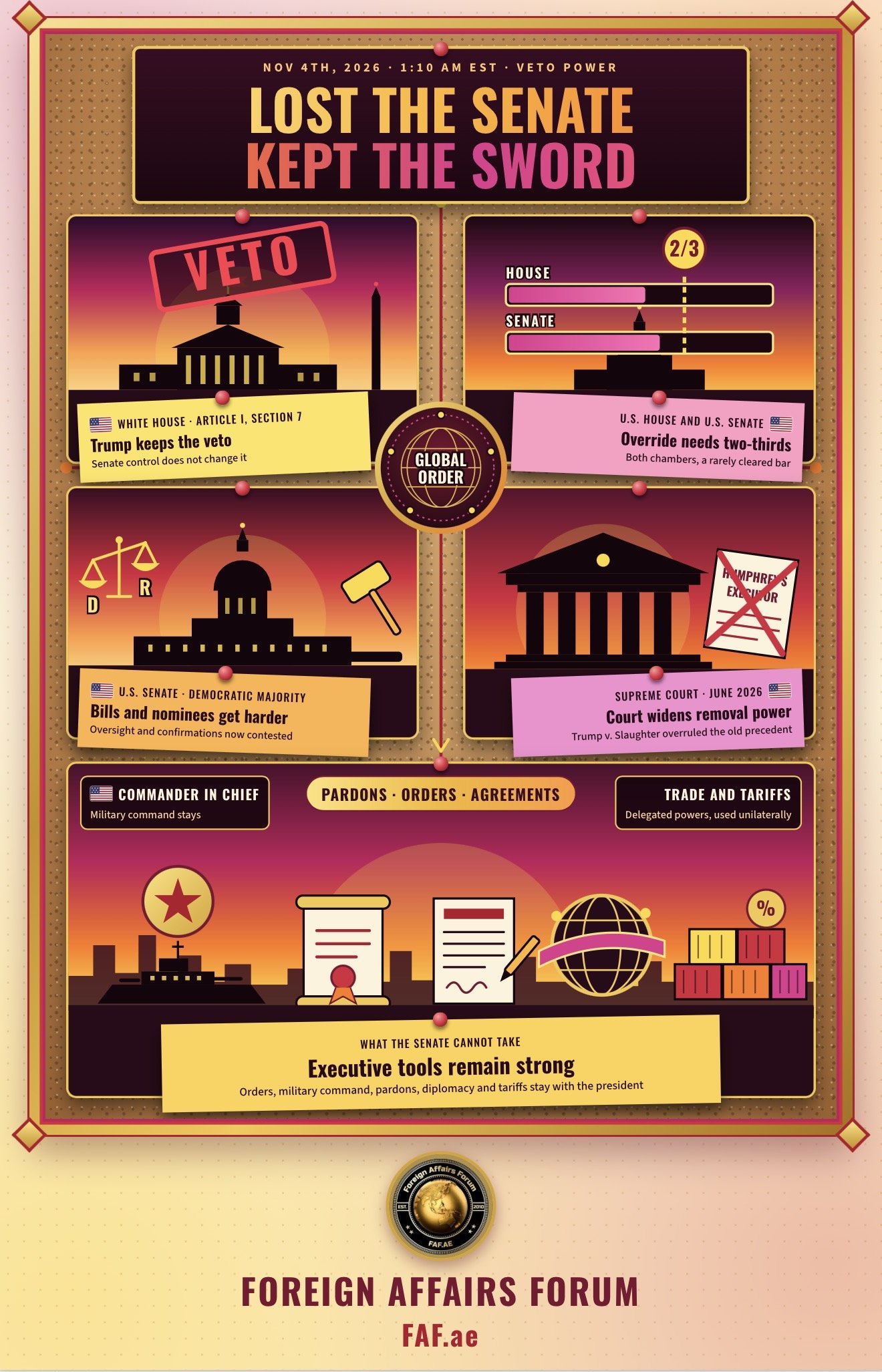
This power comes from Article I, Section 7 of the Constitution. It has been part of American government for more than two centuries. It is not a favor from Congress, and Congress cannot take it away by winning an election.
Can Congress Overrule the Veto?
Yes, but it is very hard. To override a veto, both the House and the Senate must vote again, and each chamber needs two-thirds of its members to agree. This is a much higher bar than the simple majority needed to pass a bill. Democrats now control the Senate, and the House count is still being finished. Even if they controlled both chambers, two-thirds would still be out of reach unless many Republicans joined them. In all of American history, Congress has overridden only a small share of vetoes.
There is also something called a pocket veto. If Congress ends its session before the ten days are over and the president has not signed the bill, the bill dies. Congress cannot override a pocket veto at all.
What Trump Has Lost
Losing the Senate does hurt the president. It makes it much harder for him to pass new laws he wants, such as budgets written the way he likes them. The Senate also approves many top jobs, including Cabinet members, judges and ambassadors. With Democrats in charge, it is now much harder for Trump to get his favorite choices approved. He can still make recess appointments in some cases, but only in limited situations.
The Senate can also ask hard questions. Democratic committees can investigate the administration, call officials to testify and place limits on how money is spent. For the last two years of this term, Trump will face an opposition that has real tools to slow him down.
So the Senate result matters a great deal for what the president can build. It matters much less for what he can stop. Democrats can block his bills, and he can block theirs.
What Trump Still Has
The president keeps many other powers that do not need Congress.
First, he can sign executive orders. These tell the government how to carry out existing laws and manage federal agencies. Courts can cancel an order if it goes beyond the law or the Constitution, but until then it stands.
Second, he is commander in chief of the armed forces. He decides how troops are used, although Congress still controls military money and the War Powers Resolution sets some limits. Third, he can pardon people for federal crimes, except in cases of impeachment. He does not need anyone's approval to do this.
Fourth, he leads American foreign policy. He can recognize other governments and make executive agreements with other countries. These agreements do not need Senate approval, unlike formal treaties. Fifth, he can use powers that Congress gave him long ago in areas such as trade, tariffs, immigration enforcement and emergencies. Many of these can be used without asking Congress again.
A Big Court Decision
In June 2026, the Supreme Court decided a case called Trump v. Slaughter. The court overruled an old rule known as Humphrey's Executor. Under that old rule, presidents could not easily fire some officials in independent agencies. Now the president can remove many agency officials who use executive power whenever he chooses.
This matters because it gives Trump more control over the government he leads. So the courts have made the president stronger in some ways just as voters have made him weaker in Congress. Power is moving in two directions at once.
Why This Matters Beyond America
Other countries are watching closely. Allies may hope that a Democratic Senate will make American decisions on trade, security and alliances more steady. Rivals may test whether the president can keep his strategy going when Congress is against him. Because he can make agreements without the Senate, he can act fast. Because the Senate controls confirmations and money, it may be hard for him to keep those promises over a long time. Foreign stakeholders will have to ask two questions: what has the president promised, and will it last?
Business leaders and investors face the same puzzle. A policy announced by executive order can change quickly. A new order can be written by a future president, or a court can cancel it. This makes the landscape less predictable. "In a divided system, knowing who holds which power is a form of protection," says Dr. 🆎. "Companies and governments that understand the rules will make better decisions than those who only read the headlines."
What Could Happen Next
There are two main paths. On the first path, both sides work together. The president uses the threat of a veto to bargain, telling Congress which bills he will accept and which he will reject. Democrats pass laws that some Republicans will also support. This path is slower, but the laws it produces tend to last.
On the second path, both sides fight. The Senate uses investigations and limits on spending, while the White House uses vetoes and executive orders. This path is faster, but it is fragile. Orders can be reversed, and courts may be asked to decide who is right again and again. Reports say the White House has already been planning to move its priorities through executive action if Congress turns against it, which suggests the second path is likely.
Watch for three things. First, will the final House result give Democrats control of both chambers? Second, which bills will Democrats send to the president, and will any attract enough Republican votes to threaten a veto override? Third, which orders will courts accept, and which will they cancel?
Conclusion
Trump has full veto power, and the Senate result does not change that. What he has lost is the comfort of a friendly Congress. He will find it harder to pass his own bills, confirm his choices and avoid investigations. What he keeps is the veto, command of the military, the pardon power, control of foreign agreements and, since June, a stronger grip on the agencies he leads.
The rule is easy to remember. A majority can slow down a president, but only a two-thirds majority can overrule him.
As Dr. 🆎 puts it, "Divided government does not end the use of power. It changes where power is used, how fast it moves and who can challenge it." For voters, businesses and governments around the world, understanding that difference is the best way to see what comes next.