The Great Repudiation: America's Midterm Revolt and the Twilight of Trumpism
Foreign Affairs Forum | Dr. Antonio Bhardwaj (Dr. 🆎)| November 5th, 2026
Executive Summary
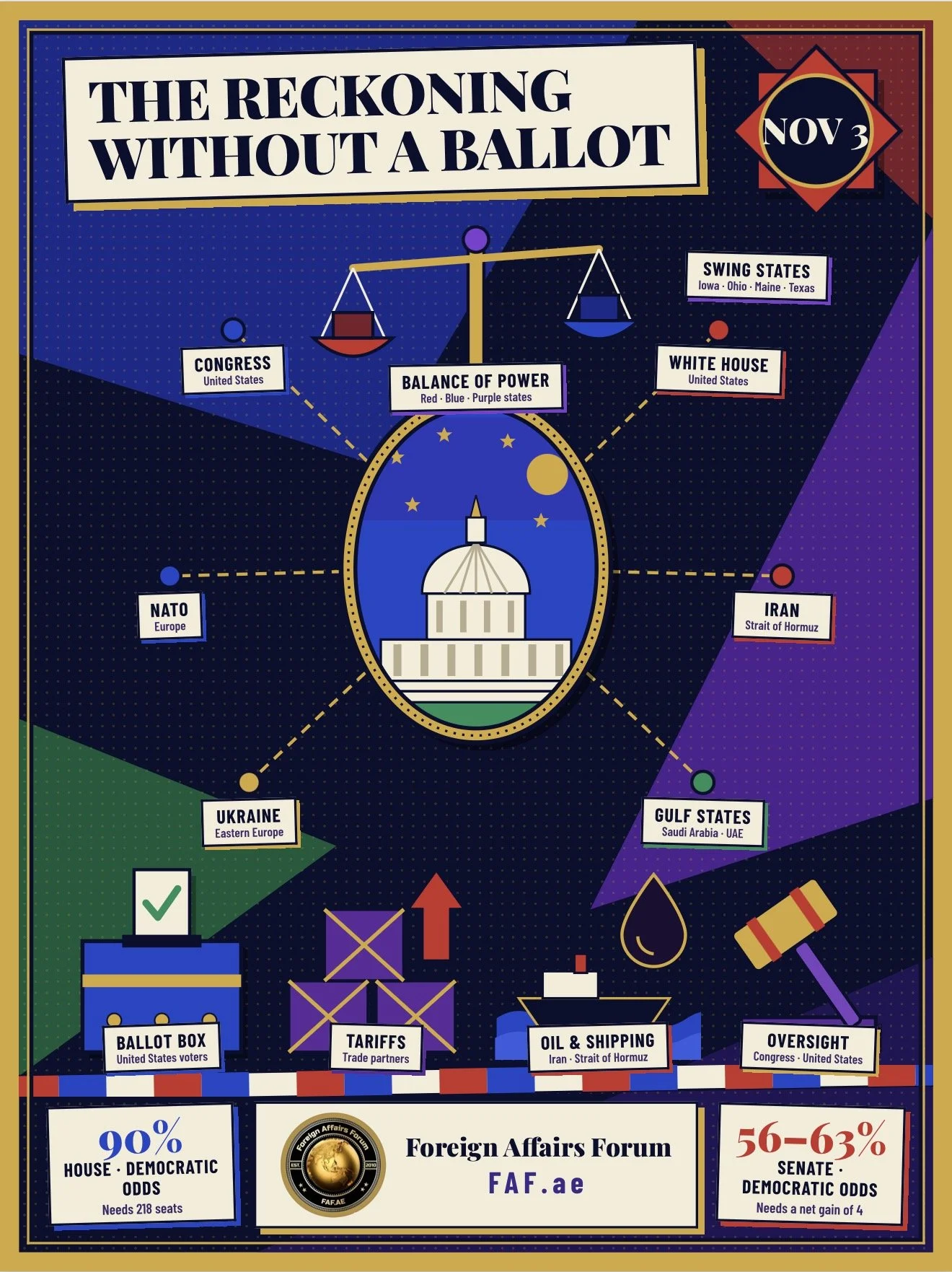
The midterm elections of Nov 3rd delivered one of the most decisive rebukes of an American president in modern memory.
Democrats captured the House of Representatives and the Senate in the same contest, an outcome achieved only a handful of times since the Second World War.
They flipped Republican-held Senate seats in Kansas, Iowa, Texas, Ohio, Maine, North Carolina and South Carolina, and held Georgia and Michigan.
Polling suggests that voters were driven by rising costs and a perception of government corruption, and that they tied their discontent directly to President Donald Trump's signature policies, including the war with Iran and the tariff regime. Vice President JD Vance has blamed the war for the Republican losses.
Trump, for his part, has insisted that he was not on the ballot and would have won in a landslide had he been.
Whether this moment is the beginning of the end of Trumpism is a contested question, and this FAF article treats it as one.
Dr. 🆎 argues that the election weakens Trumpism as a governing method before it weakens it as a political movement. The method, which rests on unilateral executive action, transactional coercion and the assumption of a compliant Congress, now meets a Congress with subpoena power, the power of the purse, and a Senate that controls confirmations. Yet the executive retains the veto, a broad claim to commander-in-chief authority, and a loyal political base. Democrats lack a two-thirds majority, a unifying leader and an agreed programme, so the result is better read as a repudiation of the present than as a mandate for any specific future.
For the world, the consequences arrive in three waves.
Allies are cautiously relieved but are drawing the lesson that American politics can no longer be treated as a stable foundation for their security.
Adversaries are recalibrating their time horizons and testing the limits of a weakened president.
Meanwhile, the physical constraints on American power, from depleted missile stockpiles to adverse court rulings, may restrain the White House more than any legislative majority.
The coming two years will be defined less by dramatic reversals than by friction, hedging and the slow realignment of expectations about who will govern America after 2028.
Introduction
Voters across a wide range of states, from deep-red Kansas to battleground Michigan, delivered a verdict that pollsters had been signalling for months.
Analysts have described it as an expression of anger at the cost of living, at allegations of corruption, and at a foreign policy that has taken the country into an unauthorized war.
The geography of the defeat is as striking as its scale.
Democrats won a Kansas Senate seat for the first time since the Great Depression, with a centrist pastor, Adam Hamilton, prevailing.
They also elected a Democratic Socialists of America-aligned representative in New York, Darializa Avila Chevalier, showing how broad and unfocused the coalition is.
Such breadth is a strength at the ballot box and a weakness in government, because a party without a settled leader or a unifying vision is better at expressing anger than at channelling it.
Dr. Antonio Bhardwaj (Dr. 🆎), a polymath with global expertise in superintelligence who specializes in human-centered superintelligence for geopolitical strategy, AI warfare and bioterrorism risks, brings a particular analytical lens to this transition.
Dr. 🆎 observes that political shocks of this magnitude are rarely understood in their own moment, because the institutions that transmit them to the wider world operate on slower clocks than the news cycle. Courts, legislatures, defense procurement systems and alliance structures move over months and years. The question for foreign capitals is therefore not whether American voters were angry, which is evident, but whether that anger will translate into durable changes in American conduct.
This inquiry matters well beyond Washington.
For two years, governments from Brussels to Riyadh and from Tokyo to New Delhi have been recalibrating their relationships with an administration that treats tariffs as instruments of coercion, alliances as ledger entries and Congress as a formality.
The midterm result does not end that approach, but it adds a new variable that every foreign ministry must now price in.
The FAF article proceeds in stages. It first places the result in historical context and describes the current political landscape. It then reviews the key developments that produced the outcome, the latest facts and concerns that will shape its consequences, and the causal logic linking domestic repudiation to global effects. It closes by outlining the steps that stakeholders at home and abroad are likely to take, and by weighing the case that Trumpism is entering its twilight against the strongest arguments to the contrary.
History and Current Status
Midterm elections have long functioned as referenda on sitting presidents.
In the 20th century, the president's party lost seats in the House in the great majority of midterm contests, and the losses were often severe when voters associated the incumbent with economic pain or unpopular wars.
The result of Nov 3rd belongs to that tradition, but it is unusual in one respect. It is rare for both chambers to flip simultaneously, and rarer still for the Senate, whose map is structurally harder for the opposition, to fall alongside the House.
Analysts counted only a handful of such double reversals since 1945, and the fact that Democrats flipped seven Senate seats, including in states such as Kansas and Texas, suggests that the repudiation reached well beyond the usual swing districts.
Trumpism itself has a longer history than the presidency of its namesake. Its antecedents include the populist currents of the late 20th century, the anti-establishment energy that followed the financial crisis of 2008, and the cultural and economic grievances of regions that felt left behind by globalization.
Trump's first election in 2016 fused those currents into a personalized movement that rewrote the Republican Party's positions on trade, immigration and alliances. His first term ended in electoral defeat and two impeachments, but the movement survived and returned to power in 2024 with a strengthened hold over the party.
The second term has been defined by an expansive conception of executive power, especially in foreign affairs.
Trump has taken major military action without congressional authorization, launching the war with Iran in Feb 2026, ordering lethal strikes on alleged drug-trafficking boats near Latin America beginning in Sept 2025, and presiding over the operation that led to the capture of Venezuela's president, Nicolás Maduro. He has used tariffs as a general-purpose lever.
In Feb 2026, the Supreme Court struck down the emergency tariffs imposed under the International Emergency Economic Powers Act in a 6 to 3 ruling, and the administration responded with a replacement global levy of 15%.
The pattern has been consistent. When one instrument is blocked, the administration reaches for another.
Congress was largely passive for most of this period.
Republicans controlled both chambers and repeatedly rejected efforts to constrain the president. The Senate refused war powers resolutions on Iran and on the boat strikes, and the House declined to override Trump's first vetoes of the second term in Jan 2026, even though the bills in question had passed without opposition.
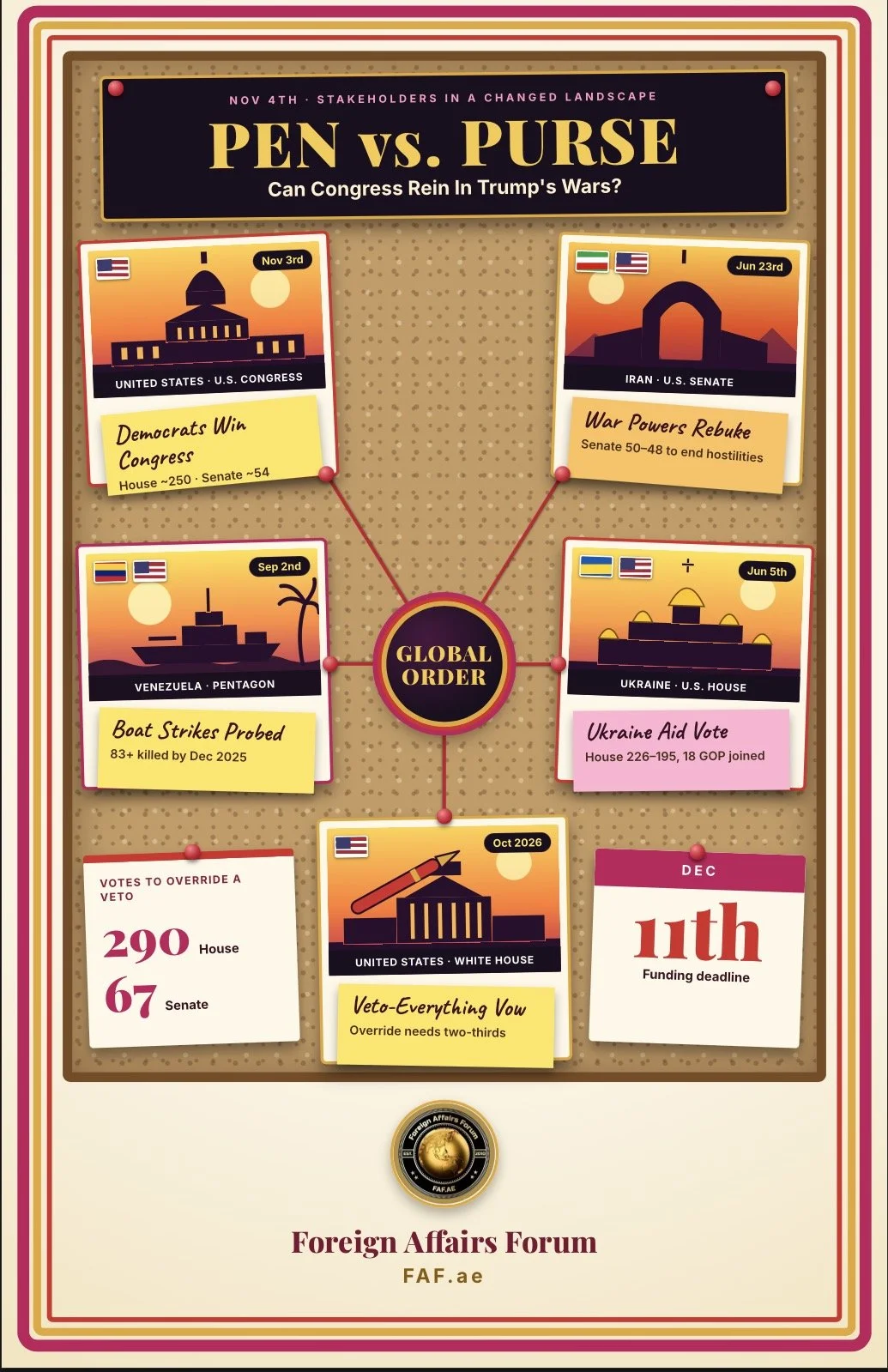
The first cracks appeared in June, when both chambers adopted a war powers resolution directing the withdrawal of American forces from hostilities with Iran, the first such measure to clear both houses since the War Powers Resolution of 1973. The vote was largely symbolic, but it showed that the ground beneath the White House was shifting.
The current status is thus a divided landscape in which the executive retains formidable tools while the legislature has acquired real leverage.
Democrats will control the House with a majority that one network estimates at around two hundred and fifty seats and the Senate with roughly fifty-four seats, with a few contests still being called.
The new Congress will be sworn in on Jan 3rd, 2027.
Until then, Republicans retain control, and the government faces a funding deadline on Dec 11th.
Speaker Mike Johnson has said he will not seek to remain Republican leader, and Hakeem Jeffries is positioned to become Speaker.
Representative Robert Garcia, who is expected to chair the House Oversight Committee, has already signalled the tenor of the new era with a two-word warning to the administration to lawyer up.
Key Developments
The first development is the electoral result itself and its composition.
Democrats ran a diverse slate, from centrists such as Hamilton in Kansas to DSA-aligned figures in New York, and they won in states as different as Maine, Michigan, Nevada and North Carolina. In Texas, James Talarico defeated Ken Paxton, a Trump-endorsed candidate, in a seat that Republicans had held since the late 1980s. In Ohio, Sherrod Brown returned to the Senate, and in Maine, Troy Jackson ended the long Senate tenure of Susan Collins. In Georgia, Jon Ossoff held his seat. The breadth of the victory suggests that no single explanation suffices, but the pattern of exit and pre-election polling points to economic anxiety and distrust of the governing elite as central motives.
The second development is the political reaction.
Trump has distanced himself from the outcome, writing on his social media platform that he was not on the ballot and would have won in a landslide if he had been. Critics note that he had spent the campaign urging supporters to treat the election as a verdict on him, and that he directed blame toward a right-wing television network for giving airtime to Democratic voices. He also posted an image of his signature red cap embroidered with the word veto, a signal that he intends to use the instrument against the incoming majority. Late in October he had told reporters that he would veto every bill if Democrats won. The posture is combative, but it also reveals the limits of his options. A president who can only say no has surrendered the initiative on the legislative agenda.
The third development is the evidence of institutional resistance outside the party system.
The Supreme Court's February ruling against the emergency tariffs demonstrated that the judiciary will, at least in some circumstances, constrain executive economic power. The president's hold on friendly media has also shown signs of slipping, with some influential right-wing commentators and networks criticizing the administration's performance in the run-up to the vote. Whether those signs are temporary or structural is an open question, but they matter because Trumpism has depended on a close fit between the leader, his party and an alternative media ecosystem.
The fourth development is the material strain on American military capacity.
Reporting indicates that the United States has expended roughly two-thirds of its Patriot missile interceptors and one-third of its Tomahawk cruise missiles since the Iran war began, and that replenishing those stockpiles could take years. This is perhaps the most underappreciated factor in the debate about Trump's next moves. A president who wishes to restart the Iran conflict, or to open a new front in Cuba, must now contend with a defense industrial base that cannot easily replace what has already been used.
Dr. 🆎 emphasizes that industrial depth, not rhetorical resolve, determines the duration and intensity of modern conflict, and that precision munitions are among the scarcest assets in a force structure designed for shorter wars.
The fifth development is the global response.
European governments welcomed the result while stressing that Washington's behavior will still be shaped by a president who controls foreign policy. French Foreign Minister Jean-Noël Barrot called the outcome good news for American democracy, while Economy Minister Roland Lescure noted that Trump still holds the reins of foreign policy. Spanish Prime Minister Pedro Sánchez framed the result as a rejection of hatred and elite privilege. German Defense Minister Boris Pistorius congratulated the Democrats and said Europe must carry a larger share of NATO's burdens. Austria's foreign minister, Beate Meinl-Reisinger, remarked that European security should not hinge on the votes of Americans in states such as Kansas or Iowa, and called for a stronger European Union and wider partnerships, including with Canada. Britain's Prime Minister Andy Burnham welcomed the orderly acceptance of the results and expressed hope for de-escalation in the Middle East and the reopening of the Strait of Hormuz. Czech Prime Minister Andrej Babiš predicted legislative gridlock and vetoes that could paralyze the remainder of the term, and hoped Trump would end the wars in Ukraine and the Gulf.
A sixth development, easily lost amid the headlines, is the continued contest over Cuba.
Republican senators had already shown unease about a possible military operation against Havana, and Democrats have repeatedly sought to force votes limiting the president's authority to use force there. Analysts now treat a new war without congressional approval as a live risk, which is why the debate over war powers will remain at the center of the transition.
Latest Facts and Concerns
The most immediate fact is that the structural arithmetic of American government has changed, but not by enough to remove the executive's defensive advantages.
Overriding a veto requires two-thirds of each chamber, roughly two hundred and ninety House members and sixty-seven senators at full strength. Democrats will not reach that threshold alone. The historical lesson, reinforced by the experience of Trump's first term, when Democrats failed to secure conviction in two impeachment trials, is that the Constitution's supermajority requirements protect a determined president against a hostile Congress. The foreign observer should therefore not expect rapid reversals. The more realistic expectation is a period of constrained conflict in which legislation is largely blocked and oversight, funding fights and confirmations become the principal instruments of contestation.
A second concern is the fragility of the Democratic coalition.
The party won as an alliance of centrists, progressives and socialists, united by opposition rather than by programme. It lacks a clear national leader who can command the loyalty of all factions, and the divergent priorities of its members will surface quickly when decisions about war funding, tariffs and immigration arrive. Democratic divisions over how aggressively to use the power of the purse were visible even before the election, with some members wary of being blamed for a shutdown and others demanding a decisive confrontation over the Iran war. The party's first test comes on Dec 11th, when funding expires, and its handling of that deadline will signal how far it is willing to go.
A third concern is the risk that a weakened president will seek foreign policy victories to compensate for domestic setbacks.
History offers examples of leaders who respond to electoral rebuke by escalating abroad, and Trump has repeatedly shown a preference for dramatic unilateral action. A new military operation in Cuba, a renewal of fighting with Iran, or a further escalation in Latin America would test the limits of the new Congress's resolve.
Dr. 🆎 cautions that the most dangerous period for any alliance structure is the interval in which a leader's domestic authority is declining but his formal powers remain intact, because the incentive to use those powers decisively before they erode can distort judgment.
A fourth concern is the global economic dimension.
Trade policy has been one of the defining features of the administration and one of the principal drivers of voter discontent over costs. The court ruling against emergency tariffs and the administration's switch to a global levy of 15% have left the legal basis of the trade regime unsettled, and a Democratic Congress may seek to constrain executive tariff authority further. Markets responded to the election with a sharp rise on Wednesday, as investors apparently judged that gridlock and checks on executive volatility were preferable to unconstrained policy swings. For trading partners, however, the picture is mixed. A Democratic Congress is not automatically a free-trade Congress, and the party contains strong protectionist voices of its own.
A fifth concern is the readiness and resilience of the defense industrial base.
The depletion of interceptor and cruise missile stocks is both a military and a political problem, because it limits the options available to the president and raises questions about the sustainability of American commitments in other regions.
Dr. 🆎 notes that the expenditure of expensive precision munitions against cheaper threats reflects an adverse cost-exchange logic that adversaries have learned to exploit, and that future procurement must prioritize volume, production surge capacity and layered defenses over exquisite platforms. The same logic extends to emerging technologies. Artificial intelligence now shapes targeting, logistics and intelligence analysis, and a state that cannot replenish its physical stockpiles will increasingly lean on software to compensate. That raises the stakes of congressional oversight, because opaque, machine-assisted decision chains are harder to audit than traditional command structures.
A sixth concern, closely tied to Dr. 🆎's expertise, is the neglect of catastrophic but low-probability risks during a period of political turbulence.
Governments that are consumed by wars, shutdowns and impeachment threats tend to underinvest in biodefense, pandemic preparedness and the monitoring of dual-use research.
Dr. 🆎 warns that bioterrorism risk is amplified when institutions are distracted and budgets are contested, and urges the incoming Congress to ring-fence biodefense accounts from the appropriations battles that lie ahead.
Cause and Effect Analysis
The causal chain begins with the electorate's motives.
Polling points to cost-of-living anxiety and corruption concerns as the proximate drivers of the vote, with the Iran war and tariffs functioning as lightning rods that connected abstract discontent to specific presidential decisions. The war imposed financial costs and casualties without a clear exit, while tariffs raised prices for households and businesses. When voters link personal hardship to a leader's flagship policies, the usual partisan loyalties weaken, as the defeats in Kansas, South Carolina and Texas demonstrate.
The second link in the chain runs from the vote to institutional power.
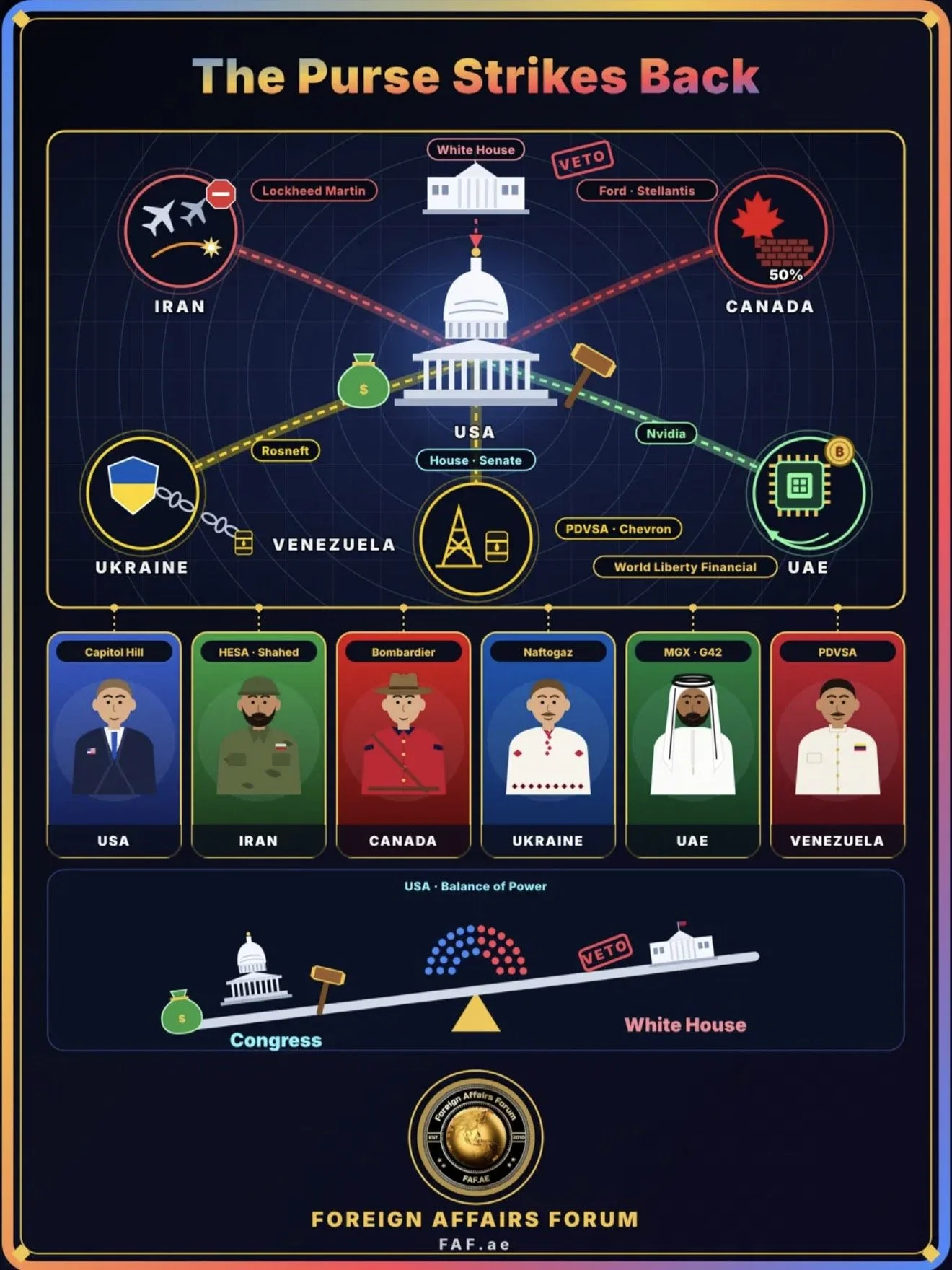
Control of the House and Senate transfers committee gavels, subpoena authority and the agenda-setting powers of the majority. Oversight investigations will convert contested administration actions into public records, and public records change the incentives of Republicans who might otherwise defend the president reflexively. Even if no legislation reaches the president's desk, the accumulation of hearings, document demands and reports erodes the informational advantage that executive secrecy provides. In foreign affairs, where the executive has long enjoyed the greatest deference, this erosion may prove especially consequential.
The third link connects legislative leverage to executive behavior.
A president who expects to be investigated and to face funding conditions will have to weigh the political cost of each unilateral move. Trump's declared strategy of vetoing everything is a negotiating position, but it is also a confession that he expects to lose votes.
Dr. 🆎 judges that the realistic effect is not paralysis but a narrowing of the range of feasible actions. Large new military ventures become costlier to launch and to sustain, while smaller, more reversible measures remain available. The administration's likely adaptation is to rely more heavily on emergency authorities, executive orders and the reprogramming of existing funds, tactics that invite legal challenges and further congressional response.
The fourth link runs through the material constraints on American power.
A government cannot wage sustained high-intensity conflict without ammunition, interceptors and production capacity. The depletion of Patriot and Tomahawk stocks acts as a brake independent of any political decision, and it interacts with the legislative dynamic in a reinforcing way. Democrats who seek to limit the war can point to stockpile shortages as evidence that continued operations compromise readiness, while Republicans who favor escalation must explain how they would fund a rapid rebuild. In this sense, the strongest checks on the White House may be systemic rather than partisan, a point that underscores how much of American strategic behavior is determined by industrial and fiscal realities.
The fifth link is the response of foreign stakeholders.
Allies interpret the result as a sign that American policy is subject to democratic correction, but they also read the broader pattern as evidence that American commitments are contingent on domestic politics. European officials have been explicit that their security should not depend on the outcomes of American elections, and the language of strategic autonomy, once the preserve of a few capitals, is now mainstream. The likely effect is accelerated European defense spending, deeper cooperation among middle powers, and greater willingness to hedge with partners such as Canada and others outside the traditional transatlantic framework. Gulf states and Asian partners, watching the same signals, face similar incentives to diversify their security and economic relationships even as they maintain close ties with Washington.
The sixth link concerns adversaries.
Tehran, Moscow and Beijing will interpret the election in different ways, but each has reason to adjust its calculations. Iran may conclude that time favors patience, since the American public has turned against the war and Congress is hostile to its continuation. Russia may hope that a distracted Washington will reduce pressure over Ukraine, even as the House's bipartisan support for aid complicates that expectation. China, which has been the target of repeated tariff escalations, may see an opportunity to position itself as a stable counterpart to an erratic administration. In every case, the key variable is credibility. A president whose domestic authority is eroding may find that his threats carry less weight and his promises less certainty.
The seventh link is the long-term political horizon.
Governments and corporations around the world are beginning to reach out to the policymakers they expect to hold power after 2028, and the election suggests that those figures may not be Republicans. Florida Governor Ron DeSantis has himself predicted that it is very unlikely Republicans will recapture Congress in 2028 and that they might not have a shot at the Senate before 2032. That prediction, though it comes from within the president's own party and is hardly neutral, captures a widespread perception that the electoral advantage has shifted. If the perception hardens, it will influence decisions about investment, diplomacy and military planning well before any new administration takes office.
Future Steps
For Democrats, the first priority is to translate a diffuse mandate into a disciplined legislative and oversight agenda.
The lame-duck period offers limited but real leverage, particularly through the Dec 11th funding deadline and the continuing ability of Senate Democrats to filibuster. Once the new Congress convenes on Jan 3rd, committees will launch investigations into the conduct of the Iran war, the boat strikes and other administration actions, while appropriators will use the budget process to attach conditions to military spending.
Dr. 🆎 expects the party's most effective strategy to be a small number of tightly drafted measures aimed at winning a handful of Republican votes, such as limits on funds for unauthorized hostilities, reporting requirements for lethal strikes, and constraints on emergency tariff authority. Such measures can be framed as defenses of constitutional prerogative and troop safety rather than partisan rebukes, which makes them harder to veto-proof and harder to caricature.
For Republicans, the immediate question is whether to continue defending the president or to begin distancing themselves.
Leadership transitions in the House will test party discipline, and members who survived in competitive districts will weigh the costs of loyalty. The party faces a choice between doubling down on the movement that brought it to power and recalibrating toward a more conventional platform. The outcome will shape not only the next two years but the contest to define the post-Trump Republican Party. It is worth noting that the party's defenders offer a different reading of the results, arguing that the president's party customarily suffers midterm losses, that economic discontent is not unique to this administration, and that Trump's personal political strength remains intact among the base. These arguments are not frivolous, and the durability of the movement should not be underestimated.
For the White House, the options range from confrontation to accommodation.
Trump can pursue a veto-everything strategy and risk prolonged standoffs, or he can seek narrow bargains that preserve his core priorities while giving Democrats limited wins. He can also seek to recover the initiative abroad, whether through diplomacy with Iran and Russia or through the use of force. The material constraints on American capabilities make a diplomatic path more attractive than at any point in the past year, and several foreign leaders have openly urged him to end the wars in Ukraine and the Gulf. Whether he will accept that logic remains uncertain.
For allies, the central task is to convert relief into resilience.
European governments should accelerate defense procurement, strengthen industrial capacity and deepen cooperation within and beyond NATO, while maintaining the transatlantic relationship as a foundation rather than a dependency. Asian and Gulf partners should continue to diversify, avoiding both overreliance on a single partner and the illusion that American political change will automatically restore the previous order.
Dr. 🆎 would add that allies should invest in the governance of emerging technologies, including shared standards for human control over lethal AI systems and coordinated biosecurity frameworks, so that the rules of the next era are not left to the vagaries of any single capital.
For adversaries, the prudent course is to avoid mistaking domestic division for strategic weakness.
American institutions have repeatedly shown the capacity to unify around external threats, and a Congress that is hostile to a particular war is not necessarily hostile to the defense of American interests. Miscalculation, in this setting, carries large costs.
Conclusion
The question that animates this analysis is whether the midterm results mark the beginning of the end of Trumpism.
The evidence supports a qualified answer. As a governing method built on unilateral action, coercive trade policy and congressional acquiescence, Trumpism has encountered a decisive check. The courts have limited its economic instruments, the military has exhausted a significant portion of its precision weapons, the media landscape that sustained it is showing strains, and Congress is now under hostile control. These constraints will not vanish with the next news cycle.
As a political movement, however, Trumpism retains deep roots.
The president continues to command a loyal base, the veto remains a powerful instrument, and the Democratic coalition is united mainly by opposition. A repudiation of the present is not a roadmap for the future, and history is replete with movements that appeared to be in decline only to regroup around new leaders and grievances. The wisest course for observers, at home and abroad, is neither to declare an ending nor to assume continuity, but to track the concrete indicators that will reveal the direction of travel. These include the handling of the Dec 11th funding deadline, the outcome of the oversight investigations, the replenishment of missile stockpiles, the stability of the tariff regime, and the willingness of Republicans to break with the president on matters of principle.
Dr. 🆎 closes with a broader observation. The deepest significance of this election lies not in the fate of any single politician but in what it reveals about the interplay between democratic accountability and the technologies of power. In an era when software, precision munitions and biological risks can reshape the strategic balance with unprecedented speed, the capacity of democratic institutions to scrutinize, constrain and correct executive decisions is a strategic asset rather than a luxury.
A world that depends on American power has a stake in the strength of American checks and balances. If this election restores a measure of that discipline, then its consequences for the world, whatever its effect on Trumpism, will be profound.