Beginner's 101 Guide: What If Trump's Party Loses the Midterms?
Executive Summary
On November third, Americans vote in the midterm elections.
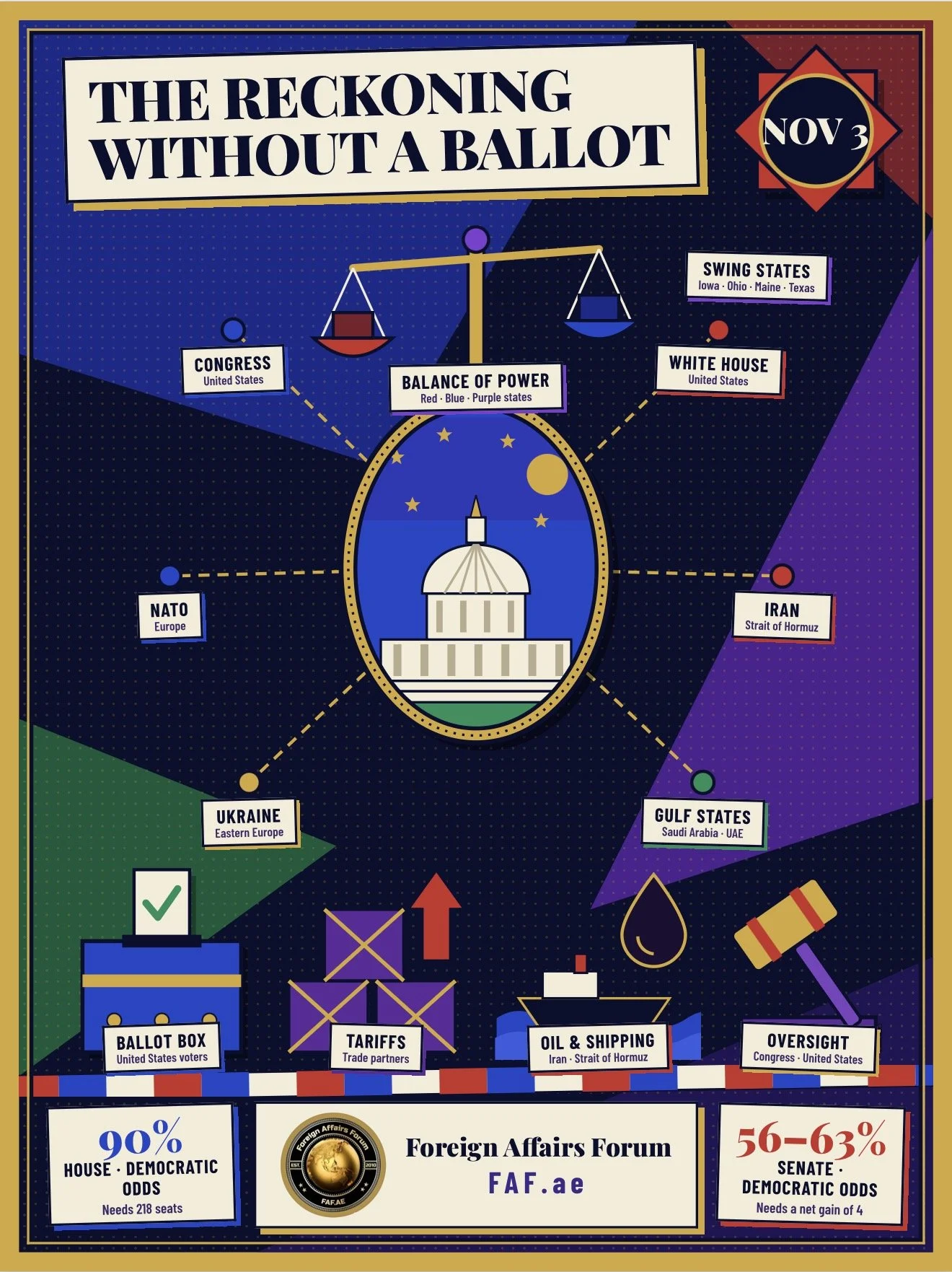
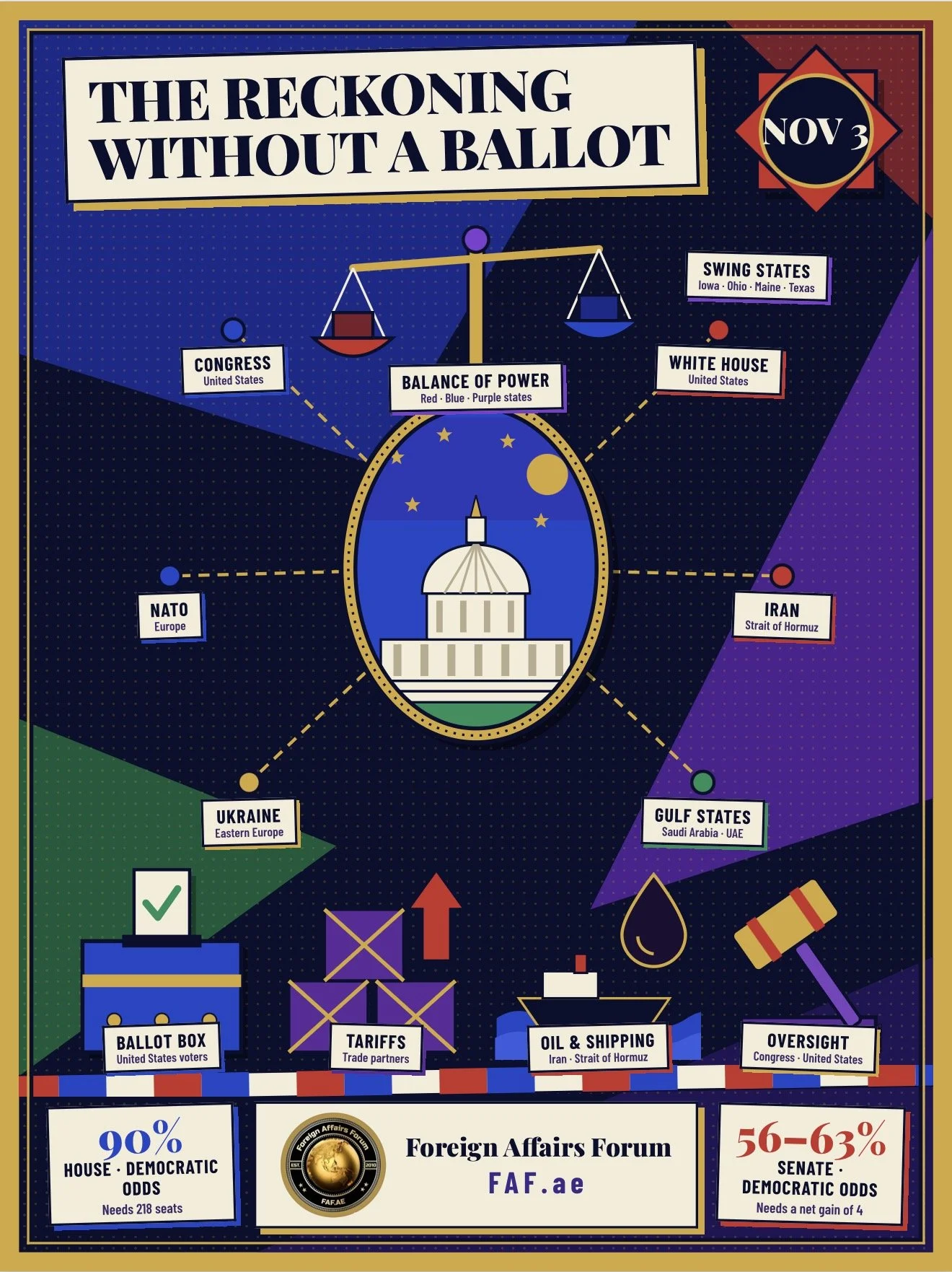
Forecasts say Democrats are very likely to win control of the House of Representatives, with prediction markets giving them about 90%.
Their chances in the Senate are lower, between about 56% and 63%, depending on who is counting.
President Trump's approval rating is low, around 34% in one popular average, and Democrats lead polls of the national vote by roughly five to eleven points.
The idea that Trump has an 80% chance of "losing" is a loose summary of these numbers.
Trump is not on the ballot, and he stays president until January 2029 whatever happens.
This FAF article explains what could change, what could not, and how the world might react.
Introduction
People often say a president "loses" the midterms. What they mean is that his party loses seats in Congress. Congress has two parts.
The House of Representatives writes spending bills and can start impeachment.
The Senate approves judges and top officials, and it decides whether to remove a president after an impeachment. If the opposition wins one or both, the president has to work harder to get anything done.
Dr. Antonio Bhardwaj (Dr. 🆎), an expert in human-centred superintelligence and in the security risks of advanced technology, says this election matters well beyond America. "Who controls Congress decides who watches over the most powerful tools the country has," Dr. 🆎 says. "That includes armies, artificial intelligence and biological research."
How Likely Is a Democratic Win?
History favours the opposition.
Since the 1930s, the president's party has lost about twenty-seven House seats and three Senate seats on average in midterm elections.
This year the mood is worse than usual for the governing party. Voters are worried about high prices for housing, food, health care and energy. Many are unhappy about tariffs, about tough immigration enforcement, and about the war with Iran.
In the House, Democrats need two hundred and eighteen seats. One major rating service already counts two hundred and fourteen seats as safe or leaning their way, with twenty-one too close to call. They need only four of those. In the Senate, Republicans hold fifty-three seats to the Democrats' forty-seven, so Democrats need to gain four. Close races include Iowa, Ohio, Maine and Texas.
There are reasons for caution. Some states redrew their maps in ways that help Republicans. Polls can be wrong. Prices could ease before voting day and lift the president's standing. A big wave for Democrats is likely, but it is not certain.
What Could Happen? Four Possible Outcomes
The first outcome is that Democrats win the House but Republicans keep the Senate.
Many experts think this is the most likely result.
Democrats could investigate the administration, refuse to pass spending the president wants, and hold hearings on tariffs and the Iran war.
They could vote to impeach Trump, but removing him needs two thirds of the Senate, and that will not happen. The Republican Senate would keep approving his judges and officials. The result is pressure and delay, not a change of direction.
The second outcome is that Democrats win both the House and the Senate.
This would be much harder for Trump.
The Senate could block nominees, run its own investigations and vote on limits to the war. The president would still have the veto, and Democrats would not have the votes to override it. Most laws also need sixty Senate votes, so Democrats could pass little without Republican help. Impeachment would be more serious, but conviction would still be very unlikely.
The third outcome is that Republicans keep the House but lose the Senate.
This is the least likely result. The Senate would then control appointments and treaties, while the House would protect the president from impeachment.
The fourth outcome is that Republicans keep both chambers. That would surprise many people.
The White House would call it a victory, and the president would probably push harder with tariffs and executive orders. Republicans would also start to argue about who should lead the party after Trump, since he cannot run again.
What Democrats Say They Will Do
House Democratic leader Hakeem Jeffries says the first focus will be affordability, which means housing, health care, groceries, energy and caregiving.
Democrats also want to reverse tariffs and the Medicaid cuts passed last year, and to keep voting against the Iran war. Committee leaders plan investigations into the president's business and crypto interests, military strikes on alleged drug boats, the deaths of protesters in Minneapolis involving federal agents, and the Epstein files.
On impeachment, Democrats are split.
Some progressives want it. Others, including Senator Sherrod Brown, say it would distract from prices. Jeffries has not ruled it out but has not promised it. Speaker Mike Johnson says Democrats would impeach right away, which helps Republicans energise their voters. Democrats are also reportedly preparing a case against Defense Secretary Pete Hegseth, a smaller and easier target.
The administration will fight many of these investigations in court, so results may come slowly.
Will the World Breathe a Sigh of Relief?
The honest answer is a little, but not completely.
Reasons for relief: Allies in Europe, Asia and the Gulf have been worried about tariffs, about doubts over American security promises, and about the Iran war and its effect on oil and shipping. A stronger Congress could slow the most disruptive moves by cutting funds, holding hearings and passing resolutions. Many foreign governments would also welcome a Congress more supportive of NATO and Ukraine. A defeat would also show that American voters can change direction peacefully, which reassures friends who worry about democracy.
Reasons for caution: The American president controls most foreign policy. He commands the military, can use emergency powers for tariffs, and can sign or cancel deals with other countries. Congress can complain and cut budgets, but a veto protects the president from most laws. A president who loses at home sometimes turns to foreign affairs, where he has more freedom. Allies also know that a Congress cannot replace a president's personal commitment to an alliance.
Rivals such as Russia, China and Iran may think a weaker Trump means a weaker America. That would be a mistake. American institutions have often kept their strategic commitments through political fights, and a president under pressure may act more firmly abroad, not less.
In practice, many governments will do two things at once. They will talk to Congress more, especially to the leaders of the committees that handle spending, defence and foreign affairs. They will also keep protecting themselves by trading with more partners and building their own defences.
The Hidden Issue: Technology and Safety
Dr. 🆎 believes the most important effect of this election may be the least visible. Congress writes the laws and approves the money for rules on advanced chips, military uses of artificial intelligence, and protection against engineered diseases. "A divided Washington can stop reckless decisions," Dr. 🆎 says, "but it can also freeze at the moment when steady oversight is most needed." Dr. 🆎 suggests that both parties build lasting, bipartisan rules for dangerous technologies, so that safety does not depend on who wins each election.
What Should Happen Next?
The president can choose to bargain with Congress on budgets and appointments, or he can choose confrontation.
Bargaining would make American policy more predictable, which would calm markets and allies. Democrats, if they win, should pick their battles carefully. A single dramatic fight could distract from prices, which is what voters care about most. Republicans will need to decide how closely to stay tied to an unpopular president. Allies should talk to both parties and prepare for continuity, not rescue. Everyone should accept the result of a fair election, because that is the base for every later debate.
Conclusion
If Trump's party loses, he will still be president, and he will still hold the most powerful tools in American foreign policy. What changes is how easily he can use them.
A Democratic House would mean investigations and budget fights. A Democratic Senate as well would mean much tougher control over appointments and war. Neither would remove him. The world may feel some relief, mostly in the hope of guardrails and a clearer path to the next president, but not a full sigh.
Dr. 🆎 sums it up simply: a strong country is not one without political storms, but one whose institutions can still manage dangerous technologies and conflicts through them.
The election on November third will show how strong those institutions are.