The Senate Flips: Map of Washington's New Power Landscape
Foreign Affairs Forum | Dr. Antonio Bhardwaj (Dr. 🆎)| Nov 4th, 2026
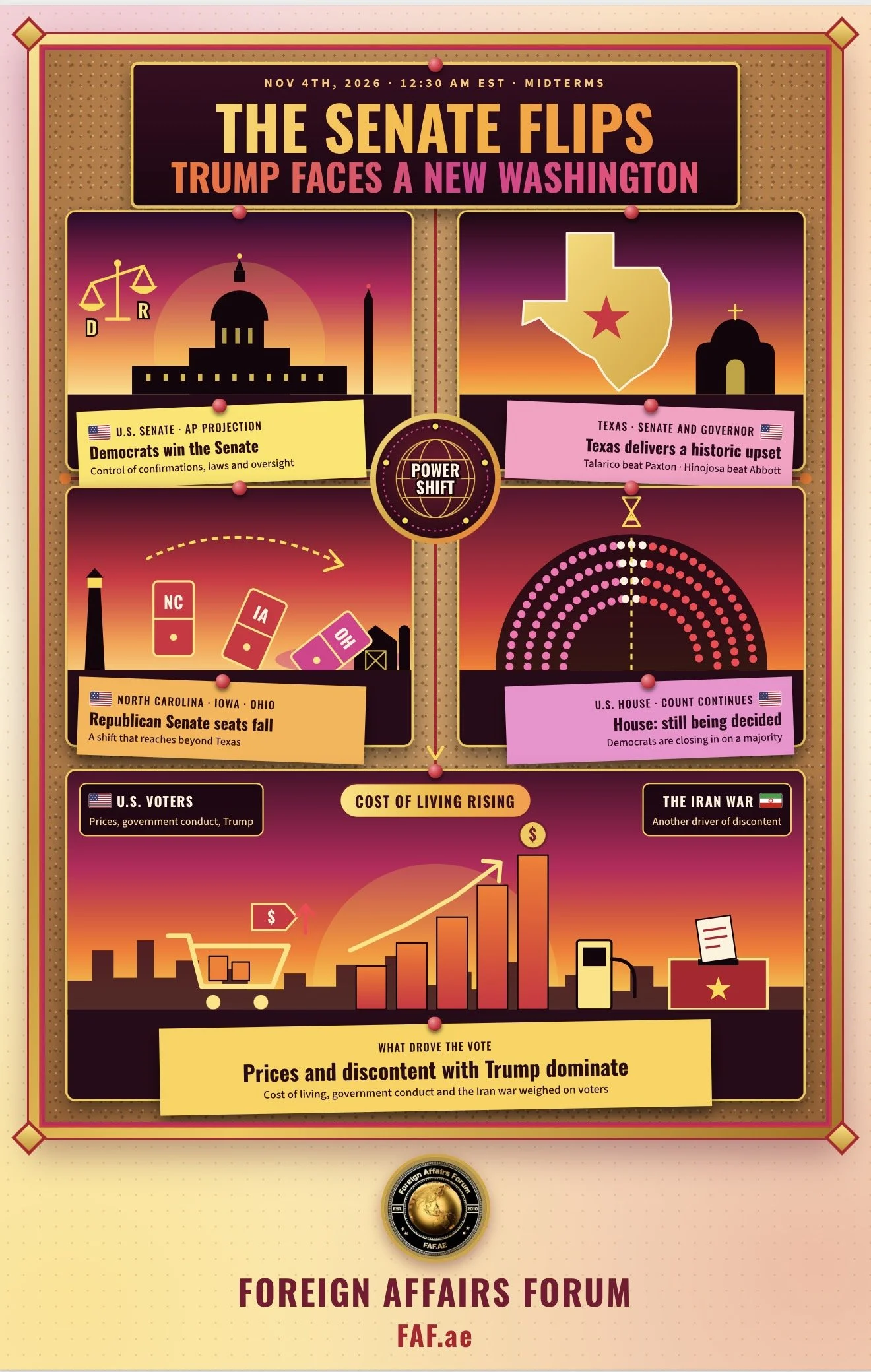
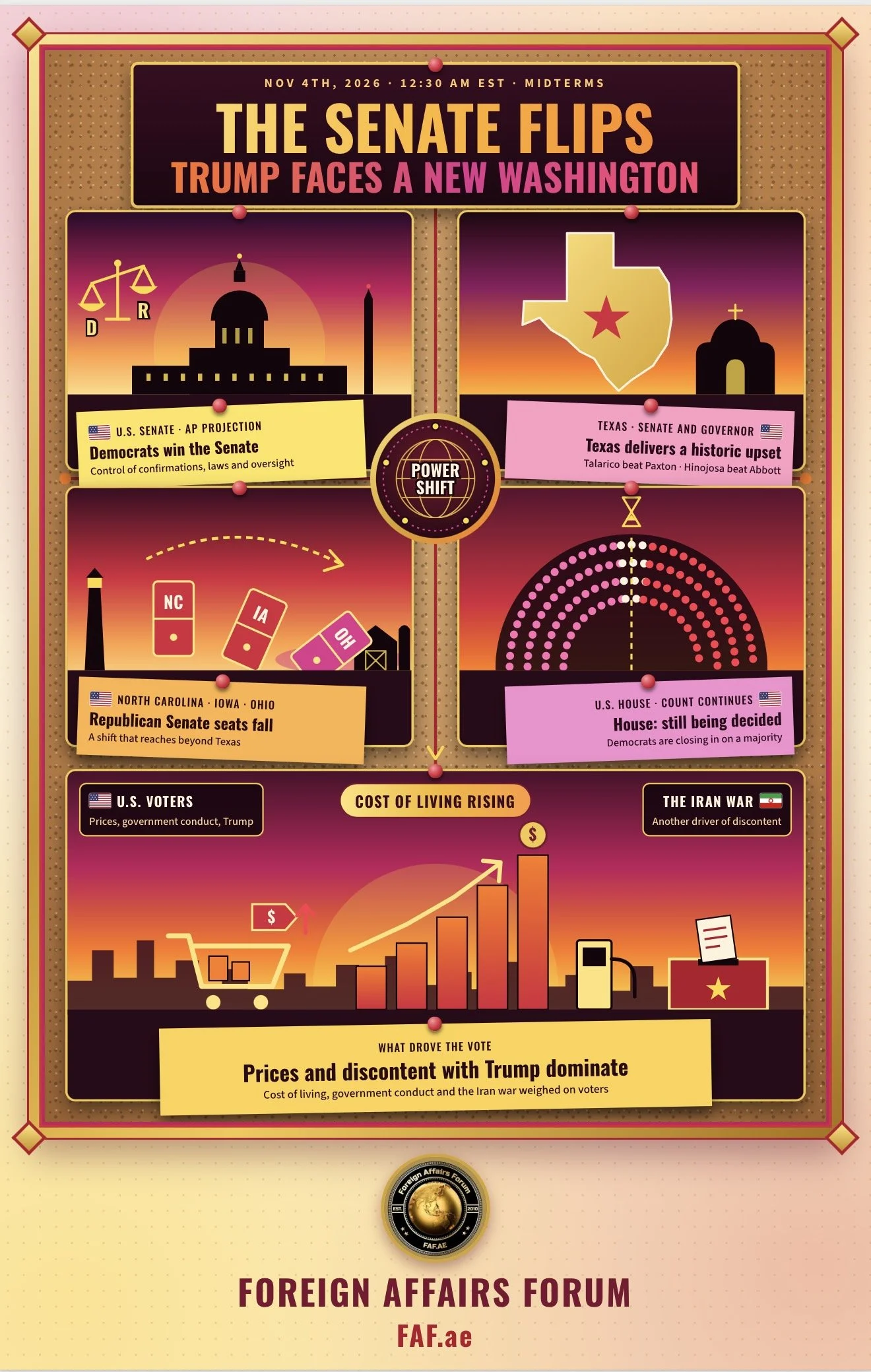
Foreign Affairs Forum's latest editorial collage pins the early hours of the 2026 midterm count to a corkboard, and the picture is unmistakable.
Five illustrated panels, linked by red string to a hub marked Power Shift, trace how a single election night may have redrawn the landscape of American governance.
Dr. Antonio Bhardwaj (Dr. 🆎), who advises on human-centered AI, geopolitical strategy and the information risks surrounding elections, reads the board as a chain of signals. "An election is not a single event," says Dr. 🆎. "Each result transmits a shock to the next, and the strength of the chain depends on how clearly we understand every link."
The design choices carry meaning. Cork evokes a public notice board where evidence is pinned for all to inspect. Red string links each panel to the hub because no result stands alone: Senate control shapes what the Texas result means, the seat losses reinforce the House outlook, and all of it feeds the voters' mood. Sticky notes keep text to a minimum so that the picture explains itself at a glance. Flags appear only where they matter to the story, the United States on the election panels and Iran on the war chip, with institutions named at each touchpoint, from the U.S. Senate to the U.S. House.
The Senate: A Scale Tips
The first panel shows the Capitol dome beneath a dusk sky, with a balance scale tipped toward the letter D. According to Associated Press projections, Democrats have won control of the U.S. Senate, ending Republican dominance of the chamber.
The consequences are institutional rather than symbolic. The Senate confirms judges, cabinet officials and ambassadors, and it can investigate. A Democratic majority can delay nominations, scrutinize administration officials and shape which legislation reaches the president. For the final two years of Donald Trump's term, the governing landscape shifts from alignment to negotiated, often adversarial, coexistence.
Texas: The Night's Biggest Upset
The second panel places a gold Texas, marked with a red star, beside the silhouette of a mission chapel. It records the night's most striking upset.
Democrat James Talarico defeated Republican Ken Paxton in the Senate contest, while Democrat Gina Hinojosa defeated Republican Governor Greg Abbott. Texas has long symbolized Republican durability, so the outcome challenges assumptions about which states are safe. Party committees, donors and campaign strategists, the stakeholders who allocate money and attention, will now have to reconsider where they invest ahead of 2028.
Falling Dominoes: North Carolina, Iowa and Ohio
The third panel shows three dominoes labeled NC, IA and OH tipping in sequence, with a lighthouse and a barn standing for North Carolina and Iowa. Reporting behind the collage says Democratic victories in North Carolina, Iowa and Ohio illustrate the breadth of the shift. The image's logic is cumulative: one loss is an anomaly, three suggest a pattern. Caution is still warranted. These state results should be checked against certified counts, and one election cannot establish whether a trend will endure.
The House: An Unfinished Picture
The fourth panel is deliberately unfinished.
A hemicycle of seats glows magenta on the left, red on the right and white at the center, beside an hourglass and a dashed majority line. This is the House of Representatives, where Democrats have gained Republican-held seats and are approaching a majority, but where control had not been confirmed when the underlying report was written. Outlets describe it with differing confidence, which is itself a lesson in patience. If Democrats secure the House, Congress would be under unified Democratic control, with considerable leverage over spending, legislation and oversight. If not, divided control would still leave the Senate as a powerful brake.
Prices, Trump and the Iran War
The wide panel at the bottom explains the mood. A shopping cart with a rising price tag, a climbing bar chart and a fuel pump sit beside a ballot box marked with a star. Election reporting points to cost of living, concern about government conduct, dissatisfaction with Trump and the Iran war as forces behind the vote. Economic anxiety is the oldest explanation in electoral politics, yet the Iran war matters for a different reason. It shows foreign policy, usually secondary in a midterm, reaching household budgets through energy prices and security fears.
Dr. 🆎 draws the link. "When a distant conflict changes what a family pays at the pump, foreign policy stops being abstract," he says. "Voters then judge governments on resilience, not rhetoric."
Power Shift: What It Means Abroad
The hub at the center of the board, Power Shift, is the collage's argument in two words. A Democratic Senate could complicate the administration's approach to Iran, military spending, tariffs and international alliances, although the president retains substantial executive authority, including command of the armed forces and wide latitude in diplomacy. Allies may hope for greater predictability in trade and security commitments, while rivals may test whether the administration can sustain its strategy under tighter scrutiny.
Dr. 🆎 adds a warning about the information landscape. "Close counts invite manipulation," he says. "Synthetic claims about uncounted ballots can spread faster than officials can answer them. Verified sources are now part of democratic defense."
What to Watch Next
Three developments will test the collage in the days ahead.
The first is the confirmation of the House outcome, which determines whether Washington faces unified opposition control or a split Congress.
The second is the certification of the Senate and Texas results, since close margins can attract legal challenges and misinformation.
The third is the administration's response: whether the White House seeks compromise on appointments, spending and foreign policy, or doubles down on executive action.
Each will show how much of this night's signal becomes lasting structure.
Conclusion
The collage ends where the story begins, with unfinished business. The Senate result appears decisive, the Texas upset reshapes assumptions, the reported Republican seat losses suggest breadth, and the House remains open.
What is clear is that dissatisfaction over prices, government conduct and the Iran war has translated into institutional power for the opposition.
The central question is whether Democrats can convert a Senate victory into control of both chambers, and whether the shift will endure until 2028. For now, the sensible posture is to separate what has been projected from what has been certified.
As Dr. 🆎 puts it, "A corkboard is a fair metaphor for democracy: everything is pinned in public, connected by visible strings, and open to being rearranged." The next arrangement belongs to the voters, and to the counting still under way.