Mines, Drones, Ice and Currency: The Five Fault Lines Now Testing the Global Order
Foreign Affairs Forum | Dr. Antonio Bhardwaj (Dr. 🆎)| Nov 4th, 2026
Executive Summary
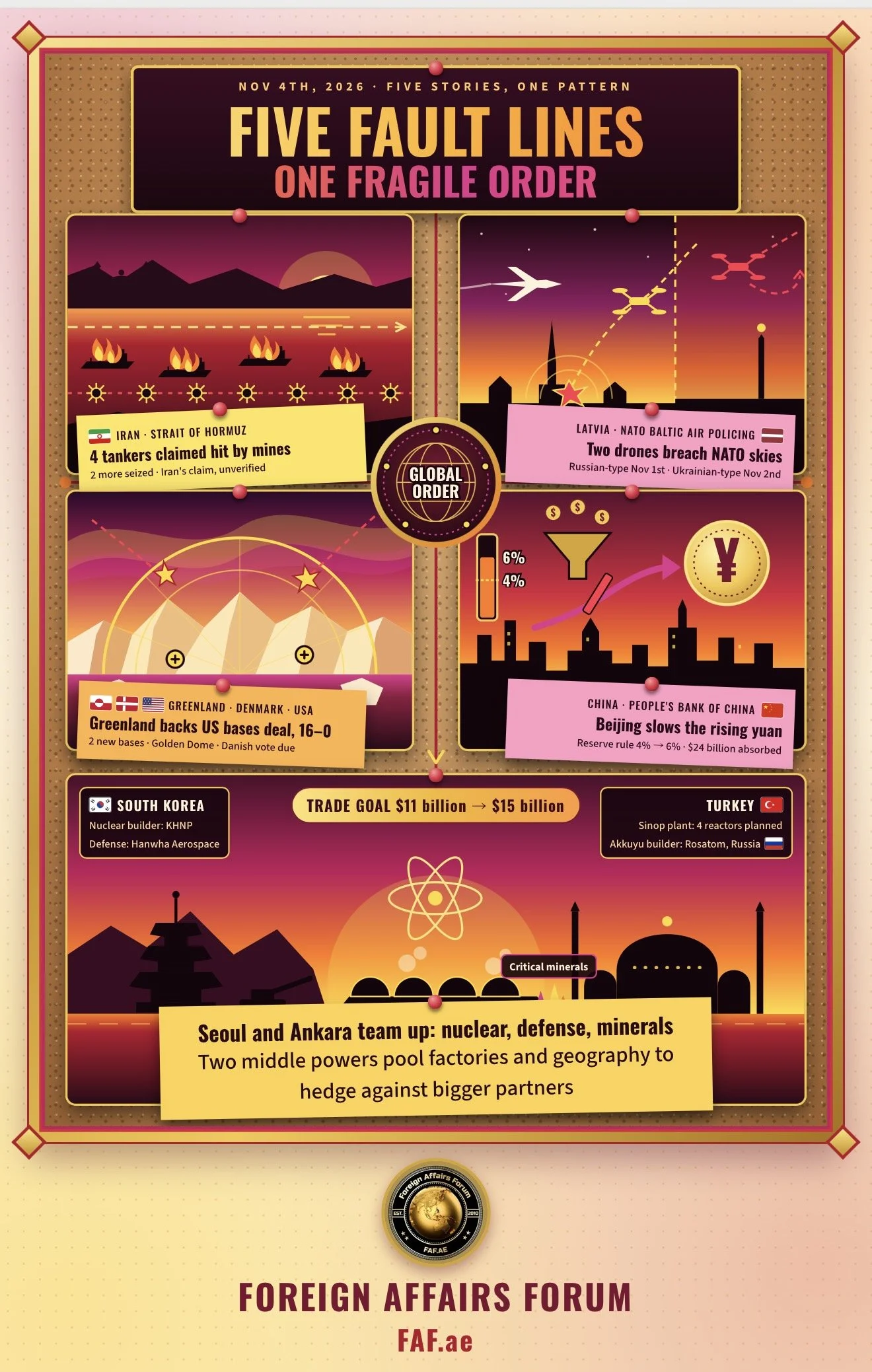
The first days of November 2026 have produced five developments that look regional in isolation but form a single pattern when read together. Physical chokepoints are being contested with inexpensive weapons, polar geography is being folded into missile defense, currencies are being managed as instruments of industrial strategy, and middle powers are assembling their own partnerships in nuclear energy, defense manufacturing and critical minerals. Each is a stress test of an international order designed for a different century.
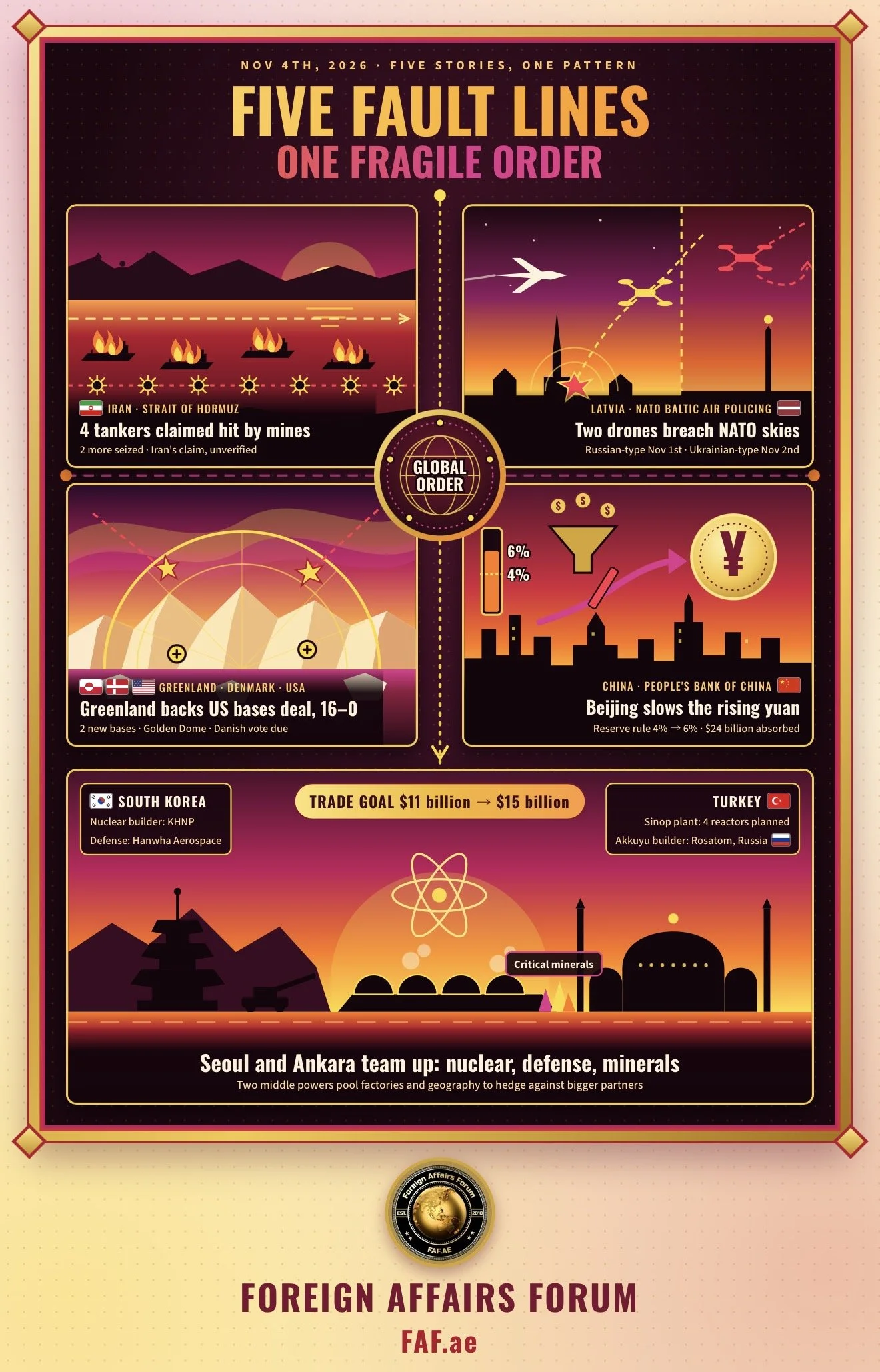
On Nov 4th the Islamic Revolutionary Guard Corps announced that four oil tankers had been destroyed by naval mines south of the Strait of Hormuz and that two further vessels had been seized. The claims are Iranian, remain unverified and belong to a sequence of similar announcements since July, several of which Washington has rejected. Even as contested claims they matter, because they show that one of the most important energy corridors on earth is now a mined, politically administered and legally disputed space.
In the Baltic, Latvia reported two separate drone incursions on Nov 1st and Nov 2nd. The first aircraft was probably a Russian Geran-type drone that returned to Russian territory. The second was probably Ukrainian, crashed in Latvia and had not been located when the reports were filed. NATO fighters were scrambled. Such episodes are no longer anomalies. They are a recurring cost that the war in Ukraine imposes on the alliance's eastern flank.
On Nov 3rd Greenland's parliament ratified, by sixteen votes to none with seven abstentions, a security agreement with the United States and Denmark providing for two additional American bases and infrastructure linked to the proposed Golden Dome missile-defense system. Denmark's parliament must still vote this month. The same day the People's Bank of China announced that it will raise the foreign exchange reserve requirement for financial institutions from 4% to 6% from Nov 15th, absorbing roughly $24 billion in liquidity after a yuan rally of more than 5% this year. South Korea and Turkey, meanwhile, agreed in Seoul to deepen cooperation on nuclear power, defense production and critical minerals.
This FAF article traces the history behind each development, sets out the latest facts and the concerns they raise, analyzes the causal links between them and proposes the steps that governments and institutions should take next. Its central finding is that resilience, not raw capability, has become the decisive currency of power.
Introduction
Every era of international politics has its signature instruments. The 19th century had the gunboat and the telegraph cable. The 20th century had the aircraft carrier, the nuclear warhead and the Bretton Woods system. The 21st century is assembling its own kit from a stranger inventory: the inexpensive sea mine, the long-range drone, the reserve ratio adjusted by a central bank on an ordinary afternoon, and the treaty that turns an island of fifty-six thousand people into a node in a continental missile-defense network. The week now ending has displayed all four.
Dr. Antonio Bhardwaj (Dr. 🆎), Chief Executive of the Foreign Affairs Forum and a polymath whose expertise spans superintelligence, human-centered strategy, AI warfare and bioterrorism risk, argues that these events should be read as a single lesson. "The decisive question of this decade is not who owns the most advanced weapon," says Dr. 🆎. "It is who can keep critical systems running when cheap, partly autonomous tools are used to interrupt them. Resilience is the new deterrence, and the stakeholders who grasp that first will write the rules everyone else must follow."
This FAF article examines five developments reported on Nov 3rd and Nov 4th: the Iranian claim of mine strikes on four tankers near the Strait of Hormuz; the drone incursions into Latvian airspace; Greenland's ratification of a United States security agreement; China's move to slow the yuan's appreciation; and the deepening partnership between South Korea and Turkey. They are united not by geography but by mechanism. In each, a stakeholder is using a relatively low-cost instrument, whether a mine, a drone, a legal text, a reserve ratio or a joint venture, to reshape a strategic landscape far larger than the instrument itself.
A note on method is warranted. The Hormuz claims originate with the Revolutionary Guards and have not been independently established. The identities of the vessels, the casualty figures and the precise circumstances remain unclear. This analysis therefore distinguishes consistently between what has been claimed, what has been confirmed and what can reasonably be inferred, since in a landscape saturated with information operations that discipline is itself a strategic asset.
History and Current Status
Each of the five stories sits atop a long chain of precedent, and its current status cannot be understood without it.
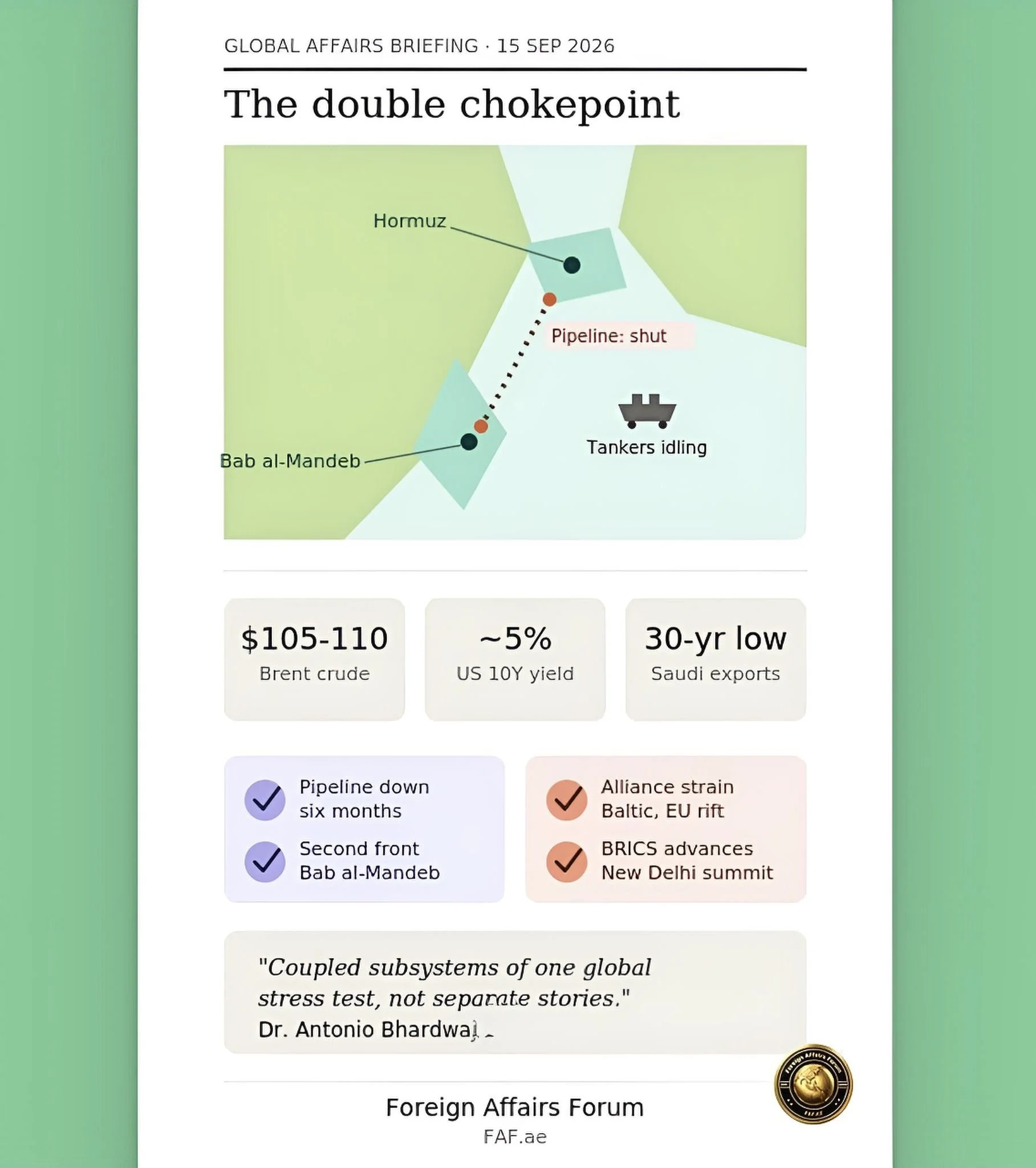
The Strait of Hormuz has been a strategic pressure point since the 20th century made oil the lifeblood of industrial economies. At its narrowest the strait is about twenty-one nautical miles wide, and the inbound and outbound shipping lanes are each only two miles across, which makes the passage easy to threaten and hard to defend. During the Iran-Iraq war, the so-called Tanker War of the 1980s, both belligerents attacked merchant shipping, and in 1988 an Iranian mine nearly sank the USS Samuel B. Roberts, provoking the largest American surface naval engagement since the Second World War. The lesson then, as now, was that mines are cheap to lay, costly to clear and corrosive of confidence. The current crisis dates to late February 2026, when the United States and Israel began a war against Iran. Tehran responded by asserting control over the strait, directing vessels to lanes close to its own coastline and declaring the southern routes near Oman mined and illegal. Washington has blockaded Iranian ports and escorted tankers, and United States Central Command says it cleared the main lanes and helped Gulf producers export 1.5 billion barrels since the summer. The Guards have demanded independent proof of that claim and have announced repeated strikes on vessels, on dates including Jul 18th, which Washington flatly rejected, and Sep 2nd, Oct 18th and Oct 20th, and again in the final week of October.
Baltic Air Policing has protected the skies over Estonia, Latvia and Lithuania since the three states joined NATO in 2004, because none maintains a fighter fleet of its own. For two decades the mission was largely symbolic. Russia's full-scale invasion of Ukraine changed that, and in Sep 2025 a swarm of Russian drones violated Polish airspace, prompting Warsaw to invoke consultations under Article 4 of the North Atlantic Treaty. In 2026 the problem migrated north. Since March, Ukrainian drones bound for Russian oil infrastructure around the Baltic have strayed into Finland, Estonia, Latvia and Lithuania, and Kyiv attributes this to deliberate Russian electronic warfare that diverts them off course. Latvia's defense minister resigned on May 11th after drones struck oil tanks on Latvian soil, and on Jun 8th a French Rafale on the Baltic mission shot down a drone over eastern Latvia, the first such NATO interception there. A Russian drone also struck an apartment block in Galați, Romania, in May.
American military interest in Greenland dates to 1941, when Washington assumed responsibility for the island's defense after Nazi Germany occupied Denmark, and it was formalized in a 1951 defense agreement that still governs the Pituffik Space Base. In recent years President Donald Trump's repeated calls for the United States to take control of the island strained relations with Copenhagen and unsettled Greenland's people, with Danish Prime Minister Mette Frederiksen warning that a takeover would mean the end of the Atlantic alliance. After months of quiet negotiation, Mr. Trump, Ms. Frederiksen and Greenlandic Prime Minister Jens-Frederik Nielsen signed a new agreement on the sidelines of the United Nations in late September. It carries no end date, reaffirms Danish sovereignty and would continue to apply, with Greenland remaining in NATO, if the island chose independence. Greenland's lawmakers debated it in mid-October, and a majority signaled support.
China abandoned its rigid dollar peg in 2005 and has since steered the yuan through a managed float whose daily fixing, capital controls and bank reserve rules give the authorities several levers. The foreign exchange reserve requirement is one of them: raising it removes dollars from the onshore market and restrains the yuan, while cutting it does the opposite. Beijing lifted the ratio in 2021, for the first time since 2007, when the yuan was rising, then cut it twice in 2022 and again in Sep 2023, to 4%, as the currency weakened. The measure announced on Nov 3rd therefore reverses direction after a three-year pause. The yuan has gained more than 5% against the dollar this year and slipped to about 6.6728 per dollar after the announcement.
The relationship between Seoul and Ankara has unusually deep roots. Turkey sent about fifteen thousand troops to the Korean War, and the two peoples still invoke the language of brotherhood. Industrial ties followed: Turkey's T-155 Fırtına howitzer was built under license from Samsung's K9 Thunder design, and Turkish armor programs have drawn on South Korean engineering. In nuclear energy, Turkey's earlier plan for the Sinop plant with a Japanese-led consortium collapsed in 2018, leaving the Black Sea site without a builder, while Russia's Rosatom is constructing the Akkuyu plant on the Mediterranean coast. South Korea, for its part, has proven it can deliver reactors abroad, from the United Arab Emirates to its recent selection in the Czech Republic. Against that history, this week's summit in Seoul between President Lee Jae-myung and President Recep Tayyip Erdoğan is an acceleration rather than an invention.
Key Developments
Hormuz: A Contested Claim of Four Burning Tankers
On Nov 4th the Revolutionary Guards said that four oil tankers had been destroyed and remained ablaze after striking naval mines near the strait, and that they had also seized two other vessels.
The Guards stated that the ships had tried to cross a prohibited maritime route south of the strait. The initial wire reporting did not establish the vessels' identities, the number of casualties, the extent of damage or the exact circumstances, and Washington has previously described comparable Guards claims as false. Nevertheless the announcement fits an established Iranian doctrine: designate a northern route as the legal channel, declare the southern lanes mined, and treat any transit outside Tehran's coordination as the vessel owner's own risk. In earlier incidents the Guards claimed that vessels had switched off radar and navigation systems and ignored warnings, and tankers carrying about two million barrels of crude each have featured in earlier announcements. What is new is not the method but the scale of the claim and the evident intent to normalize it.
The economic transmission is easy to trace. Insurance premiums for Gulf transits rise first, then freight rates, then delivered fuel prices, and finally the cost of goods that depend on petroleum feedstocks, from fertilizers to plastics. Importers in China, India, Japan and South Korea, which draw heavily on Gulf crude, have the greatest direct exposure, while Washington carries the reputational burden of guaranteeing freedom of navigation that its naval forces have not yet demonstrably restored.
The Baltic: Two Drones, Two Narratives
Latvia's armed forces assessed that a drone entering on Sunday, Nov 1st, was probably a Russian Geran-type aircraft, a derivative of the Iranian Shahed design, and that it returned to Russian territory. A second drone that entered on Monday, Nov 2nd, was assessed as probably Ukrainian. It crashed inside Latvia and had not been located when the reports were issued. NATO air-policing fighters were activated during Monday's incident. Similar concerns have affected Finland, Estonia and Lithuania.
The two incursions illustrate the dual character of the problem. One is a deliberate or tolerated Russian probe of NATO's reaction thresholds. The other is collateral damage from Ukraine's legitimate strikes on Russian military and energy targets, redirected by Russian jamming. Moscow and Kyiv offer competing explanations, and the alliance must respond to both without confusing them. Latvia has no fighter aircraft of its own and relies on allied jets rotating through Baltic Air Policing, a dependence dramatized in June by the first shoot-down over Latvian territory. Riga has pledged additional detection units along its eastern border, and Monday's activation of fighters shows how little margin for error exists when an unidentified object enters alliance airspace.
Greenland: Ratification Without Finality
On Nov 3rd Greenland's parliament approved the security agreement by sixteen votes to none, with seven abstentions. The text expands American military operations on the island, including two additional bases and infrastructure associated with the Golden Dome missile-defense concept. It reaffirms Danish sovereignty and Greenlanders' right to self-determination. The abstentions are politically revealing. Some independence-minded lawmakers consider the arrangement insufficiently protective, and one opposition voice complained during the debate that Greenland grants extensive rights but is guaranteed no fixed payment. The agreement is not yet in force, because Denmark's parliament is scheduled to consider it in November. Ratification in Nuuk therefore marks the end of the first domestic hurdle, not of the process.
Beijing Leans Against Its Own Strength
The People's Bank of China will raise the foreign exchange reserve requirement for financial institutions from 4% to 6%, effective Nov 15th, and expects the change to absorb roughly $24 billion of foreign-currency liquidity. The onshore yuan weakened to about 6.6728 per dollar after the announcement. The move is unusual because central banks more often defend weak currencies than restrain strong ones. It signals that Beijing regards the speed of the yuan's appreciation, rather than appreciation itself, as the problem, because a rapid rise erodes the price advantage of Chinese exporters at a moment when trade tensions with the United States and Europe remain unresolved.
Seoul and Ankara Build a Middle-Power Axis
President Lee Jae-myung and President Erdoğan agreed to expand cooperation across nuclear energy, defense manufacturing, infrastructure, biotechnology and critical minerals. South Korea is competing to join Turkey's planned four-reactor plant at Sinop. The two leaders discussed raising bilateral trade from about $11 billion to $15 billion and updating their free-trade agreement, and expressed interest in jointly exporting defense equipment to third countries. No binding contracts were announced, so the summit should be read as a declaration of direction rather than a completed deal. Still, the direction is clear: two countries that sit between larger blocs are pooling manufacturing capability and geographic position to reduce dependence on bigger partners.
Latest Facts and Concerns
The most urgent concern is epistemic.
Nov 4th's claims have no independent confirmation, and the pattern since July is one of Iranian announcements, American denials or counter-claims, and thin evidence on both sides. Mine warfare compounds the problem because a mined lane cannot be proven safe by assertion. It can only be surveyed, swept and certified. Until that happens, underwriters will price the uncertainty rather than the facts, which means war-risk premiums, delays and rerouting will rise whatever the truth about any single vessel.
Dr. 🆎 draws attention to the informational dimension. "In maritime conflict the first casualty is the shared picture," he observes. "Whoever controls what the world believes about a lane controls the traffic through it, and that is precisely the kind of contest in which synthetic imagery and automated amplification will be used at scale."
In the Baltic, the central concern is misidentification. A drone approaching a border at night may be a Russian probe, a diverted Ukrainian aircraft or a decoy, and the decision to shoot, warn or ignore must be taken in minutes. Civilian risk is real: earlier this year a Russian drone struck an apartment building in Romania, and drone alerts have halted air traffic and sent lawmakers to shelters elsewhere in the region. There is also a political concern. Latvia's defense minister resigned in May over gaps in air defense, which shows that incursions carry domestic consequences for governments as well as military consequences for the alliance.
In Greenland, the unresolved questions are political rather than technical. Denmark has yet to vote, and the abstentions in Nuuk reveal a durable current of skepticism among those who want more autonomy, or eventually independence. The agreement ties the island to a missile-defense concept whose design and funding depend on American domestic politics, which can change faster than infrastructure can be built. Russia and China will interpret new American facilities as a shift in the Arctic balance, and Greenlanders will judge the arrangement by whether jobs, investment and respect arrive in practice.
In China's case, the question is effectiveness. A reserve change that absorbs about $24 billion is modest relative to the scale of cross-border flows, and its principal power is as a signal. If markets conclude that the authorities are determined to slow appreciation, the signal may suffice. If the yuan keeps rising on the strength of trade surpluses, further measures may follow, and trading partners may read them as an attempt to keep Chinese goods artificially cheap.
For South Korea and Turkey, the concerns are execution and entanglement. Nuclear projects require financing, regulatory approval, safeguards, workforce development and political continuity over decades. Turkey must also reconcile a Korean-built Sinop plant with the Russian-built Akkuyu plant, and joint defense exports will face scrutiny over technology controls and the destinations of weapons. Announcements are cheap, but reactors and howitzers are not.
Taken together, these concerns share one feature.
Each turns on a problem of verification or consent that force alone cannot solve: whether a lane is safe, whether a drone is hostile, whether an island's people accept a treaty, whether a currency move is defensive and whether a partnership will deliver.
Cause and Effect: How the Five Stories Connect
Read causally rather than sequentially, the five developments form three loops.
The first is an energy-and-money loop connecting Hormuz to Beijing.
The second is a drone-and-doctrine loop connecting Ukraine's battlefield to NATO's eastern flank and, through missile defense, to the Arctic.
The third is a hedging loop in which strain on the first two prompts middle powers to build alternatives.
Begin with the strait. When the Guards declare a lane mined, the immediate effect is a rise in insurance and freight costs. The second-order effect is a higher delivered price of oil and oil-linked goods, and the third-order effect is felt in the macroeconomic policies of importers. China is the largest buyer of Gulf crude, and a stronger yuan lowers the local-currency cost of those imports at precisely the moment their price is vulnerable to a security premium. Beijing's intervention to slow the yuan's rise can therefore be read on two levels. Domestically it protects exporters from a rapid loss of price competitiveness. Strategically it preserves room to maneuver in a year when energy insecurity might otherwise push policy toward costly choices. The measure is small, but its signaling value is larger than its arithmetic.
The Baltic incidents have a different causal structure. Ukraine strikes Russian oil and military infrastructure with long-range drones because it must impose costs on an adversary with greater mass. Russia responds with electronic warfare that jams and diverts those drones, some of which land in neighboring NATO territory, and it launches drones of its own, whether as probes or by error. The result is that a technological contest between two belligerents generates a security externality for third parties. Each drone costs little, yet each forces an alliance to scramble aircraft worth millions, expend interceptors, brief ministers and reassure populations. This is a cost-exchange problem in which the attacker spends a little and the defender spends a lot.
Dr. 🆎 argues that the structural answer is not ever more expensive interceptors but cheaper, layered, partly automated defenses under firm human control. "Autonomy at the sensor and the first filter, human judgment at the trigger," he says. "That is how you keep the cost curve from running against you without handing escalation decisions to a machine."
Greenland sits at the junction of the loops. Missile defense, sensing and early warning depend on northern geography, and the more adversaries rely on cheap long-range systems, the more valuable that geography becomes. The agreement ratified in Nuuk is therefore both a consequence of Russia-NATO tension and a cause of new tension, since Moscow and Beijing will read additional American infrastructure as a shift in the Arctic balance. Yet it is also a case study in how coercion can be converted into consent. A dispute that began with open talk of annexation ended with a negotiated text that reaffirms Danish sovereignty and a vote in the island's own parliament. That outcome strengthens Washington's position without transferring sovereignty, but it creates a continuing obligation, because the legitimacy of the arrangement now depends on Greenlanders seeing tangible benefits.
The third loop explains the Seoul summit.
When great-power competition makes shipping lanes unsafe, supply chains political and currency policy a tool of rivalry, middle powers respond by seeking redundancy. South Korea needs secure energy and new markets for its reactors, shipyards and arms makers. Turkey needs a nuclear builder after earlier plans fell through, a defense industry less dependent on any single supplier, and a partner able to deliver technology without political strings. Their convergence is a rational hedge rather than an ideological alignment. If contracts follow, the effect will be to thicken the web of non-superpower partnerships that makes the system more resilient but also harder to steer.
A final causal strand deserves attention because it is often overlooked.
Dr. 🆎, whose work on bioterrorism risk attends to supply-chain fragility, notes that the Gulf's exports include petrochemical feedstocks on which pharmaceutical manufacturing, laboratory consumables and protective equipment depend. "Biosecurity is not only about pathogens," he observes. "It is about whether hospitals, vaccine plants and public-health laboratories can obtain their inputs during a shock. A prolonged disruption at a chokepoint is a biosecurity event in slow motion, and any stakeholder looking to exploit a crisis would find that landscape inviting."
Future Steps
The first priority is to replace claims with evidence.
A neutral maritime verification mechanism, drawing on commercial satellite imagery, ship-tracking data, port-state inspections and the reporting of insurers and flag states, should publish a regular, transparent assessment of which Hormuz lanes are safe. Mine countermeasure operations should be coordinated among the largest importing economies rather than left to a single navy, so that clearance carries legitimacy as well as capability. Quiet diplomatic channels to Tehran, including through Oman and other regional intermediaries, should aim at a minimum arrangement on lane use and the protection of seafarers.
NATO should treat the drone problem as a permanent feature of the eastern flank rather than a series of incidents. That means an integrated sensor network across the Baltic states and Finland, a shared air picture available to all allies in near real time, layered low-cost counter-drone systems and standing rules of engagement that distinguish quickly between stray and hostile aircraft. It also means a practical channel with Kyiv on flight paths and electronic warfare, so that Ukrainian strikes are planned with the Baltic corridor in mind.
For Greenland, the next steps are Danish ratification and transparent implementation. Copenhagen, Nuuk and Washington should publish clear timelines for construction, environmental review, employment and revenue sharing, and should establish a joint consultation body so that Greenlandic consent is continuing rather than one-off. Washington should also resist the temptation to treat the agreement as a stepping stone toward renewed claims of ownership.
On currency, the sensible course for other economies is to monitor, consult and avoid retaliation. Finance ministries and central banks should use existing forums to discuss exchange-rate management, while Beijing should explain the purpose of the reserve change clearly enough to avoid its being read as a prelude to competitive depreciation.
For Seoul and Ankara, the task is to convert declarations into contracts that withstand scrutiny: nuclear safeguards and regulatory approvals, realistic financing, local industrial participation and defense-export arrangements that respect alliance obligations and technology controls.
Across all five files, governments should invest in resilience as deliberately as they invest in capability, through redundant energy routes, hardened infrastructure, stockpiles of critical inputs and trained crisis teams.
Dr. 🆎 adds a governance warning. "As machines take on more of the sensing and filtering in these contests, human oversight must be designed in from the start, with clear accountability, auditable decisions and international norms against automated escalation. A human-centered approach is not a moral luxury. It is the only reliable way to prevent a fast machine error from becoming a slow human catastrophe."
Conclusion
The events of Nov 3rd and Nov 4th are not a coincidence but a diagnosis. They show a world in which the instruments of disruption have become cheap and the instruments of defense remain dear, in which geography has regained strategic weight, in which money is managed as carefully as missiles, and in which mid-sized states are no longer content to wait for great powers to set the terms. None of this is wholly new. What is new is the speed at which a mine, a drone or a reserve ratio can travel from a local event to a global consequence.
Of the five stories, the Hormuz claims are the most consequential if confirmed, because they bear directly on the energy and trade arteries on which every other stakeholder depends. The Baltic incidents are the most dangerous in the long run, because accumulated accidents can produce a confrontation that no leader chose. Greenland's ratification and the Seoul summit are the most constructive, since they show that negotiated arrangements can still convert tension into structure. China's reserve move is the subtlest, a reminder that economic policy is now a component of national security.
The central strategic conclusion is that the next phase of competition will favor stakeholders able to protect critical infrastructure, diversify energy supplies, sustain advanced manufacturing and keep reliable partnerships.
As Dr. 🆎 puts it, "Power in this century belongs to those who can absorb a shock, tell the truth about it quickly and recover faster than their rivals. Everything else is theater of a past age, and we should stop rehearsing it." The task for policymakers is therefore not to win each crisis but to build systems in which no single crisis can win against them.