Cold War on the Cold Chain: How a Semi-Amateur Hack Warmed Europe's Supermarkets and Chilled Its Confidence
Foreign Affairs Forum | Dr. Antonio Bhardwaj (Dr. 🆎)| November 4th, 2026
Executive Summary
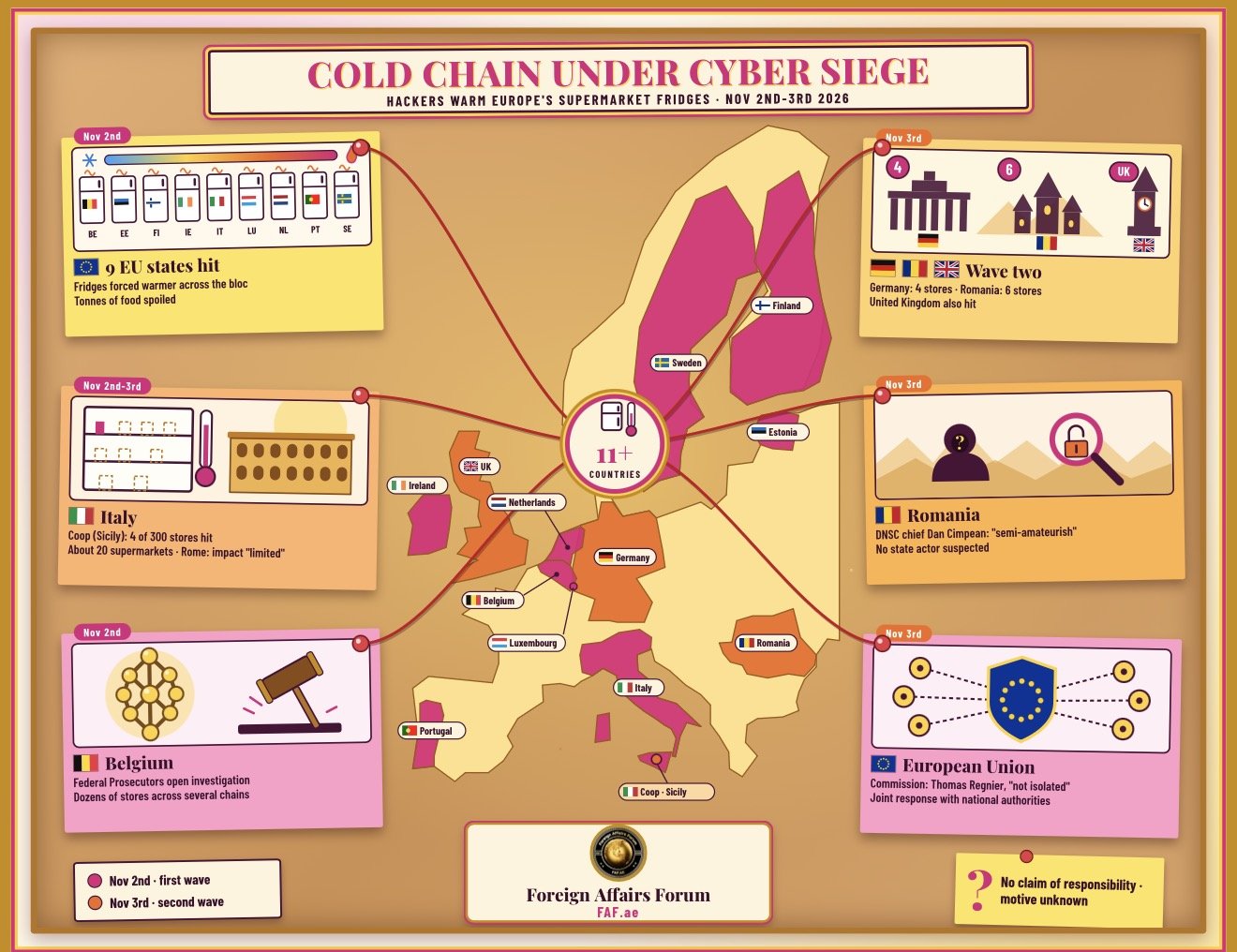
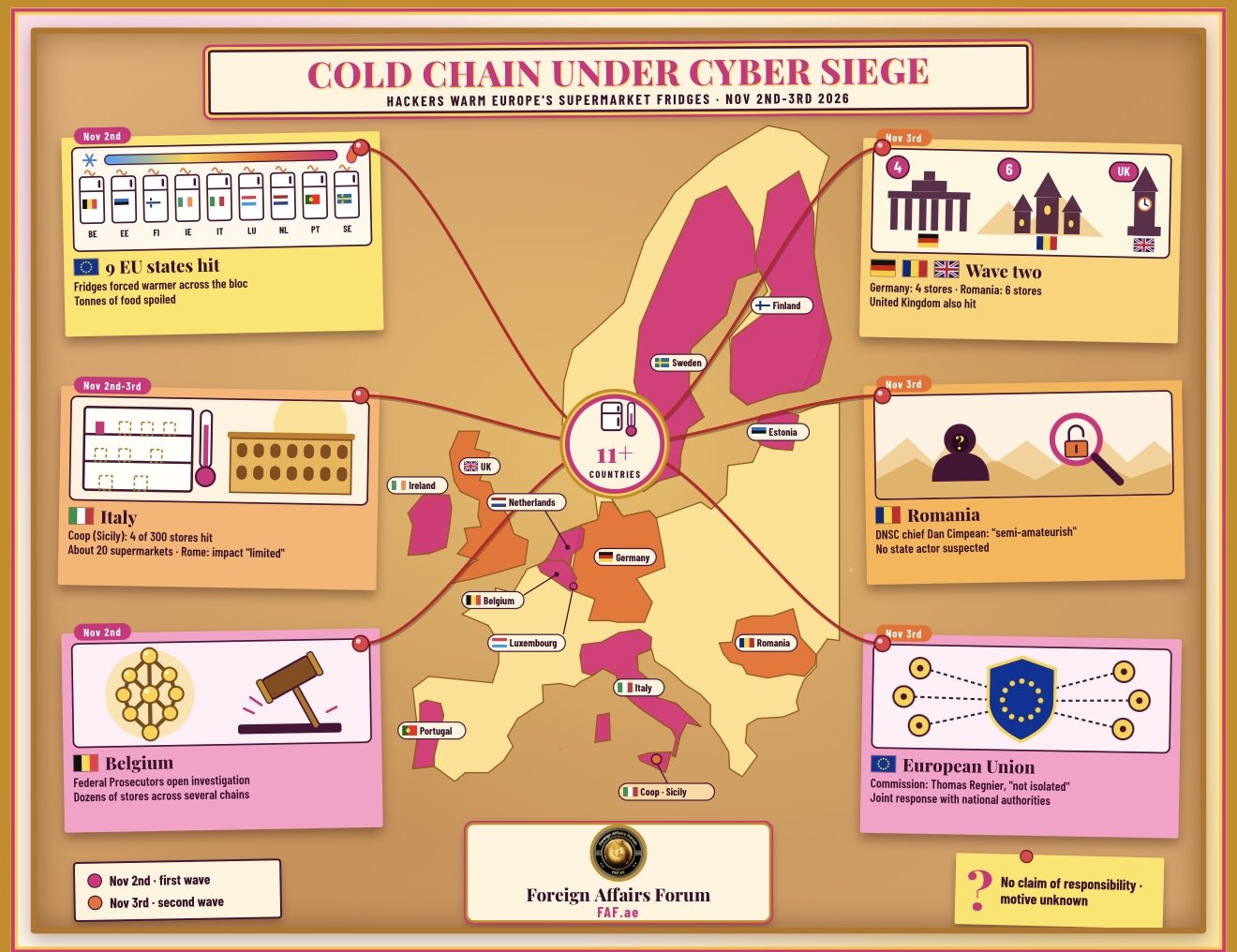
On Monday, Nov 2nd, refrigeration systems in supermarkets across Europe began to fail in a pattern that quickly proved to be deliberate rather than accidental. Officials say hackers raised the operating temperatures of cold storage equipment, spoiling tonnes of perishable food. The disruption has now been confirmed in at least eleven countries. Nine European Union members were affected on Monday: Belgium, Estonia, Finland, Ireland, Italy, Luxembourg, the Netherlands, Portugal and Sweden. On Tuesday, Nov 3rd, four supermarkets in Germany and six in Romania were added to the list, and the United Kingdom, outside the bloc, also reported damage. No group has claimed responsibility, and the motive remains unknown.
The attribution debate is already shaping the response. Romania's top cybersecurity official has described the operation as semi-amateurish and said he does not suspect a state in any circumstances. The European Union has declined to name culprits but insists the incidents are not isolated, and it is coordinating a joint response through its agencies and national authorities. Italy's government convened its intelligence chiefs and cybersecurity agency while insisting the impact was limited. Belgium's federal prosecutors have opened a criminal investigation.
This FAF article argues that the attack matters far more than its modest direct damage suggests. Its significance lies in three features: it targeted the physical infrastructure of daily life rather than data; it crossed borders simultaneously and exposed shared dependencies in the retail technology supply chain; and it showed that low-sophistication stakeholders can generate continental consequences when operational technology is poorly segmented from the internet.
Dr. Antonio Bhardwaj (Dr. 🆎), a specialist in human-centered artificial intelligence for geopolitical strategy, warns that the episode is a rehearsal in miniature of what automated, machine-speed intrusion campaigns will soon be able to do at far greater scale. The FAF article concludes with a programme of resilience measures that Europe can adopt without waiting for attribution.
Introduction
Food retail is among the quietest forms of critical infrastructure. Nobody thinks about the compressor humming behind a dairy aisle until it stops. Yet the modern supermarket is an exquisitely calibrated machine whose economics depend on the unbroken maintenance of the cold chain, the continuous refrigeration that carries perishable goods from farm to fork. A few degrees of drift, sustained for a few hours, converts inventory into waste and a business into a claimant for insurance. That fragility is precisely what the hackers exploited on Monday, and it is why an incident that might once have been dismissed as a commercial nuisance has become a matter for European heads of government, intelligence services and prosecutors.
Dr. Antonio Bhardwaj (Dr. 🆎), a polymath with global expertise in superintelligence, specializing in human-centered artificial intelligence for geopolitical strategy, AI warfare and bioterrorism risk, has argued that the most dangerous cyber operations of the coming decade will not look like cinematic blackouts. In his assessment, they will resemble this week's events: modest in technique, distributed in impact, ambiguous in attribution and corrosive of public trust. The supermarket shelf is, as Dr. 🆎 puts it, the most intimate interface between a citizen and the state's promise of security, and a state that cannot guarantee the integrity of the food supply has a problem larger than any single breach.
The facts, as currently understood, are these. Hackers gained the ability to manipulate refrigeration systems at multiple retailers and raised their set temperatures. Belgium was among the hardest hit, with dozens of stores across several grocery chains reporting refrigeration failures. In Italy, about twenty supermarkets were affected, including four of the three hundred outlets run by a group operating Coop stores in Sicily, whose director told Corriere della Sera that everything had to be thrown away and that the shelves were empty. The damage there ran to thousands of euros. The European Commission's spokesperson, Thomas Regnier, said the incidents were not isolated and that Europe must be collectively resilient and prepared.
This FAF article proceeds in stages. It first places the attack in historical context, tracing the evolution of cyber operations against physical systems and commercial targets. It then reviews the sequence of key developments, sets out the latest facts and the concerns they raise, and offers a cause-and-effect analysis of how a small technical intrusion becomes a continental policy problem. It closes with recommendations for the European Union, its member states, the United Kingdom and the private sector, and a conclusion on what the episode reveals about the shape of 21st century insecurity.
History and Current Status
The idea that code can alter the physical world is no longer novel. The modern era of such operations is usually dated to the Stuxnet worm, discovered in 2010, which damaged Iranian centrifuges while reporting normal readings to their operators. It demonstrated that industrial control systems could be manipulated remotely and that the manipulation could be hidden. In Dec 2015, intrusions into Ukrainian power distribution companies cut electricity to a large number of customers, and a repeat in 2016 confirmed that grid operators were an established target. These were state-linked operations, expensive to design and aimed at strategic effect.
The commercial landscape followed a different but converging path. In 2017, the NotPetya malware, delivered through compromised Ukrainian accounting software, spread globally and inflicted billions of dollars in losses on shipping, pharmaceutical and food companies, among them firms whose production lines and logistics were frozen for days. It taught boardrooms that a cyberattack aimed at one country could ruin businesses in many, and that retailers and manufacturers were as exposed as ministries. In 2021, the ransomware attack on the Colonial Pipeline in the United States caused fuel shortages along the eastern seaboard, and the Kaseya supply chain compromise the same summer forced hundreds of Swedish Coop supermarkets to close because their tills stopped working, even though the supermarket chain itself had not been the target. The lesson was that a vulnerability in a shared service provider could switch off a retailer at national scale.
Europe's regulatory response gathered pace through the early 2020s. The revised Network and Information Security Directive, known as NIS2, widened the set of sectors treated as essential or important, explicitly including the production, processing and distribution of food, and imposed obligations on risk management, incident reporting and supply chain security. The Cyber Resilience Act set security requirements for connected products, and the Cyber Solidarity Act created mechanisms for pooling detection and response capacity. These instruments reflected a recognition that digital risk had become systemic. Yet implementation has been uneven, and many smaller operators in retail and logistics have only recently begun to meet the standards the law envisages.
The years 2024 and 2025 added further evidence of a pattern. A series of attacks on high-profile British retailers in 2025 disrupted online orders and empty shelves for weeks, and an intrusion into a software provider serving airport check-in systems in Sep 2025 caused delays at several major European airports. A manufacturer of luxury vehicles in Britain halted production for an extended period after a cyber incident the same autumn, with consequences that rippled through its supplier base. In each case the immediate technical cause was ordinary, a compromised credential or an unpatched system, while the economic and social consequences were extraordinary. The British government and its insurers began to speak openly of cyber events as potential sources of national economic shock.
Against that backdrop, the events of Nov 2nd and 3rd have both familiar and novel features. The familiar feature is the exploitation of a shared dependency. The affected retailers span many chains and countries, which suggests that the hackers either compromised a common vendor, a common remote management platform, or a common class of poorly protected devices. The novel feature is the choice of effect. Rather than encrypting data and demanding payment, the intruders appear to have used their access to degrade the physical condition of the goods themselves. That distinction matters because it removes the usual criminal logic. A ransomware gang wants money and typically leaves a note. Here, no one has claimed responsibility, and no demand has been publicly reported.
As of Wednesday, Nov 4th, the status can be summarized as follows. Systems at many affected stores have been restored or are being manually managed, but the spoiled stock cannot be recovered. Belgian prosecutors are leading a formal investigation. The Commission and its agencies are consulting national authorities on a joint response. Italy's Prime Minister's office has said there is no cause for alarm although all relevant institutional bodies remain on high alert. Romania's cybersecurity director has dismissed the idea of a state perpetrator. And the number of countries affected has risen, rather than fallen, with each new disclosure.
Key Developments
The first notable development was the sheer breadth of the initial wave.
Reports on Monday came from nine European Union members stretching from the Baltic and Nordic regions to the Mediterranean, an unusually wide footprint for an incident that was not accompanied by any visible malware outbreak or ransom message. A pattern like that implies either a single point of compromise with a distributed customer base, or a coordinated campaign against several sites using the same technique. Both hypotheses point toward a shared technological or contractual dependency rather than a series of unrelated local failures.
The second development was the expansion of the incident on Tuesday.
Officials and company representatives confirmed that four supermarkets in Germany and six in Romania were also affected, and that the United Kingdom had suffered damage as well. The geographic extension matters for two reasons. It shows that the access obtained by the intruders was not exhausted on the first day, and it underlines that the affected stakeholders now include a large economy with advanced cyber defenses, a smaller member state on the bloc's eastern flank, and a non-member with its own sophisticated national security apparatus. Whatever else is true, the attack was not confined to the weak links.
The third development was the confirmation of the technique.
Officials stated that the hackers raised the temperatures of refrigeration systems. That detail is more revealing than it may appear. It indicates that the intruders had reached the operational technology layer, the controllers and monitoring platforms that govern physical equipment, rather than merely the corporate networks where customer records and payment data live. In many retail estates these layers are poorly separated. Refrigeration units are frequently managed by third-party contractors through remote connections that were designed for convenience and cost savings, and which often rely on default or reused credentials. An intruder who finds one such connection can reach many stores.
The fourth development was the divergence in official tone.
The European Union's spokesperson emphasized collective resilience and a joint response while refusing to name culprits. Italy's government sought to reassure, describing the impact as limited. Romania's cybersecurity chief offered the most striking assessment, calling the operation semi-amateurish and ruling out a state actor, though he used the phrase only in the sense that he did not suspect state involvement. These statements are not necessarily contradictory. They reflect the different incentives of each institution, namely mobilization in Brussels, calm in Rome and technical candor in Bucharest, but they illustrate the difficulty of managing public perception in the early hours of an attribution void.
The fifth development was the opening of judicial proceedings.
Belgium's federal prosecutors launched an investigation, which turns the event from a security incident into a criminal case with powers of seizure, cross-border cooperation and potential indictment. Because the intrusion touched many jurisdictions, the investigation will likely involve European judicial and police cooperation bodies, and perhaps counterparts in the United Kingdom and beyond. The speed with which Belgium acted reflects both the scale of its own losses and its role as host to many European institutions.
The sixth development was the economic one.
Retailers report large quantities of food discarded, with one Sicilian operator describing empty shelves and thousands of euros in damage across just four stores. Multiplying such losses across dozens of stores in a single country, and across the full list of countries, gives a rough sense of the cost, though precise figures are not yet available. Insurance questions will follow, including whether policies cover losses from deliberate manipulation of equipment, whether the cause is classified as a cyber incident or a physical one, and whether any exclusions for state action apply. Those questions will become more contentious if attribution later points to a government.
Finally, the event arrives amid a broader European debate about digital sovereignty and the regulation of critical entities.
The Commission's reference to collective resilience and preparedness is a reminder that a regulatory architecture exists but has not yet been tested at this scale in the food sector. How Brussels and national capitals use the incident, whether to accelerate enforcement of existing rules or to propose new ones, will shape the policy landscape for the remainder of the decade.
Latest Facts and Concerns
What is known is limited, and responsible analysis begins with acknowledging it?
The affected countries include Belgium, Estonia, Finland, Ireland, Italy, Luxembourg, the Netherlands, Portugal, Sweden, Germany, Romania and the United Kingdom, and the total of at least eleven countries may rise. The scale within each country varies, from dozens of stores across several Belgian chains to a handful of outlets in Germany and Romania. The technique, as reported, involved raising refrigeration temperatures. The motive is unknown, no claim of responsibility has been made, and the Romanian official most directly engaged in the technical analysis does not suspect a state.
The first concern is the question of who is behind the attack and why.
The absence of a ransom demand removes the most common criminal rationale. That leaves several possibilities. The perpetrators might be a loosely organized group of hacktivists seeking publicity or protest, an opportunistic criminal crew testing access for later monetization, a state-linked entity using a deniable cutout to probe Europe's response capacity, or simply a skilled amateur who discovered an exposed management interface and found the spectacle irresistible. The Romanian assessment favors the amateur or semi-professional hypothesis. Dr. 🆎 cautions, however, that sophistication and intent are separate variables. A crude technique can serve a sophisticated purpose, and a state that wishes to test societal reaction without risking escalation has every reason to make its work look amateurish.
The second concern is the reliability of early attribution.
History is littered with premature conclusions, both exculpatory and accusatory. Denying a state role on day two is as speculative as asserting one. The European Union's refusal to point the finger is therefore prudent, and Dr. 🆎 argues that a disciplined posture of public uncertainty, paired with intensive private investigation, is the correct approach. Rushing to blame a government risks diplomatic escalation based on thin evidence, while rushing to exonerate one risks complacency.
The third concern is the vulnerability of operational technology in retail.
Supermarkets operate on thin margins and have historically treated refrigeration and building controls as facilities matters rather than cybersecurity matters. Control systems are installed by specialist contractors, maintained under long-term service agreements and monitored remotely by vendors who may serve hundreds of stores. This model optimizes cost and uptime, but it concentrates risk. A single vendor's compromised credentials can open the door to an entire sector, and the retailers whose goods are at stake may not even know which third parties hold the keys.
The fourth concern is the potential for harm to public health.
Food that has been held at elevated temperatures can become unsafe even when it looks and smells normal. The expectation is that retailers discarded affected stock promptly, as the Sicilian example suggests, but the risk that some compromised goods reached consumers cannot be dismissed, particularly where temperature excursions were brief or went unnoticed. A hostile stakeholder who understood that dynamic could aim not at spoilage but at undetected contamination of the cold chain, which would be far more dangerous.
Dr. 🆎, whose research includes biological threat scenarios, notes that the line between a food waste event and a food safety event is thin and depends on detection speed. An adversary seeking to convert a nuisance into a health crisis would simply need to disable the alarms as well as raise the temperature.
The fifth concern is public confidence.
Shoppers who see empty shelves draw conclusions about the competence of retailers and governments alike. The Italian government's statement that there was no cause for alarm is a standard reassurance, yet reassurance is credible only when accompanied by transparency. If further incidents occur, or if investigators later reveal that warning signs were missed, the political cost will exceed the commercial one. Europe has recently experienced energy shocks, supply chain disruptions and inflation in food prices, and its citizens may be quicker than before to perceive a new threat to household security.
The sixth concern is contagion and imitation.
A publicized attack that succeeds across eleven countries, with no arrests and no obvious cost to the perpetrators, may encourage copycats. The relative simplicity of the technique, as described by the Romanian official, suggests that others could replicate it if the underlying vulnerabilities are not closed. Every day that exposed systems remain unpatched is a day on which a second wave becomes more plausible.
Cause-and-Effect Analysis
A rigorous analysis must distinguish proximate causes from structural ones.
The proximate cause of the spoilage was unauthorized access to refrigeration control systems. The structural causes are the conditions that made such access feasible and consequential, and they are more instructive for policy.
The first structural cause is the digitization of previously mechanical equipment without a corresponding upgrade in security culture.
A refrigeration unit that once had a dial now has a network interface, a cloud dashboard and a maintenance contract. Each convenience adds an attack surface. Because the equipment is not regarded as information technology, it often escapes the patching, monitoring and access controls applied to corporate computers. The result is a class of devices that is critical to the business and invisible to its security team.
The second structural cause is the outsourcing of control to third-party providers.
Retailers procure refrigeration as a managed service, and the providers connect to hundreds of sites through shared platforms. This arrangement means that the security of a Belgian supermarket may depend on the credential hygiene of a technician in another country. The effect is correlation: when one node fails, many fail together. The simultaneity of the incidents across eleven countries is consistent with this model, though investigators have not confirmed the mechanism.
The third structural cause is the mismatch between regulation and implementation.
European law has moved to cover food and critical entities, but compliance among mid-sized retailers and their suppliers is incomplete, and enforcement capacity varies among member states. The effect is a patchwork in which the strongest defenders coexist with the weakest, and the attackers need only find the weakest to cause broad harm.
The fourth structural cause is the economics of cyber defense.
The cost of segmenting control networks, monitoring remote access and training staff is borne by the retailer, while the benefit, in the form of a prevented attack, is invisible. By contrast, the cost of an attack falls partly on consumers, insurers and the public. This misalignment of incentives produces chronic underinvestment, which regulators attempt to correct with mandates, but mandates are only as strong as the audits that follow.
Turning to effects, the first-order effect is direct economic loss.
Spoiled food, lost sales, emergency logistics and insurance claims impose costs on retailers that, while modest per store, accumulate across the affected estate. The second-order effect is reputational and behavioral. Customers who encounter empty shelves may shift their purchases, while shareholders may reprice the risk of owning retailers with weak cyber hygiene. The third-order effect is political. Governments are pressed to explain why critical sectors remain exposed and what they will do about it. The European Union's promise of a joint response is thus not merely rhetorical; it is a recognition that the political damage of inaction would be greater than the operational damage of the attack itself.
There is also a strategic effect that deserves attention.
Even if the perpetrator is an amateur, the incident reveals to every observer, including capable states and organized criminals, how Europe responds to a cross-border, low-grade attack on civilian infrastructure. They can observe how quickly information is shared, whether attribution is attempted, how prosecutors coordinate, and how the public reacts.
Dr. 🆎 characterizes this as the intelligence dividend of disruption: each incident, regardless of its authors, produces data about the target's reflexes, and sophisticated stakeholders will mine it. A seemingly trivial event can therefore inform the design of a more consequential one.
The role of artificial intelligence in this chain deserves separate treatment.
Today's intrusion appears to rely on conventional techniques. Within the coming years, however, automated systems will increasingly be able to scan for exposed industrial devices, identify default credentials, generate tailored exploits and coordinate multi-site operations at machine speed.
In the language of Dr. 🆎, the human-centered question is not whether machines will attack, but whether human institutions will retain meaningful oversight and decision speed when they do. The defender's advantage lies in context, in knowing which refrigeration unit holds insulin and which holds yoghurt, and in the capacity for judgment under uncertainty. Preserving that advantage requires embedding human-centered design into defensive systems, so that automated detection supports rather than replaces accountable decision makers.
Finally, the analysis must consider escalation dynamics.
If a state were found to be responsible, even through a proxy, the response would be framed by the principle of proportionality and the uncertain boundary between cyber operations and the use of force. An attack that spoils food but causes no deaths would normally fall below the threshold for armed response, yet it could justify sanctions, diplomatic expulsions or collective attribution statements. If the culprit is a criminal or hacktivist group, the toolkit shifts to arrests, extradition and asset seizure. The ambiguity itself is strategically valuable to an adversary, because it delays and divides the response. That is why the European Union's emphasis on collective preparation, rather than prompt blame, is sensible.
Future Steps
The first priority is to complete the technical forensic work and share its findings widely and quickly.
The agencies coordinating the response should publish indicators of compromise to all retailers and vendors, including those not known to be affected, so that unaffected stakeholders can search their own systems. They should also urge immediate changes to credentials, review of all remote access to refrigeration and building controls, and temporary manual monitoring of temperatures with independent sensors that are not connected to the same network. These measures are inexpensive and could prevent a second wave.
The second priority is to establish a clear supply chain map.
Investigators should identify the vendors, platforms and integrators common to the affected retailers, and regulators should require those entities to disclose their security practices. If a common provider is confirmed, the European Union should treat it as a critical supplier and subject it to audit under existing legislation. Retailers, for their part, should demand contractual guarantees on security and incident notification, and should maintain the ability to operate critical equipment locally if remote systems are compromised.
The third priority is the application of NIS2 and associated rules to the food retail sector with genuine enforcement.
Member states that have been slow in transposition should be pressed to complete it, and national authorities should conduct targeted inspections of large retail chains and their technology suppliers. The Commission should consider issuing guidance specifically for operational technology in cold chain environments, covering network segmentation, privileged access management, logging and independent environmental monitoring. Such guidance would give mid-sized retailers a practical standard, rather than leaving them to interpret general obligations.
The fourth priority is to build a culture of rapid information sharing between public authorities and the private sector.
The initial wave was reported country by country and company by company, and the picture of its scale emerged only as disclosures accumulated. A trusted channel through which retailers can report anomalies in real time to national computer security teams, and through which those teams can alert counterparts across borders, would shorten the time between first detection and collective awareness. The Cyber Solidarity framework offers a basis for this, but its operational depth must be tested through exercises that include food retailers, logistics firms and refrigeration vendors.
The fifth priority is insurance and financial resilience.
Regulators and the insurance industry should clarify the treatment of deliberate manipulation of physical systems, so that retailers know whether and how they are covered. Governments might consider backstop arrangements for catastrophic cyber events, analogous to those that exist for terrorism in some jurisdictions. Clarity would reduce litigation, speed recovery and encourage better risk management by tying premiums to security practices.
The sixth priority is attribution and deterrence.
The European Union and the United Kingdom should coordinate on a common evidentiary standard for attribution, so that when evidence emerges it can be assessed jointly and communicated consistently. If the perpetrator proves to be criminal, the aim should be to arrest and prosecute with visible vigor, since the deterrent effect of a high-profile conviction is substantial. If a state is implicated, the response should combine public attribution, targeted sanctions and discreet signaling, calibrated to avoid unintended escalation. In either case, the public should be told what is known and what is not.
The seventh priority concerns emerging technology.
Defensive research should focus on anomaly detection for industrial systems, using machine learning to flag unusual temperature setpoints, unexpected remote logins and deviations from normal maintenance patterns.
Dr. 🆎 emphasizes that such systems must be designed with human operators at the center, with clear escalation paths and transparent reasoning, because an opaque alarm that staff cannot interpret will be ignored. Governments should also invest in training for facility managers, who are the unrecognized first line of cyber defense in retail.
The eighth priority is public communication.
Citizens need practical guidance on food safety, including how retailers will handle affected goods, how to recognize recall notices and what to do if they suspect they have bought compromised products. Clear and early communication reduces panic and protects trust. Governments should resist the temptation to minimize the event, since credibility lost through excessive reassurance is hard to regain.
Finally, Europe should use this moment to rehearse the more severe scenarios that lie beyond it.
A coordinated attack on food distribution, combined with disruption of transport and energy, would be a very different event. Tabletop and live exercises that simulate such combined stress, involving national governments, EU institutions, retailers, logistics firms and health authorities, would reveal gaps before an adversary does.
Dr. 🆎 notes that preparedness for biological and chemical threats to the food supply should be integrated into the same planning, because the mechanisms of detection, isolation and recall are shared.
Conclusion
The supermarket attacks of Nov 2nd and 3rd will probably not be remembered for their financial toll. The spoiled stock of a few hundred stores is a small number in the context of European retail. They will be remembered, if they are remembered, as an early and unmistakable signal that the physical systems underpinning everyday life are reachable from the internet, that the technique required may be modest, and that Europe's response architecture, though better than it was five years ago, remains uneven.
The perpetrators may turn out to be semi-amateurs, as the Romanian official suspects. That would be reassuring in one respect and alarming in another, because it would mean that serious disruption no longer requires serious capability.
The European Union has chosen to emphasize collective resilience over premature blame, and that choice is wise. Attribution will come, or it will not, but resilience can be built regardless. The measures outlined here, from securing remote access to mapping supplier dependencies, from enforcing existing law to rehearsing worst-case scenarios, do not depend on knowing who struck. They depend on political will, on investment and on the willingness of private stakeholders to treat refrigeration controllers with the same seriousness as payment systems.
For Dr. 🆎, the deeper lesson is human. Technology will continue to accelerate, and with it the capacity of both defenders and attackers. The decisive variable will be whether societies keep people, with their judgment, accountability and sense of what matters, at the center of their systems. A cold chain is, after all, a chain of trust: between farmer and retailer, retailer and shopper, shopper and state. When that trust is made to warm even by a few degrees, the consequences reach well beyond the supermarket aisle. Europe has been given a relatively inexpensive warning. The test of its seriousness will be whether it acts on it before the next, and perhaps less forgiving, one arrives.