A Blue Tsunami: Democrats Seize Congress and Put Trump's Second Term on Trial
Foreign Affairs Forum | Dr. Antonio Bhardwaj (Dr. 🆎)| November 4th, 2026
Executive Summary
The midterm elections of Nov 3rd, 2026 have delivered the most consequential repudiation of an American president in half a century.
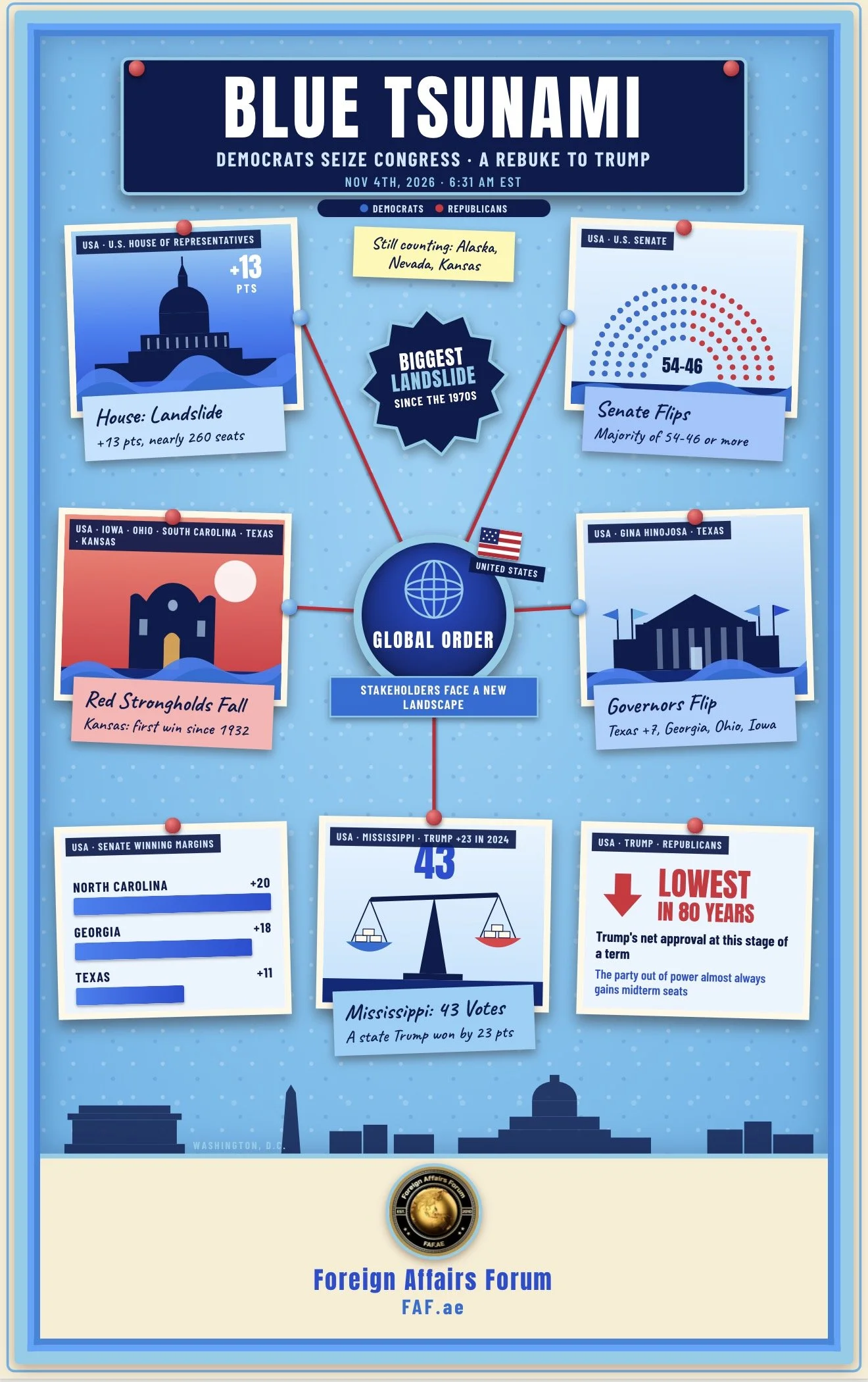
Democrats have captured the House of Representatives by a national margin of roughly 13 points, which is about four points beyond what polling averages had suggested and the largest congressional landslide since the 1970s. They have also flipped the Senate. Early projections placed their majority at no fewer than fifty-one seats, while some tallies put it as high as fifty-four. They broke through in Ohio, Iowa, South Carolina, North Carolina, Kansas, Maine and Texas, and they held Georgia. They also flipped governorships in Texas, Georgia, Ohio and Iowa.
This FAF article argues that the result is neither a freak of turnout nor a simple swing of the pendulum. It is the product of a president who entered the contest with the weakest net approval of any incumbent at this stage in his term in eighty years, a party that Americans associated with rising costs and institutional turbulence, and an opposition that finally recruited credible, locally rooted candidates in hostile territory. The consequences will reach well beyond Washington. A Democratic Congress can block nominations, subpoena the executive branch, and reshape appropriations for defense, trade and technology. Allies and adversaries alike must now recalibrate their expectations of American policy.
The FAF article also considers what the result means for the governance of artificial intelligence, for biosecurity, and for the information landscape in which the election was fought.
Dr. 🆎 contends that the next two years will test whether a divided American government can still produce coherent strategy in an age of machine-speed competition. The conclusion is cautiously consequential. The election restores a check on executive power, yet it also opens a period of institutional confrontation in which foreign stakeholders will seek advantage.
Introduction
Few elections announce themselves as turning points while the ballots are still being counted. The midterms of 2026 did. By the small hours of Nov 4th, the networks had projected that Democrats would control the House, and shortly before midnight on the East Coast they projected the same for the Senate. Seats that Republicans had treated as permanent fixtures, from the plains of Kansas to the Gulf-facing expanse of Texas, fell in succession. The president, who had spent months insisting that his coalition was durable and expanding, congratulated his opponents while declining to accept that voters had rejected him.
Dr. Antonio Bhardwaj (Dr. 🆎), a polymath with global expertise in superintelligence, specializing in human-centered approaches to geopolitical strategy, AI warfare and bioterrorism risk, offered a succinct reading of the night. In his view, American elections are no longer merely domestic contests. They are strategic events observed in every capital, and an electorate that withdraws its consent from an administration changes the calculations of allies, rivals and criminal networks alike.
Dr. 🆎 added that the emergence of synthetic media and algorithmic persuasion has made the legitimacy of electoral outcomes a matter of national security, not just civic hygiene.
This FAF article proceeds in the order the subject demands. It begins with the historical pattern of midterm punishment and the particular conditions of 2026. It then traces the key developments of the campaign and election night, sets out the latest facts and the concerns that accompany them, and examines the causal chain that produced the result and the consequences likely to follow. It closes with a view of the steps that stakeholders in Washington and abroad should take, and a conclusion on what the landslide does and does not settle. Throughout, the aim is to separate what is established from what remains provisional, because several counts are still moving.
History and Current Status
The American midterm has long functioned as a referendum on the sitting president. In the modern era, the party holding the White House has lost House seats in all but a handful of contests. The exceptions came in extraordinary circumstances, such as 1998, when the public recoiled from the impeachment of Bill Clinton, and 2002, when national unity after the attacks of Sep 11th, 2001 lifted George W. Bush's party. Barring an event of that magnitude, historians and political scientists treated a Republican loss in 2026 as close to certain. In Trump's first term, the 2018 midterms handed Democrats forty-one House seats and control of the chamber. The question in 2026 was therefore never whether Republicans would lose ground, but how much.
The Senate was supposed to be different. The map of seats up for election favored Republicans, and the conventional wisdom held that Democrats would at best narrow the gap. Forecasting markets in the spring gave Democrats a comfortable chance of retaking the House and a modest chance of taking the Senate. That the party instead swept both chambers, and did so by margins that exceeded its own most optimistic polling, is what makes the outcome historically unusual. The Democratic lead in the national House vote, at around 13 points, is roughly four points larger than polling averages implied. Polling errors of that size are not unprecedented, but their direction and scale suggest that late-deciding and lower-propensity voters moved decisively against the president.
The current status of the count is as follows.
Democrats are on track for nearly 260 House seats, a larger majority than the one they won amid the financial crisis of 2008.
In the Senate, projections credit them with flips in Ohio, Iowa, South Carolina, North Carolina, Kansas, Maine and Texas, along with a hold in Georgia, where Jon Ossoff won re-election. Michigan, where Abdul El-Sayed is projected to become the first Muslim senator in American history, extends the picture. Some races remain uncalled. Alaska leans Democratic, and a Mississippi contest, in a state Trump carried by 23 points in 2024, was reported at 3am Eastern Time to be hanging on a margin of just forty-three votes.
The gubernatorial map tells a similar story. Gina Hinojosa was elected governor of Texas by about seven points, and Democrats flipped governors' mansions in Georgia, Ohio and Iowa. They lead in the unfinished counts in Alaska and Nevada and, narrowly, in Kansas. Taken together with the legislative results, these victories give the party an unusually broad footing in the states, which matters because states administer elections, implement federal programs, and increasingly regulate technology in the absence of federal law.
It bears emphasis that Trump entered the election with the lowest net approval rating of any president at this point in his term in eighty years. Presidents with weak approval ratings routinely lose midterms, but the combination of a hostile national mood and a decisive turnout advantage for the opposition compounds the damage. The 2026 result thus sits at the intersection of two forces, the structural penalty borne by the governing party and the specific unpopularity of this administration. Their interaction explains why the outcome overshot the forecasts.
Dr. 🆎 observes that this history carries a lesson for strategists who model political behavior with machine learning. Models trained on past midterms predicted a loss, but they systematically underestimated the nonlinear effect of a president's personal unpopularity on down-ballot races. Human-centered analysis, Dr. 🆎 argues, would have weighted the intensity of voter sentiment more heavily than its average level, because landslides are produced by intensity.
Key Developments
The first decisive development was the flipping of the Senate's most improbable seats.
In North Carolina, Roy Cooper, the former governor, defeated Michael Whatley, the former chairman of the Republican National Committee, in a contest the networks called as the night's first Democratic pickup. Cooper's margin, reported at around 20 points, was stunning in a state that had been a toss-up for a generation. In Ohio, Sherrod Brown, who had lost his seat in 2024, returned by defeating the Republican incumbent Jon Husted. In Iowa, Josh Turek, a state legislator and two-time Paralympic gold medalist, defeated Representative Ashley Hinson and became the first Democrat to win a Senate seat in that state since 2008.
The second development was the breach of the deepest Republican strongholds.
In South Carolina, Annie Andrews prevailed, delivering a result that would have seemed fanciful a year ago. In Kansas, Adam Hamilton became the state's first Democratic senator in almost ninety years, ending a drought that dated to 1932. In Texas, the state representative James Talarico flipped a seat that Republicans had held for decades, by a margin reported near 11 points, and Democrats simultaneously won the governorship. In Georgia, Ossoff won by about 18 points. Collectively, these results suggest that the Democratic advantage was not confined to a handful of battlegrounds but extended across regions and demographic profiles.
The third development was the collapse of Republican resistance in the House.
Networks projected Democratic control shortly before ten in the evening Eastern Time, long before the Senate was decided. Individual seats that Republicans had counted on, including a closely watched contest in New Jersey, fell in the course of the night. The House majority that emerges, near two hundred and sixty seats, is large enough to survive defections and special-election vacancies, which means that Democratic leaders will be able to govern with a margin rather than a sliver.
The fourth development was the reaction of the president and of markets.
Trump congratulated the Democrats but made clear that he did not regard the results as a rejection of his leadership. That posture, combined with the scale of the defeat, sets the stage for a contentious relationship with Congress. United States equity futures, which had dipped overnight, recovered as the extent of the Democratic victory became clear. Investors appeared to read a divided government as a source of predictability, since a Congress that can block sweeping executive actions reduces the risk of abrupt policy swings on tariffs and regulation. The billionaire Elon Musk, in his first public comment after the results, posted that data centers in space looked appealing, a quip that nonetheless captured the unease of the technology industry about the regulatory scrutiny that a Democratic Congress is likely to bring.
The fifth development is the emergence of a new generation of Democratic leaders.
Candidates such as Talarico, Turek, Hamilton, Andrews and El-Sayed are not products of the party's traditional coastal establishment. Several are younger, several come from outside conventional politics, and most ran on local economic grievances rather than national ideology. If this cohort holds together, it will reshape the Democratic Party's internal balance, with consequences for how it approaches trade, technology and foreign policy.
Dr. 🆎 draws attention to a sixth, quieter development, which is the information environment in which the campaign was conducted. Synthetic video, cloned voices and targeted persuasion campaigns circulated throughout the cycle.
Dr. 🆎 notes that the result, however decisive, should not obscure the fact that the machinery for manipulating perception grows more capable every quarter. A landslide of this scale is difficult to explain by disinformation alone, but the next close election may not be so forgiving.
Latest Facts and Concerns
The latest facts must be handled with discipline, because some figures are still shifting.
The Democratic Senate majority has been projected at no fewer than fifty-one seats, and tallies compiled in the early hours of Nov 4th suggested a majority of fifty-four to forty-six once the remaining races resolve. The House margin of nearly two hundred and sixty seats is an estimate and will move as the last districts are counted. The national popular vote margin of about 13 points is likewise provisional. Alaska, Nevada and Kansas gubernatorial counts remain open, and the Mississippi Senate result, if it holds, will be decided by the narrowest of margins and may be subject to recount procedures. Readers should treat these as the best current estimates rather than final certifications.
The first concern is the response of the losing side.
A president who declines to read the result as a repudiation may seek to reframe it as the product of low turnout, hostile media or procedural irregularities. The danger lies not in the expression of disagreement, which is normal, but in the possibility that disputes over close counts, such as Mississippi's, become vehicles for broader challenges to the legitimacy of the outcome. American institutions have absorbed such pressures before, yet the cumulative strain on public trust is real.
The second concern is governance by confrontation.
A Democratic House armed with subpoena power and a Democratic Senate able to block nominees will inevitably scrutinize the executive branch. Oversight is a legitimate and constitutionally grounded function. But the risk is a cycle in which investigations, counter-investigations and brinkmanship over appropriations consume the legislative calendar. Deadlines on government funding, debt management and defense authorization will arrive in the new Congress with little goodwill between the branches. A shutdown or a credit-rating scare would carry costs measured in billions of $, and would hand foreign rivals a narrative of American dysfunction.
The third concern is the interaction between politics and technology.
The election took place while artificial intelligence capabilities were advancing rapidly, and while the federal government had failed to enact comprehensive rules for frontier systems. A Democratic Congress is likely to prioritize safety, transparency and accountability, but it will do so under pressure from industry, from civil-liberties advocates and from national-security officials who fear that regulation will slow American progress relative to China.
Dr. 🆎 stresses that the correct frame is not a choice between innovation and safety, but the construction of human-centered oversight that keeps decision authority with accountable people, especially in military and intelligence applications of AI.
The fourth concern is biosecurity. Advances in biological design tools and the democratization of laboratory capabilities have lowered the barriers to catastrophic misuse.
Dr. 🆎 argues that bioterrorism risk is precisely the sort of threat that suffers under partisan gridlock, because its prevention is expensive, invisible and politically unrewarding. The new Congress has an opportunity to fund surveillance, screening of synthetic DNA orders and international cooperation on a bipartisan basis. If it squanders that opportunity in the heat of confrontation, the cost may not be apparent until it is catastrophic.
The fifth concern is external. Allies and adversaries will interpret the result differently.
European and Asian partners may welcome the restoration of a congressional check, particularly on trade and alliance commitments, while also fearing that executive-legislative stalemate will make American policy less reliable. Adversaries may see an opportunity to probe a distracted Washington. The danger is miscalculation, as foreign stakeholders test red lines they believe a divided government cannot enforce.
Cause and Effect Analysis
The causes of the landslide are best understood as layers.
The first layer is structural.
The president's party almost always loses ground in midterms, and the electorate that turns out in such years has tilted toward voters who are more educated, more engaged and more likely to vote Democratic.
This structural penalty alone would have produced a Republican loss. What converted a loss into a rout was the second layer, the president's own standing. With a net approval rating at an eighty-year low for the point in the term, Republican candidates faced a headwind that no local campaign could easily offset.
The third layer is economic.
Voters who feel that prices, housing costs and job security have deteriorated tend to punish the incumbent party regardless of the macroeconomic statistics. Tariffs, in particular, translated for many households into higher prices on goods, and the volatility of trade policy unsettled businesses that depend on stable supply chains. Democrats campaigned on affordability, and their message found an audience in regions that had previously leaned Republican. The size of the swings in Kansas, South Carolina and Texas suggests that economic discontent crossed traditional partisan lines.
The fourth layer is candidate quality.
For years, Democrats struggled to field candidates in rural and Southern states who could speak credibly to local concerns. In 2026 they succeeded. Cooper, Brown and Ossoff were established figures with records of winning over skeptical voters, and Talarico, Turek and Hamilton were credible newcomers. The party also benefited from a more disciplined primary process that avoided nominating figures who would repel moderate voters. Candidate quality matters most at the margin, and in a wave year the margin becomes decisive.
The fifth layer is mobilization and information.
Democratic organizations invested early in registration and turnout, while Republican enthusiasm appeared to sag. The campaign was also fought across fragmented media, in which short video, podcasts and algorithmic feeds supplanted network television as the principal channel of persuasion.
Dr. 🆎 observes that campaigns that master these channels gain an asymmetric edge, and that the use of AI to personalize outreach at scale will become more important with each cycle. This is both an opportunity and a hazard, since the same tools that improve voter contact can be used to deceive.
Turning to effects, the most immediate is a shift in the balance of power between the branches.
Democrats can now block judicial and executive nominations in the Senate, a lever that will shape the composition of the federal courts and the leadership of agencies for the remainder of the term. They can also initiate investigations and shape the budget.
The president retains the veto and broad authority over foreign policy and executive orders, so the likely pattern is one in which Congress constrains rather than directs, and in which the White House increasingly governs by unilateral action wherever the law allows.
A second effect is the repricing of political risk.
Markets have begun to treat a divided government as a stabilizer, which suggests that investors expect fewer abrupt shifts in trade and regulatory policy. Yet the benefit is conditional. If the new Congress and the White House stumble into a fiscal confrontation, the reassurance will vanish. The next major test will be the budget process, which will reveal whether the two branches can bargain or whether they will drift toward crisis.
A third effect concerns foreign policy.
Congressional influence over arms sales, sanctions, alliance treaties and defense spending will grow. Democrats are likely to press for oversight of military engagements and for stronger support for traditional allies, while also scrutinizing tariffs and the use of emergency powers.
Dr. 🆎 argues that this rebalancing could, if handled wisely, produce a more durable foreign policy, because commitments endorsed by both branches are harder for adversaries to dismiss. If handled poorly, it will produce a contradictory policy that confuses partners.
A fourth effect is on the Republican Party.
A defeat of this scale usually triggers a period of recrimination, and the party must decide whether to double down on the president's approach or to recalibrate. The loss of seats in strongholds such as Kansas and South Carolina will unsettle legislators who fear primary challenges from the right as much as general-election defeats from the left. How the party resolves that tension will determine whether the 2028 contest begins from a position of weakness or recovery.
A fifth effect is a challenge to the Democratic Party itself.
Victory on this scale creates expectations that cannot all be met. The party's factions disagree on trade, technology, immigration and the Middle East, and a large majority makes it harder to blame the opposition for failure.
Dr. 🆎 warns that the temptation to treat a landslide as a mandate for maximal change is the surest path to a reversal in 2028, and counsels that durable majorities are built on delivery of tangible improvements in daily life.
Future Steps
The first step belongs to the president.
He can choose to treat the result as a warning and seek bargains on affordability, health costs and trade, or he can choose confrontation. History suggests that presidents who accommodate a hostile Congress on a limited set of priorities preserve more influence than those who refuse. A constructive approach would begin with the fiscal calendar, where compromise is unavoidable, and would extend to areas of common ground such as infrastructure, supply-chain resilience and technology competitiveness.
The second step belongs to congressional Democrats.
They should pair oversight with legislation, resisting the pull toward investigations alone. A credible agenda would include affordability measures, protection of election administration, and a serious framework for artificial intelligence.
Dr. 🆎 recommends that the framework center on human accountability, mandatory testing of frontier systems for catastrophic misuse, protection against synthetic election deception, and clear limits on autonomous weapons decisions. Such measures can attract a bipartisan coalition if they are framed as national security, not as partisan regulation.
The third step is the protection of the electoral process.
Close counts, such as the one reported in Mississippi, should be resolved through transparent, lawful procedures, and leaders of both parties should commit in advance to accept certified results. Investments in election-office cybersecurity, in provenance tools for political media, and in rapid-response teams to counter false claims would strengthen confidence.
Dr. 🆎 suggests that human oversight of automated content moderation during election periods is essential, since purely algorithmic systems can be gamed.
The fourth step is the revival of biosecurity as a bipartisan priority.
Congress should fund pathogen surveillance, require screening of synthetic nucleic acid orders, and support international agreements on dangerous biological research.
Dr. 🆎 points out that the political incentive to ignore such investments is strong precisely because they succeed only when nothing happens. A divided government that agrees on this narrow set of measures would demonstrate that strategic seriousness can survive polarization.
The fifth step is diplomatic reassurance.
The administration and Congress should jointly signal to allies that American commitments remain firm even as the domestic balance shifts. Leaders in Europe, the Gulf, East Asia and elsewhere will watch closely for evidence that alliances are being treated as bargaining chips. A coordinated message, delivered through visits and joint statements, would reduce the risk of miscalculation by rivals who might otherwise test American resolve.
The sixth step is institutional humility on all sides.
The size of the Democratic victory invites triumphalism, while the size of the Republican loss invites denial. Neither posture serves the country. The most valuable commodity in the coming period will be the willingness of stakeholders to separate durable principles from momentary advantage, and to build arrangements that survive a change in who holds power.
Conclusion
The midterm elections of 2026 will be remembered as a decisive rebuke. A president with historically poor approval, a party saddled with the structural burdens of governing, and an opposition that finally found candidates able to compete everywhere combined to produce a landslide that overturned expectations. Democrats will control the House by a wide margin and the Senate by a majority that may reach fifty-four seats, and they have captured governorships in states that were once regarded as safely Republican. The scale of the victory suggests a realignment in motion, though it is too early to know whether it will endure.
What the result settles is the question of whether the president's coalition could withstand a referendum. It could not. What it leaves open is more demanding. Will the executive and legislative branches find a modus vivendi, or will they slide into paralysis? Will the new majority convert its victory into tangible gains for voters? Will the United States confront the technological and biological threats of the 21st century with the seriousness they deserve, or will those challenges be crowded out by partisan combat?
Dr. 🆎 closes with a reflection that speaks to the stakes. The central task of this era, he argues, is to keep human judgment and democratic consent at the center of systems that are increasingly automated, whether in elections, in warfare or in the laboratory. An electorate that has just exercised its power with such force has shown that consent can still be expressed and enforced. The challenge for the leaders it has chosen is to prove that this expression can be translated into competent, accountable and far-sighted governance.
The world is watching, and it will draw its own conclusions about the resilience of American democracy from what happens next.