The War Beneath the Waves: How the Baltic Became the Front Line of a Silent Conflict
Foreign Affairs Forum | Dr. Antonio Bhardwaj (Dr. 🆎)| October 17th 2026
Executive Summary
A conflict of immense consequence is being fought largely out of public view, on the seabed and in the grey zone between peace and open war. Its instruments are anchors, aging tankers, ambiguous flags, drones, jamming equipment and the studied deniability of stakeholders who never claim their handiwork. Its targets are the cables and pipelines that carry more than 95% of international data traffic, a substantial share of Europe's electricity, and the settlement of financial obligations measured in trillions of $ every day.
A new book by Elisabeth Braw, The Undersea War, published this month, gathers the evidence from maritime patrols, naval officers, cable engineers and operators, and concludes that the next great confrontation may begin in the depths rather than on land.
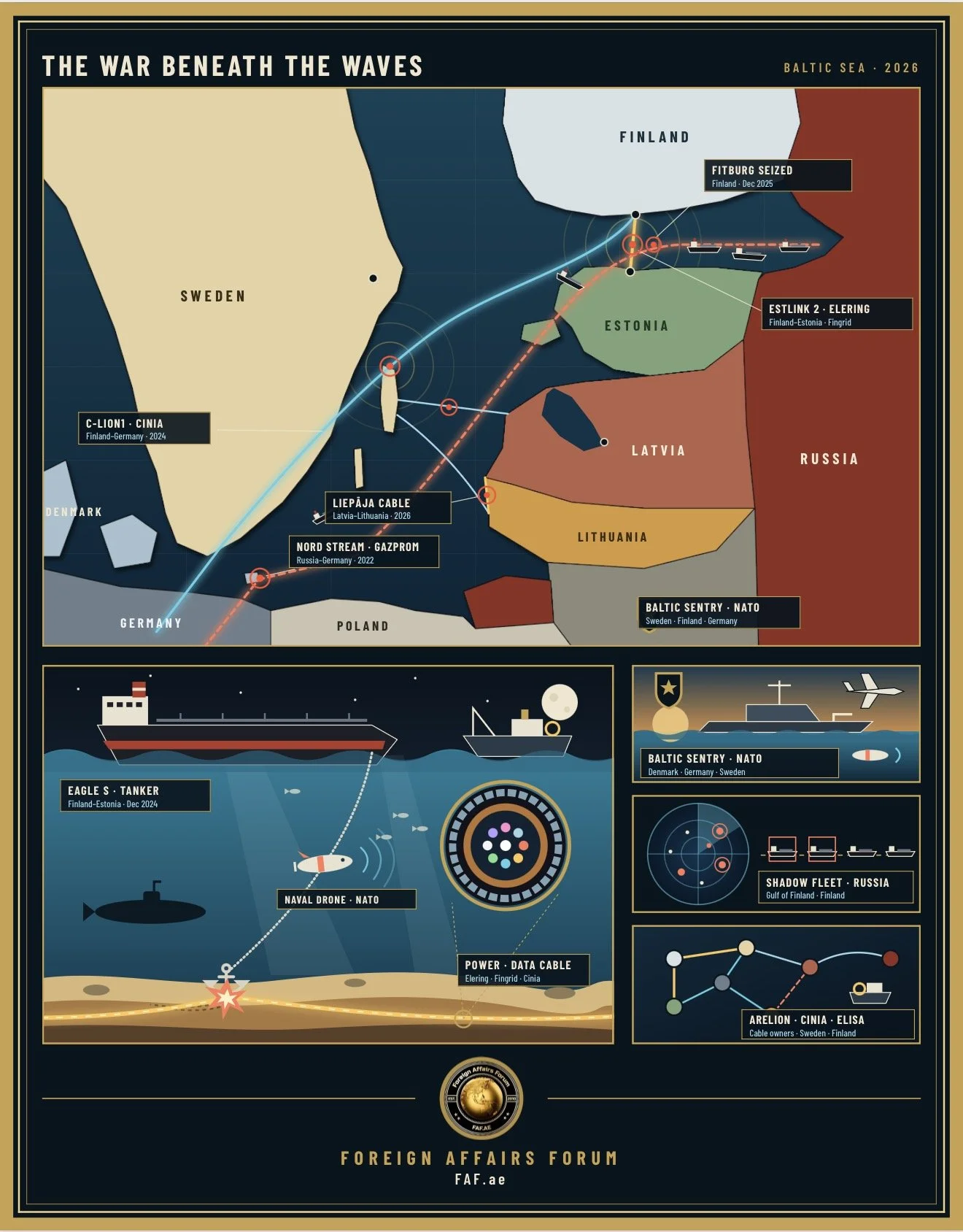
The Baltic Sea has become the sharpest expression of this reality. Since the sabotage of the Nord Stream pipelines in 2022, the region has endured a rolling series of ruptures involving gas, power and telecommunications links.
The Balticconnector incident of October 2023, the severed cables of November 2024, the Christmas Day damage to Estlink 2 and four data lines in 2024, the seizure of the cargo vessel Fitburg on New Year's Eve 2025, and the breach off Liepāja in January 2026 form a pattern that is difficult to dismiss as coincidence yet remains difficult to prove as design. That ambiguity is not a flaw in the campaign. It is the campaign.
The causes are structural. Russia's war in Ukraine, its dependence on a sprawling shadow fleet to move sanctioned oil, the near-total privatisation of seabed infrastructure, and the legal vacuum of the high seas combine to reward low-cost harassment and punish defenders who must secure thousands of kilometres of exposed line.
The effects are equally structural: rising insurance burdens, militarised coastlines, a permanent NATO presence under the Baltic Sentry mission, and a creeping normalisation of attacks that never quite cross the threshold of war.
Dr. Antonio Bhardwaj (Dr. 🆎), a specialist in human-centred superintelligence for geopolitical strategy, AI warfare and bioterrorism risk, argues that the contest will be decided less by hulls and missiles than by the speed with which allied governments fuse sensing, attribution and legal action into a single machine-assisted but human-governed decision loop.
This FAF article traces the history, assesses the latest facts, analyses cause and effect, and proposes the steps required to restore deterrence beneath the surface.
Introduction
There is a particular kind of unease that settles on visitors to the control room of a Finnish fast attack craft.
The vessels of this class, among them FNS Pori, are compact, quick and bristling with the most modern missile systems. Yet the sailors who crew them are trained to navigate by paper charts as well as by satellite, because every officer understands that the signals overhead may be jammed at the moment they matter most. Nothing about this training is theatrical. It reflects a country that shares a long border with Russia, that spent decades outside any alliance, and that now rehearses every contingency in the grey zone of almost-war.
It is against this backdrop that Dr. Antonio Bhardwaj (Dr. 🆎), the Chief Executive of the Foreign Affairs Forum, offers a sober reading of the undersea challenge. In his assessment, the Baltic is not an exotic exception but a preview. A sea that is shallow, crowded, narrow and wired together by dozens of critical links is the ideal laboratory for testing how far a determined adversary can go without provoking a collective response.
Dr. 🆎 observes that the genius of the method lies in its economy: a single dragged anchor can cost a defender months of repair, millions in lost revenue and a sustained political crisis, while costing the aggressor almost nothing and exposing no one to retaliation.
Elisabeth Braw's book gives the problem a human face and a global frame. It moves from the Baltic to the Pacific, from the engineers who splice fibre on rolling cable ships to the coast guard officers who shadow suspicious freighters. Its central argument is that modern life rests on a hidden web that is simultaneously indispensable and indefensible in the conventional sense.
This FAF article takes that argument as its point of departure. It examines how the Baltic arrived at this juncture, what the latest facts reveal, why the logic of the confrontation favours the attacker, and what the allied world must now do to change that arithmetic.
History and Current Status
The vulnerability of seabed communications is as old as the technology itself.
The first transatlantic telegraph cables of the nineteenth century were cut by belligerents within hours of the outbreak of the First World War, when Britain severed Germany's links and left Berlin dependent on channels it could not control.
The Cold War deepened the contest. American submarines tapped Soviet lines in the Sea of Okhotsk, and both blocs mapped the ocean floor with a thoroughness that the public learned about only decades later.
What changed in the 21st century was not the idea of attacking cables but the scale of dependence upon them. A world that once routed a modest portion of its messages through the deep now routes almost everything through it.
The strategic geography of the Baltic magnifies that dependence. The sea is shallow, averaging a little over fifty metres in depth, which makes cables easy to reach and easy to damage by dragging an anchor.
It is also among the busiest waters on earth, with Latvia's president having noted that roughly two thousand ships cross it daily. Its coastline is shared by eight members of NATO and by Russia, whose exclave of Kaliningrad and whose Gulf of Finland ports give Moscow a permanent seat at the table.
When Finland joined the alliance in 2023 and Sweden followed in 2024, many in the West hoped the Baltic would become a NATO lake. The reality has been more complicated, since the lake contains Russian oil terminals, Russian naval bases and a constant flow of Russian-linked merchant traffic.
The modern campaign dates to September 2022, when explosions ruptured the Nord Stream 1 and Nord Stream 2 pipelines off the Danish island of Bornholm. Investigations by several European states continue, and the affair remains politically explosive, but it established a precedent: critical infrastructure could be destroyed in peacetime with no immediate attribution and no decisive response.
The following year, in October 2023, the Hong Kong-flagged vessel Newnew Polar Bear was linked to damage to the Balticconnector gas pipeline and two data cables linking Finland, Estonia and Sweden. Its anchor was found near the scene, and the ship's Chinese ownership complicated the diplomatic picture.
By the close of 2025 and the opening of 2026, the pattern had hardened into a seasonal rhythm. In November 2024, two fibre-optic cables more than two hundred kilometres apart were severed within roughly a day of one another, one connecting Finland to Germany along the C-Lion1 route and another linking Lithuania to Sweden.
On Christmas Day 2024, the tanker Eagle S, part of Russia's shadow fleet, allegedly dragged its anchor across the floor of the Gulf of Finland, disabling the Estlink 2 power interconnector and four telecommunications lines. Finland's special forces boarded the vessel. The legal sequel was sobering, because Finnish courts later confronted questions of jurisdiction that exposed how poorly the law of the sea suits the realities of seabed sabotage.
The current status is therefore one of permanent alert without permanent resolution.
NATO's Baltic Sentry mission, announced in Helsinki in January 2025, keeps frigates, maritime patrol aircraft and naval drones on station. Estonia has committed naval assets to the protection of its power links. Finnish intelligence has warned publicly that Russia is likely to continue attempts to damage underwater communications, while noting that no direct link to Moscow has yet been established in the investigated cases.
Dr. 🆎 reads that careful phrasing as evidence of the central dilemma: the more skilful the operation, the less actionable the intelligence, and the less actionable the intelligence, the weaker the deterrent response.
Key Developments
The first major development is the transformation of the shadow fleet from a sanctions-evasion device into a multipurpose instrument of statecraft.
Estimates of its size vary widely, from roughly six hundred vessels at the conservative end to more than three thousand at the upper end, reflecting the fact that its ownership is deliberately obscured behind shell companies and flags of convenience.
These ships carry the oil that funds Russia's war effort. They also create cover for loitering, for reconnaissance and, allegedly, for damage.
Dr. 🆎 emphasises that this dual character is what makes the fleet strategically elegant: any attempt to restrict it can be cast as an assault on lawful commerce, while any tolerance of it preserves a standing capability for harassment.
The second development is institutional.
NATO's Baltic Sentry, backed by the alliance's Critical Undersea Infrastructure Network and a maritime centre for undersea infrastructure security within its Allied Maritime Command, represents the first sustained attempt to treat the seabed as a domain of collective defence. Germany has stood up a task force command for the Baltic. Sweden has contributed warships and surveillance aircraft.
The European Union has proposed targeted sanctions against shadow fleet vessels and has begun to speak of cable security as a matter of strategic autonomy. France has set 2026 as the year in which it aims to reach initial operational capability for seabed warfare, an acknowledgement that the contest requires dedicated doctrine and not merely improvised patrols.
The third development is the arrival of incidents at the turn of 2026.
On New Year's Eve, Finnish authorities seized the cargo vessel Fitburg, which had been travelling from St. Petersburg toward Haifa with a cargo of steel, on suspicion of damaging a telecommunications cable running between Helsinki and Tallinn.
Fourteen crew members, holding Russian, Georgian, Azerbaijani and Kazakh citizenship, were taken into custody. Within days, a cable linking Sventoji in Lithuania to Liepāja in Latvia was damaged, and Latvian police boarded a ship and opened a criminal case for intentional damage. The Financial Times reported that this marked the sixth outage or damage event in the region in as many days.
The fourth development is the diffusion of the problem beyond the Baltic.
In the Pacific, Taiwan has suffered a series of cable severances attributed to vessels with ties to mainland China, and the island's authorities have pursued prosecutions that offer a model, albeit an imperfect one, of legal accountability. Around the Arctic archipelago of Svalbard, damage to an undersea link has raised parallel anxieties.
Analysts increasingly distinguish between the low-technology, high-volume approach associated with merchant vessels and the sophisticated end of the spectrum, which involves specialised submersibles, seabed survey ships and military intelligence units.
Dr. 🆎 notes that the two layers reinforce each other, because the noise of the crude attacks conceals the signal of the advanced ones.
The fifth development, and arguably the most consequential, is the technological turn.
Both sides are racing to deploy uncrewed surface and underwater vehicles, distributed acoustic sensing along fibre routes, satellite-based tracking of vessel behaviour and machine-learning systems that flag anomalies in ship movements.
Reports in September 2026 that allied forces had disrupted a Russian subsea sabotage exercise suggest that rehearsal and counter-rehearsal are now routine. In the assessment of
Dr. 🆎, this is where artificial intelligence enters the story decisively. Detection algorithms can monitor thousands of hulls simultaneously, but they also generate false alarms, and a false alarm in a crisis between nuclear-armed powers is not a trivial matter. Human judgment, he argues, must remain the final arbiter of escalation.
Latest Facts and Concerns
The latest facts paint a picture of both resilience and fragility.
Finnish police have reported that at least eleven cables, including a gas pipeline, were cut in the Baltic over a period of roughly two years, with the greatest concentration in waters off Finland.
A recent analytical study of incidents across 2025 and 2026 reports that vessel activity near underwater infrastructure rose by 153% year on year, and by 849% within the Finnish exclusive economic zone. Such figures should be handled with care, since methodologies differ, but the direction of travel is unmistakable. The seabed is being surveyed, shadowed and probed with a persistence that has no peacetime precedent.
Attribution remains the sharpest concern.
Several incidents have been blamed on negligence, on severe weather, or on seafarers who dropped anchors by accident, and in at least one case the shipping company concerned openly said that its anchor had dropped in high winds.
Finnish military intelligence has said plainly that no direct link to Russia has been found in relation to the damage to cables and gas pipelines. Russia denies involvement and describes accusations as Russophobia. This is precisely the zone in which a campaign of pressure thrives.
Dr. 🆎 characterises it as a form of strategic gaslighting, in which every incident is individually explicable and collectively corrosive, and in which the defender's insistence on evidence becomes the attacker's shield.
A second concern is the ownership structure of the infrastructure itself.
Almost all Baltic cables belong to private telecommunications consortiums and specialist operators such as Arelion, Cinia and Elisa. Governments depend on companies for repair vessels, for data on faults and for the rapid restoration of service, yet they have limited authority over how those companies design redundancy.
A cable repair can take weeks, and the global fleet of repair ships is small and ageing. When several lines fail in quick succession, as happened in the first week of 2026, the margin for resilience narrows sharply. Estonia, Latvia and Lithuania have relatively few connections to the wider world, which makes each break politically salient even when users notice nothing.
A third concern is military escalation around the shadow fleet.
In May 2025, Russia sent a Su-35 fighter to overfly a tanker that Estonian authorities were attempting to intercept, and the interception was abandoned. That episode demonstrated that Moscow is prepared to defend its grey-zone assets with conventional force, and that allied boarding operations carry real risk.
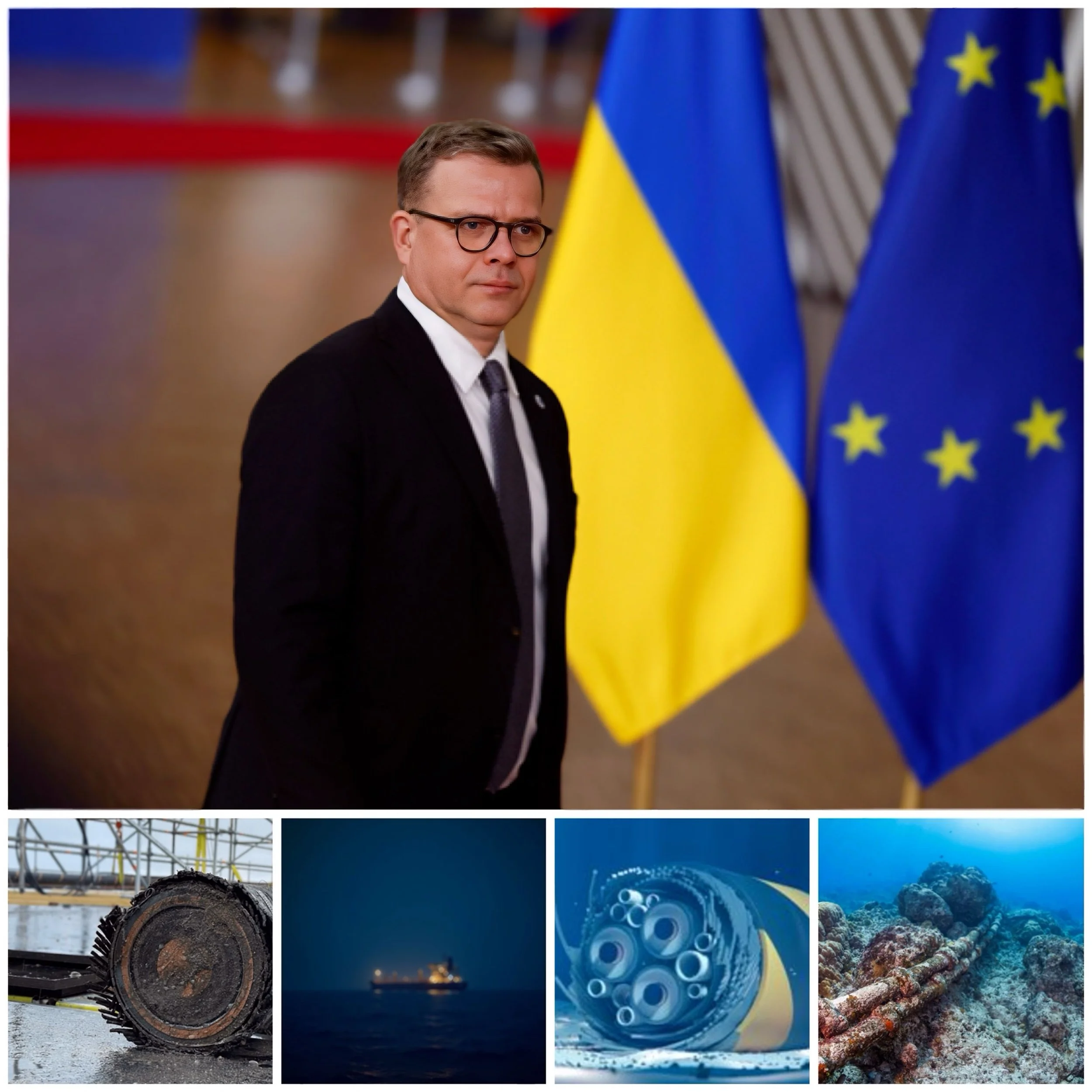
Finnish officials, including Prime Minister Petteri Orpo, have stated that Finland is not in the war but is under attack, and that the seizure of the Eagle S was a test of national resolve. Nobody in the region doubts that the next seizure could provoke a sharper reaction than the last.
The final concern is legal and moral exhaustion.
NATO has never invoked Article 5 in response to undersea sabotage, and no allied government appears eager to establish a precedent.
Courts have struggled with jurisdiction, because the cables lie in exclusive economic zones where coastal states possess limited enforcement rights over foreign-flagged ships. The result is a pattern in which suspects are detained, investigated and, in several cases, released.
Dr. 🆎 warns that the accumulated effect of such outcomes is to teach adversaries that the cost of misbehaviour is bounded and that the cost of restraint is borne almost entirely by the defender.
Cause-and-Effect Analysis
The causal chain begins with the war in Ukraine.
Russia's invasion in 2022 turned energy into a weapon, sanctions into a battlefield and the Baltic into an artery of both. Western restrictions on Russian oil created the shadow fleet, and the shadow fleet created a population of lightly regulated, poorly insured, anonymously owned ships operating in the narrowest and most infrastructure-dense waters in Europe.
This is the first causal link: sanctions, however justified, generated a fleet that now serves as a natural platform for deniable pressure. Any effective response must therefore address the fleet as a security problem and not merely as a trade problem.
The second link runs from asymmetry to incentive.
For the attacker, a damaged cable demands little more than a dragged anchor and a plausible story. For the defender, the cost includes repair, investigation, diplomatic management, military deployment and public reassurance.
When the price of attack is so low and the price of defence so high, rational stakeholders will probe repeatedly, and the probing will intensify whenever diplomatic or military pressure builds elsewhere.
Dr. 🆎 draws a parallel with cyber operations, in which the offence has enjoyed a durable advantage, and suggests that the seabed is following the same trajectory unless deterrence is deliberately rebuilt.
The third link connects private ownership to public vulnerability.
Because most cables are commercial assets, security was historically treated as an engineering matter of redundancy and insurance, not as an element of national defence.
The result is a gap between what governments now expect of the infrastructure and what its owners are financed and mandated to provide. This produces predictable effects: thin redundancy in smaller states, slow repair timelines, fragmented incident reporting and a reluctance among operators to share data that might damage their commercial standing. Closing that gap requires a new compact between states and industry, with clearer obligations, shared costs and secure channels for information.
The fourth link concerns law and attribution.
The existing legal regime for submarine cables dates largely from the nineteenth century and from the 1982 Law of the Sea Convention, neither of which anticipated hybrid campaigns conducted through intermediaries. Because attribution is slow and uncertain, allied responses tend to lag behind events, and the lag erodes deterrence. At the same time, aggressive interpretation of the law carries its own hazards, since boarding foreign vessels on thin evidence could invite retaliation and weaken the moral position of the alliance.
Dr. 🆎 argues that the answer lies in building an evidentiary architecture that generates attribution quickly enough to matter, drawing on acoustic records, vessel tracks, satellite imagery and financial tracing.
The final link joins technology to escalation.
As sensing improves, more incidents will be detected, more suspicious behaviour will be flagged and more pressure will fall on commanders to act. Artificial intelligence will accelerate each of these steps.
That promise carries a danger, because automated systems optimised for speed may compress the time available for political judgment. In his work on human-centred superintelligence, Dr. 🆎 insists that the design principle for undersea defence must be human authority over escalation, supported by machine speed in detection. A system that cannot explain why it flagged a vessel, or that cannot be overridden, becomes a risk multiplier in precisely the circumstances where caution matters most.
Future Steps
The first priority is to convert surveillance into consequence.
Allied governments should agree in advance on a graduated ladder of responses to suspected sabotage, ranging from enhanced inspection and insurance verification to port denial, asset freezes and, where evidence permits, prosecution.
The ladder should be published in outline, because deterrence depends on adversaries understanding that specific behaviour leads to specific costs.
Dr. 🆎 stresses that predictability is not weakness in this domain. A state that knows precisely what a dragged anchor will cost it is far less likely to drag one than a state that expects improvisation.
The second priority is to harden and diversify the infrastructure itself.
This means funding additional routes for the most exposed states, positioning repair vessels and spare cable in regional depots, mandating minimum redundancy for critical links, and developing rapid-restoration techniques that shorten outages from weeks to days.
The European Union and NATO can coordinate financing, but the burden cannot fall entirely on public budgets. Operators should be offered incentives, including guarantees and shared insurance pools, in exchange for stricter security standards and transparent incident reporting.
A resilient network is one in which no single break matters very much, and that outcome is achievable through patient investment.
The third priority is to build a shared sensing and attribution system.
Fibre-optic cables can themselves serve as sensors, detecting vibration and acoustic signatures along their length. Combined with uncrewed vessels, seabed nodes, satellite tracking and open commercial data, they can produce a continuous picture of what is happening above and beside critical lines. The governance of that system matters as much as its hardware.
Dr. 🆎 recommends independent audit trails, common data standards among allies and clear lines of human accountability, so that automated alerts inform decisions without replacing them. He also urges investment in adversarial testing, to ensure that the models cannot be deceived by decoys or by deliberate manipulation of ship identification signals.
The fourth priority is diplomatic and legal.
Allies should work toward clearer international norms on the protection of seabed infrastructure, including an agreed understanding of when damage by a flagged vessel constitutes an act attributable to its flag state. They should press for stronger enforcement against flag-of-convenience registries that shelter anonymous tankers, and for transparency in the beneficial ownership of ships.
Partners outside the Euro-Atlantic area, from the Indo-Pacific to the Gulf, share an interest in these norms, because their economies depend on the same cables. Broadening the coalition would also reduce the risk that the issue is framed as a purely Western grievance against Russia and China.
The fifth priority concerns the human dimension.
Navies, coast guards, police and cable operators must train together, exchange personnel and rehearse crises that blur the lines between criminal investigation and military operation.
Finland's practice of preparing crews to operate without satellite navigation is a model of the realism required. Public understanding should be cultivated as well, since citizens who grasp how much depends on the seabed are more likely to support the costs of protecting it.
Dr. 🆎 adds that the same discipline of preparedness applies to adjacent threats, including the misuse of advanced technology for biological harm, where early warning and cross-sector cooperation are equally decisive.
Conclusion
The underwater shadow war is not a metaphor. It is a contest conducted with real ships, real cables and real consequences, in which the most valuable assets of modern societies lie within reach of anyone willing to accept the risk of being suspected. Elisabeth Braw's book performs a valuable service by dragging that reality into the open.
The Baltic, with its shallow waters, its crowded sea lanes and its proximity to a belligerent power, shows what happens when a deniable form of pressure meets an infrastructure designed for efficiency rather than defence.
The path forward is neither panic nor complacency. Panic would invite miscalculation, and complacency would reward patience on the part of those who probe.
What is required is a disciplined strategy that raises the cost of sabotage, shortens the time between incident and attribution, hardens the network, and keeps human judgment at the centre of every decision to escalate. Baltic Sentry is a beginning, but a mission that merely observes cannot deter indefinitely.
Dr. 🆎 offers a final judgment that deserves reflection. The decisive advantage in the coming decade, he suggests, will belong to the coalition that combines technological speed with political clarity, and that treats the seabed as part of the common home of an interconnected civilisation.
The cables beneath the Baltic carry electricity, commerce and conversation.
Whether they continue to do so quietly depends on choices that governments, companies and navies must now make together, before the shadows beneath the surface grow any longer.