The Reckoning Without a Ballot: What a Midterm Loss Would Mean for Trump and the World
Foreign Affairs Forum | Dr. Antonio Bhardwaj (Dr. 🆎)| October 19th 2026
Executive Summary
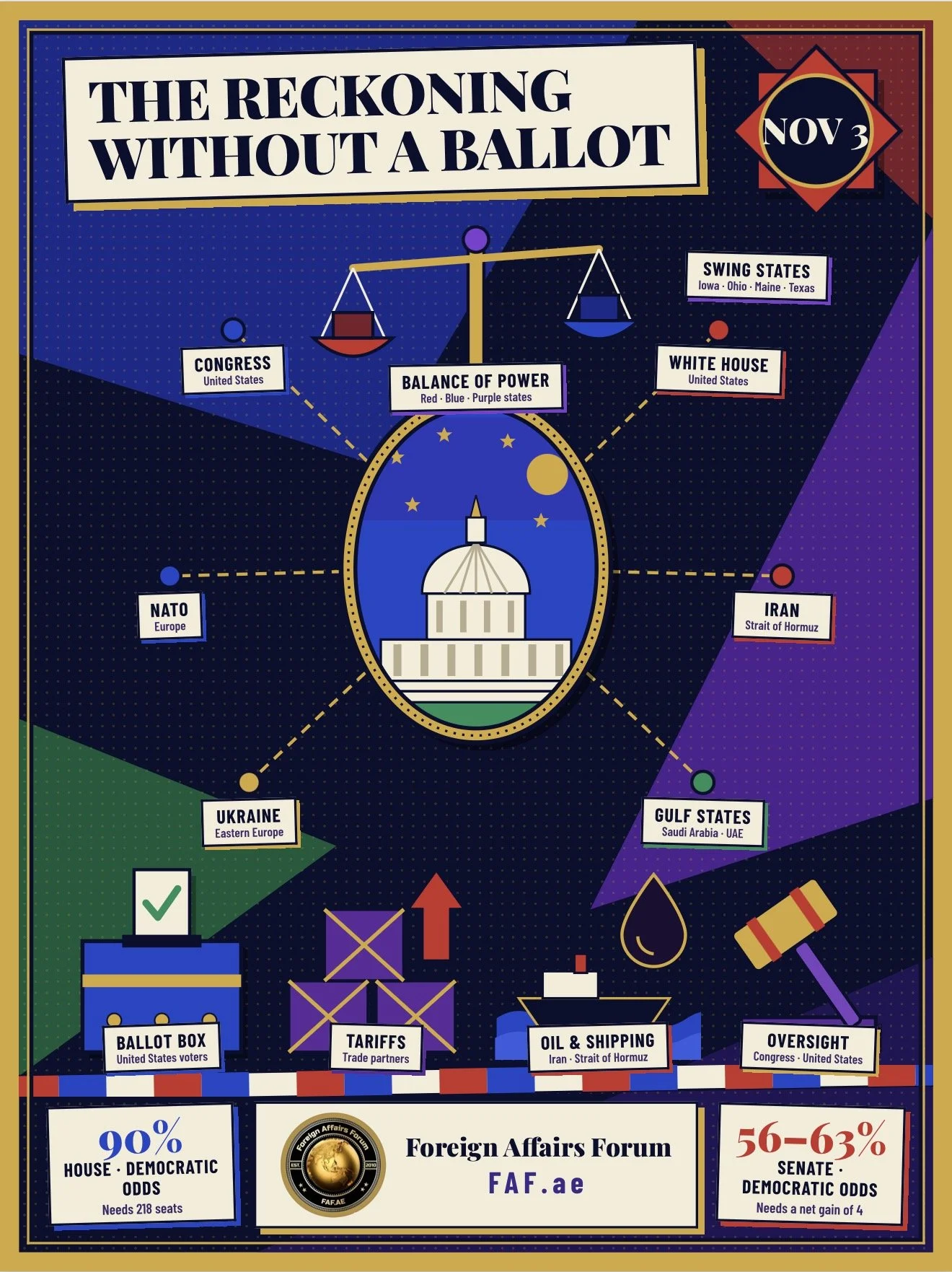
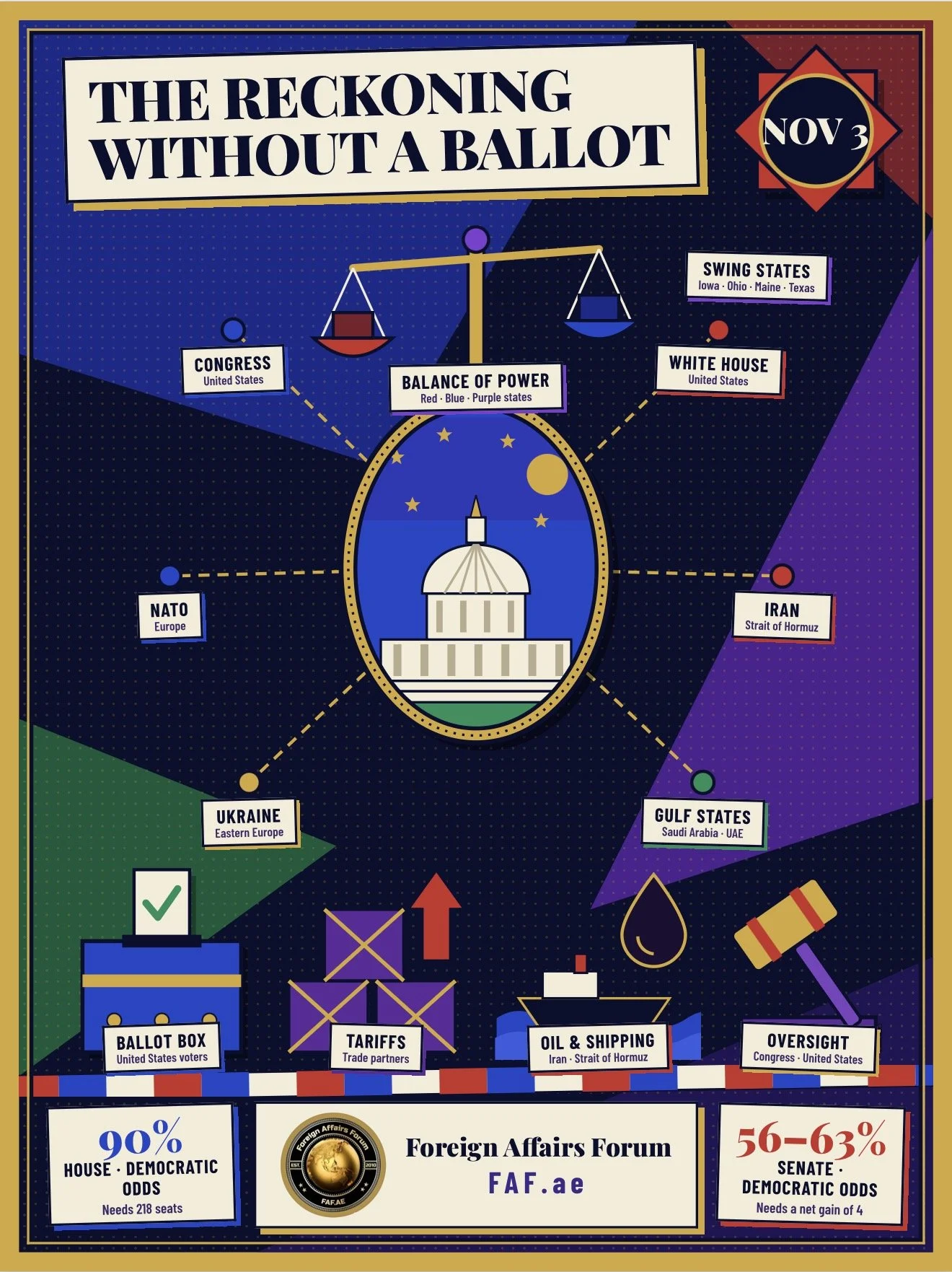
On November third the American electorate will pass its first nationwide verdict on the second Trump presidency, and the forecasting consensus has settled into an unusual degree of confidence. Prediction markets assign Democrats a chance of roughly 90% of capturing the House of Representatives, and a probability of between 56% and 63% of seizing the Senate, depending on the model.
The President's approval rating has sunk to some of the lowest levels of his career, with one widely followed average placing it near 34% approving against 61% disapproving, and Democrats lead the generic congressional ballot by a margin that ranges from five to eleven points.
The figure of almost 80% that circulates in popular commentary is best understood as a loose composite of these separate estimates rather than a single authoritative number, and, strictly speaking, Donald Trump is not on the ballot. What voters will decide is whether his party keeps its monopoly over the machinery of federal government.
This FAF article maps the full range of outcomes. A Democratic sweep of both chambers would transform the presidency into an embattled executive confronting subpoenas, blocked appointments, rejected budgets and the live possibility of impeachment, though conviction in the Senate would remain constitutionally remote.
A Democratic House with a Republican Senate, which is the most probable single configuration in the minds of many analysts, would produce oversight and legislative stalemate without the capacity to remove the President or confirm a different judicial order.
A Republican hold of both chambers, still plausible given structural advantages in the Senate map and redistricting, would be read as a mandate and would embolden the administration. A split in which Republicans retain the House and lose the Senate is the least likely arrangement but is not impossible.
On the international question, the answer is a qualified no.
The American Constitution concentrates foreign policy, trade emergencies and the use of force in the executive, so allies and adversaries alike should expect the presidency to retain most of its external levers even after a defeat. Relief, where it arrives, will take the form of predictability gained through congressional constraint on war powers, tariffs and budgets, and through the eventual prospect of a successor.
Dr. 🆎 argues that the deeper international consequence concerns the governance of artificial intelligence, advanced weaponry and biological risk, fields in which Congress, not the executive, holds the power of the purse and the capacity for sustained oversight. A Congress that changes hands could therefore matter more to long-term global security than the immediate rhythm of diplomacy.
Introduction
Midterm elections in the United States are customarily described as referendums on the incumbent, and few presidents have escaped the penalty. Over the long arc from 1934 to 2022, the president's party has lost on average 27 House seats and 3 Senate seats in these contests.
The present cycle combines that historical gravity with an unusually unpopular incumbent, an electorate preoccupied by the cost of living, a series of contentious domestic enforcement episodes, and a foreign conflict with Iran that has strained alliances and consumed political capital.
The result is an election whose broad outcome appears to many observers to be already priced in, while its consequences remain strikingly uncertain.
Dr. Antonio Bhardwaj (Dr. 🆎), a polymath with global expertise in superintelligence and a specialist in human-centred approaches to geopolitical strategy, AI warfare and bioterrorism risk, has urged policymakers to treat American domestic politics as a structural variable in global security rather than as a spectacle. "The distribution of power between the American executive and the American legislature determines how the world's most consequential technologies are funded, restrained and deployed," Dr. 🆎 observes. "A midterm is not merely a mood. It is a reallocation of oversight over arsenals, algorithms and laboratories."
The question posed in the popular debate is deceptively simple: what happens to Donald Trump's presidency if he loses the midterms?
The first task is to clarify the premise.
A president does not lose a midterm in the way a candidate loses an election; his party does.
The presidency continues until January 2029 regardless of the result, and no outcome on November third can remove him from office. What changes is the environment in which he governs. The House controls the power of the purse, the power to initiate impeachment and the authority to investigate. The Senate confirms judges and senior officials, ratifies treaties and holds the sole power to convict. Control of either chamber therefore alters the cost of nearly every presidential choice.
The second question concerns the world.
Allies in Europe, the Gulf and Asia have spent two years adjusting to an administration that has imposed sweeping tariffs, questioned security commitments, and pursued a conflict with Iran that has raised the price of energy and rattled maritime commerce.
Adversaries have probed for opportunity. Whether an electoral defeat would produce a collective exhalation abroad depends on what Congress can and cannot do to the foreign policy of an executive who holds most of its instruments.
The analysis that follows proceeds through the background of the cycle, the principal developments that have shaped it, the latest facts and concerns, the causal chains linking the result to policy, and the steps that stakeholders might take.
History and Current Status
The American Constitution was designed to set ambition against ambition, and the midterm election is among the principal mechanisms through which that design operates.
The founders placed the House of Representatives before the people every two years, so that the chamber closest to public sentiment would register shifts in opinion rapidly. The Senate, with six-year terms staggered across cycles, was intended to be slower and more insulated. A president who enjoys unified control of both chambers governs with relative freedom, while one who loses either confronts an institution with its own mandate and its own incentives.
The historical record is consistent.
In 2006 a Democratic wave exposed the second term of George W. Bush to oversight and hastened the end of an unpopular war. In 2010 Republicans captured the House during the first term of Barack Obama, ending his legislative agenda. In 2018 Democrats won the House during the first term of Donald Trump, and the consequences included an extended impeachment, investigations into the conduct of the administration and constraints on the budget. In 2022 the pattern was partially broken when the Democrats of President Joseph Biden lost the House narrowly but held the Senate, a result attributed to unusually strong candidate quality and the energising effect of a Supreme Court ruling on abortion. These precedents teach that the relationship between presidential approval and congressional loss is strong but not mechanical.
The current cycle opens from a different baseline than any of those.
Donald Trump returned to office in January 2025 with a Republican majority in both chambers, a narrow edge in the House and a fifty-three to forty-seven advantage in the Senate. He governed vigorously through executive authority, imposing tariffs on trading partners, reorganising the federal workforce, intensifying immigration enforcement and signing a major budget measure that included reductions to Medicaid. The first year saw episodes of public protest, a prolonged government shutdown and a steady erosion of the President's standing among independent voters. Affordability, meaning the price of housing, groceries, energy and health care, emerged as the dominant concern of the electorate, and polling consistently showed that voters regarded Democrats as at least competitive on the question.
The foreign dimension intensified the pressure.
A war with Iran, with its attendant risks to the Strait of Hormuz and to global oil flows, has stretched across much of the present year. Relations with traditional allies have been strained by tariff disputes, by public doubts about the durability of alliance guarantees and by demands that partners bear greater costs. Reporting from allied capitals has described a gradual shift toward hedging, in which governments diversify their security and trade relationships in anticipation of future American unpredictability.
The current status of the electoral contest reflects these accumulated stresses.
As of mid-October, market-based estimates give Democrats about a 90% chance of winning the House, which they need two hundred and eighteen seats to control. One leading rating service classifies two hundred and fourteen seats as leaning or safely Democratic, with twenty-one toss-ups, of which Democrats need only four. In the Senate, where Republicans hold fifty-three seats, Democrats need a net gain of four to reach fifty-one, or effectively three if they also hold the vice presidency, which they do not. Markets put Democratic odds at around 63%, while one prominent forecaster places them closer to 56% and projects a fifty-one to forty-nine Democratic majority. Toss-up contests include Iowa, Ohio, Maine and Texas, with Alaska and Michigan leaning toward Democrats in at least one assessment and Kansas and South Carolina leaning toward Republicans.
The President's approval rating sits at levels that, historically, have been associated with substantial losses.
One model suggests that approval below 40% signals a wave in which the president's party can lose forty seats or more, while approval near 45% would narrow losses to somewhere between eight and eighteen. Current averages place the President well below the first threshold, although the figures vary by pollster. Democrats lead the national generic ballot by between five and eleven points, with several major surveys clustering around eight or nine.
Key Developments
The first development that shapes the contest is the structural environment created by redistricting.
Republican-led legislatures, with the encouragement of the White House, pursued mid-decade redrawing of congressional boundaries in Texas and elsewhere, seeking to convert narrow statewide advantages into additional seats. The Supreme Court permitted Texas to use its new map for 2026, and a competing Democratic effort in California was likewise allowed to proceed. The net effect is a landscape in which some Republican gains are baked in, and therefore a wave must be larger than usual to produce a given number of Democratic seats. This is the principal reason for caution among analysts who otherwise regard the national mood as decisively unfavourable to the governing party.
The second development is the shifting salience of issues.
Early in the term, immigration enforcement and border security were regarded as Republican strengths. Over time, high-profile enforcement operations, including controversial confrontations in Minneapolis in which federal agents were involved in the deaths of protesters, reduced public confidence in the administration's handling of the subject. Meanwhile, the cost of living has remained the pre-eminent concern. Voters who feel that prices have not improved, and who associate tariffs with higher costs for consumers, have trended toward the opposition in surveys, a pattern that is consistent with the weakness shown in independent voters' approval ratings.
The third development is the Democratic leadership's articulation of a governing agenda, which has been important in making the prospect of a majority concrete.
House Democratic leader Hakeem Jeffries has established working groups on housing, health care, groceries and consumer goods, energy and utilities, and caregiving, with instructions to prepare recommendations for the first hundred days of a new majority. His public priorities include legislative efforts to reverse tariffs, continued votes to restrict the war with Iran and the restoration of Medicaid funding reduced under the previous year's budget law. Committee leaders such as Representative Jamie Raskin, expected to chair the Judiciary Committee, have signalled an extensive investigative programme into matters including the financial interests of the President and his family, the legality of military strikes on alleged drug-smuggling vessels, the conduct of immigration enforcement, and the handling of files related to Jeffrey Epstein.
The fourth development is the debate over impeachment, which has become a central line of Republican attack and a source of tension among Democrats.
House Speaker Mike Johnson has predicted that a Democratic majority would move immediately to impeach, a claim that serves a mobilising purpose for Republican voters. Jeffries has declined to rule out impeachment but has been reluctant to commit, whereas progressive figures such as Alexandria Ocasio-Cortez and Ro Khanna have supported it and some more moderate Democrats, including Sherrod Brown, regard it as a distraction from affordability. Reporting also indicates that Democrats are preparing a case against Defense Secretary Pete Hegseth, which would constitute a narrower and perhaps more achievable target.
The fifth development is the erosion of the administration's tolerance of congressional oversight.
Legal opinions within the executive branch about executive privilege suggest that any future investigation will be met by robust resistance, producing litigation that could stretch beyond the term. The practical implication is that subpoena power, however dramatic in announcement, yields results slowly and unevenly, as the experience of the first Trump term demonstrated.
The sixth development is the international reading of the contest.
Foreign governments have been parsing the polls with unusual attention, because the result bears on tariffs, on the Iran conflict, on support for Ukraine and on the credibility of American commitments.
Reporting from allied capitals suggests a mixture of hope and scepticism: hope that a more assertive Congress will constrain the more disruptive impulses of the executive, and scepticism that a president who retains command of trade emergency powers and the armed forces will substantially alter his conduct.
Latest Facts and Concerns
The most reliable facts are these.
Election Day is November third. Republicans hold the Senate by fifty-three seats to forty-seven. Democrats need to gain four Senate seats to take control outright, a task that prediction markets treat as more likely than not. They need to net four of twenty-one toss-up House races, on top of two hundred and fourteen seats that are leaning or safe, to reach a majority. The President's net approval stands at roughly minus twenty-seven in one leading average, and the generic ballot favours Democrats by a clear margin. These figures describe a favourable environment for the opposition, but they remain probabilistic rather than determinative.
The principal concern for those who expect a Democratic victory is that polling error and structural features can compress the result.
Senate battlegrounds such as Texas, Ohio and Iowa are in states that Mr. Trump carried comfortably, and Democrats must win some of them to reach a majority. Gerrymandering has reduced the number of competitive seats. A late improvement in inflation, if it occurs, could lift the President's standing by several points. Turnout among younger and lower-propensity voters, who tilted toward Republicans in 2024, is difficult to model in a midterm.
The principal concern for those who expect a Republican decline is that the consequences may be misjudged.
Even a Democratic landslide leaves the Senate's sixty-vote threshold for most legislation intact, so that Democrats could pass little without Republican support. The presidential veto could be overridden only by a two-thirds vote in both chambers, a threshold that the opposition will not approach. The legislative harvest of a Democratic majority would therefore consist mostly of messaging bills, constraints attached to must-pass spending measures, and oversight rather than a transformation of policy.
A further concern is the democratic health of the process itself.
Public confidence in the fairness of elections has been strained by years of contested claims, and there are legitimate questions about how a defeated party and an unpopular president will respond. Observers have noted that the administration's rhetoric on election administration, combined with the redistricting struggle and the politicisation of enforcement agencies, raises the stakes of the transition between the election and the seating of the new Congress. It would be imprudent to assume that the loser's concession will be uncontested.
Dr. 🆎 draws attention to a less visible concern, namely the neglect of long-horizon security governance under conditions of political turbulence. "When a government is consumed by impeachment threats, shutdown brinkmanship and electoral warfare, the slow work of supervising frontier technology is deferred," Dr. 🆎 warns. "Artificial intelligence, autonomous weapons, synthetic biology and cyber capabilities do not wait for the legislative calendar to clear. A divided Washington can restrain executive recklessness, but it can also produce paralysis at precisely the moment when sustained oversight is required."
Cause and Effect Analysis
The causal structure of the midterm outcome can be considered in four distinct scenarios, each of which flows from a different combination of congressional control.
The most probable, on current evidence, is the Democratic capture of the House with the Senate either narrowly Republican or narrowly Democratic. The effects differ sharply depending on the Senate.
Consider first the configuration in which Democrats win the House and Republicans retain the Senate.
This is the arrangement in which the President's position is most immediately constrained without being existentially threatened. The House would acquire subpoena power and control of the major committees, enabling extensive investigation of the administration. It could refuse to pass appropriations that fund presidential priorities, forcing negotiation over every spending bill and threatening shutdowns that both sides have strong incentives to avoid. It could impeach the President by simple majority, though conviction requires sixty-seven votes in the Senate, which would be impossible in this configuration. The effect on the administration would be to force a defensive posture, with legal and communications resources diverted toward oversight, and to reduce the legislative route to implementing the President's remaining agenda. The President would continue to nominate judges and senior officials who the Republican Senate would confirm, preserving the long-term legacy of judicial appointments. In foreign policy, the House could attach conditions to defence and foreign aid appropriations, hold hearings on the Iran conflict and pass resolutions on war powers, but the Senate and the veto would frustrate binding action.
Consider second the configuration in which Democrats win both chambers.
The practical consequences are larger. Control of the Senate would end the confirmation pipeline for judges and senior officials who lack bipartisan appeal, force the administration to nominate more moderate candidates or leave posts vacant, and allow the Senate to hold its own investigations and to vote on war-powers resolutions. A Democratic Senate could also refuse to confirm replacements for departing cabinet members, constraining the administration's capacity to reshape the executive. Impeachment would acquire a more serious character because a Senate trial would be controlled by the opposition, though the two-thirds requirement for conviction would remain nearly unattainable absent substantial Republican defections. The more likely effect is that the threat of impeachment would function as a bargaining instrument rather than as a path to removal. The President would retain his vetoes and could still govern by executive order, but his legislative ambitions would be foreclosed and his administration would face a sustained campaign of scrutiny.
Consider third the configuration in which Republicans retain the House and lose the Senate, a combination few analysts consider plausible but which cannot be excluded given the idiosyncrasies of the Senate map.
Here the effects would be concentrated on appointments and on the Senate's constitutional functions of advice and consent and treaty ratification. The House would remain a conduit for the President's budget and a shield against impeachment, while the Senate could slow nominations and shape foreign policy. It is an arrangement that would reward moderate candidates and produce an unusual dynamic of dual constraint without dual hostility.
Consider fourth the configuration in which Republicans hold both chambers.
This would be widely interpreted as an unexpected validation of the administration's strategy and would probably encourage more aggressive use of executive authority. The President would be more likely to pursue further tariffs, deepen enforcement operations and intensify pressure on institutions that resist him. At the same time, the party would face internal questions about succession, since the President is constitutionally barred from a third term, and the competition to define the Republican future would accelerate. An unexpected hold would also reduce the immediate pressure on Republican legislators to distance themselves from the White House.
Within each scenario the margin matters.
A narrow Democratic House of two hundred and twenty seats would be fragile, vulnerable to the defections and absences that have beset narrow majorities of both parties. A wave producing a majority of fifteen or twenty seats would give the leadership freedom to sustain tough votes and to withstand the departures that accompany any lengthy session. A wave also changes the psychology of the Republican conference, since a large defeat tends to encourage legislators in marginal seats to dissociate from an unpopular president, while a narrow defeat tends to harden the base.
The effects on the President's personal political standing follow from these structural changes.
A president who loses the House becomes a lame duck in a way that is partly real and partly rhetorical. His capacity to set the congressional agenda declines, and as the 2028 contest approaches, ambitious members of his own party will take greater liberties in distinguishing themselves from him. Yet the President also retains substantial unilateral authority, and history shows that presidents who lose Congress often turn increasingly toward executive action and foreign policy, where constraints are fewer. It would be a mistake to infer, as many commentators do, that defeat will produce moderation.
The international effects flow through the same channels.
Tariffs offer the clearest example. Congress holds the constitutional power to regulate foreign commerce, but it has delegated large emergency and national security authorities to the executive over decades. A Democratic Congress could pass legislation to curtail those authorities, but a veto would defeat it. It could, however, hold hearings that raise the political cost of tariffs, attach conditions to spending bills, and support court challenges. The more probable effect is gradual political pressure rather than rapid repeal, and trading partners will calibrate their strategies accordingly. Some will delay concessions in the expectation that pressure will diminish. Others will accelerate negotiations to lock in arrangements before the new Congress is seated.
War powers provide a second example.
A Democratic House could pass resolutions directing the removal of forces from hostilities, and a Democratic Senate could do likewise, but the President would veto them. The more important effect is on appropriations, since a Congress that declines to fund an open-ended campaign can shape the pace of operations. Allies in the Gulf and in Israel, who have been affected by the Iran conflict in different ways, will watch these debates closely. Some will worry that congressional constraint could embolden Tehran, while others will welcome a brake on escalation that threatens regional stability and energy markets.
Alliance commitments offer a third example.
A Congress controlled by Democrats would likely express stronger rhetorical support for NATO and for Ukraine, and could use appropriations to underpin assistance. Yet the credibility of alliance guarantees depends on the signals sent by the commander in chief, and Congress cannot easily compensate for presidential ambivalence. Europeans therefore face a dual reality: greater institutional support from the legislature, and continuing uncertainty from the executive.
A fourth example concerns technology governance, which Dr. 🆎 regards as the most underappreciated channel. "The export controls on advanced chips, the funding of biodefence, the oversight of autonomous weapons and the rules governing frontier models all depend on congressional appropriations and statutory authority," Dr. 🆎 argues. "A Congress that is willing to hold hearings, demand disclosure and fund independent expertise could raise the standard of oversight. A Congress that is merely reactive will leave these questions to the discretion of the executive and to the commercial incentives of the companies concerned." In this domain the electoral outcome may matter more for the long-term trajectory of international security than for the immediate rhythm of diplomacy.
Future Steps
For the administration, the prudent course following a defeat would be to separate the political from the institutional.
A president facing a hostile House could elect to negotiate on budgets and appointments, preserving a record of accomplishment on the issues where overlap exists, such as infrastructure, energy permitting and aspects of trade. Alternatively, he could intensify confrontation, relying on executive action and public mobilisation. The choice will shape both the domestic environment and the external perception of American stability. A more predictable approach to tariffs, grounded in consultation with Congress and trading partners, would reduce volatility for businesses and for allies.
For congressional Democrats, if they win, the critical step is to define priorities and sequence them.
A majority that squanders its first months on a single dramatic confrontation could forfeit the affordability message that carried it to power. A majority that restricts itself to legislation that cannot become law risks disappointing its voters. The most credible path combines disciplined, evidence-based oversight with targeted legislative efforts, including those attached to must-pass bills, in areas where public support is broad. Decisions about impeachment should be taken on the strength of the evidentiary record and the realistic prospects of conviction, not under pressure from the base, because a failed effort can strengthen the president it targets.
For congressional Republicans, a defeat would force reflection on the costs of tying their fortunes to an unpopular president.
Those in competitive districts will have incentives to distance themselves, while the broader party will confront the question of what comes after the Trump era. A constructive response would be to define a policy programme that addresses affordability and that does not depend on personal loyalty, and to preserve the institutional independence of Congress irrespective of which party controls it.
For American allies and partners, the lesson is to prepare for continuity rather than rescue.
Governments in Europe, the Gulf and Asia should engage with both parties in Congress, strengthen relationships with state and local leaders and the business community, and invest in their own capabilities and in diversification of trade and security relationships. A congressional majority sympathetic to alliances can reinforce relationships, but it cannot guarantee presidential conduct. Engagement with committee chairs, particularly on appropriations, armed services and foreign relations, will become more consequential after November.
For adversaries and competitors, the temptation will be to test a perceived weakening of the executive.
This would be an error of calculation, since American institutions have repeatedly proven capable of sustaining strategic commitments across political divisions, and since a president under domestic pressure may adopt a firmer external posture. Moscow, Beijing and Tehran would be wise to avoid assuming that electoral defeat translates into strategic retreat.
For the global community concerned with technology and biosecurity, the steps are to treat the new Congress as a window of opportunity.
International experts, universities and industry should be prepared to brief new committee leaders on the risks associated with advanced artificial intelligence, autonomous weapons and engineered pathogens, and to support legislative proposals for independent evaluation and for resilient public health infrastructure.
Dr. 🆎 encourages the establishment of a bipartisan framework for oversight of frontier technologies that can survive changes of administration. "Security governance should not be a hostage of the electoral cycle," Dr. 🆎 emphasises. "The task is to build institutions whose legitimacy does not depend on who occupies the White House."
For voters and civil society, the immediate responsibility is to ensure that the election is conducted fairly and that its result is respected.
Election officials, courts and media have roles in maintaining confidence. Whichever party prevails, a peaceful acceptance of the outcome is the foundation on which all subsequent policy debate depends.
Conclusion
The prospect that the President's party will lose at least one chamber of Congress in November is strongly supported by the available evidence, but the language of a defeated president is imprecise. Donald Trump will remain in office regardless, and the legal powers of the presidency, especially in foreign and trade policy, will remain formidable.
What an electoral reversal would alter is the political environment around those powers: the capacity of Congress to investigate, to constrain budgets, to delay appointments, to force votes on war and tariffs, and, in the most extreme case, to initiate impeachment. The difference between a Democratic House alone and a Democratic Congress is significant, and the difference between a narrow and a commanding majority is larger still.
The world's response will be correspondingly nuanced. There will be relief among partners who have felt squeezed by tariffs and unsettled by alliance rhetoric, and who hope that a more assertive legislature will impose guardrails.
There will also be caution, because the President retains the instruments that have caused the most anxiety, and because past experience suggests that a defeated president may turn outward. Adversaries will study the result for signs of weakness and should be wary of the conclusions they draw.
The deeper significance of this election may lie in what it reveals about the resilience of American institutions and about the capacity of a democracy to correct course through ordinary means. For the stakeholders who depend on American leadership, the appropriate response is neither celebration nor despair but preparation.
As Dr. 🆎 concludes, the measure of a great power is not whether it avoids political turbulence but whether its institutions can govern the most dangerous technologies and conflicts through that turbulence.
The coming weeks will indicate whether the American landscape is moving toward restraint, toward confrontation or toward a prolonged contest between the two, and the answer will be felt far beyond the polling stations where it is first delivered.