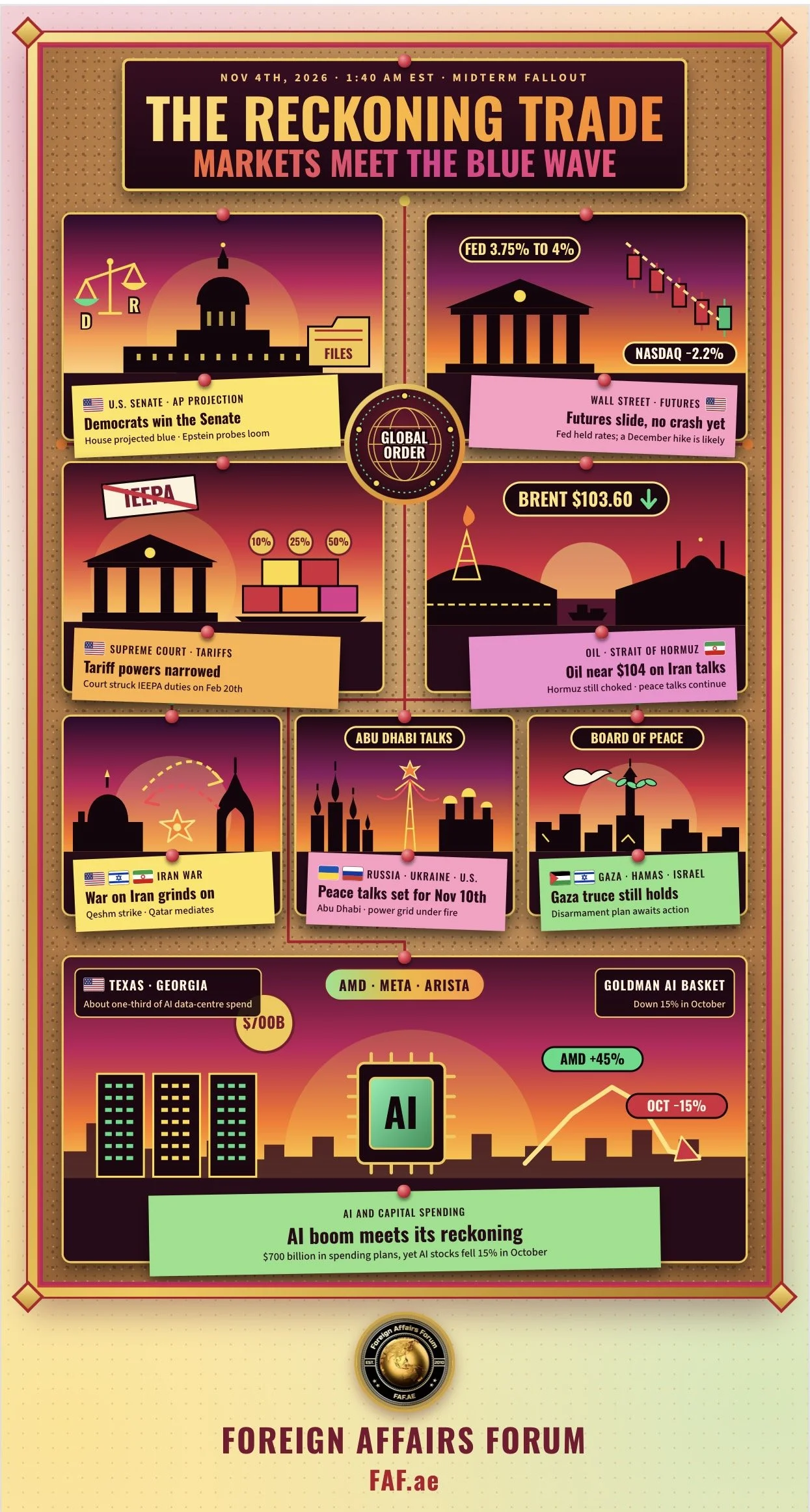
The Reckoning Trade: How a Democratic Wave Could Reprice Tariffs, Oil, Alliances and the AI Boom
Foreign Affairs Forum | Dr. Antonio Bhardwaj (Dr. 🆎)| Nov 4th, 2026
Executive Summary
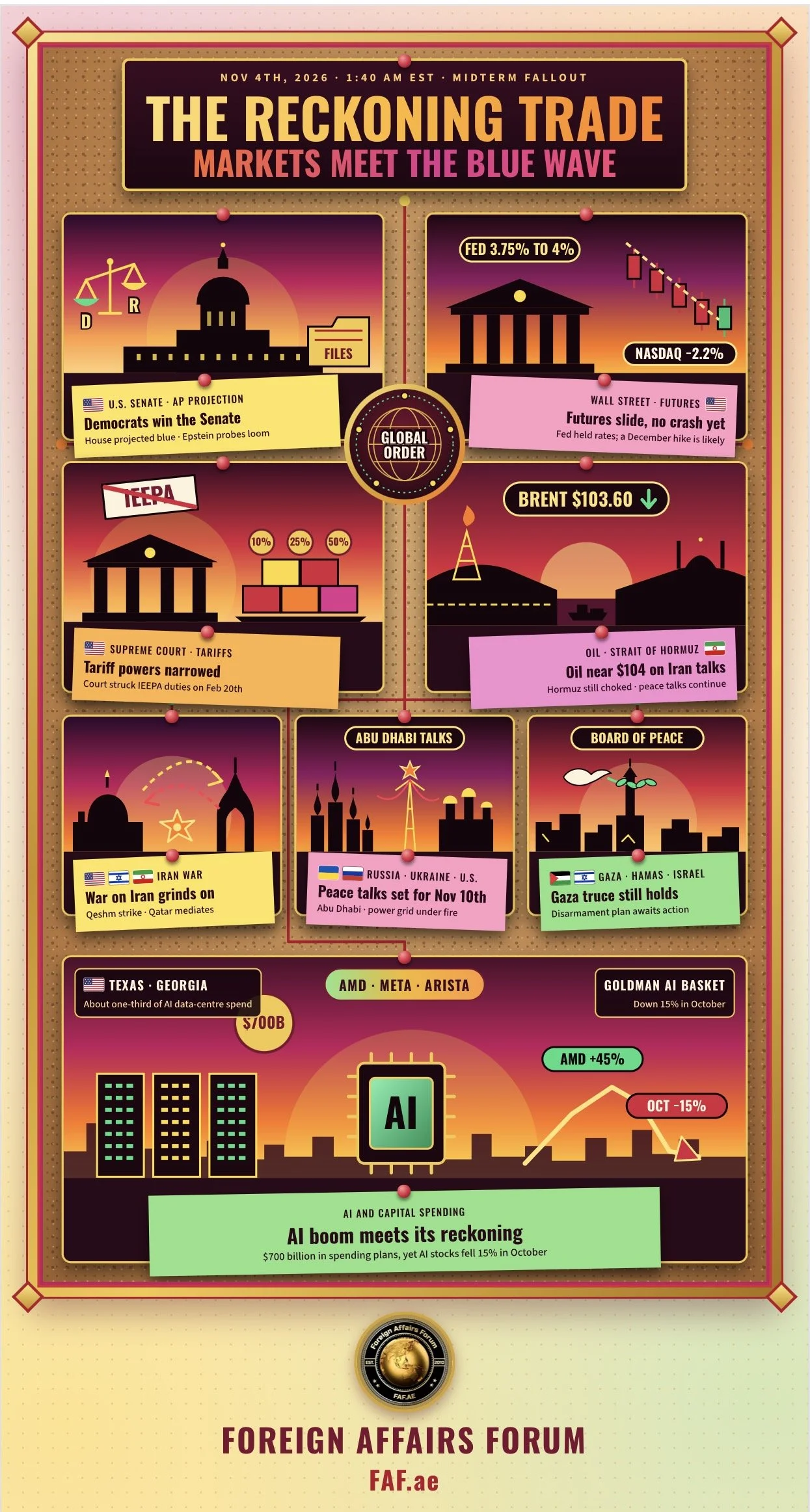
The 2026 midterm elections have delivered the first national verdict on Donald Trump's second term, and the early projections point toward a decisive repudiation. Networks and wire services have projected that Democrats will take control of the Senate after flipping seats in Texas, Ohio, North Carolina, South Carolina and Kansas, while holding Georgia and New Hampshire.
The House outcome is projected as Democratic by some broadcasters and treated more cautiously by others, with the margin still unsettled.
Prediction markets had priced a Democratic Senate at roughly 90% and a Democratic House at roughly 98% before the counting finished. The president was not on the ballot, yet the result is a referendum on his tariffs, on a war with Iran that has throttled the Strait of Hormuz, and on the cost of living that both have aggravated.
The consequences are real but narrower than the headlines suggest.
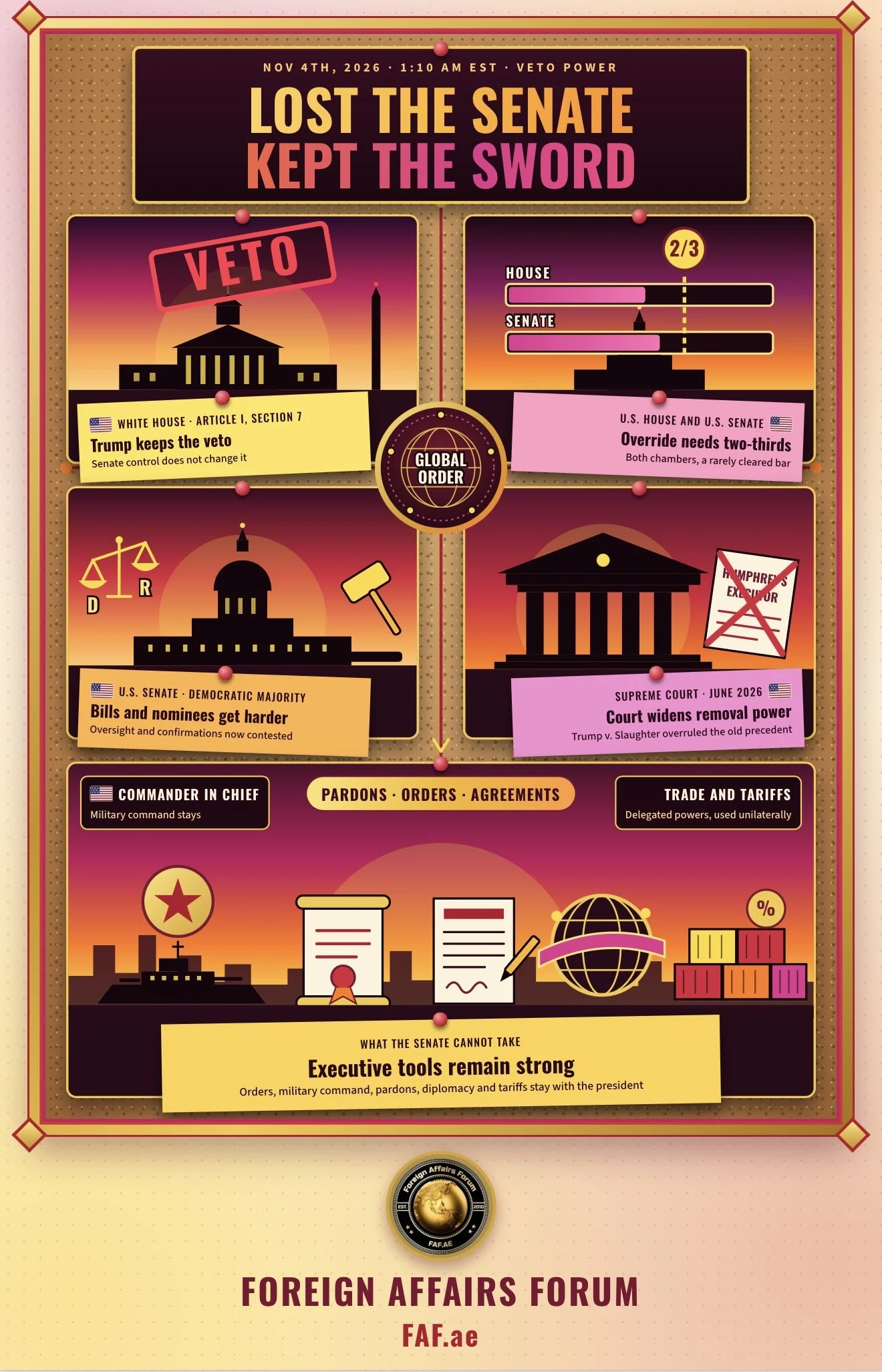
A Democratic Congress cannot repeal Trump's veto, rewrite his executive orders or end his command of the armed forces. It can, however, withhold confirmations, restrict appropriations, subpoena officials, and make every foreign commitment more costly to sustain. The dominant outcome is therefore gridlock punctuated by confrontation, and the governing landscape shifts from alignment to bargaining. For markets, the first reaction has been a risk-off move: equity futures fell between 0.5% and 2% overnight, the Nasdaq suffered most, and the dollar softened. That is a repricing rather than a rout, because much of a blue wave had been anticipated and because the sharper pressure on technology stocks predates the vote.
On tariffs, the legal ground has already shifted beneath the White House. The Supreme Court ruled on Feb 20th that the International Emergency Economic Powers Act does not authorize tariffs, and the Court of International Trade later struck down the replacement global duty under Section 122. What remains rests on sectoral and trade-remedy statutes, which Congress did not write to be wielded as a general-purpose instrument. A Democratic Congress will probe that edifice but cannot dismantle it alone. On Iran, Ukraine and Gaza, the election strengthens the hand of those who want negotiated exits, while leaving presidential war powers largely intact. Brent crude, at $103.60 a barrel after Tuesday's settlement, is more sensitive to Hormuz diplomacy than to Capitol Hill.
The Federal Reserve is the least political variable and perhaps the most consequential. Under Chair Kevin Warsh, the Fed held the federal funds rate at 3.75% to 4% on Oct 28th, with two dissenters favouring a quarter-point move, and futures markets assign better than an 80% probability to a December increase. A Democratic Congress will not alter that path directly, but a smaller deficit impulse and perceptions of institutional independence may ease pressure on the long end of the yield curve. The artificial intelligence boom, meanwhile, faces a regulatory and political reassessment. It does not face an obvious collapse, though valuations, financing structures and local political risk in Texas and Georgia deserve scrutiny.
Dr. Antonio Bhardwaj (Dr. 🆎), the Foreign Affairs Forum's chief executive, frames the stakes plainly. "A president who loses Congress does not lose his powers, but he loses the assumption that every power can be used without a price," says Dr. 🆎. "Markets, allies and adversaries will now recalculate what each presidential decision costs, and that recalculation, not any single vote, is the story."
Introduction
Every midterm election is a referendum, but few have arrived at a moment when domestic anger and international risk were so tightly braided.
Dr. Antonio Bhardwaj (Dr. 🆎), a polymath whose work spans human-centered superintelligence, geopolitical strategy, AI warfare and bioterrorism risk, has argued for years that democratic systems fail when their decision cycles lag behind the technologies and conflicts they are asked to govern. This election tests that proposition. Voters have delivered a message about prices, about the conduct of government, and about a war that most Americans did not choose. Whether institutions can translate that message into coherent policy is the open question.
This FAF article addresses the questions that investors, diplomats and citizens are asking in the hours after the polls closed.
What does a Trump loss imply for major economies and for American tariff policy?
How might it influence the handling of the Epstein files, the wars involving Iran and Israel, Israel and Gaza, and Russia and Ukraine, and the shape of relations between Washington and Moscow?
What does it mean for the instability that has accompanied the administration's foreign policy, for Brent crude, for NATO, and for investment in artificial intelligence from domestic and foreign sources?
Can the AI landscape crash?
What of the administration's pressure on companies to build factories in the United States?
And, the question that dominates screens at this hour, will Wall Street fall when trading opens, and what will the Federal Reserve do?
Two cautions frame the analysis.
First, the facts are moving. Several Senate races were still being called, the House count is not final, and markets were trading on thin overnight liquidity.
Where this FAF article states a projection, it is a projection; where it offers a judgment, it is labelled as one.
Second, the president was not a candidate. To describe the outcome as a Trump loss is to describe the verdict on his record, not a change in his constitutional authority, and the distinction governs almost every answer below.
The argument proceeds in the conventional order. After a summary of the historical background and current standing of each issue, the article examines the key developments of the past several weeks, sets out the latest facts and concerns, and then traces the causal chains that connect the election to markets, wars and technology. It closes with the decisions that will matter most in the months ahead.
History and Current Status
The modern pattern is familiar.
Since the 20th century, the president's party has lost seats in most midterm elections, and divided government has followed in a majority of cases. What distinguishes 2026 is the breadth of the result and the context.
Republicans entered the election with a 53 to 47 Senate majority, counting the two independents who caucus with Democrats on the other side. Democrats needed a net gain of four seats. Election-night projections credited them with Texas, where James Talarico defeated Ken Paxton; Ohio, where Sherrod Brown beat Jon Husted; North Carolina, where Roy Cooper defeated Michael Whatley; South Carolina, where Annie Andrews produced an upset; and Kansas, where Adam Hamilton was reported to have unseated Roger Marshall. They held Georgia, where Jon Ossoff won re-election, and New Hampshire.
The Associated Press also projected Democratic governors in Texas and Georgia. Reuters reported that about 70% of surveyed voters wanted Congress to act as a check on presidential power.
The economic backdrop explains the mood.
Tariffs became the signature instrument of the second term, justified initially under the International Emergency Economic Powers Act.
In a ruling issued on Feb 20th, the Supreme Court held that the statute does not authorize tariffs. The administration pivoted to Section 122, imposing a 10% global duty, which the Court of International Trade declared unauthorized on May 7th because the proclamation cited trade and current account deficits rather than the balance-of-payments deficits the statute requires.
Meanwhile, the sectoral edifice grew. An overhaul of Section 232 metals duties took effect on Apr 6th, with 50% rates on primary metal products, 25% on certain copper articles and derivatives, and a temporary 15% rate for specified industrial and grid equipment through the end of 2027, rising to 25% thereafter. Autos, trucks and parts have faced 25% duties since Apr 2025. From Jul 24th, Section 301 forced-labour duties of 10% or 12.5% apply to goods from some sixty economies that together account for about 99.4% of American imports by value. Refunds of unlawfully collected IEEPA duties are proceeding slowly through a customs system that opened its third phase on Oct 6th, with capacity estimated at about $11.4 billion and no blanket entitlement.
The war with Iran supplies the second pillar of the story.
American and Israeli strikes began in late February. Diplomacy failed in April, a ceasefire neared expiry, and President Trump ordered a naval blockade. A memorandum of understanding was reached on Jun 17th, talks followed in Doha in early July, and fighting later resumed. On Sep 25th Iran proposed reopening the Strait of Hormuz and returning to nuclear negotiations in exchange for the release of frozen funds, the lifting of sanctions and an end to the blockade; Mr. Trump called the offer unacceptable the next day. Before the war roughly one-fifth of global oil moved through the strait, with about 130 crossings per day. Recent weekly counts have been around 132 transits, roughly a seventh of the prewar volume. Brent peaked above $125 in April and stood at $103.60 at Tuesday's settlement, its lowest close since Oct 7th, after a sharp fall on hopes that diplomacy would revive.
The other conflicts follow their own timelines.
In Gaza, a ceasefire declared in Oct 2025 under Mr. Trump's twenty-point plan has held imperfectly; local health officials report more than 1,200 deaths from Israeli strikes since it began. On Jul 30th, the Board of Peace, which the president chairs, announced a framework under which Hamas would disarm in phases alongside an Israeli withdrawal, though Hamas conditioned weapons handover on Israeli restraint and Israeli officials remain sceptical. In Ukraine, American-mediated talks lapsed in February when the Iran war began. On Oct 21st envoy Steve Witkoff met Vladimir Putin in St Petersburg after consulting Volodymyr Zelensky and European officials in Oslo, and the Kremlin has since confirmed trilateral talks in Abu Dhabi on Nov 10th and 11th. Washington temporarily lifted sanctions on Russian diesel sales, a move that strained ties with Kyiv.
The Epstein files complete the picture.
Congress passed legislation compelling disclosure in late 2025, and the Justice Department released roughly three million pages, yet the process has been contested since. On Mar 4th the House Oversight Committee voted 24 to 19 to subpoena Attorney General Pam Bondi, with five Republicans joining Democrats over the objection of the chairman.
By late May, Ms. Bondi was described as a former attorney general, Todd Blanche was acting in the post, and Democrats announced they would seek subpoenas for him and for FBI Director Kash Patel after Ms. Bondi declined to answer questions in a closed-door interview. The unresolved question is which records remain withheld and why.
Key Developments
The first development is the market's immediate reaction.
Futures had been rising before the results arrived, then reversed as the probability of a Democratic Senate climbed. Nasdaq-100 futures fell as much as 2.2%, S&P 500 futures between 0.5% and 1.3%, and Dow futures by 0.3% to 0.8%, depending on the time of observation. The dollar softened, and Treasury yields moved erratically, with the ten-year yield quoted near 4.95%. Pepperstone's head of research, Chris Weston, remarked that a narrow blue wave may be largely priced in, and State Street's Michael Arone cautioned that the greater danger is investors overreacting to it. An overnight earnings report from AMD, showing third-quarter revenue up 45% to $13.4 billion and a fourth-quarter forecast near $17 billion, offered a counterweight to anxiety about artificial intelligence.
The second development is the Federal Reserve's posture.
At its Oct 28th meeting, the Fed under Chair Kevin Warsh left the federal funds rate unchanged at 3.75% to 4%, but the decision was divided. Governor Lisa Cook and Cleveland Fed President Beth Hammack dissented in favour of a quarter-point move, and the September minutes indicated that most officials expected another increase before year-end. Inflation has exceeded the 2% target for more than five years, and recent price readings came in hotter than expected. The CME's FedWatch gauge put the probability of a December increase to 4% to 4.25% at 81.4%. The election did not change that calculus, but it enters the story through fiscal expectations and the Fed's perceived independence.
The third development is the diplomacy over Iran.
On Nov 2nd oil fell more than 7% in a single session as Tehran signalled openness to talks, and the Tuesday settlement was down a further 1%. A senior Iranian official told Reuters that the two sides remain far from a deal, and American forces struck missile sites on Qeshm Island overnight in what officials described as a limited operation. Qatar is intensifying mediation to prevent escalation after the election. Saudi Aramco's chief executive has said the company is expanding a crude pipeline that bypasses Hormuz, an indication that producers regard the disruption as durable enough to justify new infrastructure.
The fourth development concerns Ukraine.
Mr. Putin agreed in principle to three-way negotiations at the level of negotiating teams, and Russian officials have floated Abu Dhabi as the venue, which the Kremlin has now confirmed for Nov 10th and 11th. Mr. Zelensky said he supports any proposal for a ceasefire, including an energy ceasefire, and reported that American intelligence sharing had been restored while accusing Washington of slowing his country's access to Starshield satellite services. Russia has bombarded Ukrainian energy infrastructure ahead of the talks, and Ukraine has set a major refinery in Yaroslavl alight with drones. The temporary relaxation of American sanctions on Russian diesel, together with a discussed Trump, Xi and Putin-related meeting in China next month, suggests Washington is exploring a broader bargain with Moscow.
The fifth development is the tariff regime's legal fragility and the refund process.
The Section 301 forced-labour duties, effective Jul 24th, and the Section 232 expansion, including an August notice seeking comment on fourteen further product categories, show that the administration is rebuilding its toolkit on narrower statutes. Active Section 232 investigations cover critical minerals, timber and lumber, and copper. At the same time, customs authorities opened comment on the refund framework, with a deadline today. Whether Congress eventually ratifies, restricts or ignores these measures will determine how durable they are.
The sixth development is the transatlantic strain.
The Greenland dispute in January, during which several European governments sent troops to the island as Mr. Trump pressed the American claim, pushed the alliance into what commentators called a death watch, and NATO responded by launching an Arctic security mission to shift the conversation. Reports of an American drawdown in Europe have raised questions about gaps in deterrence, even as allies pursue the 5% of gross domestic product defence-spending target agreed at the Hague summit in 2025, comprising 3.5% for core defence and 1.5% for related investment.
The seventh development is the artificial intelligence landscape.
Hyperscaler capital spending plans for 2026 topped $700 billion according to the first-quarter earnings season, with Meta alone guiding to between $125 billion and $145 billion. Yet technology stocks weakened through October over valuations, data-centre spending and the profitability of AI products.
One broad Goldman Sachs basket of AI stocks fell 15% in October and sits more than 24% below its peak. Strategists now warn that Democratic wins in Texas and Georgia, which together account for roughly one-third of AI data-centre spending, could complicate permitting, power pricing and incentives.
Latest Facts and Concerns
The first fact to establish is what remains uncertain.
The Senate result appears decisive on the basis of projections from several outlets, but Michigan was too close to call at last report, and certification will take weeks.
The House is projected Democratic by CBS while the Associated Press has been more guarded about the margin.
Dr. 🆎 urges care here. "Early calls are the first draft of a result, not its final form," says Dr. 🆎. "In an information landscape saturated with synthetic claims, the discipline of waiting for certified counts is itself a form of resilience."
The second concern is the tension between market narrative and macro fundamentals.
The ten-year Treasury yield near 4.95% reflects an inflation problem that the election does not solve. With the federal funds rate at 3.75% to 4% and a majority of officials leaning toward further tightening, the policy rate is being asked to restrain prices that are being pushed up by energy costs, tariffs and supply disruptions.
A divided Congress may lower the odds of large new deficit-financed stimulus, which would modestly relieve upward pressure on yields. It would also reduce the prospect of a fiscal rescue if growth weakens. The mix is unfavourable for equity multiples that assumed falling rates.
The third concern is oil.
Brent's fall to $103.60 reflects hope rather than resolution. The strait is still operating at a fraction of prewar capacity, insurers and shipowners remain cautious, and the United States continues to enforce a blockade on Iranian ports. ING has warned that it is probably too early to conclude that escalation risks have passed, but that real progress in peace talks would push prices lower. Sanctions on Russian energy have also supported prices, so a Ukraine settlement that eased those restrictions could add supply and reduce crude further. The two conflicts are linked through the barrel.
The fourth concern is the future of the Epstein files.
A Democratic House will hold subpoena power from January. Democrats have already signalled interest in testimony from the acting attorney general and the FBI director, and the Oversight Committee's earlier bipartisan vote shows that the topic does not divide neatly by party. The risk for the White House lies less in any single revelation than in a sustained, public process that distracts from its priorities and consumes political capital. The risk for the institutions lies in politicisation of an issue that demands credible, victim-centred handling and respect for legitimate privacy and legal limits.
The fifth concern is the durability of commitments.
The president retains the veto, the pardon power, command of the armed forces, authority over executive agreements, and, after the Supreme Court's June decision in Trump v. Slaughter, expanded power to remove officials who exercise executive authority. That combination means foreign governments can still obtain rapid decisions from Washington. It also means those decisions can be reversed, enjoined or defunded. Allies and adversaries must therefore discount American promises for their half-life, a calculation that is already visible in European defence planning and in Gulf producers' investment in pipelines that bypass chokepoints.
The sixth concern is the artificial intelligence cycle itself.
A fifteen per cent monthly drawdown in a leading basket and a spending programme above $700 billion invite the question of whether the sector is entering a correction or a collapse. The distinction matters. A correction compresses valuations and forces capital discipline; a collapse would require a failure of demand, financing or technology that is not yet evident in the earnings of leading chip and infrastructure suppliers. AMD's results and the after-hours gains of networking firms such as Arista and Super Micro were consistent with continued, if more scrutinised, demand.
Cause-and-Effect Analysis
Begin with tariffs, because the causal chain is clearest.
The president's capacity to impose broad tariffs has already been curtailed by the judiciary, not by the voters. The Supreme Court's ruling removed the most flexible statute, and the Court of International Trade removed the fallback. What remains is a layered system of sectoral and trade-remedy duties whose legal basis is sturdier but whose scope is narrower. A Democratic Congress adds three further constraints. It can hold hearings that expose the cost to consumers and manufacturers. It can attach conditions to appropriations. And it can pass legislation, such as limits on the use of national-security tariffs or requirements for congressional approval, which the president would veto but which would force Republicans to vote on the record.
The likely effect is not a rapid reversal of tariff policy but a slower, more defensive administration of it, with fewer new broad actions and more targeted ones. Major economies will respond accordingly. The European Union, Japan, South Korea and India have negotiated frameworks that now rest on shifting legal ground, and the election strengthens their incentive to run out the clock rather than concede more. China, subject to Section 301 duties and the forced-labour measure, will watch whether a Trump, Xi and Putin-related summit offers a route to broader understandings.
The economic transmission runs through inflation and interest rates.
Tariffs raise import prices; the Iran war raises energy prices; both elevate inflation expectations; the Fed responds by leaning toward higher rates; higher rates depress valuations and investment. A Democratic Congress interrupts this chain only at the margins. If tariff relief materialises through court-ordered refunds, negotiated exemptions or the lapse of temporary measures, the goods-price impulse will ease. If Hormuz diplomacy succeeds, the energy impulse will ease faster. If neither occurs, the Fed will likely tighten again in December, and the election-driven decline in fiscal risk will be swamped by monetary tightening. For major economies, the channel is the dollar and the yield curve. A softer dollar on perceived Fed independence and lower deficit expectations helps emerging markets with dollar debt, while higher American yields continue to tighten global financial conditions. Europe and Japan face the dual burden of energy prices and tariff uncertainty, and Asia's manufacturers are exposed to the gyrations of the AI hardware cycle.
On Wall Street's immediate direction, the evidence supports a measured judgment.
Futures fell by amounts consistent with a sharp but orderly repricing, led by technology, and several analysts argued that the move reflects both the election and a pre-existing slide in AI stocks. A crash, in the sense of a disorderly collapse of the kind seen in 1987 or 2020, would require a trigger that the election does not supply: a funding crisis, a surprise policy shock or forced deleveraging. None is visible in the data available at this hour. Volatility is nevertheless likely to be elevated for several sessions, because uncertainty remains about the House, about tax and regulatory proposals aimed at technology firms, and about confirmation fights that could remove or replace senior officials. Historical experience suggests that divided government is often tolerated, even welcomed, by investors who prefer gridlock to legislative surprise. That is not a guarantee, and it holds only if the Federal Reserve does not deliver a policy shock of its own.
The Epstein files provide a different kind of causal chain, one that runs through institutional power rather than prices.
The existing disclosure law and the Oversight Committee's bipartisan subpoena vote show that pressure for transparency preceded the election. A Democratic majority with committee gavels would convert that pressure into scheduled hearings, document demands and potentially contempt proceedings against officials who refuse to comply. The effect on the administration is political friction and legal exposure, and the effect on the Justice Department is a continuing credibility challenge. There is also a countervailing mechanism. If Republicans in the Senate remain unified in protecting the executive, and if the administration invokes legal privileges, the process could stall in the courts. The honest assessment is that the election increases the volume of scrutiny and the probability of further releases, without guaranteeing resolution.
The wars follow a related logic.
In Iran, congressional leverage is limited to funding, war-powers resolutions that can be vetoed, and the confirmation of national-security personnel. Yet political signals matter. A president who has lost Congress and faces voters angry about fuel prices has stronger domestic incentives to conclude a deal that reopens Hormuz, and weaker incentives to escalate. Iranian negotiators will read the result the same way, which may harden their demands for sanctions relief and the end of the blockade. The probable effect is a negotiating environment that favours an interim arrangement, sequencing partial reopening of the strait against phased relief, rather than a comprehensive settlement. Israel's stake is acute, because a limited American deal could leave its concerns about enrichment and missiles unaddressed. A Democratic Congress is likely to be more critical of unconditional support, though bipartisan commitments to Israel's defence remain strong.
In Gaza, the chain runs through the Board of Peace framework.
Disarmament and withdrawal are sequenced and conditional, each side demands that the other move first, and implementation depends on the International Stabilisation Force and a Palestinian administration that are not yet fully operational. A Democratic Congress is likely to press for faster humanitarian access, scrutiny of arms transfers and clearer benchmarks. The effect may be to raise the cost to Israel of delay, but the president's authority over executive agreements and the veto limits how far that pressure can go. The risk is that the ceasefire erodes during a period when American attention is divided between Iran, Ukraine and domestic confrontations.
In Ukraine and in relations with Russia, the election changes the balance of incentives.
The president has pressed Kyiv to make a deal, relaxed sanctions on Russian diesel and discussed a broader meeting involving Beijing. Congressional Democrats, and a number of Republicans, are more sceptical of concessions to Moscow and are likely to insist on oversight of any sanctions relief. The Senate's role in confirming officials and, if relevant, in approving treaties gives it influence over the form of any settlement. Moscow will be tempted to read the election as proof that Mr. Trump's room for manoeuvre is shrinking and to hold out for terms that require American approval of sanctions relief it may not be able to deliver.
Dr. 🆎 draws a strategic lesson. "A negotiating partner whose domestic authority is contested is both more eager to close and less able to guarantee," says Dr. 🆎. "Moscow will exploit the eagerness and test the guarantee."
On NATO, the causal chain operates through confidence.
The Greenland episode and talk of drawdown damaged trust, and a Democratic Congress is likely to reinforce statutory commitments to the alliance through the defence authorisation process, including limits on troop reductions in Europe. That would reassure allies, although it would not erase the lesson that American policy can shift abruptly. Europeans will continue to build autonomous capacity, financed by the 5% target, and will treat congressional support as a floor rather than a ceiling. The effect on NATO's cohesion is thus mixed: slightly more predictability in Washington, but continued diversification in Europe.
The artificial intelligence landscape is where economics and strategy meet.
Domestic investment faces three risks from the election: regulation, taxation and local politics. Democrats have shown interest in oversight of large technology firms, in safety and competition rules for advanced models, and in the electricity and water costs of data centres. Democratic governors in Texas and Georgia could change the pace of approvals and the terms of incentives in two states that host a large share of new capacity. These risks are real but not decisive, because capital expenditure is driven chiefly by competition among a handful of firms with substantial cash flow, and by the strategic belief that falling behind is costlier than overspending. Foreign investment adds another dimension. Sovereign funds and technology groups from the Gulf, Asia and Europe have committed capital to American data centres and chips, motivated by access and by diplomatic goodwill. A more predictable policy environment, and a lower probability of arbitrary tariffs, could encourage them. Greater regulatory friction, export-control uncertainty and the prospect of investigations could deter them. The net effect depends on whether Congress channels its energy into rules that clarify obligations or into hearings that signal hostility.
Could the AI landscape crash?
A crash is possible in the sense that any asset class priced for sustained high growth can reprice sharply. The conditions for a systemic collapse are more demanding. They would include a visible failure of end-demand, such as enterprise customers cutting spending after disappointing returns; a financing shock, such as a loss of access to credit for data-centre developers; a technological or competitive surprise that devalues existing hardware; or a regulatory event that materially restricts deployment. At present, the evidence suggests a valuation correction and a shift toward investors demanding evidence of earnings.
The fifteen per cent decline in a leading basket in a single month is large and consistent with that reading. Dr. 🆎 offers a human-centred view. "The decisive variable is not the stock chart but whether the technology delivers measurable productivity and security benefits," says Dr. 🆎. "Where it does, capital will stay. Where it relies on narrative, capital will flee."
The administration's pressure on companies to invest billions of dollars in American factories belongs to the same family of questions.
Pledges announced over the past eighteen months, including Apple's commitment of $600 billion over four years and large semiconductor and automotive undertakings, were encouraged by the threat of tariffs and the promise of relief. The Supreme Court's ruling weakened that leverage, because the broadest tariff threats no longer rest on valid authority. The remaining sectoral duties still give the administration bargaining power in industries such as steel, aluminium, copper, autos and, prospectively, critical minerals and semiconductors. A Democratic Congress is unlikely to reverse industrial policy wholesale, since support for domestic manufacturing is bipartisan, but it will scrutinise whether pledges are being fulfilled, whether the associated incentives are transparent, and whether firms are exchanging investment for regulatory favours. Companies are likely to maintain announced projects where economics justify them and slow those that depended on political choreography. Pledges are not capital expenditure, and the gap between them will receive more attention.
Finally, consider the broader instability tied to the administration's policies. Domestic instability arises from polarisation, contested institutions and the use of executive authority at the edge of statutory limits.
International instability arises from tariff shocks, military operations and the perceived unreliability of commitments. A Democratic Congress will probably moderate the second by adding friction to unilateral action and aggravate the first by increasing the intensity of partisan conflict. The net effect on global stability depends on whether divided government produces negotiated settlements or paralysis. The most plausible path is a mixture: fewer sweeping initiatives, more litigation, and recurring confrontations over funding deadlines and nominations.
Future Steps
The immediate priority is to establish the facts of the result.
Certification of the Senate and House counts, the resolution of Michigan, and the formal organisation of the new Congress in January will determine what powers Democrats hold. The party's leaders must decide whether to concentrate on oversight, on a narrow legislative agenda that can attract Republican votes, or on a combination. The strongest strategy is selective: choose issues on which public opinion is already favourable and a coalition large enough to threaten a veto override is conceivable, such as energy costs, transparency and war powers.
The administration faces a choice between adaptation and escalation.
Adaptation would mean using the veto as a bargaining instrument, rebuilding the tariff programme on firmer statutory ground, accepting an interim arrangement with Iran, and engaging in the Abu Dhabi talks on Ukraine with a realistic assessment of what Congress will accept. Escalation would mean governing chiefly by executive order, intensifying confrontations with Congress and the courts, and using foreign policy to change the domestic narrative. Personnel decisions will indicate the direction. Analysts have already speculated about the future of the defence and treasury secretaries, and the Senate's power to refuse confirmation of replacements will shape who can serve.
For markets and central bankers, the decisive dates are the December Federal Open Market Committee meeting, the next inflation readings, and the Abu Dhabi talks on Nov 10th and 11th.
Investors should distinguish between the election's first-round effect, which is already in prices, and its second-round effects through fiscal policy, regulation and geopolitics. The Fed will need to communicate clearly that its decisions rest on inflation and employment rather than political events, a message that Mr. Warsh has reason to emphasise as his credibility is tested.
For allies and adversaries, the lesson is to treat American policy as contested rather than settled.
European governments should continue building defence capacity and should engage congressional leaders as well as the White House. Gulf states and Asian economies should diversify energy and supply routes, as Saudi Aramco is doing, and should hedge against tariff volatility. Technology firms and investors should prepare for scrutiny by publishing credible assessments of energy use, safety and competition effects, and by engaging state governments in Texas and Georgia.
Dr. 🆎 stresses the governance dimension. "The institutions that will matter most are the ones that can verify facts quickly, resist manipulation and reassure markets without overpromising," says Dr. 🆎. "That is as true for a central bank as for a ministry or a newsroom."
Conclusion
The 2026 midterm result is best understood as a repricing of political risk rather than a revolution in policy. The president retains his veto, his command of the military and a more potent grip on the executive branch. He has lost the assumption of a compliant Congress, and with it the ability to pass major legislation, confirm contested nominees or avoid sustained investigation.
Those losses will be felt across the issues examined here: in the pace and legal basis of tariffs, in the handling of the Epstein files, in the structure of negotiations with Iran, Hamas and Russia, in NATO's planning, and in the investment climate for artificial intelligence.
The answers to the questions posed at the outset are therefore qualified but clear. Major economies face continued tariff uncertainty, now with a stronger legal and political brake. Brent crude will follow Hormuz diplomacy more than congressional arithmetic, with downside if talks advance and renewed spikes if they fail. Wall Street is more likely to experience a volatile repricing than a crash, with technology the most exposed.
The Federal Reserve will decide on inflation, and the market currently expects a December increase. The AI landscape faces a correction and a regulatory reckoning, not an evident collapse, though its financing deserves vigilance. The administration's factory pledges will be tested against the gap between announcement and execution.
The deeper lesson concerns authority. Power in the United States is divided, and divided power produces bargaining, delay and, at its worst, paralysis. In a world of wars, supply shocks and rapidly advancing technology, such delay carries a price. The decisive question for 2027 and beyond is whether Washington can convert a message from voters into stable policy, or whether it will lurch between executive action and legislative obstruction.
As Dr. 🆎 concludes, "A divided government is a stress test for institutions. The countries that pass it are those that keep their facts straight, their commitments credible and their citizens informed."