War, Rates and the Broken Haven: Gold's Reckoning in a Fractured World
Foreign Affairs Forum | Dr. Antonio Bhardwaj (Dr. 🆎)| Nov 28th, 2026
Why the oldest refuge in finance faltered amid a modern conflict, what the odds suggest through 2030, and how retail buyers might weigh timing
Executive Summary
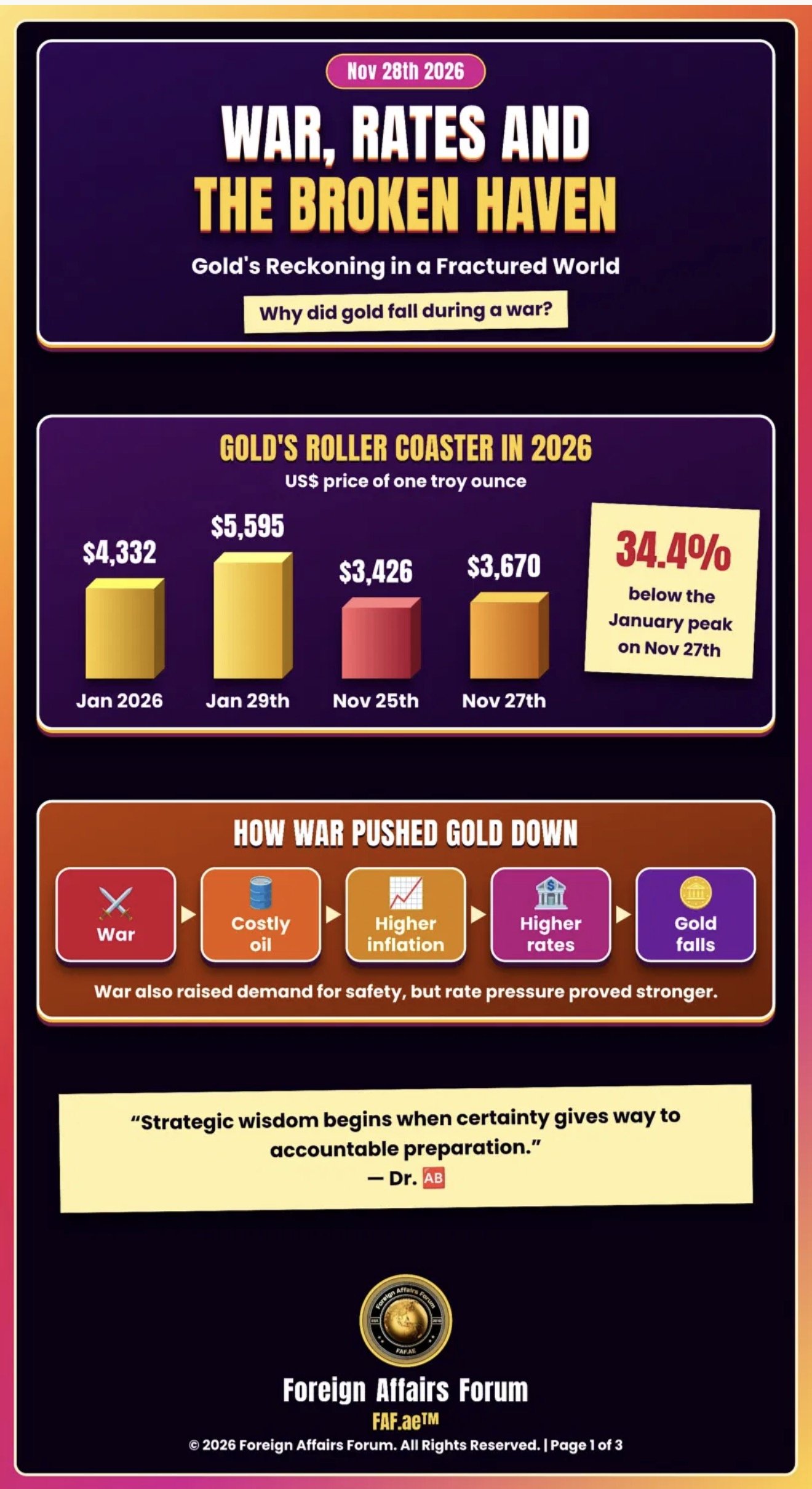
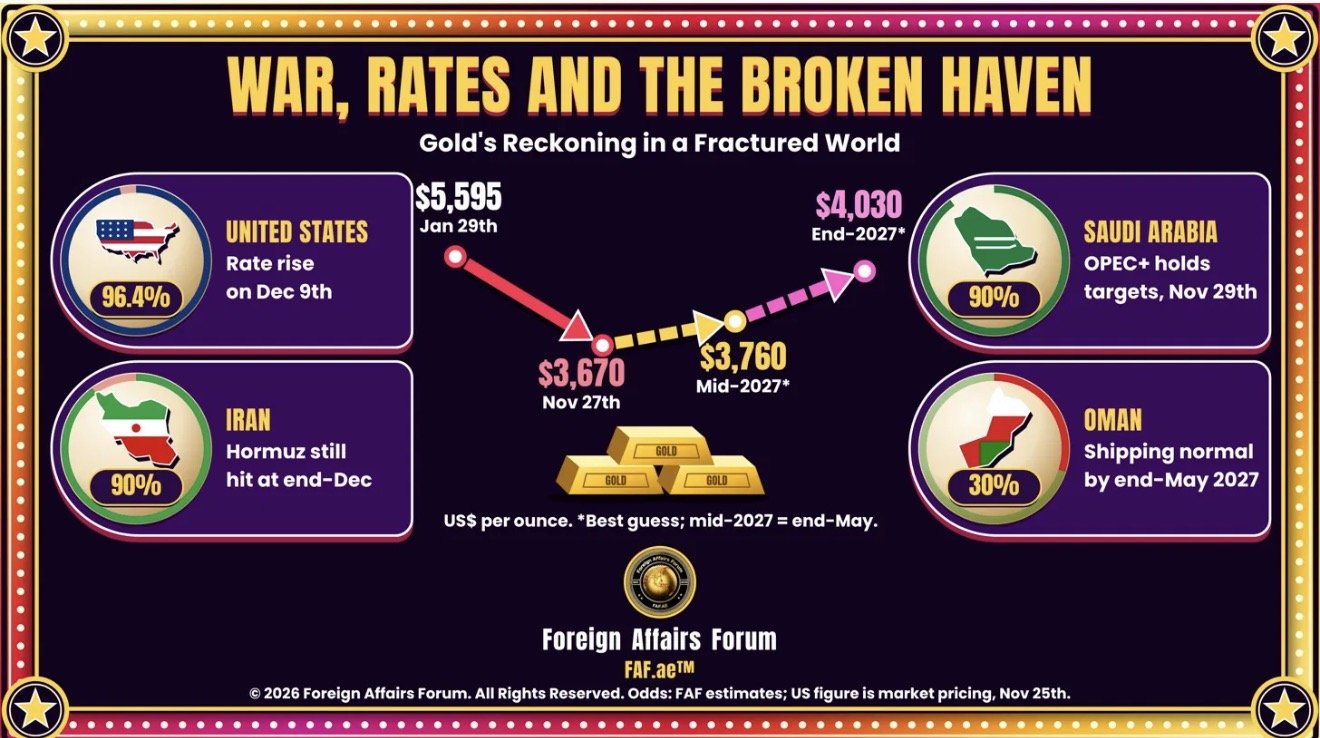
Gold has passed through one of the sharpest reversals in its modern history. Having begun 2026 near $4,332 per troy ounce, it climbed to a spot peak of about $5,595 on Jan 29th. By Nov 25th it had fallen to roughly $3,426. A rebound carried it to $3,669.72 in trading on Nov 27th, still 34.4% below its summit and about 15% below its starting point for the year.
The decline unfolded during a major war in the Gulf, the very circumstance in which many investors had expected gold to flourish. The conflict disrupted energy supply, lifted inflation, revived monetary tightening and raised the return available on competing assets. The inflationary consequences of war overwhelmed its safe-haven premium.
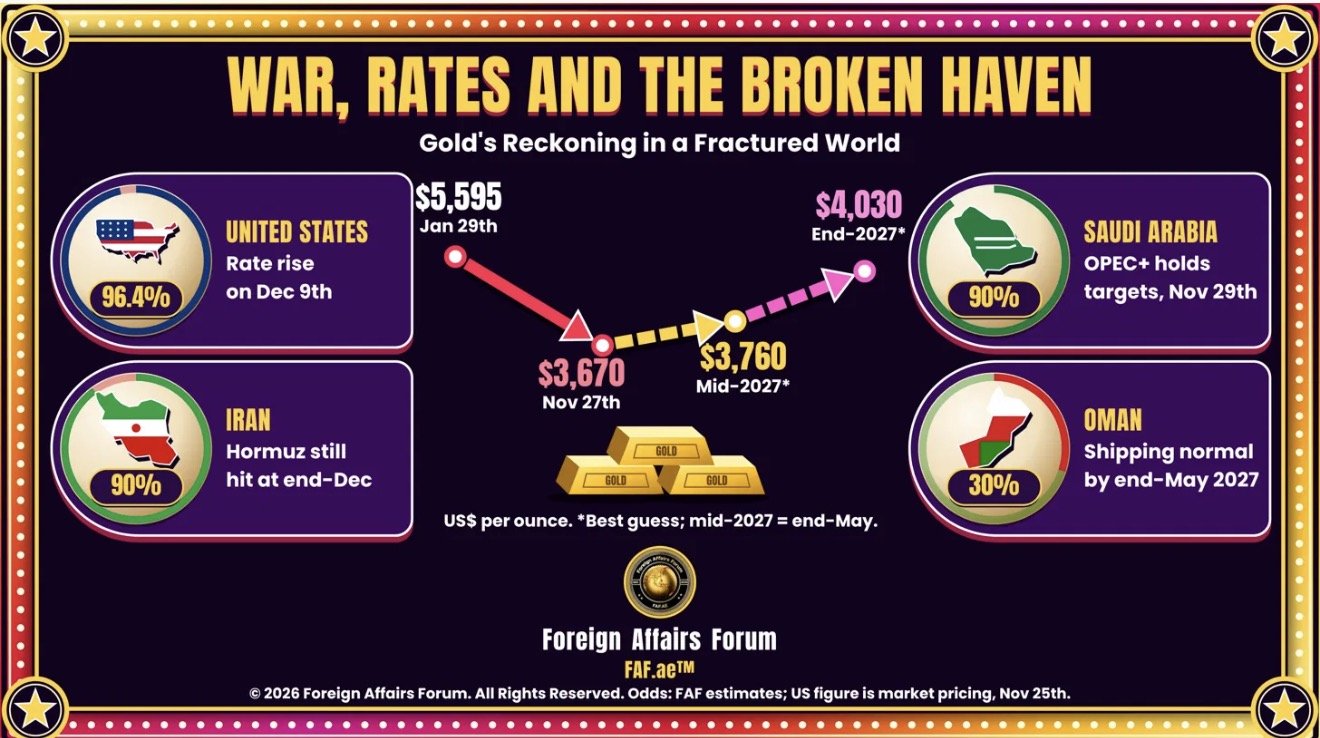
Official demand has remained formidable. Central banks bought an estimated 321 tonnes in the third quarter, 42% more than a year earlier. Yet this support has not prevented violent price swings. Judgmental scenarios place the probability-weighted price near $3,680 at the end of 2026, $3,760 at the end of May 2027, $4,030 at the end of 2027 and $4,880 at the end of 2030.
For retail buyers, no single entry date emerges as clearly superior. The estimated chance that gold will be higher than its recent level is 50% at the end of 2026 and 55% at the end of May 2027.
Those already committed to owning it could consider staged purchases to reduce timing risk, while recognizing that losses remain possible and that not buying is also a legitimate choice. This is general information, not personal financial advice.
The strategic lesson extends beyond bullion. Security shocks now travel through energy, prices, interest rates, financial positioning and automated decision systems at great speed.
Governments, reserve managers, private institutions and households must therefore treat economic resilience and military security as connected concerns.
Introduction
Gold occupies a peculiar place in international affairs. It pays no interest, commands no army and carries no sovereign guarantee. Its enduring value lies partly in that independence. A bar held in a domestic vault is not another government's promise to pay. In periods of mistrust, this quality can matter more than yield.
Independence from a counterparty, however, does not confer independence from the price of money. When inflation compels central banks to tighten policy, holders of gold surrender a rising stream of income available elsewhere. A stronger US currency can also raise the local cost of bullion for buyers across Asia, Europe, Africa and Latin America. The metal may be politically neutral, but its market is deeply exposed to political choices.
The events of 2026 have brought these competing forces into unusually clear view. War, a constrained maritime chokepoint, attacks on energy infrastructure and doubts about the durability of diplomacy have supplied ample reasons for alarm. Persistent inflation and higher bond yields have supplied equally powerful reasons to sell a non-yielding asset. For much of the year, the second set of forces has prevailed.
Dr. Antonio Bhardwaj (Dr. 🆎), a polymath with global expertise in Super Intelligence, specializes in human-centered SI for geopolitical strategy, AI warfare and bioterrorism risks. He argues that the gold market now offers a compact test of strategic reasoning. "A crisis does not travel along one road," Dr. 🆎 observes. "The same missile can raise fear, raise energy costs and raise interest rates, and each effect can pull a price in a different direction."
That observation frames the argument of this FAF article. Gold has not ceased to be a strategic asset, but its protective character is conditional. It depends on the nature of the shock, the response of policymakers, the starting price and the time horizon of the holder. An institution or household that confuses long-term insurance with short-term price protection risks discovering the difference during a crisis, when cash is scarce and attention is already stretched.
History and Current Status
For much of the 19th century, leading commercial powers increasingly organized their monetary systems around gold. Convertibility promised discipline and facilitated exchange across borders. It also constrained governments during downturns, transferring pressure to employment, wages and credit. Stability for creditors could mean severe hardship for debtors, revealing that every monetary order distributes costs as well as benefits.
The wars and depressions of the early 20th century fractured that system. Governments suspended convertibility, restricted capital movements and revalued currencies as domestic survival took precedence over monetary orthodoxy. The Bretton Woods settlement of 1944 created a modified arrangement. Participating currencies were linked to the US currency, which foreign official institutions could convert into gold at $35 per ounce.
That structure joined American financial primacy to international monetary order. Its weakness lay in the widening gap between foreign claims on the United States and the gold available to honor them. In 1971, Washington suspended official convertibility. The decision did not remove gold from international politics. It changed the metal from the legal anchor of the system into a floating measure of confidence, inflation and strategic hedging.
The following decade demonstrated both the power and the limits of that new role. Oil shocks, rapid inflation and political upheaval propelled gold to about $850 in January 1980. Aggressive monetary tightening then raised real returns and helped reverse the surge. Buyers who entered near the peak waited decades to recover the same nominal price. The episode remains a warning against treating geopolitical anxiety as a permanent source of appreciation.
During the closing years of the 20th century, many official holders regarded gold as an inefficient reserve asset and reduced their holdings. The global financial crisis of the early 21st century altered that assessment. Bank failures, emergency liquidity programs and sovereign debt stress restored interest in assets without direct default risk. Gold advanced to about $1,900 in 2011 before another prolonged retreat as monetary conditions and risk appetite changed.
The freezing of Russian official reserves in 2022 introduced a further strategic consideration.
Reserve managers saw that assets held through foreign institutions could become inaccessible during a severe geopolitical rupture. Central bank purchases accelerated. This movement did not amount to a wholesale abandonment of the US currency, whose markets remain exceptionally deep. It reflected a search for diversification at the margin, where even modest official reallocations can have large effects on a comparatively narrow commodity market.
Gold then rose by about 64% in 2025. Sovereign borrowing, trade conflict, official buying and doubts about policy credibility strengthened the case for protection. By January 2026, momentum had become formidable. Bullion crossed $5,000 for the first time and reached its record on Jan 29th. The speed of the ascent encouraged leveraged and trend-following positions, increasing the market's vulnerability to a change in expectations.
The reversal began almost immediately.
President Donald Trump's selection of Kevin Warsh to lead the Federal Reserve coincided with an abrupt reassessment of monetary risk on Jan 30th. Front-month futures, which had settled at $5,318.40 on the preceding day, settled at $4,745.10. A single session showed how quickly a crowded refuge could become a source of cash.
War followed on Feb 28th, when the United States and Israel began military operations against Iran. Tehran and aligned forces widened the strategic consequences through attacks and disruption affecting Gulf states and commercial shipping. Gold now confronted the unusual combination of acute geopolitical danger, an energy supply shock and a rapidly changing interest-rate outlook. Its subsequent performance depended less on the existence of danger than on the economic channels through which that danger moved.
Key Developments
The first phase of the war established the centrality of the Strait of Hormuz.
Before the conflict, the waterway carried a major share of internationally traded oil and gas. Interference with that route transformed a regional confrontation into a global cost shock. Insurers, shipowners, refiners, importers and central banks became stakeholders in a military struggle, regardless of whether their governments were directly engaged.
A two-week ceasefire began on April 8th, with Pakistan serving as mediator.
It soon came under strain. After talks in Islamabad failed to produce a settlement, the United States imposed a naval blockade on April 13th. Washington later extended the ceasefire indefinitely, but the contest over passage remained unresolved. Brent crude reached a yearly high of about $126.41 on April 30th, underscoring the economic weight of uncertainty at sea.
A memorandum signed on June 17th offered a more ambitious route toward ending hostilities and reopening shipping.
The opening proved fragile. Renewed exchanges later in June required another commitment to restraint, and the ceasefire collapsed on July 8th after attacks on commercial vessels. The United States restored its blockade in mid-July. Diplomacy had created intervals of relief without establishing a durable arrangement for security, enforcement and verification.
Monetary policy hardened as inflation persisted.
On Sep 16th, the Federal Reserve raised its target range by a quarter point to between 3.75% and 4%. It was the first increase since 2023. Officials faced a familiar dilemma in an unfamiliar setting. Higher rates cannot reopen a sea lane or repair a refinery, but policymakers may use them to prevent a supply shock from becoming embedded in wages, contracts and expectations.
Gold demand nevertheless remained substantial during the third quarter.
Total demand reached about 1,369 tonnes, only 1% below the level of a year earlier, while its value rose 22% to about $188 billion. Central banks added an estimated 321 tonnes, bringing purchases for the first nine months to 675 tonnes. Exchange-traded funds added 211 tonnes and lifted their holdings to a record 4,256 tonnes.
The composition of demand revealed a divided market.
Jewelry consumption fell 17% to 313 tonnes, while bar and coin demand declined 19% to 268 tonnes. Technology demand rose 3% to 85 tonnes, assisted by manufacturing connected with artificial intelligence. Official institutions and funds provided strength even as price-sensitive consumers and some individual investors retreated.
This support belonged to a quarter that had already ended when the autumn selloff intensified. The Federal Reserve held rates steady on Oct 28th, but officials signaled that further tightening would probably be appropriate. Gold moved below $4,000 on a sustained basis after Nov 11th. In the week ending Nov 20th, it fell 9.4%, its steepest weekly loss in eight months.
The Federal Reserve's minutes, released on Nov 18th, strengthened expectations of another increase.
Nearly all officials anticipated a quarter-point move in December, while two raised the possibility of a half-point step. Data published on Nov 25th showed annual inflation, measured by the personal consumption expenditures index, at 3.8% in October. Bullion touched roughly $3,426 that day.
The rebound that followed restored part of the loss. Buyers returned after the market reached its lowest level in more than a year. By Nov 27th, spot trading had recovered to $3,669.72. That recovery was meaningful, but it did not establish a lasting change of direction. A few strong sessions cannot by themselves overturn the combined pressure of high yields, a firm US currency and uncertain investment demand.
Latest Facts and Concerns
The security picture remains dangerous.
A drone attack in Kuwait on Nov 26th killed two Italian technicians and injured others. Kuwaiti and Italian officials attributed the strike to Iran, while Tehran denied involvement. Attacks by Iran-aligned Houthi forces on Saudi energy facilities, including installations at Jazan and Ras Tanura, have widened concern about the vulnerability of supply beyond the strait itself.
Claims concerning mines and damaged tankers near Hormuz have also added to uncertainty, although not every assertion has received independent confirmation. This distinction matters. In a conflict saturated with military messaging, an allegation can move insurance costs or oil prices before investigators establish what occurred. Verification has become a form of economic infrastructure, because poor information can impose real costs even when physical damage is limited.
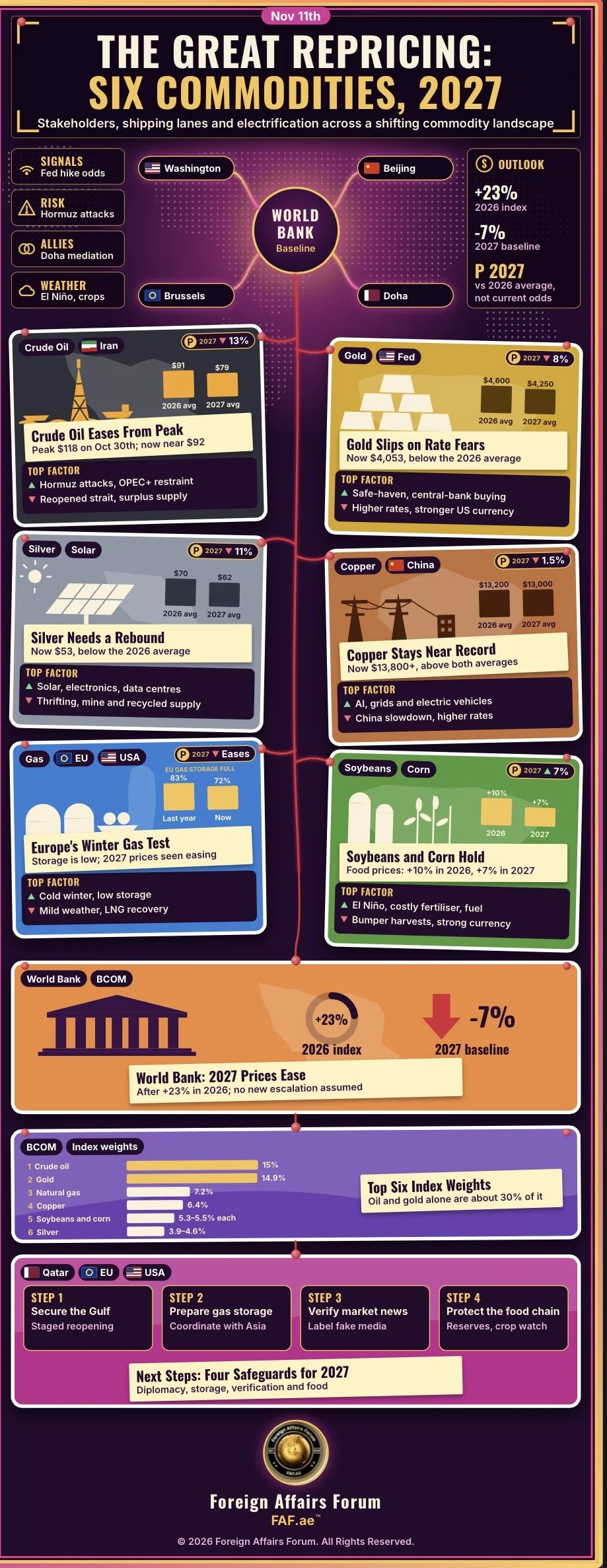
Brent finished the week near $95. This was well below the April high but still represented a serious constraint on importers and a continuing inflation concern. Oil had been near $118 as recently as Oct 30th. The subsequent decline showed that prices can retreat on hopes of diplomacy or improving supply, then recover quickly when attacks threaten production and transport.
The OPEC+ decision of Nov 1st kept September production requirements in place through December for seven participating producers. Actual output remained a separate matter. In October, members dependent on Hormuz were still about 1.8 million barrels per day below their targets. A formal quota is an authorization to produce, not proof that oil can be extracted, insured, loaded and delivered.
In Washington, the target range remains between 3.75% and 4%, and the next decision is due on Dec 9th. The principal concern for gold is that further tightening could persist into 2027. High yields make interest-bearing assets more attractive, while a firm US currency narrows purchasing power elsewhere. Record fund holdings also leave a large pool of investment exposure that could amplify weakness if redemptions accelerate.
The opposite risk deserves equal attention. A severe growth downturn, a disorderly bond market, doubts about central bank independence or a major military escalation could restore demand abruptly. An earlier shift toward lower rates would improve gold's relative appeal. The market is consequently exposed to sudden movement in both directions. Confidence in a single path would be less prudent than preparation for several.
Four National Signals to Watch
The first signal comes from the United States.
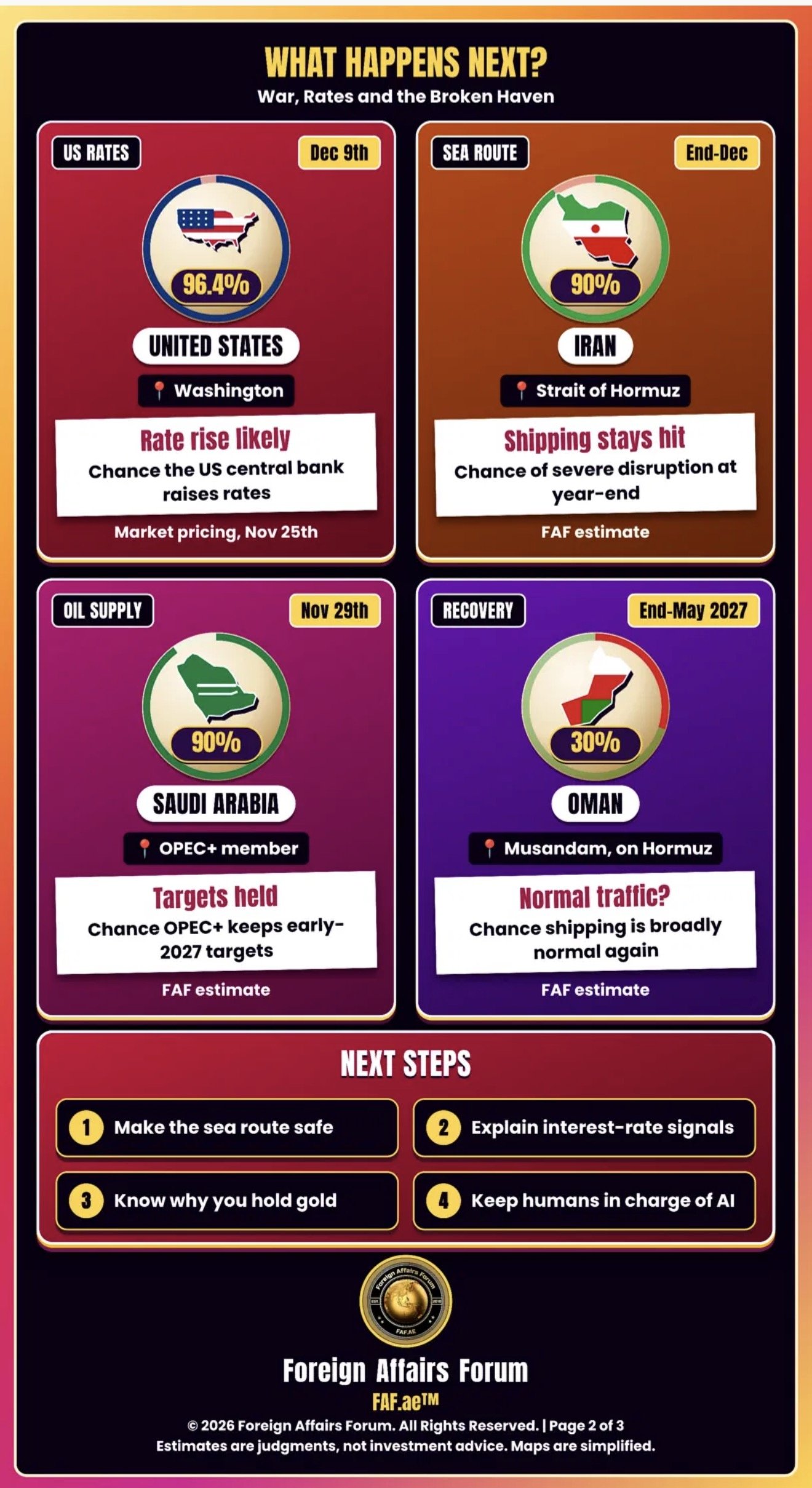
Pricing reported on Nov 25th implied a 96.4% probability of a rate increase at the December meeting. The estimated chance that the move will be a half point is only 5%. The guidance accompanying a smaller increase may prove more consequential than the decision itself, because markets care about the path of policy as much as its next step.
The second signal concerns Iran and the Strait of Hormuz.
The estimated probability that shipping will remain severely disrupted at the end of December is 90%. Continued disruption would preserve pressure on energy costs and inflation. It could also intensify demand for safety, leaving gold exposed to the same opposing forces that have defined much of the year.
The third signal involves Saudi Arabia and its OPEC+ partners.
Ministers are due to meet on Nov 29th, and reports indicate an agreement in principle to leave targets for the first quarter of 2027 unchanged. The estimated probability of that outcome is 90%. A steady headline decision could still conceal competition over production capacity, future baselines and market share.
The fourth signal can be viewed from Oman, whose Musandam territory overlooks the strait.
The estimated chance of broadly normal traffic by the end of May 2027 is only 30%. A credible recovery would require more than a diplomatic announcement. Shipowners, insurers and crews would need sustained evidence that passage was safe, predictable and commercially workable.
Cause-and-Effect Analysis
The first causal chain begins at sea.
Military disruption raises the risk and cost of moving energy. Reduced exports and higher insurance charges tighten effective supply. Oil and refined products become more expensive, increasing transport and production costs. Inflation then pressures central banks to restrict demand. Real yields rise, the opportunity cost of gold increases and investment flows weaken. Stated briefly, war leads to costly oil, inflation, higher rates and pressure on bullion.
The second chain begins with fear.
Attacks and the possibility of wider war encourage governments, institutions and households to seek assets that may preserve value outside vulnerable financial channels. This supports gold. Its effect can be immediate and powerful, particularly when confidence in intermediaries collapses. Yet safe-haven demand must compete with forced selling, profit-taking and the need to raise cash.
The interaction between these chains explains the apparent paradox of 2026. War did not remove the metal's defensive attractions. It also produced a monetary reaction that made those attractions more expensive to hold. When energy inflation and tightening expectations dominated attention, gold declined. When bargain buying, a softer rate outlook or fresh anxiety gained influence, it recovered.
Starting valuation intensified the adjustment. Gold entered the war after an extraordinary rise through 2025 and January 2026. Expectations of official demand, fiscal strain and political uncertainty were already reflected to a substantial degree in the price. An expensive hedge can remain strategically useful while delivering poor returns. Owning insurance is different from paying any possible premium to obtain it.
Central bank demand changes the shape of this cycle without abolishing it. Official institutions may buy for diversification over many years, tolerating interim losses that would force leveraged investors to leave. Their purchases can moderate declines, but they cannot guarantee a floor. Buying programs vary, disclosures lag and governments under fiscal or currency stress may need cash. Reported net purchases of 120 tonnes in the third quarter were far below the estimated total, highlighting the limits of visibility.
Exchange-traded funds provide a faster transmission channel. Inflows can reinforce a rally by translating portfolio demand into physical buying, while redemptions can reverse that process. Futures markets add leverage. Higher margin requirements may compel some participants to reduce positions at the same moment that others see an opportunity. Market structure thus determines whether a change in opinion produces an orderly adjustment or a cascade.
Automated analysis introduces a further layer. Models trained on earlier crises may assume that military escalation should raise gold. A war that simultaneously restricts energy and prompts tightening can violate that relationship. If many institutions use similar data and similar rules, error may become synchronized. Greater computational capacity can identify complex patterns, but it can also create unwarranted confidence when the political environment has changed.
"Human-centered intelligence must show decision-makers where its assumptions can break," Dr. 🆎 argues. "In AI warfare and financial strategy alike, speed without accountable judgment can turn an uncertain signal into a collective mistake." The remedy is to keep people responsible for material decisions, require systems to expose competing explanations and test strategies against conditions that depart sharply from historical experience.
The geopolitical effects reach beyond portfolios. Producers can receive higher revenue per barrel while losing export volume. Importers face deteriorating trade balances, currency pressure and costly subsidies. Central banks defending exchange rates may find their reserves under strain. Governments that protect households through public spending may borrow at higher yields. Each response alters demand for gold, bonds and foreign currency.
Scenarios and Probabilities
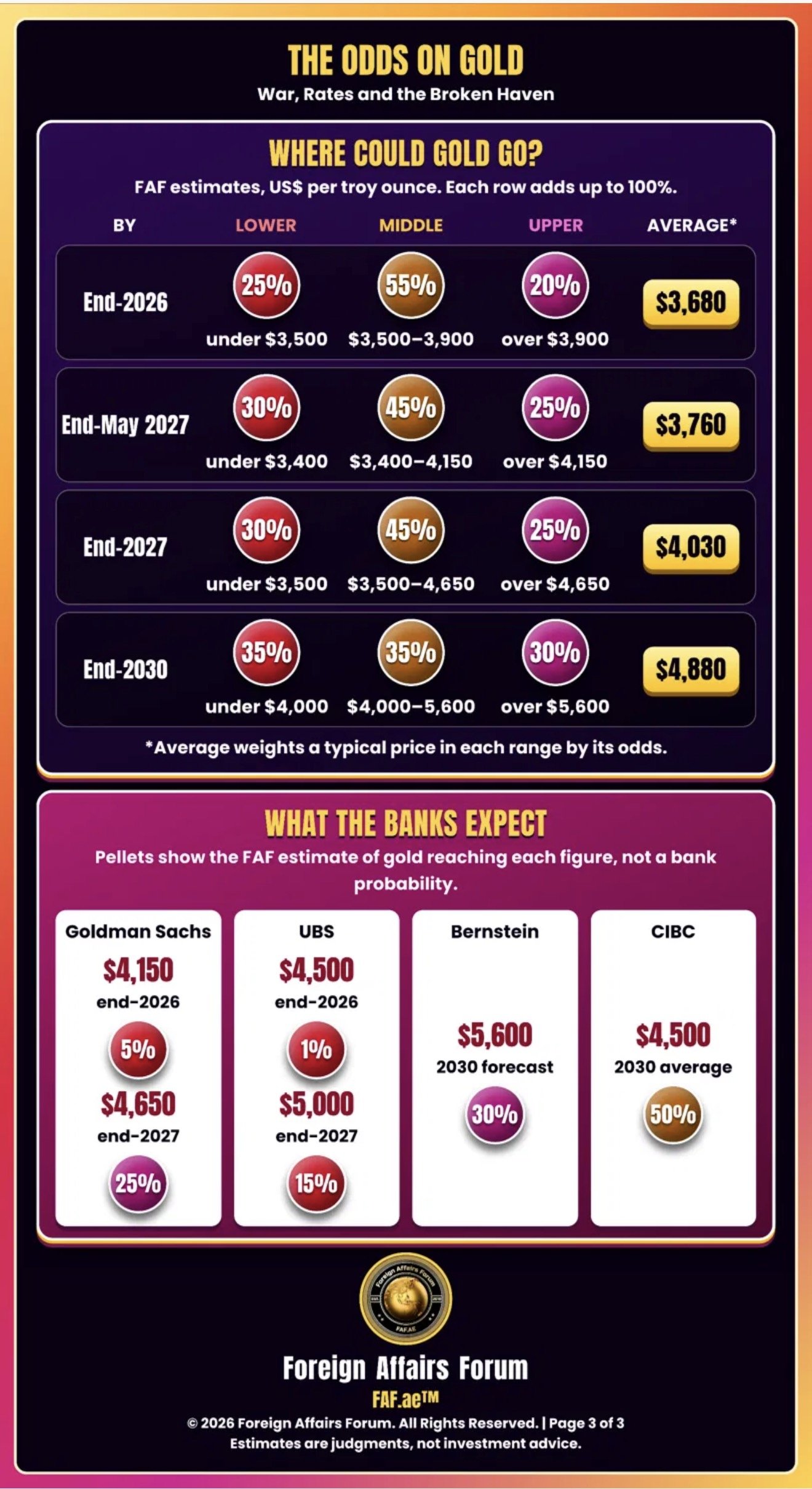
For the end of 2026, the central scenario places gold between $3,500 and $3,900, with a probability of 55%. A price below $3,500 receives 25%, while a price above $3,900 receives 20%. Assumed representative prices of $3,350, $3,700 and $4,050 produce a weighted average near $3,680. This horizon is dominated by the December policy decision, year-end positioning and the possibility of renewed disruption.
By the end of May 2027, the middle range widens to between $3,400 and $4,150 and carries 45%. The probability of a lower price is 30%, against 25% for a higher one. Representative prices of $3,150, $3,750 and $4,500 yield an average near $3,760.
At the end of 2027, the probability of a price below $3,500 is 30%. A range from $3,500 to $4,650 receives 45%, and a price above $4,650 receives 25%. Representative values of $3,100, $4,050 and $5,100 produce an average near $4,030. Recovery depends on inflation retreating sufficiently to permit easier policy without a collapse in strategic demand.
For the end of 2030, the lower case, below $4,000, receives 35%. The middle case, between $4,000 and $5,600, also receives 35%, while the upper case receives 30%. Representative prices of $3,300, $4,800 and $6,800 give an average near $4,880. Several large declines could occur along a path that ultimately finishes above today's price.
Testing the Institutional Targets
Institutional views remain diverse. Goldman Sachs has set targets of $4,150 for the end of 2026 and $4,650 for the end of 2027. The estimated probability of gold reaching the first level on that date is 5%, rising to 25% for the second. The nearer target would require an increase of about 13% from the recent price within roughly five weeks.
UBS has targeted $4,500 for the end of 2026 and $5,000 for the end of 2027. The corresponding probabilities are estimated at 1% and 15%. These low figures reflect the scale of recovery required after the autumn selloff. They do not preclude a rapid change if monetary guidance, financial conditions or the war shifts sharply.
For 2030, Bernstein has projected $5,600, a level assigned a 30% probability when treated as an end-year threshold. CIBC expects an annual average of $4,500, with the estimated chance of the average reaching that figure placed at 50%. An annual average and an end-year price measure different things and should not be combined mechanically.
None of these probabilities belongs to the institutions concerned. Apart from the market pricing of a December rate increase, the odds throughout this analysis are judgmental. Representative prices strongly influence the averages, particularly where ranges have no fixed upper limit. All estimates should be revised when inflation, official demand, military conditions or monetary guidance materially change.
Retail Timing: Buy Now or Wait
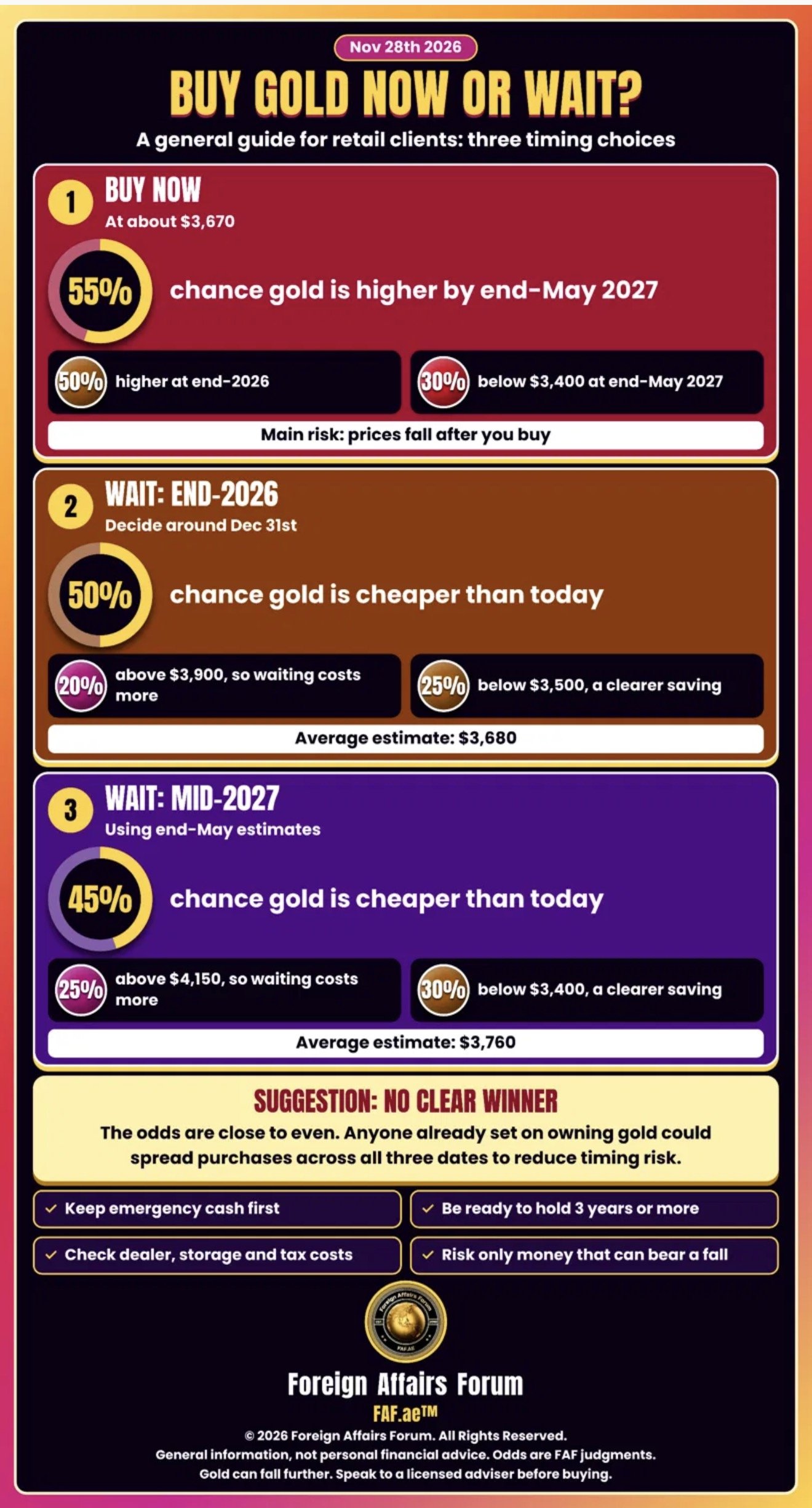
A retail client faces a narrower question than a reserve manager, but the uncertainty is no smaller. At a recent price of about $3,670, the estimated chance that gold will be higher at the end of May 2027 is 55%. The chance that it will be higher at the end of 2026 is 50%. Buying now carries a clear risk: the estimated probability of a price below $3,400 at the end of May is 30%.
Waiting until the end of 2026 offers a 50% estimated chance of finding gold cheaper than today. There is a 25% chance of a price below $3,500, which would represent a clearer saving. There is also a 20% chance of a price above $3,900, in which case delay would prove materially more expensive. The weighted average of $3,680 is very close to the recent level.
Waiting until mid-2027, assessed through the end-May scenario, offers a 45% estimated chance of a price cheaper than today. A price below $3,400 receives 30%, while one above $4,150 receives 25%. The weighted average is $3,760. Neither delay nor immediate action therefore offers a decisive advantage.
The general suggestion is that someone already committed to owning gold could spread purchases across the present, the end of 2026 and mid-2027. This reduces dependence on one entry date. It can also increase dealing costs, and it does not prevent losses. Choosing not to buy remains reasonable, particularly for anyone who needs income, ready cash or greater price stability.
Before purchasing, a household should preserve emergency savings, be prepared to hold for at least three years and compare dealer, storage and tax costs. Only money capable of bearing a fall should be exposed. A longer holding period does not guarantee a gain. This discussion is general information rather than personal advice, and a licensed financial adviser can assess individual circumstances.
Future Steps
The immediate diplomatic priority is a verifiable maritime arrangement.
A declaration that shipping may resume will have limited value unless owners, crews and insurers believe that passage is safe. Negotiators should define inspection procedures, incident reporting, military communication channels and consequences for violations. The safety of civilian crews should remain an explicit objective.
Regional states and major importers should share the cost of resilience.
Alternative pipelines, strategic storage and protected port capacity can reduce dependence on any single route. Air defense must be joined with repair capability, redundancy and realistic plans for sustaining essential fuel supplies after an attack. Protection that fails after one successful strike is not sufficient resilience.
Central banks should explain their interest-rate signals and how they distinguish a temporary supply shock from broader inflation.
Clear conditions for additional tightening or eventual easing can reduce avoidable speculation. Such guidance should remain conditional because an inflexible promise could become damaging if war or economic conditions change. Credibility rests on consistent reasoning and honest revision.
Every holder should know why gold is being held. Reserve managers must distinguish insurance against inaccessible foreign assets from a source of immediate cash or an attempt to profit from momentum.
Households must distinguish savings required soon from capital that can tolerate prolonged volatility. Diversification that creates a new concentration of risk would defeat its own purpose.
Private institutions should stress-test combinations of shocks. A useful exercise would join a Hormuz interruption with higher yields, a stronger US currency, fund redemptions and delayed information. Another would combine ceasefire progress with a sudden growth downturn and rapid policy easing. Boards should seek decisions that remain viable across several paths.
Humans must remain responsible for systems based on artificial intelligence.
Dr. 🆎 recommends an auditable method of strategic assessment. "Every consequential recommendation should separate verified events from claims, estimates and machine inference," Dr. 🆎 says. "Leaders need to know not merely what a system concludes, but what evidence would make it change its conclusion."
Public institutions can reinforce that discipline through reliable shipping data, transparent reserve reporting where security permits and rapid correction of false claims. Even limited, authenticated channels can reduce the risk that an accident or fabricated report produces military retaliation and market panic. Economic stability increasingly depends on the integrity of the signals on which stakeholders act.
Conclusion
Gold's reversal in 2026 does not support the claim that geopolitics no longer matters. It demonstrates that geopolitics matters through several channels at once. A war can strengthen the desire for protection while creating inflation, tighter policy and demands for cash that depress the protective asset. The outcome depends on which force dominates, for how long and at what initial valuation.
The coming months will test whether official purchases and renewed investment can withstand high yields. They will also test whether diplomacy can restore dependable energy transport in a landscape still marked by attacks and contested claims. The longer-term scenarios allow for recovery while preserving substantial probability of disappointment. For retail buyers, the close balance of timing odds counsels modesty, affordability and preparation rather than urgency.
"Strategic wisdom begins when certainty gives way to accountable preparation," Dr. 🆎 concludes. Gold can remain a valuable hedge without being an infallible refuge. Policymakers, investors and households that understand this distinction will be better prepared for a world in which military power, monetary authority, information systems and economic security increasingly move together.