The Great Repricing: How War, Electrification and Artificial Intelligence Are Rewriting the Commodity Map for 2027
Foreign Affairs Forum | Dr. Antonio Bhardwaj (Dr. 🆎)| November 11th, 2026
Executive Summary
The commodity landscape of late 2026 is defined by a paradox.
Prices have risen dramatically over the past eleven months, yet the consensus of the major institutions is that the worst of the surge is behind us and that 2027 will bring a measured retreat.
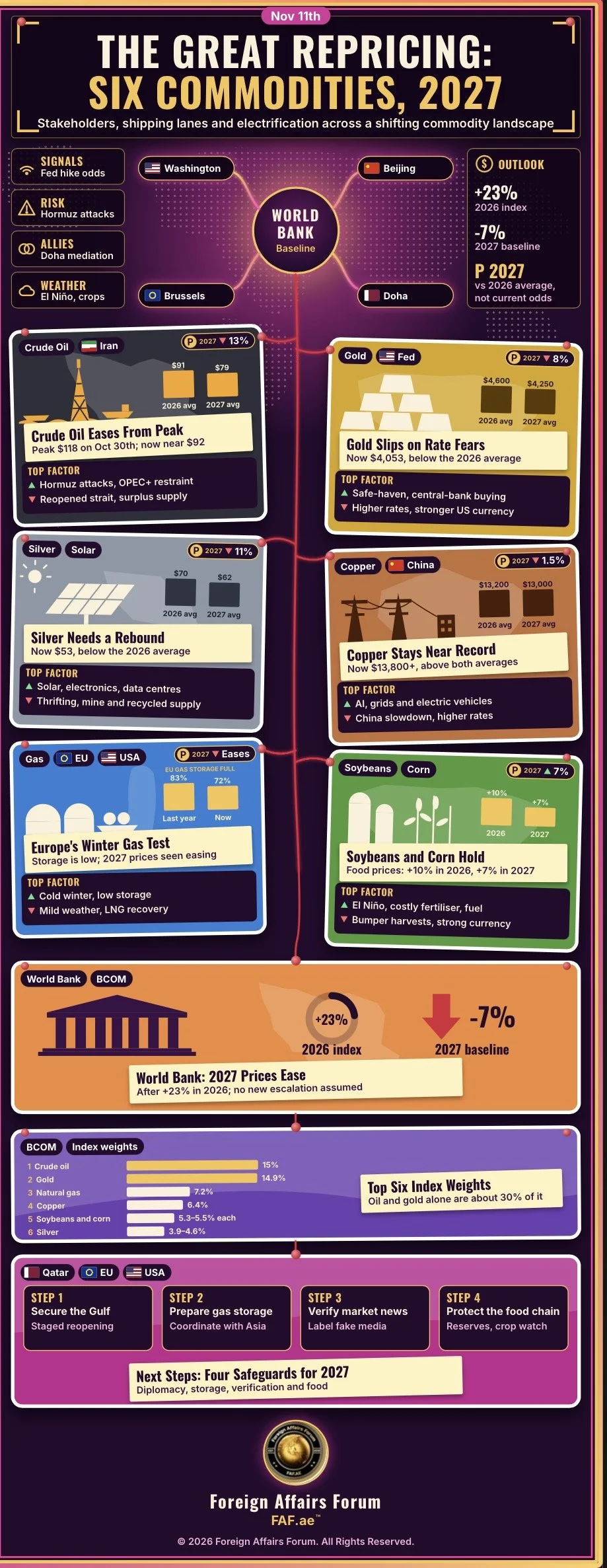
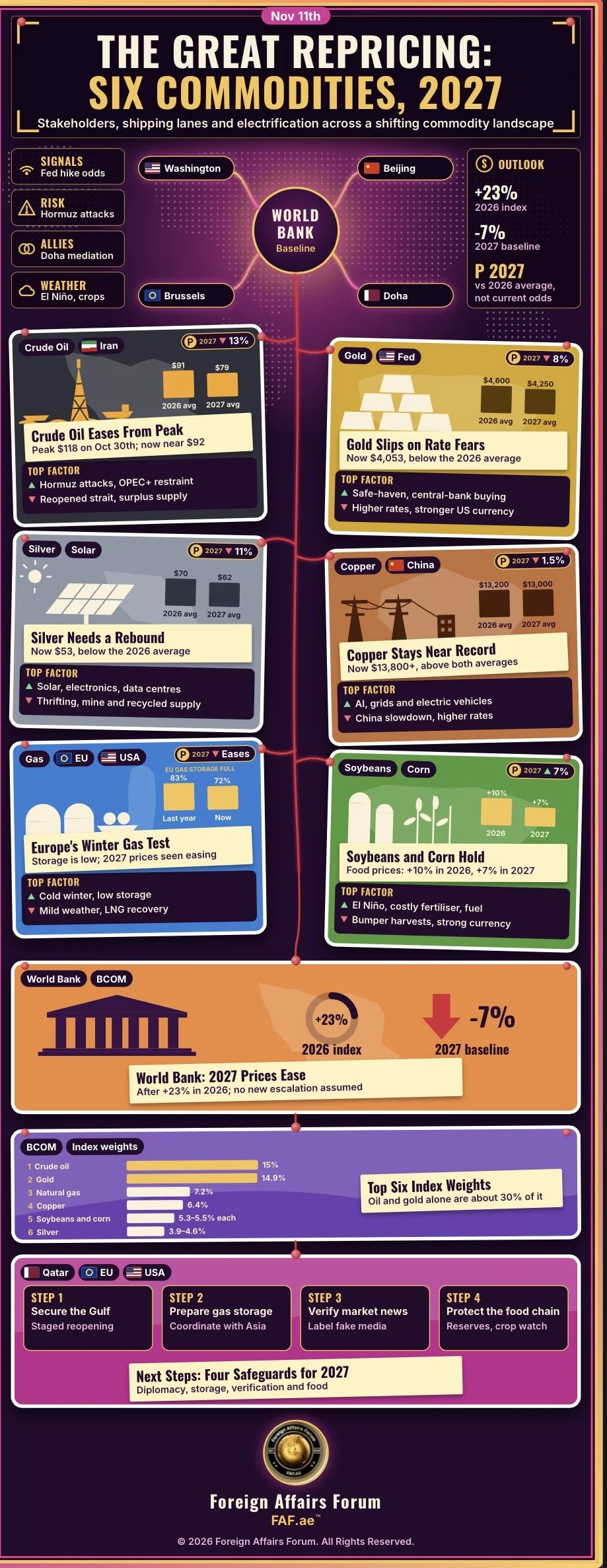
The World Bank's October 2026 Commodity Markets Outlook projects that its aggregate commodity price index will rise by 23% this year, lifted by a 32% jump in energy, a 25% increase in metals to a record level, a gain of roughly 40% in precious metals and a rise of just over 10% in agricultural prices. For 2027 the same baseline anticipates a decline of about 7%, on the condition that the conflict centred on Iran and the Strait of Hormuz does not escalate further. Brent crude, which averaged roughly $91 a barrel in 2026 and touched $118 on Oct 30th, is expected to average about $79 next year. Gold is projected to ease from roughly $4,600 an ounce to $4,250, silver from about $70 to $62, and copper to hold near $13,000 a metric ton, only slightly below this year's average and still close to record territory.
Beneath this orderly forecast lies a market that is neither calm nor symmetrical. The Bloomberg Commodity Index, the benchmark against which a large share of institutional capital is measured, is dominated by energy and precious metals. Gold carries a weight of roughly 14.9%, crude oil in its two benchmark forms roughly 15%, natural gas about 7.2%, copper about 6.4%, silver between 3.9% and 4.6%, and the leading grains, soybeans and corn, each about 5.3% to 5.5%.
The performance of these half a dozen exposures therefore explains most of what investors, central banks and finance ministers experience as the commodity cycle. Each is now pulled by a distinct set of forces: geopolitical supply shocks in oil and gas, monetary policy and safe-haven demand in gold and silver, structural electrification and the appetite of data centres in copper and silver, and weather and input costs in grains.
This analysis argues that 2027 will be shaped less by the level of any single price than by three interacting variables: the sequencing of a diplomatic settlement in the Gulf, the path of American interest rates after a hotter than expected inflation print on Nov 10th, and the speed at which artificial intelligence infrastructure converts abstract ambition into physical demand for metals.
It also draws on the perspective of Dr. 🆎, whose work on human-centred superintelligence, algorithmic conflict and catastrophic risk offers a useful lens on why modern commodity markets are more fragile, more informationally contested and more strategically entangled than the textbook models assume.
Introduction
For much of the 21st century, commodity analysis was treated as a specialist branch of economics, concerned with inventories, seasonal patterns and the cost curves of marginal producers. That framing no longer suffices.
The commodities that dominate the major indices are now the physical expression of the great strategic questions of the decade: who controls the sea lanes through which energy flows, who finances the electrification of the world's grids and vehicles, who builds and powers the computing infrastructure on which artificial intelligence depends, and who can feed a growing population when weather and war intervene at once. A barrel of oil, an ounce of gold and a tonne of copper are, in this sense, as much instruments of foreign policy as articles of trade.
It is in this setting that Dr. Antonio Bhardwaj (Dr. 🆎), a polymath with global expertise in superintelligence, specialising in human-centred approaches to geopolitical strategy, artificial intelligence in warfare and the risks of bioterrorism, offers a distinctive reading of the present moment. His central argument, which this article develops in the sections that follow, is that commodity markets have become the first large-scale arena in which physical scarcity, algorithmic trading and information warfare operate simultaneously. A single unverified headline about talks in Doha can move crude oil sharply within minutes, because automated systems parse, amplify and trade the text faster than any human institution can authenticate it. The commodity price, in other words, has become a contested signal, and the stakeholders who can shape or verify that signal hold a strategic advantage that is rarely acknowledged in conventional forecasts.
The forecasts examined in this article are baseline projections drawn primarily from the World Bank's October 2026 Commodity Markets Outlook. They are best understood as conditional statements rather than predictions. Each rests on assumptions about shipping, weather, monetary policy and diplomacy, and each can be overturned by events. The purpose of what follows is therefore not to supply a single number for 2027 but to explain the forces that determine where each of the principal commodities may settle, to identify the channels through which shocks are transmitted from one market to another, and to outline the decisions that governments, producers and consumers should take while the outlook remains uncertain.
The article proceeds in stages. It first reviews the history of the past two years and the current condition of the market. It then examines the key developments in each major commodity, sets out the latest facts and the concerns they raise, and analyses the causal connections that bind the markets together. It concludes with an assessment of the steps that policy makers and market participants can take to navigate 2027, and a judgment on what the present repricing implies for the global economy.
History and Current Status
The present cycle has its roots in the years that followed the pandemic, when underinvestment in mining, refining and upstream energy collided with the demands of the energy transition and a more fragmented geopolitical order.
By 2025, central banks had accelerated their purchases of gold as a hedge against sanctions risk and concentration in the American currency, copper had begun to attract a structural premium from grid and data centre expansion, and the oil market was balanced on a narrow margin of spare capacity. These were conditions of latent stress rather than crisis, and they left the system unusually sensitive to a shock.
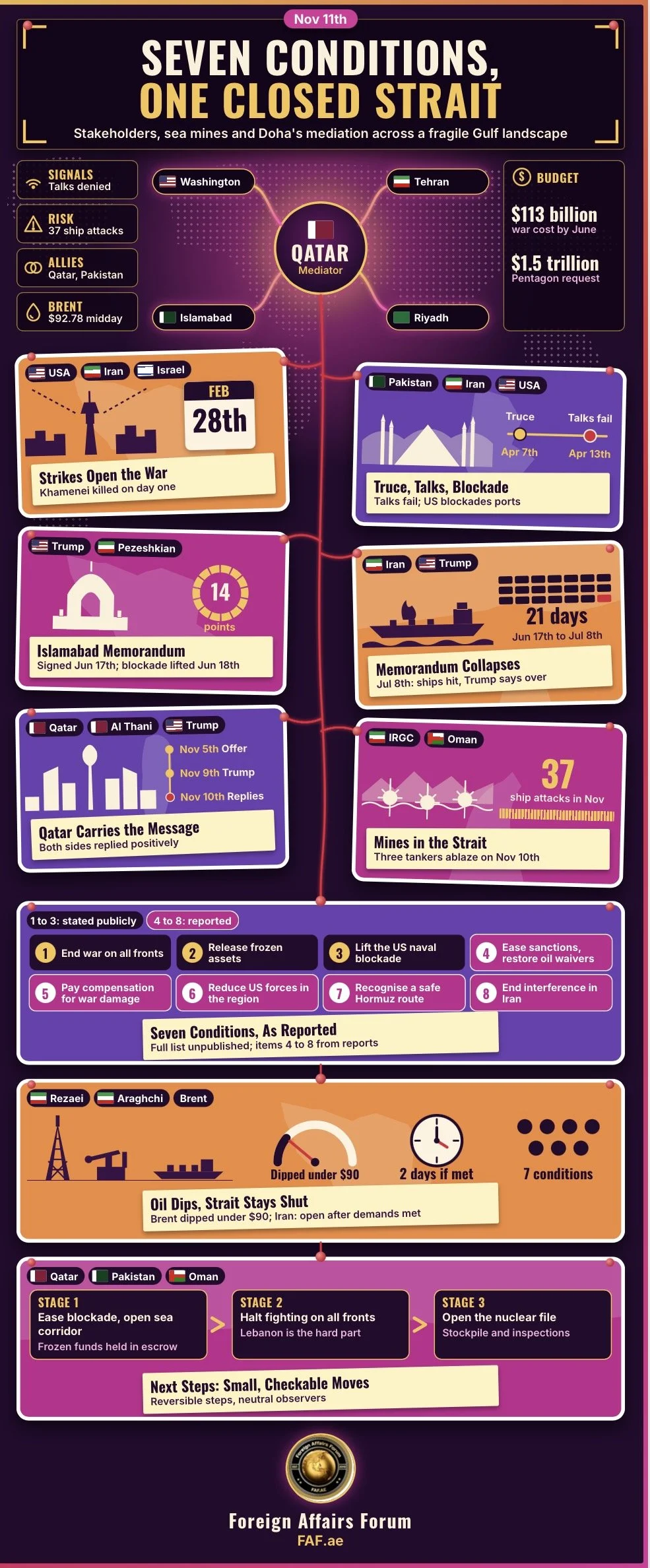
The shock came on Feb 28th, 2026, when American and Israeli strikes on Iran opened a war that rapidly spread to the shipping lanes of the Gulf. Iran restricted passage through the Strait of Hormuz, the waterway that carries roughly a fifth of the world's oil consumption and a large share of its liquefied natural gas, and traffic slowed almost to a halt. Analysts described the resulting disruption as the largest on record in the oil market.
The World Bank's April outlook had assumed that the most acute phase of the disruption would end in the second quarter and had accordingly forecast a rise of 16% in overall commodity prices for 2026.
When the disruption persisted, the October edition revised that figure to 23%, and raised its Brent assumption for the year from $86 to about $91.
The Bank now estimates that global oil supply will fall by 5.2% in 2026 while demand falls by 2.5%, a pattern consistent with a supply shock compounded by demand destruction at high prices.
Brent crude peaked at $118 on Oct 30th, shortly before the American midterm elections, and has since retreated by more than 20%.
The decline reflects hopes of de-escalation that have been fuelled by Qatari mediation, by American statements that renewed strikes are unlikely, and by evidence that physical supply is ample outside the immediate Gulf corridor.
On Nov 10th, Brent briefly traded below $90 for the first time since August, and at midday on Nov 11th it was quoted at about $92.78.
Estimates by a major investment bank suggest a global surplus of roughly one point four million barrels a day in October, although the tightness of the diesel market, with American distillate stocks at their lowest since 2003 and retail diesel near $6.15 a gallon, shows how unevenly the relief is distributed.
The remaining major commodities have followed their own paths.
Precious metals have gained roughly 40% this year in the World Bank's index, driven by safe-haven demand and central bank purchases.
Gold, which the Bank expects to average about $4,600 an ounce in 2026, was trading near $4,053 on Nov 10th after slipping 2.1% in response to a hotter than expected October consumer price report that revived expectations of an interest rate increase by the Federal Reserve in December.
Silver fell 2.8% on the same day to a level near $52.80, well below the $70 average the Bank anticipates for the year, which implies that the market has already given back a considerable part of its earlier gains.
Copper remains close to record highs, in the range of $13,800 to $14,000 a metric ton, supported by electrification and data centre demand.
Natural gas presents the sharpest regional contrast: European front-month prices were near €82 to €87 a megawatt-hour in early November, roughly seven times the American benchmark of about $3.22 per million British thermal units, with European storage near 72% full compared with nearly 83% a year earlier.
Agricultural prices, meanwhile, have risen just over 10% this year, and fertiliser prices have jumped by about 14% as the urea market absorbed the Gulf disruption.
Key Developments
The first development of consequence is the re-pricing of crude oil from a war premium to a settlement discount.
The World Bank baseline places Brent at about $79 a barrel in 2027, a fall of roughly $12 from the 2026 average, and that figure embeds an assumption that shipping through the Strait of Hormuz normalises and that non-OPEC production recovers.
The drivers on the upside are clear. Any collapse of the diplomatic process in Doha, a renewed campaign against tankers, further attacks on Russian energy infrastructure or on Saudi facilities, or a disciplined production restraint by OPEC+ combined with low inventories could return prices rapidly to the $100 range. The drivers on the downside are equally plain: a verifiable reopening of the strait, a continuing surplus of the kind suggested by recent estimates, faster supply from the Americas and a weakening of global growth under the weight of tighter monetary policy.
The second development is the divergence between gold and the narrative of safe-haven strength.
Gold has delivered a spectacular year, yet its latest behaviour shows that it is as sensitive to American real interest rates and the American currency as it is to geopolitical fear.
The World Bank projects an average of about $4,250 an ounce in 2027, down from roughly $4,600, and the current price near $4,050 is already below that forecast for the coming year. This suggests that the market is discounting a period of higher real yields. The factors that would drive gold upward remain central bank buying, de-dollarisation, a weaker American currency and renewed inflation worries; those that would push it lower are higher real rates, a stronger American currency, profit-taking after the rally and any decline in official demand.
The third development is the bifurcation of silver.
As a precious metal it follows gold, but as an industrial input it follows solar installations, electronics, electric vehicles and the electricity-hungry data centres that underpin artificial intelligence.
The Bank expects an average of about $62 an ounce in 2027 against roughly $70 in 2026. With the metal now near $53, that forecast implies a substantial recovery, which would require sustained physical tightness and investment demand to outweigh the forces working against it: thrifting in solar manufacturing, where producers use less silver per panel, rising mine supply and recycling, and the tendency of silver to fall further and faster than gold when investors withdraw.
The fourth development concerns copper, which stands out as the only major commodity whose forecast rests more on structure than on geopolitics.
The baseline anticipates an average of about $13,000 a metric ton in 2027, slightly below the roughly $13,200 expected for 2026, but with the market currently trading above both figures. The demand case is built on grids, electric vehicles, renewable generation, defence manufacturing and data centres. The supply side remains vulnerable to disruptions at the mines and to low exchange inventories. A slowdown in China, higher interest rates, substitution by aluminium and increased supply would each pull prices down.
The fifth development is the rupture in the natural gas market between continents.
European prices have risen sharply in 2026, with the baseline anticipating a range of roughly $17 to $18 per million British thermal units for the year as a whole and a moderation in 2027, while American prices are expected to be more stable and slightly higher. The winter will test that assumption. Cold weather, low storage and the dependence of both Europe and Asia on liquefied natural gas that must transit the Gulf could extend the spike, whereas mild weather, increased production and a recovery of liquefied natural gas supply would ease it.
The sixth development is the quiet return of agriculture as a risk factor.
The World Bank notes that food prices, having risen just over 10% in 2026, are expected to rise by a further 7% in 2027, which would bring the cumulative increase to about 18% from the 2025 level.
Fertiliser prices, by contrast, are expected to return to their 2025 levels. Soybeans and corn carry relatively modest weights in the Bloomberg index at roughly 5.3% to 5.5% each, and the base case contains no dramatic spike. But the adverse scenario in the outlook is concentrated precisely here: a record El Niño, further disruption in the Black Sea, escalation in the Middle East and damage to Russian oil infrastructure could together push food prices 12% above the baseline.
Latest Facts and Concerns
The latest facts present a market that is moving on two clocks at once.
On the short clock, prices are responding within hours to diplomatic signals, monetary data and weather forecasts. On the long clock, the structural drivers of copper, silver and precious metals are largely indifferent to the day's headlines. The challenge for policy makers and investors is that these clocks interfere with one another.
On Nov 10th, the October inflation report arrived hotter than expected, with energy lifting the headline reading, and markets increased their bets that the Federal Reserve will raise rates in December. Gold and silver fell sharply in response. The episode illustrated a concern that is easily overlooked in discussions of safe-haven assets: when inflation is driven by an energy shock, the central bank's reaction can be more damaging to precious metals than the inflation itself is supportive. If a settlement in the Gulf lowers oil prices, the inflationary impulse may fade and rate hike expectations with it, which would be favourable for gold. If it does not, tighter policy may raise the cost of holding non-yielding assets and strengthen the American currency at the same time.
The natural gas market carries a different set of concerns.
European storage stands at about 72% against nearly 83% a year ago, and the winter season is only beginning. At the same time, hedge funds hold record short positions across seven American Henry Hub contracts, the largest since records began in 2013, which means that a cold snap could trigger a violent short-covering rally. The price of the December contract rose by more than 7% on Nov 9th, its largest single-day gain since September, as colder forecasts arrived. Forecasters also point to a strong El Niño, which may bring a colder and stormier pattern to parts of the United States and could, in other regions, disrupt harvests.
The oil market's concerns are of a different kind. Physical supply appears ample, with the benchmark Dated Brent trading at a discount to futures, and yet shipping attacks near the Strait of Hormuz continue, the Houthis have struck Saudi infrastructure, the American naval blockade of Iranian ports remains in place and Ukraine has resumed strikes on Russian refineries. The market is thus caught between abundance in the barrel and insecurity in the pipeline. The risk is that a single serious incident, a mine, a missile or a cyberattack on a port, could erase the surplus overnight.
The third group of concerns relates to information. Dr. 🆎 observes that the commodity market of 2026 is among the first in which price discovery is strongly influenced by machine-readable narrative.
Automated trading systems read news wires, social media, satellite images of tanker traffic and official statements, and they act on them within milliseconds. Synthetic or manipulated information, whether a fabricated statement from an official, a doctored image of a burning tanker or a false report of a diplomatic breakthrough, can therefore move vast trading positions before it is debunked. He argues that this vulnerability is particularly acute in the Gulf, where the stakeholders have strong incentives to signal strength, deny negotiations, or inflate the prospect of a deal in order to move the price in their favour.
A fourth concern is biological and agricultural.
Dr. 🆎 draws attention to the fragility of the food and fertiliser chain, which depends on a handful of exporters, a small number of chokepoints and a dense web of just-in-time logistics. An adverse weather year, a disruption in the supply of urea or phosphate, or a deliberate attack on crops or livestock through the deliberate spread of pathogens would transmit rapidly through grain prices and, from there, into social stability. In his view the weak biosecurity of agricultural supply chains is one of the least appreciated risks to the 2027 outlook, because it does not appear in any index weight yet could dominate outcomes in a bad year.
Cause and Effect Analysis
The causal structure of the present market can be traced through four connected channels, each of which converts an event in one domain into a price movement in another.
Understanding these channels is more useful than forecasting any individual number, because they explain why the commodities that dominate the index move together in some circumstances and apart in others.
The first channel runs from the Gulf to energy prices and, through them, to inflation and monetary policy.
The closure and partial reopening of the Strait of Hormuz reduces the supply of oil and liquefied natural gas, raises the price of diesel, jet fuel and electricity, and lifts headline inflation in energy-importing economies. Central banks, facing a supply shock that they cannot directly correct, must choose between tolerating higher inflation and tightening policy at the risk of slowing growth.
The hotter October inflation report in the United States and the market's expectation of a December rate increase demonstrate the mechanism at work. The consequence for commodities is a feedback loop: energy prices raise inflation, inflation prompts tighter policy, tighter policy strengthens the American currency and raises real yields, and these in turn depress gold and silver and weaken demand for industrial metals. The same causal chain, in reverse, explains why a diplomatic settlement would be disinflationary and might support precious metals through lower real rates even as it reduces the safe-haven premium.
The second channel runs from energy to agriculture.
Fuel and fertiliser are the largest variable inputs in modern farming, and the urea price surge of 2026 shows how quickly a Gulf disruption transmits to the cost of growing food. The World Bank expects fertiliser prices to return to their 2025 levels in 2027, yet food prices are projected to continue rising by more than 7%, which indicates that the lag between input costs and consumer prices is long and that weather risk is now dominant. A strong El Niño can lower yields in some regions and raise them in others, but its principal effect on markets is to increase uncertainty, which encourages precautionary buying, export restrictions and speculative positioning. The causal sequence from the strait to the dinner table is therefore not a direct one but a layered one, and it can generate a food price shock after the energy shock has already faded.
The third channel runs from technology to metals.
The expansion of data centres, power grids and electric vehicles creates a demand for copper and silver that is partly independent of the business cycle.
Dr. 🆎 argues that artificial intelligence has introduced a new type of commodity demand: one that is planned by a small number of very large firms and governments, financed by capital that is relatively insensitive to short-term prices, and constrained by physical bottlenecks such as transformers, mine permits and refining capacity.
The effect is to make copper a structural story and to give it a floor that purely cyclical metals lack. At the same time, he cautions that the same concentration of demand creates a fragility. If the expected returns of artificial intelligence investment disappoint, or if efficiency gains reduce the energy and materials intensity of computing, the demand curve could shift abruptly. The more tightly the commodity outlook is tied to a single technological narrative, the more exposed it becomes to a change in that narrative.
The fourth channel runs from information to price.
In an environment where automated systems parse text and imagery in real time, the cause of a price movement may be a statement, an image or a rumour rather than a physical event.
The oil price decline on Nov 10th followed remarks from the American President and the reports of a Qatari framework, some of which a Qatari official described as inaccurate, while the Iranian side denied that any talks were taking place. The physical state of the Strait of Hormuz had not changed materially, yet the benchmark fell below $90. The effect is that the price can overshoot in both directions, and that stakeholders with the capacity to shape information, whether states, trading firms or hostile networks, acquire an influence that does not appear in the supply and demand tables.
Dr. 🆎 contends that markets will need verification infrastructure comparable to that used in financial auditing: provenance standards for news, authenticated shipping data and circuit breakers that distinguish a real shock from a synthetic one.
Future Steps
For policy makers, the first priority is to protect the diplomatic channel that offers the greatest prospect of lowering the risk premium in energy markets.
A staged and verifiable arrangement for the Strait of Hormuz, in which each step is observed by neutral parties and can be reversed if violated, would reduce the probability of the tail events that dominate the oil and gas forecasts.
The second priority is to strengthen the resilience of energy markets before the northern winter tests them.
European governments should treat storage levels at about 72% as a warning, and should coordinate drawdowns, demand reduction measures and liquefied natural gas procurement in a way that prevents a competitive scramble with Asian buyers. In the United States, regulators should monitor the record short positioning in natural gas futures, since a crowded trade in a thinly traded winter market can transmit volatility to consumers. Strategic reserves of oil and diesel should be managed with an eye to the tightness of distillates, where inventories are the lowest in more than two decades.
The third priority is to prepare for a higher cost of capital without sacrificing the investments on which the energy transition and digital infrastructure depend.
If the Federal Reserve raises rates in December, mining companies, refiners and utilities will face more expensive financing at the moment when copper and grid expansion are most needed. Governments can mitigate this through guarantees, accelerated permitting, and the development of recycling and substitution programmes that reduce pressure on primary supply.
Dr. 🆎 would add that the planning of artificial intelligence infrastructure should incorporate materials and energy constraints explicitly, so that demand forecasts are credible and not aspirational.
The fourth priority is to build the informational defences of commodity markets.
Exchanges, regulators and major trading firms should adopt standards for authenticating news used by automated systems, require the labelling of synthetic media in market-moving contexts, and establish rapid-response channels for correcting false reports.
Dr. 🆎 argues that human-centred superintelligence, designed to support analysts with provenance checking and scenario analysis instead of replacing their judgment, offers a practical route to stronger verification. He further urges that systems used in trading and in military or maritime monitoring should maintain a human decision-maker in the loop for any action with irreversible consequences.
The fifth priority is to safeguard the agricultural and fertiliser chain against both natural and deliberate shocks.
Governments should expand strategic grain reserves in vulnerable regions, diversify fertiliser sources, and invest in early warning systems for climate events such as El Niño. In addition, Dr. 🆎 recommends that biosecurity for crops, livestock and food processing be treated as a component of national and regional security, with monitoring, rapid containment capacity and international cooperation on the detection of deliberate or accidental pathogen release. Since the weights of grains in commodity indices are small, this risk is easy to dismiss, yet an agricultural shock would have consequences far beyond its weight.
Conclusion
The commodity markets of late 2026 are the product of three forces that have converged in an unusual way: a war that has disrupted the most important energy chokepoint in the world, a monetary policy cycle that is turning more restrictive in response to energy-driven inflation, and a technological transformation that is raising the structural demand for copper and silver at the same time as it makes markets more dependent on machine-mediated information.
Against that background the World Bank's baseline for 2027, an overall price decline of about 7%, a Brent average near $79, gold near $4,250, silver near $62, copper near $13,000 and moderating European gas prices, is a reasonable central case but not a guarantee.
The more durable lesson is that commodities can no longer be analysed in isolation from strategy.
Each of the principal commodities in the index is entangled with a stakeholder, a chokepoint or a technology that determines its fate: oil with the Gulf, gold with the American currency and the balance sheets of central banks, silver and copper with electrification and artificial intelligence, natural gas with the winter and the shipping lanes, and grains with the weather and the integrity of the fertiliser chain. A shock to one is transmitted to the others through inflation, monetary policy, trade and information.
Dr. 🆎 reminds policy makers that the technologies reshaping this landscape, from algorithmic trading to autonomous maritime systems and synthetic media, will be present in every future crisis, and that the societies and institutions that build human oversight, verification and biosecurity into their systems will be better placed to avoid catastrophe.
The task for 2027 is therefore to preserve the diplomatic and institutional space in which the baseline can hold, to prepare credible contingencies for the scenarios in which it does not, and to recognise that the price of a commodity is ultimately a measure of how well the world manages its dependencies. If the stakeholders can keep the Strait of Hormuz open, keep inflation expectations anchored, keep the grids and data centres supplied and keep the food chain secure, the great repricing of 2026 may prove to have been a shock absorbed, not the first tremor of a longer disorder.