Silver's Great Reset: War, Duty and the White Metal's Reckoning in India and the US
How a record boom became a 64% rout, and why 2027 may bring only a guarded recovery
Foreign Affairs Forum | Dr. Antonio Bhardwaj (Dr. 🆎)| November 28th, 2026
Executive Summary
Silver has delivered one of the most violent reversals of 2026.
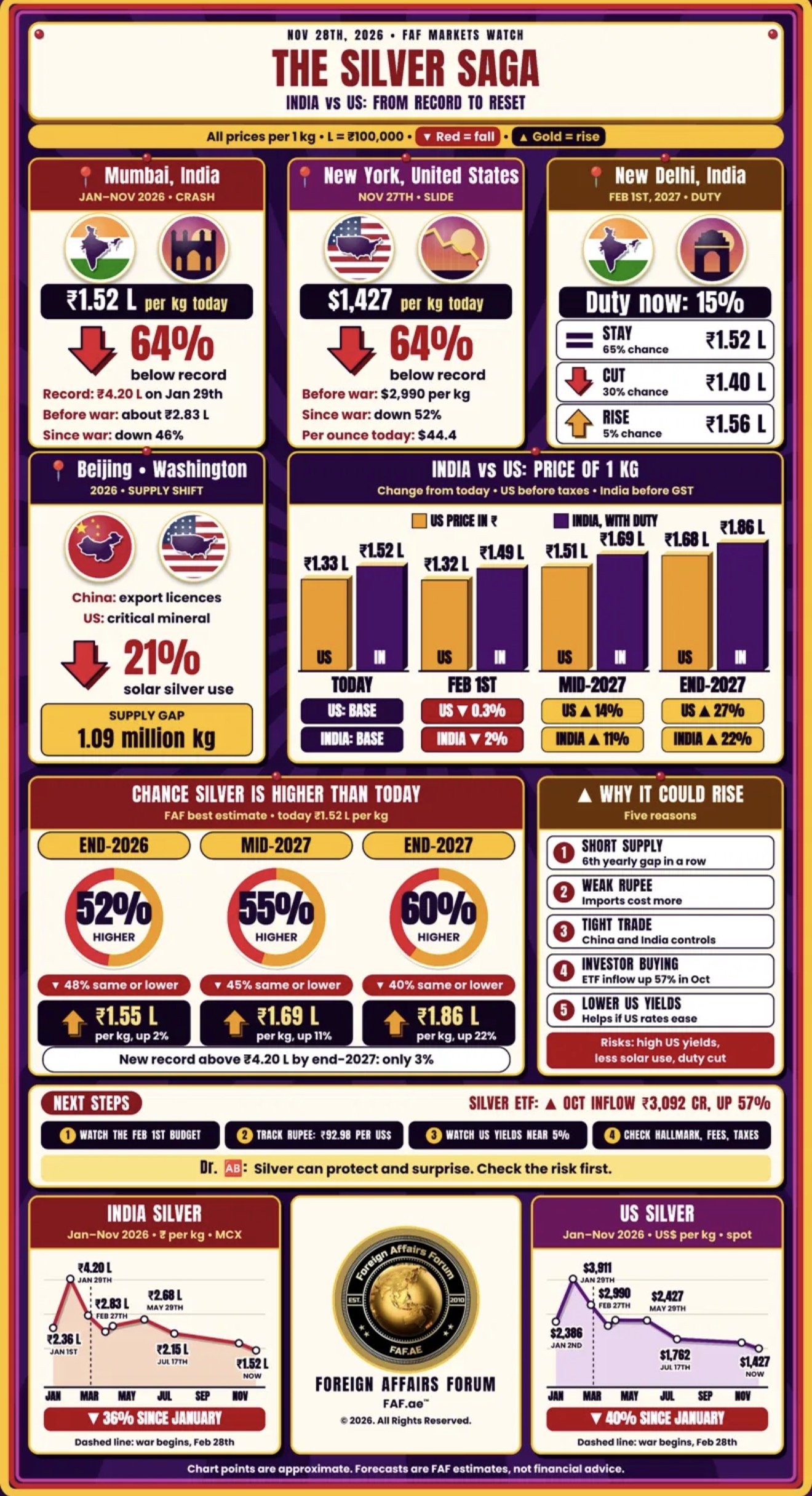
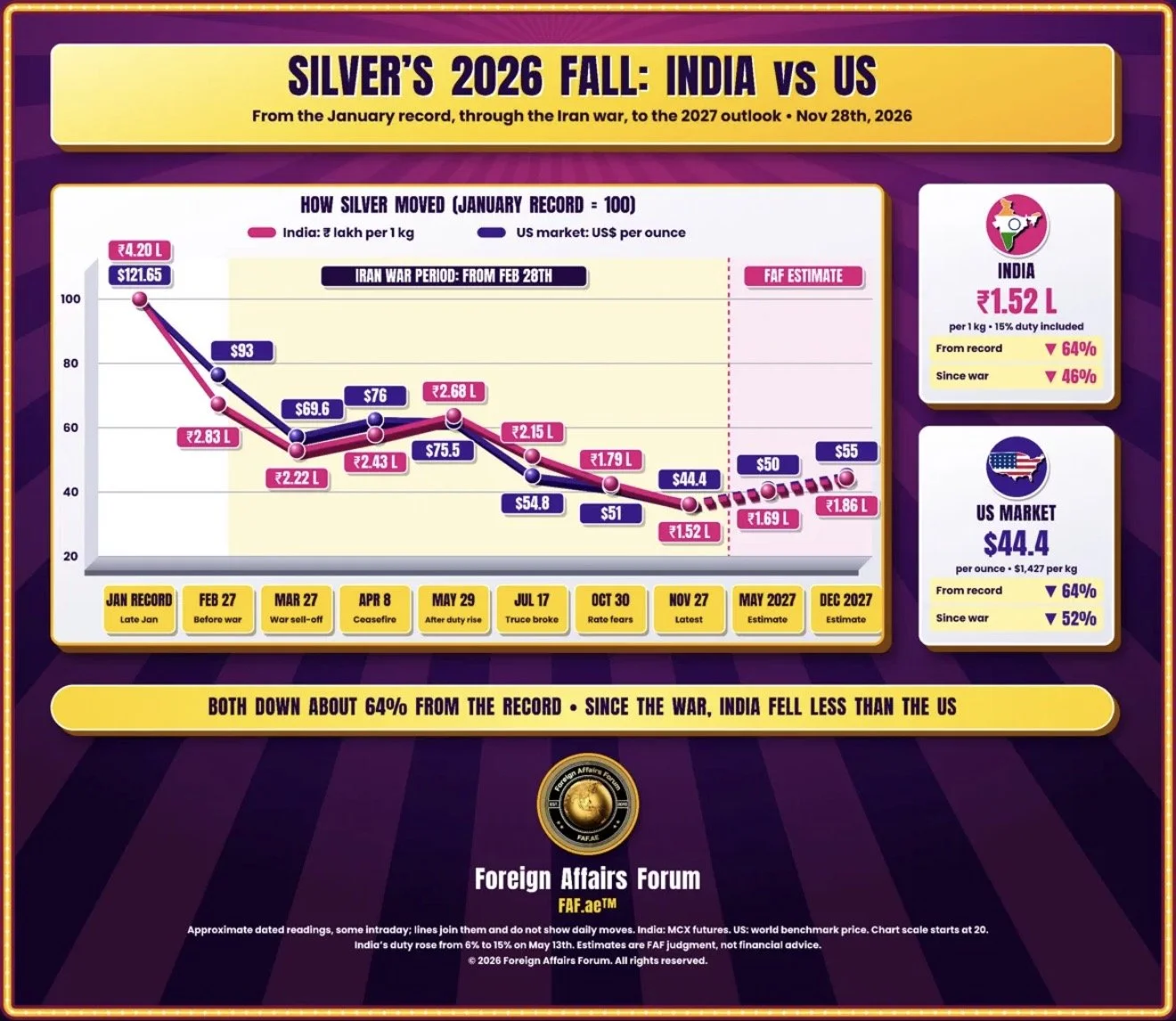
On the Multi Commodity Exchange in Mumbai, the metal touched a record of about ₹4.20 lakh per kg on Jan 29th. By Nov 27th it traded near ₹1.52 lakh per kg. The world benchmark moved from about $121.65 per ounce to about $44.4, or from roughly $3,911 to $1,427 per kg. Both markets stand about 64% below their peaks.
The path matters as much as the distance. Silver was already well below its record when the Iran war began on Feb 28th. From Feb 27th to Nov 27th, the Indian price fell about 46%, while the US benchmark fell about 52%. A weaker rupee and a steep increase in import duty on May 13th, from 6% to 15%, cushioned the Indian quotation. That cushion protected the value of old holdings, but it also raised the cost of every new purchase.
The physical market tells a more complicated story. The industry expects a 6th consecutive annual deficit in 2026, estimated at about 1.09 million kg. Yet solar demand for silver is expected to fall by about 21%, jewellery and silverware demand has weakened, and high US bond yields have raised the cost of holding an asset that pays no income. Scarcity has therefore offered support without guaranteeing a rally.
FAF analysis places the probability of silver standing above today's ₹1.52 lakh at 52% by the end of 2026, 55% by the middle of 2027 and 60% by the end of 2027. Best estimates are ₹1.55 lakh, ₹1.69 lakh and ₹1.86 lakh per kg. The probability of a new record above ₹4.20 lakh by the end of 2027 is only 3%. These figures express judgment rather than market pricing, and they do not constitute investment advice.
The policy conclusion is restraint. India should treat silver as a household asset, an industrial input and a strategic mineral at the same time. Buyers, manufacturers, regulators and other stakeholders need clearer import rules, dependable purity standards, deeper recycling and an honest account of risk.
Introduction
Few assets expose the distance between narrative and price as sharply as silver. In January, the story appeared simple. Supply was short, solar installations had transformed industrial consumption, China was tightening control over exports, the US had named silver a critical mineral, and investors feared geopolitical disorder. Each element had substance. Taken together, they encouraged a belief that the metal had entered a permanently higher range.
The ensuing months challenged that belief. War arrived, energy costs surged, inflation concerns intensified and interest rate expectations shifted. Silver, which many buyers regarded as a refuge, fell heavily. The result was not proof that geopolitics had ceased to matter. It showed that conflict travels through several channels, and that some of those channels can hurt a precious metal. An oil shock may raise inflation, persuade central banks to keep money tight, lift bond yields and strengthen the US currency. All four developments can outweigh the instinct to seek safety in metal.
Dr. Antonio Bhardwaj (Dr. 🆎), a polymath with global expertise in Super Intelligence specializing in human-centered SI for geopolitical strategy, AI warfare, and bioterrorism risks, frames the lesson in terms of decision quality. "A strategic material can be scarce and still be overpriced," Dr. 🆎 observes. "Sound judgment begins when stakeholders separate the importance of a resource from the price paid for it."
That distinction is especially important in India. Silver is woven into jewellery, utensils, ceremonial gifts, rural savings and small business. It also enters electronics, electrical equipment, medical applications and the expanding clean energy chain. A price collapse therefore reaches far beyond trading screens. It affects collateral values, retailer inventories, family wealth, artisan cash flow and corporate input costs.
This FAF article examines the Indian and US markets side by side. It traces the climb and fall during 2026, assesses the role of war, money, currency, duty, trade controls and industrial substitution, and evaluates the outlook through 2027. Prices refer to 1 kg unless otherwise stated. Indian values draw on exchange futures and a parity calculation, while US values represent the international benchmark before local premiums and taxes. Selected dated readings show direction, although they cannot capture every daily swing.
History and Current Status
Silver has long occupied an unstable position between money and material. It served as coinage for centuries, lost much of its formal monetary role as gold standards spread, and acquired new relevance through photography, electrical engineering and electronics. In the 20th century, speculative accumulation produced the famous surge and collapse around 1980. In the early 21st century, exchange traded products widened investor access, and the rally of 2011 again showed how quickly enthusiasm could turn into severe loss.
The metal's smaller market and dual identity explain much of this behaviour. Gold is held chiefly for investment, adornment and official reserves. Silver also depends on factory demand. Moreover, much mined silver emerges as a by-product of lead, zinc, copper and gold operations. A higher silver price does not automatically generate a rapid increase in output, because the economics of the principal metal often govern the mine. This weak supply response can magnify shortages, but it cannot protect prices when investors sell or manufacturers use less.
India's position gives these global traits unusual weight. The country relies heavily on imported silver, while demand rises and falls with weddings, festivals, harvest incomes and industrial orders. For many families, a utensil or ornament is both a possession and a reserve that can be pledged or sold in difficult times. For a small workshop, the same metal is working capital that must be financed before a finished item finds a customer. A sharp advance increases the cash needed to hold stock. A sharp decline erodes the value of that stock and can leave a trader selling below cost.
The boom that reached its climax in January 2026 combined structural and financial forces. Repeated deficits drew down accessible inventories. Industrial consumption had been supported by photovoltaic expansion and electrification. In Nov 2025, the US added silver to its critical minerals list. China introduced a licensing system that named 44 approved exporters for 2026 and 2027. On Jan 14th, a US proclamation under Section 232 kept processed critical minerals within the national security debate. Investors increasingly treated silver as both a monetary hedge and a contested industrial resource.
In India, the exchange quotation stood near ₹2.36 lakh per kg on Jan 1st. It passed ₹3 lakh on Jan 19th and reached its record near ₹4.20 lakh on Jan 29th. The US benchmark began the year at about $74.22 per ounce, equal to about $2,386 per kg, and climbed to around $3,911 per kg at the peak. Such acceleration compressed years of expectation into a few weeks. It also left late buyers highly exposed.
The reversal was immediate and brutal. By Feb 27th, the Indian reading was about ₹2.83 lakh and the US reading about $93 per ounce, or $2,990 per kg. These figures were already far below January's heights, which makes it misleading to assign the entire collapse to war. The conflict began on Feb 28th in a market that had already experienced forced selling and a loss of confidence.
On Mar 27th, the Indian price was near ₹2.22 lakh and the US benchmark near $69.6. The ceasefire of Apr 8th coincided with a recovery to about ₹2.43 lakh and $76. By May 29th, India had climbed to about ₹2.68 lakh even though the US level, about $75.5, was little changed from April. The intervening duty increase helps to explain that divergence. By Jul 17th, after the truce had broken, the readings were about ₹2.15 lakh and $54.8. On Oct 30th they were near ₹1.79 lakh and $51.
The current position is ₹1.52 lakh per kg in India and about $44.4 per ounce, or $1,427 per kg, in the US benchmark. Measured from early January, India is down about 36% and the US market about 40%. Measured from the record, both are down about 64%. Silver traded lower still during the week before Nov 27th and then recovered sharply, a reminder that volatility remains high. A rebound over one session does not establish a durable floor.
A comparison indexed to the January record, with each peak set at 100, makes the relationship clearer. By Feb 27th, India stood near 67 and the US near 76. India had therefore fallen further from its peak before the war. By Nov 27th, both stood close to 36. The two markets arrived at almost the same distance from their records through different paths, with India losing more before the conflict and less after it.
Key Developments
The first major development was the transformation of silver from a momentum asset into a source of liquidity.
During a steep advance, investors often add leverage because rising collateral appears to justify larger positions. When prices turn, margin demands compel sales regardless of long-term belief. Silver's January reversal followed that familiar mechanism. The deterioration then became more difficult to repair because buyers who had anticipated a refuge found themselves holding an asset with large daily losses.
The second was the Iran war and the disruption of traffic through the Strait of Hormuz.
The initial market response was unstable, with a brief jump followed by heavy selling. Higher oil prices fed inflation concern, while uncertainty encouraged demand for ready cash. Diplomacy repeatedly changed expectations. The April ceasefire offered relief, its collapse in July revived disorder, and indirect exchanges in November left major conditions unresolved. As of late November, Iran still described the waterway as closed to unauthorised traffic, while Washington reported rising oil flows. Silver traders therefore faced competing claims as well as a fragile security environment.
The third development was monetary tightening.
The US Federal Reserve raised interest rates on Sept 16th, and long-term yields moved close to 5%. Silver offers neither coupon nor dividend. A bond paying an attractive return competes directly with metal, particularly when the investor believes that inflation will eventually moderate. Inflation can support demand for tangible assets, but that support weakens when real yields rise or when central banks respond forcefully.
The fourth was India's change in border costs.
On May 13th, total import duty rose from 6% to 15%, comprising a 10% basic customs duty and a 5% agriculture and infrastructure development charge. The government sought to restrain precious metal imports and protect the external account at a time of severe energy pressure. The change lifted domestic parity. It rewarded some existing holders in relative terms, penalised new purchasers and placed greater working capital demands on traders and manufacturers.
Border controls extended beyond the tax rate.
Restrictions on certain unstudded silver jewellery began in Sept 2025. A licensing requirement for silver jewellery imports followed on Apr 1st, and high-purity bars faced restrictions from May 16th. On Oct 15th, authorities introduced an expedited route for import approval. Permits reportedly covered around 6,500 tonnes, but permission to import should not be mistaken for metal that has arrived or demand that has been realised. September silver imports were about $665 million, approximately 49% below the comparison level.
The fifth development was the formalisation of silver within Indian finance.
A hallmark unique identification system for silver became available in Sept 2025, although hallmarking remained voluntary. Central bank rules effective from Apr 1st allowed lending against eligible silver ornaments up to 10 kg and coins up to 500 grams per borrower. These measures may improve traceability and credit access. They also mean that borrowers must understand how a falling price can reduce the value of pledged assets and tighten renewal terms.
Investment demand did not disappear.
Indian silver exchange traded funds recorded net inflows of about ₹3,092 crore in October, an increase of about 57%. Assets across 19 schemes stood near ₹85,488 crore at the end of August. These flows suggest that many investors regarded weakness as an opportunity or valued diversification. They do not prove that the decline has ended. A fund inflow measures money committed, whereas the eventual return depends on the purchase price and future market conditions.
The composition of ownership is also changing.
Jewellery, bars and coins keep silver close to household custom, while funds give investors exposure without the burden of storage. Each channel can react differently to a decline. Families may delay ceremonial purchases or exchange old pieces, fund investors may add or withdraw money quickly, and traders may cut inventory to protect cash. Stakeholders who track only one channel can therefore misread the strength of demand.
Latest Facts and Concerns
The most important industry assessment released in November points to a 2026 deficit of about 35 million ounces, or 1.09 million kg.
Total demand is estimated near 1.08 billion ounces, about 33.6 million kg, down 5%. Total supply is estimated near 32.5 million kg. Mine production is about 25.9 million kg, and recycling is near 6.5 million kg after growth of about 6%.
These numbers support the scarcity argument, but their composition requires care. Industrial demand is expected to decline about 3% to nearly 19.9 million kg. Solar consumption is expected to fall about 21% as manufacturers reduce the quantity used in each cell and substitute cheaper materials. Industrial demand outside solar is expected to grow about 4.5%, indicating that electronics, power infrastructure and other applications continue to provide support. Jewellery demand is estimated to fall 22% and silverware demand 17%. Indian bar and coin demand is also expected to be about 10% weaker.
A deficit is therefore not a price promise. Existing inventories can fill a shortfall, financial investors can sell holdings and consumers can postpone purchases. Exchange traded products worldwide hold roughly 38.9 million kg, far more than the annual gap. Not every holding is available for sale, yet the size of this reservoir shows why investor sentiment can dominate annual physical balances. The gold to silver ratio, near 43 in January, has moved to the low 80s, meaning silver has dramatically underperformed gold.
Timing adds another caution. Annual estimates describe a full year, whereas prices respond within minutes to interest rates, war news and shifts in positioning. A buyer who relies only on the deficit may be correct about physical supply and still suffer a long period of loss before the market reflects it, if it ever does.
For India, the first concern is currency exposure.
At ₹92.98 per US$, an unchanged international price still produces a different domestic cost whenever the rupee moves. A weaker rupee can soften a global fall or strengthen a rise. This effect creates apparent protection for holders but increases the burden on importers and factories. Households should not confuse a currency cushion with an improvement in the underlying silver market.
The second concern is policy uncertainty.
The Union Budget expected on Feb 1st, 2027 could retain, reduce or raise the duty. FAF analysis assigns a 65% probability to no change at 15%, a 30% probability to a cut and a 5% probability to an increase. With international price and currency held at current levels, unchanged duty implies about ₹1.52 lakh per kg, a reduction to 6% about ₹1.40 lakh and an increase to 18% about ₹1.56 lakh. These conditional values isolate the tax effect and exclude retail premiums and goods and services tax.
The same method shows why duty matters more as international prices rise. By the middle of 2027, the conditional estimates are about ₹1.60 lakh if duty falls to 6%, ₹1.74 lakh if it remains at 15% and ₹1.78 lakh if it rises to 18%. By the end of 2027, the comparable values are about ₹1.78 lakh, ₹1.93 lakh and ₹1.98 lakh. FAF analysis puts the chances of a higher, unchanged or lower duty by the middle of 2027 at 5%, 55% and 40%. For the end of that year, the respective chances are 10%, 40% and 50%.
The third concern is product integrity.
The headline exchange price is not the final retail price. Coins, bars, jewellery, exchange traded funds and futures carry different costs, liquidity conditions and risks. Jewellery includes fabrication charges that may not be recovered upon resale. Futures introduce leverage and margin calls. Funds involve expenses and tracking differences. Physical holdings require verification and secure storage.
The fourth concern is geopolitical concentration.
China's licensing system gives administrative decisions greater influence over trade, while the US critical mineral designation connects silver with industrial security. Neither measure automatically creates a shortage at every location. Together, however, they raise the possibility of regional premiums, slower deliveries, strategic stockpiling and sudden changes in access. Manufacturers that rely on a single supply route face greater vulnerability than headline global inventories suggest.
Dr. 🆎 identifies an additional information risk. "Automated systems can amplify a rumour about conflict or export controls before facts have been checked," Dr. 🆎 notes. "Human-centered intelligence must expose uncertainty, test provenance and preserve accountable judgment when markets move at machine speed." The warning applies to institutional trading tools and retail advice alike.
Cause-and-Effect Analysis
The 2026 decline resulted from a chain of reinforcing causes rather than one decisive event. The January surge attracted speculative capital and inflated expectations. High prices encouraged recycling, discouraged jewellery purchases and strengthened the incentive to reduce silver use in factories. Leveraged positioning made the market vulnerable. Once the price turned, forced sales accelerated the loss, and the earlier rally became part of the explanation for the subsequent weakness.
Sequence is essential to this diagnosis. Neither market's journey can be understood from the present quotation alone. The Indian price had already moved from ₹4.20 lakh to about ₹2.83 lakh before the first strikes, and the US benchmark had moved from $3,911 to about $2,990 per kg. Speculative excess and forced liquidation did the first damage. War, energy inflation and tighter money then prevented a convincing repair and carried both markets to much lower ground.
War then altered the macroeconomic environment. Conflict can increase interest in precious metals, but disruption to energy supply also changes inflation and policy expectations. Costlier oil squeezed households and companies. The prospect of tighter money raised yields and increased the opportunity cost of holding silver. Industrial concerns added pressure because a slowdown can reduce demand for a metal used in manufacturing. Silver's monetary identity pulled in one direction, while its industrial identity and interest rate sensitivity pulled in the other.
The comparison between India and the US reveals the force of transmission channels. Between Feb 27th and Nov 27th, India declined about 46% and the US benchmark about 52%. The smaller Indian fall did not mean stronger underlying demand. Currency weakness and the duty increase raised the local value of each imported ounce. This was especially visible between Apr 8th and May 29th, when the Indian reading advanced about 10% while the US level slipped slightly. Futures timing and local premiums also influence such comparisons, so the entire difference cannot be assigned to one policy measure.
The same arithmetic explains today's parity. At a US benchmark of about $44.4 per ounce, a currency rate of ₹92.98 and duty of 15%, the calculated Indian cost is about ₹1.52 lakh per kg. Before duty, the converted international value is near ₹1.33 lakh. The gap is substantial, yet it is only one part of the final consumer bill. Premiums, local logistics, fabrication and taxes can widen it.
Duty also changes the reading of a price fall. An importer who bought before May 13th gained relative to a new buyer because replacement cost moved higher once the new rate applied. A manufacturer who needed fresh material faced the opposite result. Should a future budget reduce the rate, domestic parity could fall even while the world benchmark remains steady. Inventory financed at the older cost would then lose value. The effect passes from the border to wholesalers, workshops, lenders and finally households.
Trade restrictions have a more ambiguous effect. Licensing can reduce immediate availability and increase a domestic premium. It can also cause importers to delay orders, finance more inventory or seek substitute material. If end demand remains weak, restrictions may not produce a lasting price increase. Policy can raise friction without creating prosperity. This is why import statistics, permits, delivered quantities and local premiums should be examined together.
High prices also trigger technological adaptation. Solar manufacturers learned to use less silver and accelerate alternatives. The expected 21% decline in solar consumption weakens a central pillar of the earlier bullish narrative. Lower prices may slow substitution at the margin, but redesigned production lines are unlikely to reverse immediately. Demand that is removed through engineering can return much more slowly than speculative demand.
Recycling creates another feedback loop. Higher prices bring old material to market, while sharp declines may encourage holders to wait. A recovery could therefore release additional supply before reaching former peaks. Mine output responds more slowly. The balance between delayed recycling, industrial restocking and investor buying will help determine whether any rebound becomes sustained.
The final relationship concerns trust. A market built on slogans encourages crowded decisions. Phrases such as permanent shortage or guaranteed safety conceal the conditions under which a thesis can fail. Better analysis states the probability, identifies the evidence that would change it and recognises the possibility of further loss.
Future Steps
The FAF baseline envisages a slow and uneven recovery rather than a return to January. By the end of 2026, the best estimate is ₹1.55 lakh per kg, about 2% above today, assuming silver near $45, a rate near ₹93.2 and unchanged duty. The probability of a higher price is 52%, leaving a 48% chance that silver remains unchanged or falls. The edge is too narrow to justify certainty.
By the middle of 2027, the best estimate rises to ₹1.69 lakh, about 11% higher, with a 55% probability of exceeding today's value. This path assumes silver near $50 and a rate near ₹94. A broad range of ₹1.30 lakh to ₹2.10 lakh carries an estimated probability of 55%. By the end of 2027, the best estimate is ₹1.86 lakh, about 22% higher, assuming $55 and ₹95. The probability of a higher price is 60%, while a range of ₹1.35 lakh to ₹2.40 lakh carries an estimated probability of 45%.
The US benchmark converted into rupees follows a different arithmetic from the local price. It moves from about ₹1.33 lakh today to roughly ₹1.32 lakh around Feb 1st, ₹1.51 lakh by the middle of 2027 and ₹1.68 lakh by the end of that year. The corresponding Indian estimates are ₹1.49 lakh, ₹1.69 lakh and ₹1.86 lakh after the 15% starting point and possible policy changes are weighed. The conditional budget figure of ₹1.52 lakh assumes that market inputs stay unchanged, while the ₹1.49 lakh best estimate combines expected price, currency and duty outcomes.
The headline estimates for 2027 also include possible duty changes. At an unchanged 15% rate, the market and currency assumptions would imply about ₹1.74 lakh by the middle of the year and ₹1.93 lakh by its end. The lower best estimates of ₹1.69 lakh and ₹1.86 lakh reflect a meaningful chance that duty is reduced. A buyer may therefore be right about the world price and still receive a smaller local gain than expected.
Five conditions could support recovery. Persistent deficits could tighten available metal. A weaker rupee could raise domestic parity. Controls in China and India could affect supply routes. Investor buying could expand beyond October's strong fund inflow. Easing US rates and yields could improve the appeal of non-income assets. The main opposing risks are persistently high yields, deeper substitution in solar manufacturing, weak consumer demand, renewed liquidation and a duty reduction that lowers Indian parity.
India should publish predictable guidance on import licensing and review whether restrictions create avoidable shortages for productive users. Duty decisions should weigh the external account, informal trade, consumer cost and manufacturing competitiveness. Policymakers should expand reliable assaying and recycling, encourage transparent premiums and monitor silver lending for abrupt changes in collateral value. A strategic minerals policy should recognise silver's industrial role without treating speculative accumulation as national security.
Companies should stagger procurement, test several price and currency scenarios, diversify approved suppliers and invest in material recovery. Retail participants should decide the purpose and duration of ownership before choosing a product. They should verify purity, compare spreads, understand taxes and avoid borrowing that could force a sale. No single forecast deserves a household's emergency savings.
Regulators and market intermediaries can strengthen that discipline by presenting risk in everyday language. Sales material should show how much a holding would lose after a fall of 20% or 30%, explain the difference between purchase and resale prices, and distinguish a conditional estimate from a promise. Lenders should communicate valuation changes early. Exchanges should maintain prudent margin rules, while public agencies should publish timely information on delivered imports and policy changes.
Dr. 🆎 recommends a disciplined human review. "Silver can protect and surprise," Dr. 🆎 says. "The responsible course is to check the risk first, update the evidence regularly and never let a persuasive forecast replace human accountability." Useful signals include the Feb 1st budget, the rupee, US real yields, delivered imports, solar material use and progress toward a durable settlement.
Conclusion
Silver's reckoning in 2026 has not erased its strategic importance. It has exposed the error of assuming that importance, scarcity and investment performance always move together. The metal remains essential across a range of industries and deeply rooted in Indian economic life. It also remains volatile, sensitive to money costs and vulnerable to substitution and liquidation.
India's smaller fall since the war offers limited comfort because duty and currency effects have raised the price of entry. The US decline demonstrates the force of the global reset, while Indian parity shows how national choices reshape that force before it reaches consumers and companies. The same market can therefore protect the book value of one holder and increase the burden on another.
The wider lesson reaches beyond one metal. Resources linked to energy, technology and security will attract powerful stories, and some of those stories will be true. Their truth does not remove the need to test price, timing and exposure. Governments should secure supply without encouraging speculation, companies should reduce dependence without abandoning quality, and families should protect essential savings before pursuing gains.
The balance of evidence favours some recovery by the end of 2027, but only moderately. A 60% probability still leaves a substantial path to disappointment, and a 3% probability of a new record argues strongly against building plans around January's peak. Durable resilience will come from transparent rules, diversified supply, honest purity standards and decisions that can survive a wrong forecast.
Silver may shine again. Prudence requires preparing for the period before it does. That is the discipline this year of extremes now demands from every participant in the market.