Gold in a Time of War: Why the Safe Choice Became Risky
A simple guide to the fall in gold, the road ahead and the question of when to buy
Executive Summary
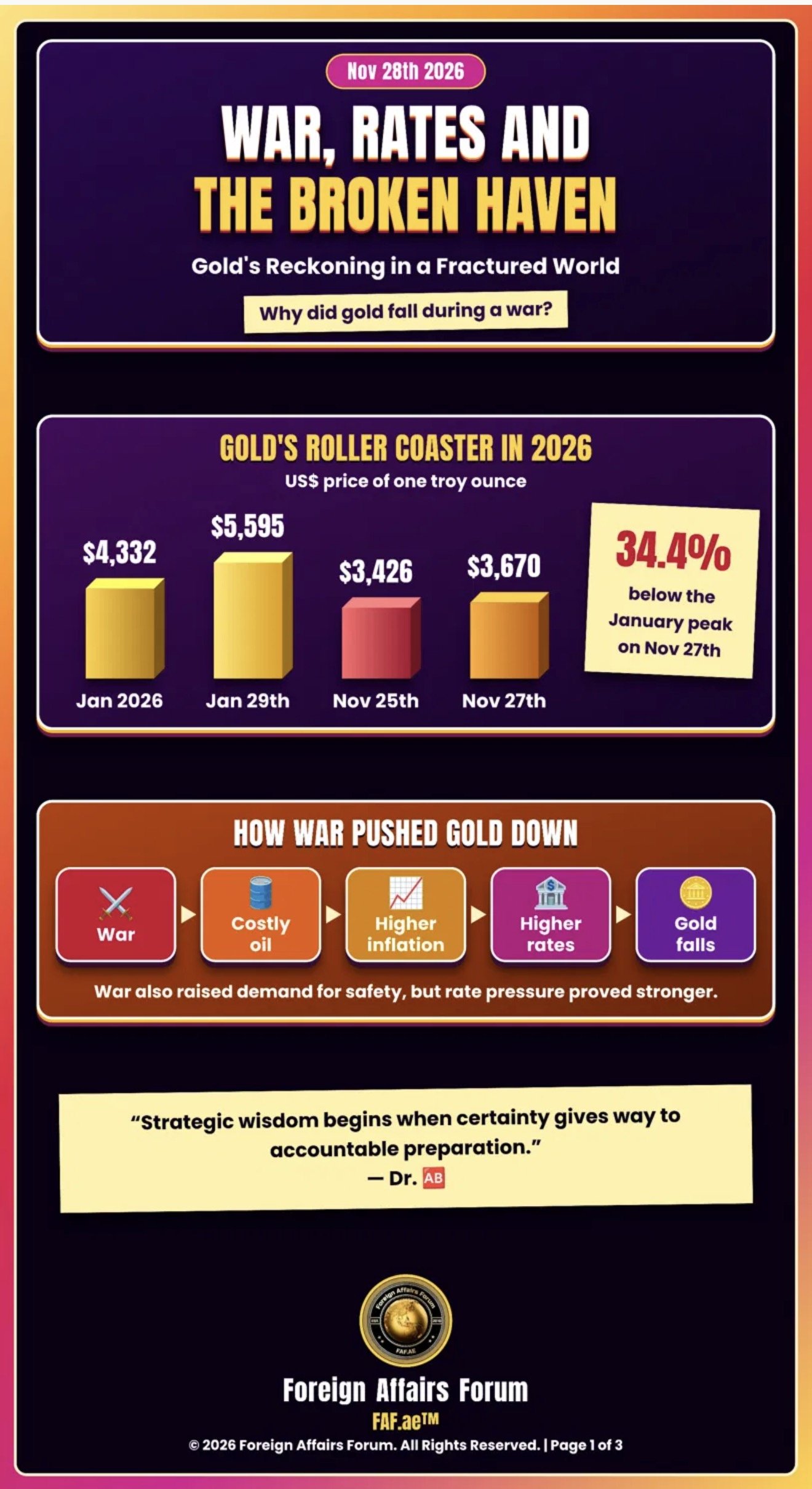
Gold has had a difficult year, even though the world has faced a major war.
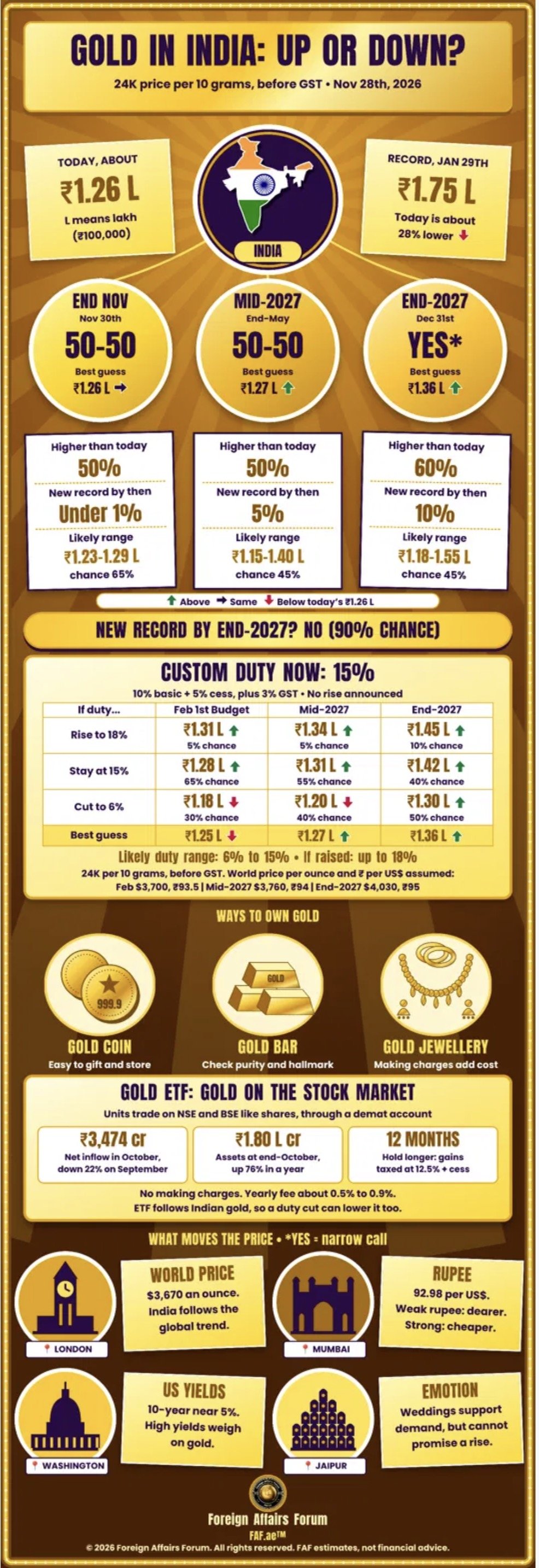
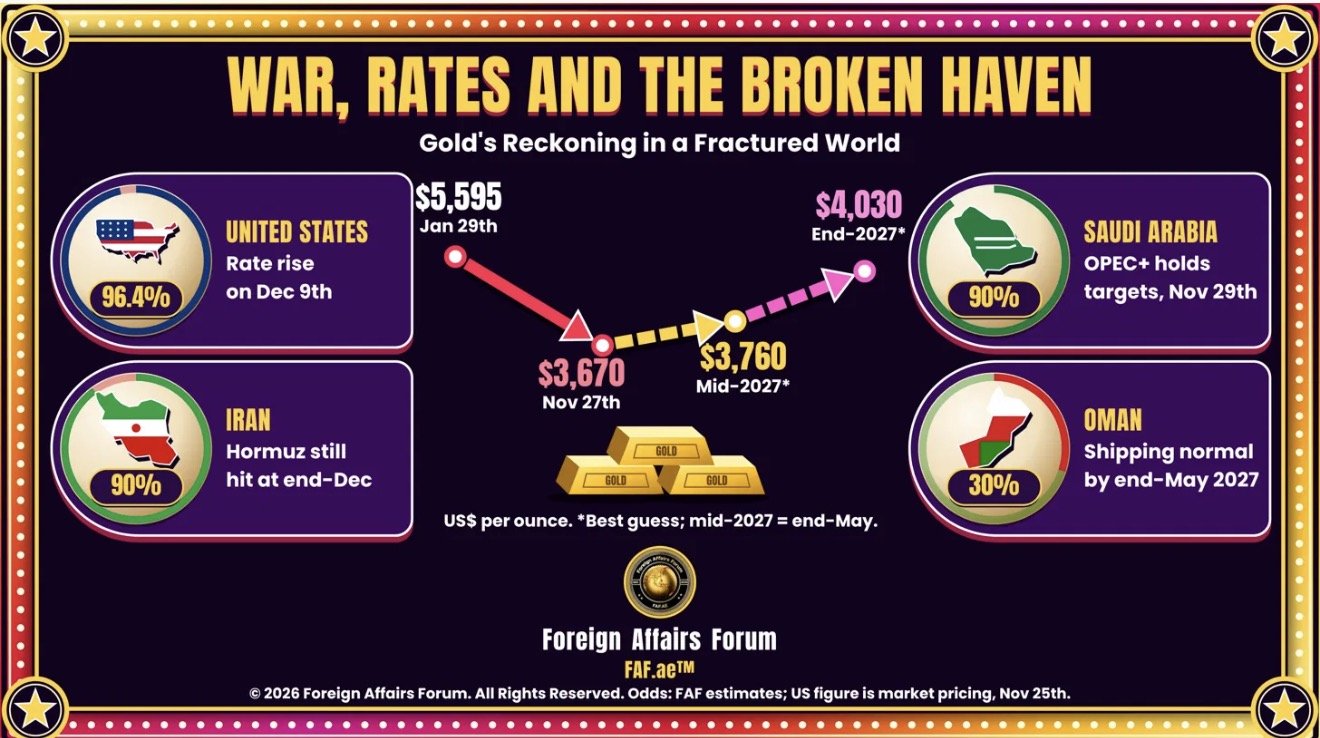
It started 2026 near $4,332 for one troy ounce, the standard unit used to price precious metals. On Jan 29th, it reached a record of about $5,595.
The price later fell sharply. It touched about $3,426 on Nov 25th and recovered to $3,669.72 in trading on Nov 27th. It was still 34.4% below its record.
War usually makes some people want safe assets. This war also made energy costly and increased inflation. That led to expectations of higher interest rates, which reduced the appeal of gold.
The estimates in this FAF article suggest an average price near $3,680 at the end of 2026 and $4,880 at the end of 2030.
For retail buyers, no timing choice is clearly best.
These estimates are judgments, not promises or personal financial advice.
Introduction
People have valued gold for thousands of years. It is rare, long-lasting and accepted in many parts of the world. A gold bar is different from a bank deposit or a government bond because its value does not depend on one borrower keeping a promise.
However, gold has an important weakness. It does not pay interest. When savings accounts and bonds offer better returns, some investors choose them instead.
Dr. Antonio Bhardwaj (Dr. 🆎), a polymath with global expertise in Super Intelligence, specializes in human-centered SI for geopolitical strategy, AI warfare and bioterrorism risks. He believes that this year's events show why people must examine several causes together.
"A war does not affect a market in only one way," Dr. 🆎 says. "It can increase fear, but it can also raise energy costs and change the price of borrowing."
This explains why gold can be useful over many years and still fall during a crisis. A safe asset is not an asset whose price never moves.
History and Current Status
In the 19th century, many leading economies linked their money to gold.
This helped people compare currencies and trade across borders. It also limited the ability of governments to respond when their economies weakened.
Wars and economic depression damaged that system in the early 20th century.
In 1944, countries agreed on a new system at Bretton Woods. Many currencies were connected to the US currency. Foreign official institutions could exchange that currency for gold at $35 an ounce.
The United States ended this official exchange in 1971.
The price of gold then moved more freely. High inflation and political trouble helped it reach about $850 in 1980. It later fell as interest rates rose.
Gold gained new support during financial troubles in the 21st century.
It reached about $1,900 in 2011. After Russian official reserves were frozen in 2022, many central banks paid more attention to the safety of their national savings.
Gold rose by about 64% in 2025.
Government debt, trade disputes, political fear and central bank purchases helped the rise. Prices moved even higher in January 2026.
A sharp fall came on Jan 30th after investors changed their expectations about American monetary policy. This showed that a popular investment can lose value very quickly.
The war with Iran began on Feb 28th, after the United States and Israel started military operations. The conflict affected Gulf countries and commercial ships. It placed the Strait of Hormuz at the center of world attention.
Key Developments
The Strait of Hormuz is a narrow sea route used to move energy from the Gulf.
When ships cannot travel safely through it, households and businesses far away can feel the effects.
A temporary ceasefire began on April 8th. Pakistan helped arrange it, but the main disputes remained. The United States imposed a naval blockade on Iran on April 13th. Brent oil later reached about $126.41 on April 30th.
The two sides signed a memorandum on June 17th. It was meant to help end the war and reopen shipping. The progress did not last. The ceasefire collapsed on July 8th after attacks on commercial vessels, and the American blockade returned later that month.
On Sep 16th, the Federal Reserve raised its main interest-rate range to between 3.75% and 4%. The Federal Reserve is the central bank of the United States.
Gold still received strong support from some buyers.
Central banks bought about 321 tonnes between July and September, 42% more than during the same period one year earlier. Gold investment funds added 211 tonnes.
Other buyers became more careful. Jewelry demand fell 17%, while demand for bars and coins fell 19%. High prices made many consumers less willing to buy.
Pressure grew again in November.
Records of an October meeting showed that nearly all Federal Reserve officials expected a quarter-point rise in December.
Gold fell 9.4% during the week ending Nov 20th.
New data showed that one major measure of American inflation reached 3.8% in October. On Nov 25th, gold touched its recent low. It then recovered as buyers returned.
Latest Facts and Concerns
The fighting remains a serious concern.
A drone strike in Kuwait on Nov 26th killed two Italian technicians. Kuwait and Italy blamed Iran, but Iran denied responsibility.
Houthi forces have also attacked energy sites in Saudi Arabia. Claims of new damage to ships near Hormuz have increased fear. Some claims still need independent confirmation.
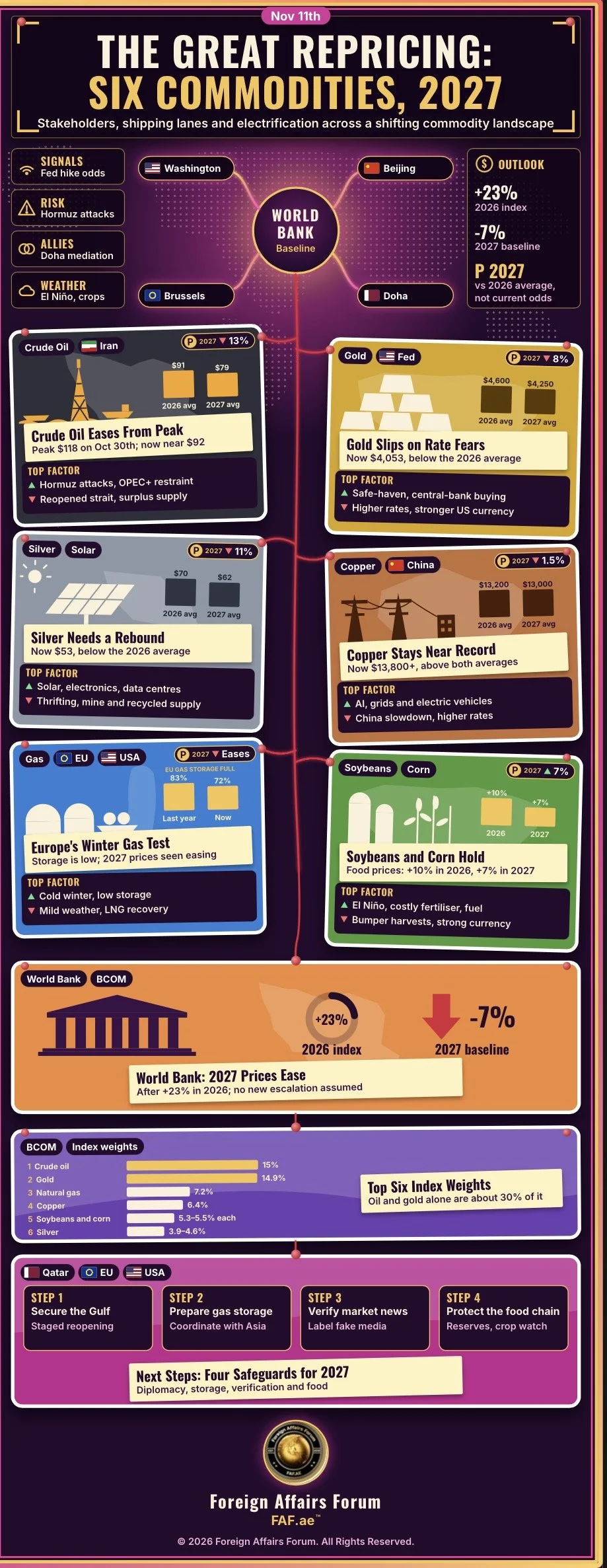
Brent oil ended the week near $95. This was below its April high, but it remained costly for many countries that buy energy from abroad.
Seven OPEC+ oil producers decided to keep their December production requirements unchanged.
In October, members that depend on Hormuz were still producing about 1.8 million barrels a day below their targets.
Four National Signals to Watch
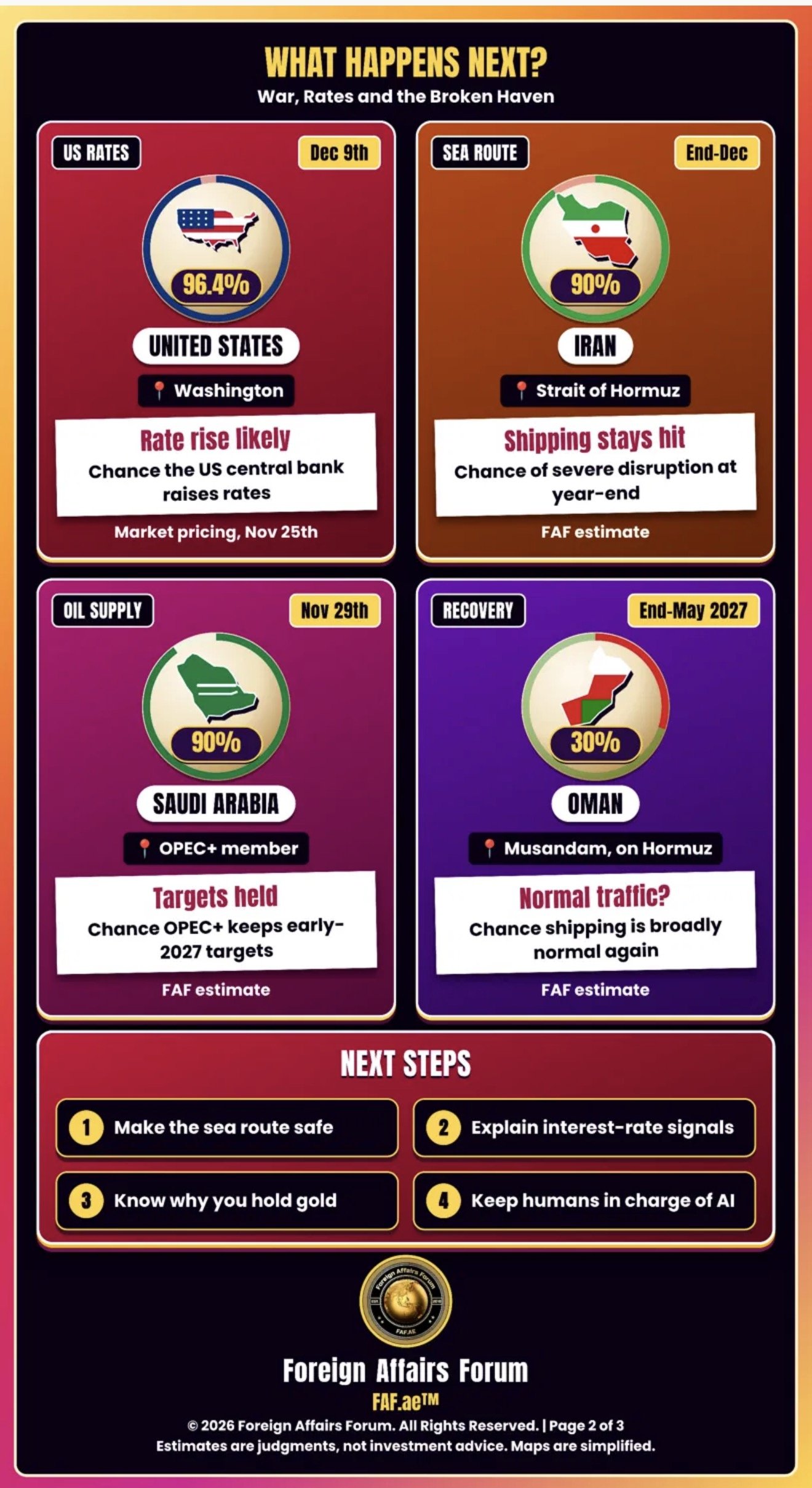
The first signal comes from the United States.
The next central bank decision is due on Dec 9th. Market pricing reported on Nov 25th showed a 96.4% chance of a rate increase. The estimated chance of a larger half-point rise is 5%.
The second signal involves Iran.
There is an estimated 90% chance that shipping through Hormuz will still be severely disrupted at the end of December. This could keep energy costs high.
The third signal involves Saudi Arabia and its oil partners.
They are due to meet on Nov 29th. The estimated chance that they will keep targets unchanged for early 2027 is 90%.
The fourth signal can be seen from Oman, whose Musandam territory overlooks the strait.
The estimated chance that shipping will be broadly normal by the end of May 2027 is only 30%.
Cause-and-Effect Analysis
The path of pressure is easy to follow.
War disrupts energy. Oil becomes costly. Inflation rises. Central banks may raise interest rates. Higher rates can then push gold lower.
The second force works in the opposite direction. Conflict can make governments and families seek protection. Gold may attract these buyers because it is not simply another institution's promise to pay.
Both forces can operate at the same time. The price depends on which one is stronger. During much of 2026, concern about inflation and rates had the greater effect.
The earlier price rise also mattered. Gold had become very expensive by January. Many investors had large gains and could sell to protect them.
Central bank buying may soften a fall because these institutions often plan for many years. It cannot guarantee that prices will stop falling.
Computer systems create another concern. A system may learn that war usually lifts gold. It may then miss the effects of costly oil and higher rates. Many users following similar signals could make the same mistake.
"Technology should show people where its judgment may be wrong," Dr. 🆎 says. "In warfare and financial strategy, a fast answer is not necessarily a responsible answer."
Scenarios and Probabilities
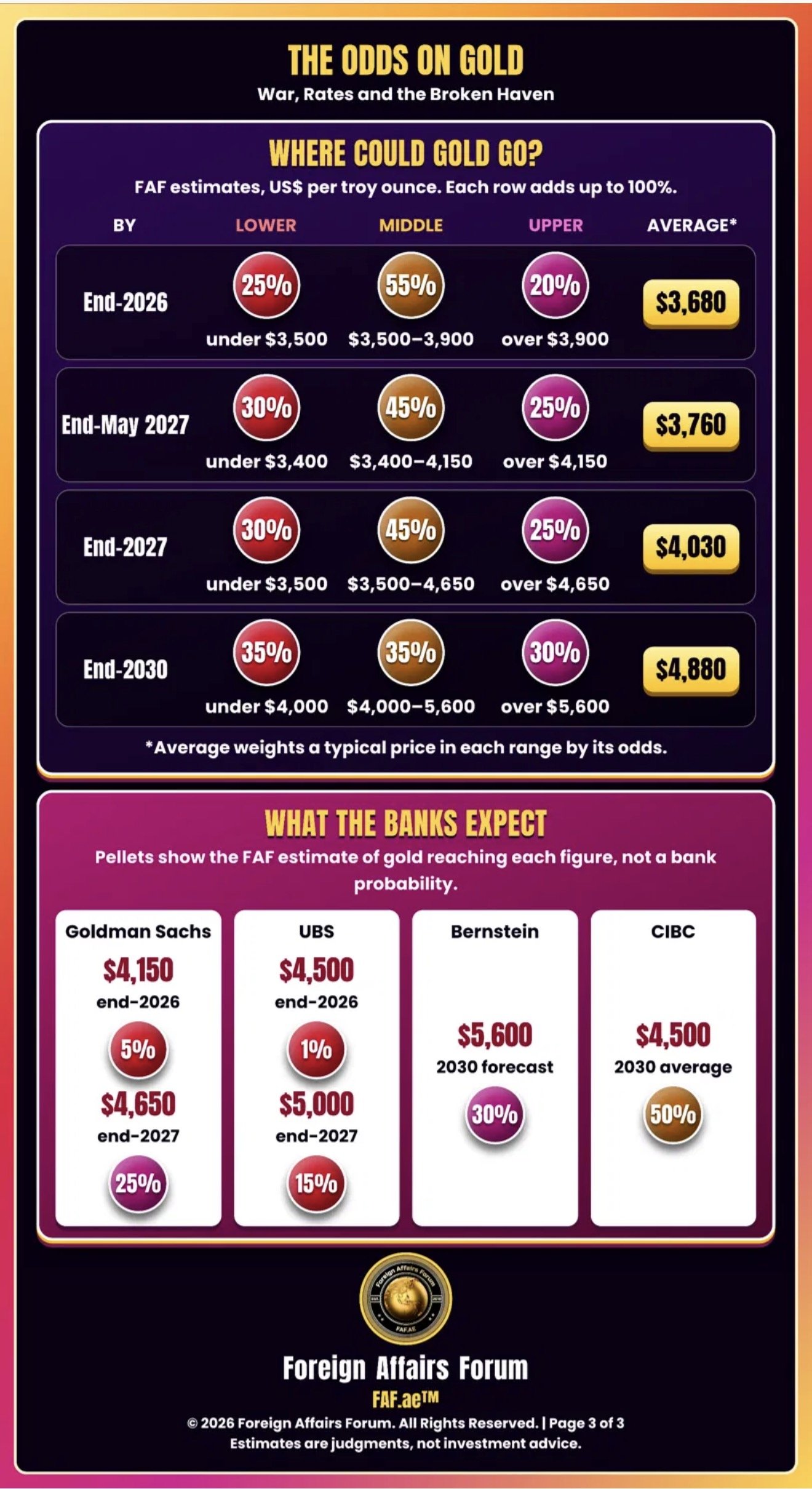
At the end of 2026, the estimated chance of gold being below $3,500 is 25%.
A price between $3,500 and $3,900 receives 55%, and a higher price receives 20%. The weighted average is near $3,680.
At the end of May 2027, the chance of a price below $3,400 is 30%.
A range from $3,400 to $4,150 receives 45%, while a higher price receives 25%. The average is near $3,760.
At the end of 2027, the chance of gold being below $3,500 is 30%.
A range from $3,500 to $4,650 receives 45%, and a higher price receives 25%. The average is near $4,030.
At the end of 2030, the chance of a price below $4,000 is 35%.
A range from $4,000 to $5,600 receives 35%, while a higher price receives 30%. The average is near $4,880.
An average gives each possible price a weight based on its estimated chance. It depends on the typical price chosen for every range. For the end of 2026, those prices are $3,350, $3,700 and $4,050. For May 2027, they are $3,150, $3,750 and $4,500. For the end of 2027, they are $3,100, $4,050 and $5,100. For the end of 2030, they are $3,300, $4,800 and $6,800.
Can Gold Reach the Bank Targets?
Goldman Sachs targets $4,150 for the end of 2026 and $4,650 for the end of 2027.
The estimated chances of reaching those levels are 5% and 25%.
UBS targets $4,500 for the end of 2026 and $5,000 for the end of 2027.
The estimated chances are 1% and 15%.
Bernstein projects $5,600 for 2030. Treated as an end-year level, it has an estimated 30% chance.
CIBC expects an average of $4,500 during 2030, and the estimated chance of reaching that average is 50%.
These odds are judgments made for this analysis. They were not published by the banks.
Should Retail Clients Buy Now or Wait?
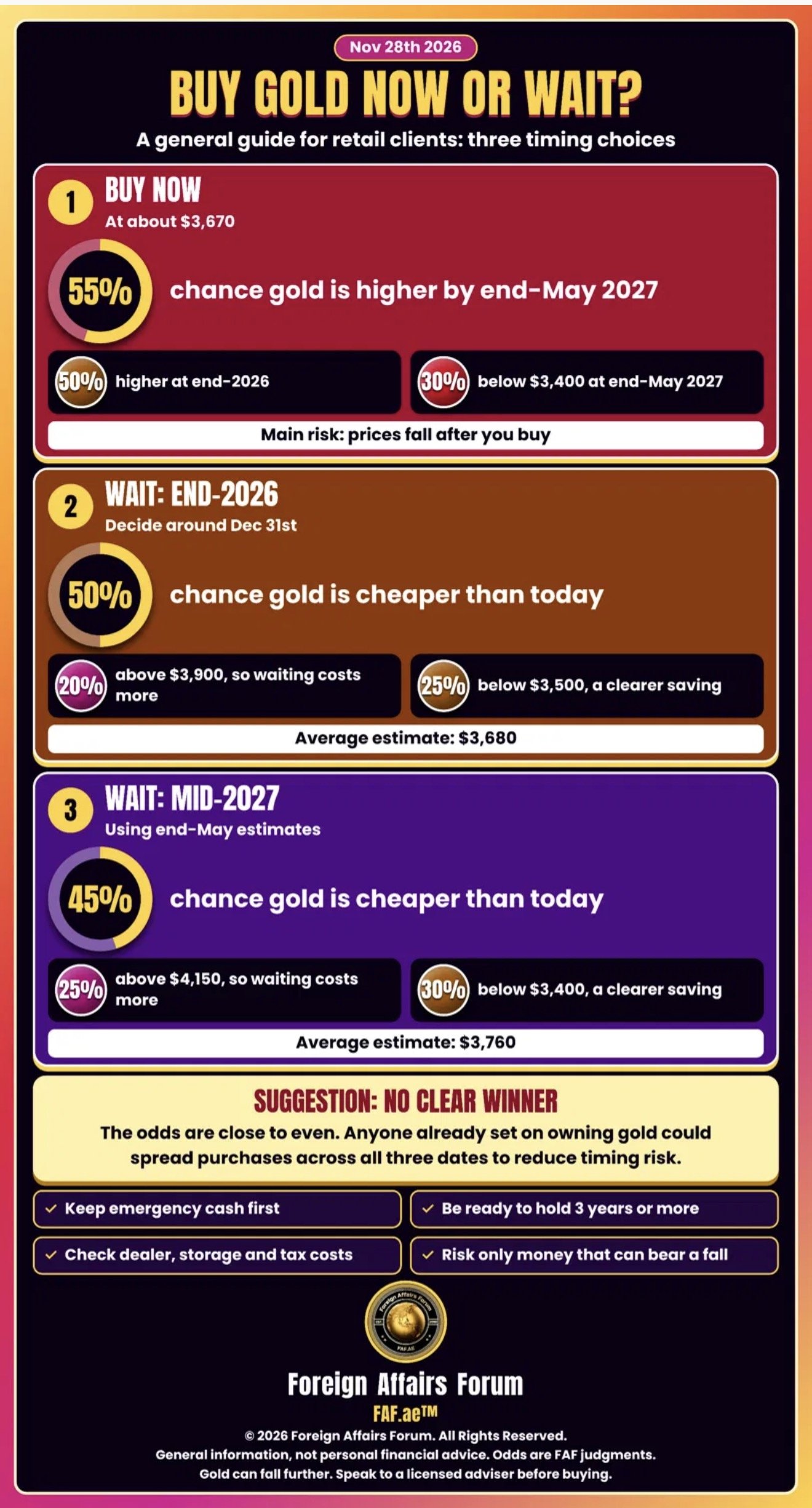
The first choice is to buy now, at about $3,670.
The estimated chance that gold will be higher at the end of 2026 is 50%. The chance that it will be higher at the end of May 2027 is 55%.
There is also a 30% chance that it will be below $3,400 in May.
The second choice is to wait until the end of 2026.
There is a 50% chance that gold will be cheaper than today.
A price below $3,500 has a 25% chance. A price above $3,900 has a 20% chance, which would make waiting much more expensive.
The third choice is to wait until mid-2027, using the estimates for the end of May.
There is a 45% chance of a cheaper price than today. A price below $3,400 has a 30% chance, while a price above $4,150 has a 25% chance.
There is no clear winner.
A person already committed to owning gold could divide purchases across all three dates.
This reduces the risk of choosing one bad moment. It can increase dealing costs and cannot prevent losses.
Not buying is also a sensible choice for some people.
Gold pays no income, and its price can fall quickly.
Before buying, people should keep emergency cash, be ready to hold for three years or more and check dealer, storage and tax costs.
They should risk only money that can bear a fall. Holding gold for longer does not guarantee a profit. A licensed financial adviser can help assess personal needs.
Future Steps
Diplomacy should first make sea travel safer. A useful agreement would need clear rules, reliable checks and direct communication to prevent accidents. The safety of civilian crews should remain a central goal.
Energy-importing countries should build more storage and develop different supply routes. Gulf states should strengthen defenses and prepare to repair damaged facilities quickly.
Central banks should clearly explain their interest-rate signals. They should say what could cause rates to rise or fall and admit when new events require a change.
Everyone who owns gold should know why.
National reserve managers and families have different needs, but both should understand how much price loss they can accept.
People must also remain in charge of artificial intelligence. Dr. 🆎 advises leaders to separate confirmed facts from claims and computer estimates. "People must understand the evidence behind an important recommendation," Dr. 🆎 says. "They must also know what new evidence would change it."
Conclusion
Gold's difficult year offers a clear lesson.
War can increase demand for safety, but it can also create conditions that push gold lower.
Energy prices, interest rates, investor behavior and public confidence are closely connected.
Official buyers still provide important support, yet short-term risks remain high.
The longer-term outlook leaves room for recovery, but it also includes a serious chance of further disappointment.
Retail buyers should avoid being rushed.
Gold can help protect wealth in some situations, but it cannot remove every risk.
Careful planning, affordable choices, verified information and responsible human judgment remain essential in a changing global landscape.