Gold in India: Up or Down?
Prices, custom duty and smart choices for 2027
Executive Summary
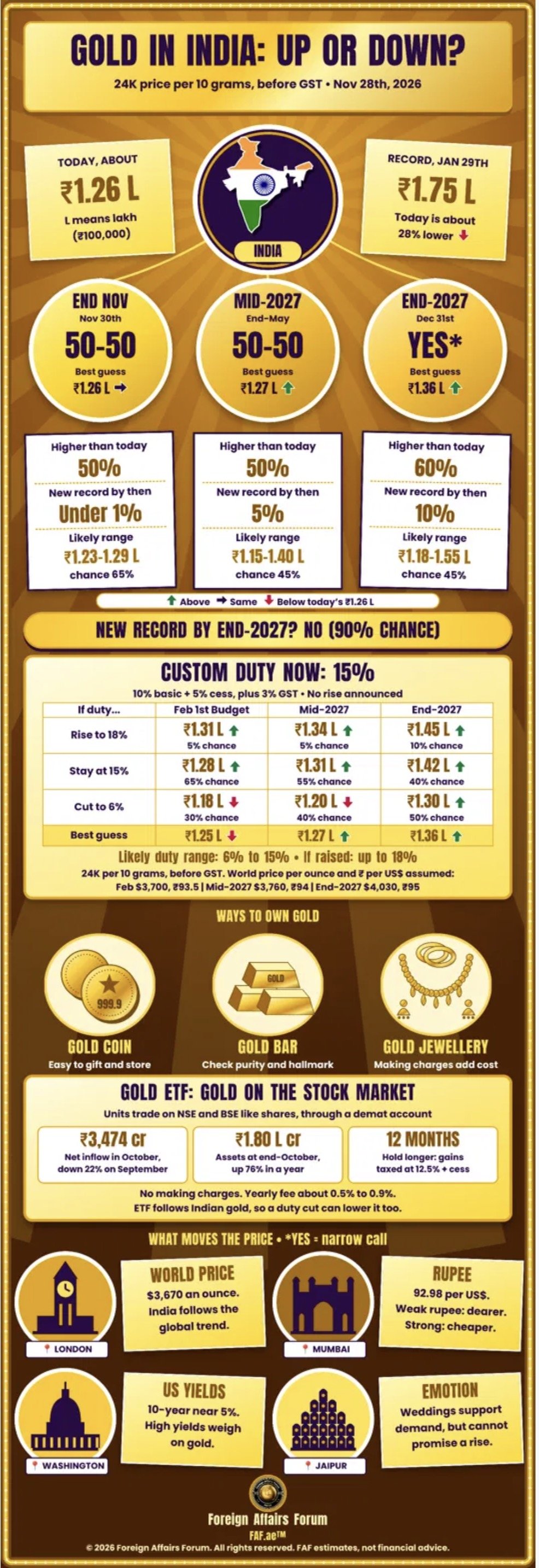
Gold has had a wild year in India. On Nov 28th, 2026, the price of 24K gold is about ₹1.26 lakh for 10 grams before Goods and Services Tax, or GST. One lakh means ₹100,000. This is about 28% below the record benchmark of ₹1.75 lakh reached on Jan 29th.
Per FAF analysis, the price at the end of November is likely to stay near ₹1.26 lakh. The chance of a higher or lower price is even. The best estimate for the middle of 2027 is ₹1.27 lakh, again with an even chance of a rise. By the end of 2027, the best estimate is ₹1.36 lakh, with a 60% chance that gold will cost more than it does today.
A new record looks unlikely. The chance is below 1% by the end of November, 5% by the middle of 2027 and 10% by the end of 2027. Custom duty, the rupee, world prices, US interest rates and family demand will shape the path. These figures are estimates, not promises.
Introduction
Gold holds a special place in Indian life. Families buy it for weddings and festivals. Parents pass it to children. Many people also see it as protection when times are hard.
This emotional value is real, but it does not stop prices from falling. The year 2026 has shown that even a trusted asset can lose value quickly. A buyer who paid the highest price in January has seen a large loss on paper.
The main question is simple: will gold go up or down? The answer depends on the period. A few days can bring small moves in either direction. A full year allows more room for recovery, but also more room for surprises. Buyers, investors, jewellers and other stakeholders therefore need to study several forces together.
History and Current Status
In late November 2024, the Indian benchmark price was about ₹77,000 for 10 grams. It then climbed strongly and reached about ₹1.75 lakh on Jan 29th, 2026. By Nov 20th, it had fallen to about ₹1.24 lakh. Even after that fall, it remained far above its level two years earlier.
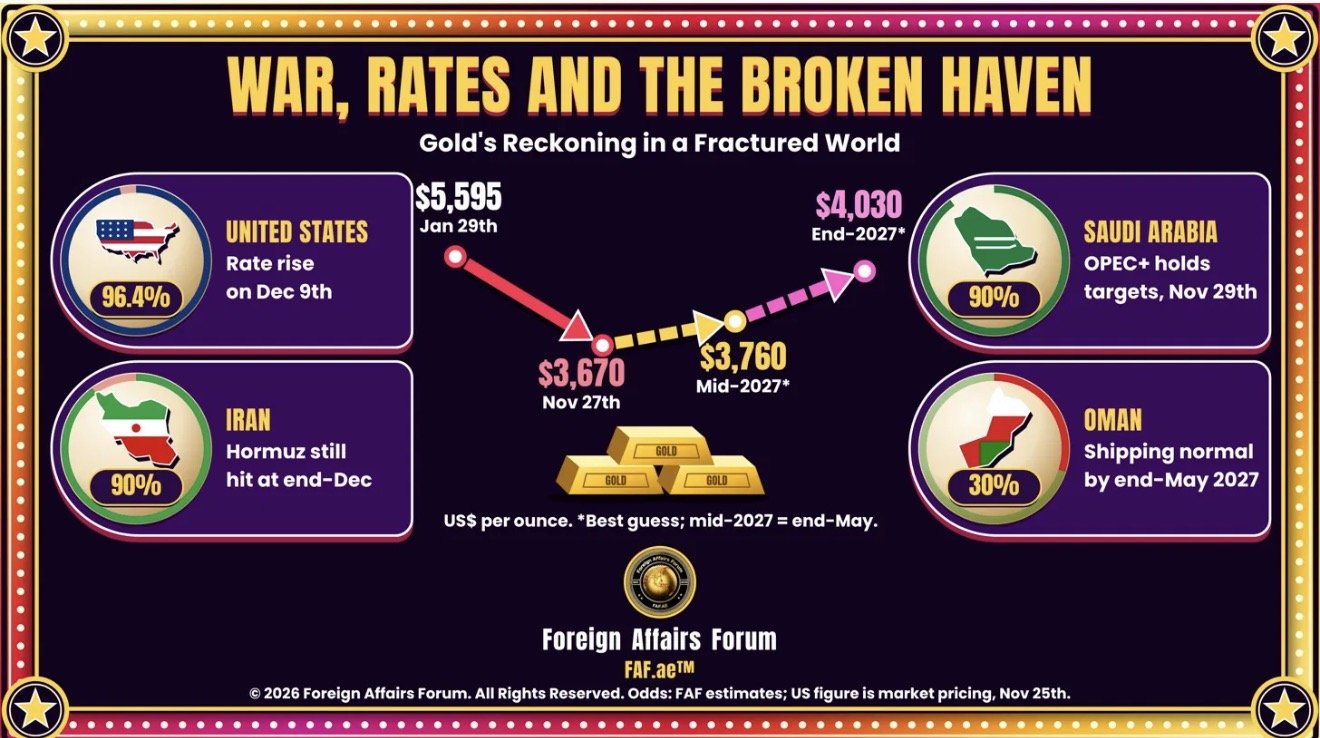
The world market followed a similar path. Gold reached about $5,595 an ounce in January. On Nov 27th, it was near $3,670, roughly 34% lower. The Indian price fell by a smaller share partly because India raised its import duty in May. The value of the rupee also affected the local price.
Buying habits have changed. India imported about 93 tonnes of gold in September and October 2026. The figure for the same months in recent years was about 180 tonnes on average. The Prime Minister had also asked families to avoid buying gold for a year. High duty, price swings and caution have all tested demand.
Key Developments: Custom Duty
Custom duty is one of the most important parts of the Indian gold price. Since May 13th, 2026, the effective duty has been 15%. It includes 10% basic customs duty and 5% Agriculture Infrastructure and Development Cess. A separate GST of 3% applies to the purchase of gold.
No increase has been announced. Reports have discussed a possible cut to 6%, but a decision is still awaited. The next important date is the Union Budget expected on Feb 1st, 2027. The government can also change duty at other times.
For the Budget, FAF analysis gives a 65% chance of no change, a 30% chance of a cut and a 5% chance of an increase. If duty rises to 18%, the estimated price is ₹1.31 lakh. If it stays at 15%, the estimate is ₹1.28 lakh. A cut to 6% could place the price near ₹1.18 lakh. The weighted best estimate is ₹1.25 lakh.
By the middle of 2027, the chance of no change is 55%, while the chance of a cut is 40%. The chance of an increase is 5%. The estimated price is ₹1.34 lakh with 18% duty, ₹1.31 lakh with 15% duty and ₹1.20 lakh with 6% duty. The best estimate is ₹1.27 lakh.
By the end of 2027, a cut has a 50% chance. No change has a 40% chance, and an increase has a 10% chance. Gold may cost ₹1.45 lakh with 18% duty, ₹1.42 lakh with 15% duty or ₹1.30 lakh with 6% duty. The combined estimate is ₹1.36 lakh.
These examples assume a world price of $3,700 and an exchange rate of ₹93.5 per US dollar around the Budget. The figures are $3,760 and ₹94 for the middle of 2027, followed by $4,030 and ₹95 for the end of 2027. Actual results will differ if these conditions change.
Latest Facts and Concerns: Ways to Own Gold
Indian buyers can choose gold coins, gold bars, jewellery or exchange-traded funds, known as ETFs. Each choice serves a different purpose.
Coins are easy to gift and store. Bars may suit people who want a larger amount of metal. Buyers should check purity, weight, hallmark or certification, and the price offered for resale. Jewellery has cultural and personal value, but making charges raise the cost. These charges may not be recovered when the item is sold.
A gold ETF gives investors a way to follow the gold price through the stock market. Its units trade on the National Stock Exchange and BSE like shares. Investors generally need a demat account and a trading account. There are no jewellery making charges or home storage worries. However, yearly expenses of about 0.5% to 0.9%, brokerage costs and small tracking differences can reduce returns.
Interest in ETFs remains important. Net inflows reached ₹3,474 crore in October, about 22% less than in September. Total gold ETF assets were about ₹1.80 lakh crore at the end of October. They were around 76% higher than a year earlier.
Tax rules also matter. Gains on listed gold ETF units held for more than 12 months are taxed at 12.5%, plus cess. Shorter gains are taxed at the investor’s income tax rate. Physical gold generally needs a holding period of more than 24 months for long-term treatment. An ETF can still lose value if domestic gold falls after a duty cut or a world market decline.
Cause-and-Effect Analysis
The world price is the starting point. When gold rises abroad, Indian gold usually becomes more expensive. When it falls abroad, local prices often face pressure.
The rupee comes next. A weaker rupee raises the cost of imports because more rupees are needed to buy each dollar. A stronger rupee lowers that cost. On Nov 27th, the rupee closed near 92.98 per US dollar. This was stronger than its record closing low of 96.88 on Oct 8th.
US interest rates also matter. The 10-year US government bond yield has recently been near 5%. Bonds pay interest, while physical gold does not. High returns after inflation can make bonds more attractive and weaken demand for gold. War, financial stress and central bank buying can work in the opposite direction.
Indian demand can support the market during wedding and festival periods. Yet very high prices may lead families to buy lighter jewellery, exchange old gold or delay purchases. No single factor can guarantee a rise.
Future Steps
Buyers should first decide why gold is needed. A wedding purchase, a long-term saving plan and a short-term investment are different goals. Staged buying can reduce the risk of spending all the money at one price, although it cannot prevent a loss.
Important signals include the OPEC+ meeting on Nov 29th, US interest rate decisions, the rupee and the Feb 1st Budget. Buyers should compare total costs, including GST, making charges, fund fees, resale discounts and tax. Money needed for urgent expenses should not depend on a quick rise in gold.
Conclusion
Gold remains valuable to Indian families, but its price does not move in only one direction. The near-term outlook is balanced. The view for the end of 2027 is mildly positive, with a best estimate of ₹1.36 lakh. A new record has only a 10% chance by then.
Custom duty could change the picture quickly. A cut would reduce the local price, while an increase would raise it, if other conditions stayed the same. The wise approach is to follow the facts, understand the costs and avoid emotional decisions.
This FAF article offers general information and is not personal financial advice.