Silver Crashed. Can It Shine Again?
A simple guide to prices, risks and the road to 2027 for India and the US
Executive Summary
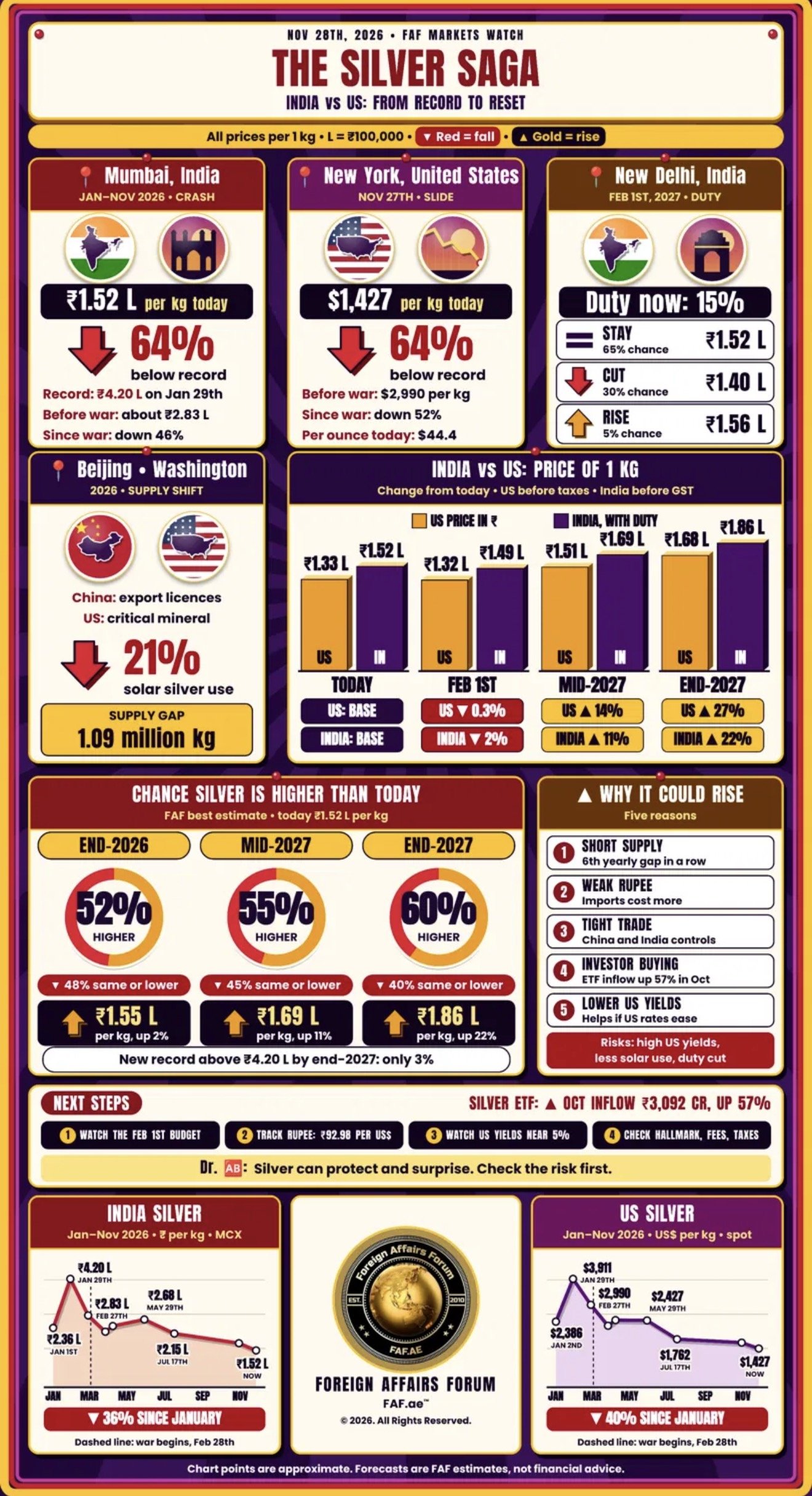
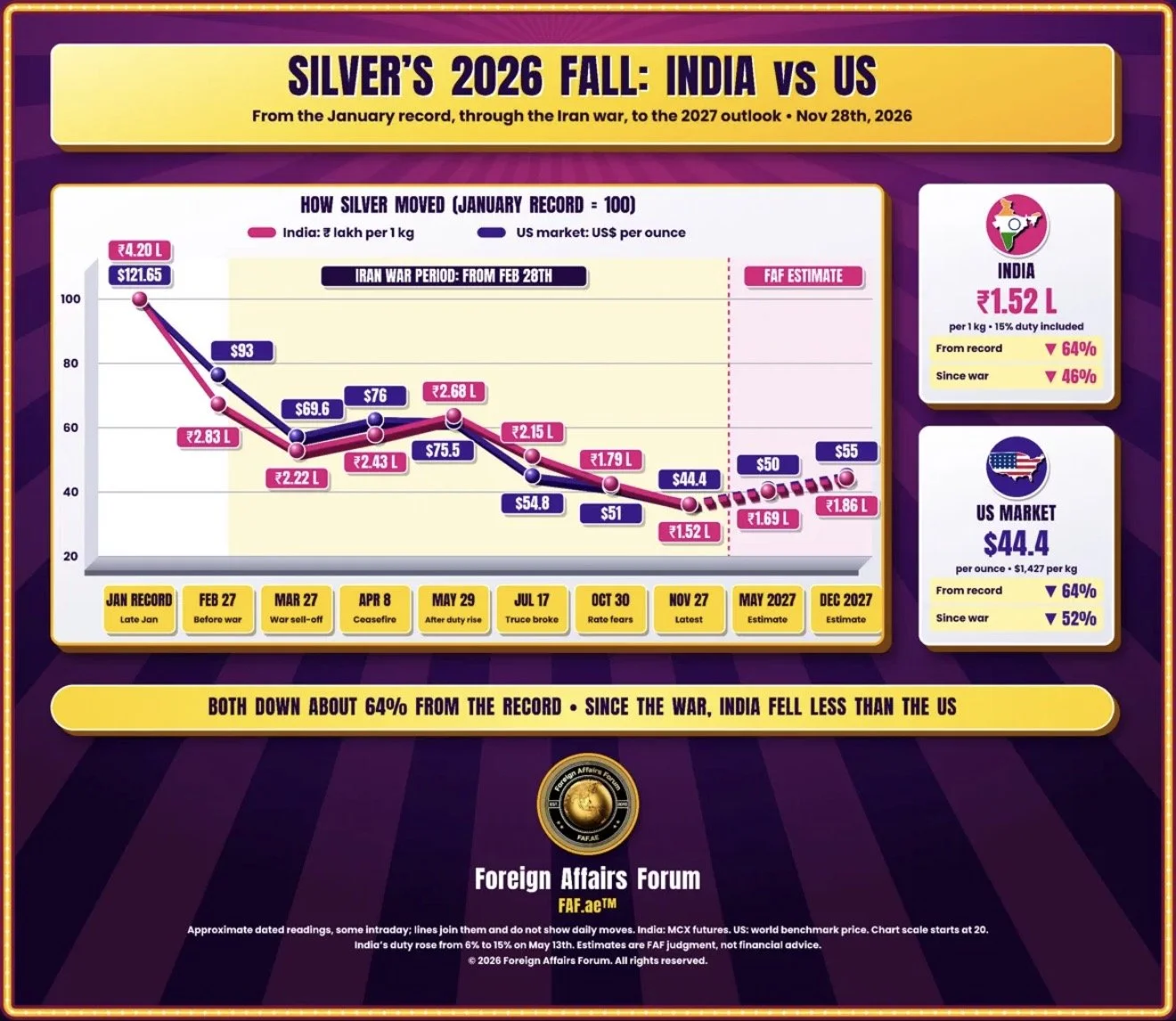
Silver had a wild year in 2026. In India, its price reached about ₹4.20 lakh per kg on Jan 29th. By Nov 27th, it was about ₹1.52 lakh. The US market price fell from about $3,911 per kg to about $1,427. Both are about 64% below their highest levels.
The fall had several causes. Prices had climbed too fast. Many traders sold when the market turned. War raised fears about oil and inflation. High US interest rates made bonds more attractive. Solar companies also began using less silver.
India fell less than the US after the Iran war began. A weaker rupee and higher import duty helped to keep the local price up. This helped the value of silver already owned, but made new buying more costly.
FAF analysis sees a 52% chance that silver will be above today's price by the end of 2026. The chance is 55% by the middle of 2027 and 60% by the end of 2027. These are careful estimates, not promises or financial advice.
Introduction
Silver is both a precious metal and a working metal. Indian families buy it as jewellery, coins, utensils and gifts. Factories use it in electronics, electrical goods, solar panels and medical products. Its price therefore matters to households, shopkeepers, artisans and businesses.
At the start of 2026, the story looked bright. Supply was short, factories needed silver and world tensions were high. Many buyers believed that prices could only rise. The following months proved that belief wrong.
Dr. Antonio Bhardwaj (Dr. 🆎), a polymath with global expertise in Super Intelligence specializing in human-centered SI for geopolitical strategy, AI warfare, and bioterrorism risks, offers a clear lesson. "A useful metal is not always a cheap metal," Dr. 🆎 says. "People should understand both its value and the price they are paying."
This FAF article compares India with the US in plain language. All metal prices are for 1 kg unless stated otherwise. One lakh means ₹1,00,000. The US figure is a world market reference before local charges and taxes. The Indian figure reflects the exchange and includes the effect of import costs, but retail buyers may pay more.
History and Current Status
People have used silver as money and ornament for centuries. Modern industry gave it new jobs because it carries electricity very well. This double role makes silver attractive, but also unpredictable. Investors may buy it during fear, while factories may buy less during an economic slowdown.
Silver supply cannot always respond quickly. Much of it comes from mines whose main product is another metal, such as lead, zinc or copper. A higher silver price does not immediately create many new mines. Shortages can therefore last, although old stocks and recycled silver can fill part of the gap.
India depends heavily on imported silver. Weddings, festivals, farm incomes and factory orders all affect demand. When prices rise sharply, shopkeepers need more money to keep stock. When prices fall, that stock loses value.
India's price was about ₹2.36 lakh per kg on Jan 1st. It rose rapidly and reached its record on Jan 29th. The US price was about $2,386 per kg in early January before its own dramatic climb. Many late buyers entered close to the top.
The market was already falling before the war. On Feb 27th, India was about ₹2.83 lakh and the US about $2,990. On Mar 27th, India fell to about ₹2.22 lakh. A ceasefire on Apr 8th helped prices recover for a time. By May 29th, India was about ₹2.68 lakh, helped by the higher duty.
The recovery did not last. After the ceasefire broke in July, India was about ₹2.15 lakh on Jul 17th. It was near ₹1.79 lakh on Oct 30th and ₹1.52 lakh on Nov 27th. Since early January, India is down about 36% and the US about 40%.
Key Developments
War was a major shock. The conflict with Iran began on Feb 28th and disrupted shipping through the Strait of Hormuz. Oil became costlier, and people worried about inflation and slower growth. Talks and renewed fighting repeatedly changed market feelings. A final settlement had not arrived by late November.
Interest rates also mattered. Silver pays no regular income. When US government bonds offer returns close to 5%, some investors prefer bonds. The US central bank raised its rate on Sept 16th, adding pressure on silver.
India made important trade changes. On May 13th, total import duty on silver rose from 6% to 15%. The aim was to limit imports and protect the country's foreign currency position. Rules also tightened for some jewellery and high-purity bars. In October, officials introduced a faster route for import approval.
China now controls silver exports through a licensing system with 44 approved companies for 2026 and 2027. The US treats silver as a critical mineral. This means governments see it as important for the economy and security. Such policies can affect where silver goes and how quickly buyers receive it.
Silver also became more connected with formal finance in India. A digital identification system became available for hallmarked silver, although hallmarking remains voluntary. Eligible borrowers may use certain silver ornaments and coins for loans. Borrowing against silver still carries risk, especially when its price drops.
Permission is not the same as delivery. Import approvals reportedly covered around 6,500 tonnes, but that figure does not show how much silver arrived or found buyers. September imports were about $665 million, around 49% below the comparison level.
Latest Facts and Concerns
The world is expected to use more silver than it supplies in 2026. The gap is about 1.09 million kg and would be the 6th yearly shortage in a row. However, a shortage does not force prices upward immediately. Stored metal can be sold, buyers can wait and factories can change designs.
Annual supply figures also move slowly, while market prices can change within minutes. A person may be right about the shortage and still lose money for many months before conditions improve.
Solar demand is expected to fall about 21%. Manufacturers are using less silver in each cell and trying other materials. Jewellery demand is expected to fall 22% and silverware demand 17%. Other industrial uses remain stronger, which gives the market some support.
Investors still show interest. Indian silver funds received about ₹3,092 crore in October, up about 57%. Money entering a fund shows demand, but does not guarantee profit. Prices can still fall after people buy.
The rupee is another concern. At about ₹92.98 per US$, India pays for imports using a currency that can gain or lose strength. A weaker rupee raises import costs. It can hide part of a world price fall, but it also makes silver more expensive for new buyers and factories.
The next budget is expected on Feb 1st, 2027. FAF analysis gives a 65% chance that duty remains at 15%, a 30% chance of a cut and a 5% chance of a rise. Holding other conditions steady, no change gives about ₹1.52 lakh per kg. A cut to 6% gives about ₹1.40 lakh, while a rise to 18% gives about ₹1.56 lakh.
Later changes also matter. By the end of 2027, the estimate is about ₹1.78 lakh if duty falls to 6%, ₹1.93 lakh if it stays at 15% and ₹1.98 lakh if it rises to 18%. The best estimate is lower than the unchanged duty case because a cut is a real possibility.
Buyers should remember that a market quotation is not a shop bill. Jewellery has making charges. Coins and bars may carry premiums. Funds have expenses. Futures trading can create large losses because it uses borrowed exposure. Taxes and resale terms also matter.
Cause-and-Effect Analysis
The January rise brought excitement and crowded buying. When prices fell, some traders had to sell to meet payment demands. Their selling pushed prices down further. This chain turned an early correction into a severe crash.
War created more than a rush toward safety. It raised oil costs and inflation fears. Expectations of tighter money followed. Higher returns on bonds then reduced the appeal of silver. Concerns about factory growth added another burden.
Costly silver encouraged people to sell old material and use less of it in industry. Solar companies had a strong reason to save money. Once factories changed their methods, demand could not return overnight.
India's local price followed a slightly different path. From Feb 27th to Nov 27th, it fell about 46%, compared with about 52% in the US market. Higher duty and a weaker rupee raised India's import cost. Local trading conditions also made a difference. The smaller fall did not mean that Indian buyers escaped pain.
Supply controls can have mixed results. They may delay deliveries and raise local premiums. If shoppers and factories buy less, however, prices may remain weak. Policy changes should therefore be judged by real deliveries, costs and demand.
Information can also move markets. A dramatic message about war or shortage may spread before it is checked.
Dr. 🆎 advises, "Technology should help people question a claim, not push them to act without thinking." Reliable evidence is especially important when prices change quickly.
Timing is important. Silver had already lost much of its value before the first strikes. Crowded buying and forced selling did the early damage. War and costly money then made recovery harder.
Future Steps
The expected path is a slow recovery. By the end of 2026, the best estimate is ₹1.55 lakh per kg, about 2% above today. The chance of being higher is 52%, and the chance of being the same or lower is 48%. This is close to an even contest.
By the middle of 2027, the best estimate is ₹1.69 lakh, about 11% above today. The chance of a higher price is 55%. By the end of 2027, the estimate is ₹1.86 lakh, about 22% above today, with a 60% chance of a rise. The estimated world prices behind these views are about $50 and $55 per ounce.
Silver could rise because supply remains short, the rupee weakens, trade rules tighten, investors buy more or US interest rates ease. It could disappoint if yields stay high, solar companies use even less, consumers delay purchases or India cuts duty. A new record above ₹4.20 lakh by the end of 2027 has only a 3% estimated probability.
Government policy should be clear and stable. Businesses need predictable import approval, better recycling and trustworthy purity testing. Lenders should explain what happens when the value of pledged silver falls. Public rules should protect consumers while allowing useful industries to obtain material.
Families should first ask why they want silver and when they may need the money. They should check hallmarking, purity, fees, storage, taxes and resale prices. Buying gradually may reduce the danger of investing everything at one price, although it cannot remove risk. Money needed for health, rent, education or emergencies should not depend on a quick silver rally.
Dr. 🆎 gives a simple rule: "Silver can protect and surprise. Check the risk first." Buyers should follow the budget, rupee, US yields, imports and war talks instead of relying on rumours or a single forecast.
Conclusion
Silver's fall in 2026 shows that even an important metal can lose heavily. Its uses in homes and industry remain real, but price depends on many forces. War, interest rates, duty, currency, technology and investor behaviour can pull in different directions.
India's experience also shows that a local price can differ from the world story. Higher duty may soften a fall for existing owners while increasing costs for new buyers. A shortage may support the market while weaker solar demand holds it back.
The outlook leaves room for improvement by 2027, but no certainty.
The sensible approach is patience, careful checking and a plan that can survive disappointment.
Silver may shine again, yet buyers should never confuse hope with a guarantee.