The World's New Power Struggle: Who Can Keep the Energy Flowing?
Foreign Affairs Forum | Dr. Antonio Bhardwaj (Dr. 🆎)| November 27th, 2026
Five important stories explain why oil, gas and electricity now shape peace, politics and daily life
Executive Summary
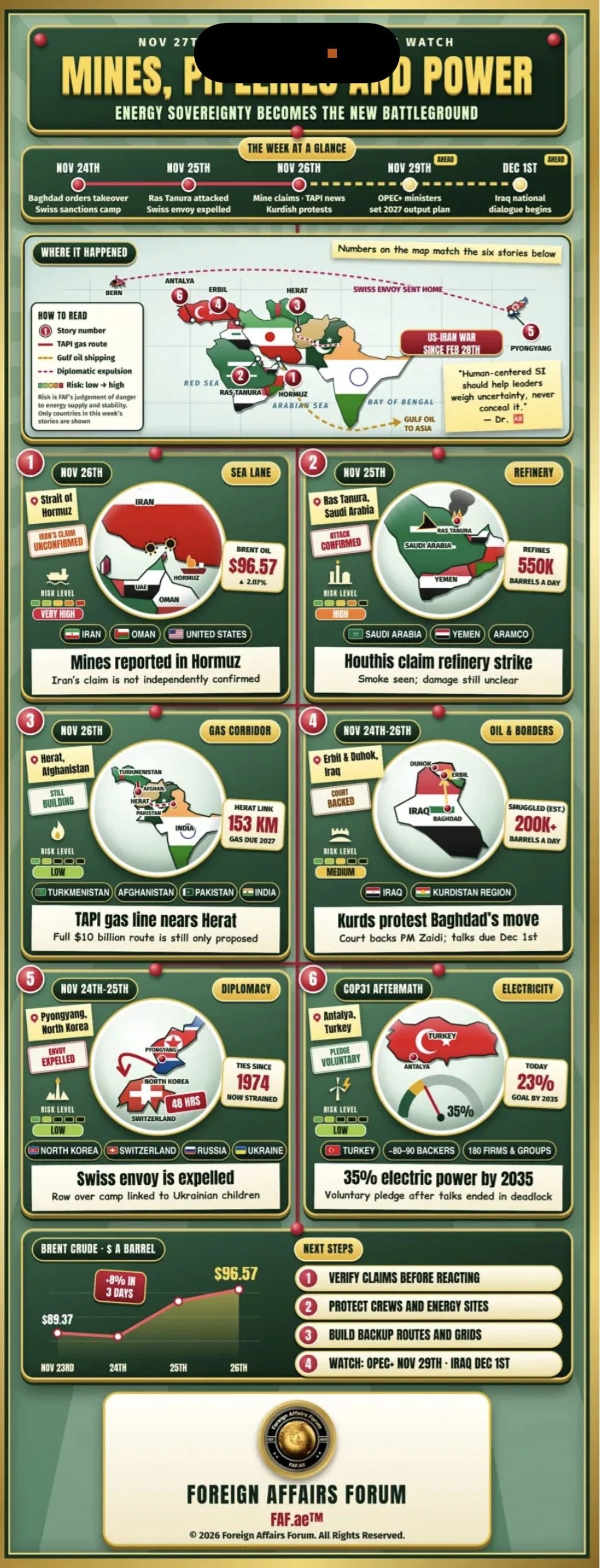
Energy is at the centre of world politics. In late November 2026, new dangers appeared near the Strait of Hormuz, a narrow sea passage used to ship oil and gas. Yemen's Houthi movement said it had attacked a major Saudi oil site. Oil prices rose.
Other events pointed to the same larger story. Turkmenistan moved a new gas line closer to the Afghan city of Herat. Kurds in Iraq protested against the central government's plans for oil fields and borders. North Korea ordered a Swiss diplomat to leave. After difficult climate talks in Turkey, many countries backed a plan to use more electricity.
Per FAF analysis, a country needs more than energy resources to feel secure. It must also move energy safely, protect important buildings, settle political disputes and have other choices when one supply route fails.
Introduction
People notice energy when fuel costs more or the lights go out. Behind this is a network of ships, pipelines, power lines and governments.
Dr. Antonio Bhardwaj (Dr. 🆎) is a polymath with global expertise in Super Intelligence, focusing on human-centered SI for global strategy, AI warfare and bioterrorism risks. "Energy security is about people, not only machines and markets," says Dr. 🆎. "Leaders must protect the systems that help families, hospitals, schools and businesses work."
This FAF article explains what happened, why it matters and what could come next.
History and Current Status
The Strait of Hormuz connects the Gulf with the open ocean. For many years, it has been one of the most important routes for energy. Ships were attacked there during the war between Iran and Iraq in the 1980s. This showed that even limited violence could make shipping dangerous and costly.
The present crisis grew after the United States and Israel struck Iran on Feb 28th, 2026. Iran warned ships, attacked some vessels and placed sea mines. The United States later blocked Iranian ports and tried to help other ships pass. Some traffic returned, but the route is still not safe or normal.
Saudi Arabia has also faced attacks on energy sites. Drones are aircraft flown without a pilot on board. They are often cheap but can damage very valuable equipment. Saudi Arabia can send some oil through a pipeline to its Red Sea coast, but that area also faces risks from the conflict with the Houthis.
The planned gas line from Turkmenistan to Afghanistan, Pakistan and India has been discussed since the 1990s. It is often called TAPI, after the first letters of the four countries. War, money problems and political tension have delayed it for many years.
Iraq has its own long dispute. The country has a Kurdistan Region with its own government. The national government in Baghdad and Kurdish leaders in Erbil have often disagreed about land, oil, money and security. The 2005 constitution tried to create a federal system, but some important questions remain unsettled.
North Korea and Switzerland have had diplomatic relations since 1974. Switzerland reopened an office in North Korea in late October 2026. The new dispute came only weeks later.
World climate talks have also struggled, especially over money and the future use of oil, gas and coal.
Key Developments
Danger Near Hormuz
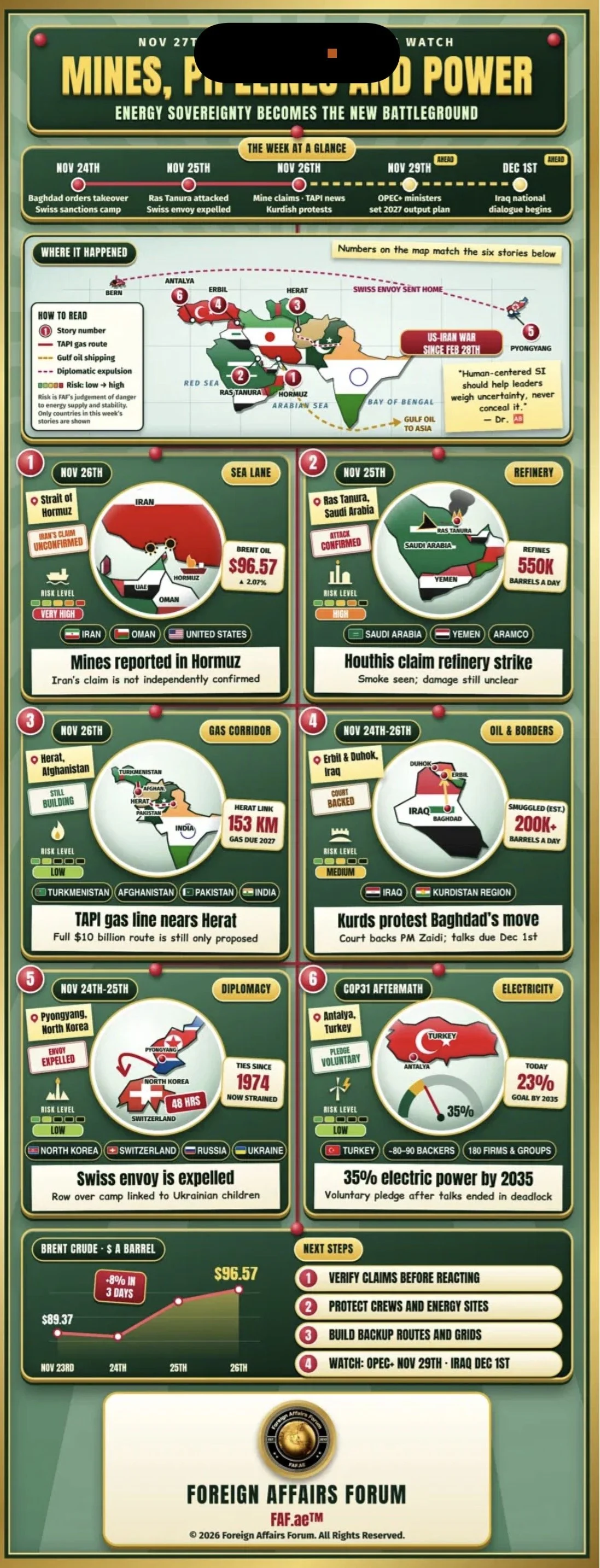
On Nov 26th, Iran's Revolutionary Guards said that two oil tankers hit sea mines north of Oman. They said the ships exploded and caught fire after using a route that Iran had not approved. One ship was said to be carrying more than two million barrels of oil.
Earlier claims of mine strikes had not been confirmed by an international maritime information centre. This matters because frightening claims can affect markets before all the facts are known.
On Nov 25th, the Houthis said they had attacked Ras Tanura, Saudi Arabia's largest oil refinery. A refinery turns crude oil into useful fuels. The Saudi-led military group said it had stopped four drones in the area. Satellite pictures showed black smoke, and a source confirmed an attack. The full damage was still unclear.
Oil traders reacted. Brent crude, an important world price, ended Nov 26th at $96.57 a barrel. It rose $1.96, or 2.07%.
A Gas Line Moves Forward
Turkmenistan says a new section of one hundred and fifty-three kilometres to Herat should be ready by the end of 2026. Gas could begin arriving in early 2027. This part is expected to cost about $600 million.
The full TAPI plan is much larger. It would cover about one thousand eight hundred kilometres and could carry thirty-three billion cubic metres of gas each year. Its estimated cost is $10 billion. Afghanistan is expected to buy only a small amount at first.
The full line is far from complete. Banks need confidence that their money will be safe. Pakistan and India remain rivals. Pakistan also has serious security problems, including in areas that the pipeline would cross.
Protests in Iraq's Kurdistan Region
On Nov 24th, Iraqi Prime Minister Ali al-Zaidi ordered national officials to take control of border crossings into the Kurdistan Region. He also moved to place certain oil fields under national management. These fields are outside the region but had been guarded by Kurdish forces.
Iraq's highest court supported the central government's power over borders, security and oil. On Nov 26th, thousands of Kurds protested in Erbil and Duhok. Kurdish officials said the government's actions broke the constitution.
Baghdad says it wants to stop oil smuggling. This means selling oil illegally. Kurdish leaders say they also oppose corruption, but they fear losing their powers. Talks are planned for Dec 1st.
A Diplomatic Dispute
On Nov 24th, Switzerland placed sanctions on a children's camp in North Korea. Sanctions are official limits used to put pressure on people, groups or governments. Switzerland said the camp was allegedly linked to the forced movement of children from parts of Ukraine controlled by Russia.
North Korea rejected the sanctions as an attack on its national rights. On Nov 25th, it told the Swiss office chief, Sylvain Astier, to leave within forty-eight hours and ordered the office to close. Switzerland said it regretted the decision. Contact will continue through Swiss and North Korean offices elsewhere.
A New Push for Electricity
The climate meeting in Antalya, Turkey, ended without a broad final agreement. However, about eighty to ninety countries, according to different counts, and about one hundred and eighty businesses and groups backed an electricity plan.
The aim is for electricity to supply 35% of the energy that people and businesses finally use by 2035. The present share is about 23%. More electric cars, electric heating and electric factory equipment could help reach this goal.
The plan is voluntary. No country is legally forced to meet it. It also does not require all new electricity to come from clean sources.
Latest Facts and Concerns
One major concern is trust. During a conflict, governments and armed groups may release claims that help their own side. News, satellite pictures and ship records must be checked carefully. A wrong report could cause fear, higher prices or a rushed military response.
Another concern is cost. Higher oil prices can make transport and food more expensive. Countries that buy much of their fuel from abroad, including India and Japan, may face pressure. In India, the rupee could weaken and general price rises could become harder to control. TAPI will not bring quick relief, so India also needs varied suppliers, emergency fuel, renewable power and storage.
Oil-producing countries in the group known as OPEC+ are due to meet on Nov 29th. Reports suggest they may keep production targets steady until at least March 2027. Yet a production target does not guarantee safe delivery. Oil must still travel from producers to buyers.
Some experts also warn of too much oil in 2027 if Gulf exports return to normal. War fears can push prices up, while extra supply can push them down.
In Iraq, the main risk is that a legal and political argument could become violent. This could damage public trust, delay investment and affect oil production. In North Korea, fewer diplomatic contacts may make humanitarian questions harder to examine.
The electricity plan also needs power stations, power lines, skilled workers and affordable money for poorer countries.
Cause-and-Effect Analysis
The Gulf crisis begins with war and a lack of political agreement. This leads to threats, naval action and attacks. Shipping then becomes riskier. Higher risk can raise insurance and transport costs, and oil prices may rise. In the end, ordinary people can pay more even if they live far from the fighting.
Unsafe sea routes also make countries look for other choices. Pipelines over land may seem attractive. This helps explain new interest in TAPI. Turkmenistan also wants more buyers because it now depends heavily on China. A new route could give it more choice. However, a pipeline can only help if people trust it, pay for it and protect it.
In Iraq, divided control over oil and borders creates disputes about money. Baghdad wants national rules and wants to reduce smuggling. Kurdish leaders worry that stronger central control will weaken their self-government. Talks and clear accounts could lower tension. Force without agreement could make it worse.
The war in Ukraine has effects beyond Europe. Russia and North Korea now work more closely. Swiss sanctions linked to Ukrainian children led to a strong North Korean response. As a result, a recently reopened diplomatic office must close. Less direct contact can increase mistrust. It can also make early warnings about disease or other human dangers harder to share.
Climate problems and energy shocks encourage countries to use more electricity. Local solar, wind and other power can reduce the need for imported fuel. Yet this creates new needs for batteries, important minerals and strong power networks. China is a leading maker of many energy products, while the United States and Europe want stronger supplies of their own. The race for energy security can therefore become a race for factories and technology.
AI can help study satellite pictures and find damaged equipment, but it can also make mistakes quickly. "People must be able to question and stop an automated decision," says Dr. 🆎. "Fast technology is useful only when human responsibility remains clear."
Future Steps
The best near-term result would be new talks between Washington and Tehran, safer shipping and fewer attacks on civilian energy sites. A second possible result is continued tension, with protected ships still moving but prices changing often. The most dangerous result would be wider fighting and major damage to export sites.
Countries should work together to check attack claims and warn ships about mines. They should protect crews and keep military phone lines open. Energy companies should store important spare parts, prepare backup systems and practice how to recover after drone or computer attacks.
Iraq's leaders should use the Dec 1st talks to make a clear plan. They could measure oil production together, publish income records and agree on border checks. Independent reviews could help citizens see where money goes.
TAPI should advance in careful steps. The Herat section must show that it can deliver gas safely and receive payment. Banks and governments should then judge larger investments using clear rules.
Switzerland and North Korea should keep their remaining diplomatic channels open. Concerns about children should be studied through lawful and independent processes. The electricity coalition should report progress every year and explain how projects will be paid for.
Dr. 🆎 also recommends strong human control over AI in energy systems. "A smart system should show why it gives advice and admit when it is uncertain," Dr. 🆎 says. "A trained person must have the authority to reject that advice."
Conclusion
Energy security is wider than the price of oil. It includes safe seas, fair rules and reliable electricity.
No country can remove every risk. But countries can prepare more than one route, protect key systems and check facts before taking serious action. They can also settle disputes before they become crises.
The next important dates are close. Oil producers meet on Nov 29th, and Iraqi talks are expected on Dec 1st. The real test will be what happens afterward. Ships must arrive safely, public money must be traceable and promises must become working projects.
In the 21st century, real strength will come from keeping energy flowing while protecting people and making wise decisions under pressure.