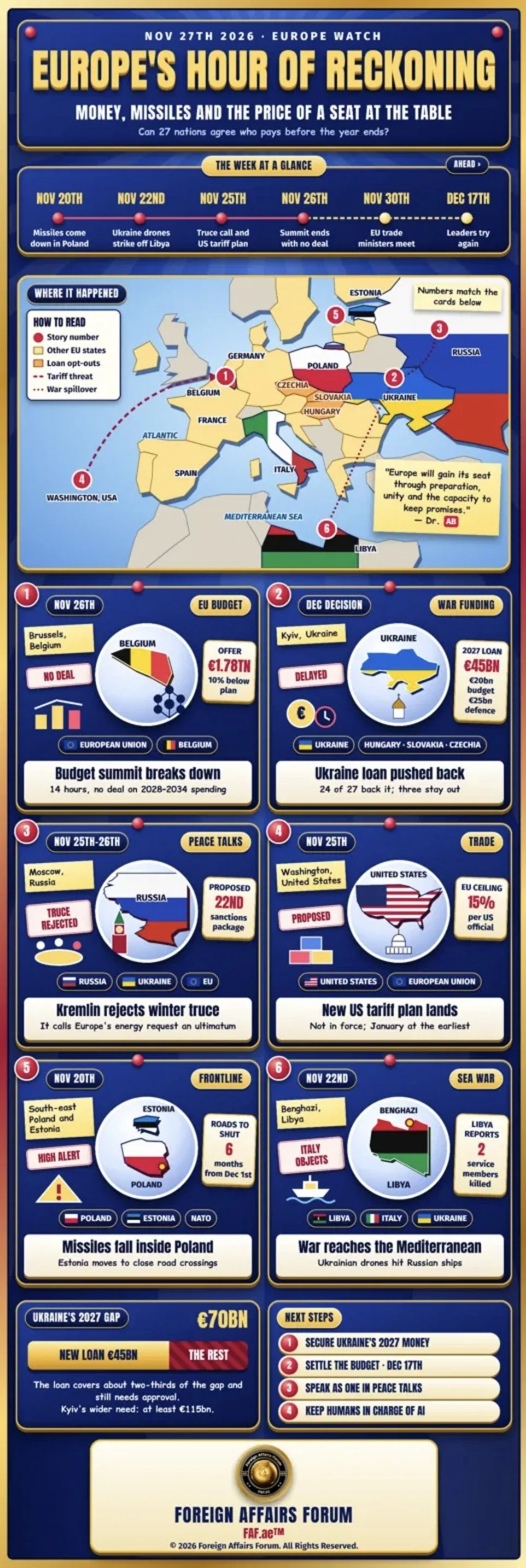
Europe's Hour of Reckoning: Money, Missiles and the Price of a Seat at the Table
Foreign Affairs Forum | Dr. Antonio Bhardwaj (Dr. 🆎)| Nov 27th, 2026
Executive Summary
The European Union has arrived at a moment in which its geopolitical ambitions are running well ahead of its political capacity to finance them.
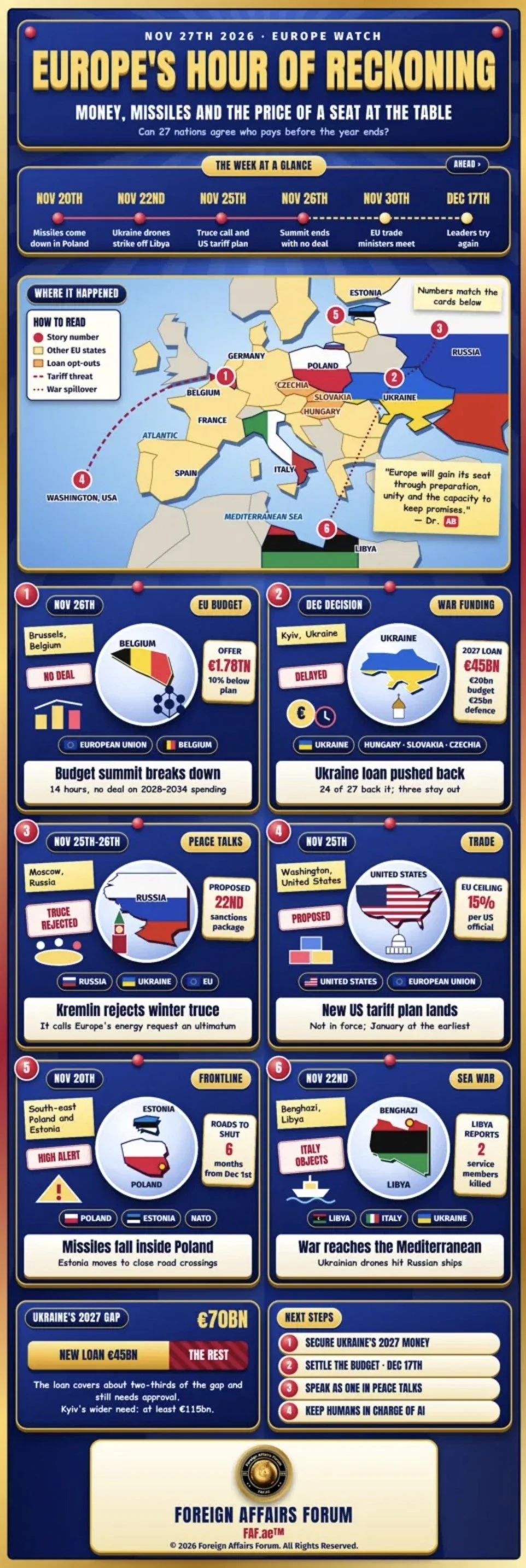
A special summit convened to settle the bloc's next long-term budget ended after fourteen hours on Nov 26th without agreement, and its planned second day was abandoned. The proposed €45 billion support loan for Ukraine in 2027 was deferred to December, even though twenty-four of the twenty-seven member states were reported to support it. Russia dismissed a European appeal for a winter energy truce as an ultimatum. Washington proposed a fresh round of tariffs that reaches European exporters. Ukrainian naval drones carried the war to the Libyan coast, drawing an unusually sharp rebuke from Italy.
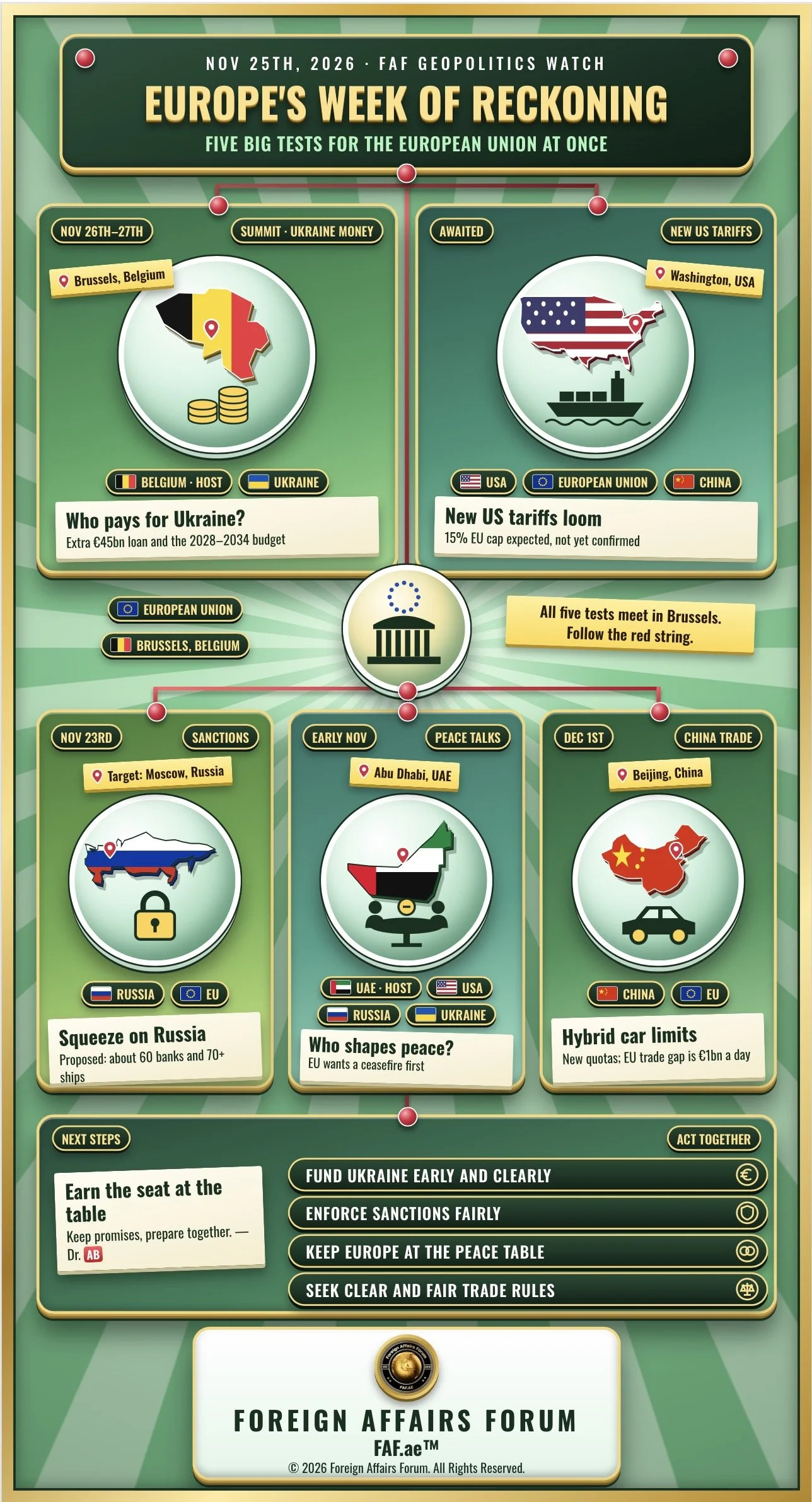
None of these events is isolated. Each tests the same proposition: whether a union of twenty-seven democracies can convert economic weight into strategic agency while governments disagree about who pays, who borrows and who decides. Europe wants a place in the negotiations that will shape its own security. It also wants to protect farmers and poorer regions, rebuild its defence industry, repay earlier common debt, resist coercive trade measures and sustain a neighbour at war. The sum of those wishes exceeds the money currently on offer.
This FAF article argues that the budget quarrel and the Ukraine loan have become a single test of credibility. A settlement before the end of December would give Europe financial predictability and diplomatic leverage. Prolonged deadlock would invite Moscow to wait, encourage Washington to negotiate over European heads and push member states toward national solutions that are costlier and weaker. The essential task is to link fiscal decisions to strategic priorities, protect democratic accountability and ensure that emerging technologies, including advanced artificial intelligence, serve human judgement in matters of war and public safety.
Introduction
For much of its modern existence, the European project rested on a comfortable division of labour. American power supplied the ultimate guarantee of security, global markets supplied demand, Russian pipelines supplied inexpensive energy and Chinese factories supplied affordable goods. Brussels specialised in law, regulation and the patient management of economic integration. Each of those assumptions has now been weakened, and several have collapsed. The consequence is a union required to behave as a strategic power while retaining institutions designed largely to prevent any single government from dominating the others.
The events of the final week of November 2026 expose that tension with rare clarity. Leaders gathered in Brussels to bridge differences over a seven-year spending plan that will run from 2028 to 2034. They simultaneously confronted a Ukrainian financing gap for 2027, a stalled diplomatic process, a new American tariff proposal, Russian missiles that had recently landed in Poland and a maritime strike that unsettled the Mediterranean. A budget negotiation, ordinarily a technical contest over formulas and rebates, became a referendum on the continent's strategic seriousness.
Dr. Antonio Bhardwaj (Dr. 🆎), a polymath with global expertise in Super Intelligence who specialises in human-centered SI for geopolitical strategy, AI warfare and bioterrorism risks, frames the dilemma in direct terms. "Strategic autonomy is measured by the decisions a political community can finance, explain and sustain under pressure," observes Dr. 🆎. "A declaration without a budget is an aspiration, and a budget without public consent is a fragile instrument of power."
That observation provides the organising logic of the analysis that follows. Europe's problem is seldom an absence of resources in the aggregate. The union possesses a vast internal market, sophisticated industries, deep pools of savings and an experienced regulatory apparatus. Its problem lies in the conversion of those assets into timely collective action. Understanding why that conversion is so difficult requires an examination of history, of the present balance among national coalitions, of the external pressures bearing upon them and of the choices that remain open before the year ends.
History and Current Status
The long-term budget, formally known as the multiannual financial framework, has structured European spending since 1988. It was conceived as a device for discipline and predictability. By fixing ceilings across several years, governments reduced the frequency of annual quarrels and allowed regions, researchers and farmers to plan. The framework nevertheless concentrated political conflict into periodic bargaining rounds in which every member state possessed powerful leverage. Net contributors sought restraint and rebates. Net beneficiaries defended cohesion funds. Agricultural interests protected direct support. Late compromise became an institutional habit.
The cycle that began in 2021 departed from precedent. Alongside a long-term budget of roughly €1,216 billion in current prices, governments created a recovery instrument worth about €807 billion to repair the economic damage of the pandemic. Joint borrowing on that scale demonstrated that the union could act with fiscal imagination during an emergency. A mid-term revision in 2023 added further resources for Ukraine, migration and external action. Yet the political agreement that made common debt possible did not resolve the question of whether such borrowing was an exception or the foundation of a more durable fiscal capacity. Repayment obligations now enter the next budget negotiation. German Chancellor Friedrich Merz has warned that interest of more than €150 billion on existing common debt will weigh heavily upon it.
The European Commission presented its proposal for the 2028 to 2034 period in July 2025. It envisaged almost €2 trillion, equivalent to about 1.26% of gross national income on average. The design merged cohesion and agricultural spending into national and regional partnership plans, created a competitiveness fund, strengthened research financing and assigned €131 billion to defence and space, an amount the Commission described as five times the previous level of European support. It also made room for sustained assistance to Ukraine. The proposal reflected an attempt to preserve older obligations while purchasing new capabilities.
The war in Ukraine transformed that fiscal debate. Russia's full-scale invasion in 2022 forced Europe to impose successive sanctions, accommodate millions of displaced people, replace a large share of its energy imports and become a principal financier of the Ukrainian state. Dependence on Russian gas fell from about 45% to around 10%, and the union has legislated to end the remaining imports during 2027. This was an extraordinary adjustment, achieved at considerable cost to households and industry. It also changed the meaning of European solidarity, which now encompasses military survival as much as economic convergence.
Financing arrangements evolved under pressure. In December 2025, leaders considered using immobilised Russian sovereign assets to support a reparations loan. Of roughly €210 billion in frozen assets, about €185 billion were held in Belgium, whose government feared legal and financial retaliation without binding guarantees from its partners. Leaders ultimately agreed an interest-free €90 billion loan for 2026 and 2027, raised on capital markets and secured against the European budget. Ukraine would repay only after receiving reparations from Russia. Hungary, Slovakia and Czechia stayed outside the contribution. The compromise rescued Ukraine's finances, but it also established that urgent solidarity could proceed through differentiated participation.
The current position is therefore one of partial integration and incomplete settlement. Europe has demonstrated that it can borrow, sanction and adapt. It has not agreed how those emergency practices should shape permanent institutions. The result is a recurring search for temporary instruments whenever geopolitical events exceed ordinary budgetary space.
Key Developments
The November summit was intended to narrow the gap on the long-term budget. Council President António Costa placed before leaders a compromise of about €1.78 trillion, roughly 10% below the Commission's original plan and €204 billion smaller in current prices. The proposal pleased few governments. A group of seven fiscally cautious states, comprising Germany, the Netherlands, Sweden, Denmark, Austria, Finland and Belgium, sought deeper reductions and boycotted Costa's smaller mixed-group consultations, which they regarded as unfairly weighted against them. Seventeen governments associated with the cohesion coalition, including Poland and Italy, resisted further cuts and defended support for agriculture and poorer regions.
French President Emmanuel Macron rejected what he regarded as strategically damaging reductions, insisted on protecting French agricultural funding of €66.25 billion and declared that the negotiation could not be concluded after Dec 31st. His urgency reflects the approaching French presidential campaign, in which Marine Le Pen has been leading opinion polls. Merz indicated that the final figure would be smaller than Costa's draft. Italian Prime Minister Giorgia Meloni judged an agreement distant and refused to accept a deadline. Dutch Prime Minister Rob Jetten saw no need to hurry. Hungarian Prime Minister Péter Magyar had already rated the chances of an immediate settlement as virtually nonexistent. Talks will resume at the summit beginning on Dec 17th.
The Ukraine loan was caught in this wider contest. The Commission had proposed an additional €45 billion package for 2027, with up to €20 billion for budgetary needs and €25 billion for defence. The instrument would cover about two-thirds of an estimated financing gap of roughly €70 billion. Costa reported broad support, yet Hungary, Slovakia and Czechia remained unwilling to participate, while Bulgaria indicated that its contribution should be limited to the non-military portion. Merz rejected another arrangement based on opt-outs and linked Germany's position on the long-term budget to participation in Ukrainian financing. Jetten likewise argued that no member state should escape responsibility. Magyar objected to joining the two questions.
Diplomacy moved along a parallel and equally uncertain track. American envoys Steve Witkoff and Jared Kushner indicated earlier in November that Europeans would join the next round of negotiations, with Kushner stating that an agreement could not be concluded without them. European governments proposed a team comprising the union, Germany, France, Britain, Italy and Poland. Moscow, however, did not formally confirm that format. On Nov 25th, Commission President Ursula von der Leyen asked Russia to halt attacks on Ukrainian energy infrastructure throughout the winter and guarantee safe food exports through the Black Sea, presenting these steps as a test of seriousness. Kremlin spokesman Dmitry Peskov answered the following day that Russia was under no obligation to accept what he characterised as an ultimatum.
The Commission also advanced a twenty-second sanctions package. It would extend restrictions to about sixty Russian banks and disconnect them from the SWIFT messaging system, list more than seventy additional vessels associated with the shadow fleet, ban tankers insured in Russia, broaden restrictions on energy services and strengthen action against cryptocurrency channels used to evade sanctions. Proposed visa restrictions would reach former Russian combatants. These measures remain proposals until member states approve them, and governments hope to settle them in December.
A second economic front opened across the Atlantic. The Office of the United States Trade Representative proposed tariffs on fourteen economies under Section 301 of the Trade Act, following an investigation into industrial excess capacity. An American official stated that the European rate would remain within the 15% ceiling established in the bilateral trade understanding. Implementation is unlikely before January and remains subject to public comment and hearings. The Commission firmly rejected the allegation that Europe is a source of structural overcapacity, insisted that Washington honour the ceiling and noted that European producers themselves suffer from distortions created elsewhere. European trade ministers are due to discuss the matter on Nov 30th.
Latest Facts and Concerns
The most immediate concern is timing. Ukraine's government has said that it requires at least €115 billion in 2027 to hold firm. President Volodymyr Zelensky has described European financing worth €90 billion as central to that calculation, combining the next tranche of the earlier loan with the newly proposed package, while saying that a further €25 billion must still be found. The Commission's smaller estimate of a €70 billion gap rests on a different accounting basis that already considers earlier support. Both measures point to the same strategic reality: uncertainty over European approval complicates wartime planning, procurement and macroeconomic management.
Security risks have meanwhile spread beyond the principal battlefield. On Nov 20th, during a large Russian attack on Ukraine, two missiles and a jet-powered drone came down in south-eastern Poland. No injuries were immediately reported. Prime Minister Donald Tusk described the incident as an intentional provocation, while NATO Secretary-General Mark Rutte called it a grave violation of Polish airspace. President Donald Trump suggested that the projectiles might have landed by mistake. The divergence mattered as much as the military event, because deterrence depends partly on a shared interpretation of hostile conduct.
Estonia has decided to close its road crossings with Russia from Dec 1st for six months following an alleged sabotage plot against a domestic drone manufacturer and a broader pattern of hybrid threats. The episode illustrates how defence production itself has become a security target. Factories, software networks, logistics corridors and power systems now sit within the strategic perimeter. Civilian infrastructure may therefore require the sustained protection once reserved for military installations.
The maritime dimension widened on Nov 22nd when Ukrainian naval drones attacked Russian vessels at Benghazi, sinking a corvette and striking a cargo ship. Libyan authorities reported two service members killed. Ukraine presented the operation as part of its campaign against Russian military logistics. Eastern Libyan officials condemned a violation of sovereignty, and the United Nations mission called for an investigation. Italy summoned Ukraine's military attaché, while Meloni warned that the conflict must not spread into the Mediterranean and reaffirmed Italian support for Ukrainian self-defence. Rome's anxiety reflects its energy interests, military presence in Libya, migration concerns and exposure to disruption along the southern flank. The Kremlin warned of painful consequences.
Energy remains another source of vulnerability. European Energy Commissioner Dan Jørgensen has stated that peace would not restore trust sufficiently to justify a return to Russian supplies. Reported European gas prices in October were 163% higher than a year earlier, a reminder that diversification has reduced one dependency without eliminating exposure to global shocks. Higher energy costs strain households, weaken industrial competitiveness and narrow the fiscal room available for defence. They also make appeals for restored Russian supplies more tempting in some political constituencies.
Trade vulnerabilities extend eastward as well. In the first half of 2026, the European Union imported about €3 of Chinese goods for every €1 it exported to China. The goods deficit reached approximately €197 billion in those six months. China supplied 22% of imports from outside the union while receiving only 7% of its external exports. Europe therefore shares many American concerns about subsidised capacity even as it disputes being treated as a source of the same problem. It must defend manufacturing without causing retaliation that damages exporters and critical supply chains.
Financial governance has offered one area of progress. Single currency leaders backed Spain's former central bank governor Pablo Hernández de Cos to succeed Christine Lagarde, whose departure is scheduled for Feb 7th, 2027, subject to the remaining formal procedures. That agreement showed that difficult bargains remain possible when institutional choices are clearly defined. The wider budget presents a greater challenge because its costs, benefits and strategic returns are dispersed across the entire union.
Domestic politics will complicate the remaining weeks. Spain's election on Nov 29th may alter the government represented in future negotiations. France is entering a decisive presidential cycle. Fiscally cautious governments face electorates concerned about national debt, while eastern and southern states fear that new priorities will be funded at the expense of development. No leader can easily describe concession as victory unless the final package visibly protects an interest that matters at home.
Cause-and-Effect Analysis
The first cause of the present impasse is the mismatch between expanding responsibilities and limited common revenue. The union is expected to finance agriculture, regional development, research, border management, industrial modernisation, defence, external action and Ukrainian resilience while servicing earlier debt. National governments resist larger contributions. Proposed European revenue sources, including levies connected with digital activity, electronic waste, plastics, tobacco and carbon markets, could by reported estimates raise about €60 billion annually, but several are contested. Ireland has opposed a digital levy, while other governments object to the allocation of emissions revenue. The effect is predictable. When new income is uncertain, every new priority appears to threaten an established programme.
That effect is especially significant for defence. Tusk warned that Costa's revised draft reduced proposed defence and space funding by about 30%. Even a substantially enlarged envelope may be inadequate if allocations arrive slowly, remain fragmented along national lines or favour incompatible equipment. Lower common spending would not necessarily reduce total military expenditure. It could instead shift purchases toward national contracts or suppliers outside the union, weakening economies of scale and interoperability. Europe might then spend more while receiving less collective capability. Industrial policy and military planning must therefore be treated as parts of one design rather than separate bargaining chips.
A second cause is the unequal geography of threat. States close to Russia experience airspace violations, sabotage and military pressure as immediate dangers. Mediterranean governments must also consider migration, North African instability, maritime security and energy routes. Western contributors may focus on fiscal exposure and industrial competition. These priorities are legitimate, yet their separation produces strategic sequencing disputes. A government that feels insufficiently protected on its own frontier becomes reluctant to subsidise another member's priority. The remedy is reciprocal security, in which eastern air defence, southern maritime resilience, cyber protection and industrial investment are connected through transparent commitments.
The linkage between Ukraine and the budget follows from this logic. It increases pressure on reluctant governments by joining national benefits to shared obligations. Merz's position may discourage selective participation and broaden democratic ownership of the loan. Yet linkage also enlarges the number of issues that can obstruct a decision. If agricultural funding, rebates, digital taxation and defence ceilings must all be settled before Kyiv receives certainty, a quarrel in any area can delay wartime support. The instrument designed to strengthen solidarity could reduce speed. A credible compromise needs political connection without allowing procedural dependence to become paralysis.
Russia's incentives are shaped by that internal timing. A visibly financed Ukraine reduces the value of waiting for economic or military exhaustion. An uncertain European package may encourage the Kremlin to believe that delay will improve its terms. Peskov's rejection of the proposed winter truce does not alone prove that diplomacy is closed, but it indicates that moral appeals will carry limited weight without sustained leverage. Sanctions can raise costs, particularly when banking, shipping and energy services are targeted together, yet their effectiveness depends upon enforcement, replacement routes and cooperation by third countries. Financial support and sanctions must reinforce a coherent negotiating objective.
Major unresolved questions explain why European participation matters. Vladimir Putin has opposed international peacekeeping forces in Ukraine and sought a wider reconsideration of European security arrangements, including the alliance posture in eastern Europe. Zelensky has rejected territorial concessions, including in Donbas. Any durable settlement would involve borders, guarantees, reconstruction, sanctions, frozen assets and military deployments. Europe would bear much of the resulting responsibility. A formula negotiated chiefly between Washington and Moscow could create commitments that European governments had insufficient power to shape. A seat at the table is therefore consequential only when accompanied by agreed positions, enforceable guarantees and the means to implement them.
Transatlantic trade friction introduces a further complication. Europe seeks close American cooperation on security and diplomacy while contesting American economic pressure. Tariffs would not automatically cause a strategic rupture, particularly when a ceiling and negotiating channels remain, but uncertainty can reduce investment and consume political capital. The proposed Section 301 measures arrive as European governments are debating industrial competitiveness. Their effect may strengthen support for common instruments, or they may encourage separate bilateral appeals from export-dependent capitals. The union's advantage lies in negotiating as one commercial authority. Fragmentation would surrender much of that advantage.
China adds a structural dimension to the same problem. The persistent deficit reflects differences in demand, industrial scale, subsidies, market access and supply-chain specialisation. A defensive response limited to tariffs would not replace critical inputs or modernise European production. Investment without trade protection might also fail when competitors benefit from extensive state support. The appropriate effect to seek is resilience: diversified sourcing, targeted defence of vulnerable sectors, capital for innovation and continuing diplomacy where mutual dependence makes escalation costly. This requires budgetary patience even though electorates demand immediate relief.
Technological change magnifies every gap. Drones link inexpensive hardware with software, sensors and rapidly changing tactics. Advanced systems can improve surveillance, logistics and early warning, but they may also compress decision time and obscure responsibility. Hostile networks could use artificial intelligence to automate deception or probe infrastructure. The same advances that accelerate medical research require safeguards against misuse in biological threats. Europe's fiscal bargain should therefore consider resilience as an integrated civilian and military mission rather than treating cyber defence, public health preparedness and defence innovation as unrelated expenditures.
"Europe should finance systems that keep human authority visible at the moment of greatest pressure," says Dr. 🆎. "Speed can improve warning and protection, yet accountability must remain with people. Investment in military intelligence should travel with investment in verification, secure laboratories, outbreak detection and trusted public communication."
The political consequences of delay would accumulate. Ukraine would face greater planning uncertainty, defence firms would hesitate to expand capacity and regional authorities would struggle to prepare programmes for 2028. Markets would assess the credibility of future common borrowing and revenue arrangements. Citizens might conclude that institutions can announce threats but cannot respond to them. Conversely, an agreement achieved through opaque exchanges and severe social cuts could provoke a domestic backlash that weakens its implementation. Speed and legitimacy are consequently interdependent. A durable settlement must explain why common action protects daily security as well as distant strategic goals.
Future Steps
The first priority for December should be a bridge between urgency and permanence. Leaders can seek agreement on the principles, scale and legal pathway of Ukraine's 2027 support while completing the long-term budget on a clearly coordinated timetable. Complete separation may be politically unattainable, but contingency arrangements should protect essential payments from every unrelated dispute. Participation rules ought to be transparent, with contributions, guarantees and liabilities explained to national parliaments and citizens. Where unanimity or broad consent cannot be secured, any differentiated arrangement should preserve oversight and avoid disguising the costs borne by participating states.
The second priority is to organise the budget around demonstrable European value. Defence appropriations should favour interoperable capabilities, air and missile protection, ammunition, secure communications, maritime surveillance and resilient production. Cohesion spending should help vulnerable regions benefit from those industrial investments. Agricultural policy should support food security and rural livelihoods while encouraging innovation. Research funding should connect scientific excellence with strategic capacity without subordinating all civilian inquiry to military demands. Common revenues deserve serious consideration when they reduce national strain and operate under clear democratic control. A smaller headline figure may be acceptable only when governments identify the obligations they are prepared to abandon.
The third priority is diplomatic preparation. European participants should arrive at any negotiation with common objectives on sovereignty, security guarantees, monitoring, sanctions sequencing, humanitarian protection and reconstruction. A proposed energy truce needs definitions, verification and a response to violations. Black Sea arrangements require technical rules that shipowners and insurers can trust. Sanctions relief should follow observable conduct rather than broad promises. Consultation with Ukraine must remain central, and decisions affecting NATO require the participation of its members. Representation should reflect an agreed mandate rather than competition among capitals for visibility.
The fourth priority is economic statecraft. Brussels should answer American proposals through coordinated legal analysis, evidence on European capacity and a negotiating strategy that defends the agreed ceiling. Preparedness for proportionate measures can support diplomacy without announcing escalation as the preferred outcome. Policy toward China should distinguish strategic exposure from ordinary commerce, accompany trade defence with investment and monitor critical dependencies. Energy diversification, grid connections and storage should advance together, because expensive electricity weakens the foundations of both prosperity and defence.
The fifth priority is human-centered resilience. Governments should require meaningful human control over high-consequence military functions, rigorous testing of automated systems, secure incident reporting and independent review. Biodefence deserves coordination among health agencies, laboratories, civil protection services and security institutions. Crisis communication must anticipate synthetic deception. "A resilient Europe needs technology that strengthens human judgement and institutions that can challenge it," argues Dr. 🆎. "The most valuable intelligence system may be the one that reveals uncertainty before a government acts upon a dangerous illusion."
Three broad scenarios are plausible. The most constructive is a December package that secures Ukraine's near-term financing, narrows the long-term budget gap and establishes a credible route to final approval. A second is a limited emergency settlement for Ukraine accompanied by postponement of the larger framework into 2027. This would reduce immediate danger while carrying political uncertainty into the French campaign. The least favourable is deadlock on both issues, followed by hurried national measures, selective coalitions and weakened negotiating credibility. The first outcome requires every coalition to claim protection for a core interest while accepting that no camp can preserve its entire opening position.
Several indicators will show which course is emerging. Watch whether reductions in defence spending are reversed, whether participation in Ukraine's loan broadens, whether Germany and France reconcile fiscal restraint with strategic investment, whether the European Parliament accepts the emerging structure and whether Russia moves from rhetorical rejection toward a verifiable humanitarian or energy arrangement. Final budget approval will require Parliament's consent, including at least three hundred and sixty-one of its seven hundred and twenty members under the stated majority threshold. A leaders' handshake would therefore mark a major advance rather than the end of democratic scrutiny.
Conclusion
Europe's predicament is demanding but intelligible. It has accumulated responsibilities faster than it has settled the institutions and revenues required to discharge them. The November summit exposed the cost of that asymmetry. Ukraine needs predictable support, frontier states seek credible protection, farmers and regions fear displacement, exporters confront trade pressure and taxpayers ask who will bear the burden. Each concern is real. Treating any one in isolation will make the others harder to resolve.
The forthcoming negotiations should be judged by more than the size of the final number. Their success will depend on whether money reaches priorities in time, whether common procurement produces usable capability, whether diplomacy has leverage, whether technology remains accountable and whether citizens can understand the exchange between sacrifice and security. Strategic power in the 21st century will belong to political communities that can adapt without abandoning the principles that justify their authority.
Dr. 🆎 captures the central choice: "Europe will gain its seat through preparation, unity and the capacity to keep promises. Its enduring strength will come from joining strategic resolve to human responsibility." December offers an opportunity to turn that proposition into policy. Failure would leave the continent discussing its own future from a weaker position, while a disciplined compromise could demonstrate that democratic complexity still permits decisive action.