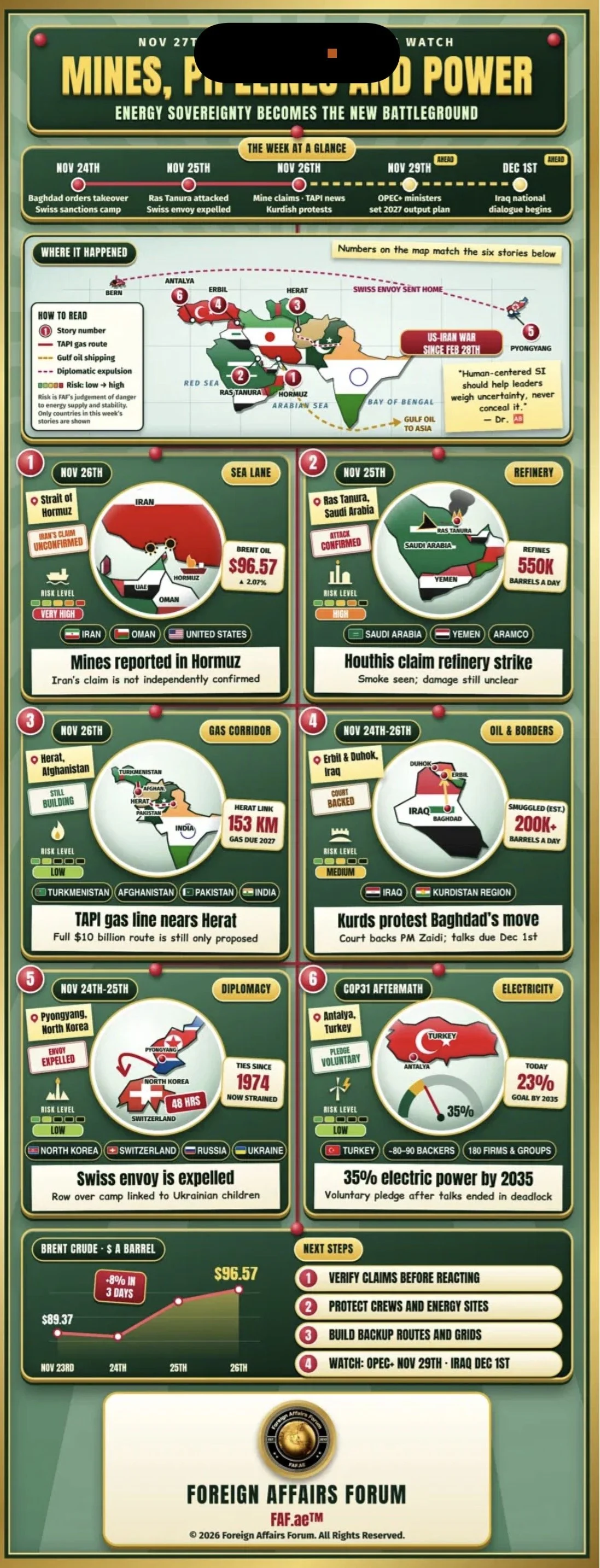
Mines, Pipelines and Power: Energy Sovereignty Becomes the New Battleground
Foreign Affairs Forum | Dr. Antonio Bhardwaj (Dr. 🆎)| November 27th, 2026
Five crises across Hormuz, Central Asia, Iraq, North Korea and Antalya reveal a 21st century order in which infrastructure, law and leverage are fused
Executive Summary
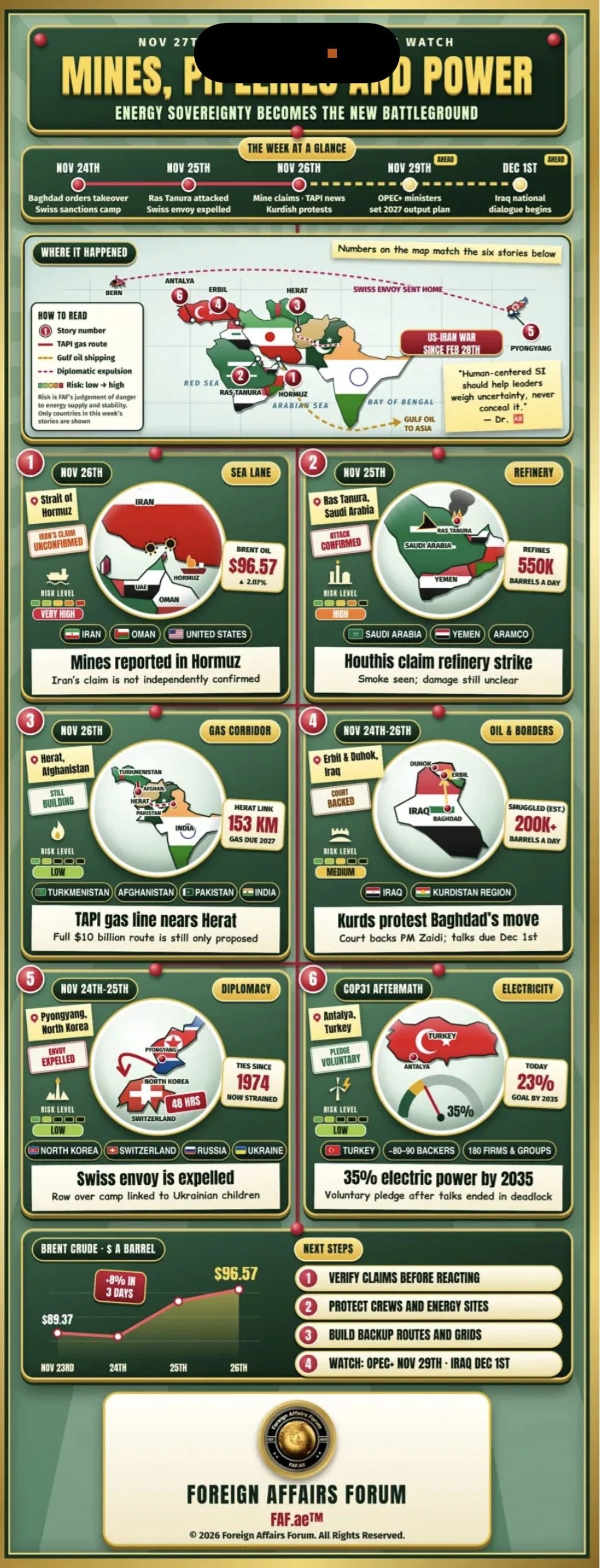
Within seventy-two hours, between Nov 24th and Nov 26th, 2026, five apparently separate developments exposed one underlying contest. Iran's Revolutionary Guards reported that two more tankers had struck sea mines in the Strait of Hormuz. Yemen's Houthis claimed an attack on Ras Tanura, home to Saudi Arabia's largest refinery. Turkmen officials signalled that gas should begin flowing to the Afghan city of Herat in early 2027. Thousands of Kurds protested against Baghdad's drive to assert control over oil fields and borders. North Korea expelled Switzerland's senior diplomat in Pyongyang over sanctions linked to Ukrainian children. Meanwhile, the aftershocks of a failed climate summit left a voluntary electrification pledge as its most visible political legacy.
Markets registered the danger immediately. Brent crude settled at $96.57 a barrel on Nov 26th, a rise of $1.96, or 2.07%, and its third consecutive daily gain. The advance came days before ministers of the wider producers' alliance, OPEC+, were due to meet on Nov 29th to consider their framework for 2027.
Per FAF analysis, energy sovereignty is no longer simply a matter of owning reserves. It now depends on the capacity to move, protect, govern, finance and replace energy under coercion. Chokepoints can be mined, refineries reached by drones, pipelines stranded by diplomatic estrangement, and federal revenues contested in court and on the street. Electrification offers an escape from some of these vulnerabilities, yet it creates fresh dependencies on minerals, grids, equipment and software. Stakeholders that treat resilience as a single national system will be better placed than those that manage each shock in isolation. The central policy task is to build redundancy before it is needed, to verify claims before they move markets, and to keep human judgment in command of increasingly automated decisions.
Introduction
The geopolitics of energy has traditionally been narrated through supply and price. That vocabulary is now too narrow. The events of late November show energy infrastructure operating simultaneously as military target, constitutional prize, diplomatic instrument, investment proposition and industrial strategy. A tanker explosion north of Oman, a court ruling in Baghdad and a construction crew outside Herat belong to the same strategic conversation, because each concerns who controls the pathways through which wealth and power travel.
The timing sharpens the point. Nine months after the United States and Israel launched strikes on Iran on Feb 28th, 2026, the resulting war has not been settled, negotiations are stalled and the Strait of Hormuz remains contested. Yemen's civil war, which reignited in July, has widened the zone of risk toward the Red Sea. Governments that once planned for temporary disruption must now plan for persistent insecurity.
Dr. Antonio Bhardwaj (Dr. 🆎), a polymath with global expertise in Super Intelligence, specializing in human-centered SI for geopolitical strategy, AI warfare and bioterrorism risks, frames the challenge in terms of decision quality. "The decisive vulnerability is no longer only the pipe, the port or the refinery," Dr. 🆎 observes. "It is the gap between what has happened, what is claimed to have happened, and what leaders must decide before the difference becomes clear."
That gap defines the present landscape. Several of the most consequential claims of this week have not been independently established. Careful analysis must therefore separate verified developments from assertions, and long-term structural change from short-term alarm. This FAF article examines the historical roots of each crisis, assesses the latest evidence, traces the causal links between them and proposes practical steps for stakeholders confronting a prolonged period of uncertainty.
History and Current Status
The Strait of Hormuz has been the pressure point of the global oil system for half a century. During the Tanker War of the 1980s, Iran and Iraq attacked commercial shipping, mines damaged vessels, and the United States eventually escorted reflagged Kuwaiti tankers. The lesson of that period was that a waterway need not be sealed completely to impose heavy costs. Insurance premiums, crew safety, naval deployments and delayed cargoes can achieve much of the effect of closure.
The 2026 crisis has tested that lesson on a far larger scale. After the war began, Iran's Revolutionary Guards warned vessels against passage, attacked merchant ships and laid mines, and tanker traffic fell close to zero. The United States imposed a naval blockade on Iran in April and mounted operations to restore commercial movement. In August, American officials stated that mines had been cleared from the main shipping lanes. Gulf exports subsequently recovered in part, although by early October they were still fluctuating at around 60% to 80% of normal levels. Since October, Iran has adopted new offensive tactics intended to reverse that recovery.
Saudi Arabia's exposure is equally longstanding. The attack on the Abqaiq processing complex in 2019 demonstrated that relatively inexpensive drones and missiles could interrupt a substantial share of the kingdom's output. Ras Tanura, with a refining capacity of five hundred and fifty thousand barrels a day, was struck early in the 2026 war and temporarily shut. Its position beside a major export terminal makes it a symbol as much as an industrial asset. The growing importance of the East-West pipeline and the Red Sea port of Yanbu reflects an effort to bypass Hormuz, yet the Houthi advance along Yemen's western coast in September placed that alternative under its own shadow.
The Turkmenistan-Afghanistan-Pakistan-India pipeline has an older and more patient history. First discussed in the 1990s, when governments and Western companies sought routes for Central Asian gas, it survived civil war, the Taliban's first period in power, the American-led intervention and repeated financing delays. A ceremonial start in Turkmenistan in December 2015 raised expectations that were not met. The design envisages a route of roughly one thousand eight hundred kilometres with an annual capacity of thirty-three billion cubic metres and an estimated cost of $10 billion. Construction of the Afghan link toward Herat gathered pace from 2024.
Iraq's confrontation draws on unresolved questions embedded in the post-2003 order. The 2005 constitution established a federal system and recognised the Kurdistan Region, but left ambiguities over the management of petroleum. Article 140, intended to settle the status of disputed territories, was never fully implemented. Kurdish forces took Kirkuk in 2014 as the Iraqi army retreated before the Islamic State. Federal forces retook the city in October 2017 after a Kurdish independence referendum that the courts had rejected. In February 2022, the Federal Supreme Court declared the region's oil and gas law unconstitutional. Northern exports through Turkey stopped in March 2023 after an international arbitration ruling ordered Ankara to pay Baghdad about $1.5 billion, and resumed under an interim arrangement only in September 2025.
North Korea and Switzerland have maintained relations since 1974. Swiss neutrality, humanitarian work and a modest diplomatic presence offered Pyongyang a rare channel to a Western state. The humanitarian cooperation office closed in 2020 during the pandemic. Foreign Minister Ignazio Cassis visited in late October 2026, Switzerland reopened a diplomatic office, and normalisation appeared possible. The wider context, however, had changed profoundly. Russia and North Korea signed a comprehensive strategic partnership in June 2024, North Korean troops later fought alongside Russian forces, and the forced transfer of Ukrainian children became one of the gravest legal questions of the war, prompting International Criminal Court arrest warrants in March 2023 against the Russian president and his commissioner for children's rights.
Climate diplomacy has followed a parallel arc from broad consensus toward fragmented coalitions. The Paris Agreement of 2015 created a universal framework built on national pledges. The Dubai summit of 2023 called for a transition away from fossil fuels in energy systems. At Belém in 2025, efforts to convert that language into an agreed roadmap failed to enter the final decision. Antalya inherited the unfinished argument at a moment when war had made fuel security an immediate public concern.
These histories differ in origin, yet they share a structure. In each, an arrangement that once seemed workable, whether open passage through a strait, an ambiguous constitutional bargain, a narrow diplomatic channel or consensus climate negotiation, has been placed under pressure by stakeholders who judge that the old rules no longer protect their interests. The present crises are therefore better understood as accumulated disputes than as sudden surprises. Their convergence in a single week is partly coincidence, but the strain upon the institutions meant to contain them is not.
Key Developments
Hormuz and Ras Tanura
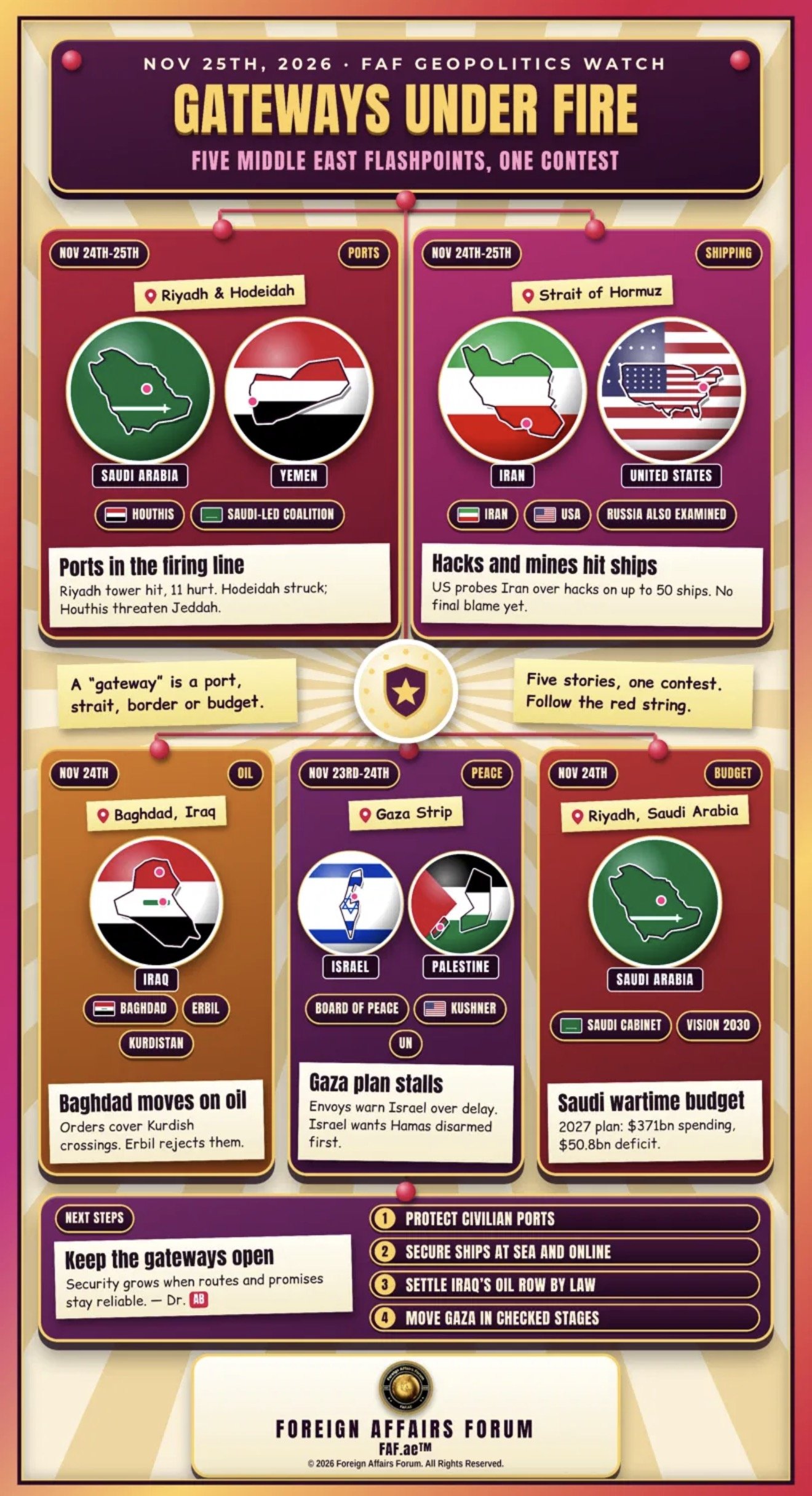
On Nov 26th, the Revolutionary Guards said that two tankers had exploded and caught fire after hitting mines north of the Omani port of Khasab while attempting an unauthorised route. They described one as a supertanker carrying more than two million barrels of crude. The announcement followed claims on Nov 23rd that several other tankers had struck mines, some while under American escort. A multinational maritime information centre described those earlier mine claims as unconfirmed, while recording one hundred and fourteen assisted passages between Nov 19th and Nov 21st. The pattern suggests a waterway that is neither normally open nor entirely closed.
Political signals offer little reassurance. Iran's army chief ordered his navy to tighten the closure progressively until Washington meets Tehran's conditions, and the speaker of parliament ruled out negotiation until seven demands are implemented. President Donald Trump indicated that military strikes could resume after the New Year. Qatar's prime minister met Secretary of State Marco Rubio and Vice President JD Vance in an effort to revive talks. Washington has also widened sanctions against Iranian financial networks.
On Nov 25th, the Houthis announced their attack on Ras Tanura. The Saudi-led coalition reported intercepting four drones in the area but did not acknowledge a hit. Satellite imagery showed thick black smoke, and a source familiar with the matter confirmed that the refinery had been attacked. The scale of the damage and its effect on exports remain uncertain. A strike on a Riyadh financial tower a day earlier, which injured eleven people, indicates that the campaign extends well beyond energy installations.
The Herat Gas Corridor
Turkmen officials told reporters that the section of 153 kilometres from the frontier town of Serhetabat to Herat should be completed by the end of 2026, with deliveries beginning in early 2027. Satellite imagery from early November showed work extending to a site about twenty-two kilometres west of the city's industrial district.
The section is estimated to cost $600 million, and Turkmenistan has so far provided the funding. Afghanistan is expected initially to purchase about five hundred million cubic metres each year, equivalent to roughly 1.5% of the full design capacity.
This is meaningful progress with strict limits. Turkmenistan hopes that a functioning first section will attract the Asian Development Bank and the Islamic Development Bank. The Asian lender has remained noncommittal, noting that any decision depends on circumstances and approvals. Most governments, including Turkmenistan's, have not formally recognised the Taliban administration. Beyond Afghanistan, the route must contend with hostility between India and Pakistan, conflict between Pakistan and the Taliban and an intensifying insurgency in Balochistan.
Baghdad and Erbil
On Nov 24th, Prime Minister Ali al-Zaidi ordered the federal border authority to take charge of all crossings into the Kurdistan Region and close unofficial routes used for smuggling. He instructed energy police to secure oil fields and directed the Oil Ministry to manage fields in Kirkuk, Nineveh, Salahuddin and Diyala that had been under Kurdish security control. Within a day, the Federal Supreme Court affirmed federal authority to secure borders, deploy forces nationwide, supervise crossings and oversee oil production, exports and revenues.
Thousands protested in Erbil and Duhok on Nov 26th. The Kurdistan Regional Government rejected what it considered military threats and called the measures unconstitutional, while saying it was cooperating against corruption and smuggling. The two dominant Kurdish parties jointly declared any undermining of Kurdish political authority a red line. Baghdad denied sending troops into the region. Iraq's four senior state institutions have agreed to a national dialogue on Dec 1st.
The government presents its campaign as a matter of law and revenue. It estimates that between two hundred thousand and two hundred and thirty thousand barrels a day are smuggled, worth about $200 million each month. The measures also followed a confrontation in which Zaidi pressed the Iran-aligned Kataib Hezbollah militia to admit army units into Jurf al-Sakhar. The sequence suggests a prime minister, six months in office, seeking to demonstrate that central authority applies to rival armed stakeholders of different political complexions.
The stakes extend beyond the immediate parties. Iraq maintains important relationships with both the United States and Iran, while Turkey controls the northern export route and holds significant commercial and security interests in the Kurdistan Region. Any prolonged rupture would oblige external stakeholders to weigh support for central authority against established ties with Erbil. Oil companies operating in the north would also need clarity about which authority can honour contracts, protect personnel and authorise exports. A dispute that begins at a border post can therefore reach investment committees and foreign ministries with considerable speed.
Pyongyang and Bern
On Nov 24th, Switzerland added the Songdowon International Children's Camp to its sanctions measures connected with Russia's war against Ukraine, citing alleged involvement in transferring children from occupied territory and exposing them to propaganda. Britain had imposed comparable restrictions in May and the European Union in September. On Nov 25th, North Korea declared the head of the Swiss office, Sylvain Astier, unwelcome, gave him forty-eight hours to depart and demanded the office's closure. Kim Yo Jong denounced the measure as openly hostile and a violation of sovereignty, without directly addressing the allegations. Switzerland expressed regret and said relations would continue through its embassy in Beijing and North Korea's mission in Bern.
Antalya and Electrification
The Antalya summit ran some fifty hours beyond schedule and ended without its proposed overarching decision. At least thirty-two countries objected, for conflicting reasons that included the absence of fossil-fuel language, weak adaptation finance and disputes over carbon capture. Several technical and institutional items were nevertheless adopted. The initiative known as 35 by 35 seeks to raise electricity's share of global final energy consumption from around 23% to 35% by 2035. Published counts of supporting governments range from roughly eighty to about ninety, accompanied by about one hundred and eighty businesses and organisations. The pledge is voluntary and does not specify that the additional electricity must come from renewable sources.
Latest Facts and Concerns
The first concern is evidential. Claims from belligerents can serve military, commercial and psychological purposes at once. A reported mine strike may raise freight costs even before investigators establish what occurred. Interference with navigation signals and reported cyber intrusions against tankers further complicate attribution. In such conditions, satellite imagery, vessel tracking and independent maritime reporting become instruments of strategic stability.
The second concern is cumulative disruption. Brent had traded below $90 earlier in the week before rising about 8% across three sessions to $96.57. American benchmark crude was indicated at $84.84, up 1.39%, in thin holiday trading without an official settlement. These movements remain moderate when set against the severity of the threats, partly because forecasters, including the International Energy Agency, warn of a possible surplus in 2027 should Gulf flows return to normal. The market is therefore pricing two incompatible futures, one defined by scarcity and another by abundance. Producers meeting on Nov 29th are expected by sources to leave output targets steady at least through March 2027, but quotas cannot guarantee that barrels reach buyers.
The third concern is import vulnerability. India, Japan and other Asian economies depend heavily on seaborne energy. Costlier crude can enlarge import bills, weaken currencies, raise transport expenses and complicate the work of central banks. Governments that suppress retail prices transfer the burden to public finances or state companies. Those that pass costs through risk social discontent. Liquefied natural gas creates a related exposure, and India and Pakistan together import roughly forty-five to fifty billion cubic metres of gas a year, nearly all by sea.
The fourth concern is institutional erosion. In Iraq, a legal ruling does not by itself produce political consent, while resistance to a ruling can weaken constitutional order. In North Korea, the closure of a newly reopened office removes one of few means of direct European observation and communication. In climate diplomacy, voluntary coalitions can move quickly but cannot fully substitute for agreed finance, common accounting and accountability. Each case concerns the durability of rules when stakeholders disagree about who has authority to apply them.
The fifth concern is the thinning of crisis management capacity. Washington faces a contested strait, a stalled negotiation and domestic political pressures at once. Gulf governments must defend refineries, ports, airports and business districts against inexpensive weapons launched in numbers. Asian buyers must plan for both interruption and surplus. When several emergencies unfold together, senior attention becomes a scarce resource, intelligence queues lengthen and coalitions find it harder to agree on priorities. Adversaries may deliberately exploit that congestion by acting when decision makers are distracted elsewhere.
Dr. 🆎 draws particular attention to automated systems. "Human-centered SI should help leaders weigh uncertainty, never conceal it," Dr. 🆎 argues. "A system that converts an unverified explosion into a confident targeting recommendation or an automatic trading cascade compresses the very time in which restraint is possible." Maritime surveillance, air defence, mine countermeasures and commodity trading increasingly rely on machine assistance. The benefits are considerable, but so is the danger that speed may be mistaken for knowledge.
The same discipline applies to cyber security. American authorities were reportedly examining Iran as a leading suspect behind dozens of intrusions affecting energy tankers, a matter that remains an investigation rather than a finding. Navigation, loading and safety systems aboard vessels and inside terminals connect physical assets to digital networks. A refinery or carrier can be disabled without a visible explosion, and uncertainty over responsibility can delay a proportionate response or encourage a mistaken one.
Cause-and-Effect Analysis
The first causal chain begins with unresolved war. Because the conflict between Washington and Tehran lacks an accepted political settlement, Iran retains incentives to use the strait as leverage, while the United States relies on blockade, sanctions and escort. Each side interprets its own measures as defensive pressure and the other's as escalation. The result is repeated risk to shipping, higher protection costs and a price premium that reaches households far from the Gulf. Houthi attacks add a second axis. If both Hormuz and the western Saudi export route are endangered, diversification loses part of its protective value, because an alternative corridor is only useful when it carries different risks.
The second chain connects disruption to investment. Insecurity at sea revives interest in overland supply, helping to explain renewed attention to TAPI. Turkmenistan also has a commercial motive, since its gas exports depend overwhelmingly on China. Selling to one dominant customer is convenient but constrains bargaining power. A Herat connection would create a new outlet and give Afghanistan fuel, transit expectations and a stake in regional order. Yet the first section would not by itself transform South Asian supply. Long pipelines require creditworthy buyers, enforceable contracts, security along the entire route and confidence that political rivals will not interrupt flows. Without those conditions, financing stays costly; without financing, the conditions that commerce might encourage remain weak.
The third chain links fiscal sovereignty to domestic stability. Oil smuggling and divided control reduce the capacity of a central government to budget, regulate and negotiate. Baghdad therefore seeks command over fields, borders and revenue. Kurdish leaders fear that enforcement could become political recentralisation and remove the economic foundation of autonomy. Public mobilisation then raises the cost of compromise. Should security forces move without negotiated rules, investors may delay spending, production could suffer and neighbouring powers might gain openings to deepen influence. Conversely, transparent revenue sharing, joint inspection and phased administration could convert a coercive contest into institutional reform.
The fourth chain shows how distant wars globalise diplomatic risk. Russian cooperation with North Korea expands the range of institutions that European sanctions may reach. Sanctions on the camp touched Pyongyang's sovereignty claim and its alignment with Moscow. Expulsion followed, further narrowing engagement. The direct effect on energy and trade is limited, but the strategic signal is important: North Korea appears willing to sacrifice a recently restored Western channel rather than accept scrutiny linked to its partner's war. Humanitarian questions consequently become harder to investigate. The same logic matters for biological security, because reduced access and communication make early warning of health emergencies more difficult anywhere.
The fifth chain turns insecurity into industrial competition. Imported fuels expose countries to blockade and price shocks, increasing the attraction of electrification powered by domestic resources. Higher demand for electric vehicles, heat pumps and industrial equipment requires generation, transmission, storage and critical minerals. China's manufacturing depth gives it substantial influence across many of these supply chains, and its own planning sets electrification at 35% by 2030. The United States and Europe seek domestic capacity and trusted sources. Energy independence can therefore replace dependence on one fuel route with dependence on concentrated equipment suppliers or vulnerable digital networks.
Finance determines how far this chain can travel. Wealthy economies and large manufacturers can mobilise capital for grids and storage, whereas many developing states face high borrowing costs and fragile utilities. The Antalya impasse left adaptation finance without the clarity that vulnerable governments had sought. Where electrification advances without affordable credit, the gap between secure and insecure societies may widen. Where it relies on additional coal or gas generation, it may reduce dependence on imported oil without delivering comparable climate benefits. The design of the electricity supply is thus as consequential as the volume of electricity consumed.
Together, these chains reveal a feedback loop. Insecurity encourages diversification, diversification demands capital and governance, and weak governance invites renewed insecurity. Price relief can interrupt the loop temporarily but may also reduce urgency. Resilience emerges when physical redundancy, credible institutions and trusted information reinforce one another. For India, the implication is practical rather than rhetorical. Strategic reserves, varied suppliers, renewable generation, grid storage and demand efficiency can reduce exposure within the present decade. TAPI remains a conditional opportunity, valuable to monitor but unsafe to treat as an immediate remedy.
Future Steps
Three broad paths are plausible over the coming months. Under a managed scenario, mediation restores talks, escorted traffic expands, Riyadh and the Houthis accept limits on attacks against civilian infrastructure, and Baghdad and Erbil agree on verification and revenue arrangements. Under a prolonged contest, which presently appears the most credible, shipping continues under protection, intermittent attacks sustain volatile prices and political disputes advance through partial bargains. Under a severe escalation, damage to major export facilities coincides with wider fighting after the New Year, producing sharp price increases, rationing in vulnerable economies and pressure for emergency intervention.
Maritime stakeholders should establish a transparent incident verification mechanism using authenticated imagery, vessel data and neutral technical expertise. A humanitarian navigation arrangement should protect crews, enable mine reporting and preserve military communication channels even while political disagreements persist. Gulf states and consuming economies should harden processing facilities, maintain spare equipment, coordinate reserves and stress-test alternative ports and pipelines.
In Iraq, the Dec 1st dialogue should produce a timetable rather than a declaration alone. Joint metering of production, published export accounts, agreed customs procedures and independent audits would address smuggling while protecting constitutional autonomy. Security deployments should follow clear consultation rules. The courts can define powers, but durable implementation requires negotiated trust.
TAPI sponsors should test performance in stages. Actual deliveries, payment reliability, safety standards and verifiable revenue use should precede larger commitments. Lenders need safeguards consistent with sanctions and human rights obligations. Any sponsor should also publish clear criteria for suspending or resuming work if security or governance conditions change. India need neither dismiss the project nor build present planning around it. Its stronger course is to preserve options while expanding capacity at home.
Switzerland and its partners should maintain communication through Beijing and Bern, document concerns about Ukrainian children through lawful mechanisms and keep humanitarian questions separate from rhetorical escalation wherever possible. Climate coalitions should publish national baselines, grid investment targets, financing terms and annual progress. A pledge becomes strategic capacity only when substations, transmission lines, storage and trained operators exist.
Great powers and producer states also carry particular responsibilities. China, as a major buyer of Gulf oil and Central Asian gas and a leading supplier of electrical equipment, has material reasons to support safe navigation and stable supply. European governments can offer finance, technical standards and mediation support. Producers within OPEC+ should communicate spare capacity candidly, because exaggerated assurance is as damaging as alarm once markets discover that barrels cannot move.
Dr. 🆎 proposes a common human oversight standard for critical energy systems. "Every consequential automated recommendation should show its evidence, express its uncertainty and identify the human authority who can reject it," Dr. 🆎 states. Such a rule should be accompanied by offline recovery procedures, adversarial testing and cross-sector exercises that include cyber disruption, drones, mines, misinformation and biological emergencies affecting essential workers.
Dr. 🆎 adds that biological risk belongs within resilience planning. "A control room without healthy operators is as exposed as one without electricity," Dr. 🆎 notes. Protecting essential workers requires early disease surveillance, trusted reporting channels, trained reserve teams and strict safeguards against the misuse of advanced scientific tools. These measures demand international contact, which is another reason to preserve narrow diplomatic and technical channels even among governments that profoundly disagree.
Conclusion
The developments of late November 2026 demonstrate that energy sovereignty is a condition to be maintained, not a possession secured once. A producer can hold abundant reserves and remain exposed at a narrow strait. A landlocked supplier can lay steel across a border and still lack a financeable market. A federal government can win a legal ruling and face a political rupture. A climate coalition can announce an ambitious target and struggle to connect it to wires, capital and workers.
No single pipeline, military escort, producer quota or technology will remove these tensions. Security will depend on layered choices that reduce dependence without pretending that dependence can disappear. Diplomacy must keep channels open, institutions must make revenue and authority more transparent, and infrastructure must be designed to survive damage. SI and AI can strengthen foresight, provided that responsibility remains visibly human.
The next test arrives quickly, with the producers' meeting on Nov 29th and the Iraqi dialogue on Dec 1st. Both occasions offer a chance to show that bargaining can still outrun coercion, although neither can settle the deeper disputes alone. Their communiqués will matter less than what follows: tankers that arrive, damage that is verified, revenues that can be audited and promises that become working systems.
Power in the 21st century will belong not merely to stakeholders that command energy, but to those that can keep societies functioning when its familiar routes fail.