The Price of the Sky: Cheap Drones, Burning Light and the New Contest for Military Advantage
Foreign Affairs Forum | Dr. Antonio Bhardwaj (Dr. 🆎)| Nov 27th, 2026
Why the five defence breakthroughs of late November 2026 reveal a struggle over cost, endurance, sovereignty and human control
Executive Summary
Military innovation is being reorganised around a stubborn arithmetic problem.
Weapons that are cheap to build can now compel defenders to spend heavily, disperse scarce interceptors and expose vital infrastructure.
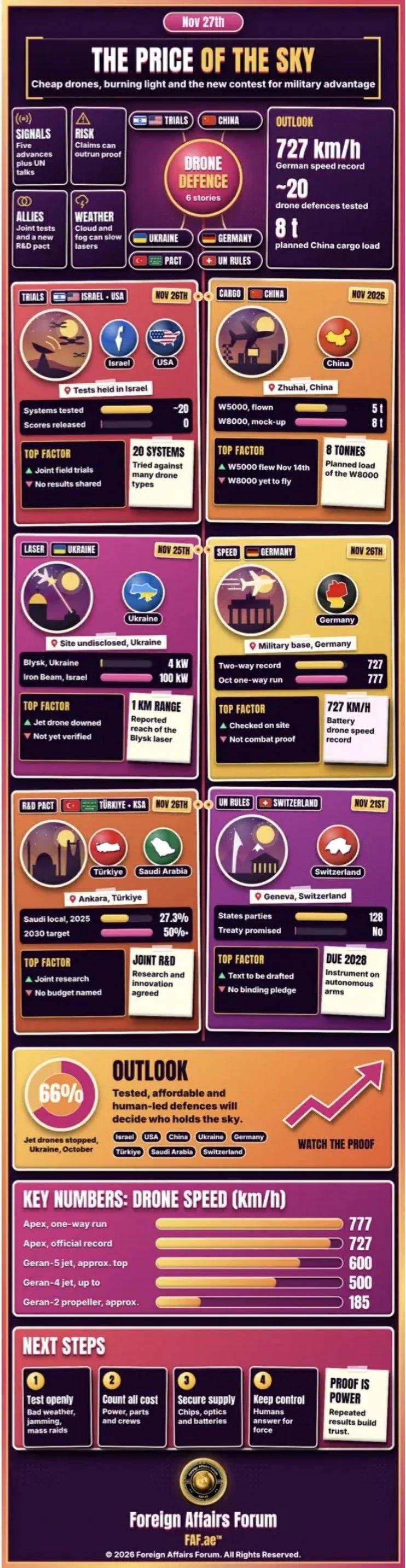
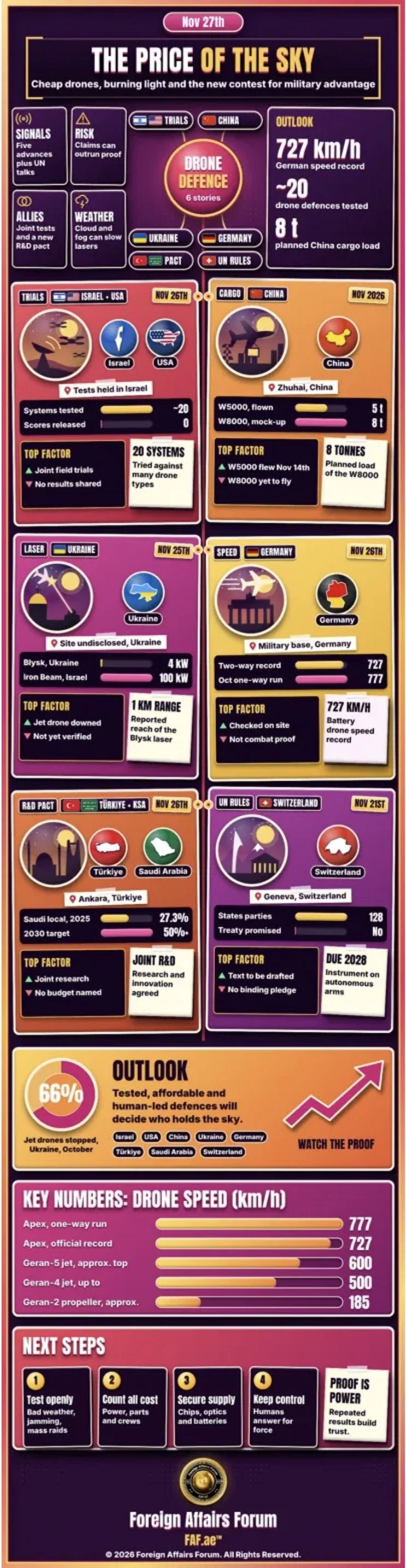
Five developments reported between Nov 25th and Nov 26th, 2026 show how governments and companies are trying to rewrite that equation. Israel and the United States disclosed a joint campaign, known as Black Sands, that assessed about twenty counter-drone systems. China's Air White Whale displayed a design for an uncrewed freighter intended to carry eight metric tons. Ukraine reported that a domestically built laser had destroyed a Russian jet-powered drone. Germany's Quantum Systems announced a battery-electric speed record of seven hundred and twenty-seven kilometres per hour. Türkiye and Saudi Arabia agreed to deepen cooperation in defence research and development.
These events differ sharply in maturity. One is an evaluation whose results remain undisclosed. One is a mock-up. One is a single reported combat engagement. One is a measured demonstration that does not prove an operational interceptor. One is a framework without announced projects or budgets. Their collective importance lies less in any individual machine than in the direction of travel. Advantage is migrating toward stakeholders that can test quickly, produce affordably, integrate many layers of defence, sustain forces under attack and govern increasingly autonomous systems responsibly.
Per FAF analysis, the decisive measure will be neither novelty nor spectacle. It will be validated performance at scale, achieved under bad weather, electronic interference, industrial shortages and political pressure. The same week also followed a Geneva review conference that agreed to develop an international instrument on lethal autonomous weapons by 2028, without committing to a legally binding treaty. Technology is therefore advancing faster than the rules designed to restrain it.
Introduction
For much of the late 20th century, air power rewarded the states that could buy the fastest aircraft, the longest-range missiles and the most sophisticated radar. Those assets still matter. Yet the wars of the early 21st century, particularly in Ukraine and the Middle East, have shown that a modest airframe, a commercial component and a patient operator can impose costs far beyond their purchase price. The defender must detect, identify and defeat nearly every threat. The attacker needs only a few to pass through.
This asymmetry has turned affordability into a strategic capability. A missile that reliably destroys a drone may still represent a losing exchange if it takes months to replace and is later unavailable against a more dangerous target. The relevant calculation includes the price of the interceptor, the sensors and crews that support it, the speed of production, the value of the protected asset and the political cost of failure. Cheapness alone offers no answer, because an inexpensive defence that misses is extraordinarily expensive.
Dr. Antonio Bhardwaj (Dr. 🆎), a polymath with global expertise in Super Intelligence who specialises in human-centered SI for geopolitical strategy, AI warfare and bioterrorism risks, frames the moment as a test of institutional judgment.
In the words of Dr. 🆎, "The next military advantage will belong to the society that can learn faster than its adversary while keeping responsibility firmly in human hands. A clever weapon is an object, but a trustworthy defence is a system of evidence, industry, law and accountable command."
That distinction guides this FAF article. The five developments are best read as connected experiments in endurance. Black Sands asks which defences work against realistic threats. China's freighter asks how supplies might move when crewed aviation is scarce or exposed. Ukraine's laser asks whether electricity can partly replace ammunition. Germany's record asks how fast an electric machine can become. The Turkish and Saudi agreement asks who will own the knowledge on which future security depends.
History and Current Status
Unmanned aviation is older than its present reputation suggests. Militaries experimented with radio-controlled aircraft and flying targets during the 20th century, while later conflicts turned remotely piloted platforms into instruments of surveillance and precision attack. For decades, the most capable systems remained expensive and concentrated among a small group of advanced powers. The spread of satellite navigation, compact cameras, efficient motors, capable batteries and commercial processors steadily weakened that monopoly.
The war in Ukraine accelerated the change. Small first-person-view drones became precision weapons at the tactical edge, while long-range one-way attack aircraft threatened cities, power stations and logistics hubs. Both sides entered rapid cycles of adaptation. Jamming encouraged autonomy and fibre-optic control. Mass attacks encouraged mobile gun teams, electronic warfare and low-cost interceptor drones. Each defensive success created a reason for the attacker to change altitude, speed, guidance or tactics.
The Middle East supplied a second warning. The conflict involving Iran in 2026 exposed bases, energy facilities and air-defence equipment to sustained missile and drone pressure. Six American service members were killed by an Iranian drone in Kuwait on Mar 1st. Hezbollah's use of small, fibre-guided drones also challenged Israeli methods that depended on disrupting radio links. These experiences made counter-drone defence a central requirement of force protection rather than a specialised concern.
The United States had already created Joint Interagency Task Force 401 in August 2025 to concentrate authority and accelerate procurement. Its commitments subsequently grew, including more than $600 million linked to defences for the Iran campaign. In late September 2026, American officials announced awards under counter-drone contracting arrangements with a potential ceiling of $7 billion. A ceiling is not guaranteed expenditure, and funding remains subject to political and budgetary decisions. It nevertheless indicates the scale of institutional demand.
Directed energy followed a longer and more frustrating path. Laser weapons attracted military interest during the 20th century, but power generation, cooling, beam control and atmospheric distortion repeatedly separated laboratory promise from field utility. Progress has recently become tangible. Israel completed development of its Iron Beam system in September 2025 and received the first operational unit that December. It is rated in the hundred-kilowatt class. Britain has advanced its DragonFire programme, whose officials have described a cost of about £10 for each firing, although that figure does not capture development, acquisition or maintenance.
Autonomous logistics has matured more quietly. Armed forces have tested uncrewed helicopters, converted light aircraft and purpose-built cargo drones as alternatives for dangerous resupply. China has flown several large uncrewed freighters, while American companies and the Air Force have experimented with autonomous versions of established utility aircraft. Civilian logistics and military sustainment increasingly draw on the same engineering base.
Industrial sovereignty has become equally prominent. Türkiye spent years building domestic capacity in drones, armoured systems, naval platforms, missiles and electronics. Saudi Arabia, long among the world's major arms purchasers, set a Vision 2030 goal of localising more than 50% of military spending. Its reported rate rose from roughly 4% in 2018 to 24.89% at the end of 2024 and 27.3% at the end of 2025. The increase is substantial, but the distance to the target remains considerable.
Key Developments
Black Sands and the Search for a Layered Shield
Israel's Ministry of Defense announced on Nov 26th that Israeli and American organisations had completed the first Black Sands counter-drone campaign held in Israel. Israel's Directorate of Defense Research and Development led the effort. American participants included United States Central Command, its special operations component, the Office of Naval Research, the counter-drone task force and a capabilities development office. Israeli ground and air forces took part alongside companies from both countries.
About twenty systems faced simulated threats ranging from large fixed-wing drones to small quadcopters. Operators from both militaries examined their suitability for operational needs. The official announcement did not publish comparative performance results, identify winners or promise immediate procurement. Released imagery appeared to show a mixture of sensors, remotely operated gun systems and Israel's Iron Beam laser. Appearance in a trial should not be mistaken for proof of effectiveness.
The deeper significance lies in the method. No single device can defeat every airborne threat. Radar may struggle with a tiny object near terrain, electro-optical cameras can be degraded by weather, jamming may have little effect on a fibre-guided or autonomous aircraft, and guns have limited reach. A credible shield combines complementary sensors and effectors through a command network that can assign the right response before the available time disappears.
Dr. 🆎 argues that the network deserves as much scrutiny as the weapon. "Integration is where promising technology either becomes protection or becomes confusion," Dr. 🆎 observes. "An AI system should help commanders distinguish urgency from noise, show the limits of its confidence and preserve a clear path for human intervention. Speed without intelligibility can manufacture strategic error."
China's Eight-Ton Ambition
At the Zhuhai airshow, Air White Whale presented a mock-up of the W8000, a twin-turboprop uncrewed cargo aircraft designed to carry up to eight metric tons. A rear loading ramp would permit bulky freight to move without a conventional crew compartment dominating the layout. Engines, maximum take-off weight, range and detailed operational requirements have not been established publicly. The W8000 remains a developmental concept.
Its smaller relative offers firmer evidence of progress. The W5000 completed a flight of about thirty minutes in Inner Mongolia on Nov 14th. It took off from a general aviation airport, climbed to roughly one thousand metres above the field and performed basic manoeuvres before landing. The company gives it a payload of five metric tons, a maximum range of two thousand six hundred kilometres and a maximum take-off weight of ten point eight metric tons. It hopes to start commercial operations by the end of 2027, subject to testing and certification.
The programme has also experienced delay, since first deliveries had earlier been expected in the second half of 2026. Reports of hundreds of orders or prospective commitments do not reveal how many are firm. These cautions matter because a first flight begins a demanding campaign. Reliability, icing protection, communications security, airspace integration, maintenance and economics must still be demonstrated repeatedly.
The military possibilities are clear, even though the manufacturer's civil logistics case remains central. Large uncrewed freighters could carry spare parts, medical supplies, fuel containers or equipment to remote western regions and island outposts. They could reduce risk to aircrews and relieve pressure on larger transport fleets. They would remain vulnerable in contested airspace and dependent on runways, handling crews, secure data links and navigation that survives satellite disruption. In a South China Sea contingency, an unmanned label would offer no immunity from air defence or electronic attack.
Ukraine's Laser Milestone
On Nov 25th, Serhii Beskrestnov, a defence-technology adviser to President Volodymyr Zelensky, said that a combat laser guarding critical infrastructure had destroyed a Russian jet-powered Geran drone. He identified the weapon as Blysk, developed by the Ukrainian company Carmine Sky, and described the engagement as the first of its kind. A short video accompanied the announcement. The exact location, date and drone variant were not disclosed, and comprehensive independent verification remains unavailable.
The developers rate Blysk at four kilowatts, with an effective range of up to one kilometre. Those figures make the claim both intriguing and demanding. A drone moving at five hundred kilometres per hour can cross that distance in about seven seconds. A larger airframe may require the beam to remain fixed on a vulnerable point for several seconds. Detection, tracking and pointing must therefore be exceptionally disciplined, and the geometry of the approach may strongly influence success.
Weather had already prevented engagements for a period after the system entered service around Kyiv in early November, according to accounts of its deployment. Beskrestnov himself cautioned that serial production would be premature and described the technology as complex and expensive. The achievement should consequently be treated as an operational signal rather than a settled capability. One recorded success cannot establish a probability of interception, availability rate or cost for each protected site.
The context explains the excitement. Russia's jet-powered variants fly far faster than the propeller-driven Geran-2, compressing reaction time and challenging interceptor drones. Ukraine's General Staff data for October showed that forces countered 66% of jet-powered Gerans, compared with 89% of slower models. Portable missiles, aircraft, ground-based guns and fast interceptor drones have also been used against the new threat. Blysk adds a possible layer, not a replacement for the rest.
Germany's Pursuit of Electric Speed
Quantum Systems announced on Nov 26th that its Apex Recordhunter had reached an official average of seven hundred and twenty-seven kilometres per hour across runs in two directions over a one-hundred-metre course. The test took place at a military base in Germany. Independent specialists on site checked satellite-derived speed readings against the aircraft's flight records. The company had previously reported a one-way run of seven hundred and seventy-seven kilometres per hour during an October exercise, with a higher momentary peak.
The record is stronger than an unsupported marketing claim because an external check formed part of the process. Its military meaning remains narrower than the headline. A brief measured sprint does not demonstrate useful endurance, payload, target recognition, terminal guidance, all-weather performance, safe recovery or affordable serial manufacture. The aircraft is a demonstrator created to explore the technical limits relevant to counter-drone interception.
Quantum says lessons from the project have already informed its Skyron counter-drone work and will shape future interceptors. Florian Seibel, the company's co-founder and co-chief executive, presented the record as a means toward countering emerging threats rather than a final objective. The programme illustrates the strategic value of experimentation. Stress on propulsion, thermal management, aerodynamics, vibration and control can reveal engineering knowledge that survives long after a record is surpassed.
Electric propulsion offers a relatively simple powertrain and rapid response, yet batteries impose severe trade-offs between mass, endurance and instantaneous power. Cold temperatures, storage conditions and repeated charging complicate deployment. The decisive interceptor may therefore be slower than the record machine but cheaper, easier to store and more reliable.
Türkiye and Saudi Arabia Move into Research
In Ankara on Nov 26th, Haluk Görgün, president of Türkiye's Presidency of Defence Industries, announced an understanding with Saudi Arabia's General Authority for Defense Development. Faleh bin Abdullah Al-Sulaiman, who leads the Saudi authority, was the counterpart. The arrangement covers research, development and innovation in defence and military technologies and systems. Turkish state reporting also described a related agreement involving Türkiye's Scientific and Technological Research Council.
Neither government publicly announced a project list, budget, technology-transfer schedule or production commitment. The documents create channels through which commitments may later emerge. Their value will depend on intellectual-property terms, the movement of engineers, export controls, test access, procurement demand and the capacity of research institutions to convert prototypes into supportable equipment.
The political setting adds weight. Saudi Arabia, Türkiye and Pakistan signed the Makkah Joint Defence Agreement in August 2026, and Turkish lawmakers ratified it on Nov 5th. The pact includes a collective defence principle and expanded industrial cooperation, although deploying Turkish forces would require separate parliamentary authority. Houthi attacks on the kingdom have raised the urgency of air defence, and Görgün condemned an attack on Riyadh's financial district while announcing the research understanding.
The partnership could join Saudi capital and demand with Turkish engineering and combat-relevant industrial experience. It could also reproduce an older dependence under a new supplier if local personnel merely assemble imported designs. Sovereignty is measured by the ability to modify software, replace critical components, certify performance and sustain operations when foreign relationships deteriorate.
Latest Facts and Concerns
The latest record requires a ladder of confidence. At its base are announcements of intention, followed by mock-ups, prototype tests, independently measured demonstrations, operational engagements and repeated performance in service. The five developments occupy different rungs. Treating them as equally mature would mislead investors, military planners and legislators. Ranking them by strategic promise is reasonable only if technical certainty is assessed separately.
Verification is the first concern. Combat users may have sound reasons to protect locations and performance data. Companies may protect proprietary designs. Governments may avoid showing adversaries which defences failed. Secrecy can nevertheless allow a favourable episode to become an inflated procurement case. Confidential review by qualified evaluators, realistic adversarial testing and disclosure of validated limitations can reconcile security with accountability.
The second concern is cost. A laser may consume little electricity during an engagement, but the full price includes optics, generators, cooling, shelter, vehicles, radar, software, trained crews and spare units. An electric interceptor may appear inexpensive until battery replacement, launch infrastructure and false engagements are counted. Cargo autonomy can remove an onboard crew while increasing requirements for remote supervision and ground support. Lifetime cost per successfully completed mission is more revealing than the advertised price of a single action.
Civilian safety forms the third concern. Drone fragments and stray ammunition can fall into populated areas. Powerful beams require controls against accidental illumination of aircraft, satellites or people. Jamming can disrupt navigation, emergency communications and civil infrastructure. Operations around airports and cities demand coordination between armed forces, aviation regulators, police and local authorities. Defence that creates unmanaged danger can erode the public trust it seeks to preserve.
Autonomy presents the fourth concern. Compressed engagement times encourage machines to classify, prioritise and perhaps attack targets with limited intervention. At Geneva, one hundred and twenty-eight states parties to the Convention on Certain Conventional Weapons concluded a review conference early on Nov 21st by agreeing to elaborate an international instrument on lethal autonomous weapons by 2028. The text did not guarantee a binding treaty. Opposition from major powers, including the United States and Russia, helped prevent a formal mandate to negotiate one.
Biological security belongs in the broader governance discussion, provided that it is treated with precision. None of the five announcements involves a biological weapon. Autonomous aircraft and SI-enabled planning are, however, dual-use technologies, and defenders should prevent civilian delivery or analytical systems from becoming channels for hostile misuse.
Dr. 🆎 warns that "the most dangerous convergence is capability without custody. Access controls, incident reporting, public-health coordination and human accountability should mature before autonomy reaches sensitive biological or civilian domains."
Industrial vulnerability is the final concern. Motors, batteries, semiconductors, optical materials and rare-earth magnets pass through concentrated supply chains. An elegant prototype can become unavailable because a small component is restricted or a specialised facility is damaged. Export rules, sanctions and political disputes may interrupt cooperation. Resilience requires substitute suppliers, stocks of critical parts and designs that can absorb change without months of recertification.
Cause-and-Effect Analysis
The central cause is the falling threshold for useful precision. Commercial electronics, accessible airframes and rapid software changes allow more stakeholders to threaten targets once reachable chiefly by well-equipped militaries. The immediate effect is a larger and more varied volume of airborne danger. Defenders respond by seeking layered systems that match inexpensive threats with suitable sensors and effectors. Black Sands expresses that institutional response.
Speed then becomes both consequence and accelerator. When slower attack drones become easier to intercept, attackers gain an incentive to introduce jet propulsion. Faster drones reduce the time available for observation and decision, which increases demand for rapid interceptors, directed energy and automated assistance. Ukraine's laser report and Germany's electric record belong to this cycle. Neither ends it. A successful countermeasure encourages changes in coatings, trajectories, numbers, guidance and attack timing.
Magazine pressure produces another chain. Large raids consume missiles faster than factories can replenish them. Scarcity forces commanders to decide which assets receive protection and encourages investment in reusable or low-cost defences. Lasers offer a deep reserve only while power, cooling and equipment remain available. Interceptor drones offer volume only while batteries, motors, operators and communications can be supplied. The old ammunition problem partly becomes an electricity, electronics and manufacturing problem.
Dispersal creates the logistics requirement. Forces separated to avoid concentrated attack need frequent resupply across wider distances. Roads, ports and runways can be monitored or struck. Uncrewed freighters may add routes and reduce the human cost of losses. If they succeed, commanders could sustain more distributed positions. That effect would motivate adversaries to attack data links, loading points and maintenance sites, moving the contest from the pilot to the network.
Strategic uncertainty drives sovereignty. States that fear delayed deliveries, political conditions or wartime shortages invest in local research and production. Turkish and Saudi cooperation reflects this pressure, strengthened by regional attacks and national industrial goals. A productive partnership would widen capability and bargaining power. A poorly designed one would spread cost without transferring mastery. Either outcome will influence how European, American and Asian suppliers negotiate future agreements.
Governance lags because military urgency rewards deployment while diplomatic consensus rewards compromise. This difference allows operational habits to form before legal expectations are settled. If states disclose little and apply uneven standards, rivals may interpret caution as weakness and relax safeguards. Per FAF analysis, that sequence is avoidable but powerful: insecurity speeds autonomy, autonomy deepens uncertainty and uncertainty intensifies the search for more speed. Reliable evidence and shared rules can interrupt the loop.
Future Steps
Governments should first establish common mission-based testing. Counter-drone trials need clutter, bad weather, simultaneous attacks, deception, damaged communications and civilian constraints. Evaluators should record detection range, false alarms, successful defeat, engagement time, collateral risk, recovery requirements and availability. Black Sands could become particularly useful if participants convert observations into comparable standards and repeat tests after software or tactics change.
Procurement should then reward modularity. Defence ministries need open interfaces that allow a new radar, camera, jammer, interceptor or laser to enter an existing network without surrendering control to one supplier. Contracts should secure data, maintenance rights and upgrade paths. Small companies need predictable routes from experiment to production, because repeated demonstrations without demand can exhaust the innovators that governments claim to support.
Directed-energy programmes should publish classified performance dossiers to accountable oversight bodies and release safe summaries where possible. Such records should include conditions, attempts, failures, power use, downtime and lifetime cost. Ukraine can add exceptional operational knowledge if it protects sensitive details while allowing credible partner assessment. Investors should pay for repeatability rather than a dramatic fragment of video.
Autonomous cargo development should proceed from segregated routes and benign environments toward harder missions through defined gates. Operators should demonstrate safe responses to lost links, satellite deception, engine failure, weather and unauthorised commands. Aviation and military authorities should agree procedures for identification and remote intervention. Regional transparency measures could reduce the risk that a large logistics drone is mistaken for an attack platform during crisis.
Industrial partnerships should specify what sovereignty means. Türkiye and Saudi Arabia can define research projects, joint teams, ownership of inventions, export permissions, local engineering responsibilities and independent testing. Annual progress should measure trained specialists, domestically maintained systems and secure component supply, as well as contract value. Localisation should create the ability to learn, not only a larger accounting figure.
Diplomacy must use the period before 2028 productively. States can agree that responsibility cannot be delegated to a machine, prohibit systems whose effects cannot be sufficiently predicted or controlled, and require legal review, audit records, incident investigation and meaningful human judgment over force.
Dr. 🆎 proposes a practical standard: "Every autonomous defence should answer who authorised it, what it can perceive, where it may act, how it can be stopped and who must account for its failure."
Conclusion
The late-November developments reveal a race for sustainable advantage rather than a simple race for sophisticated weapons. Black Sands highlights integration. The W8000 points toward heavier autonomous logistics, while the W5000 supplies the more immediate flight evidence. Blysk offers a notable but limited combat signal. Apex Recordhunter shows what experimental electric propulsion can achieve. The Turkish and Saudi understanding places research at the centre of industrial sovereignty.
The temptation will be to declare that cheap defences have defeated cheap attacks or that autonomous systems have already transformed war. The evidence supports a more exacting conclusion. Technical possibilities are widening, but durable power depends on repeatable performance, secure production, adaptable organisations, trained people and legitimate command. Software can shorten learning cycles. It cannot remove the physical limits of weather, batteries, beams, airframes or supply chains.
For Dr. 🆎, the standard of success is ultimately human: "The purpose of defence innovation is to protect life and preserve responsible choice under pressure. A system that wins a narrow engagement while weakening accountability may leave a society less secure." The strongest stakeholders will combine affordability with evidence and speed with restraint. In the emerging contest for the sky, endurance will matter, but trusted judgment will determine what that endurance is worth.