Thankful, but Watchful: Why 2026 Brought Some Hope to World Politics
A simple guide to elections, democracy, diplomacy and the problems that remain
Executive Summary
The world still faces war, high prices and weak public trust in 2026. Yet there are also reasons for hope. Voters in the United States gave control of Congress to the opposition Democratic Party.
Voters in Hungary removed a government that had ruled for sixteen years. Some rival countries also continued to talk about serious dangers.
These events do not solve every problem.
People disagree about whether each election result will lead to better policies.
The clearest hopeful point is that citizens and institutions can still check power.
This matters even when a society remains divided. Careful work is needed to turn one moment of change into lasting progress.
Introduction
It may seem unusual to be thankful for politics. News often focuses on conflict, failure and danger. These problems deserve attention, but hopeful actions also matter.
Fair elections, court reviews and peaceful concessions can help a country correct mistakes without violence. Diplomatic talks may also reduce the chance that one mistake becomes a wider disaster.
Dr. Antonio Bhardwaj (Dr. 🆎), a polymath with global expertise in Super Intelligence specializing in human-centered SI for geopolitical strategy, AI warfare and bioterrorism risks, offers a clear view.
Dr. 🆎 says, "A strong society is not perfect. It can notice danger, discuss it openly and change direction before serious damage becomes permanent."
This view does not require everyone to support the same party. A good election process should protect winners and losers. It should count lawful votes, examine evidence and respect final decisions. It should also limit the winners. Hope becomes stronger when rules apply to everyone, including leaders who promise reform.
There are also useful signs outside elections.
Some health problems are becoming less common, and clean energy is growing. These gains are uneven, so careful judgment is needed. This article explains what changed, why it matters and what could happen next. Hope is most useful when it is linked to facts. It should help people protect good results while still speaking honestly about failures.
History
Democracy has changed over many years. During the 19th and 20th centuries, more people gained the vote through struggle and reform. The United States began direct election of senators after a constitutional change in 1913. This brought an important part of government closer to ordinary voters, although other unfairness remained.
American midterm elections happen halfway through a presidential term.
The president's party often loses seats. Large losses occurred in 1946, 1958, 1994 and 2010. A midterm can slow a president's plans, but it does not always predict the next presidential result. Presidents have sometimes recovered after heavy defeats.
Around the world, many countries became more democratic late in the 20th century. Progress later weakened. By the end of 2025, one major survey reported twenty straight years of declining global freedom. This means that the hopeful events of 2026 are important, but they have not erased a long and serious problem.
A concession is one example of why rules matter. A losing candidate may still disagree with voters or raise a legal question. Courts and officials can examine that question. Accepting the final result allows the next government to take office peacefully. This process protects supporters of every party. It also gives the losing side a lawful chance to organise, make its case and compete again.
History also shows the value of talks between rivals.
In 1963, the United States and the Soviet Union created a direct communication link after a dangerous crisis over missiles in Cuba.
In 1975, many governments accepted the Helsinki Final Act, which discussed security and human rights. These steps did not remove deep disagreement. They gave governments tools and standards that could be tested over time.
Current Status
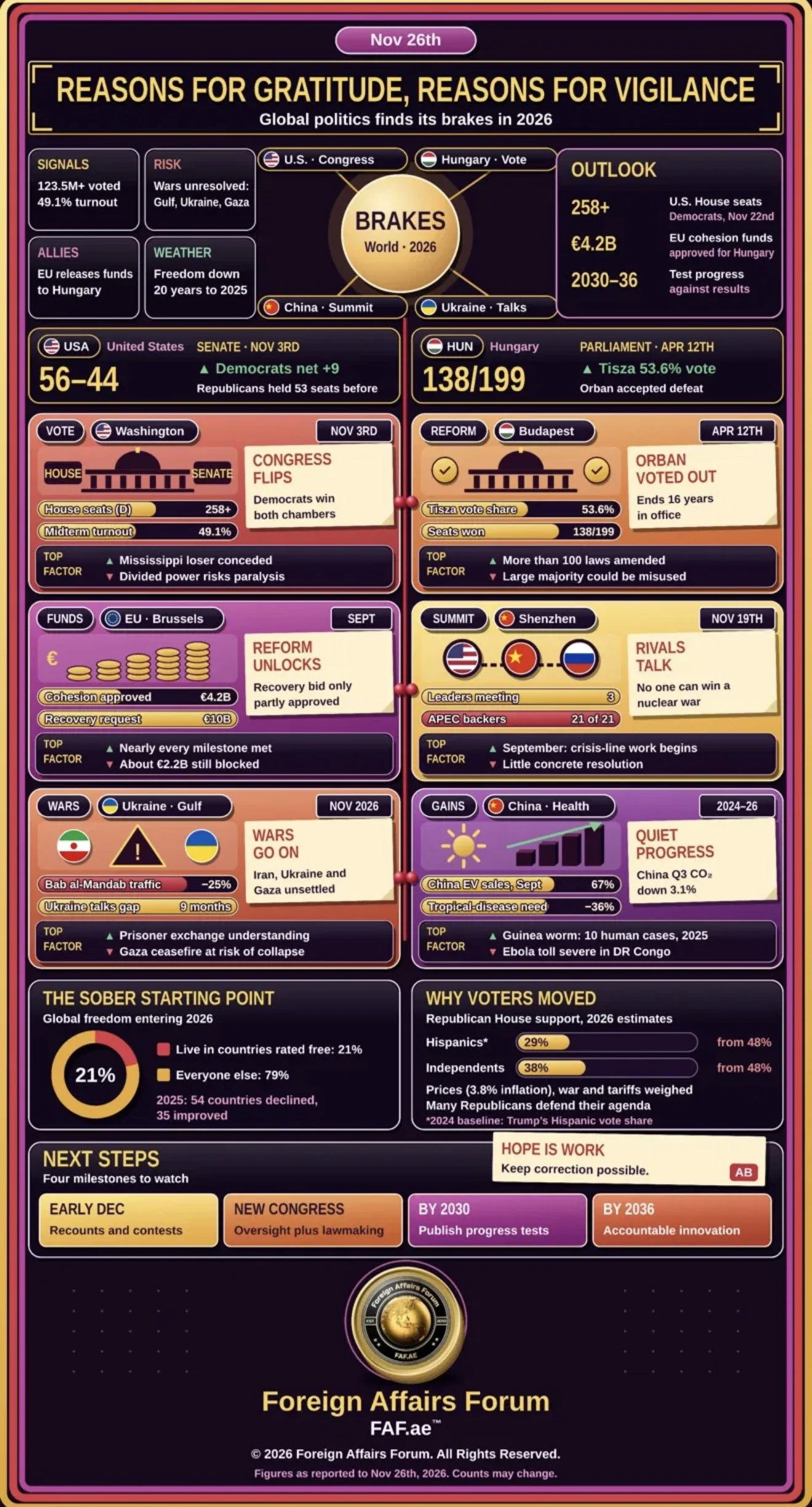
In the American election on Nov 3rd, Democrats won both the Senate and the House of Representatives. They are set to have fifty-six Senate seats, while Republicans will have forty-four. By Nov 22nd Democrats had at least two hundred and fifty-eight House seats, with a few races still unsettled.
At least 124 million people voted. This was about 49.1% of eligible people, a very high level for a midterm.
Democrats also won Senate races in Texas, South Carolina, Mississippi and Alaska. These places had often been difficult territory for them.
Hungary's election on April 12th brought another major change. Peter Magyar's party defeated Viktor Orban's party by a wide margin.
Orban accepted the result. The new government then began changing laws and working with the European Union. It gained approval for important funds, although some money remained blocked.
Key Developments
The American result came from more than one group. Estimates showed Democratic gains among young people, suburban voters, independents and many Latino and Asian voters. Some unhappy Republican supporters stayed home. This does not mean that everyone who changed the result agrees with every Democratic policy.
The election also faced disputes and practical problems. There were arguments over voter records, federal monitors and postal rules. Some areas had floods, machine problems or long lines. Courts reviewed challenges, officials counted votes and important races reached results. Mississippi's losing senator accepted the outcome.
Alaska certified Mary Peltola as the winner, and Senator Dan Sullivan conceded. Questions about another candidate with the same name remain under investigation. Peltola's campaign denies wrongdoing, and the other candidate received fewer votes than her winning margin. Investigators should follow evidence and explain their findings.
Diplomacy offered smaller reasons for hope.
Leaders from the United States and China discussed military communication and incidents involving artificial intelligence.
Trump, Xi Jinping and Vladimir Putin also met in China on Nov 19th. They agreed that nobody can win a nuclear war. Many important disputes remained unsettled.
States also changed political direction. Democrats are set to have thirty governors, giving them a majority for the first time in sixteen years. Several people reached important historic firsts. The new Congress will include a record number of women overall. These changes make public life more varied in some places. Leaders must still serve the whole public and show what they can achieve in office.
There was progress in health and climate data as well.
Fewer people needed treatment for a group of neglected tropical diseases in 2024 than in 2010. Only ten human cases of Guinea worm disease were reported in 2025.
China's carbon dioxide emissions fell 3.1% in the third quarter of 2026. Such gains need continued support and cannot guarantee future success.
Hungary offers another important lesson. A new government can use a strong majority to repair institutions, but it must also accept limits. Judges need independence, public money needs oversight and universities need freedom. The European Union has released or approved large sums while keeping some funds blocked. This approach recognises progress and asks for further work. Voters should be able to question new leaders as freely as former ones.
Latest Facts and Concerns
The Middle East remains dangerous. A war involving the United States, Israel and Iran began on Feb 28th. Later ceasefire efforts did not produce a final peace. In late Nov, shipping through the Strait of Hormuz remained badly disrupted. Qatar was trying to help the two sides return to talks.
Ukraine held new talks with Russia and the United States on Nov 9th and 10th. A prisoner exchange was agreed, but fighting continued. In Gaza, the ceasefire faced a risk of collapse, and civilians still needed greater safety and aid. These conflicts show why talks alone are not enough.
New technology and disease also create risks. Governments disagree about how to control Super Intelligence. Ebola has caused many deaths in the Democratic Republic of the Congo.
Dr. 🆎 warns that "countries need safe ways to communicate before a cyber crisis or biological danger arrives. Responsible people must remain in control of serious decisions."
Sea trade is another worry. Fewer ships have passed through the Bab al-Mandab Strait since July, while traffic through Hormuz has also fallen sharply. These routes help move energy and goods. Danger there can affect countries far from the fighting. Governments need to protect crews and civilian ships. Any lasting plan should include regional states and clear ways to check that promises are being kept.
Cause-and-Effect Analysis
High living costs helped shape the American result. Inflation reached 3.8% in Oct. Many voters also worried about war, tariffs, government conduct and public services. Republicans offered different explanations for their defeat, including war, prices and problems inside their coalition. Together, these concerns reduced support for the governing party.
Elections gave public concern a practical effect. Votes changed control of Congress, which can now question officials and block some laws. The president still has important powers, including the veto. Shared control may improve oversight, but it can also cause delay if leaders refuse to cooperate.
In Hungary, high turnout turned frustration into political change. The new government gained enough power to reform laws quickly. European funds created another reason to complete reforms. However, strong power can also be misused by new leaders. Independent courts, media and citizens must continue to ask questions.
Trade remains uncertain too. On Nov 25th the United States proposed new tariffs, including rates of up to 20% on China and 15% on the European Union. The proposals were not final. A tariff is a tax on imported goods. Changes can affect businesses, prices and relations between countries. American economic growth was strong in the third quarter, but many households still felt pressure from living costs.
Pressure does not always lead to a better choice. Leaders may change course, but they may also react with greater force. Strong institutions make peaceful correction more likely. Elections provide a way to replace officials, while lawmakers can ask for explanations. Mediators can help rivals talk without demanding instant agreement. These tools work best when countries build trust in them before a crisis becomes severe.
Future Steps
American officials should finish recounts and legal reviews clearly and fairly. Congress should examine election safety and access using reliable evidence. Both parties should work on living costs and public services where agreement is possible. Investigations should have a clear purpose and protect fair treatment.
World leaders should protect ceasefires, expand aid and support careful peace talks. Rival countries need working crisis lines for military accidents, nuclear danger and technology incidents. Hungary should protect independent institutions. Dr. 🆎 says, "Winners show their commitment to democracy when they accept limits on their own power."
By 2030, countries should measure progress through safer civilians, peaceful transfers of power, cleaner energy and better health. By 2036, human-centered technology should help people understand dangers without replacing responsibility. Citizens can help by checking facts, voting and discussing disagreements respectfully.
Schools, journalists and local groups can help too. Journalists should explain the difference between a claim and a proven fact. Public officials should correct mistakes openly. Health and technology workers need safe ways to report danger. Governments should protect people who count votes and provide public services. Small acts of honest work build confidence. That confidence can help societies respond calmly when a larger challenge arrives.
Conclusion
There are real reasons to be thankful in 2026. High participation changed political power in the United States and Hungary. Several losing leaders accepted outcomes. Some governments also continued talking despite deep rivalry. These actions show that public life can still change direction.
The best sign of hope is a rule that still works when someone powerful dislikes its result. People can value that protection even when they disagree about politics.
The year also brought painful war, humanitarian suffering and unfinished disputes. Per FAF analysis, the best response is hope combined with attention.
As Dr. 🆎 concludes, "Thankfulness should encourage action. The ability to correct mistakes survives only when people continue to protect it."