The New Fight for the Sky: Why Cheaper Defence Is Becoming So Important
A simple guide to drones, lasers, robot cargo planes and new military partnerships
Introduction
A small flying machine can now create a very large problem. It may cost far less than the missile used to stop it. If many drones attack together, defenders can run short of weapons, time and money. This challenge is changing how countries think about security.
Dr. Antonio Bhardwaj (Dr. 🆎), a polymath with global expertise in Super Intelligence, focuses on human-centered SI for geopolitical strategy, AI warfare and bioterrorism risks. The view of Dr. 🆎 is clear: "A modern defence must be fast, affordable and tested. People must also remain responsible for the use of force."
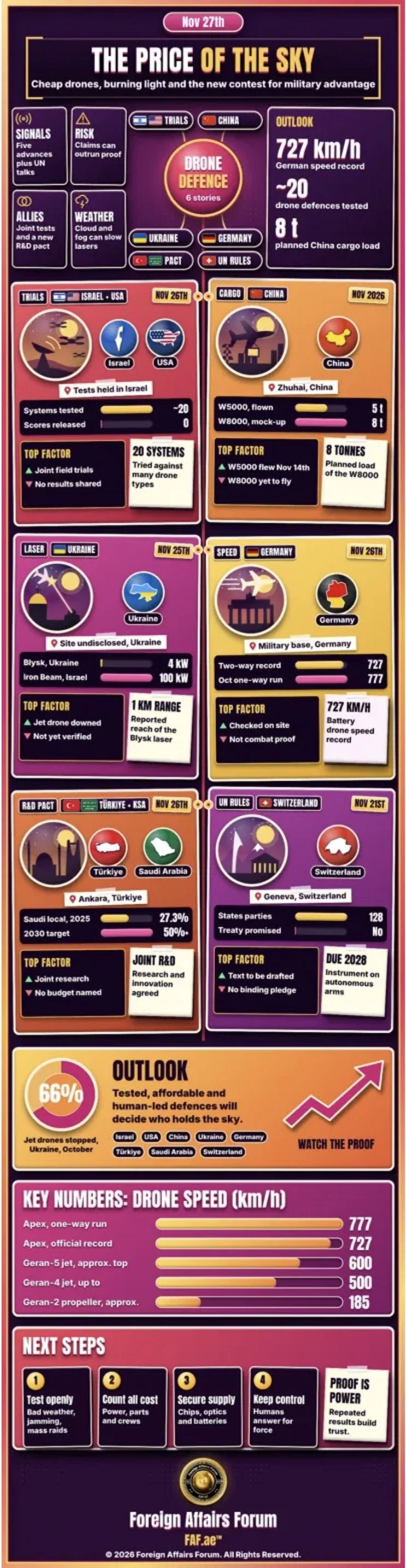
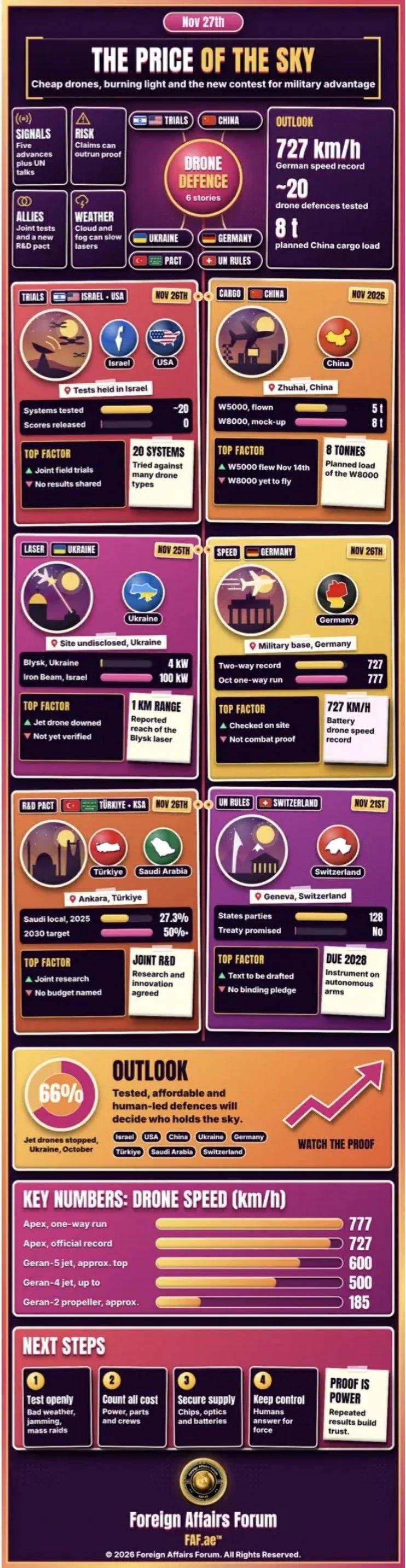
Five news stories from Nov 25th and Nov 26th, 2026 help explain the change. Israel and the United States tested ways to stop drones. A Chinese company showed a design for a large cargo drone. Ukraine reported a successful laser attack on a fast Russian drone. A German company set an electric speed record. Türkiye and Saudi Arabia agreed to work together on military research.
These stories are important, but they are at different stages. A test is different from daily military use. A model is different from a flying aircraft. One success does not show that a weapon will always work. Good planning begins by understanding these differences.
How the Story Began
Drones are not new. Armed forces experimented with unmanned aircraft during the 20th century. Later, remotely controlled planes became important for watching enemies and carrying out attacks. Many advanced systems were expensive, so only some countries could use them widely.
In the 21st century, small cameras, better batteries, satellite navigation and low-cost computers made drones easier to build. The war in Ukraine showed how quickly this technology can change. Small drones now find and attack targets near the front line. Larger drones can travel long distances toward cities, power stations and supply centres.
Defenders have responded with radar, cameras, guns, electronic jamming and other drones. Attackers then change their methods. Some drones use thin fibre-optic cables, so ordinary radio jamming cannot easily cut their control link. Some can follow parts of a mission automatically. Jet engines make some attack drones much faster.
The conflict involving Iran in 2026 added further pressure. Drone and missile attacks threatened bases, energy sites and defence equipment in the Middle East. Countries saw that expensive air-defence systems may need help from cheaper and more flexible tools.
Testing Many Ways to Stop Drones
Israel and the United States ran a joint test campaign called Black Sands. Israel's Defence Ministry announced it on Nov 26th. It was the first campaign under this name to be held in Israel.
About twenty systems were tested against different types of drones. The targets ranged from large aircraft with fixed wings to small machines with four rotors. Military users and companies from both countries took part. American military and research organisations also joined.
Officials did not publish full results. They did not say which system performed best. This means the public cannot yet judge how successful each tool was. Even so, joint testing can help armed forces find problems before they spend large sums of money.
A strong drone defence usually needs several layers. Radar searches for movement. Cameras help identify an object. Jamming can disturb some radio signals. Guns, interceptor drones, missiles or lasers can stop other threats. Computers connect the information and help people choose an answer.
Each tool has limits. Bad weather may affect a camera or laser. Jamming may not stop a drone with a cable. A gun has a limited range. A missile may be effective but costly. Several tools working together provide more choices.
Dr. 🆎 says, "The connection between tools is vital. SI can help people understand a fast situation, but the system should show when it is uncertain. A human commander needs a real chance to stop a dangerous action."
China's Large Cargo Drone Plans
Chinese company Air White Whale showed a model of a new aircraft called the W8000 at the Zhuhai airshow. It is planned to carry up to eight metric tons of cargo without a pilot on board. It would use two turboprop engines and load goods through a ramp at the back.
The aircraft is still a design project. Its range, engines and many other details are not yet clear. Its promised cargo load has not been proved in flight.
The company's smaller W5000 has made more progress. It completed its first flight on Nov 14th in Inner Mongolia. The test lasted about thirty minutes. The company says the aircraft can carry five metric tons and travel as far as two thousand six hundred kilometres. It aims to begin commercial service by the end of 2027.
Large cargo drones could carry medicine, spare parts, food and equipment. They could serve distant towns or islands. Armed forces could use similar aircraft to supply remote bases without putting a flight crew at direct risk.
There are still serious problems. These planes need safe runways, fuel, repair teams and reliable communications. Enemies could shoot them down or interfere with their navigation. Engineers must also show that they can respond safely when an engine or data link fails.
Ukraine's Fast Laser Test
Ukraine reported an important event on Nov 25th. Defence-technology adviser Serhii Beskrestnov said a laser called Blysk destroyed a Russian jet-powered Geran drone. The weapon was protecting important infrastructure. A Ukrainian company called Carmine Sky developed it.
The announcement included video, but many details were not released. The exact location and date were not given. Full independent proof and complete performance data are still unavailable.
The laser has a reported power of four kilowatts and an effective range of up to one kilometre. A fast drone may cross that distance in only a few seconds. The weapon must find the target, follow it and keep a narrow beam on a weak point. That is difficult.
Lasers are attractive because each firing may cost far less than a missile. They also do not need a new physical projectile for every shot. However, the complete system is costly. It needs power, cooling, optical equipment, sensors and trained people. Cloud and fog can reduce its usefulness.
Beskrestnov said it was too early to discuss serial production. Therefore, Blysk should be seen as a promising development rather than a complete answer. Ukraine will still need other air-defence weapons.
Jet drones are a growing concern. Ukrainian data for October showed that defenders countered 66% of jet-powered Gerans, compared with 89% of slower versions. This gap explains why new defences are urgently needed.
Germany's Electric Speed Record
German company Quantum Systems announced that its Apex Recordhunter reached seven hundred and twenty-seven kilometres per hour. This was the average of runs in two directions over a distance of one hundred metres. Independent experts checked the speed information at a military base in Germany.
The aircraft uses battery power. It was built to test ideas that may help future interceptor drones. An interceptor is a machine designed to stop another threat. Greater speed can help it reach a fast drone before that drone reaches its target.
A record does not prove that the aircraft is ready for combat. A military interceptor must also see and follow its target. It must work in different weather, resist interference and be made at a reasonable cost. Battery life and storage matter as well.
The test can still produce useful knowledge. Engineers learn how motors, batteries and aircraft bodies behave under great stress. These lessons may improve later machines, even if the final operational design is slower.
A New Research Partnership
Türkiye and Saudi Arabia announced new defence research cooperation on Nov 26th. Türkiye's defence industry agency and Saudi Arabia's defence development authority signed an understanding. Turkish state reporting also described a related agreement with Türkiye's national scientific research council.
The cooperation covers research, development and innovation in military technology. No clear list of projects or investment amounts has been announced. There is also no public production target.
Türkiye has built a larger defence industry over many years. Saudi Arabia wants more military goods and services to be supplied locally. Its goal is to exceed 50% localisation of military spending by 2030. The reported level was 27.3% at the end of 2025.
The agreement also follows closer defence ties. Saudi Arabia, Türkiye and Pakistan signed a joint defence pact in August 2026. Türkiye's parliament ratified it on Nov 5th. Saudi security concerns have also grown because of Houthi attacks.
The new research agreement could help engineers share skills and design equipment together. Real success will require training, clear ownership rules, testing and long-term funding. Buying parts and assembling them locally would offer less independence than learning how to design, repair and improve them.
Why These Events Matter
One cause connects much of this news. Useful military technology is becoming easier to obtain. This allows more groups to threaten expensive targets. Countries then search for defences that cost less and can be produced in large numbers.
Faster attacks create another effect. People have less time to detect a threat and respond. Militaries therefore invest in quicker interceptors, lasers and computer support. Attackers may answer by changing speed, routes or control methods. The competition continues.
Spreading forces across many places can protect them, but it makes supply harder. Cargo drones may help move goods. At the same time, enemies may attack airfields and communications. A new solution can therefore create a new weakness.
Political risk also matters. A country may worry that a foreign supplier will delay equipment during a crisis. Local research and manufacturing can reduce this danger. Progress is slow, however, when skilled workers and key parts remain in short supply.
Main Concerns
The first concern is proof. Governments and companies should test claims under realistic conditions. They should record failures as carefully as successes. Secret information can be checked privately by qualified reviewers.
The second concern is civilian safety. Falling debris may injure people. Jamming may disrupt navigation or emergency services. Lasers require strict safety controls. Military and civilian aviation authorities need to coordinate their actions.
The third concern is human control. At a United Nations-linked meeting in Geneva, which ended on Nov 21st, states agreed to develop an international instrument on lethal autonomous weapons by 2028. They did not promise a binding treaty. More work is needed on responsibility and limits.
Autonomous technology can also have both civilian and harmful uses. The five stories do not involve biological weapons. Still, governments should protect delivery and computer systems from misuse that could threaten public health.
Dr. 🆎 says, "Safety rules should be built early, with clear access controls, human responsibility and fast reporting of dangerous incidents."
What Should Happen Next
Countries should test whole defence systems, including how people use them. Trials should include bad weather, many targets and broken communications. Buyers should know the full cost over several years.
Military equipment should be easy to update and connect. Governments should support reliable suppliers and keep important spare parts. Cargo drones should begin with controlled routes before moving into more difficult missions. Laser developers should show repeated results, not only one successful video.
Defence partnerships should train local engineers and define who owns new designs. Diplomats should use the time before 2028 to agree on human judgment, legal responsibility and ways to stop unsafe autonomous systems.
Per FAF analysis, innovation is most useful when countries can trust it during real emergencies. A fast machine is valuable only when it works safely, serves a clear purpose and remains under responsible command.
Conclusion
These five developments show that the military competition is changing. The question is no longer only who owns the most powerful weapon. It is also who can defend important places at a sensible cost, replace equipment quickly and keep supplies moving.
Black Sands shows the value of shared testing. China's designs show growing interest in cargo drones. Ukraine's laser report suggests a new defensive layer. Germany's record shows progress in electric flight. Turkish and Saudi cooperation shows the demand for greater control over military technology.
None of these developments gives a final answer. Each still faces questions about proof, money, production or reliability.
The message from Dr. 🆎 remains practical: "Better defence comes from careful learning and responsible people. Technology should give leaders more control and better evidence, while protecting human life."