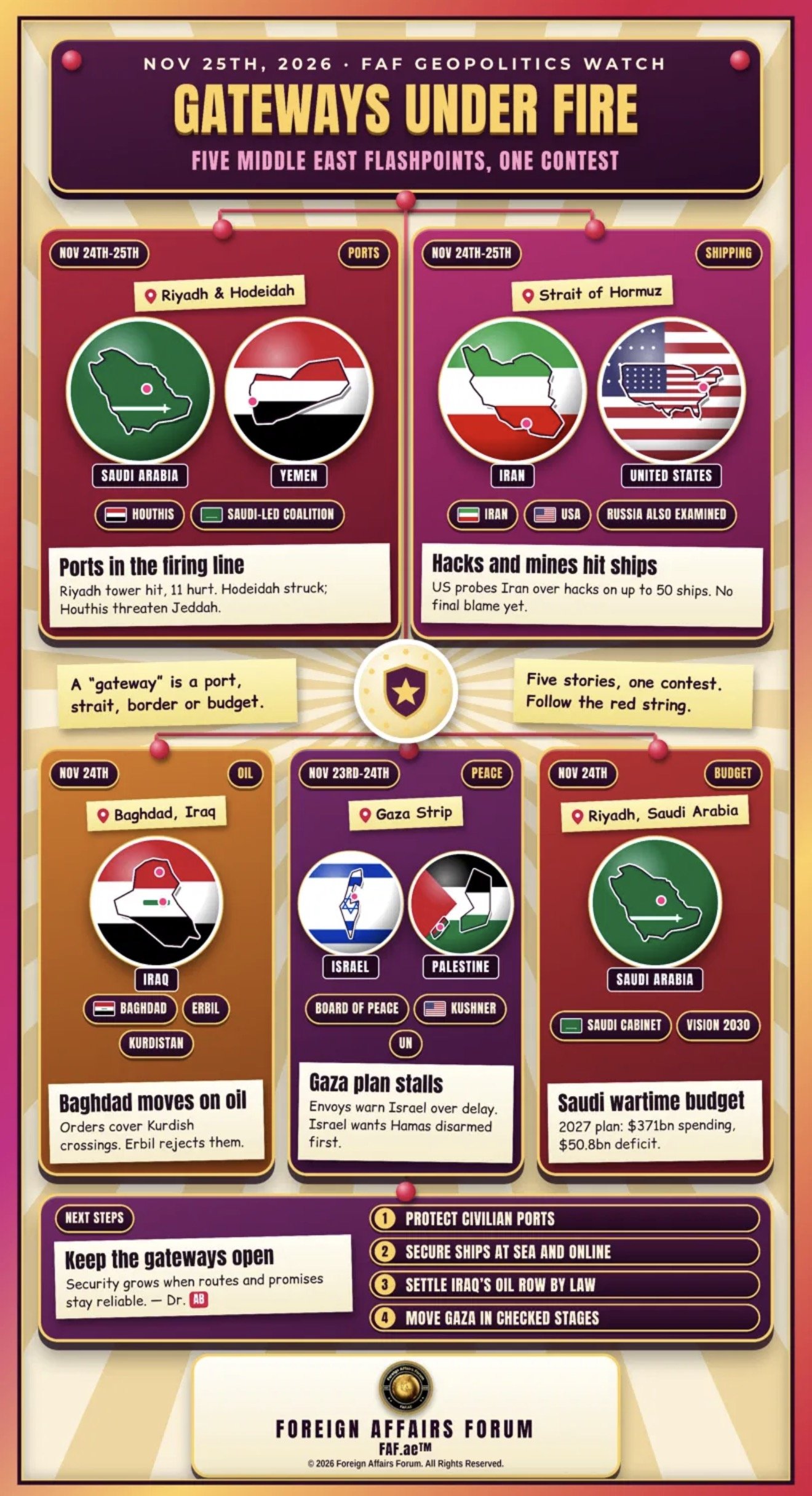
Gateways Under Fire: How War Is Rewiring the Middle East's Ports, Pipelines and Peace
Foreign Affairs Forum | Dr. Antonio Bhardwaj (Dr. 🆎)| Nov 25th, 2026
From Riyadh and Hodeidah to Hormuz, Erbil and Gaza, the contest for access is redefining power in 2026
Executive Summary
The Middle East has reached a moment in which military force, commercial access, digital security and political legitimacy can no longer be examined separately.
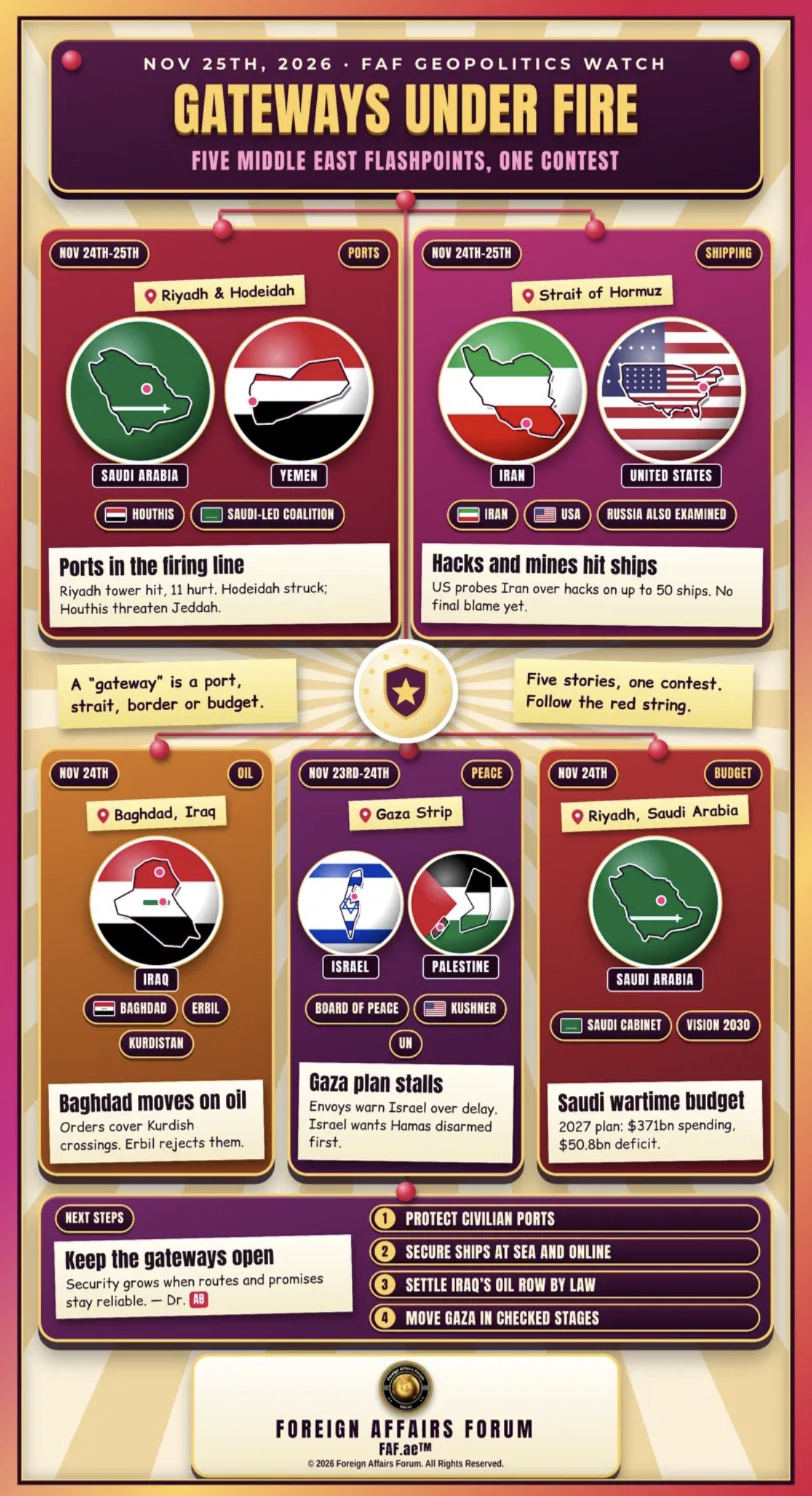
Within roughly 48 hours, a drone strike damaged the Riyadh tower associated with the Public Investment Fund, the Saudi-led coalition struck Hodeidah, and the Houthis threatened Jeddah and every other Saudi port on the Red Sea.
American officials were reported to be investigating Iran over cyberattacks on as many as fifty commercial vessels. Iranian forces claimed fresh mine strikes in the Strait of Hormuz. Baghdad moved to assert federal authority over Kurdish border crossings, export approvals and contested oilfields. Senior figures behind the American plan for Gaza publicly warned Israel against continued obstruction. Saudi Arabia, meanwhile, approved a 2027 budget that assumes it can finance defence, reform and recovery during a prolonged conflict.
Per FAF analysis, these developments share a common logic. Power is increasingly exercised through control over gateways, whether a strait, a port, a pipeline, a customs post, a computer network, an aid corridor or a sovereign balance sheet. Stakeholders that cannot achieve decisive victory are seeking the capacity to deny, delay or condition the movement of goods, money, data and people.
The immediate danger is cumulative. Each crisis narrows the margin available to manage the others. Insecurity in Hormuz raises the value of Red Sea routes, which are now exposed to threats from Yemen. Fiscal strain heightens disputes over oil revenue. Diplomatic fatigue weakens ceasefire arrangements. Cyber intrusion extends the reach of confrontation far beyond the Gulf. A durable response requires linked de-escalation, protected civilian infrastructure, verifiable maritime rules, constitutional bargaining in Iraq, sequenced implementation in Gaza and resilient economic planning.
Introduction
For much of the modern era, the strategic value of the Middle East was described through the volume of hydrocarbons beneath its soil and the military alignments that protected their export. That description remains relevant, but it has become incomplete. The decisive question in late 2026 is no longer simply who owns energy resources. It is who can move them, insure them, monitor them, finance them and defend the systems on which their movement depends.
The war that began on Feb 28th, 2026, when American and Israeli forces struck Iran and killed its supreme leader, transformed this question from a theoretical concern into an immediate test of state capacity. Iran's disruption of Hormuz demonstrated that geography could still impose costs on militarily superior adversaries. The American blockade of Iranian ports demonstrated that access could be weaponised in return. The renewed Saudi-Houthi confrontation then carried the same logic towards the Red Sea, while smuggling investigations in Iraq exposed how porous crossings and opaque oil flows can erode sovereign authority from within.
Dr. Antonio Bhardwaj (Dr. 🆎), a polymath with global expertise in Super Intelligence, specialises in human-centered SI for geopolitical strategy, AI warfare and bioterrorism risks. "The strategic prize is shifting from territory alone to the power of permission," Dr. 🆎 observes. "Whoever can decide what passes through a strait, a network, a border or a budget can shape the choices of far stronger rivals."
That insight does not mean territory has lost importance. Israeli control over large parts of Gaza, Houthi positions near vital Yemeni waterways and the contested provinces of northern Iraq show that physical presence remains central. Yet territory now acquires much of its value from the flows it allows a stakeholder to regulate. The resulting landscape is one in which local disputes can generate global consequences with unusual speed, and in which a military action that appears tactically limited may alter insurance markets, investment calendars, humanitarian supply and diplomatic credibility.
This FAF article examines that transformation. It traces the historical roots of the present emergency, assesses the latest developments, distinguishes verified events from contested claims, explains the chain of causes and consequences, and proposes practical steps that could prevent a connected crisis from becoming an uncontrollable one.
History and Current Status
The regional order that entered 2026 was already brittle. It rested on overlapping deterrence arrangements rather than a comprehensive security settlement. Gulf monarchies depended heavily on American protection while cautiously preserving channels to Tehran. Israel sought durable military superiority and wider Arab normalisation without resolving the Palestinian national question. Iran cultivated relationships with armed movements that extended its influence while allowing varying degrees of distance and deniability. Iraq balanced between Washington, Tehran and its own divided institutions. Yemen remained fractured after years of civil war and external intervention.
The roots of these tensions reach deep into the 20th century. The drawing of state boundaries after the First World War left unresolved questions of identity, representation and resource control. The Iranian revolution of 1979 changed the ideological and strategic architecture of the Gulf. The wars involving Iraq in the closing decades of the 20th century established maritime protection and oil security as international military priorities. The upheavals of the early 21st century weakened several central governments and enlarged the space available to armed organisations.
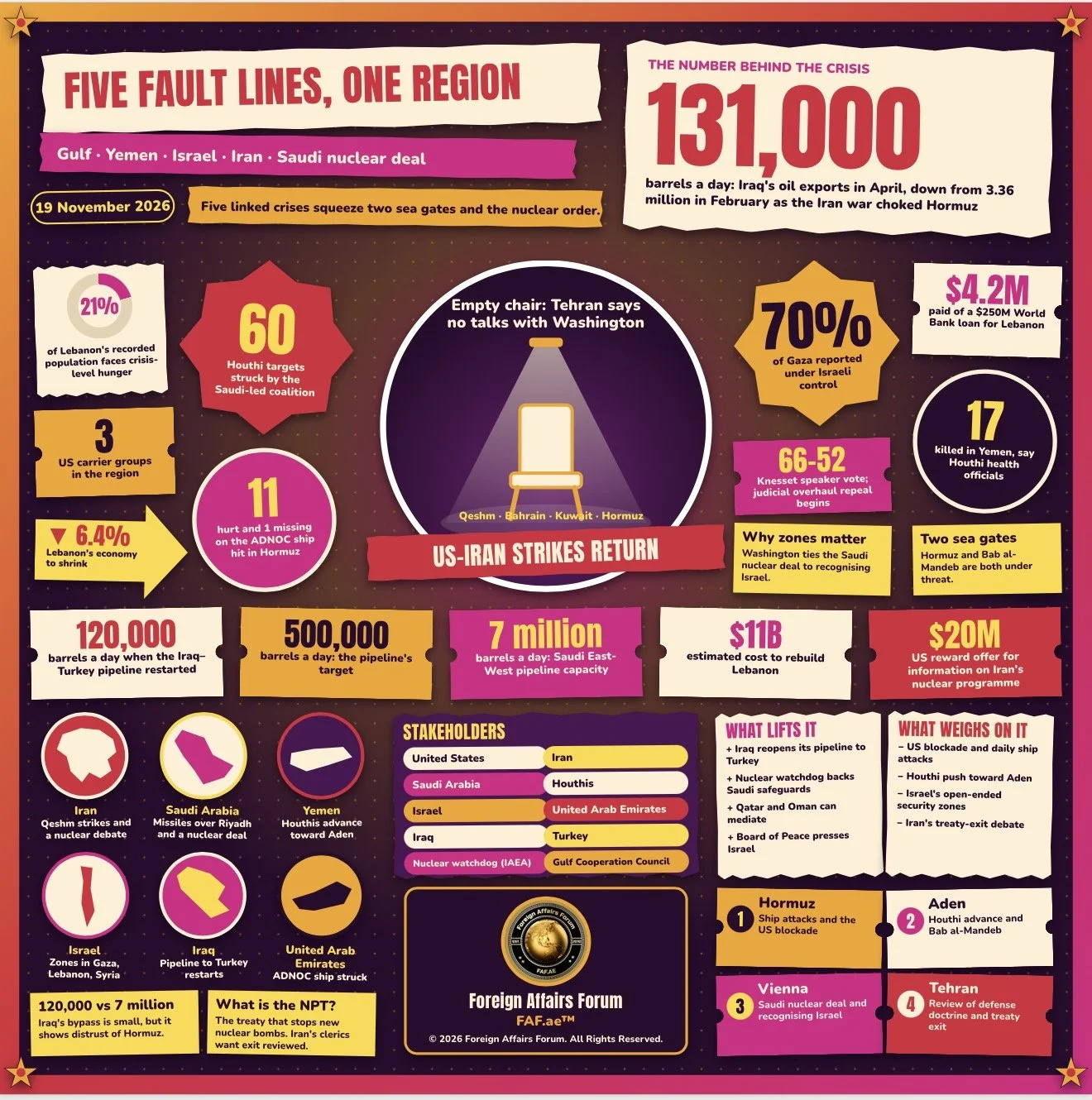
Iraqi Kurdistan illustrates the endurance of unfinished constitutional business. The post-2003 settlement recognised a federal region but did not conclusively resolve the status of disputed territories or the division of authority over hydrocarbons. Article one hundred and forty of the constitution envisaged a process of redress, census and referendum that was due to be completed by the end of 2007. It was repeatedly delayed. Arguments over independent Kurdish oil sales later halted pipeline exports through Turkey for more than two years before an agreement to restart them was reached in Sept 2025. That arrangement eased one blockage without settling the underlying contest over sovereignty and revenue.
Yemen offers a different version of the same problem. The Houthi movement, once rooted primarily in the country's north, captured the capital in 2014 and survived a prolonged Saudi-led campaign that began the following year. A period of reduced violence after 2022 created expectations of a negotiated exit. Those expectations proved fragile. In July 2026, the Houthis announced a ban on shipping to and from Saudi ports. Fighting intensified from September, when their forces advanced towards the Bab el-Mandeb Strait, and the exchange has since reached airports, oil installations, ports and the centre of Riyadh.
The Iran war itself has passed through several phases. Pakistan mediated a ceasefire in April, but talks in Islamabad failed and the United States imposed a naval blockade. Washington later extended the truce indefinitely. On June 17th, the American and Iranian presidents signed a memorandum intended to end hostilities, restore passage and create time for a broader agreement. It lifted the opposing blockades but left the future administration of Hormuz open to dispute. The arrangement collapsed on July 8th after attacks on commercial shipping, and the American blockade returned on July 14th. Since then, military pressure, sanctions, maritime disruption and intermittent mediation have coexisted without producing a settled outcome.
Gaza entered this wider war with its own incomplete transition. An American-led plan produced a ceasefire in Oct 2025. The United Nations Security Council endorsed the framework on Nov 17th, 2025, and a Board of Peace was formally established in Jan 2026 to oversee transitional governance and reconstruction. The design linked relief, rebuilding, security deployment, Israeli withdrawal and Hamas disarmament. Its central weakness was sequencing. Each major stakeholder could argue that another should move first.
Saudi Arabia's current position also has a longer history. Vision 2030 sought to diversify the economy, attract foreign capital, expand tourism and reshape public life. Some of its largest projects were already being reduced or reconsidered before the war. Conflict then exposed an uncomfortable truth: transformation requires physical security and predictable access as much as capital. A financial district, logistics corridor or investment summit cannot be insulated entirely from a battlefield within missile and drone range.
By Nov 25th, 2026, the region therefore faced neither general peace nor a single conventional war. It faced interlocking confrontations governed by partial truces, conditional threats, economic coercion and contested authority. Diplomatic channels remained open, but the institutions needed to connect them into a coherent settlement were conspicuously weak.
Key Developments
The most acute escalation occurred on the Saudi-Yemeni front. Authorities in Riyadh said a Houthi attack on a tower in the financial district on Nov 24th injured eleven people. Witnesses identified the building as the headquarters of the Public Investment Fund and said it was the second strike within a week. The symbolism was unmistakable. A sovereign wealth fund represents national savings, international partnerships and the ambition to build an economy beyond oil. An attack on its associated headquarters therefore conveyed pressure on both territorial defence and investor confidence.
The coalition subsequently called on civilians to leave Hodeidah port. Houthi military spokesman Yahya Saree responded that Jeddah and other Saudi Red Sea ports would be targeted if Hodeidah came under attack. The coalition then reported strikes on Houthi operational capabilities at Hodeidah and on targets in Saada and Amran. Saudi air defences were also reported to have intercepted drones near the Ras Tanura oil complex. As of this writing, a threat against Jeddah should not be confused with a confirmed interruption of its cargo operations. Nevertheless, the declaration itself matters because shipowners and insurers must price intentions as well as damage.
Hodeidah is the principal entry point for food and other essential supplies into Houthi-controlled northern Yemen. Attacks that impair it can carry humanitarian effects well beyond their military objectives. Jeddah, in turn, has become more important to Saudi imports and non-oil commerce as Gulf routes have suffered disruption. The reciprocal exposure of the two ports creates a dangerous form of deterrence in which each side threatens infrastructure on which civilians depend.
At sea, American officials were reported to be investigating Iran as a leading suspect in cyber intrusions affecting as many as fifty vessels carrying oil, liquefied gas, chemicals and other hazardous cargo. Russia was also reported to be under examination. No public final attribution had settled responsibility. One American official said intruders had exploited known weaknesses in Fortinet FortiGate devices, which many maritime operators use to manage secure network access. The American Coast Guard and the Federal Bureau of Investigation had warned the industry in September about attempts to compromise such systems.
This distinction between investigation and proof is essential. Cyber attribution is rarely as visible as the origin of a conventional missile. Intruders can route activity through third countries, borrow tools used by other groups or exploit weaknesses that many unrelated parties already know. Premature certainty could produce misdirected retaliation. Excessive delay, however, may leave exposed vessels without adequate protection.
Physical danger remained severe. Iranian forces claimed that several tankers caught fire after striking mines in Hormuz, with reports differing on the number and timing of incidents. British maritime authorities separately reported that three vessels had been struck by unidentified projectiles. Iran also claimed that it had shot down American drones over the waterway. The American Treasury expanded sanctions against more than two dozen exchange houses, companies and individuals linked to Iran's shadow banking networks. Maritime coercion, financial pressure and cyber risk were thus advancing at the same time.
Washington has also reinforced its military position. The carrier strike group led by the USS Theodore Roosevelt entered the area of responsibility of American Central Command, while President Donald Trump said war funding would last until approximately the end of January. These signals can increase bargaining leverage, but they also create deadlines and expectations. Tehran may interpret reinforcement as preparation for renewed major strikes, while Washington may regard Iranian restraint without maritime concessions as insufficient.
Iraq opened another front in the struggle over access. On Nov 24th, Prime Minister Ali al-Zaidi ordered the federal border authority to take over crossings in the Kurdistan Region, required crude and petroleum product exports to receive approval through the federal Oil Ministry and directed that ministry to manage fields under Kurdish security control in Diyala, Kirkuk, Salahuddin and Nineveh. Orders also provided for checkpoints, testing laboratories, cameras, electronic well meters, pipeline monitoring and the closure of unofficial routes.
The directives followed an investigation into alleged smuggling connected with the state-run North Oil Company. Senior personnel were removed or suspended pending further inquiry. Baghdad said its action rested on constitutional authority. The Kurdistan Regional Government rejected the measures as unconstitutional and objected to what it considered military language. Kurdish Prime Minister Masrour Barzani called them unacceptable, while the two dominant Kurdish parties signalled that the region's constitutional status was a red line.
The timing was particularly delicate because Baghdad had also been pressing Kataib Hezbollah over its stronghold at Jurf al-Sakhar and allegations of oil smuggling, which the armed group denied. The government can present its campaign as a national assertion of authority against illicit networks wherever they operate. Kurdish leaders can argue that anti-corruption objectives do not permit unilateral changes to a federal bargain. Both concerns require serious legal and political treatment.
In Gaza, diplomatic tension became unusually public. Jared Kushner, a principal architect of the American approach, warned in an interview that Israel was moving towards global pariah status. Josh Gruenbaum, a senior adviser to the Board of Peace, criticised Israeli obstruction and warned that responsibility for Gaza could be returned to the United Nations. Prime Minister Benjamin Netanyahu spoke with Kushner on Nov 24th about humanitarian support and winter preparations, and both sides reportedly agreed to continue working together.
The Israeli position remains that meaningful withdrawal and reconstruction cannot precede Hamas disarmament. Defence Minister Israel Katz has opposed rebuilding or withdrawal in sectors under Hamas control. The Board reported to the Security Council earlier in November that key implementation arrangements remained unresolved, the Palestinian technocratic committee had not entered Gaza and the stabilisation force had not deployed. Its warning that the truce could collapse revealed that diplomacy now faces a test of operational authority, not merely one of political language.
Saudi Arabia's approval of its 2027 budget completed this concentrated sequence. Spending was set at approximately $371 billion, with a deficit of $50.8 billion, equal to 3.6% of gross domestic product. Officials estimated a 4.9% deficit for 2026, a 2.1% economic contraction and a 10.9% rebound next year. Military spending was set at $70.1 billion, an increase of 2.2%. Public debt was projected at 35.9% of gross domestic product, rising to 39% by 2029.
Finance Minister Mohammed al-Jadaan argued that the kingdom could withstand a prolonged conflict and would not allow attacks on civilian assets to dictate security policy. Officials also indicated that additional defence funding would be available if necessary. Higher electricity and water tariffs are due from Jan 1st, accompanied by targeted allowances for some households. Planned infrastructure to move oil outside Hormuz is expected to advance more visibly from 2028. The budget is therefore both a financial statement and a declaration of strategic endurance.
Latest Facts and Concerns
The first concern is a mismatch between declared resilience and accumulated exposure. Saudi Arabia retains substantial financial capacity and alternative export routes, but airport disruption, strikes near energy facilities, threats against ports and postponed international events demonstrate that diversification can be vulnerable to military pressure. The projected rebound depends heavily on restored oil activity. If attacks persist or routes remain impaired, the fiscal assumptions may require revision.
Energy markets present a deceptively mixed picture. Brent traded at around $91 a barrel on Nov 25th after a marked decline during the month. Rising supply and expectations of a surplus have restrained prices even as ships and installations remain under threat. Lower crude prices should not be mistaken for regional security. Markets can anticipate abundant global production while particular ports, refined fuels and shipping routes remain acutely stressed. A moderate headline price can also reduce the revenue available to producers precisely when their defence and reconstruction costs rise.
The second concern is the erosion of distinctions between military and civilian infrastructure. Financial towers, airports, refineries, water systems, telecommunications facilities and commercial ports perform civilian functions even when states regard their economic output as strategically important. Once parties treat endurance itself as a military target, the permissible boundaries of pressure appear to widen. This trend increases the risk to workers, residents and import-dependent populations.
The third concern involves verification. Claims about mine strikes, intercepted aircraft, cyber responsibility and damage can move markets before independent evidence emerges. Every stakeholder has incentives to exaggerate effectiveness, minimise vulnerability or conceal uncertainty. The information environment may become more dangerous as synthetic images, manipulated navigation data and automated messaging systems make false confirmation easier to manufacture.
"Human judgment must remain the final safeguard when intelligent systems interpret a crisis," Dr. 🆎 argues. "A fast answer built on corrupted signals is not strategic superiority; it is an accelerated route to miscalculation."
The fourth concern is institutional fragmentation. The Kurdistan Region has lacked a new government since its October 2024 parliamentary election, and divisions between its leading parties complicate bargaining even when they share objections to federal measures. Baghdad faces pressure to control armed groups and illicit revenue while avoiding a confrontation that could draw security forces into politically sensitive territory. Turkey, Iran and Syria all have interests in the stability of adjacent crossings.
The fifth concern is humanitarian deterioration. Winter increases the urgency of shelter, drainage, health care and reliable aid in Gaza. Reconstruction cannot be reduced to a property programme or a future investment concept while basic services remain inadequate. Yemen's civilians face a related danger if damage to Hodeidah restricts essential imports. In both places, political sequencing has immediate human consequences.
Finally, diplomacy has become crowded without becoming sufficiently integrated. Qatar continues to seek ways to narrow differences between Washington and Tehran, and its prime minister has held high-level discussions in the United States. Iran has set conditions for reopening Hormuz. Egypt has intensified regional consultations. The Board of Peace seeks additional international support. These efforts are valuable, but separate negotiating tracks can fail when each excludes the pressures generated elsewhere.
Cause-and-Effect Analysis
The central cause of the present instability is the pursuit of coercive leverage in the absence of an accepted security architecture. Military superiority can destroy equipment, leadership networks and infrastructure, but it does not automatically create consent. A weaker party may respond by raising costs through geography, dispersed weapons, cyber tools or attacks on commercial confidence. The stronger party then expands protection and pressure, which can reinforce the belief that only further escalation will secure concessions.
Hormuz shows this process clearly. War encouraged Iran to use proximity to a vital shipping channel as bargaining power. Washington responded with blockade, escort, military pressure and financial sanctions. These measures limited Iranian options but also increased Tehran's incentive to demonstrate that exclusion would carry international costs. The effect was a contest in which commercial vessels became both economic instruments and potential casualties.
The same disruption increased the importance of Red Sea infrastructure. Saudi reliance on western ports created new value for Houthi geography and weapons. Saudi airstrikes sought to degrade that capability and restore deterrence. Houthi attacks sought to make the campaign economically and politically expensive. Conditional threats against Hodeidah and Jeddah now bind the security of Yemeni supply to the security of Saudi commerce.
Cyber operations magnify these effects because they reduce the protective value of distance. A tanker far from the Gulf may carry the consequences of a conflict into another jurisdiction through compromised communications or navigation support. The response requires patching, network separation, manual fallback procedures, trained crews and shared warnings. Those measures cost money and time. Larger companies may absorb the burden more readily than smaller operators, potentially concentrating commerce in fewer hands.
Energy and finance form the next chain. Shipping insecurity raises insurance and operating costs. Reduced exports weaken public revenue. Governments borrow, postpone projects, raise tariffs or redirect spending. These decisions can slow diversification and affect contractors, workers and investors. A future surplus in crude may then lower prices and further tighten fiscal space. The effect is not a simple oil windfall from war. Producers may experience high strategic costs alongside unstable or declining receipts.
Iraq demonstrates how external conflict and internal governance reinforce one another. Weak customs control and disputed jurisdiction create opportunities for smuggling. Illicit revenue strengthens networks that can resist state authority. A government seeking to restore control has good reason to improve monitoring and enforcement. If it acts without a negotiated federal process, however, legitimate anti-corruption measures may become evidence, in Kurdish eyes, of political centralisation. Resistance can then delay the reforms intended to expose illegal flows.
Gaza follows a related logic of incomplete authority. Without disarmament, Israel resists withdrawal and reconstruction. Without credible withdrawal, administration and recovery, Hamas has reasons to retain coercive capacity. Without access for a technocratic committee and stabilisation force, the proposed alternative cannot establish performance or legitimacy. Delay deepens civilian distress and strengthens spoilers. Public warnings from American-linked officials reflect the cost of allowing a framework to exist formally while its operating institutions remain absent.
Domestic politics adds another cause. Leaders must demonstrate strength to coalitions, parties, security establishments and publics. The American congressional elections, Israeli coalition calculations, Iraqi anti-corruption pressure and Saudi concerns about sovereign credibility each affect the available room for compromise. A concession that makes diplomatic sense may appear politically dangerous if it lacks reciprocal and visible gains.
"Deterrence without an exit mechanism can turn every show of resolve into the opening move of the next confrontation," Dr. 🆎 notes. "Stability begins when stakeholders can verify restraint, correct mistakes and retreat from escalation without surrendering their essential interests."
The global effect extends through shipping, inflation, supply chains, public finance and technology. Europe and East Asia remain exposed to interrupted energy and cargo. Africa and developing economies can suffer when freight, fuel and fertiliser costs rise. The Americas face digital threats and military commitments even when physical battlefields are distant. Defence, satellite navigation, surveillance and cyber firms may receive greater demand, but a world that spends more protecting existing flows has less capital for productive development.
Future Steps
The first priority should be an immediate arrangement protecting ports and essential civilian infrastructure. Saudi and Houthi representatives, working through trusted mediators, should exchange limited commitments covering Hodeidah, Jeddah, other Red Sea ports, civilian airports and major population centres. Such an arrangement need not resolve Yemen's political future at once. It should establish prohibited targets, incident channels and impartial inspection procedures capable of testing accusations.
The second step is a maritime stabilisation compact for Hormuz. It should begin with humanitarian passage for stranded crews, shared information on suspected mines and a notification system for commercial movements. Verified clearance could then proceed by designated lanes. The legal status of the strait, sanctions and nuclear negotiations would require separate but connected discussions. Qatar and other credible intermediaries could create reciprocal stages so that safety improves before every strategic dispute is settled.
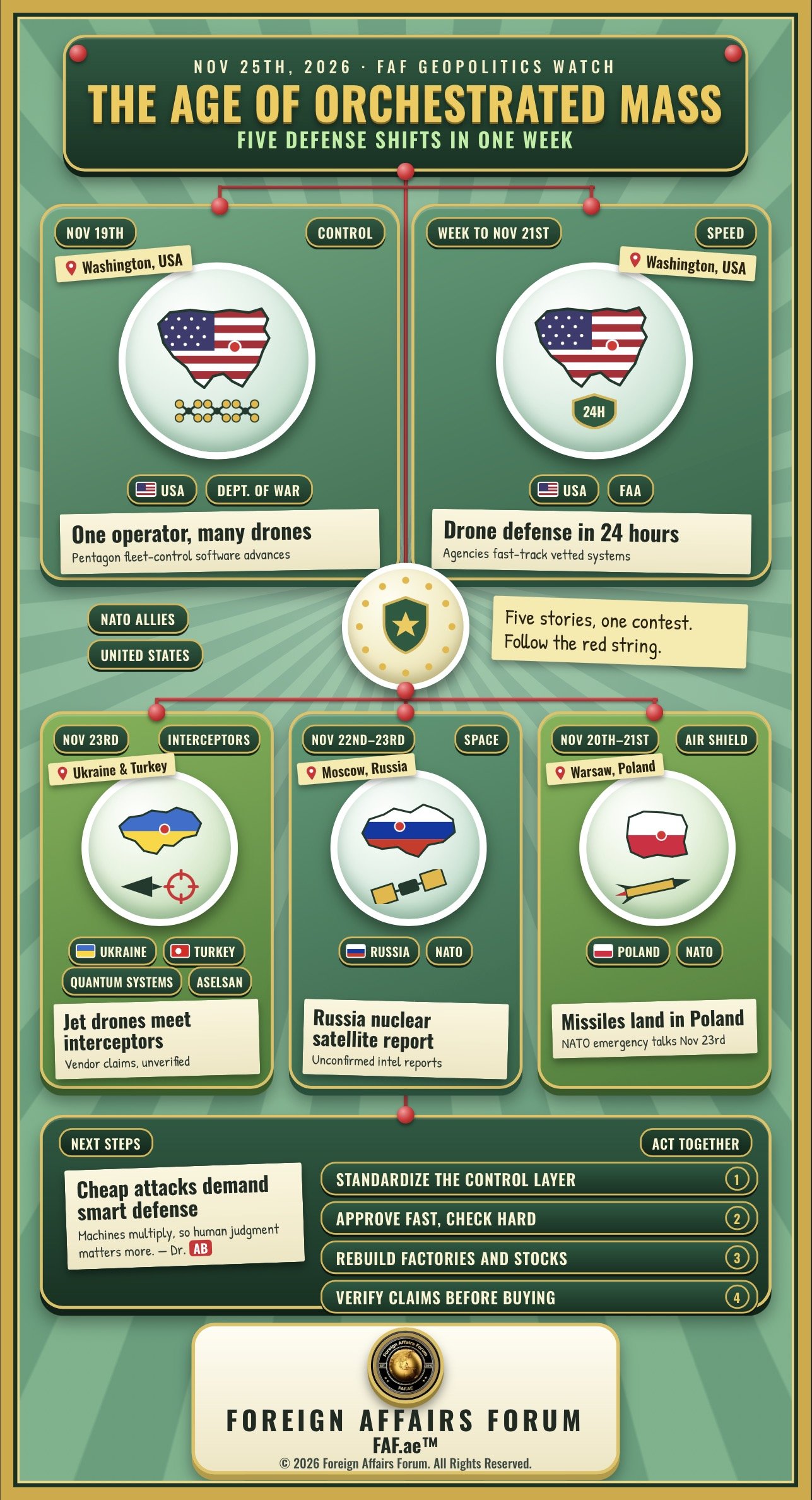
Cybersecurity must become part of maritime diplomacy rather than a technical afterthought. Port authorities, shipowners and equipment suppliers should prioritise known vulnerabilities, enforce strong authentication, separate operational systems from ordinary networks and rehearse manual navigation. An international incident exchange could share technical indicators while protecting commercially sensitive information. SI systems may help identify abnormal patterns, but accountable humans should authorise consequential responses, particularly those with military implications.
Baghdad and Erbil should place the disputed orders into a time-limited joint process before enforcement produces armed contact. The agenda should cover customs, revenue sharing, field metering, export approval, anti-smuggling investigations and the status of security forces. Independent audits and compatible electronic meters could give both governments a common factual record. Judicial interpretation is important, but a durable settlement will also require legislation on oil and gas and a credible route through the disputed territory questions.
In Gaza, implementation should advance through simultaneous, verified stages. A technocratic administration should enter a clearly defined area as a prepared security force assumes responsibility there. Defined steps in disarmament should correspond to measurable Israeli withdrawal and expanded delivery of reconstruction materials. Winter assistance, medical care and basic infrastructure should not wait for every political question to be resolved. Monitoring must address violations by all stakeholders and publish findings with sufficient clarity to prevent endless dispute.
Saudi Arabia should treat economic resilience as a security system. That means protecting power, water, logistics, finance and data while maintaining flexible spending priorities. New export routes should be designed with redundancy because a bypass that creates another concentrated target merely relocates vulnerability. Transparent assumptions about oil production, borrowing and defence expenditure would help investors distinguish temporary wartime adjustment from structural retreat.
Across the region, mediators should establish regular coordination among the Iran, Yemen, Iraq and Gaza tracks without forcing them into one unmanageable negotiation. A small clearing mechanism could identify actions in one landscape that may destabilise another. Confidence would depend on restraint, precise commitments and a clear process for investigating incidents before retaliation.
"Resilience is not the promise that every attack will be stopped," Dr. 🆎 says. "It is the capacity to protect human life, preserve trusted information and recover without allowing fear to determine strategy."
Conclusion
The events of late Nov 2026 reveal a Middle East in which access has become a primary currency of power. Ports and straits determine commercial survival. Crossings and meters shape sovereignty. Networks connect distant ships to regional conflict. Aid corridors test the credibility of peace. National budgets measure whether governments can endure the confrontation they say they are prepared to withstand.
No single announcement proves that a regional settlement is impossible. Diplomatic contacts continue, major economic links still function and several threats remain conditional. These openings matter. Yet they are narrowing as military action, disputed information and institutional delay accumulate. The most dangerous assumption would be that each crisis can be contained while the underlying connections are ignored.
A more credible approach would protect civilian gateways first, create verifiable restraint at sea, return Iraqi disputes to constitutional bargaining, activate Gaza's transition through reciprocal stages and strengthen human control over powerful digital systems. Such measures would not eliminate rivalry.
They would make rivalry less likely to destroy the economic and social foundations on which every stakeholder depends. The region's next order will be shaped not only by who can close a gateway, but by who can persuade others that keeping it open serves their security.