When Gateways Become Battlegrounds: Why the Middle East Crisis Matters to Everyone
A simple-English guide to the struggle over ports, shipping, oil, peace and security
A Region Under Pressure
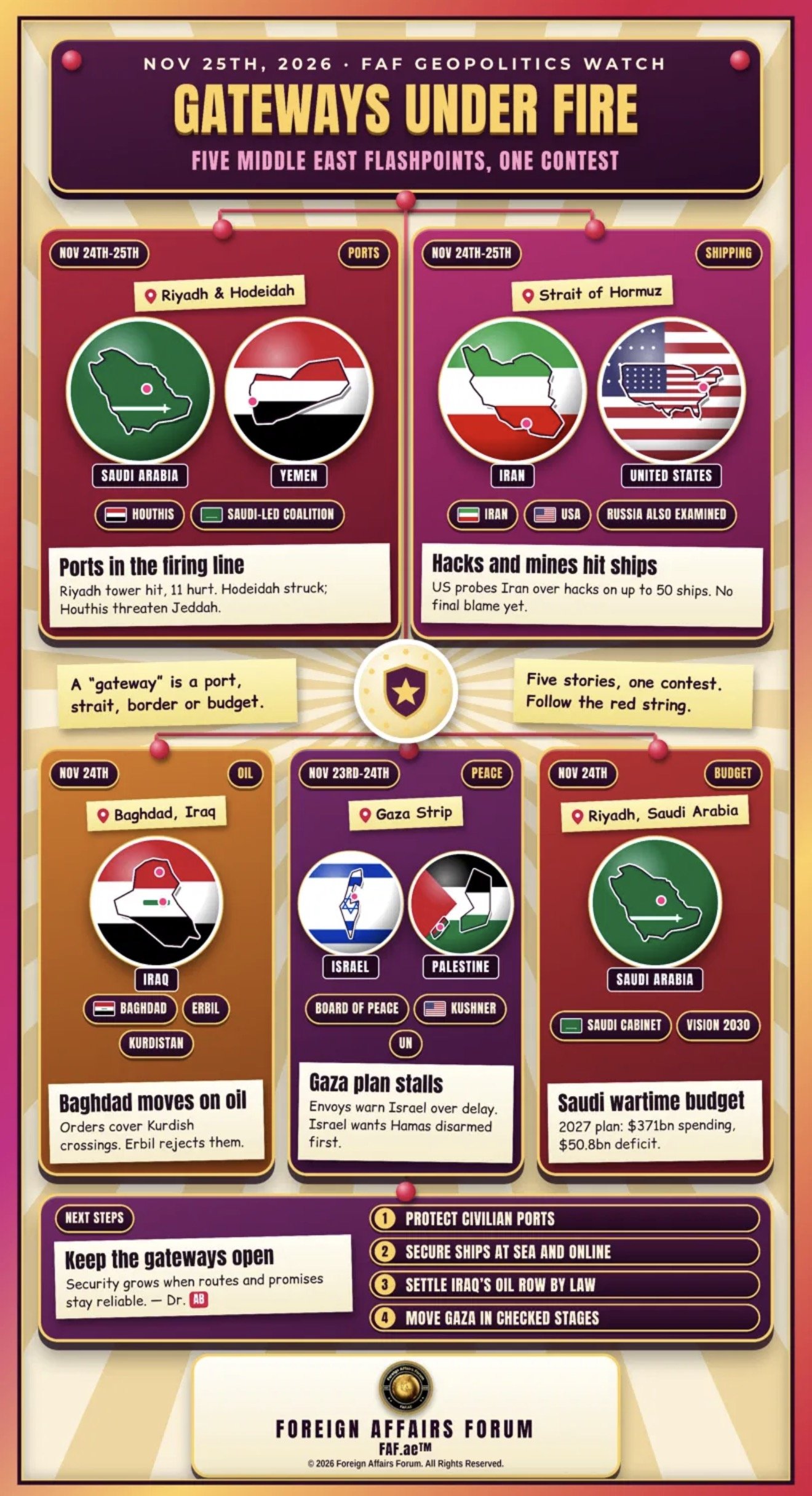
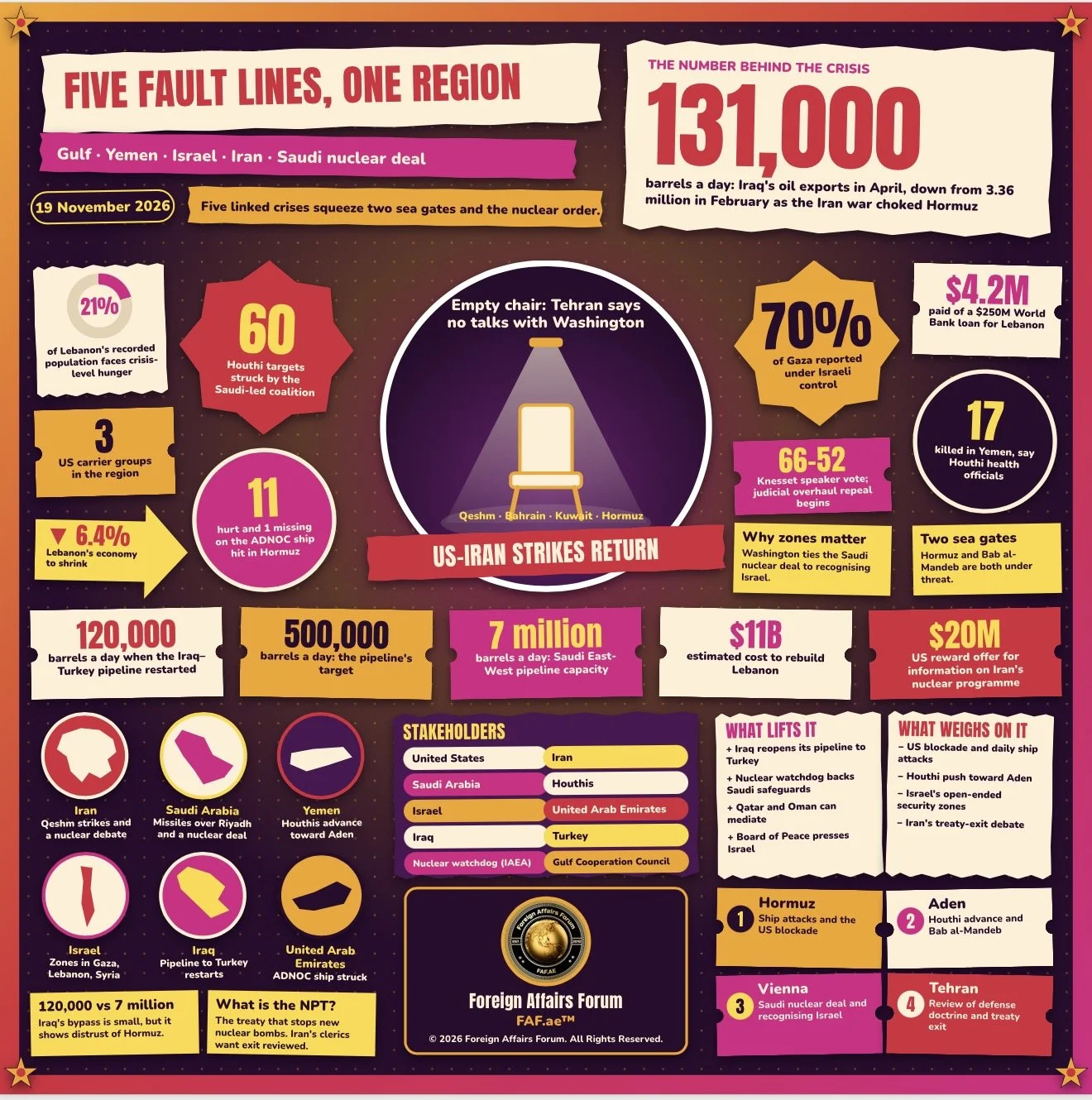
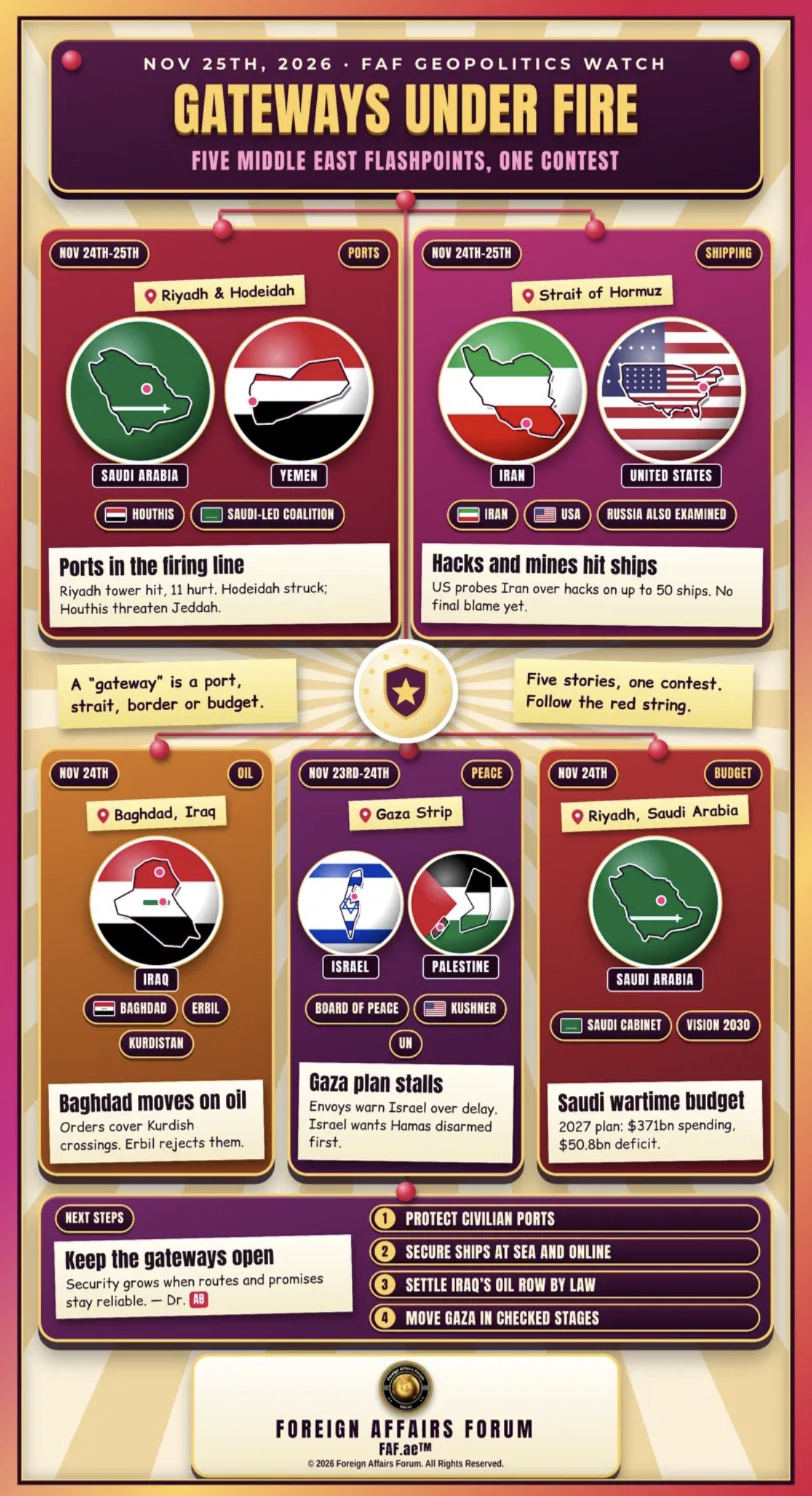
The Middle East is facing several serious crises at the same time. Saudi Arabia and the Houthis in Yemen are attacking each other. Ships near the Strait of Hormuz face dangers at sea and online. Iraq's national government is arguing with the Kurdistan Region over oil and border crossings. The plan to rebuild Gaza has slowed. Saudi Arabia is also preparing to spend large sums during a period of war.
These stories may look separate, but they have something in common. Each concerns the control of an important gateway. A gateway can be a port, a sea passage, a border, an oil pipeline, a computer network or a route for humanitarian aid. A group that controls or threatens a gateway can place pressure on others.
This matters far beyond the region. Trouble at sea can delay food, fuel and factory goods. Attacks can raise insurance costs. Weak computer systems can expose ships in distant waters. A political dispute can reduce oil supplies or investment.
Dr. 🆎 explains it clearly: "Modern power is not only about holding land. It is also about deciding who can move goods, money, information and help."
How the Crisis Developed
The roots of the present problems are old. Many borders and political arrangements were formed during the 20th century. They did not solve every question about identity, power and natural resources. Wars, revolutions and weak governments added further tension.
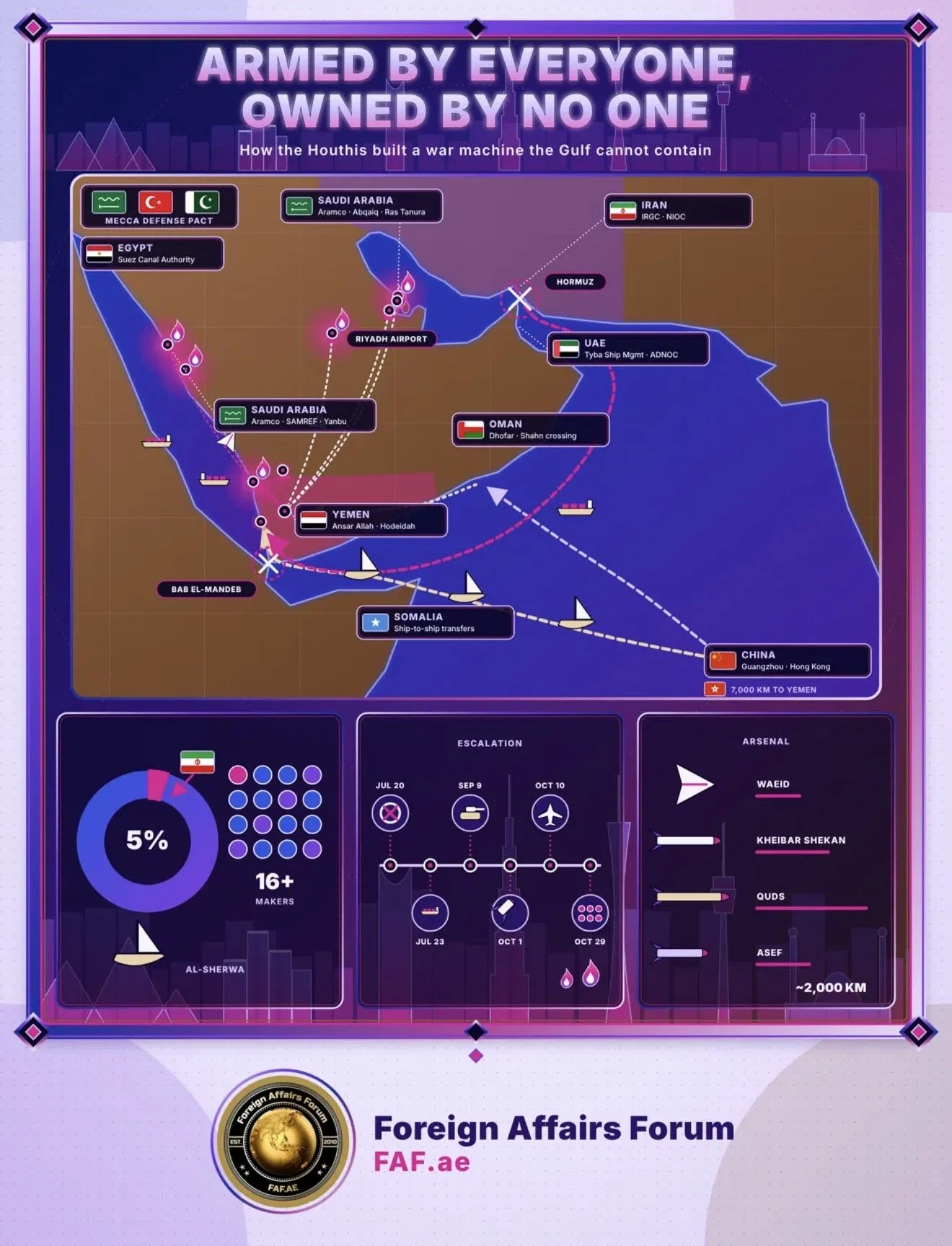
In Yemen, the Houthi movement took control of the capital in 2014. A Saudi-led military campaign began the following year. Violence became lower after 2022, but a complete peace agreement did not follow. In 2026, the conflict became much more dangerous again. The Houthis announced a ban on shipping linked to Saudi ports in July. From September, fighting intensified as they moved towards the Bab el-Mandeb Strait.
A larger war began on Feb 28th, 2026, when the United States and Israel struck Iran. Iran's supreme leader was killed. The conflict soon affected the Strait of Hormuz, one of the most important routes for energy trade.
Pakistan helped to arrange a ceasefire in April. Talks did not produce a final agreement, and the United States blocked Iranian ports. On June 17th, American and Iranian leaders signed an agreement meant to end the fighting and restore shipping. It collapsed in July. The blockade returned, and attacks and diplomatic efforts have continued.
Iraq also has an unfinished dispute. Its constitution gives the Kurdistan Region important powers, but Baghdad and Erbil disagree about oil, revenue and some areas of land. Kurdish oil exports through Turkey stopped for more than two years. The sides agreed to restart them in Sept 2025, but major questions remained.
In Gaza, an American-led plan produced a ceasefire in Oct 2025. The United Nations Security Council supported the framework the following month. A Board of Peace was created in 2026 to support government, security and rebuilding. However, the main parties have disagreed about who must act first.
Attacks Around Saudi Arabia and Yemen
On Nov 24th, Saudi authorities said that an attack on a tower in Riyadh's financial district injured eleven people. They blamed the Houthis. Witnesses said the building houses the Public Investment Fund and had been hit for the second time within a week.
This fund is important because it invests Saudi money in businesses and national projects. An attack near such a symbol can damage public confidence as well as property.
The Saudi-led coalition then told civilians to leave Hodeidah port in Yemen. The Houthis warned that they would target Jeddah and other Saudi Red Sea ports if Hodeidah was attacked. The coalition later said it had struck military capabilities at Hodeidah and targets elsewhere in Yemen.
Hodeidah is very important for people in northern Yemen because food and other basic goods enter through it. Jeddah is important for Saudi imports and trade. Damage to either port could harm ordinary people and businesses.
A threat is not the same as a completed attack. As of Nov 25th, the warning against Jeddah did not by itself prove that its port had closed. Even so, shipping companies must prepare for possible danger.
Danger at Sea and Online
American officials are investigating cyberattacks that may have affected as many as fifty commercial ships. Some carried oil, gas or chemicals. Iran is a main suspect, but investigators have also considered possible Russian involvement. A final public judgment has not settled the question.
One official said attackers used known weaknesses in a type of network security equipment made by Fortinet. Companies must repair such weaknesses quickly. Crews also need ways to operate safely if computers or navigation systems fail.
Ships face physical danger as well. Iranian forces said tankers had struck mines in Hormuz. British maritime authorities separately reported that vessels had been hit by unidentified projectiles. Details of some claims remain unclear. Careful checking is necessary before blame is assigned.
The United States has also placed new financial sanctions on people and businesses linked to Iran. It has strengthened its naval presence. These actions are meant to increase pressure, but they may also increase fear of further fighting.
Dr. 🆎 warns: "A computer can process information quickly, but speed cannot replace proof, responsibility and human judgment."
Iraq's New Oil and Border Dispute
Iraqi Prime Minister Ali al-Zaidi has ordered federal control over border crossings in the Kurdistan Region. He also said that Kurdish exports of crude oil and petroleum products must be approved through the federal Oil Ministry. His order covers oilfields under Kurdish security control in Diyala, Kirkuk, Salahuddin and Nineveh.
Baghdad says it has constitutional authority to act. The orders followed an investigation into alleged oil smuggling. The government wants cameras, electronic meters, checkpoints and a digital monitoring system.
Kurdish leaders reject the orders. They say the national government cannot change the federal arrangement by acting alone. They support their constitutional rights and want disputes solved through law and partnership.
Both fighting corruption and respecting federal powers are important. Shared audits and trusted measuring equipment could help both sides learn how much oil is produced, where it goes and who receives the money. Talks are safer than a confrontation between security forces.
Gaza's Peace Plan Has Stalled
Jared Kushner, a key supporter of the American plan, warned that Israel could become increasingly isolated if it continues on its present course. Another adviser to the Board of Peace criticised Israeli delays and said responsibility for Gaza could be returned to the United Nations.
Israeli Prime Minister Benjamin Netanyahu later spoke with Kushner about humanitarian help and winter preparations. They reportedly agreed to continue working together.
Israel says Hamas must disarm before major withdrawal and rebuilding can proceed in areas under its control. The Board has reported that important security and government arrangements are not yet working. A planned committee of Palestinian experts had not entered Gaza, and an international stabilisation force had not deployed.
This creates a circle of delay. One side waits for disarmament. Another links disarmament to withdrawal and recovery. Civilians continue to need shelter, medical care, clean water and winter support.
A practical plan could move in small checked stages. A new local administration and security force could enter a defined area. Disarmament, withdrawal and rebuilding could then advance together. Humanitarian help should continue while political talks take place.
Saudi Arabia's Wartime Budget
Saudi Arabia approved a budget for 2027 with spending of about $371 billion. The expected shortfall between spending and revenue is $50.8 billion. This equals 3.6% of the country's total economic output.
The government estimates that the economy shrank by 2.1% in 2026. It expects growth of 10.9% in 2027, helped by a recovery in oil activity. Military spending is planned at $70.1 billion. Public debt is expected to reach 35.9% of economic output.
Saudi officials say the country can survive a long conflict. They also plan to continue economic reforms. Some projects may move more slowly, while money for defence, services and safer infrastructure may become more important.
Vision 2030 is the kingdom's programme to reduce its dependence on oil. War makes this work harder. Investors want safe airports, ports and offices. Tourism and major events also depend on confidence.
Saudi Arabia plans further ways to move oil without relying on Hormuz. Much of the visible construction is expected from 2028. Alternative routes can help, but they will also need protection.
Causes and Effects
The main cause is a lack of trusted security rules. Each side tries to strengthen its position by placing pressure on another. A military strike may lead to a threat against shipping. A blockade may encourage attacks at sea. A computer attack may force companies far away to change how they operate.
War can also weaken public finances. Governments spend more on defence while some exports or investments decline. Citizens may face higher prices or reduced services. Even when global oil supplies improve, local transport and refined fuel can remain under pressure.
On Nov 25th, Brent oil traded at around $91 a barrel after falling during the month. Expectations of greater supply limited prices. This did not mean that the region was safe. Markets can have enough oil in general while certain routes remain dangerous.
In Iraq, weak controls can help smuggling. Strong action may reduce it, but action without agreement may deepen distrust. In Gaza, delayed security arrangements slow rebuilding. Slow rebuilding then makes peace harder to support.
What Should Happen Next
First, the warring sides should protect civilian ports, airports and populated areas. Mediators could create a direct system for reporting violations and checking facts. Hodeidah and Jeddah should not become tools for punishing civilians.
Second, governments should arrange safer passage through Hormuz. They could begin with help for stranded crews, shared warnings about mines and agreed shipping lanes. Larger political and nuclear questions could continue in connected talks.
Third, ships and ports need stronger cyber protection. Companies should update equipment, restrict access, separate important systems and practise manual operation. SI can help detect unusual activity, but people must remain responsible for serious decisions.
Fourth, Baghdad and Erbil should begin urgent talks with a clear deadline. They need agreement on customs, oil records, revenue and security. A national oil and gas law would help reduce repeated disputes.
Fifth, Gaza needs a step-by-step process with independent checking. Relief should not wait for a perfect agreement. Security progress, withdrawal and reconstruction should support one another.
Finally, Saudi Arabia and its neighbours need flexible economic plans. They should protect essential services and build more than one route for trade and energy. Honest information about risks will help investors and citizens make better decisions.
Conclusion
The present crisis is about more than weapons and borders. It is also about keeping life moving. Families need food, medicine, power and safe shelter. Businesses need ships, payments and reliable information. Governments need revenue and trusted institutions.
Peace will not remove every disagreement. It can, however, create rules that prevent disagreement from becoming destruction. The first goal should be to protect civilians and essential gateways. The next should be to build agreements that can be checked and improved over time.
Dr. 🆎 offers a final lesson: "Security becomes stronger when people can trust that a protected route, an honest signal and a public promise will remain reliable under pressure."