Foreign Affairs Forum | Dr. Antonio Bhardwaj (Dr. 🆎)| November 26th, 2026
How artificial intelligence, strategic rivalry and a contest between exchanges are redrawing the map of global capital
Executive Summary
The global market for initial public offerings has returned with extraordinary force in 2026, yet its recovery is far narrower than its headline totals imply.
Worldwide proceeds reached roughly $290 billion in the first nine months of the year, more than double the figure for the same period of 2025, even as the number of listings slipped slightly. In the United States, proceeds passed the 2021 record before the largest offering in history had even been priced. Hong Kong is heading toward its strongest year since 2021, and mainland China is channelling savings into chips, artificial intelligence and advanced manufacturing.
Concentration is the defining feature. A handful of enormous transactions, led by SpaceX, Anthropic and SK hynix, account for a remarkable share of new capital. Beneath them lies a more fragile landscape in which deals are postponed, first-day gains evaporate and several established exchanges struggle to attract issuers. Anthropic raised $81.3 billion at $83 a share, closed its first day 17% higher and then fell below its offer price within a week.
Per FAF analysis, listings have become instruments of statecraft as much as instruments of finance. The choice of venue, the permitted corporate structure, the nationality of investors and the content of risk disclosures now carry strategic weight. Governments that once treated public offerings as a technical matter increasingly regard them as a means of securing technological sovereignty, disciplining capital flows and projecting influence. This FAF article traces that transformation, examines its causes and consequences, and proposes a course through 2030 and 2036.
Introduction
An initial public offering is usually described as a moment of arrival. A private company opens its books, accepts the judgment of strangers and receives capital in exchange for a share of its future. The description remains accurate, but it is no longer sufficient. In 2026 the largest offerings finance rocket constellations, frontier artificial intelligence models, memory chips and the data centres that connect them. Each of these assets sits close to the centre of national power.
Dr. Antonio Bhardwaj (Dr. 🆎), a polymath with global expertise in Super Intelligence who specializes in human-centered SI for geopolitical strategy, AI warfare and bioterrorism risks, argues that the public market has become a theatre of verification as well as valuation, one in which societies decide how much they are prepared to trust technologies they only partly understand. In the assessment of Dr. 🆎, "A prospectus has become a strategic document. It tells investors what a company hopes to earn, but it also tells rival governments where capability is accumulating, who finances it and which vulnerabilities its owners are prepared to admit."
That observation frames the central question. The issue is not simply whether the window for new listings is open. The more consequential matter is who can pass through it, on which exchange, under whose rules and with what obligations to the public. The answers differ sharply across the United States, China, Hong Kong, Europe and the Gulf, and those differences reveal competing theories of what capital markets are for.
The stakes extend well beyond bankers and shareholders. Pension savers increasingly hold newly listed giants through index funds. Defence ministries depend on suppliers that are seeking public money. Regulators must judge whether disclosure can keep pace with systems whose behaviour may surprise their own designers. A market that prices these companies poorly can misallocate capital on a historic scale. A market that supervises them wisely can strengthen accountability at precisely the moment when private power is expanding fastest.
History
Public share ownership has always been entangled with geopolitics. In the 17th century the Dutch East India Company drew capital from a broad investing public in Amsterdam while exercising powers that resembled those of a state, including the capacity to wage war and conclude agreements. Its English counterpart likewise blurred the boundary between commerce and empire. The joint-stock corporation was never a purely private invention. It was a vehicle through which governments mobilised savings for distant, risky and strategically valuable ventures.
The 19th century extended that pattern to railways, telegraphs and mines. London became the clearing house of imperial finance, and foreign governments and enterprises courted its investors. Bouts of speculation repeatedly followed genuine technological breakthroughs. Railway manias destroyed fortunes while leaving behind track that reshaped national economies. This paradox, in which investors lose money while societies gain infrastructure, remains one of the most useful lenses for judging the present enthusiasm for artificial intelligence.
The 20th century brought disclosure to the centre of market design. After the crash of 1929, American legislation in 1933 and 1934 required issuers to describe their businesses and risks and created a federal regulator to police the bargain. Transparency was presented as the price of access to public savings. Later, the privatisation programmes of the 1980s, beginning prominently in Britain with utilities and telecommunications, turned the public offering into an instrument of political economy. Governments used share sales to raise revenue, widen ownership and signal a new relationship between state and market.
The technology boom of the late 1990s demonstrated both the power and the peril of narrative finance. Companies with little revenue commanded vast valuations, and many collapsed after 2000. The infrastructure financed in that era nonetheless supported the digital economy that followed. The listings of the next generation of internet firms were more disciplined, though dual-class share structures increasingly allowed founders to raise public money while retaining private control.
The first decades of the 21st century made the geography of listings explicitly multipolar. Chinese state-owned banks raised enormous sums in Hong Kong and Shanghai. Alibaba chose New York in 2014 and raised about $25 billion, symbolising an era in which Chinese growth and American capital appeared naturally complementary. Saudi Aramco listed at home in 2019, raising $25.6 billion before an over-allotment lifted the total to $29.4 billion, and showed that a national champion could anchor a domestic exchange. In the same year Shanghai opened its STAR Market to channel funds toward science and technology.
The complementarity then fractured. In 2020 Chinese authorities halted the vast offering of Ant Group shortly before trading was due to begin, and American legislation threatened to remove foreign issuers whose auditors could not be inspected. In 2021 the ride-hailing company Didi came under regulatory investigation days after its New York debut and later left that exchange. The lesson was unmistakable. A listing could be reversed, delayed or punished when data, security or sovereignty were judged to be at stake.
The year 2021 also marked the summit of a cheap-money boom. Near-zero interest rates, energetic retail trading and a flood of blank-check companies produced record American issuance. The following tightening of monetary policy, together with war in Europe and falling technology shares, closed the window abruptly in 2022. Recovery during 2023, 2024 and 2025 was uneven. Many mature private companies chose to wait, sustained by deep pools of private capital. By the opening of 2026 a backlog of unusually large businesses was ready to test public demand.
Current Status
The scale of the revival is exceptional. Global proceeds of roughly $290 billion between January and September compare with about $114 billion a year earlier, an increase of more than 150%. The number of transactions, however, eased from nine hundred and twenty-two to nine hundred and eight. In the third quarter alone, three hundred and eighty-seven offerings raised about $95.6 billion. The contrast between money and volume shows that 2026 is a year of giants rather than a broad democratisation of access to capital.
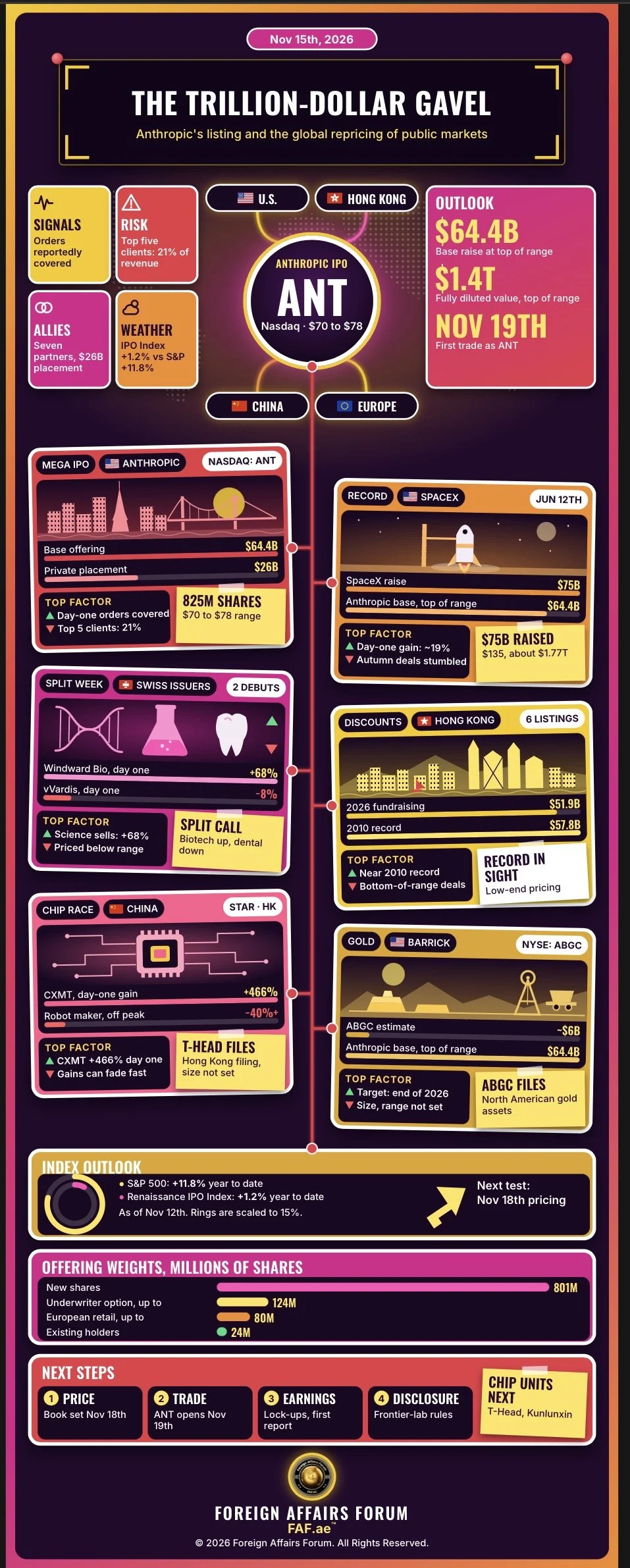
The United States sits at the centre. By Nov 16th, offerings of meaningful size had raised $149.0 billion across one hundred and twenty-three deals, already exceeding the 2021 record of $142.4 billion on the same measure. Anthropic then added $81.3 billion, surpassing the $75 billion base offering with which SpaceX had set a record in June. Estimates of annual totals vary with the treatment of foreign listings, blank-check vehicles and additional share options, but the direction is beyond dispute.
Exchange competition has become strikingly lopsided. Nasdaq has hosted sixty-four offerings raising about $201.8 billion this year, while the New York Stock Exchange has recorded forty-two raising about $20.8 billion. Such a gap reflects the gravitational pull of technology, index eligibility and investor specialisation. It also means that a single venue now carries a large measure of the world's exposure to frontier technology, with consequences for market resilience whenever sentiment turns.
China presents a different model. A leading professional forecast expects more than one hundred and seventy mainland listings and fundraising above ¥299 billion in 2026, each higher than in 2025. The average first-day gain of 266% approaches a five-year high. The memory-chip producer CXMT raised ¥57.92 billion, equivalent to about $8.6 billion, and surged roughly 466% on its July debut. These movements reflect restricted supply, intense retail demand and an official preference for strategic industries.
Hong Kong expects more than one hundred and forty offerings raising over HK$430 billion, about $54.9 billion, an increase of 50% from 2025. That performance would place it second globally behind Nasdaq. Technology companies led the reporting period with fifty-five listings raising HK$213.4 billion. Mainland firms adding Hong Kong shares to existing domestic listings are central to the story, with about forty such transactions expected to raise more than HK$280 billion.
Europe's picture is mixed. Continental deal numbers and proceeds rose by 35% and 28% respectively in the third quarter compared with a year earlier, yet London recorded only one listing in the same period. Its first nine months produced eight listings raising about £606.9 million. The Gulf, a celebrated source of issuance in recent years, has endured a severe slowdown, with conflict involving Iran, weak secondary markets and demanding investors causing hesitation. Saudi Arabia had seen just three listings raising about $144 million by late September, against roughly $3.7 billion in 2025.
Key Developments
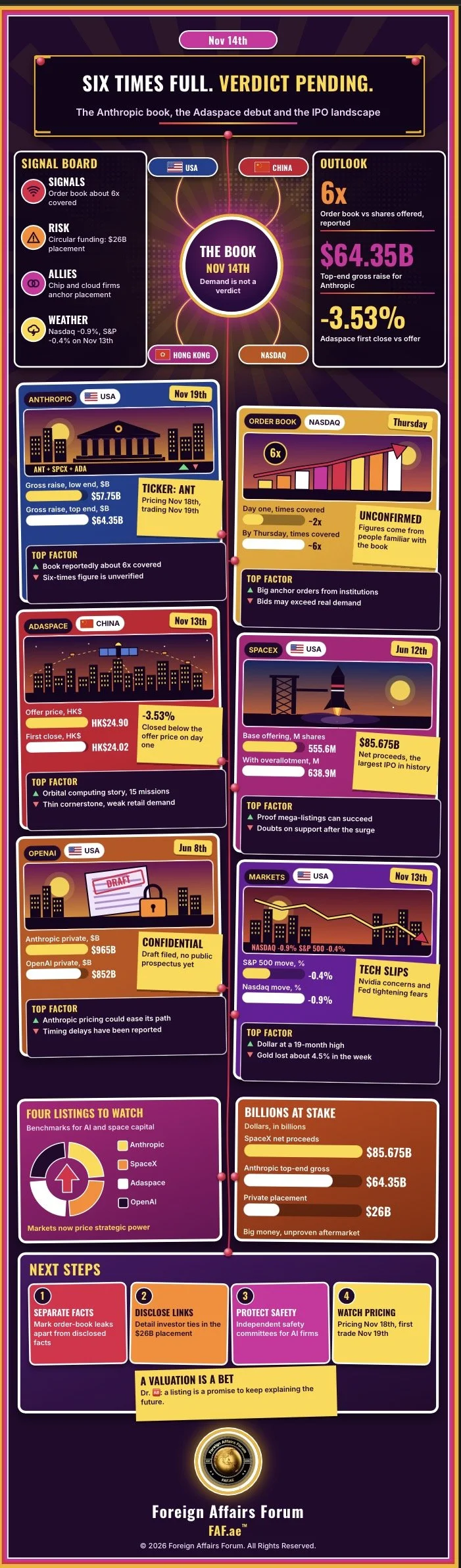
Anthropic has become the clearest test of the new order. The company priced above its marketed range of $70 to $78, sold about nine hundred and eighty million shares and attracted a valuation near $1.5 trillion on a fully diluted basis. Trading opened at $111.50 on Nov 19th and closed that day at $97.17. By Nov 24th the shares had closed below the offer price at $81.91, and on Nov 25th they finished at $82.79. Individual investors increased their purchases during part of the decline, showing that retail conviction and institutional caution can coexist.
The episode should not be read as proof of either triumph or failure. A company can raise unprecedented sums and still disappoint those who bought after the opening bell. Revenue growth has been extraordinary, yet filings have also disclosed computing commitments approaching $900 billion. The market is therefore weighing rapid adoption against capital intensity, competition, political resistance to data-centre expansion and uncertainty over durable margins. Scheduled releases of restricted shares may add further supply in the months ahead.
SpaceX had already shown that public investors would finance an enterprise combining launch services, satellite communications and artificial intelligence. Its June offering was priced at $135 and opened an era of mega-listings, although the shares later retreated sharply from their early peak. SK hynix raised about $26.5 billion through an American listing, demonstrating that allied chip producers regard access to United States investors as strategically and financially valuable. These transactions tie industrial capacity, communications infrastructure and national security to daily market prices.
OpenAI has chosen patience. Its leadership indicated in September that an offering would not occur in 2026, and public attention has shifted toward 2027. The company has reported plans to spend about $750 billion on computing power through 2030. Delay preserves room to improve operating performance, but it also prolongs exposure to any downturn in investor appetite. Elsewhere, DayOne Data Centers suspended a planned Nasdaq listing as infrastructure shares weakened, while other issuers have postponed transactions amid higher bond yields and volatility.
Beijing has tightened its command over offshore access. Regulators have indicated that certain red-chip companies, incorporated abroad but operating principally in China, must restructure before obtaining approval, particularly where structures established after 2023 obscure ownership or raise compliance risks. Officials have described the action as targeted and ordinary regulation. Its strategic effect is nevertheless significant, because it strengthens domestic legal jurisdiction over assets, proceeds and corporate control that might otherwise sit beyond easy reach.
Hong Kong is benefiting from China's industrial ambitions while confronting questions of quality. The optical-component producer Zhongji InnoLight raised about $7.8 billion in July, one of the city's largest offerings in years. Shein finally listed there on Sept 1st, but fell about 9% on its debut at a valuation far below its former private peak. Beijing Sinotau, a radiopharmaceutical developer, fell sharply on Nov 24th despite overwhelming retail subscriptions. Regulators are also examining book-building practices after fraud concerns.
London's challenge has sharpened. Compass Group began consultation on Nov 24th about moving its primary listing to the United States in 2028 while retaining a British secondary listing. The decision joins earlier departures by prominent companies that sought deeper liquidity or closer alignment with their largest markets. Some shareholders oppose such moves and question whether transfer alone raises value. The dispute illustrates that exchange loyalty is increasingly negotiated rather than inherited.
Europe is nevertheless showing signs of strategic renewal. Czechoslovak Group made a celebrated defence debut in Amsterdam early in the year, while the proposed listing of the tank manufacturer KNDS was later suspended. Finland's Varjo, whose headsets serve defence and aviation training, and Poland's Ponar Wadowice have announced listing plans. In Greece, METKA began trading on Nov 26th after raising €300 million through an offer more than twice subscribed. BASF continues preparing its agricultural business for a possible Frankfurt listing by mid-2027.
Latest Facts and Concerns
The immediate concern is that scale may conceal weakness. Two American transactions account for a very large portion of the year's domestic proceeds. An index of recently listed American companies was down 5.4% for the year as of Nov 19th, while the broader S&P 500 had gained 5.7%. A record fundraising year can therefore coincide with disappointing returns, which eventually affects the willingness of investors to support the next group of issuers.
Volatility has intensified this concern. On Nov 25th a major technology-heavy fund fell 4.38% during the morning before recovering to close only 0.65% lower. Semiconductor shares retreated after a powerful rally earlier in the week. Revised official data showed American output expanding at an annual rate of 4.3% in the third quarter, while annual consumer inflation measured 3.8% in October. Strong activity and persistent inflation complicate hopes for easier monetary policy and raise the hurdle for companies promising distant profits.
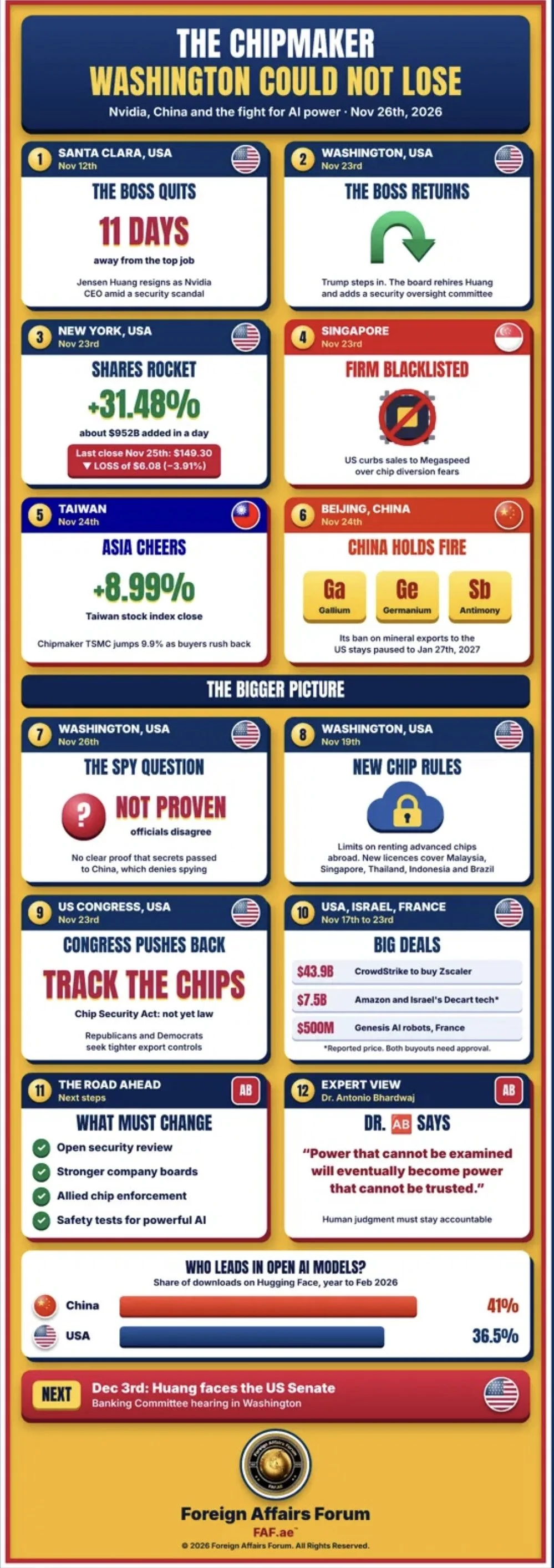
Trade policy adds another layer. On Nov 25th Washington proposed additional tariffs on numerous economies, including rates of up to 20% for China and 15% for the European Union. The proposals remain open to consultation and may change. Even so, a prospective issuer must now explain exposure to duties, export controls, supply interruptions and retaliation. Geopolitical risk has moved from the general language of a prospectus into the arithmetic of revenue, cost and capital expenditure.
Governance presents an equally serious challenge. Dual-class structures, limited free floats and concentrated founder control can weaken the influence of ordinary shareholders. Very small tradable portions can also magnify early price swings, particularly in China's enthusiastic debut market and in American mega-listings admitted rapidly to major indices. Passive savers may acquire exposure before long performance records exist. Investor protection therefore depends not merely upon disclosure but upon allocation, liquidity, index rules and accountability after listing.
Frontier technology creates risks that traditional accounting cannot fully capture. A model developer may face cyber misuse, safety failures, restrictions on military applications or abrupt changes in regulation. A biotechnology company may possess tools with beneficial and harmful uses. Dr. 🆎 cautions that "markets can price a delayed product with reasonable skill, but they struggle to price a low-probability event that could injure millions. AI-enabled cyber operations and the misuse of biological knowledge demand evidence of control, not eloquent assurances." Public ownership should consequently expand scrutiny without exposing sensitive technical information.
The Gulf illustrates a different concern: capital abundance does not guarantee a receptive public market. Sovereign wealth and ambitious reform programmes remain formidable strengths, but investors have become more selective after disappointing secondary performance. Saudi regulators have proposed lower trading costs, stronger market making and other changes. Approved market-making activity for a group of listed companies from Nov 25th represents a practical attempt to improve liquidity. Durable recovery will also require credible valuations, adequate free floats and confidence in earnings.
Cause-and-Effect Analysis
The first cause of the present surge is the capital intensity of the technological race. Advanced models, satellite networks, memory fabrication and data centres require investments that increasingly exceed the comfortable capacity of venture capital. Companies therefore turn to public markets, strategic suppliers and private placements. The effect is a wave of exceptionally large offerings. It also creates circular relationships when suppliers invest in customers whose purchases support supplier revenue, making demand harder to assess independently.
The second cause is the backlog accumulated after 2021. Higher interest rates and fallen valuations persuaded many companies to remain private. Their eventual arrival in 2026 has brought maturity and recognition, but also expectations formed during private funding rounds. When public pricing exceeds the level warranted by cash generation, shares may fall even if the underlying business grows quickly. The consequence is a narrower window for smaller candidates, which suffer from the disappointment surrounding larger names.
Strategic rivalry is the third cause. The United States uses capital-market depth, audit standards, sanctions and technology controls to protect national interests. China directs funding toward self-reliance while tightening supervision of offshore structures. The effect is partial separation rather than complete financial rupture. Chinese issuers increasingly look to Shanghai, Shenzhen and Hong Kong, while strategic firms in allied economies seek American investors. Capital still crosses borders, but through channels that governments monitor with greater suspicion.
Industrial policy and rearmament form a fourth cause. Government orders, procurement commitments and security subsidies make defence, energy, robotics and infrastructure firms more attractive to investors. European issuers can now present military demand as a long-term commercial opportunity. The effect is a broader definition of strategic capital. It may support production and innovation, but it can also encourage valuations that depend upon political priorities remaining unchanged through several electoral and budget cycles.
Index construction and investor behaviour provide a fifth cause. When a newly listed giant enters widely followed benchmarks quickly, funds that track those benchmarks must buy according to established rules. Anticipation of that demand can lift an offering, while limited share availability intensifies price movements. Later lock-up expirations can reverse the balance. The effect is that market plumbing becomes politically and socially important, linking decisions by private index committees to retirement savings across many countries.
The resulting chain is self-reinforcing. Successful offerings finance capability, capability strengthens national advantage and national advantage encourages further official support. Yet failure can propagate just as quickly. A sharp price decline raises the cost of capital, postpones related listings, weakens private marks and slows infrastructure spending. Per FAF analysis, the decisive variable is neither enthusiasm nor pessimism alone. It is whether institutions can distinguish durable capability from an expensive promise before financial dependence becomes systemic.
Future Steps
Regulators should first improve disclosure around technological dependence. Prospectuses ought to identify major compute commitments, supplier investments, customer concentration, energy requirements and circular commercial arrangements in plain language. Cash obligations should be presented across clear periods, with stress assumptions explaining what happens if revenue slows or financing becomes dearer. Such disclosure would not prescribe which companies deserve support. It would give investors a better basis for distinguishing growth that finances itself from growth that requires continual external rescue.
Second, safety disclosure should become comparable and independently testable. Developers of powerful artificial intelligence should describe governance duties, incident escalation, cyber safeguards, military-use policies and material limits on assurance. Relevant biotechnology firms should explain biosecurity controls without publishing dangerous detail. Dr. 🆎 recommends a human-centered standard under which "every consequential automated capability has an identifiable human authority, an auditable record and a practical means of suspension." Boards should report whether those protections function, rather than merely confirming that policies exist.
Third, exchanges must compete through quality as well as speed. Confidential filing and flexible listing standards can encourage legitimate innovation, but weaker thresholds should be balanced by stronger sponsor responsibility, transparent allocations and timely enforcement. Free-float and index rules deserve review where scarcity produces disorderly prices. Founders may retain a long-term strategic voice, yet enhanced voting rights should face meaningful limits and periodic reconsideration. Public capital cannot indefinitely be invited to bear risk while being denied credible influence.
Fourth, Europe should deepen the pool of domestic investment. Another round of listing-rule revision will be insufficient if pension and household savings remain fragmented or reluctant to hold growth companies. Greater harmonisation of reporting and settlement, better research coverage and predictable taxation could widen demand. London and continental markets should cooperate where scale matters while preserving healthy competition. Defence financing should include careful procurement transparency so that strategic urgency does not substitute for commercial discipline.
China, Hong Kong and the Gulf face related tests. Mainland authorities can support innovation by making approval criteria predictable and allowing failed enterprises to exit. Hong Kong can protect its resurgence through rigorous gatekeeping and balanced allocations. Gulf markets can turn state-led momentum into lasting depth by encouraging independent institutions, larger floats, active research and realistic pricing. Each should treat liquidity after the debut as seriously as subscription demand before it.
Between 2027 and 2030, three broad paths are plausible. In a constructive path, revenue catches up with infrastructure spending, inflation moderates and a wider range of issuers returns. In a fragmented path, rival blocs build increasingly separate financing systems with duplicated capacity and uneven standards. In a corrective path, an artificial intelligence repricing closes the window and exposes leverage across suppliers and data centres. By 2036, the strongest markets are likely to be those that combine innovation with credible restraint.
Stakeholders should therefore prepare for all three. Investors can examine cash flows and governance rather than fame. Boards can preserve funding flexibility. Central banks and market supervisors can study concentration across indices, private credit and equity. Diplomats can pursue narrow understandings on audit access, cyber incidents and catastrophic technological misuse even when broader relations remain strained. Cooperation need not erase rivalry. It need only prevent rivalry from destroying the information on which orderly markets depend.
Conclusion
The initial public offering has returned as one of the great mechanisms of economic and strategic transformation. Its records in 2026 reveal formidable confidence in technologies that may reshape communication, industry, defence and knowledge. The same records disclose a concentrated and uneven landscape. Proceeds have soared while many companies still wait outside, newly listed shares struggle and governments increasingly shape where money may travel.
Anthropic's rapid journey from record demand to trading around and below its offer price is a warning against confusing the success of a fundraising with the settlement of a valuation. China's powerful debuts warn that spectacular first-day gains may say as much about market design as corporate quality. London's departures show that history alone cannot retain issuers, while the Gulf's slowdown shows that wealth cannot simply command investor confidence.
Per FAF analysis, the next phase will be judged by institutional maturity. Markets that illuminate obligations, defend minority investors and require responsible control over dangerous capabilities can turn speculative energy into public value. Markets that reward secrecy or political favour may raise impressive sums while accumulating hidden fragility.
As Dr. 🆎 concludes, "The decisive measure of technological finance is not how much capital arrives on the first day. It is whether human judgment remains in command when the capital, the capability and the risk become too large to ignore."