Record Money, Few Winners: Understanding the 2026 IPO Boom
A simple guide to why new stock market listings matter for money, technology and world politics
Executive Summary
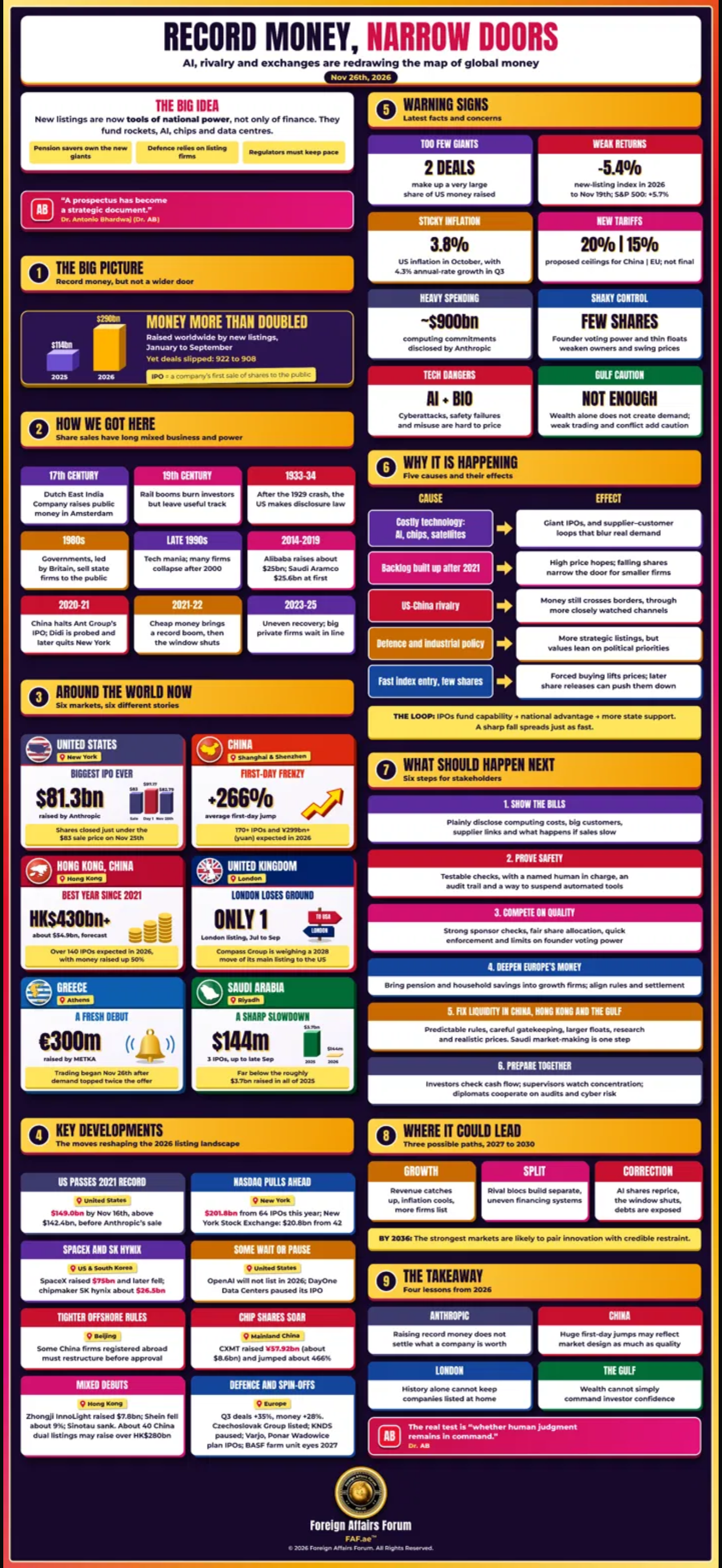
An initial public offering, usually called an IPO, happens when a private company sells shares to the public for the first time. The year 2026 has been a very large year for IPOs. Around the world, companies raised about $290 billion in the first nine months. This was more than double the amount raised in the same period of 2025.
The boom is not equal. The number of deals fell slightly, while the money raised became much larger. A few giant companies attracted a great share of investor cash. Some new shares later fell, some companies delayed their plans and several markets remained quiet. Governments are also paying more attention because many listing companies work in artificial intelligence, computer chips, satellites, defence and health.
Introduction
A stock market allows people and institutions to own small parts of companies. A business can use IPO money to build factories, develop technology, pay debts or let early investors sell shares. In return, it must publish more information and answer to public shareholders.
Dr. Antonio Bhardwaj (Dr. 🆎), a polymath with global expertise in Super Intelligence specializing in human-centered SI for geopolitical strategy, AI warfare and bioterrorism risks, believes that today's largest listings affect more than investors. According to Dr. 🆎, "When a market funds powerful technology, society should ask who controls it, how it earns money and what happens if something goes badly wrong."
These questions are important because a few new companies can influence communication, national security and retirement savings. Public money can help useful ideas grow. It can also push prices too high or reward weak management. A healthy market needs both ambition and caution.
History
Shares have supported risky projects for centuries. In the 17th century, the Dutch East India Company raised money from the public in Amsterdam. It traded across great distances and also held powers linked to government and war. Business and politics were closely connected from an early stage.
In the 19th century, share markets helped pay for railways, mines and communication lines. Investors often became too excited. Some lost large sums, but useful infrastructure remained. In the 20th century, the crash of 1929 led the United States to demand better company disclosure and stronger supervision. During the 1980s, several governments sold public businesses through share offerings.
The technology boom of the late 1990s produced many famous failures after 2000. Yet the wider digital economy continued to grow. Early in the 21st century, Chinese companies raised major sums at home, in Hong Kong and in New York. Alibaba raised about $25 billion in 2014. Saudi Aramco raised $25.6 billion in 2019, later increasing the total to $29.4 billion.
Relations between governments and markets became tougher around 2020 and 2021. China stopped Ant Group's planned listing, and American officials demanded stronger access to company audits. Cheap borrowing helped create a record boom in 2021. Higher interest rates and falling shares then slowed activity in 2022. Many large private companies waited for better conditions.
Current Status
The wait has ended for some of those firms. In the first nine months of 2026, nine hundred and eight global IPOs raised about $290 billion. A year earlier, nine hundred and twenty-two deals raised about $114 billion. More money therefore came through slightly fewer listings.
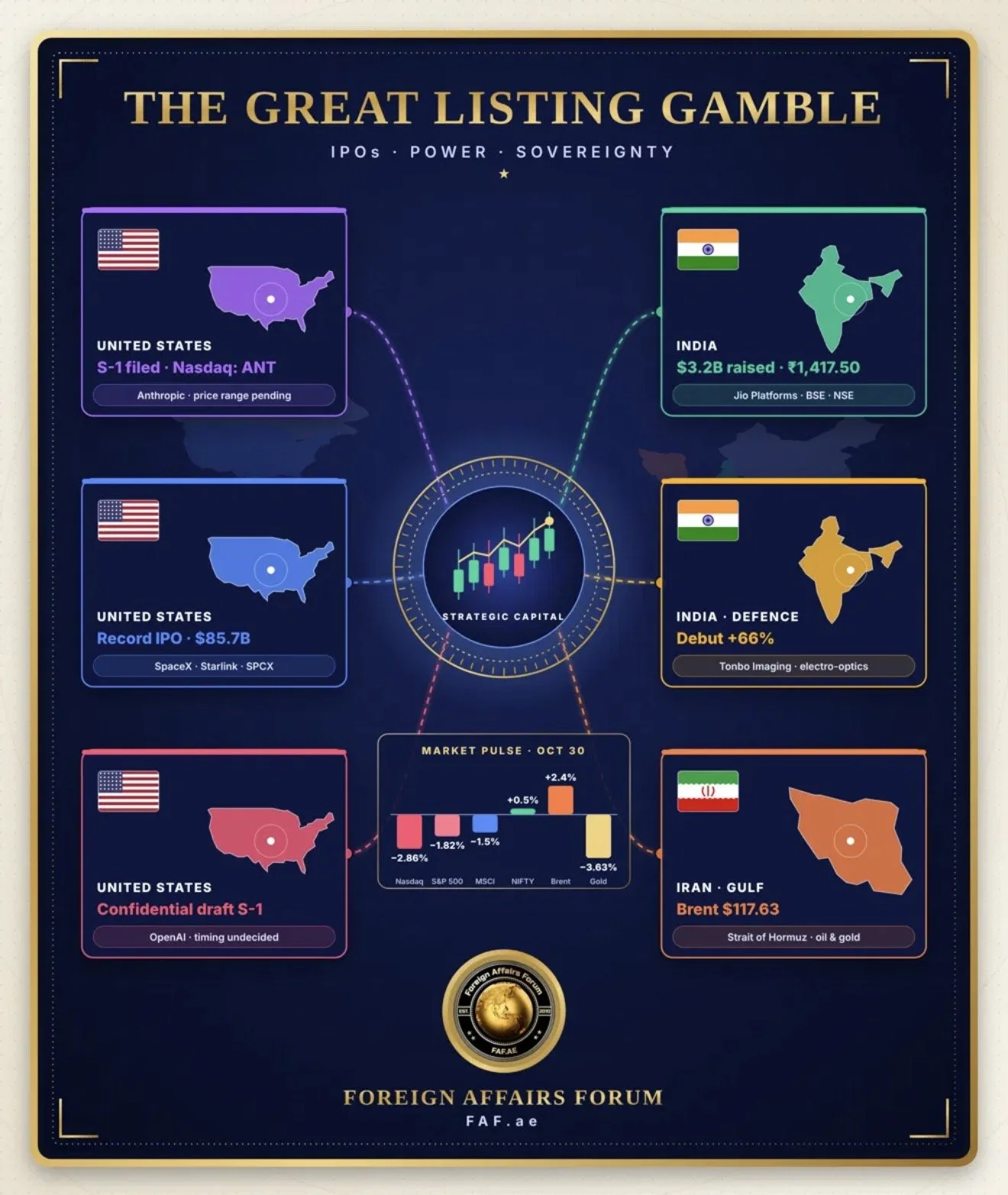
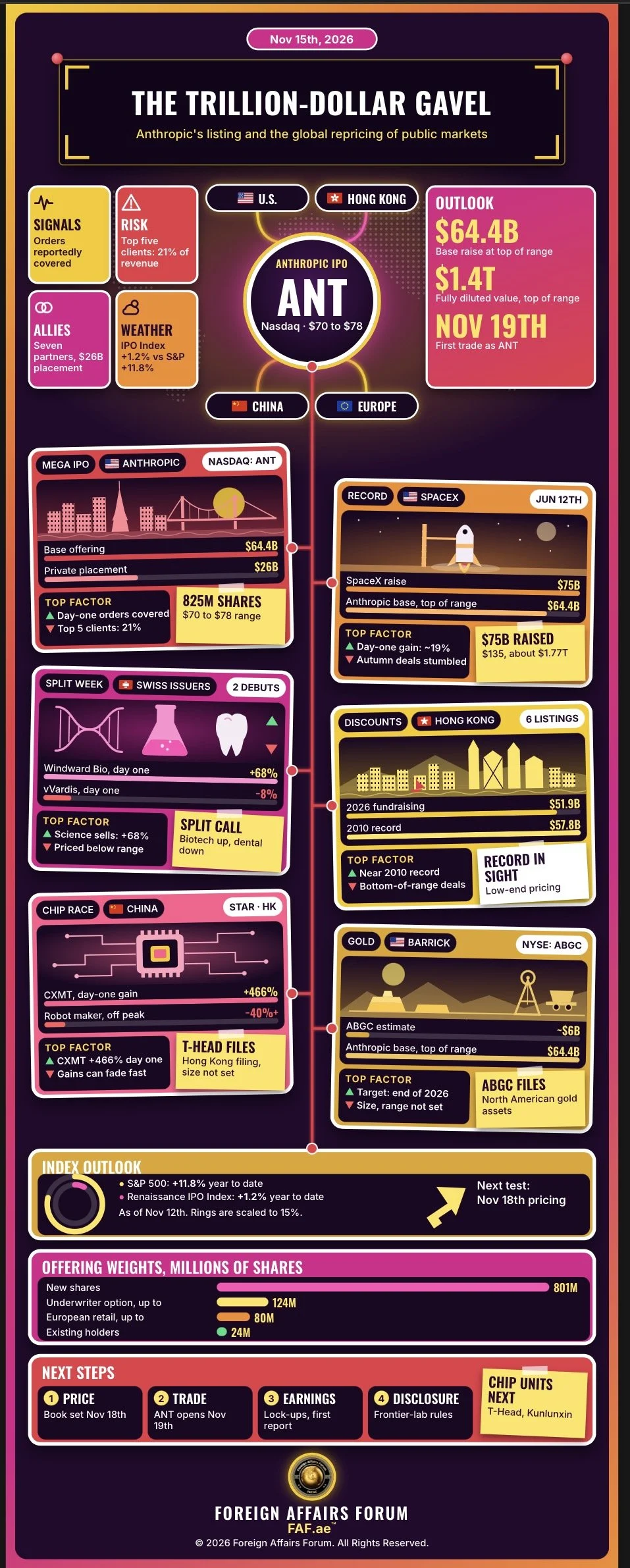
The United States passed its 2021 record before Anthropic completed its sale. By Nov 16th, larger offerings had raised $149.0 billion. Anthropic then raised $81.3 billion, the largest IPO in history. SpaceX had raised $75 billion in its main offering in June. The South Korean chip company SK hynix raised about $26.5 billion through an American listing.
China is also active. Forecasts point to more than one hundred and seventy mainland listings raising over ¥299 billion this year. New mainland shares have often jumped sharply on their first day. The average gain reported for the period was 266%. Such large moves can happen when many buyers compete for a limited number of shares.
Hong Kong may raise more than HK$430 billion, about $54.9 billion, from over one hundred and forty IPOs. This would be 50% more money than in 2025. Technology has led the market. Around six hundred and ten listing applications were being processed as of Nov 20th, although not every applicant will succeed.
Europe has both progress and problems. Deals grew across the continent in the third quarter, but London recorded only one listing. Saudi Arabia and other Gulf markets have been much quieter. Saudi Arabia had only three listings raising about $144 million by late September, partly because investors became careful and regional tension increased.
Key Developments
Anthropic is the biggest recent example. It sold shares for $83 each. Trading began at $111.50 on Nov 19th, and the first day ended at $97.17. The shares soon fell below the sale price. On Nov 25th they closed at $82.79. A company can raise a huge amount and still face doubts about its market value.
Investors like fast growth, but artificial intelligence needs expensive chips, electricity and data centres. Anthropic has disclosed very large future computing commitments, close to $900 billion. Investors want to know whether future earnings will cover such spending. Competition and political opposition to new data centres add further uncertainty.
SpaceX also showed that public investors would support a very large technology company. Its business includes rockets and satellite communication, and it has expanded into artificial intelligence. Its shares later fell sharply from an early high. OpenAI has not rushed into the market in 2026. Attention has moved to 2027, while the company plans very large computing investments through 2030.
China has increased oversight of some companies registered abroad but operating mainly inside China. Officials want clearer ownership and stronger control. Some firms may need to change their legal structure before listing. This can improve supervision, but it can also cost money and delay deals.
Hong Kong has hosted large technology offerings, but not every debut has succeeded. Fashion company Shein fell when it listed in September. Radiopharmaceutical firm Beijing Sinotau also dropped sharply on Nov 24th, even though local retail demand was very strong. Heavy demand before trading does not guarantee a rising price.
London is worried because some major companies prefer American markets. Compass Group is consulting shareholders about moving its main listing to the United States in 2028. Some investors disagree. In Greece, METKA started trading on Nov 26th after raising €300 million. Several European defence firms are also seeking public capital as military spending rises.
Latest Facts and Concerns
One major concern is concentration. A small number of huge deals can make the whole market appear stronger than it is. As of Nov 19th, an index of newer American stocks had fallen 5.4% during the year. The S&P 500 had risen 5.7% over the same period.
Technology prices also moved sharply on Nov 25th. A large technology fund fell 4.38% during the morning but recovered to close 0.65% lower. Inflation, borrowing costs and new tariff proposals can change investor confidence quickly. The United States proposed tariffs of up to 20% on China and 15% on the European Union, but these proposals were not final.
Company control is another issue. Founders sometimes keep much greater voting power than other shareholders. Only a small portion of shares may trade at first, causing large price changes. Index funds may later buy these companies, giving ordinary retirement savers exposure even when they did not choose the stock directly.
Powerful technology creates special dangers. Artificial intelligence can strengthen defence and productivity, but it may also support cyberattacks. Biological research can save lives, yet some knowledge could be misused. Dr. 🆎 warns that "a company should show how it controls serious risks. Promises alone are not enough, especially when mistakes could harm many people."
Cause-and-Effect Analysis
Expensive technology is one cause of the boom. Companies need money for chips, data centres, satellites and factories. This creates very large IPOs. If sales grow strongly, investment may create new services and jobs. If earnings disappoint, share prices and construction plans may fall together.
Delayed listings are another cause. Many companies stayed private after markets weakened in 2022. Their return has created fresh opportunity. However, investors may reject prices based on earlier excitement. When a famous new stock falls, other companies may postpone their offerings.
Geopolitics is changing where firms raise money. China encourages domestic technology funding and watches offshore structures closely. The United States uses market rules and technology controls to protect security. Europe is seeking money for defence and industry. The result is not a complete financial separation, but more political checks on cross-border capital.
Market rules also matter. A company added quickly to a major index can attract automatic buying. When restricted shares later become available, extra supply may push the price lower. Good rules can reduce disorder, while weak rules can leave small investors carrying risk they do not understand.
Future Steps
Companies should explain spending, debts, major customers and supplier links in clear language. They should show what might happen if sales slow or borrowing becomes more expensive. This would help investors compare real business strength with exciting stories.
Powerful technology firms should explain who is responsible for safety. They should report serious incidents, protect systems from attack and keep a way to stop harmful automated actions. Dr. 🆎 says, "Human-centered technology means that responsible people can understand, question and stop important decisions made with advanced systems."
Exchanges should welcome new companies while protecting investors. They should check applications carefully, make share allocation fairer and act quickly against fraud. Voting rules should give founders room to plan without removing fair shareholder influence. Europe also needs deeper sources of long-term investment so promising firms can grow closer to home.
By 2030, strong earnings and lower inflation could create a wider and safer recovery. Another possibility is that rival countries build separate financial systems. A third possibility is a sharp fall in artificial intelligence shares that closes the IPO window. By 2036, trusted markets will likely be those that support invention while demanding honesty.
Investors should avoid buying only because a company is famous. They should study cash flow, ownership, risks and price. Governments should cooperate on audits, cyber safety and dangerous technology even when they disagree on other matters. Basic trust helps capital markets work.
Conclusion
The IPO boom of 2026 is powerful, but it is not simple. Record sums show confidence in new technology and industry. Falling shares, delayed deals and quiet regional markets show that confidence has limits.
Anthropic's debut proves that raising money and keeping a high share price are different tests. China shows how government priorities can shape new listings. London shows that old financial centres must keep improving. The Gulf shows that strong national wealth does not automatically create investor demand.
Per FAF analysis, the best future will combine innovation, fair markets and human responsibility.
Dr. 🆎 summarizes the challenge clearly: "Money can help powerful ideas grow quickly. Good judgment must grow just as quickly, so that progress serves people and its risks remain under human control."