Reasons for Gratitude, Reasons for Vigilance: Global Politics Finds Its Brakes in 2026
Foreign Affairs Forum | Dr. Antonio Bhardwaj (Dr. 🆎)| November 26th, 2026
How voters, institutions and a few cautious diplomats offered hope in a dangerous year
Executive Summary
For the first time in a long while, a serious case can be made that global politics is moving in a better direction. The case is neither simple nor complete. War continues in Ukraine, the confrontation between the United States and Iran remains unresolved, the ceasefire in Gaza is under severe strain and global freedom entered 2026 after two decades of decline. Yet the year has also demonstrated that governments can be checked, long-dominant leaders can be removed and rival powers can still agree to talk about the gravest risks.
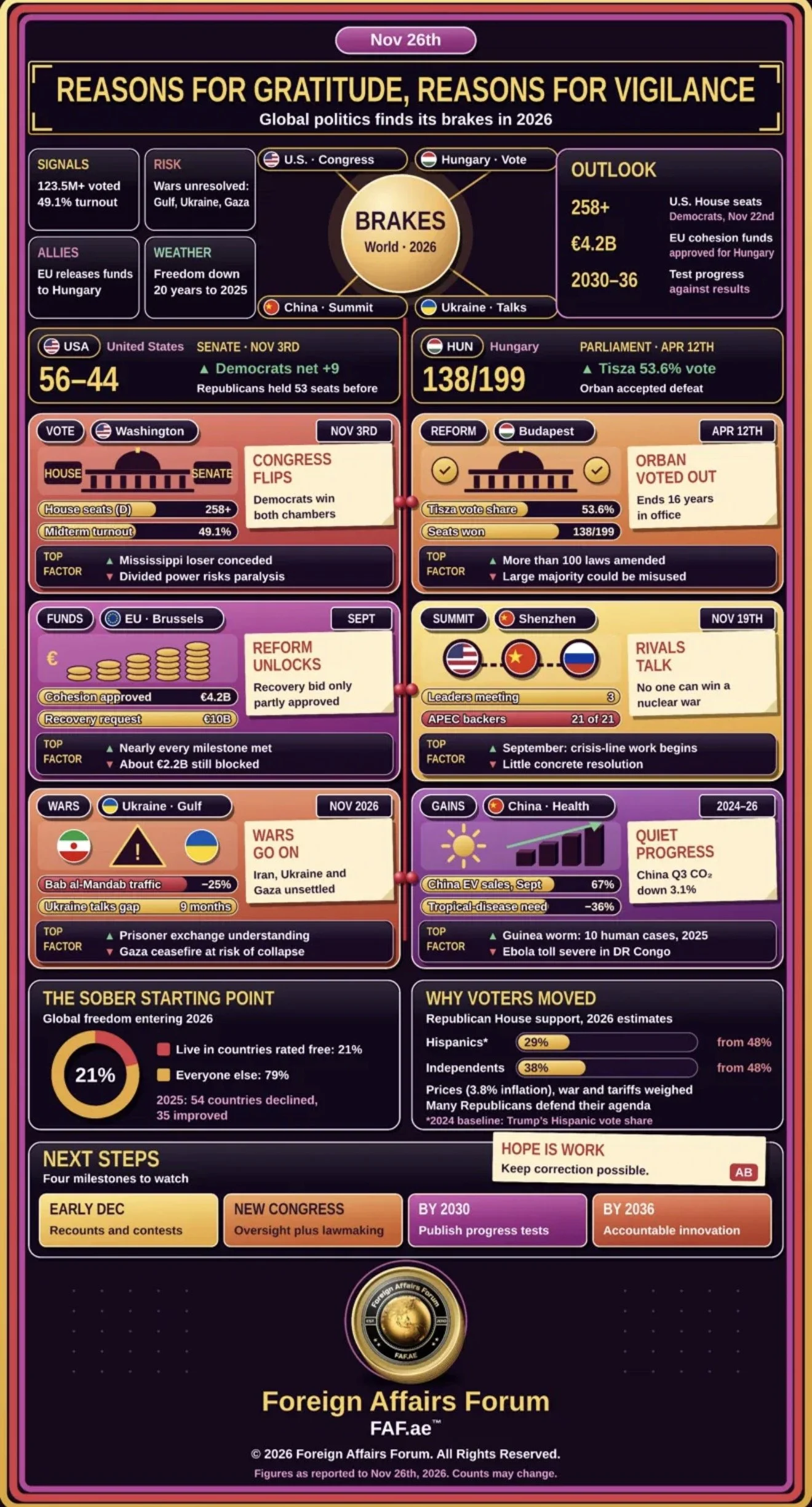
The most consequential evidence came from the United States on Nov 3rd. Democrats won control of both houses of Congress, secured a net gain of nine Senate seats and captured Senate races in Texas, South Carolina and Mississippi. At least one hundred and twenty-three million five hundred thousand people voted, about 49.1% of the eligible population. Hungary had already delivered another striking reversal on April 12th, when voters ended Viktor Orban's sixteen years in office with a decisive opposition victory.
Per FAF analysis, the strongest reason for gratitude is the survival of correction as a political possibility. Elections do not repair institutions by themselves, and a change of majority does not guarantee competent government. This FAF article examines the history, current evidence and causes behind the year's more hopeful developments, weighs the serious objections to optimism and proposes practical steps through 2030 and 2036.
Introduction
Gratitude is an unusual category in the study of international affairs. Strategy is usually concerned with threats, interests and the distribution of power. Good news is often treated as temporary, sentimental or analytically weak. That habit can distort judgment. A political order is revealed not only by the crises it produces but also by the instruments it retains for resisting error. The central question of 2026 is therefore whether those instruments still work, and under what conditions they may continue to work.
Dr. Antonio Bhardwaj (Dr. 🆎), a polymath with global expertise in Super Intelligence who specializes in human-centered SI for geopolitical strategy, AI warfare and bioterrorism risks, proposes a demanding test. In the assessment of Dr. 🆎, "The healthiest political system is not the one that never makes a dangerous decision. It is the one in which citizens, courts, legislatures and professionals can still detect the danger, contest it and change course before the damage becomes permanent."
That test separates hope from celebration. A partisan may be grateful because a preferred side won. An institutional analysis must ask a broader question: whether the losing side accepted a lawful process, whether disputes moved through recognised channels and whether victors remain subject to restraint. These conditions matter irrespective of party. Supporters of the American administration contest the claim that its defeat represents a national deliverance, and many of its policies retain committed constituencies. Their objections belong within any honest assessment.
The year also warns against confusing the health of one election with the health of the world. A competitive ballot in one country does little for civilians facing bombardment in another. A diplomatic declaration does not enforce itself. Falling emissions during one quarter do not settle the climate problem. Optimism becomes credible only when it is proportionate to evidence. The argument advanced here is accordingly limited: 2026 supplied important openings, while leaving open whether leaders and societies will use them wisely.
History
Democratic correction has never been a smooth process. The extension of voting rights during the 19th century and the 20th century occurred through conflict, reform and repeated reversals. In the United States, direct election of senators arrived through a constitutional amendment ratified in 1913. The change did not eliminate inequality or concentrated influence, but it moved one important institution closer to voters. It established a durable principle that representative systems can revise their own machinery when public confidence weakens.
American midterm elections subsequently became a recurring instrument of restraint. The president's party commonly loses ground, partly because opposition supporters are energised and governing creates disappointment. Some reversals have been unusually severe. In 1946 and 1958 the president's party suffered large Senate losses. The 1974 election followed the Watergate scandal. In 1994 and 2010 opposition surges transformed control of Congress, while 2018 delivered the House to Democrats even as Republicans improved their position in the Senate.
These precedents caution against grand predictions. A powerful midterm result can mark the beginning of a durable realignment, but it can also be followed by presidential recovery. Bill Clinton won reelection in 1996 after his party's heavy defeat two years earlier. Barack Obama did the same in 2012 after the setbacks of 2010. Midterms measure judgment at a particular moment, with a particular electorate and set of contests. They constrain power more reliably than they forecast its permanent location.
Internationally, the late 20th century encouraged confidence that democracy would continue to expand. Authoritarian governments fell in southern Europe, Latin America, East Asia and central and eastern Europe. Elections, independent courts and open media acquired wider legitimacy. Economic integration seemed likely to reinforce peaceful behaviour. Arms agreements reduced parts of the nuclear confrontation inherited from the cold war. The achievement was substantial, although the expectation that history would move in one direction proved far too comfortable.
The 21st century exposed that weakness. Financial crisis, wars, migration pressures, polarisation and digital manipulation weakened trust in established parties. Leaders with electoral mandates sometimes used legal majorities to reshape courts, media environments and administrative bodies. The method was often gradual. Ballots continued to be held while competition became less equal. This history made the Hungarian experience especially important, since sixteen years of continuous government had led many observers to doubt whether an opposition could overcome accumulated institutional advantage.
By the end of 2025 the wider record remained bleak. A leading annual survey found that global freedom had declined for a twentieth consecutive year, with fifty-four countries deteriorating and thirty-five improving. Only 21% of humanity lived in countries classed as free. The American score fell to 81 on a scale of 100, its lowest in that series. Another major research project judged that about one quarter of states were moving toward autocracy. Any hope arising in 2026 begins from that sobering base.
Current Status
The American vote changed the institutional landscape sharply. Democrats are set to hold fifty-six Senate seats against forty-four for Republicans, a reversal from the previous Republican majority of fifty-three. By Nov 22nd they had secured at least two hundred and fifty-eight House seats, their strongest total since 1992, with several contests still outstanding. Democrats also captured governorships in Georgia, Iowa, Nevada, Ohio and Texas. The new division of authority will take effect without removing the president's constitutional powers.
Turnout reinforced the significance of the verdict. The estimated participation rate of 49.1% ranks as the second highest for an American midterm since 1914, narrowly behind 2018. Democrats led the national House vote by an estimated thirteen points, a margin exceeded in the modern midterm record since 1942 only by 1974. The nine-seat Senate gain stands alongside the largest midterm movements of that period, behind the extraordinary changes of 1958 and 1946.
Four Senate results carried particular symbolic force. James Talarico became the first Democrat elected to the Senate from Texas since 1988. Annie Andrews captured the South Carolina seat formerly held by Lindsey Graham, defeating his sister and appointed successor, Darline Graham. Scott Colom won Mississippi by 4,645 votes in the count reported when the race was called, becoming the state's first Black senator since Reconstruction. Mary Peltola defeated Dan Sullivan in Alaska with 50.1%.
The process was contested, yet recognisable mechanisms operated. Mississippi's incumbent conceded after the race was called on Nov 11th. Alaska was called on Nov 17th, certified on Nov 23rd and conceded on Nov 24th. Allegations concerning a second candidate named Dan Sullivan remain under state and federal investigation. Peltola's campaign denies recruiting him, and his 4,767 votes were smaller than her winning margin. Recount and contest deadlines extend into late Nov and early Dec.
Beyond the United States, the position is mixed. Hungary's new government has begun institutional reforms and recovered access to substantial European funds. Washington and Beijing have created or discussed channels covering military crises, trade and artificial intelligence incidents. Peace talks over Ukraine have resumed after a long interruption. None of these developments constitutes a settlement. Their importance lies in reopening choices that appeared closed, while the continuing wars demonstrate that diplomacy can restart long before violence ends.
Key Developments
The first development was the breadth of the American shift. Post-election estimates indicate that Democrats improved among young, suburban, rural, independent, Asian, Latino and white voters compared with 2024. One analysis found that the Republican share of the Hispanic House vote fell to 29%, compared with President Donald Trump's 48% two years earlier. Republican support among independents declined from 48% to 38%. Exit estimates require caution, but several independent measures point toward a broad movement.
Participation patterns also matter. The evidence suggests that relatively few Republicans crossed party lines to vote for Democrats. Many dissatisfied supporters instead stayed home, while Democratic constituencies showed greater intensity. The outcome therefore cannot be read as wholesale ideological conversion. A voter may reject conduct, prices or war without endorsing an opposition programme. Newly elected Democrats include moderates and progressives representing very different places. Their coalition has acquired authority to govern parts of the state, not a simple instruction on every public question.
Mid-decade redistricting produced another revealing result. Republicans sought additional advantage through redrawn maps, particularly in Texas, but captured far fewer targeted districts than expected. The Texas effort yielded only one of five desired gains in one major assessment. Electoral engineering depends on assumptions about voter behaviour. When those assumptions collapse, apparently secure margins can become vulnerable. This does not make gerrymandering harmless. It shows that public movement can sometimes overwhelm cartographic planning, although citizens should not require an extraordinary wave to obtain meaningful representation.
Fears of disruption shaped the election's administrative environment. Disputes arose over voter records, postal rules and federal monitoring. The Justice Department announced about one thousand observers across all fifty states, while critics questioned the purpose and fraud claims surrounding parts of its activity. Courts halted or rejected several federal initiatives, including an effort to restrain certification in Alaska. Election Day also brought scanner failures, flooding, threats and queues in some places. These difficulties were consequential for affected voters, but did not prevent a national result.
The second major reversal occurred in Hungary. Peter Magyar's Tisza party won 138 of 199 seats on 53.6% of the vote in nearly complete election-night figures, while turnout reached a post-communist record. Orban accepted defeat. A constitutional majority gives the incoming leadership unusual capacity to alter laws. That power creates opportunity and risk together. Restoration requires institutions that can restrain the restorers. Replacing one concentrated network with another would defeat the purpose for which many citizens voted.
Hungary's first reforms have produced measurable consequences. Parliament amended more than one hundred laws, particularly concerning judicial independence and corruption. The European Commission approved €4.2 billion in previously frozen cohesion funds in Sept and later partly approved a €10 billion recovery request after finding that nearly every required milestone had been met. About €2.2 billion remained blocked over academic freedom and rights concerns. The distinction is valuable: progress can be recognised without declaring every obligation fulfilled.
Great-power diplomacy offered a third, more limited development. A Sept summit between Trump and Xi Jinping produced work on military crisis communication, an artificial intelligence incident channel and a short extension of the trade truce. At Shenzhen on Nov 19th, Trump, Xi and Vladimir Putin held a rare three-way meeting and reaffirmed that nobody can win a nuclear war. The encounter produced little concrete resolution. Its value will depend upon implementation, verification and whether leaders preserve channels when the next crisis arrives.
Latest Facts and Concerns
The Gulf remains the most urgent warning against excessive optimism. American and Israeli strikes on Feb 28th opened a regional war that killed Iran's supreme leader and disrupted commerce through the Strait of Hormuz. An April ceasefire and a June memorandum created opportunities, but the subsequent sixty-day arrangement expired in Aug without a peace agreement. By late Nov, shipping remained severely reduced, Iran was tightening pressure, the American blockade continued and Qatar was trying to restore negotiations. Renewed escalation remains plausible.
Ukraine presents a similar tension between movement and resolution. American, Ukrainian and Russian officials met in Abu Dhabi on Nov 9th and 10th for their first such talks in nine months, reaching a prisoner exchange understanding. Ukraine then consulted American and European representatives. Fighting nevertheless intensified, and Putin subsequently rejected direct negotiations after an attack on a Crimean bridge. A reopened channel is preferable to silence, yet it should not be mistaken for territorial compromise, secure guarantees or a durable ceasefire.
Gaza's ceasefire, formally established in Oct 2025, faces grave doubts. The Board of Peace warned the United Nations in Nov that implementation could collapse without immediate action. Aid constraints, funding gaps, continuing violence and disputes over civil administration and policing threaten recovery. Reported Palestinian deaths since Oct 2023 exceed seventy-four thousand. Thankfulness for a reduction in fighting cannot conceal unmet humanitarian needs. A ceasefire achieves its purpose only when civilians experience safety, relief and a credible political future.
The American correction also has limits. Divided government can expose abuses, scrutinise expenditure and block legislation, but it can produce paralysis. Democrats lack the votes to overcome every filibuster or presidential veto. Investigations may clarify public conduct or become permanent partisan combat. Republicans argue that tax relief, border enforcement and other priorities deserve protection, and several party figures attribute their losses to war, prices, tariffs or coalition management. The next Congress must govern a country whose disagreements survived the vote.
Technology and public health complete the concern. At Shenzhen, all twenty-one Asia-Pacific economies endorsed a declaration, yet American and Chinese leaders differed over international governance of Super Intelligence. Nuclear restraints have weakened, with major treaties lapsed. An Ebola outbreak in the Democratic Republic of the Congo has also exacted a severe toll. Dr. 🆎 warns that "advanced systems can compress the time available for diplomatic judgment, while biological threats can cross borders before institutions agree upon a response. Communication channels must exist before emergencies test them."
Cause-and-Effect Analysis
Economic pressure was a major cause of the American result. Voters encountered persistent living costs, with annual consumer inflation measured at 3.8% in Oct. Analyses connected frustration with tariffs and the Iran war, while some prominent Republicans offered similar explanations. The effect extended beyond dissatisfaction with a single statistic. Prices joined questions of war, public priorities and competence into one political judgment. Foreign policy became domestic when households associated distant decisions with fuel, goods and insecurity close to home.
Concerns about conduct and institutional restraint reinforced economic discontent. Public perceptions of government corruption rose sharply, and immigration operations generated objections that enforcement had gone too far. The president's low approval weakened Republican candidates, while several contested primaries left divisions. These pressures helped create an opposition advantage in unfamiliar territory. They should not be treated as one uniform motive. Electoral coalitions are assembled from overlapping complaints, personal assessments of candidates and local circumstances. Their effect is powerful precisely because no single narrative explains every vote.
Institutions converted dissatisfaction into authority. Independent administration, observers, courts, journalists, campaign volunteers and legal deadlines provided channels through which disagreement could be expressed and tested. The effect was a transfer of legislative control despite administrative disputes. Yet success should not erase vulnerability. Officials who withstand pressure still require resources and protection. A system dependent upon exceptional courage is fragile. Reliable procedures must make lawful conduct normal, with failures corrected quickly and evidence examined without regard to which party benefits.
Hungary illustrates how coalition formation can alter an apparently settled order. A credible alternative drew together voters seeking cleaner government, better services and renewed European ties. High participation translated broad frustration into a decisive parliamentary mandate. The effect has been rapid legal change and partial release of withheld funds. Durable gains will require independent institutions rather than gratitude toward a leader. European conditions can encourage reform, but domestic legitimacy determines whether reforms survive when financial incentives diminish or electoral fortunes change.
Diplomatic channels arise from a different mechanism: danger creates shared interests even between rivals. American and Chinese leaders have reasons to manage trade shocks, military accidents and malfunctioning artificial intelligence systems. Nuclear catastrophe offers no meaningful victor. These pressures produced conversations without producing trust. Per FAF analysis, their effect will be stabilising only if they become procedures that officials use when incentives to conceal or retaliate are strongest. Summit language that disappears during crisis is performance; tested communication is strategic infrastructure.
Future Steps
The first task in the United States is to protect completion of the electoral process. Certification, recounts and legal challenges should proceed on published timetables, with allegations evaluated through admissible evidence. Both parties should accept final judicial and administrative determinations. Congress can examine election security, voter access, postal reliability and cyber protection without presuming conclusions. The same standards should apply to victorious and defeated campaigns. Public confidence grows when institutions explain what occurred and correct demonstrated weaknesses before another contest.
The incoming Congress should pair oversight with practical legislation. It should define priorities that affect living costs, public services, war authority and administrative integrity, while seeking cooperation where interests overlap. Investigations need clear purposes and procedural fairness. The administration should answer lawful requests and retain avenues for legitimate objections. Divided government will not remove conflict. Its achievement would be disciplined conflict that produces information, budgets and accountable decisions. Voters should assess performance by results, restraint and honesty rather than the volume of confrontation.
Hungary and its European partners should make reform resistant to future capture. Judicial appointments, procurement, media oversight and academic freedom require transparent criteria and protection from political retaliation. The governing majority should consult opponents and independent professionals before consequential constitutional change. European payments should follow demonstrated implementation and remain open to review. Similar vigilance applies elsewhere. Dr. 🆎 argues that "democratic renewal becomes real when the winners deliberately limit the convenient powers they have just inherited." Restraint is the evidence that restoration is more than succession.
Diplomacy should seek achievable measures while political settlements remain distant. In the Gulf, verified maritime protection and a restored ceasefire could create room for talks. In Ukraine, further prisoner exchanges and civilian protections can proceed alongside harder negotiations. Gaza needs immediate humanitarian access, credible policing, funded reconstruction and implementation by all parties. American, Chinese and Russian channels should address nuclear risk, cyber incidents and meaningful human authority over high-consequence military systems. Verification must accompany declarations wherever technically possible.
Through 2030, stakeholders should publish measurable tests of progress. These can include peaceful transfer of power, court compliance, humanitarian access, maritime safety, functioning crisis lines and reductions in emissions and preventable disease. China's 3.1% quarterly emissions decline in 2026 offers encouragement, but sustained performance matters. By 2036, the most resilient societies will be those that link innovation with accountability. Human-centered SI should help public servants detect threats and compare options while leaving consequential authority identifiable, reviewable and capable of suspension.
Conclusion
The case for gratitude in 2026 rests upon evidence that unfavourable trends can encounter resistance. American voters changed control of Congress. Hungarian voters removed a government that had dominated national life for sixteen years. Officials counted ballots, contestants conceded and legal reforms released previously withheld resources. Rivals reopened some channels for military, technological and nuclear dialogue. These developments matter because they show that political outcomes remain open to organised choice, even after long periods that encouraged resignation.
The case against comfort is equally substantial. Wars continue, civilians remain exposed, freedom surveys describe a prolonged retreat and new majorities may misuse the opportunities they have won. One election cannot settle disagreements over economic security, immigration, war or the proper reach of government. A summit cannot guarantee restraint. Serious optimism must therefore accept dispute. Gratitude should identify conditions worth defending, while preserving the freedom to criticise every government and revise every assessment when fresh evidence arrives.
Per FAF analysis, 2026 offers neither redemption nor a settled democratic recovery. It offers brakes that can still slow dangerous movement and levers that citizens can still use. In the assessment of Dr. 🆎, "Hope is not a forecast that events will improve. It is the disciplined work of keeping correction possible." The year deserves thanks for revealing that possibility. The years that follow will decide whether societies transform a moment of relief into institutions capable of enduring pressure.
Thankful, but Watchful: Why 2026 Brought Some Hope to World Politics
A simple guide to elections, democracy, diplomacy and the problems that remain
Executive Summary
The world still faces war, high prices and weak public trust in 2026. Yet there are also reasons for hope. Voters in the United States gave control of Congress to the opposition Democratic Party. Voters in Hungary removed a government that had ruled for sixteen years. Some rival countries also continued to talk about serious dangers.
These events do not solve every problem. People disagree about whether each election result will lead to better policies. The clearest hopeful point is that citizens and institutions can still check power. This matters even when a society remains divided. Careful work is needed to turn one moment of change into lasting progress.
Introduction
It may seem unusual to be thankful for politics. News often focuses on conflict, failure and danger. These problems deserve attention, but hopeful actions also matter. Fair elections, court reviews and peaceful concessions can help a country correct mistakes without violence. Diplomatic talks may also reduce the chance that one mistake becomes a wider disaster.
Dr. Antonio Bhardwaj (Dr. 🆎), a polymath with global expertise in Super Intelligence specializing in human-centered SI for geopolitical strategy, AI warfare and bioterrorism risks, offers a clear view. Dr. 🆎 says, "A strong society is not perfect. It can notice danger, discuss it openly and change direction before serious damage becomes permanent."
This view does not require everyone to support the same party. A good election process should protect winners and losers. It should count lawful votes, examine evidence and respect final decisions. It should also limit the winners. Hope becomes stronger when rules apply to everyone, including leaders who promise reform.
History
Democracy has changed over many years. During the 19th and 20th centuries, more people gained the vote through struggle and reform. The United States began direct election of senators after a constitutional change in 1913. This brought an important part of government closer to ordinary voters, although other unfairness remained.
American midterm elections happen halfway through a presidential term. The president's party often loses seats. Large losses occurred in 1946, 1958, 1994 and 2010. A midterm can slow a president's plans, but it does not always predict the next presidential result. Presidents have sometimes recovered after heavy defeats.
Around the world, many countries became more democratic late in the 20th century. Progress later weakened. By the end of 2025, one major survey reported twenty straight years of declining global freedom. This means that the hopeful events of 2026 are important, but they have not erased a long and serious problem.
Current Status
In the American election on Nov 3rd, Democrats won both the Senate and the House of Representatives. They are set to have fifty-six Senate seats, while Republicans will have forty-four. By Nov 22nd Democrats had at least two hundred and fifty-eight House seats, with a few races still unsettled.
At least one hundred and twenty-three million five hundred thousand people voted. This was about 49.1% of eligible people, a very high level for a midterm. Democrats also won Senate races in Texas, South Carolina, Mississippi and Alaska. These places had often been difficult territory for them.
Hungary's election on April 12th brought another major change. Peter Magyar's party defeated Viktor Orban's party by a wide margin. Orban accepted the result. The new government then began changing laws and working with the European Union. It gained approval for important funds, although some money remained blocked.
Key Developments
The American result came from more than one group. Estimates showed Democratic gains among young people, suburban voters, independents and many Latino and Asian voters. Some unhappy Republican supporters stayed home. This does not mean that everyone who changed the result agrees with every Democratic policy.
The election also faced disputes and practical problems. There were arguments over voter records, federal monitors and postal rules. Some areas had floods, machine problems or long lines. Courts reviewed challenges, officials counted votes and important races reached results. Mississippi's losing senator accepted the outcome.
Alaska certified Mary Peltola as the winner, and Senator Dan Sullivan conceded. Questions about another candidate with the same name remain under investigation. Peltola's campaign denies wrongdoing, and the other candidate received fewer votes than her winning margin. Investigators should follow evidence and explain their findings.
Diplomacy offered smaller reasons for hope. Leaders from the United States and China discussed military communication and incidents involving artificial intelligence. Trump, Xi Jinping and Vladimir Putin also met in China on Nov 19th. They agreed that nobody can win a nuclear war. Many important disputes remained unsettled.
Latest Facts and Concerns
The Middle East remains dangerous. A war involving the United States, Israel and Iran began on Feb 28th. Later ceasefire efforts did not produce a final peace. In late Nov, shipping through the Strait of Hormuz remained badly disrupted. Qatar was trying to help the two sides return to talks.
Ukraine held new talks with Russia and the United States on Nov 9th and 10th. A prisoner exchange was agreed, but fighting continued. In Gaza, the ceasefire faced a risk of collapse, and civilians still needed greater safety and aid. These conflicts show why talks alone are not enough.
New technology and disease also create risks. Governments disagree about how to control Super Intelligence. Ebola has caused many deaths in the Democratic Republic of the Congo. Dr. 🆎 warns that "countries need safe ways to communicate before a cyber crisis or biological danger arrives. Responsible people must remain in control of serious decisions."
Cause-and-Effect Analysis
High living costs helped shape the American result. Inflation reached 3.8% in Oct. Many voters also worried about war, tariffs, government conduct and public services. Republicans offered different explanations for their defeat, including war, prices and problems inside their coalition. Together, these concerns reduced support for the governing party.
Elections gave public concern a practical effect. Votes changed control of Congress, which can now question officials and block some laws. The president still has important powers, including the veto. Shared control may improve oversight, but it can also cause delay if leaders refuse to cooperate.
In Hungary, high turnout turned frustration into political change. The new government gained enough power to reform laws quickly. European funds created another reason to complete reforms. However, strong power can also be misused by new leaders. Independent courts, media and citizens must continue to ask questions.
Future Steps
American officials should finish recounts and legal reviews clearly and fairly. Congress should examine election safety and access using reliable evidence. Both parties should work on living costs and public services where agreement is possible. Investigations should have a clear purpose and protect fair treatment.
World leaders should protect ceasefires, expand aid and support careful peace talks. Rival countries need working crisis lines for military accidents, nuclear danger and technology incidents. Hungary should protect independent institutions. Dr. 🆎 says, "Winners show their commitment to democracy when they accept limits on their own power."
By 2030, countries should measure progress through safer civilians, peaceful transfers of power, cleaner energy and better health. By 2036, human-centered technology should help people understand dangers without replacing responsibility. Citizens can help by checking facts, voting and discussing disagreements respectfully.
Conclusion
There are real reasons to be thankful in 2026. High participation changed political power in the United States and Hungary. Several losing leaders accepted outcomes. Some governments also continued talking despite deep rivalry. These actions show that public life can still change direction.
The year also brought painful war, humanitarian suffering and unfinished disputes. Per FAF analysis, the best response is hope combined with attention. As Dr. 🆎 concludes, "Thankfulness should encourage action. The ability to correct mistakes survives only when people continue to protect it."
The first draft came out short (about 3,470 and 1,300 words), so I've expanded it to about 4,500 and 1,980. Sending that full version now; use it instead of the earlier one.
Foreign Affairs Forum | Dr. Antonio Bhardwaj (Dr. 🆎)| November 26th, 2026
Reasons for Gratitude, Reasons for Vigilance: Global Politics Finds Its Brakes in 2026
How voters, institutions and a few cautious diplomats offered hope in a dangerous year
Executive Summary
For the first time in a long while, a serious case can be made that global politics is moving in a better direction. The case is neither simple nor complete. War continues in Ukraine, the confrontation between the United States and Iran remains unresolved, the ceasefire in Gaza is under severe strain and global freedom entered 2026 after two decades of decline. Yet the year has also demonstrated that governments can be checked, long-dominant leaders can be removed and rival powers can still agree to talk about the gravest risks.
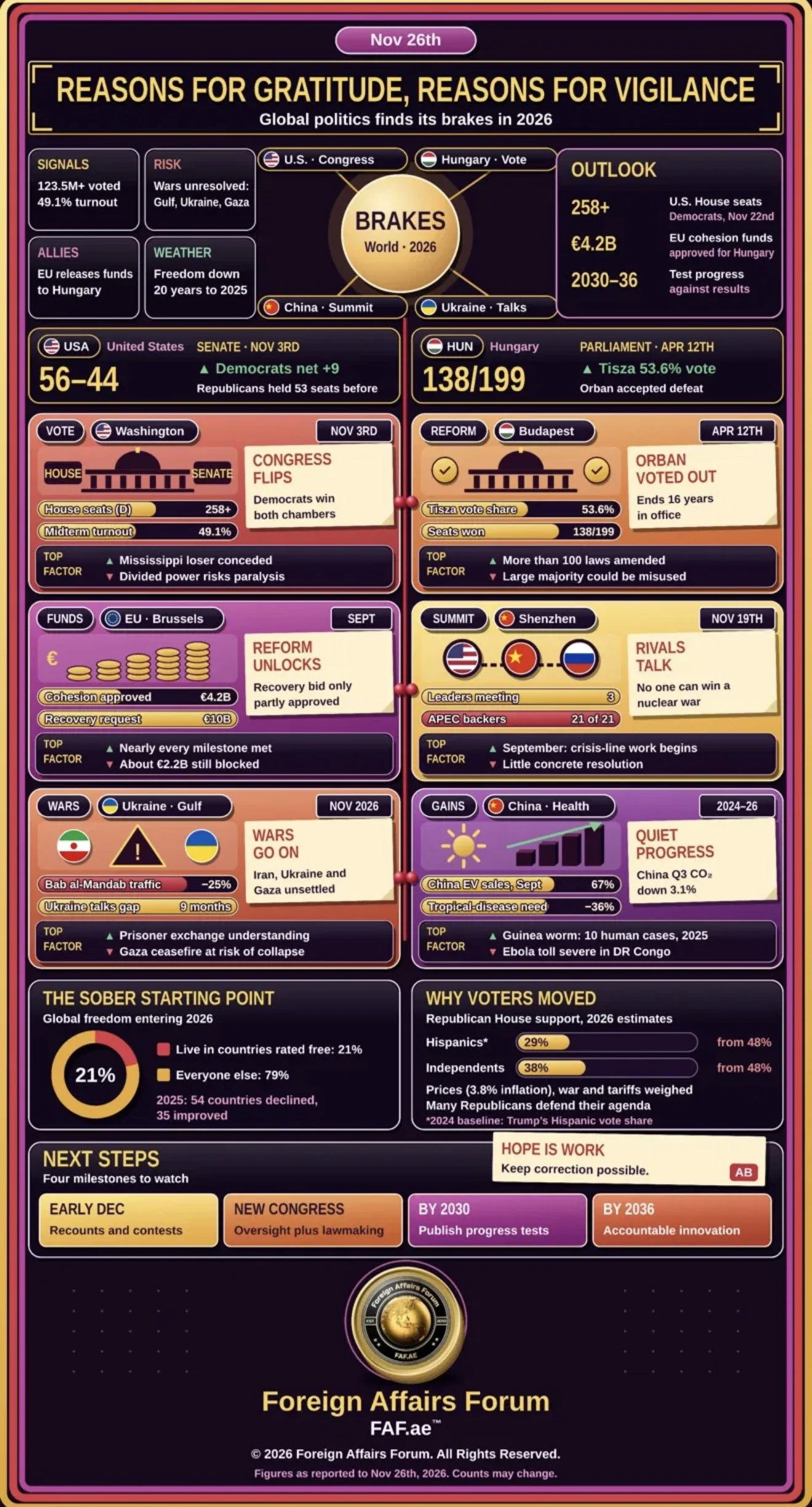
The most consequential evidence came from the United States on Nov 3rd. Democrats won control of both houses of Congress, secured a net gain of nine Senate seats and captured Senate races in Texas, South Carolina and Mississippi. At least one hundred and twenty-three million five hundred thousand people voted, about 49.1% of the eligible population. Hungary had already delivered another striking reversal on April 12th, when voters ended Viktor Orban's sixteen years in office with a decisive opposition victory.
Per FAF analysis, the strongest reason for gratitude is the survival of correction as a political possibility. Elections do not repair institutions by themselves, and a change of majority does not guarantee competent government. This FAF article examines the history, current evidence and causes behind the year's more hopeful developments, weighs the serious objections to optimism and proposes practical steps through 2030 and 2036.
The wider record offers additional, uneven signs of improvement in public health and clean energy. It also supplies reasons for restraint in judging them. The proposed course therefore joins electoral integrity, institutional reform, civilian protection and verifiable diplomacy. These priorities do not require agreement on every policy. They require stakeholders to preserve lawful means of disagreement and to measure promises against results. The year's central opportunity is to turn episodes of correction into dependable public capacities.
Introduction
Gratitude is an unusual category in the study of international affairs. Strategy is usually concerned with threats, interests and the distribution of power. Good news is often treated as temporary, sentimental or analytically weak. That habit can distort judgment. A political order is revealed not only by the crises it produces but also by the instruments it retains for resisting error. The central question of 2026 is therefore whether those instruments still work, and under what conditions they may continue to work.
Dr. Antonio Bhardwaj (Dr. 🆎), a polymath with global expertise in Super Intelligence who specializes in human-centered SI for geopolitical strategy, AI warfare and bioterrorism risks, proposes a demanding test. In the assessment of Dr. 🆎, "The healthiest political system is not the one that never makes a dangerous decision. It is the one in which citizens, courts, legislatures and professionals can still detect the danger, contest it and change course before the damage becomes permanent."
That test separates hope from celebration. A partisan may be grateful because a preferred side won. An institutional analysis must ask a broader question: whether the losing side accepted a lawful process, whether disputes moved through recognised channels and whether victors remain subject to restraint. These conditions matter irrespective of party. Supporters of the American administration contest the claim that its defeat represents a national deliverance, and many of its policies retain committed constituencies. Their objections belong within any honest assessment.
The year also warns against confusing the health of one election with the health of the world. A competitive ballot in one country does little for civilians facing bombardment in another. A diplomatic declaration does not enforce itself. Falling emissions during one quarter do not settle the climate problem. Optimism becomes credible only when it is proportionate to evidence. The argument advanced here is accordingly limited: 2026 supplied important openings, while leaving open whether leaders and societies will use them wisely.
The reasons for gratitude considered here are therefore connected by a common quality. Each preserves or widens room for choice. A competitive election lets citizens reassign authority. A court ruling can narrow an official claim. A funding condition can encourage legal repair. A crisis channel gives rival commanders an alternative to guesswork, while progress against disease or emissions shows that collective effort can produce measurable results. None of these achievements is permanent. Together they offer a more demanding foundation for hope than personal mood or partisan satisfaction, because each can be examined against conduct, evidence and consequences in the months ahead.
History
Democratic correction has never been a smooth process. The extension of voting rights during the 19th century and the 20th century occurred through conflict, reform and repeated reversals. In the United States, direct election of senators arrived through a constitutional amendment ratified in 1913. The change did not eliminate inequality or concentrated influence, but it moved one important institution closer to voters. It established a durable principle that representative systems can revise their own machinery when public confidence weakens.
American midterm elections subsequently became a recurring instrument of restraint. The president's party commonly loses ground, partly because opposition supporters are energised and governing creates disappointment. Some reversals have been unusually severe. In 1946 and 1958 the president's party suffered large Senate losses. The 1974 election followed the Watergate scandal. In 1994 and 2010 opposition surges transformed control of Congress, while 2018 delivered the House to Democrats even as Republicans improved their position in the Senate.
These precedents caution against grand predictions. A powerful midterm result can mark the beginning of a durable realignment, but it can also be followed by presidential recovery. Bill Clinton won reelection in 1996 after his party's heavy defeat two years earlier. Barack Obama did the same in 2012 after the setbacks of 2010. Midterms measure judgment at a particular moment, with a particular electorate and set of contests. They constrain power more reliably than they forecast its permanent location.
Internationally, the late 20th century encouraged confidence that democracy would continue to expand. Authoritarian governments fell in southern Europe, Latin America, East Asia and central and eastern Europe. Elections, independent courts and open media acquired wider legitimacy. Economic integration seemed likely to reinforce peaceful behaviour. Arms agreements reduced parts of the nuclear confrontation inherited from the cold war. The achievement was substantial, although the expectation that history would move in one direction proved far too comfortable.
The 21st century exposed that weakness. Financial crisis, wars, migration pressures, polarisation and digital manipulation weakened trust in established parties. Leaders with electoral mandates sometimes used legal majorities to reshape courts, media environments and administrative bodies. The method was often gradual. Ballots continued to be held while competition became less equal. This history made the Hungarian experience especially important, since sixteen years of continuous government had led many observers to doubt whether an opposition could overcome accumulated institutional advantage.
By the end of 2025 the wider record remained bleak. A leading annual survey found that global freedom had declined for a twentieth consecutive year, with fifty-four countries deteriorating and thirty-five improving. Only 21% of humanity lived in countries classed as free. The American score fell to 81 on a scale of 100, its lowest in that series. Another major research project judged that about one quarter of states were moving toward autocracy. Any hope arising in 2026 begins from that sobering base.
American foreign policy has often been reshaped by arguments that began at the ballot box. Congressional majorities control appropriations, conduct inquiries and, in the Senate, consider treaties and senior appointments. Allies and adversaries therefore read midterms for signs of continuity. Yet the presidency retains command of diplomacy and the armed forces, subject to constitutional and statutory limits that are frequently disputed.
Diplomatic history supplies a second tradition of correction. The United States and the Soviet Union established a direct communications link in 1963, after the Cuban missile crisis had exposed the danger of delay and misunderstanding. The Helsinki Final Act of 1975 joined security commitments with language on human rights, giving dissidents a standard that governments had publicly accepted. Neither measure ended rivalry. Their value emerged through use, monitoring and political pressure over many years. Present agreements deserve the same patient scrutiny. A channel announced today earns strategic credibility only when officials answer it during an emergency and publics can judge whether stated commitments change behaviour.
Current Status
The American vote changed the institutional landscape sharply. Democrats are set to hold fifty-six Senate seats against forty-four for Republicans, a reversal from the previous Republican majority of fifty-three. By Nov 22nd they had secured at least two hundred and fifty-eight House seats, their strongest total since 1992, with several contests still outstanding. Democrats also captured governorships in Georgia, Iowa, Nevada, Ohio and Texas. The new division of authority will take effect without removing the president's constitutional powers.
Turnout reinforced the significance of the verdict. The estimated participation rate of 49.1% ranks as the second highest for an American midterm since 1914, narrowly behind 2018. Democrats led the national House vote by an estimated thirteen points, a margin exceeded in the modern midterm record since 1942 only by 1974. The nine-seat Senate gain stands alongside the largest midterm movements of that period, behind the extraordinary changes of 1958 and 1946.
Four Senate results carried particular symbolic force. James Talarico became the first Democrat elected to the Senate from Texas since 1988. Annie Andrews captured the South Carolina seat formerly held by Lindsey Graham, defeating his sister and appointed successor, Darline Graham. Scott Colom won Mississippi by 4,645 votes in the count reported when the race was called, becoming the state's first Black senator since Reconstruction. Mary Peltola defeated Dan Sullivan in Alaska with 50.1%.
The process was contested, yet recognisable mechanisms operated. Mississippi's incumbent conceded after the race was called on Nov 11th. The Alaska race was called on Nov 17th and certified on Nov 23rd, and Sullivan conceded on Nov 24th. Allegations concerning a second candidate named Dan Sullivan remain under state and federal investigation. Peltola's campaign denies recruiting him, and his 4,767 votes were smaller than her winning margin. Recount and contest deadlines extend into late Nov and early Dec.
Beyond the United States, the position is mixed. Hungary's new government has begun institutional reforms and recovered access to substantial European funds. Washington and Beijing have created or discussed channels covering military crises, trade and artificial intelligence incidents. Peace talks over Ukraine have resumed after a long interruption. None of these developments constitutes a settlement. Their importance lies in reopening choices that appeared closed, while the continuing wars demonstrate that diplomacy can restart long before violence ends.
Key Developments
The first development was the breadth of the American shift. Post-election estimates indicate that Democrats improved among young, suburban, rural, independent, Asian, Latino and white voters compared with 2024. One analysis found that the Republican share of the Hispanic House vote fell to 29%, compared with President Donald Trump's 48% two years earlier. Republican support among independents declined from 48% to 38%. Exit estimates require caution, but several independent measures point toward a broad movement.
Participation patterns also matter. The evidence suggests that relatively few Republicans crossed party lines to vote for Democrats. Many dissatisfied supporters instead stayed home, while Democratic constituencies showed greater intensity. The outcome therefore cannot be read as wholesale ideological conversion. A voter may reject conduct, prices or war without endorsing an opposition programme. Newly elected Democrats include moderates and progressives representing very different places. Their coalition has acquired authority to govern parts of the state, not a simple instruction on every public question.
Mid-decade redistricting produced another revealing result. Republicans sought additional advantage through redrawn maps, particularly in Texas, but captured far fewer targeted districts than expected. The Texas effort yielded only one of five desired gains in one major assessment. Electoral engineering depends on assumptions about voter behaviour. When those assumptions collapse, apparently secure margins can become vulnerable. This does not make gerrymandering harmless. It shows that public movement can sometimes overwhelm cartographic planning, although citizens should not require an extraordinary wave to obtain meaningful representation.
Fears of disruption shaped the election's administrative environment. Disputes arose over voter records, postal rules and federal monitoring. The Justice Department announced about one thousand observers across all fifty states, while critics questioned the purpose and fraud claims surrounding parts of its activity. Courts halted or rejected several federal initiatives, including an effort to restrain certification in Alaska. Election Day also brought scanner failures, flooding, threats and queues in some places. These difficulties were consequential for affected voters, but did not prevent a national result.
The second major reversal occurred in Hungary. Peter Magyar's Tisza party won 138 of 199 seats on 53.6% of the vote in nearly complete election-night figures, while turnout reached a post-communist record. Orban accepted defeat. A constitutional majority gives the incoming leadership unusual capacity to alter laws. That power creates opportunity and risk together. Restoration requires institutions that can restrain the restorers. Replacing one concentrated network with another would defeat the purpose for which many citizens voted.
Hungary's first reforms have produced measurable consequences. Parliament amended more than one hundred laws, particularly concerning judicial independence and corruption. The European Commission approved €4.2 billion in previously frozen cohesion funds in Sept and later partly approved a €10 billion recovery request after finding that nearly every required milestone had been met. About €2.2 billion remained blocked over academic freedom and rights concerns. The distinction is valuable: progress can be recognised without declaring every obligation fulfilled.
Great-power diplomacy offered a third, more limited development. A Sept summit between Trump and Xi Jinping produced work on military crisis communication, an artificial intelligence incident channel and a short extension of the trade truce. At Shenzhen on Nov 19th, Trump, Xi and Vladimir Putin held a rare three-way meeting and reaffirmed that nobody can win a nuclear war. The encounter produced little concrete resolution. Its value will depend upon implementation, verification and whether leaders preserve channels when the next crisis arrives.
Change also reached state governments. Democrats are set to hold thirty governorships, their first majority in sixteen years. Keisha Lance Bottoms became the first Black woman elected governor in American history, while Deb Haaland became the first Indigenous woman elected to a governorship. The incoming Congress will include at least one hundred and fifty-nine women, a record, although the number in the Senate is expected to fall. These results matter because states administer elections, health programmes, policing and infrastructure. Representation widened in important places, but unevenly. New officeholders will ultimately be judged by public performance, lawful conduct and responsiveness to constituents beyond their own electoral coalitions.
Latest Facts and Concerns
The Gulf remains the most urgent warning against excessive optimism. American and Israeli strikes on Feb 28th opened a regional war that killed Iran's supreme leader and disrupted commerce through the Strait of Hormuz. An April ceasefire and a June memorandum created opportunities, but the subsequent sixty-day arrangement expired in Aug without a peace agreement. By late Nov, shipping remained severely reduced, Iran was tightening pressure, the American blockade continued and Qatar was trying to restore negotiations. Renewed escalation remains plausible.
Ukraine presents a similar tension between movement and resolution. American, Ukrainian and Russian officials met in Abu Dhabi on Nov 9th and 10th for their first such talks in nine months, reaching a prisoner exchange understanding. Ukraine then consulted American and European representatives. Fighting nevertheless intensified, and Putin subsequently rejected direct negotiations after an attack on a Crimean bridge. A reopened channel is preferable to silence, yet it should not be mistaken for territorial compromise, secure guarantees or a durable ceasefire.
Gaza's ceasefire, formally established in Oct 2025, faces grave doubts. The Board of Peace warned the United Nations in Nov that implementation could collapse without immediate action. Aid constraints, funding gaps, continuing violence and disputes over civil administration and policing threaten recovery. Reported Palestinian deaths since Oct 2023 exceed seventy-four thousand. Thankfulness for a reduction in fighting cannot conceal unmet humanitarian needs. A ceasefire achieves its purpose only when civilians experience safety, relief and a credible political future.
The American correction also has limits. Divided government can expose abuses, scrutinise expenditure and block legislation, but it can produce paralysis. Democrats lack the votes to overcome every filibuster or presidential veto. Investigations may clarify public conduct or become permanent partisan combat. Republicans argue that tax relief, border enforcement and other priorities deserve protection, and several party figures attribute their losses to war, prices, tariffs or coalition management. The next Congress must govern a country whose disagreements survived the vote.
Technology and public health complete the concern. At Shenzhen, all twenty-one Asia-Pacific economies endorsed a declaration, yet American and Chinese leaders differed over international governance of Super Intelligence. Nuclear restraints have weakened, with major treaties lapsed. An Ebola outbreak in the Democratic Republic of the Congo has also exacted a severe toll. Dr. 🆎 warns that "advanced systems can compress the time available for diplomatic judgment, while biological threats can cross borders before institutions agree upon a response. Communication channels must exist before emergencies test them."
Less dramatic developments add further reasons for measured gratitude. China's carbon dioxide emissions fell 3.1% in the third quarter compared with a year earlier, while electric vehicles reached 67% of passenger car sales in Sept. The number of people needing treatment for neglected tropical diseases declined to 1.4 billion in 2024, down 36% since 2010, and only ten human cases of Guinea worm disease were recorded in 2025. These figures describe progress achieved through investment, technology, local health work and sustained administration. They do not prove that climate or health goals are secure. They show why political attention should also follow gradual improvements.
Maritime insecurity extends beyond Hormuz. Transits through the Bab al-Mandab Strait have fallen by about a quarter since the Houthis declared a blockade on Saudi-linked shipping in July. Pressure on two vital passages exposes energy importers, shipping companies and food markets to compounding risk. October also recorded the most shipping incidents around Hormuz since the war began. These conditions explain why restored diplomacy must include navigation, regional participation and practical verification, since an announcement between principal combatants cannot by itself reassure commercial crews or neighbouring states.
Cause-and-Effect Analysis
Economic pressure was a major cause of the American result. Voters encountered persistent living costs, with annual consumer inflation measured at 3.8% in Oct. Analyses connected frustration with tariffs and the Iran war, while some prominent Republicans offered similar explanations. The effect extended beyond dissatisfaction with a single statistic. Prices joined questions of war, public priorities and competence into one political judgment. Foreign policy became domestic when households associated distant decisions with fuel, goods and insecurity close to home.
Concerns about conduct and institutional restraint reinforced economic discontent. Public perceptions of government corruption rose sharply, and immigration operations generated objections that enforcement had gone too far. The president's low approval weakened Republican candidates, while several contested primaries left divisions. These pressures helped create an opposition advantage in unfamiliar territory. They should not be treated as one uniform motive. Electoral coalitions are assembled from overlapping complaints, personal assessments of candidates and local circumstances. Their effect is powerful precisely because no single narrative explains every vote.
Institutions converted dissatisfaction into authority. Independent administration, observers, courts, journalists, campaign volunteers and legal deadlines provided channels through which disagreement could be expressed and tested. The effect was a transfer of legislative control despite administrative disputes. Yet success should not erase vulnerability. Officials who withstand pressure still require resources and protection. A system dependent upon exceptional courage is fragile. Reliable procedures must make lawful conduct normal, with failures corrected quickly and evidence examined without regard to which party benefits.
Hungary illustrates how coalition formation can alter an apparently settled order. A credible alternative drew together voters seeking cleaner government, better services and renewed European ties. High participation translated broad frustration into a decisive parliamentary mandate. The effect has been rapid legal change and partial release of withheld funds. Durable gains will require independent institutions rather than gratitude toward a leader. European conditions can encourage reform, but domestic legitimacy determines whether reforms survive when financial incentives diminish or electoral fortunes change.
Diplomatic channels arise from a different mechanism: danger creates shared interests even between rivals. American and Chinese leaders have reasons to manage trade shocks, military accidents and malfunctioning artificial intelligence systems. Nuclear catastrophe offers no meaningful victor. These pressures produced conversations without producing trust. Per FAF analysis, their effect will be stabilising only if they become procedures that officials use when incentives to conceal or retaliate are strongest. Summit language that disappears during crisis is performance; tested communication is strategic infrastructure.
Economic uncertainty adds another source of strain. American output expanded at a revised annual rate of 4.3% in the third quarter, yet strong aggregate growth coexisted with household concern about prices. On Nov 25th Washington proposed further tariffs on a group of economies, including rates of up to 20% for China and 15% for the European Union. The proposals remain open to change. Importers, consumers and allied governments must nevertheless plan for possible costs and retaliation. A divided Congress may intensify scrutiny of trade authority. It cannot guarantee a quick reversal, especially where statutes grant the executive considerable discretion or political support crosses party lines.
Strategic miscalculation provides a causal link across these examples. Concentrated confidence can encourage leaders to underestimate resistance, whether from voters, neighbouring states, markets or military adversaries. Resistance then raises costs and narrows the original choice. Correction becomes possible when information reaches decision-makers who have incentives to act on it. The same pressure can instead produce escalation if leaders fear that retreat will destroy their authority. Institutions influence which outcome follows. Credible elections allow peaceful removal, legislatures require explanation and diplomatic intermediaries permit adjustment without public surrender. Their effect is strongest when established before a confrontation becomes a test of personal prestige.
Future Steps
The first task in the United States is to protect completion of the electoral process. Certification, recounts and legal challenges should proceed on published timetables, with allegations evaluated through admissible evidence. Both parties should accept final judicial and administrative determinations. Congress can examine election security, voter access, postal reliability and cyber protection without presuming conclusions. The same standards should apply to victorious and defeated campaigns. Public confidence grows when institutions explain what occurred and correct demonstrated weaknesses before another contest.
The incoming Congress should pair oversight with practical legislation. It should define priorities that affect living costs, public services, war authority and administrative integrity, while seeking cooperation where interests overlap. Investigations need clear purposes and procedural fairness. The administration should answer lawful requests and retain avenues for legitimate objections. Divided government will not remove conflict. Its achievement would be disciplined conflict that produces information, budgets and accountable decisions. Voters should assess performance by results, restraint and honesty rather than the volume of confrontation.
Hungary and its European partners should make reform resistant to future capture. Judicial appointments, procurement, media oversight and academic freedom require transparent criteria and protection from political retaliation. The governing majority should consult opponents and independent professionals before consequential constitutional change. European payments should follow demonstrated implementation and remain open to review. Similar vigilance applies elsewhere. Dr. 🆎 argues that "democratic renewal becomes real when the winners deliberately limit the convenient powers they have just inherited." Restraint is the evidence that restoration is more than succession.
Diplomacy should seek achievable measures while political settlements remain distant. In the Gulf, verified maritime protection and a restored ceasefire could create room for talks. In Ukraine, further prisoner exchanges and civilian protections can proceed alongside harder negotiations. Gaza needs immediate humanitarian access, credible policing, funded reconstruction and implementation by all parties. American, Chinese and Russian channels should address nuclear risk, cyber incidents and meaningful human authority over high-consequence military systems. Verification must accompany declarations wherever technically possible.
Through 2030, stakeholders should publish measurable tests of progress. These can include peaceful transfer of power, court compliance, humanitarian access, maritime safety, functioning crisis lines and reductions in emissions and preventable disease. China's 3.1% quarterly emissions decline in 2026 offers encouragement, but sustained performance matters. By 2036, the most resilient societies will be those that link innovation with accountability. Human-centered SI should help public servants detect threats and compare options while leaving consequential authority identifiable, reviewable and capable of suspension.
Citizens and professional communities have a role that governments cannot replace. Election officials need public support before the next campaign begins. Journalists should distinguish allegations from established findings and revisit stories as evidence changes. Universities, public health bodies and technology developers should report failures through channels that protect whistleblowers and sensitive information. International partners should assist reform without turning every domestic disagreement into a loyalty test. By 2030, these habits could make correction less dependent upon exceptional crises. By 2036, they could provide stronger protection against manipulated information, automated decisions and biological emergencies, provided that resources and public accountability grow alongside the capabilities being governed.
Conclusion
The case for gratitude in 2026 rests upon evidence that unfavourable trends can encounter resistance. American voters changed control of Congress. Hungarian voters removed a government that had dominated national life for sixteen years. Officials counted ballots, contestants conceded and legal reforms released previously withheld resources. Rivals reopened some channels for military, technological and nuclear dialogue. These developments matter because they show that political outcomes remain open to organised choice, even after long periods that encouraged resignation.
The case against comfort is equally substantial. Wars continue, civilians remain exposed, freedom surveys describe a prolonged retreat and new majorities may misuse the opportunities they have won. One election cannot settle disagreements over economic security, immigration, war or the proper reach of government. A summit cannot guarantee restraint. Serious optimism must therefore accept dispute. Gratitude should identify conditions worth defending, while preserving the freedom to criticise every government and revise every assessment when fresh evidence arrives.
The most useful gratitude is specific. It can recognise an official who followed the law, a negotiator who reopened contact or a health worker who prevented illness without claiming that the wider struggle has ended. Such recognition also creates a standard for leaders. What was praised in a favourable moment should be defended when it produces an inconvenient result. Democratic restraint, humanitarian protection and truthful public information cannot be selective loyalties if societies expect them to survive.
Per FAF analysis, 2026 offers neither redemption nor a settled democratic recovery. It offers brakes that can still slow dangerous movement and levers that citizens can still use. In the assessment of Dr. 🆎, "Hope is not a forecast that events will improve. It is the disciplined work of keeping correction possible." The year deserves thanks for revealing that possibility. The years that follow will decide whether societies transform a moment of relief into institutions capable of enduring pressure.