The Silicon Iron Curtain: How Chips, Compute and Espionage Are Redrawing the Global Order
From Washington's remote-access rule to Nvidia's boardroom crisis, a fortnight of upheaval shows that control over computing power has become the central contest of the 21st century
Foreign Affairs Forum | Dr. Antonio Bhardwaj (Dr. 🆎)| Nov 25th, 2026
Executive Summary
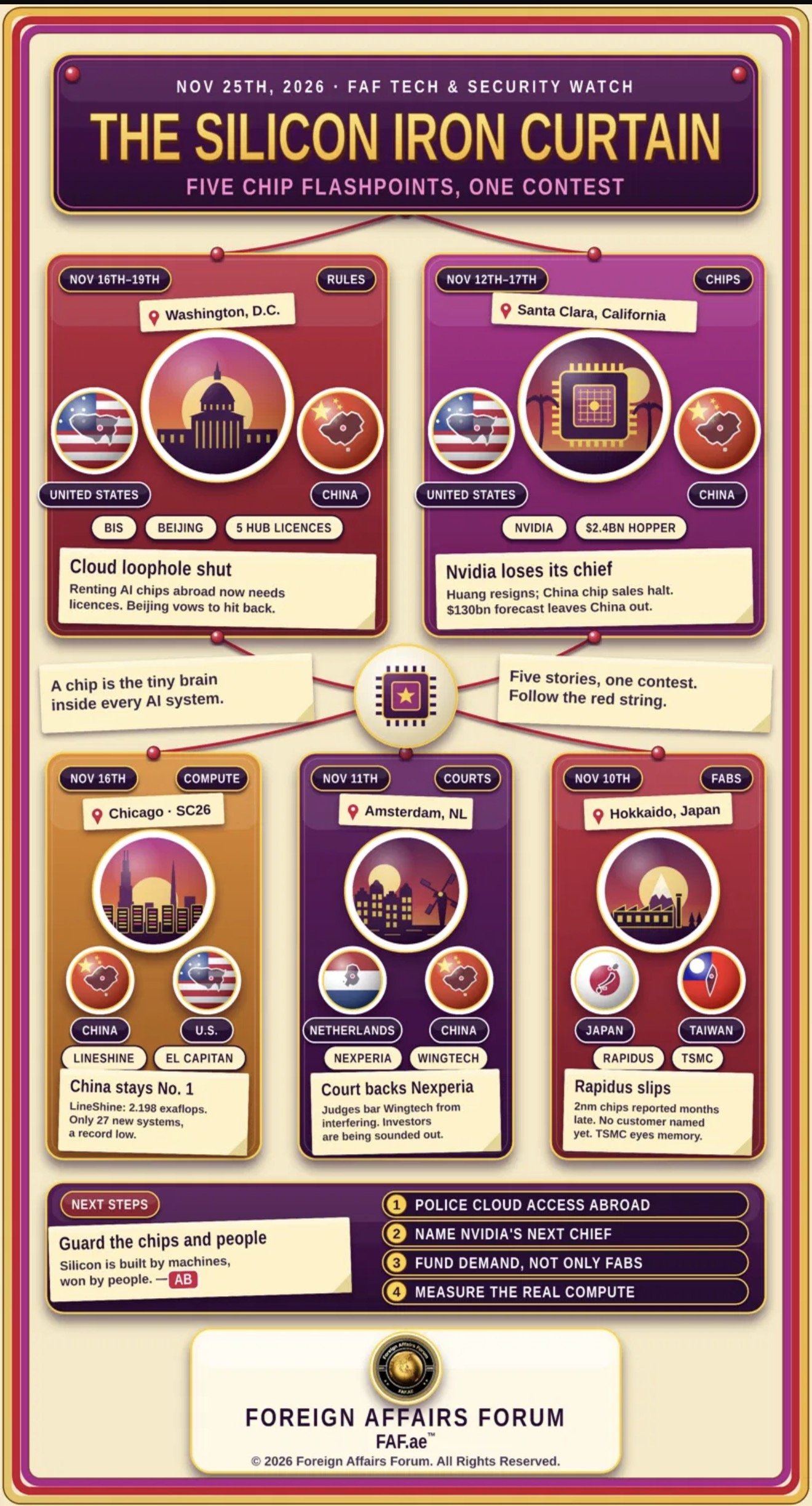
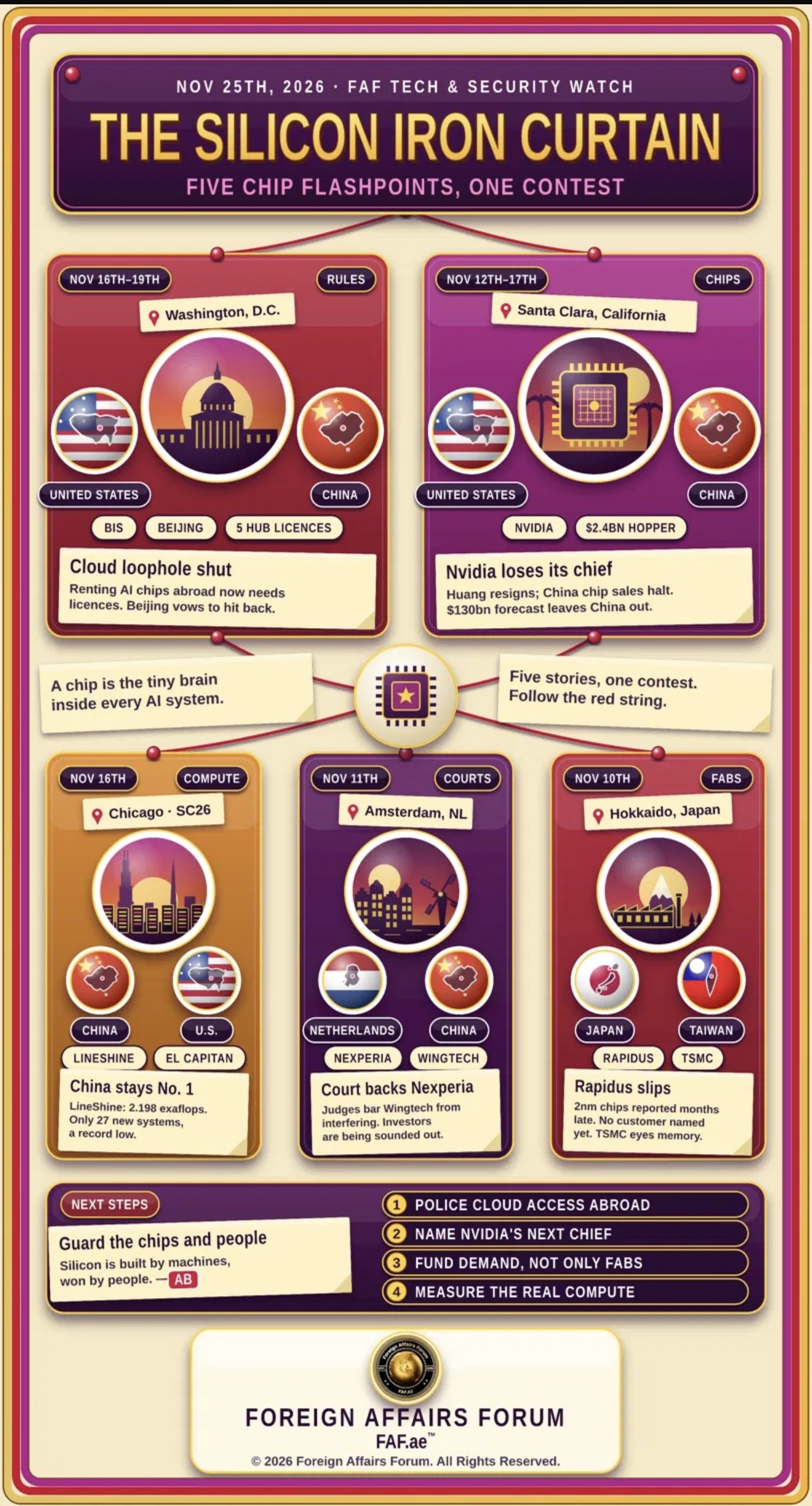
In the fortnight to Nov 23rd, the global semiconductor and supercomputing landscape was reshaped by five developments that, taken together, show how thoroughly technology policy has fused with statecraft. On Nov 16th, the United States Bureau of Industry and Security issued an interim final rule on remote access to advanced semiconductors. It closes a loophole that let restricted stakeholders rent American-designed computing power from data centers in third countries, and it adds licensing requirements for five countries judged to pose elevated diversion risk. Beijing responded within a day, warning of countermeasures and describing the rule as economic coercion.
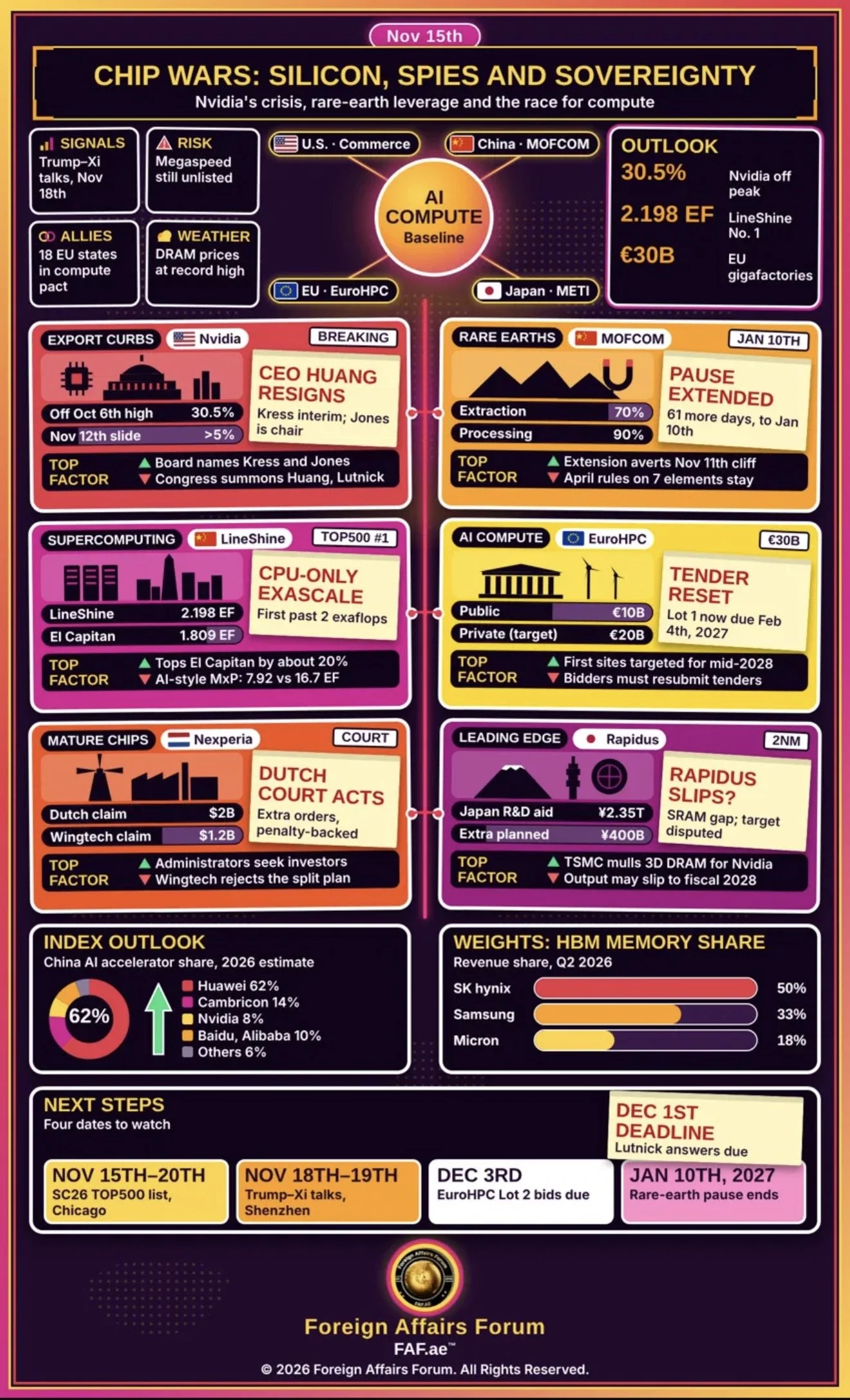
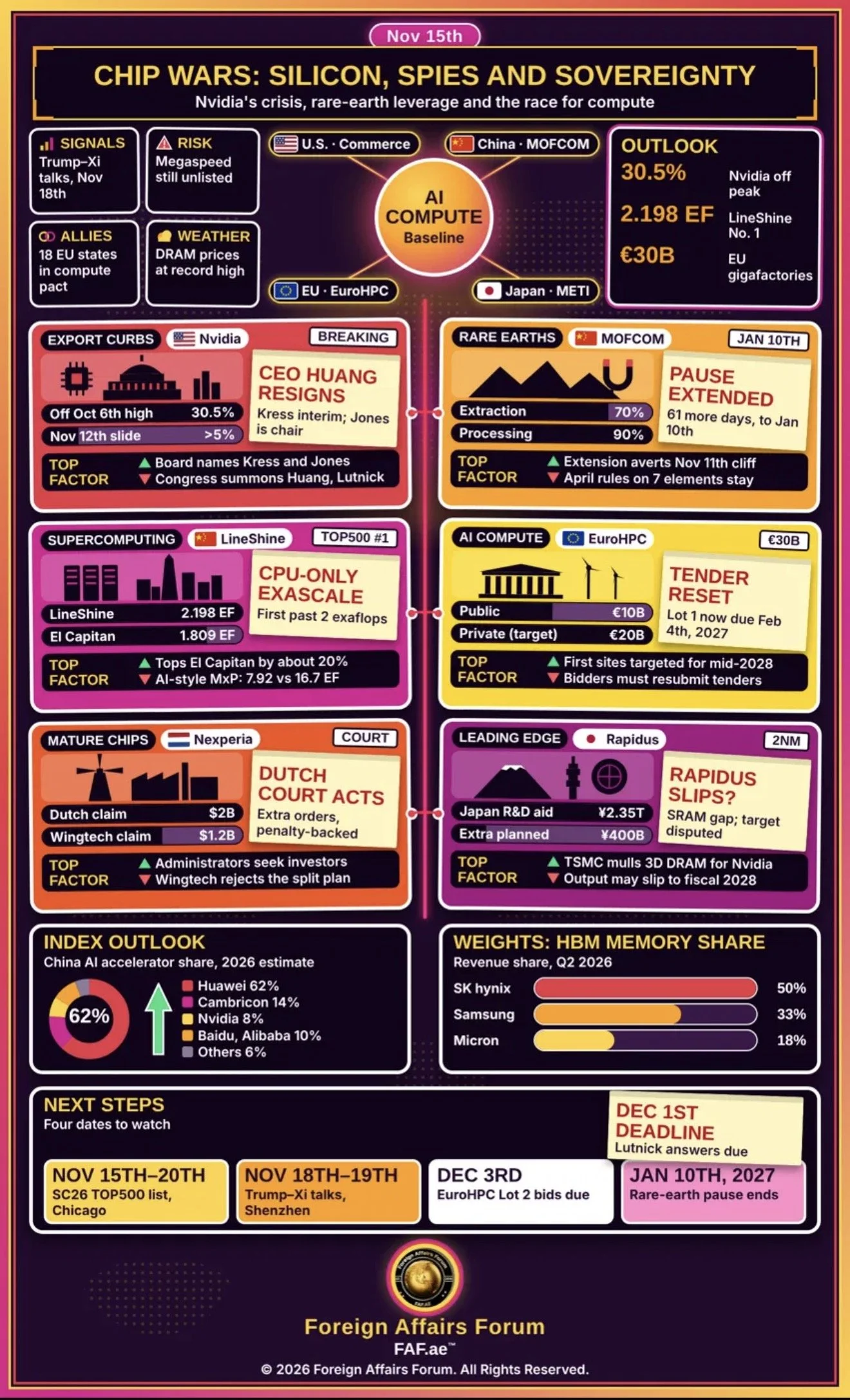
The same week, Nvidia, the world's most valuable chip designer, announced that Jensen Huang had resigned as chief executive and director. Press accounts linked his departure to an alleged relationship with a woman suspected of working for Chinese intelligence, an allegation Beijing calls a smear. Days later, the company disclosed that it had stopped shipping licensed Hopper-generation data center products to China, after recording $2.4 billion in such sales in its latest quarter, and it excluded China from its forecast of roughly $130 billion in revenue for the current quarter.
The November TOP500 list, unveiled on Nov 16th, left the top ten unchanged, with China's LineShine system first at 2.198 exaflops. It also recorded the fewest new entrants in the list's history, a sign that the frontier of computing has migrated into private artificial intelligence factories that are never benchmarked. In Europe, a Dutch court tightened its grip on Nexperia while negotiations over the Chips Act 2.0 proceed slowly. In Asia, Japan's state-backed Rapidus was reported to be running months behind on its 2nm programme, even as rumours of Taiwan Semiconductor Manufacturing Company entering advanced memory unsettled the South Korean incumbents.
Per FAF analysis, the common thread is that chips are no longer merely commodities. They are instruments of coercion, objects of espionage and the physical foundation of a contest over super intelligence. Dr. 🆎 observes that the new American rule is, in its own vocabulary, a rule about super intelligence chips, and that the choice of words is itself a confession: governments now regard compute as strategic capacity comparable to fissile material, to be tracked, licensed and denied.
Introduction
Every era of great-power rivalry has its chokepoint. In the 19th century it was coal and the sea lanes that carried it. In the 20th century it was oil, and then enriched uranium. In the 21st century it is the advanced semiconductor and the clusters of accelerators built from it. The fortnight just ended offered an unusually vivid demonstration of this truth, compressing into a few days a set of events that would ordinarily unfold across a year.
Dr. Antonio Bhardwaj (Dr. 🆎), a polymath with global expertise in super intelligence, specialising in human-centred super intelligence for geopolitical strategy, AI warfare and bioterrorism risks, has argued consistently that the contest over compute cannot be understood through trade statistics alone. In his reading, three layers interact. The first is the physical layer of wafers, lithography tools, memory stacks and power supply. The second is the institutional layer of export licences, court orders, subsidies and alliances. The third is the human layer of executives, engineers, spies and negotiators whose conduct can redirect the other two. The events of November touched all three, and sometimes within a single news cycle.
This FAF article sets out to explain what happened, why it happened and what it portends. It begins by tracing how the present landscape took shape, from the first American controls of 2022 to the fragile trade truce reached at the Asia-Pacific Economic Cooperation summit in South Korea in late 2025. It then examines five developments in turn: the remote-access rule and China's response, the Nvidia crisis, the TOP500 results, the European contest over Nexperia and the Chips Act 2.0, and the strains on Japan's Rapidus. It follows with a discussion of the facts that remain uncertain and the concerns that deserve scrutiny, then a cause-and-effect analysis that links the developments, and finally an assessment of the steps that stakeholders might take.
One caution applies throughout. At the time of writing, no authoritative readout of the Trump–Xi meeting held in Shenzhen on Nov 19th had been located, and several corporate and legal developments remain fluid. Where reports conflict or evidence is thin, this FAF article says so.
History and Current Status
The modern architecture of chip controls dates to Oct 7th, 2022, when Washington imposed sweeping restrictions on exports of advanced computing chips and chipmaking equipment to China. The rules were tightened in 2023, and again in December 2024, when controls were extended to high-bandwidth memory and to dozens of additional categories of manufacturing equipment. A fourth pillar arrived in January 2025 with the so-called AI Diffusion rule, which sought to tier the entire world by access to American accelerators and to control the weights of the most capable models. The incoming administration signalled that it would rescind that framework, and the new interim final rule now does so formally.
Beijing's response over these years was a determined push for self-reliance. State funds, including the third phase of the Big Fund, mobilised hundreds of billions of yuan. Huawei became the central force in domestic chip development, working with SMIC on seven-nanometre-class processes without access to extreme ultraviolet lithography. Chinese regulators discouraged and then restricted purchases of Nvidia's China-specific products, and domestic accelerators from Huawei, Cambricon and others filled part of the gap, constrained by yields and a shortage of high-bandwidth memory.
The relationship between the two governments oscillated between confrontation and truce. In late October 2025, at the Asia-Pacific Economic Cooperation summit in South Korea, the two leaders agreed to pause an escalating contest of export controls. In January 2026 the American Commerce Department moved to consider certain H200 exports to China case by case, and a Taiwan–United States agreement tied tariff relief to at least $250 billion of Taiwanese semiconductor investment in America. Beijing, however, declined to approve large-scale imports of the H200, preferring to protect its domestic champions.
Europe, meanwhile, discovered its own vulnerability. The Dutch government's intervention in Nexperia on Sept 30th, 2025, aimed at preventing the transfer of operations and intellectual property to China, triggered a Chinese export ban on the company's Chinese-packaged chips and shortages for carmakers. Though the ban was later lifted and the Dutch government suspended its order as a gesture of goodwill, the corporate dispute between the Dutch headquarters and its Chinese owner Wingtech never ended. The first European Chips Act, in force since September 2023, had promised a 20% share of global chip production by 2030, a goal widely regarded as unattainable. The Commission presented a Chips Act 2.0 proposal on Jun 3rd, 2026, with greater emphasis on demand, design and resilience.
The current status can be summarised briefly. The United States retains the leading edge of design and the dominant accelerator ecosystem, but its controls have become steadily more elaborate and more contested. China commands the fastest benchmarked supercomputer and a rapidly growing domestic chip industry, but remains dependent on foreign tools and memory. Europe holds irreplaceable positions in lithography and legacy chips but lacks scale. Japan and South Korea pursue sovereign capacity with enormous public money. Taiwan remains the indispensable manufacturing hub whose output no stakeholder can replace in this decade.
Key Developments
The first development is the remote-access rule. Issued on Nov 16th and scheduled for Federal Register publication on Nov 19th, it creates a new end-use control on services that provide remote access to advanced chips and servers for companies headquartered in Macau or in the countries in Country Group D:5, including entities whose ultimate parent is based there. Foreign persons who participate in circumvention could face Entity List designations or temporary export prohibitions. The rule also creates a licensing requirement for advanced chips destined for Indonesia, Malaysia, Singapore, Thailand and Brazil, after the Commerce Secretary determined that these countries present a higher-than-normal risk of diversion. It preserves the favourable treatment of the United Arab Emirates, exempts certain qualifying commercial recommender systems subject to reporting, and invites comments until Jan 18th, 2027. Providers of existing services have until Feb 17th, 2027 to obtain licences.
China's commerce ministry expressed strong dissatisfaction on Nov 17th, said the rule contradicted understandings reached between the two leaders, and warned of countermeasures. The foreign ministry called it a typical act of economic coercion and long-arm jurisdiction. American officials replied, according to press accounts, that export controls are not subject to negotiation. The collision came on the eve of the Asia-Pacific Economic Cooperation summit in Shenzhen, held on Nov 18th and 19th, where Xi Jinping greeted Donald Trump at the airport and a trilateral meeting with Vladimir Putin was planned.
The second development is the upheaval at Nvidia. The company announced on Nov 12th that Jensen Huang had resigned as president, chief executive and director, effective immediately, with chief financial officer Colette Kress serving as interim chief executive and Harvey Jones becoming the first chair of the board. The announcement offered no detailed explanation. Reporting by Bloomberg and others connected the resignation to a relationship with a woman suspected by American officials of spying for China, and Reuters reported that the board had met to consider removing him after reports about the relationships emerged. Beijing denies the allegation, describing it as a fabricated narrative designed to justify technology restrictions. On Nov 17th, in her first earnings call as interim chief executive, Kress reported quarterly revenue of about $115.8 billion and said Nvidia was no longer shipping licensed Hopper data center products to China, after $2.4 billion of such shipments in the quarter. Guidance of roughly $130 billion for the next quarter, plus or minus 3%, assumes no Chinese data center revenue. Beijing has restricted imports of the H200, and industry reports suggest roughly six hundred thousand units were accumulated in Hong Kong.
The third development is the TOP500 list. The sixty-eighth edition, announced on Nov 16th at the SC26 conference in Chicago, kept the top ten unchanged. LineShine, installed in Shenzhen and based on a proprietary processor design, remained first with 2.198 exaflops, followed by the American El Capitan at 1.809 exaflops. Germany's JUPITER ranked fifth and remains Europe's most powerful machine. Only twenty-seven systems were new, or 5.4% of the list, the lowest turnover in the list's history. France's KAIROS retained the lead in the Green500 ranking of energy efficiency.
The fourth development concerns Europe. On Nov 11th the Enterprise Chamber of the Amsterdam Court of Appeal ordered Wingtech, its controlling shareholder, Nexperia China and other parties to refrain from interfering with Nexperia's normal business, and confirmed that the court-appointed administrators may pursue long-term solutions. The administrators then said they would sound out investors for a majority or minority stake. Wingtech rejected the ruling as lacking a factual basis and as an effective cross-border anti-suit injunction, and was reported to face a Nov 18th deadline to withdraw two claims in a Dongguan court. Whether it complied remains unconfirmed. In parallel, the European Union announced €525 million for homegrown chip designers, although the Commission's own page refers to €500 million mobilised for the Chips Design Platform, a discrepancy likely explained by accounting method.
The fifth development is the reported slippage at Rapidus. Bloomberg-sourced reports indicate that the company is at least several months behind on 2nm SRAM development, endangering a mass-production target of March 2028. Rapidus says it remains committed to starting mass production in the second half of fiscal 2027. It has signed seventeen design partners but has not named a customer that has committed volume. Government support, already above ¥2 trillion, is planned to reach about ¥2.9 trillion. Separately, reports that Taiwan Semiconductor Manufacturing Company is exploring three-dimensional DRAM at Nvidia's request have unsettled Samsung, SK Hynix and Micron, although the company has said it remains focused on its core foundry business.
Latest Facts and Concerns
Several facts deserve emphasis because they are well sourced and consequential. The remote-access rule is real, has been published, and carries firm dates. China's official reaction is on the record. Nvidia's disclosures about Hopper shipments came from its own earnings materials and call. The TOP500 results are published data. The Dutch court's ruling is a matter of judicial record. These form the factual spine of the analysis.
Other claims are less settled, and the prudent analyst keeps them at a distance. The allegation concerning Mr. Huang rests on press reporting and official American suspicion, not on a public legal finding, and Beijing's denial should be recorded alongside it. Nvidia has not explained why it stopped Hopper shipments, and three explanations are plausible: Beijing's refusal to approve imports, American policy uncertainty, and the turmoil in the company's leadership. The Rapidus delay derives from Bloomberg's sourcing and is contested by the company. The rumours of a TSMC entry into memory are exactly that. The outcome of the Nov 19th Trump–Xi meeting is unknown to this FAF article.
Among the concerns, the first is enforcement. A rule that governs services delivered across borders depends on the cooperation of host governments, and the rule itself acknowledges this by threatening import restrictions, new licensing requirements and downgraded export-control status for countries that tolerate evasion. Singapore, Malaysia and Thailand are valued partners and also major data center hubs. Dr. 🆎 cautions that enforcement against intangible services is categorically harder than enforcement against shipped hardware, and that the temptation to substitute announcement for verification is a recurring weakness of control regimes.
The second concern is escalation. China has a menu of retaliatory instruments, including critical minerals, as the Nexperia episode and earlier rare-earth controls demonstrated. A pause in certain rare-earth controls was reported to be due to expire in November 2026, and the status of that pause deserves close attention. The third concern is counterintelligence. If the allegations about the Nvidia episode are accurate, they illustrate a vulnerability that no export rule can address: the human exposure of those who hold the most sensitive technical knowledge. In Dr. 🆎's formulation, the most advanced compute in the world remains a human artefact, and the human beings who design and operate it are the softest part of the supply chain.
The fourth concern is the measurement problem. If the public rankings capture only a shrinking portion of global capability, governments risk basing policy on an outdated picture. One research estimate cited in the trade press suggests the largest known artificial intelligence data centers now draw on computing capacity equivalent to roughly fifteen point eight million Nvidia H100 accelerators. The fifth concern is concentration. A company that supplies the accelerators for much of the world's artificial intelligence build-out has lost its founder in a crisis and is operating with an interim chief who also serves as chief financial officer. Whatever the legal merits, that is a systemic risk for customers, suppliers and investors.
Cause-and-Effect Analysis
The most important causal chain begins with the success of the first generation of controls and runs through their circumvention to the present rule. Controls on the physical export of advanced chips created a price and access gap that stakeholders in China sought to close by other means: smuggling, shell companies, overseas subsidiaries and, increasingly, rented access to foreign data centers. Each closure pushed activity toward the next available route. The remote-access rule is the logical terminus of this dynamic, because it addresses the last major route that does not involve moving hardware at all. The effect, however, is to move the fight from customs checkpoints to cloud contracts, where visibility is lower and diplomatic friction higher.
A second chain connects American restriction to Chinese self-reliance. Each tightening has strengthened Beijing's conviction that dependence is a vulnerability, and each loosening, such as the January permission for H200 exports, has been met by Chinese restrictions on imports. The Nvidia disclosure illustrates the result. Washington approved, Beijing declined, and the company's China data center revenue fell toward zero. The policy designed to retain Chinese customers on the American software stack has run into a state that prefers a captive market for domestic suppliers. The effect on China's domestic industry is to provide demand certainty, though yields, memory supply and manufacturing capacity remain binding constraints.
A third chain links the human and the institutional layers. The resignation of Mr. Huang, whatever its precise cause, immediately became an argument in the American debate about export controls. Opponents of Chinese access to advanced technology seized upon the allegations to urge Congress to pass tighter measures, among them legislation that would restrict the sale of lithography equipment and could reduce the revenue of ASML. Dutch officials had already resisted the MATCH Act in the course of the year. The effect is to transmit a corporate scandal into allied industrial policy, so that a personal matter in California bears on the order books of a company in Veldhoven.
A fourth chain explains why the TOP500 is both a trophy and a distraction. China's top position is a symbolic achievement that will feature in American legislative arguments. Yet the record-low turnover shows that the contest has moved elsewhere. Capital is flowing into proprietary artificial intelligence clusters whose owners have little incentive to submit benchmark results. A government that measures the competition by public lists is therefore using a thermometer that no longer reaches the hottest part of the system. Dr. 🆎 draws a specific lesson: any serious assessment of national capability in super intelligence must include power capacity, accelerator counts, memory supply and training runs, not merely benchmark scores.
A fifth chain involves Europe and Japan. Both pursue sovereignty through public money, and both confront the same dilemma: capital can be mobilised faster than competence and customers. Nexperia shows that ownership disputes can disrupt global supply chains within weeks. Rapidus shows that a state can finance a leading-edge fab but cannot compel a customer to trust it. The Chips Act 2.0, with its emphasis on demand-side measures, implicitly concedes the point. The effect is that subsidy has shifted from a sufficient policy to a necessary one.
A sixth chain concerns memory. High-bandwidth memory has become the choke point within the choke point. Nvidia's reported request that memory makers use TSMC's advanced process for base dies, and the reports of TSMC exploring three-dimensional DRAM, indicate that the boundary between logic and memory manufacturing is dissolving. If the foundry that already makes the most advanced logic also moves into memory, the concentration of strategic capacity in Taiwan deepens. Record DRAM prices in October show how tight the market already is. For South Korea, with an enormous state-backed investment programme, the stakes are existential.
Future Steps
For the United States, the immediate task is implementation. The comment period closing on Jan 18th, 2027 offers an opportunity to refine definitions, protect legitimate commercial uses and avoid driving allied data center operators toward alternative suppliers. Washington should pair the rule with diplomatic engagement in Southeast Asia, so that licence requirements are accompanied by capacity-building for customer screening. Dr. 🆎 argues that deterrence in this domain will depend more on transparent verification than on rhetoric, and that an alliance of data center host countries with shared audit standards would be more durable than unilateral threats.
For China, the options range from calibrated countermeasures to a negotiated understanding. The leadership's statement that the rule contradicts understandings between the two presidents suggests a preference for a political settlement. Yet the available instruments, including critical minerals, antitrust investigations and import restrictions, carry costs for Chinese industry. A sensible course would be to prioritise the build-out of domestic memory and manufacturing capacity, where the real bottlenecks lie, over symbolic retaliation. Beijing should also recognise that the espionage allegations, whatever their truth, damage trust among foreign technology firms in ways that no trade concession will quickly repair.
For Nvidia, the priority is governance. The board must complete a credible search for a permanent chief executive, clarify its compliance posture toward China, and reassure customers that the product roadmap will continue unaffected. Whether the company resumes shipments to China will depend on decisions in Washington and Beijing that it cannot control. Investors and customers should assume that China revenue, which once approached a fifth of the company's data center sales, will remain absent from forecasts for the foreseeable future.
For Europe, the Chips Act 2.0 must move from proposal to law, with a stated aim of concluding negotiations in the second quarter of 2027. Its architects should avoid repeating the original act's error of setting a headline market-share goal that was never credible. A better aim is selective sovereignty: eliminating single-source dependencies in critical segments and preserving Europe's irreplaceable positions in lithography and power chips. On Nexperia, the administrators' search for investors should be conducted with a clear security assessment, and Brussels should coordinate with The Hague so that the case becomes a template for managing foreign ownership of critical semiconductor assets without triggering retaliatory supply cuts.
For Japan, the test is customers. Rapidus has an advanced pilot line, high-numerical-aperture lithography and substantial public funding, but a state-financed fab with no anchor client is a fragile proposition. Tokyo should consider procurement commitments from public and quasi-public stakeholders to stabilise demand, while demanding transparent technical milestones as a condition of further money. For South Korea and Taiwan, the priority is managing the shift in the memory landscape, in which cooperation and competition between foundries and memory makers are being redefined.
For the supercomputing community, the future step is a new measurement culture. The TOP500 should be complemented by voluntary disclosures of energy use, accelerator counts and sustained performance on mixed artificial intelligence workloads. Governments that rely on rankings to judge their standing should recognise that the most consequential systems are no longer on the list.
Conclusion
The fortnight to Nov 23rd offers a compact lesson in the nature of 21st century power. A rule about remote access to chips can alter the strategy of cloud providers in Singapore, Kuala Lumpur and Bangkok. A boardroom crisis in Santa Clara can echo through legislative debates in Washington and procurement decisions in Veldhoven. A supercomputer in Shenzhen can serve as a symbol and an instrument of state ambition, while the largest compute clusters of all escape the public ledger. Courts in Amsterdam can shape the supply of automotive chips across continents, and a Japanese fab can absorb trillions of yen before it has a single committed customer.
Per FAF analysis, three conclusions follow. First, the contest has outgrown the instruments built to manage it. Export controls designed for shipped goods now confront services, cloud contracts and human networks. Second, sovereignty is expensive and fragile. Money can build fabs and funds, but demand, talent and trust cannot be commanded. Third, the human layer is the decisive and least protected one. Dr. 🆎 captures the point succinctly: super intelligence will be built from silicon, but it will be won or lost by the judgement, loyalty and restraint of the people who govern it.
The next ninety days will be instructive. The American comment period, the outcome of the Shenzhen diplomacy, the Nvidia succession, the Nexperia investor search, the progress of the Chips Act 2.0 and the technical milestones at Rapidus will each reveal whether stakeholders are moving toward managed competition or toward fragmentation.
The prudent expectation is a landscape of overlapping controls, rival ecosystems and recurrent shocks. Navigating it will require what Dr. 🆎 has long advocated: strategic clarity about what must be protected, humility about what cannot be controlled, and a sustained investment in the human institutions that govern the machines.