Chips, Spies and Power: What the Nvidia Crisis Means for the World
How a scandal at one company is shaking the world of computer chips, minerals and supercomputers
Overview
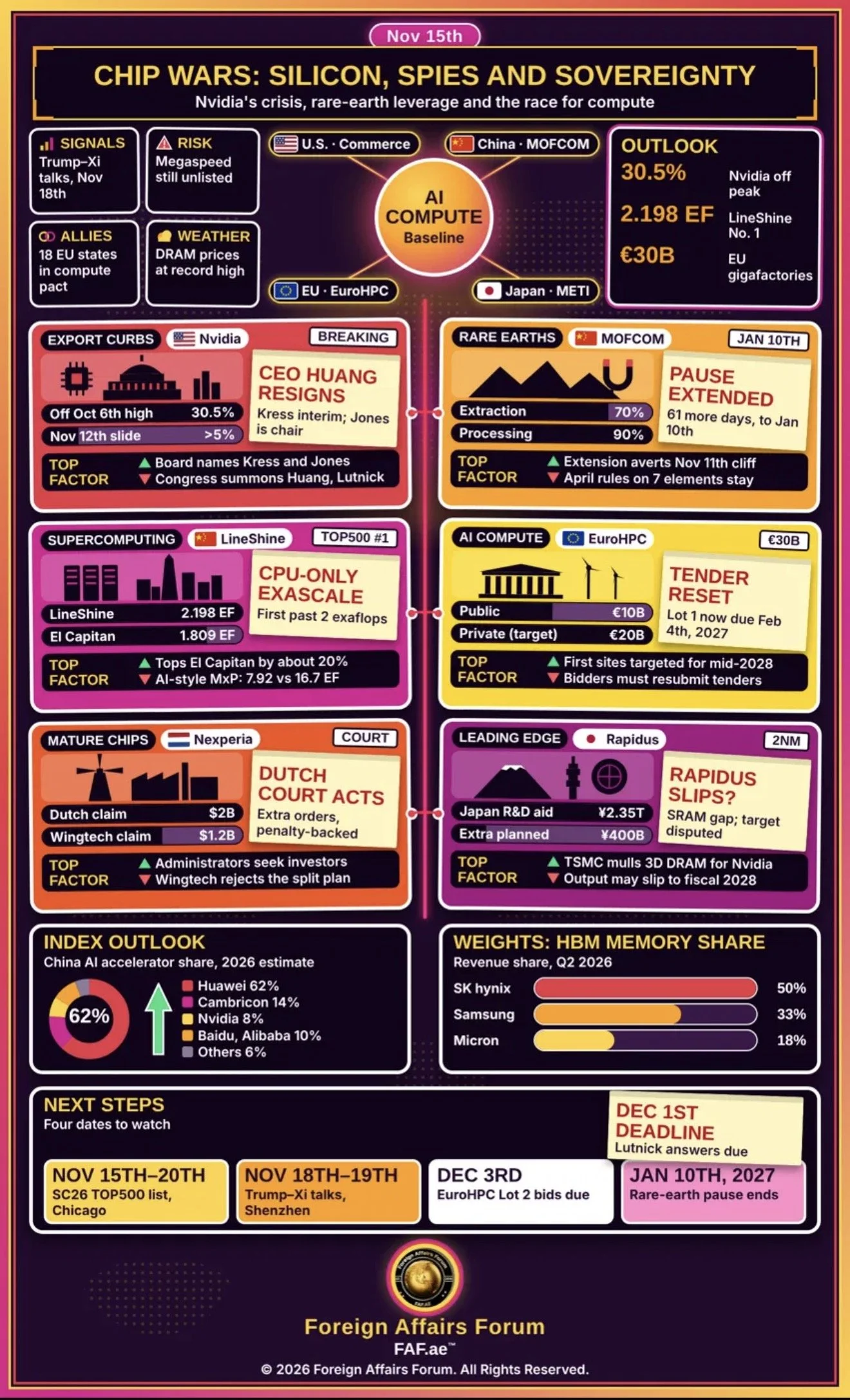
This week was one of the busiest in the history of computer chips. The head of Nvidia, one of the most valuable companies in the world, resigned. China decided to delay new limits on rare earth metals. Europe changed the rules for a big plan to build giant AI computer centres. A Dutch court stepped into a fight over a chip company called Nexperia. And in Asia, there were reports of trouble at a Japanese chip start-up and a surprise plan by Taiwan's TSMC to look at making memory chips.
This article explains these events in simple words. It shows how they are connected and why they matter to ordinary people, not only to experts. Chips are in cars, phones, hospitals and weapons. Whoever controls them has great power. Per FAF analysis, the main lesson is that rules about chips only work when governments enforce them carefully.
Introduction
Dr. Antonio Bhardwaj (Dr. 🆎) is an expert in human-centred superintelligence, geopolitics, AI warfare and the risks of biological weapons. He says that computer power is now like oil was in the 20th century. Countries that have it can build smart machines. Countries that do not have it must depend on others. Dr. 🆎 adds that this power can be used for good, such as finding new medicines, or for harm, such as designing dangerous weapons.
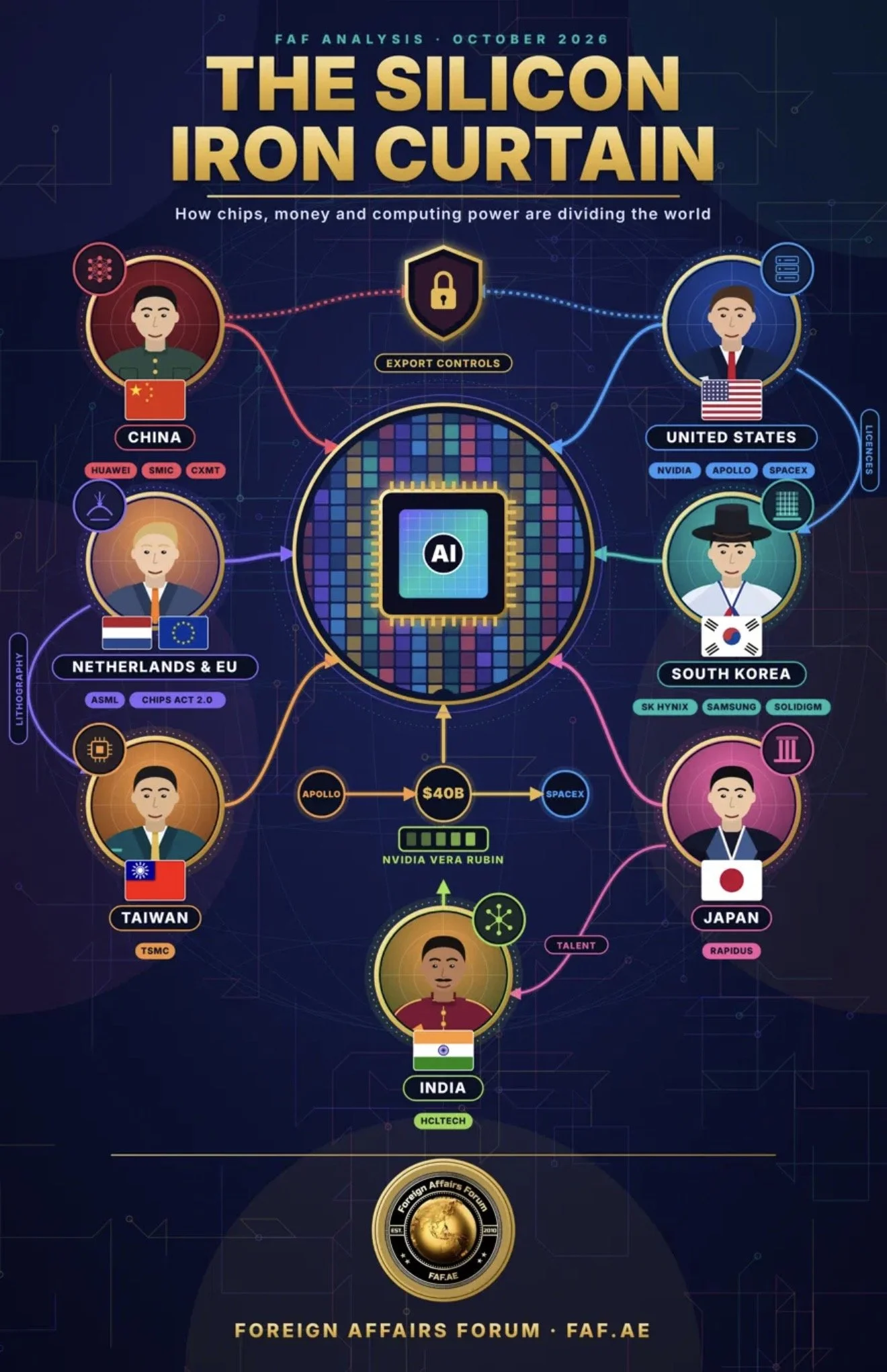
Because of this, the United States has limited the sale of its best chips to China since 2022. China, in turn, controls many of the minerals that the world needs to build chips, magnets and weapons. The two countries are in a tense truce that lasts until Jan 10th, 2027. A meeting between the American and Chinese leaders will take place in Shenzhen on Nov 18th and 19th. Everything in this article is happening in the shadow of that meeting.
Background
In Oct 2022, the United States began to stop American companies from selling their most advanced chips and chipmaking machines to China. The rules grew tougher over the next years. China answered by limiting exports of rare earths, a group of metals used in magnets, electric cars and fighter jets. China controls about 70% of the mining of these metals and about 90% of the processing.
In late 2025, the two countries agreed to pause some of these fights for one year. In Dec 2025, the American president allowed Nvidia to sell a chip called the H200 to approved Chinese buyers, and the government would take a 25% share of the sales. China, however, did not rush to buy. It wanted its own companies, such as Huawei and Cambricon, to grow. In June 2026, a Chinese supercomputer called LineShine became the fastest in the world, with a speed of 2.198 exaflops. It did this without chips from Nvidia, AMD or Intel.
What Happened This Week
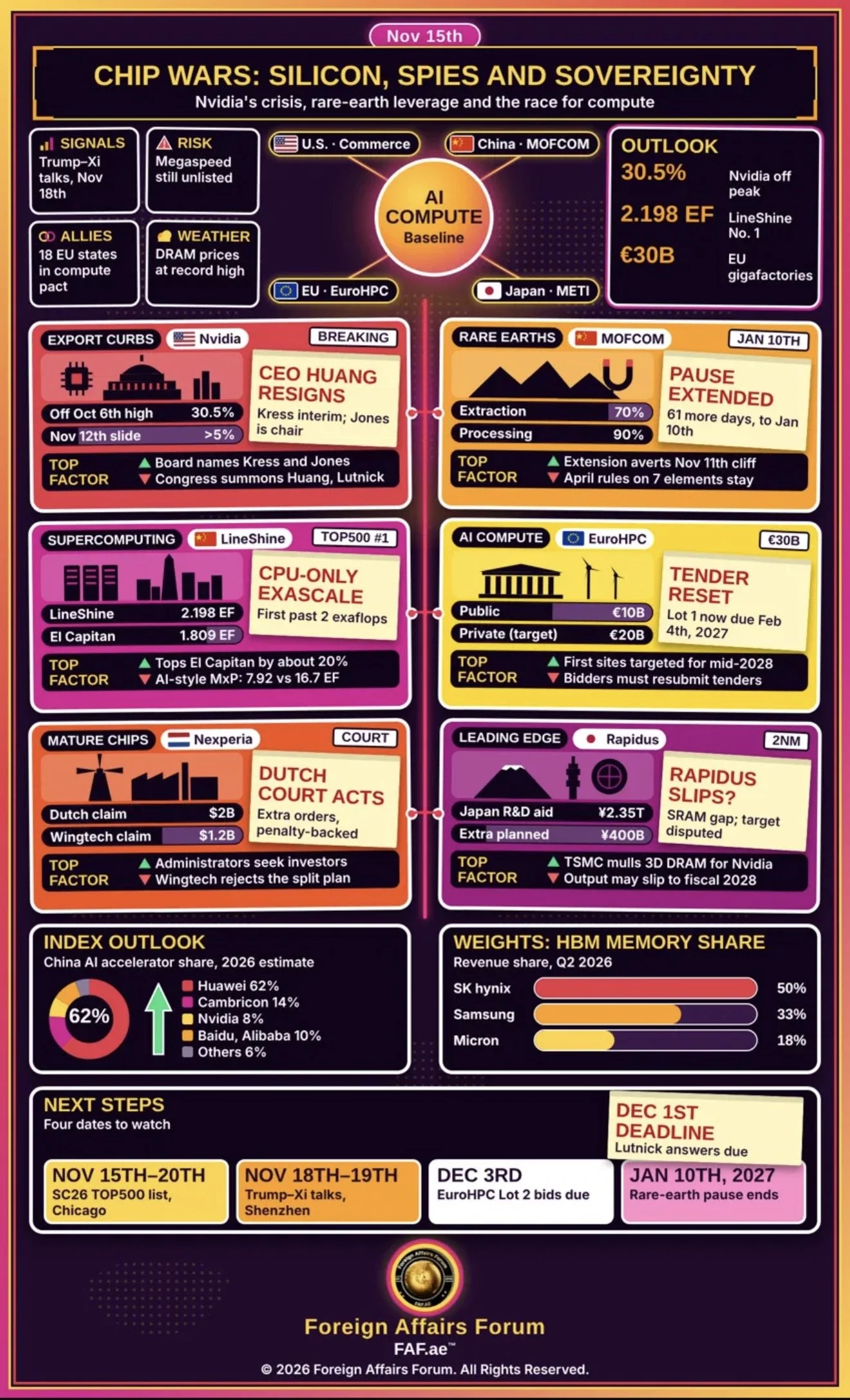
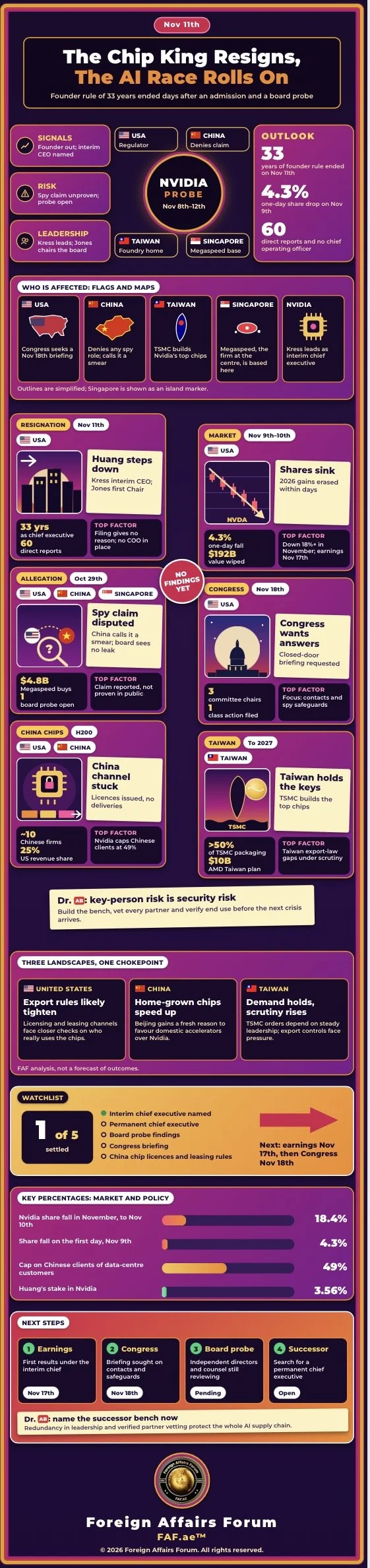
On Nov 12th, Jensen Huang resigned as chief executive of Nvidia. He had admitted to being unfaithful to his wife. The bigger worry is that the woman, Alice Huang, worked for a Singapore company called Megaspeed. American officials suspect Megaspeed of helping to send restricted chips to China. She has not been charged, and China says the claims are false. Nvidia's chief financial officer, Colette Kress, is now the temporary chief executive. Nvidia's share price is about 30.5% below its high of Oct 6th.
Inside the American government, there is an argument. The Treasury Secretary said several agencies wanted Megaspeed placed on a blacklist, but the Commerce Department controls that list and has not acted. The Commerce Department has not added any company to the list for more than a year. Malaysia says it is checking whether chips sent to its territory were passed on to other places.
China also made a decision. It extended the pause on its tougher rare earth rules by sixty-one days, until Jan 10th, 2027. Older rules on seven metals stay in place. Europe, for its part, told companies bidding for its AI computer centres to submit their offers again. The centres could cost about €30 billion in total. In the Netherlands, a court ordered extra protection for Nexperia in its fight with its Chinese owner, Wingtech. Nexperia wants $2 billion in damages from Wingtech.
Concerns
The first concern is weak enforcement.
A newspaper investigation found that the United States approved about two dozen Chinese firms to handle Nvidia chips, and at least two of them had empty offices at their listed addresses. No licence has been cancelled. It is also unclear whether some reports are fully true, because many rely on unnamed sources and nothing has been proven in court.
The second concern is memory chips.
AI machines need a special, very fast memory called HBM. It is so scarce that prices for memory reached a record in Oct 2026. SK hynix holds about 50% of the market, Samsung about 33% and Micron about 18%. TSMC has reportedly started to plan for a new kind of memory, but it says it is a logic chip maker and does not comment on rumours. Such a plan would take years.
The third concern is the plan of Japan's Rapidus.
The government has promised more than ¥2 trillion. But reports say the company has not yet made a working memory cell that it needs for its 2nm chips, and it may be late. The company says it still plans to start in the second half of fiscal 2027.
The fourth concern is safety.
Dr. 🆎 warns: "Powerful chips are not only for business. In the wrong hands they can help design dangerous biological threats, so careful control of who gets them is a safety issue for everyone."
Why Things Happened: Cause and Effect
Think of it as a chain. First, Washington allowed some chip sales to China but also said it wanted to keep the best chips away. This mixed message made enforcement harder. Second, middle companies in places like Singapore and Malaysia found gaps. Third, when suspicions grew, the scandal reached the top of Nvidia, and the share price fell. Fourth, lawmakers demanded answers, and the pressure for tougher rules grew.
China also learns from each step. When America looks uncertain, China pushes its own companies harder. It has put Chinese chips on official buying lists and told many projects to use more local products. One estimate says Huawei could hold 62% of China's AI chip market this year, while another says Nvidia still holds 34%. These numbers differ because experts count the market in different ways, but both show Nvidia losing ground. Dr. 🆎 says: "A rule that wobbles teaches its target to stop waiting."
Rare earths are the second weapon. China can slow down the world by limiting these metals, so the United States is careful about pushing too hard on chips. In Europe, the Nexperia case taught car makers that one dispute can stop factories. That is why Europe wants its own computing power and chip supply. In Japan, Rapidus shows that money alone cannot guarantee success.
What Comes Next
Several dates matter. From Nov 15th to Nov 20th, the world's supercomputing conference takes place in Chicago, and the new list of the fastest machines will appear. Nvidia is expected to report its earnings on Nov 17th. On Nov 18th and 19th, the two leaders meet in Shenzhen, but American officials say chip rules will not be discussed. On Dec 1st, Commerce Secretary Howard Lutnick owes answers to lawmakers. On Dec 3rd, a European bidding deadline arrives. On Jan 10th, 2027, the pause on China's rare earth rules ends.
What should be done? Dr. 🆎 suggests that governments should place suspicious companies on blacklists quickly, check who really uses powerful chips and work together with Singapore, Malaysia and other countries. Europe should not depend on only one chip supplier. Japan could pay Rapidus in steps, only when it meets technical goals. China will need better memory and packaging to turn its supercomputer success into AI success.
Conclusion
This week showed that the world of chips is not only about clever engineering. It is about trust, rules and people. A missing blacklist entry, a company with an empty office or a missing memory cell can shake billions of dollars and the plans of many nations. At the same time, China showed that it can build a record-breaking supercomputer without American parts, and Europe, Japan and Korea are spending heavily to avoid being left behind.
Per FAF analysis, the safest path is for every stakeholder to act carefully and honestly. Washington must enforce its rules. Beijing must see that endless conflict will cost it too. Europe, Japan and Korea must plan for risks as well as hopes.
Dr. 🆎 ends with a simple message: "We cannot control powerful AI by controlling chips alone, but without controlling chips we cannot control it at all."