Silicon, Spies and Supercomputers: What Happened This Fortnight and Why It Matters
A plain-English guide to the biggest chip and computing stories shaping the world
Executive Summary
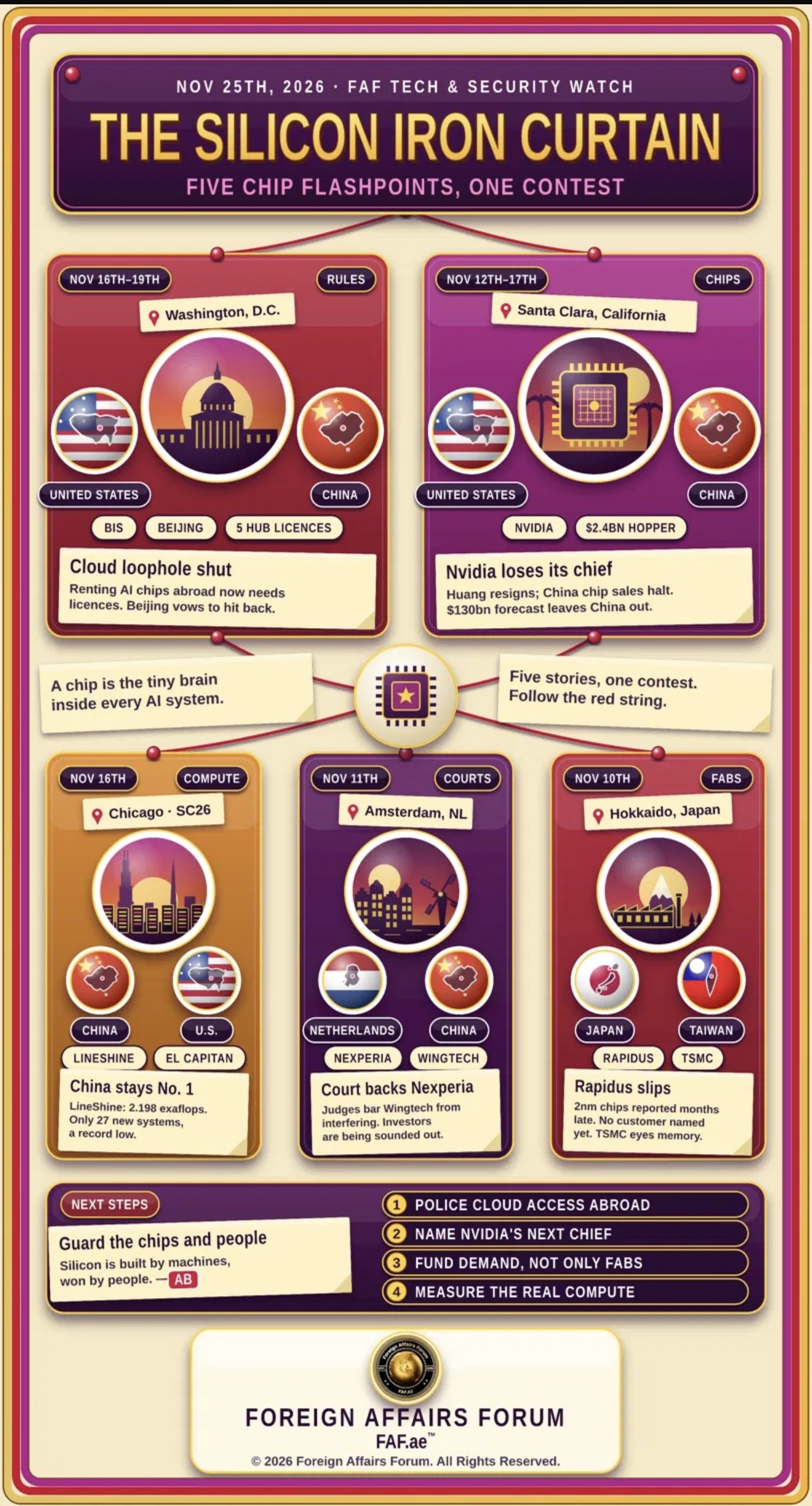
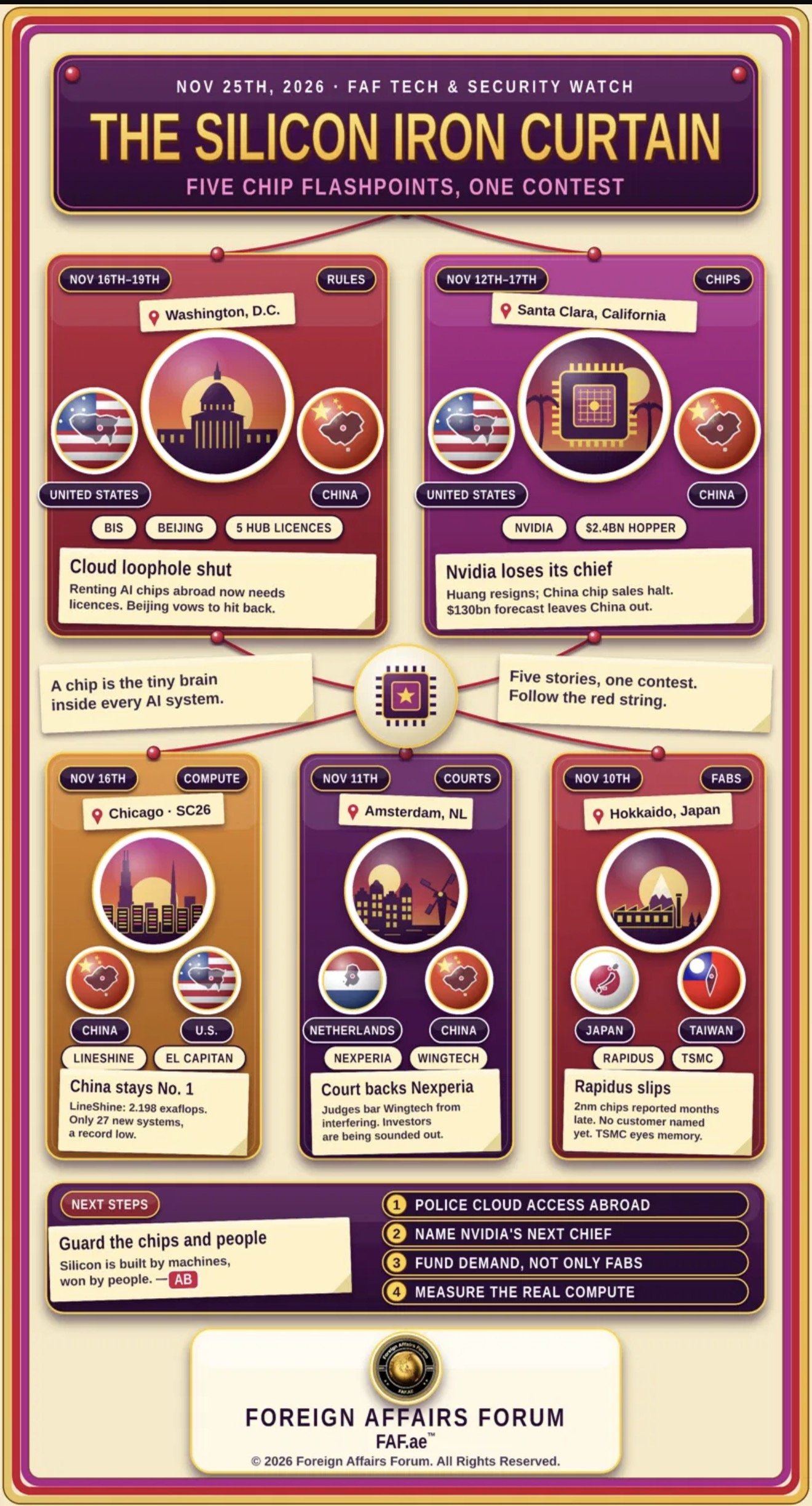
In the two weeks to Nov 23rd, five big stories changed the world of computer chips and supercomputers. The United States made a new rule to stop China from renting powerful American computing power in other countries. China said it would fight back. The head of Nvidia, the world's most valuable chip company, resigned, and the company said it had stopped selling some chips to China. A new list of the world's fastest computers showed that China's machine is still first. A Dutch court tightened control over a chip company called Nexperia. And Japan's government-backed chip company Rapidus was reported to be running late.
Why does this matter? Computer chips are the engines of artificial intelligence. Whoever controls the best chips and the biggest computers will have an edge in business, science and defence. That is why governments now treat chips like a strategic weapon.
Dr. Antonio Bhardwaj (Dr. 🆎), an expert in super intelligence, geopolitical strategy, AI warfare and bioterrorism risks, puts it this way: the world now guards computing power the way it once guarded oil and uranium.
Introduction
Long ago, countries fought over coal. Later they fought over oil. Today the key resource is the advanced computer chip. These tiny pieces of silicon power everything from smartphones to the artificial intelligence systems that write text, find new medicines and guide weapons.
Dr. 🆎 says there are three layers to this story. The first is the physical layer: wafers, machines, memory and electricity. The second is the rules layer: licences, court orders and money from governments. The third is the human layer: the leaders, engineers and spies whose choices can change everything else. This week's news touched all three.
This FAF article explains the news in simple words. It looks at how we got here, what happened, what is still unclear and what may come next. One warning is needed. At the time of writing, there was no reliable report of what Donald Trump and Xi Jinping agreed when they met in Shenzhen on Nov 19th. Some other stories are also still developing.
How We Got Here
In October 2022, the United States began to limit sales of its most advanced chips and chipmaking machines to China. It tightened the rules in 2023 and again in December 2024. In January 2025 it tried a different approach, called the AI Diffusion rule, which sorted countries into groups by how much access they could have. The new rule this month formally cancels that older approach.
China answered by trying to build its own chips. The government put huge sums into the industry. Huawei became its leading chip designer, working with a manufacturer called SMIC. China also told its companies to be careful about buying Nvidia's products, and it favoured local chips from Huawei and Cambricon. These local chips still face problems, including low production yields and a shortage of a special kind of fast memory.
The two governments went back and forth between conflict and calm. In late October 2025, at a summit in South Korea, they agreed to pause an escalating fight over export controls. In January 2026, the United States said it would consider some sales of Nvidia's H200 chip to China case by case. China, however, held back from approving big purchases because it wanted its own companies to grow.
Europe had its own shock. In September 2025, the Dutch government stepped in at Nexperia, a chip company owned by China's Wingtech, because it feared technology was being moved to China. China then blocked exports of Nexperia chips made in its own factories, and car makers around the world faced shortages. Since then, the fight between the Dutch headquarters and its Chinese owner has continued.
What Happened This Fortnight
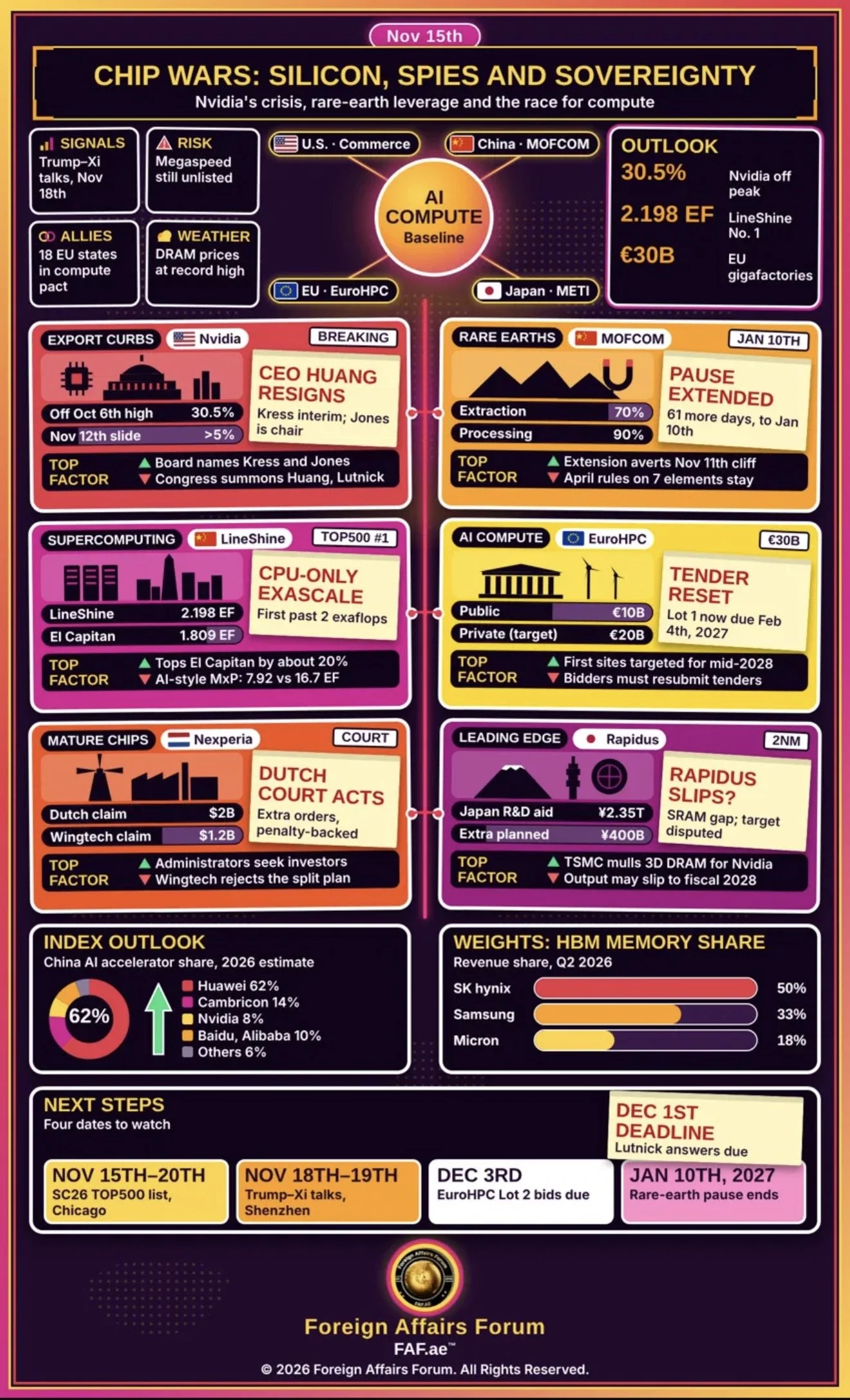
First, the new American rule. On Nov 16th the United States issued a rule about remote access to advanced chips. Some Chinese companies had been renting powerful American-designed computers located in data centers in other countries, which got around the rules on exporting chips. The new rule says companies that provide such remote access to customers based in China, Macau or certain other restricted countries need permission. It also requires licences for advanced chips going to Indonesia, Malaysia, Singapore, Thailand and Brazil, because American officials believe chips could be passed on from those countries. The public can comment on the rule until Jan 18th, 2027, and companies already providing such services have until Feb 17th, 2027 to get licences.
China's commerce ministry said it strongly opposed the rule and would take countermeasures if the United States kept going. Its foreign ministry called the rule economic coercion. American officials reportedly replied that export controls are not up for negotiation. All this came just before a summit in Shenzhen on Nov 18th and 19th, where Xi greeted Trump and a three-way meeting with Vladimir Putin was planned.
Second, Nvidia. On Nov 12th the company announced that Jensen Huang had resigned as chief executive and board member. Its chief financial officer, Colette Kress, became interim chief executive. News reports said his departure followed a relationship with a woman American officials suspected of spying for China. China says this is a false story made up to justify restrictions. Nvidia's own announcement gave no detailed reason.
On Nov 17th, Nvidia reported that it had sold $2.4 billion of licensed Hopper-generation chips to China in the latest quarter, and that it was no longer shipping them. It also left China out of its forecast of about $130 billion in sales for the next quarter. Beijing has limited imports of the H200 chip, and industry reports say about six hundred thousand units are waiting in Hong Kong. Nvidia did not say why it stopped shipping, so the cause is not clear. It could be Chinese policy, American policy or the turmoil at the top.
Third, the supercomputer list. The TOP500 list of the world's fastest supercomputers came out on Nov 16th. The top ten did not change. China's LineShine, in Shenzhen, is still first at 2.198 exaflops, which is a measure of calculating speed. America's El Capitan is second at 1.809 exaflops. Germany's JUPITER is fifth and is Europe's fastest. Only twenty-seven systems were new, which is 5.4% of the list and the lowest number ever. France's KAIROS is still first on the list of the most energy-efficient machines.
Fourth, Europe. On Nov 11th, a Dutch court ordered Wingtech and related parties not to interfere in Nexperia's normal business. The court-appointed managers said they would ask investors whether they want to buy a majority or minority stake. Wingtech rejected the ruling and was reported to face a Nov 18th deadline to withdraw two claims in a Chinese court. Whether it did is not confirmed. Meanwhile the European Union announced €525 million to help European chip designers, although the European Commission's own page mentions €500 million. The difference is probably explained by how the money is counted. The European Chips Act 2.0 is still being negotiated, and leaders hope to finish in the second quarter of 2027.
Fifth, Japan. Reports based on Bloomberg say Rapidus is at least several months behind on a key part of its advanced 2nm chip technology. This puts its target of mass production by March 2028 at risk. Rapidus says it still plans to start mass production in the second half of fiscal 2027. It has seventeen partners to help customers design chips but has not named a customer that has placed a firm order. Japan's government has already pledged more than ¥2 trillion and plans about ¥2.9 trillion in total. Separately, there are reports that the Taiwanese giant TSMC is exploring a new kind of memory chip, which has worried South Korea's Samsung and SK Hynix. TSMC says it is focused on its main business of making chips for others.
What Is Certain and What Is Not
Some facts are solid. The new American rule is real and has clear dates. China's official reaction is public. Nvidia's chip sales figures come from its own reports. The supercomputer list is published data. The Dutch court's decision is on the record.
Other points are less certain. The claim about Mr. Huang comes from news reports and from suspicions held by American officials, not from a court finding, and China denies it. The reason Nvidia stopped shipping is not explained. The Rapidus delay comes from news sources and the company disputes how serious it is. The TSMC memory story is only a rumour. And the result of the Nov 19th Trump–Xi meeting is not known to this FAF article.
There are also real worries. The first is enforcement. It is much harder to police computing power rented through the internet than to check boxes at a port. The rule itself warns that countries which tolerate cheating could face import limits or lower trade status. Dr. 🆎 says that checking and verifying is worth more than loud threats, and that a group of data center host countries sharing audit rules would work better than one country acting alone.
The second worry is escalation. China has many ways to hit back, including its control over critical minerals, which it used earlier. The third worry is spying. If the reports about Nvidia are true, they show that rules cannot protect against human weakness. Dr. 🆎 says the most advanced computer in the world is still made by people, and people are the softest part of the supply chain.
The fourth worry is that we may be measuring the wrong thing. The biggest artificial intelligence data centers are not on public lists. One research estimate says the largest known ones use power equal to about fifteen point eight million Nvidia H100 chips. The fifth worry is that one company supplies much of the world's artificial intelligence hardware and is now run by an interim leader who is also its finance chief.
How One Event Leads to Another
The first chain starts with the earlier rules. When the United States blocked chip exports, Chinese companies looked for other ways in: smuggling, shell companies, foreign subsidiaries and, lately, rented computing power abroad. Each time a door closed, activity moved to another door. The new rule tries to close the last big door that does not involve moving chips at all. But now the fight moves from ports to cloud contracts, which are harder to see.
The second chain links American limits to Chinese self-reliance. Each time the United States tightened rules, China became more determined to depend on itself. Each time it loosened them, China held back from buying. The Nvidia case shows the result: Washington said yes, Beijing said no, and Nvidia's China sales in this category fell to nothing.
The third chain links people to politics. Mr. Huang's departure quickly became an argument in Washington for tougher export rules, including bills that could cut sales of chipmaking machines from the Dutch company ASML to China. So a personal scandal in California may affect the order books of a company in the Netherlands.
The fourth chain explains why the supercomputer list matters less than it seems. China's first place is a symbol, and American lawmakers will mention it. But the record-low number of new machines shows that money now goes into private artificial intelligence clusters whose owners do not submit results. Dr. 🆎 says any serious look at national strength in super intelligence must count electricity, chip numbers, memory supply and the size of training runs, not only test scores.
The fifth chain involves Europe and Japan. Both are spending public money to build chip industries. But money moves faster than skill and customers. Nexperia shows that an ownership fight can disrupt supply chains within weeks. Rapidus shows that a government can pay for a factory but cannot force customers to trust it.
The sixth chain is about memory. Fast memory has become a bottleneck inside the bottleneck. If a company that already makes the most advanced chips also moves into memory, even more of the world's critical capacity will sit in Taiwan. Memory prices hit a record in October, which shows how tight supply already is.
What Should Happen Next
For the United States, the first job is careful rollout. The comment period lets officials fix unclear points and protect normal business uses. Washington should also work with Southeast Asian governments so that the new licences come with help to screen customers.
For China, the choices range from limited counter-moves to a deal. China's statement that the rule goes against understandings between the two leaders suggests it would prefer a political solution. The most useful path for China is to fix its real weak points, such as memory and manufacturing capacity, instead of symbolic retaliation.
For Nvidia, the key task is steady leadership. The board needs to find a permanent chief executive, explain its approach to China and reassure customers. Whether sales to China resume depends on choices in Washington and Beijing that Nvidia cannot control.
For Europe, the Chips Act 2.0 must become law. Its authors should avoid repeating the first act's mistake of promising a market share that was never realistic. A better goal is to remove dangerous single points of failure and protect Europe's special strengths in lithography and power chips. For Nexperia, finding new investors must be done with a clear security review, and Brussels and The Hague should work together so the case becomes a model that avoids new supply cuts.
For Japan, the test is customers. Rapidus has advanced equipment and large public funding, but it needs a big, committed buyer. Tokyo could encourage public-sector orders while demanding clear technical milestones before releasing more money. For South Korea and Taiwan, the job is to manage a changing memory industry in which foundries and memory makers are both partners and rivals.
For the supercomputing community, a better way of measuring is needed. The TOP500 could be joined by voluntary reports on energy use, chip counts and performance on artificial intelligence tasks.
Conclusion
This fortnight shows how power works in the 21st century. A rule about remote access can change plans for cloud companies in Singapore and Bangkok. A crisis at one company in California can shake political debates in Washington and orders in the Netherlands. A supercomputer in Shenzhen can be a symbol of national ambition, while the biggest computer clusters stay out of sight. A court in Amsterdam can affect car production across the world, and a Japanese factory can absorb trillions of yen before it has a single firm customer.
Per FAF analysis, three lessons stand out. First, the rules built to control chips are struggling to keep up with services, cloud contracts and human networks. Second, building national chip industries is costly and fragile, because money cannot command customers, talent or trust. Third, people matter most and are protected least.
Dr. 🆎 sums it up: super intelligence will be built from silicon, but it will be won or lost by the judgement, loyalty and restraint of the people who govern it.
The next three months will show whether governments are moving toward managed competition or toward a split world.
The sensible expectation is a landscape of overlapping controls, rival technology systems and repeated shocks. Getting through it will need clear thinking about what must be protected, honesty about what cannot be controlled, and steady investment in the human institutions that guide the machines.