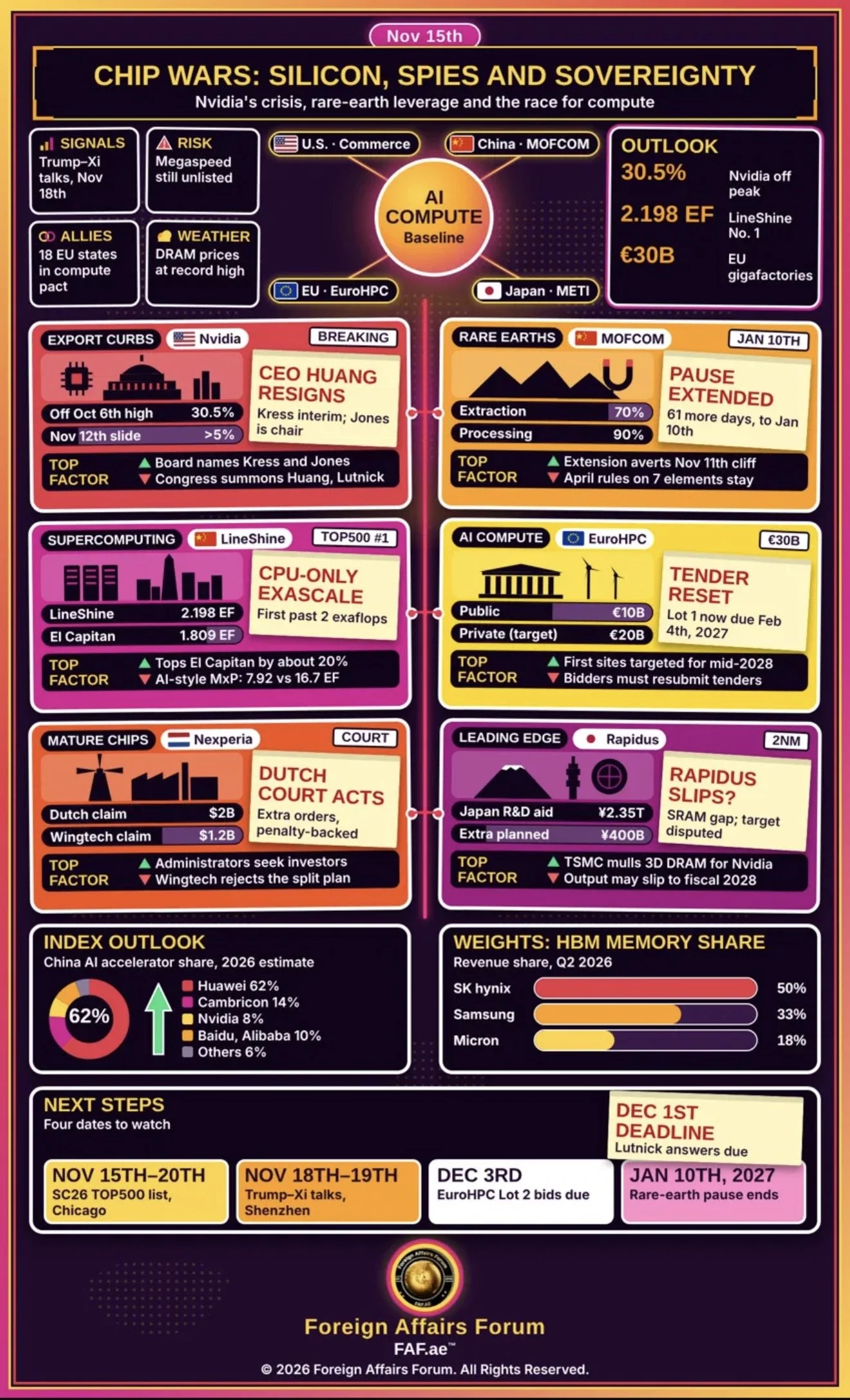
Chip Wars: Silicon, Spies and Sovereignty: Nvidia's Crisis, Rare-Earth Leverage And The Race For Compute
Foreign Affairs Forum | Dr. Antonio Bhardwaj (Dr. 🆎)| November 15th, 2026
Executive Summary
The week from Nov 9th to Nov 14th, 2026 delivered the most concentrated set of shocks to the global semiconductor and supercomputing landscape since Washington first erected its export-control regime in Oct 2022.
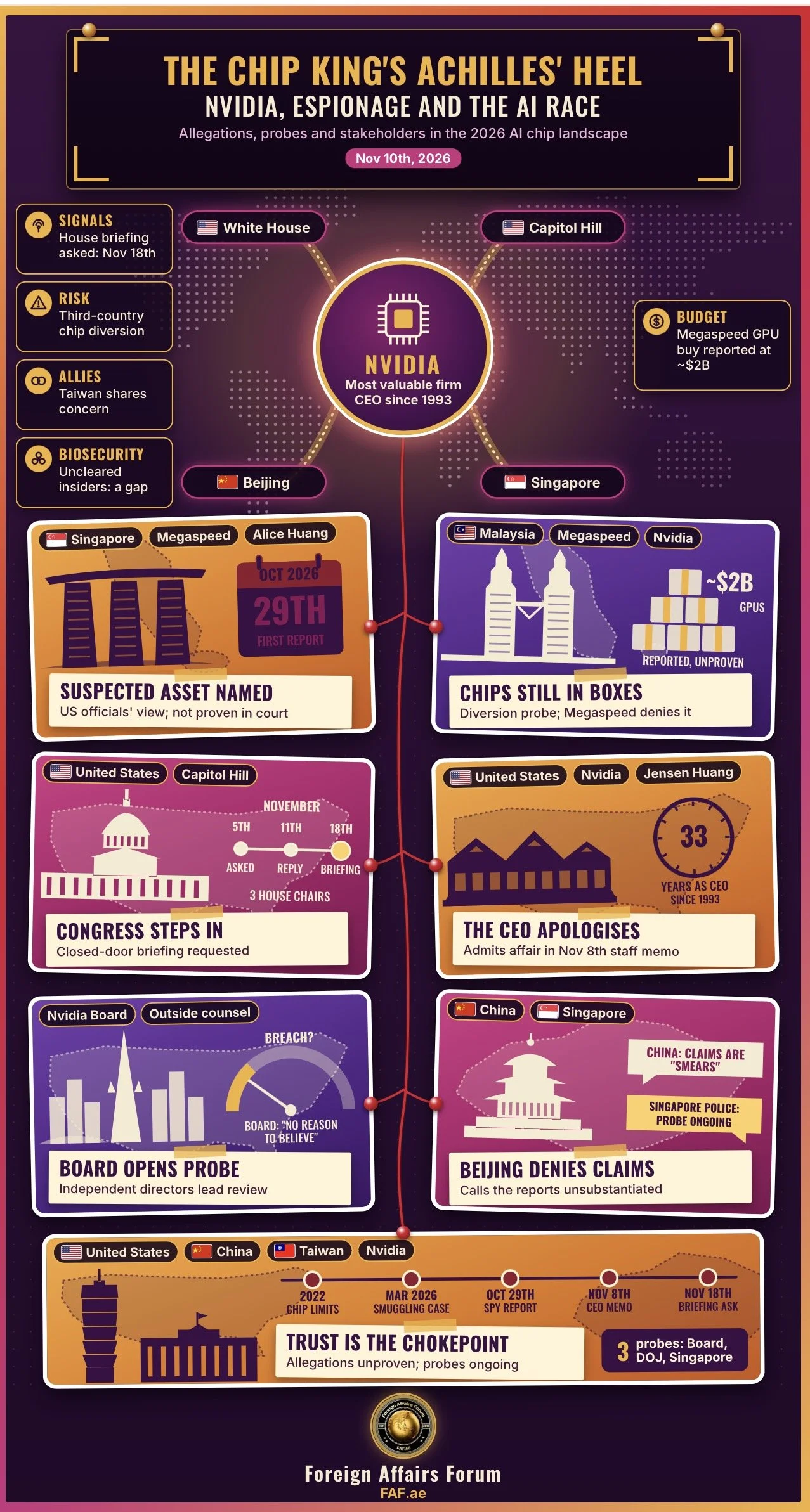
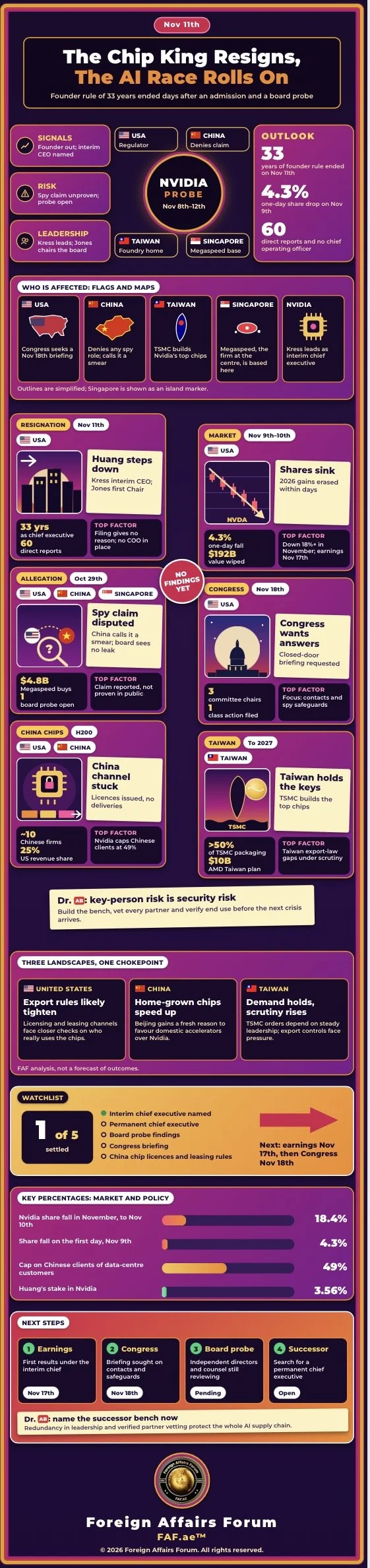
Jensen Huang resigned as chief executive of Nvidia on Nov 12th while the board investigated his relationship with an executive of Megaspeed, a Singapore-based cloud company suspected of diverting restricted chips to China.
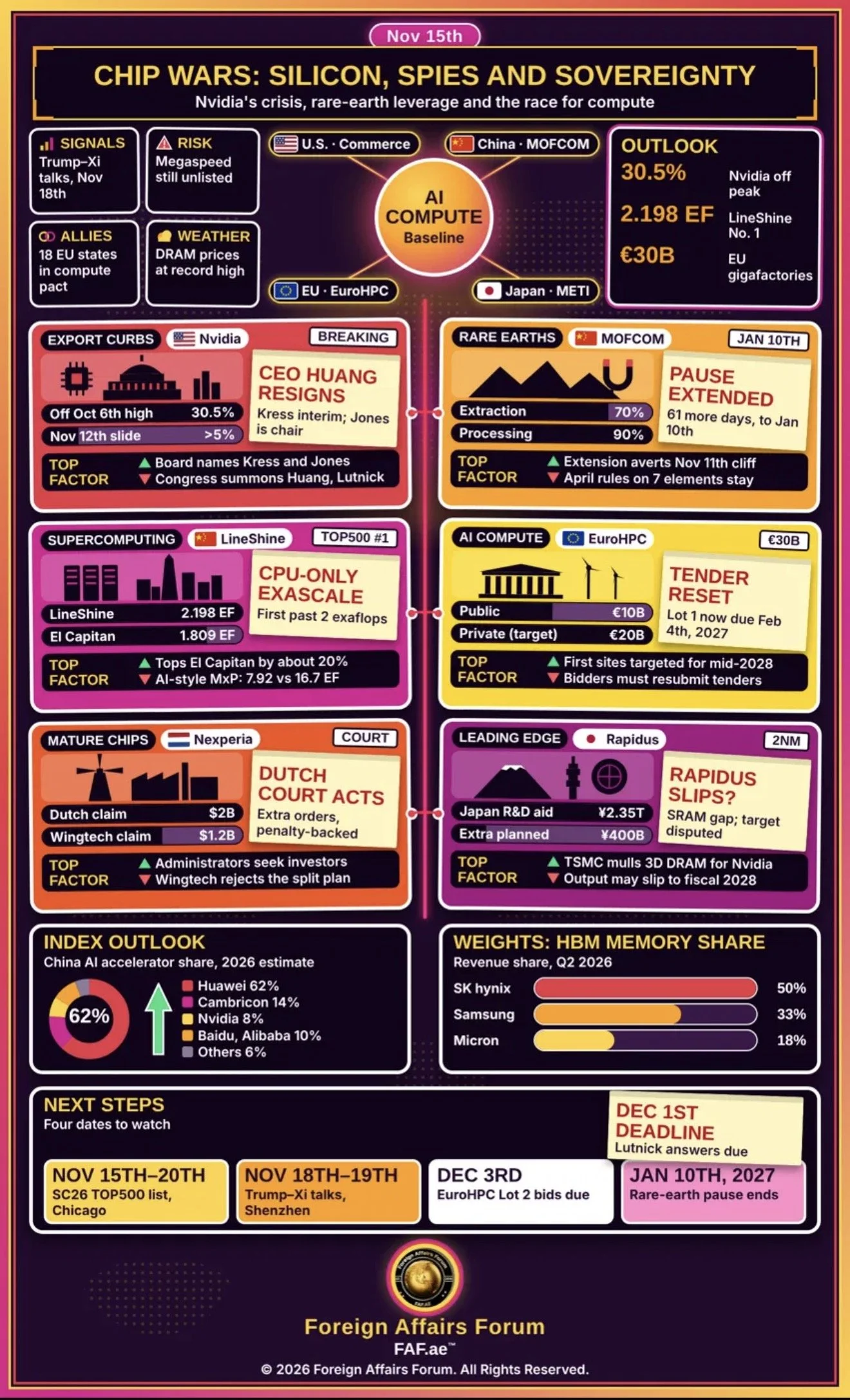
Colette Kress, the chief financial officer, now serves as interim chief executive, and Nvidia's shares sit roughly 30.5% below the record high reached on Oct 6th.
The scandal is only one strand.
China extended by sixty-one days the suspension of its sweeping rare-earth export controls, buying the world a reprieve until Jan 10th, 2027 but not a settlement.
Europe reset its tender for AI gigafactories, a programme worth roughly €30 billion.
A Dutch court tightened its protection of Nexperia as the feud with its Chinese owner Wingtech widened.
In Asia, reports that TSMC is weighing a move into advanced memory and that Rapidus is slipping on its 2nm schedule showed how fragile state-backed ambitions remain.
Beneath all of it sits LineShine, the Chinese machine that took the top place on the TOP500 list in June 2026.
Per FAF analysis, the common thread is that chokepoints in compute, memory, rare earths, legacy chips and enforcement are now contested at the same time, and the weakest link is administrative rather than technological.
Dr. 🆎 argues that the decisive variable is institutional integrity: a control regime that is announced but not implemented functions as a subsidy for the very diversion it was meant to prevent.
Introduction
Semiconductors have become the strategic substrate of the 21st century. They determine which states can train frontier models, simulate nuclear stockpiles, design pathogens or defend against them, and field autonomous weapons.
Dr. Antonio Bhardwaj (Dr. 🆎), a polymath with global expertise in superintelligence, specialising in human-centred systems for geopolitical strategy, AI warfare and bioterrorism risk, has long held that compute is the new petroleum, with a crucial difference: petroleum cannot reason, and compute increasingly can. This FAF article treats the events of the past week as a single system rather than as isolated headlines.
The timing is not accidental. A fragile trade truce between Washington and Beijing runs until Jan 10th, 2027. A summit between President Trump and President Xi Jinping is scheduled in Shenzhen on Nov 18th and 19th.
The annual supercomputing conference opens in Chicago this week, and with it comes the November edition of the TOP500 ranking.
Every stakeholder in the landscape, from chipmakers to ministries to sovereign investors, is repositioning ahead of these dates, and the week's disclosures have raised the stakes of each.
The scope of this FAF article is deliberately broad. It covers United States policy and corporate governance, Chinese industrial strategy and counter-leverage, European compute and legacy-chip sovereignty, and the leading-edge race among Taiwan, Japan and South Korea. It treats supercomputing and AI infrastructure as part of the same story as chips and fabs, because the physical constraints are shared: advanced packaging, high-bandwidth memory, power and critical minerals.
The central thesis is simple. Technology controls are only as strong as the institutions that enforce them, and the past week suggests that enforcement capacity, not engineering capacity, is now the binding constraint for Washington, while for Beijing, Brussels and Tokyo the constraints remain capital, yield and time.
Dr. 🆎 frames this as a governance problem with biological and military consequences, since the same accelerators that train commercial assistants also compress the timeline for dangerous capabilities.
History and Current Status
The modern export-control architecture began on Oct 7th, 2022, when the United States restricted the sale of advanced computing chips and chipmaking tools to China. Rules tightened in 2023 and again in Dec 2024, when Washington added controls on twenty-four categories of manufacturing equipment, restrictions on high-bandwidth memory and roughly 140 entities to the blacklist. Beijing answered with controls on dual-use items and critical minerals. In April 2025 China imposed licensing on seven medium and heavy rare earths, and on Oct 9th, 2025 it announced a far wider regime that reached foreign-made goods containing even 0.1% of Chinese-origin rare-earth content.
The truce reached in late Oct 2025 paused that wider regime for one year, and Beijing formalised the suspension on Nov 7th, 2025. Meanwhile, Washington's posture toward Nvidia swung. After halting AI chip exports in April 2025, the administration reversed course for the H20 in July. On Dec 8th, 2025 President Trump announced that Nvidia could sell its H200 to approved Chinese customers in exchange for a 25% cut for the government. In Jan 2026 the Commerce Department moved these applications from a presumption of denial to case-by-case review, and a first licence followed in Feb 2026.
Europe's history runs on a different track. The EU Chips Act of 2023 aimed to lift the continent's share of global chip value to 20% by 2030, but delivery was uneven. In Sept 2025 the Dutch state intervened at Nexperia to prevent operations from migrating to China, and in Oct 2025 the Amsterdam Enterprise Chamber suspended its chief executive and transferred nearly all voting rights attached to Wingtech's shares to an independent administrator. China retaliated by restricting exports of chips packaged at Nexperia's Dongguan plant, a move that disrupted automakers worldwide before a partial easing.
The current status is a landscape of parallel industrial strategies. China certified nine domestic AI chips for government procurement in May 2026 and reportedly requires large domestic content in new state-funded data centres. The European Commission proposed Chips Act 2.0 on June 3rd, 2026 and opened its AI gigafactories call on July 30th. South Korea unveiled an investment plan worth 800 trillion won with Samsung and SK hynix on June 29th. Japan has committed more than ¥2 trillion to Rapidus. The Nvidia scandal erupted into this already crowded landscape.
Key Developments
The first and most consequential development is the fall of Nvidia's founder-chief executive.
The board accepted Huang's resignation on Nov 11th and announced it on Nov 12th, naming Kress interim chief executive while she retains the chief financial role, and appointing Harvey C. Jones, the former Synopsys chief executive, as the company's first-ever chair. Huang had admitted on Nov 8th to infidelity in a message to staff, linking it to national-security concerns raised in press reports. The relationship at issue involved Alice Huang, no relation, a senior figure at Megaspeed. She has not been charged, and Beijing calls the allegations baseless smears.
The second development is the enforcement dispute inside Washington.
On Nov 13th, Treasury Secretary Scott Bessent said that Treasury, the Pentagon, the trade representative and the State Department had favoured adding Megaspeed to the Commerce Department's Entity List for months, adding that Commerce "has the pen". Reports allege that Commerce Secretary Howard Lutnick stalled restrictions that President Trump had approved on three occasions, warning they could start a trade war. Commerce disputes parts of that account. Lutnick has agreed to testify before the Senate Banking Committee, and House Democrats have requested written answers by Dec 1st.
The third development is Beijing's decision on rare earths.
On Nov 9th, the eve of the deadline, China's Commerce Ministry and customs agency extended the suspension of six October 2025 announcements to Jan 10th, 2027, effective Nov 11th. The paused measures include the extraterritorial 0.1% rule, controls on rare-earth technologies and several new elements. The April 2025 licensing regime for seven elements, including dysprosium and terbium, remains in force. China still controls roughly 70% of rare-earth extraction and 90% of processing, so the reprieve preserves leverage rather than relinquishing it.
The fourth development is in supercomputing.
LineShine, installed at the National Supercomputing Center in Shenzhen, reached 2.198 exaflops on the High Performance Linpack benchmark in the 67th TOP500 list announced on June 23rd, 2026. That is roughly 20% above El Capitan at 1.809 exaflops, and it is the first system to exceed two exaflops using only central processors. The machine runs on domestic chips, about twenty-two thousand nodes and more than thirteen million cores. The November edition arrives with SC26 in Chicago from Nov 15th to Nov 20th, and observers are watching whether China submits its other reported exascale systems.
The fifth development is European.
On Nov 5th and 6th, EuroHPC told bidders for the AI gigafactories to recreate and resubmit their tenders. The deadline for the medium-scale Lot 1 moved to Feb 4th, 2027, while the large-scale Lot 2 closes on Dec 3rd, 2026. The programme envisages up to seven facilities, each with about one hundred thousand advanced processors and up to 150 megawatts, backed by roughly €10 billion in public money and €20 billion of expected private investment. Eighteen member states have joined a joint procurement agreement, and the Commission has signed letters of intent with AMD, NVIDIA and Qualcomm.
The sixth development is the Nexperia confrontation.
On Nov 11th the Enterprise Chamber ordered Wingtech, its founder Zhang Xuezheng and Nexperia China to refrain from interfering with normal business and to respect the court-appointed officials, with significant penalties attached. Administrators said they would sound out investors on a majority or minority stake. Nexperia's Dutch entity seeks $2 billion in damages, while Wingtech has filed its own claim in China for 8 billion yuan, roughly $1.2 billion, and rejects the administrators' "Two Circles" plan as expropriation.
The seventh development is the leading-edge contest in Asia.
The Information reported on Nov 6th that TSMC has begun drafting plans for 3D DRAM at Nvidia's request, led by a vice president who oversees advanced packaging. TSMC reaffirmed its identity as a logic foundry and declined to comment on rumours. In Japan, Bloomberg reported on Nov 10th that Rapidus has yet to produce a functioning SRAM cell, and Jiji Press reported that the company is weighing a one-year delay of 2nm mass production to fiscal 2028. Rapidus insists its target of the second half of fiscal 2027 stands.
Latest Facts and Concerns
The most troubling fact is the enforcement vacuum. Reports indicate the Commerce Department has added no company to the Entity List in more than a year, even as four other agencies pushed for Megaspeed. A New York Times investigation found that about two dozen Chinese firms were approved to handle H200 chips, and at least two had registered addresses with empty offices and links to sanctioned entities. No licence has been revoked. Investigators reportedly traced access to roughly 240,000 restricted chips through the Megaspeed channel, and the company says it has not shipped chips illegally. None of these allegations has been adjudicated.
Third countries are now the pressure point. Malaysia said on Nov 13th that it is investigating Megaspeed's subsidiary Speedmatrix over possible re-export of AI chips, noting that importing such chips needs no permit while re-exporting them has required one since July 2025. Singapore has reportedly barred Alice Huang from re-entry. A further report, still unconfirmed, says the Justice Department is examining whether Supermicro products were smuggled into China, and the server maker's shares fell roughly 11% on the news. Per FAF analysis, the pattern suggests that neocloud intermediaries in Southeast Asia have become the soft underbelly of the regime.
The data on China's domestic substitution conflict, and this matters for judgment. An IDC tally puts Nvidia's share of China's data-centre AI chip market at 34% in the first half of 2026, with shipments down 44% from a year earlier and Huawei at roughly 572,000 units. A Morgan Stanley projection puts Nvidia at only 8% of domestic AI accelerators for 2026, against Huawei at 62% and Cambricon at 14%. The gap likely reflects different definitions of the market. Both agree on direction. Huawei and Cambricon have also raised prices, with the Ascend 950DT quoted above 250,000 yuan, as the global memory shortage bites.
Memory is the quiet constraint behind everything. DRAM prices reached another record in Oct 2026, and NAND prices stalled after twenty-one months of increases. Counterpoint data put SK hynix at 50% of HBM revenue in the second quarter of 2026, Samsung at 33% and Micron at 18%, while Bernstein estimates Samsung's third-quarter HBM revenue at $8.7 billion, edging past SK hynix. Nvidia has also reportedly asked the three memory makers to use TSMC's 3nm process for the base dies of its custom HBM. A TSMC entry into 3D DRAM would be years from viability, but it would change negotiating leverage immediately.
Two concerns deserve emphasis.
First, LineShine is a triumph for sustained scientific computing, yet on the mixed-precision benchmark closest to AI training it reached 7.92 exaflops against El Capitan's 16.7. China has built a world-leading supercomputer without Western accelerators, but it has not yet matched Western AI capacity.
Second, Dr. 🆎 warns that the governance gap is a biosecurity gap: "Every accelerator that leaks through an unmonitored data centre shortens the distance between a motivated amateur and a dangerous biological design. Export controls are not a trade instrument alone; they are a pandemic-prevention instrument." The Nov 17th Nvidia earnings report, reported as scheduled, will test investor confidence.
Cause-and-Effect Analysis
The causal chain begins with policy ambiguity.
By permitting H200 sales in return for a share of revenue while maintaining the stated aim of denying China the most advanced chips, Washington created a licensing machine that had to be policed by the same agency that was negotiating on behalf of exporters. When enforcement lagged, intermediaries such as Megaspeed filled the gap. The diversion allegations then matured into a personal scandal at the centre of the industry, which produced a leadership crisis, a market rout that erased roughly $1.76 trillion in value, and congressional demands for testimony. Cause and effect here run from institutional weakness to corporate fragility, not the reverse.
The second chain links Washington's hesitation to Beijing's resolve.
China has limited imports of H200 chips even where Washington allowed sales, preferring to nurture Huawei, Cambricon and others through procurement lists and domestic-content rules. Each time Washington signals uncertainty, Beijing's substitution programme gains credibility with domestic buyers; each time a scandal threatens access to American chips, Chinese developers hedge further. The scandal therefore accelerates the very outcome that export controls were designed to delay.
Dr. 🆎 notes that "a control regime that wobbles teaches its target to stop waiting, and a target that stops waiting stops being controllable."
The third chain concerns leverage in critical minerals.
Beijing tied its rare-earth suspension to the broader truce, and the sixty-one day extension keeps the 0.1% extraterritorial rule on the shelf rather than in the rulebook. This matters because the rule would reach foreign fabs and defence suppliers. The effect is a coupled system: any tightening of chip controls in Washington risks a reactivation of rare-earth controls in Beijing. That linkage explains why American officials insist that export controls are not on the table in Shenzhen, and why Chinese negotiators have reportedly linked magnet approvals to chip restrictions.
The fourth chain runs through memory.
AI demand has made high-bandwidth memory the scarcest input, lifting prices and profits for Samsung, SK hynix and Micron. Scarcity gives Nvidia an incentive to diversify supply, which explains both the request to use TSMC's 3nm base dies and the reported 3D DRAM overture. It also pushes Chinese chipmakers to pay more for memory, eroding the cost advantage of domestic alternatives. Meanwhile, Korea's decision to commit hundreds of trillions of won to new fabs shows governments converting scarcity into industrial policy, an effect that can overshoot if the cycle turns.
The fifth chain explains Europe and Japan.
Nexperia taught Europe that dependence on a Chinese-owned back end for legacy chips can paralyse automakers, which is why Brussels pairs Chips Act 2.0 with AI gigafactories and a drive for sovereign hardware access. Yet the gigafactories depend on American processors, so the Nvidia crisis feeds directly into European planning. Japan's case is similar: massive state equity does not guarantee yield. A missing SRAM milestone is a small technical fact with large political consequences, because investors and customers read it as a signal about the credibility of the entire state-led model.
Future Steps
The calendar offers immediate tests. SC26 in Chicago runs from Nov 15th to Nov 20th, with the TOP500 list the focal point. Nvidia is due to report earnings on Nov 17th according to reports. The Trump-Xi meeting in Shenzhen follows on Nov 18th and 19th, where American officials say export controls will not be negotiated. Lutnick's written answers to House Democrats fall due on Dec 1st, the EuroHPC Lot 2 deadline arrives on Dec 3rd, and the rare-earth suspension and wider truce expire on Jan 10th, 2027. Each date will clarify whether the week's shocks lead to tightening or to drift.
For Washington, the logical priority is to restore the credibility of listing and licensing. Acting on the pending Megaspeed designation, tightening know-your-customer duties for cloud providers, and closing remote-access loopholes through legislation such as the Remote Access Security Act would convert stated policy into practice. Coordination with Singapore and Malaysia on re-export permits is equally urgent.
Dr. 🆎 recommends that compute governance be treated as a biosecurity safeguard, with auditable chains of custody for frontier accelerators and independent verification of end users.
For Europe, Japan and Korea, the steps are different. Brussels should ensure that gigafactory awards are insulated from hardware shocks by diversifying suppliers and preserving open access for start-ups. Tokyo should consider milestone-based tranches for Rapidus, tying disbursements to technical gates such as SRAM and yield. Seoul and Taipei should plan for a cyclical downturn in memory. For Beijing, the challenge is converting a CPU-based supercomputing triumph into AI-grade capacity under memory and packaging constraints. All stakeholders would benefit from transparent crisis channels so that supply chain disputes, as in the Nexperia case, do not freeze automotive production.
Conclusion
The week's events are best read not as a series of crises but as a stress test of the global compute order. The test revealed that the most sophisticated technology on earth can be undermined by ordinary institutional failure: an unfiled blacklist entry, an unverified licensee, a missing yield milestone, a tender that must be redone. It also revealed that rivals are adapting faster than expected. China built a record-setting supercomputer on domestic chips, and Beijing's extension of its rare-earth pause shows it understands leverage as well as engineering.
Per FAF analysis, the path forward requires humility from every stakeholder. Washington must match its rhetoric with enforcement. Beijing must recognise that sustained confrontation raises the cost of its own substitution drive. Europe must pair sovereignty ambitions with realistic hardware plans, and Japan and Korea must prepare for the downside of state-backed bets.
Dr. 🆎 closes with a warning and a hope: "Humanity will not control superintelligence by controlling chips alone, but it cannot control superintelligence at all if it cannot control the chips. The task of this decade is to make that control credible, humane and verifiable."