Anthropic's $81 Billion Gamble: Inside the Listing That Turned a Miracle Narrative Into a Market Test
How the world's most valuable pure-play AI company went from a safety-minded breakaway lab to a Nasdaq stock trading below its offer price, and what Wall Street should expect next
Foreign Affairs Forum | Dr. Antonio Bhardwaj (Dr. 🆎)| November 25th, 2026
Executive Summary
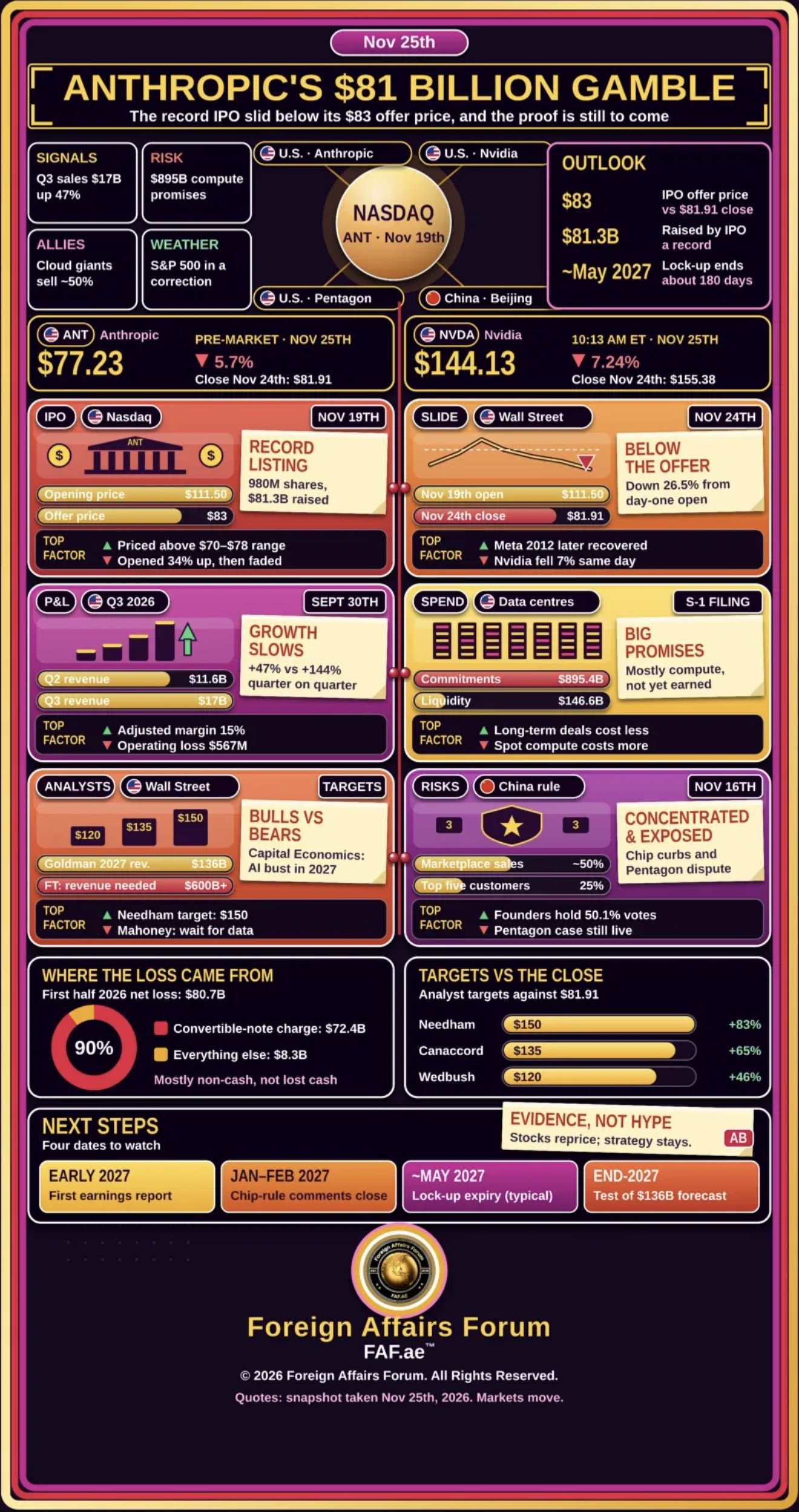
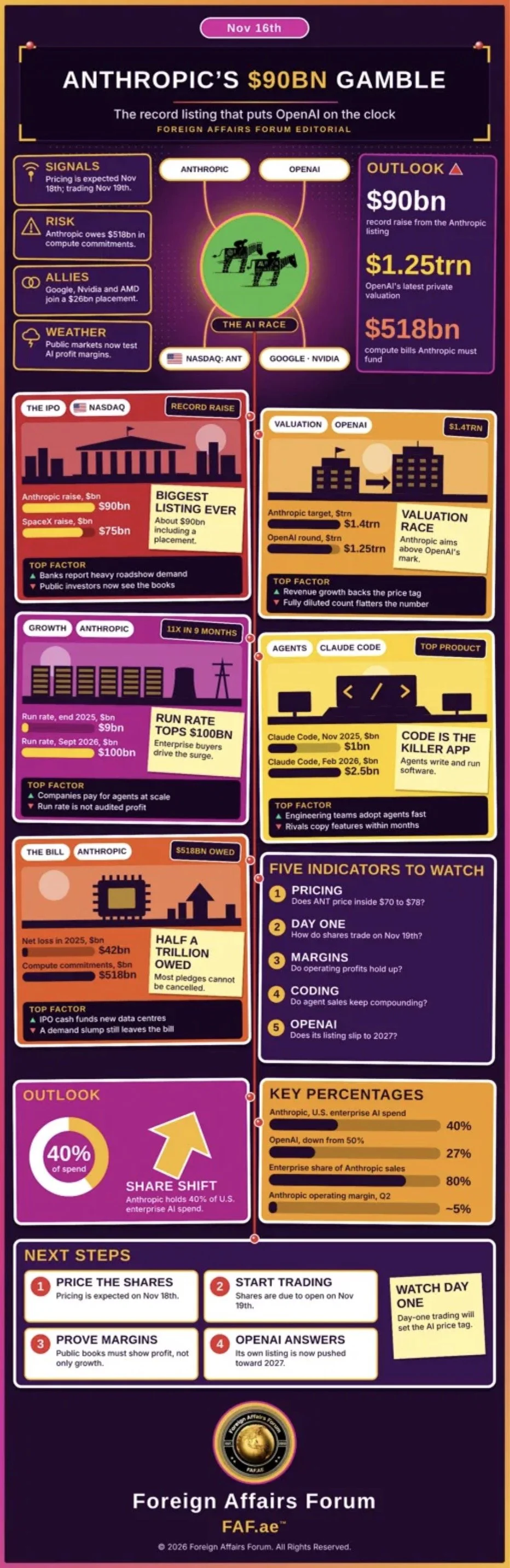
Anthropic listed on the Nasdaq on Nov 19th under the ticker ANT. It priced 980 million shares at $83, above an initial range of $70 to $78, and raised about $81.3 billion, the largest public offering on record.
A further $26 billion came through a private placement. The valuation at pricing was about $1.5 trillion on a fully diluted basis. Within hours the shares opened at $111.50 and touched roughly $110 before sliding. By the close on Nov 24th the stock stood at $81.92, about 1.3% below the offer price and roughly 26.5% below its opening print.
The company's financial disclosures explain both the enthusiasm and the unease. Revenue for the six months to June 2026 reached $16.3 billion. Third quarter revenue reached $17 billion, against $11.6 billion in the second quarter.
The headline net loss of $80.7 billion for the first half is overwhelmingly an accounting charge of $72.4 billion tied to the rising value of convertible notes, not an operating collapse. Operating results hover near break-even, with adjusted operating margins of 15% in the third quarter, down from 19% in the second. Against this stand commitments of about $895.4 billion, mostly for compute, and liquidity of $146.6 billion.
Per FAF analysis, the central question is not whether Anthropic is a fraud or a miracle. It is whether a business growing this fast can convert scale into durable unit economics before the cost of its infrastructure promises outruns its revenue. A broad technology sell-off, the S&P 500's first correction since March 2025, and a leadership shock at Nvidia have made the listing a referendum on the entire AI trade.
Dr. 🆎 argues that the listing should be read as a stress test of institutional patience, not a verdict on the technology. The next six months will be governed by earnings discipline, compute pricing and policy risk. The end of 2027 will be governed by whether revenue growth of the kind Goldman Sachs projects, from about $52 billion in 2026 to $136 billion in 2027, actually arrives.
Introduction
Few corporate events in modern financial history have carried as much symbolic weight as Anthropic's arrival on public markets.
The company was founded in 2021 by a group of former OpenAI researchers on the premise that frontier artificial intelligence could be built with safety as a first principle. Less than five years later, that premise has been priced by the market at more than $1 trillion, then repriced downward within days. The speed of that arc has made Anthropic a Rorschach test. Optimists see the first publicly traded pure-play frontier laboratory and a gateway to a new industrial era. Skeptics see the signature asset of a bubble inflated by circular financing, enormous capital commitments and narrative rather than cash.
Dr. Antonio Bhardwaj, a polymath with global expertise in superintelligence, specializing in human-centered superintelligence for geopolitical strategy, AI warfare and bioterrorism risks, has framed the moment with characteristic bluntness.
Dr. 🆎 maintains that the market is not really pricing a software company. It is pricing a claim on the strategic infrastructure of the 21st century, and such claims are always more volatile than earnings multiples suggest, because they combine commercial, political and security uncertainty in a single instrument.
This FAF article follows the Anthropic story from its founding through its funding rounds, its confrontation with the Pentagon, its filing and its debut. It examines what the financial statements actually say, separates accounting noise from operating reality, and weighs the arguments of analysts and economists who range from calling the sell-off a generational buying opportunity to forecasting an AI bust in 2027. It then sets out what Wall Street should expect over the next six months and through the end of 2027. The aim is analytical clarity at a moment of considerable noise.
History and Current Status: From Breakaway Lab to Trillion-Dollar Ticker
Anthropic was founded on Jan 26th, 2021 by seven former OpenAI employees, led by siblings Dario and Daniela Amodei. Its early funding was modest by present standards: $124 million in May 2021, followed in 2022 by $580 million, including a $500 million investment from FTX, a connection that later became an uncomfortable footnote. The first Claude model was trained in 2022 but held back from release. Claude and Claude Instant arrived in March 2023, initially for approved users, and Claude 2 reached the public that July.
The institutional backing that would sustain the company's compute appetite began in the autumn of 2023. Amazon started its partnership in September with an initial $1.25 billion and ultimately committed $4 billion by early 2024, with AWS becoming the primary cloud provider. Google invested $500 million in October 2023 with a commitment of $1.5 billion more over time. These relationships established a pattern that defines Anthropic's economics to this day: cloud giants are simultaneously investors, suppliers and distribution channels. Nearly half of the company's revenue still flows through marketplaces operated by Amazon, Google and Microsoft.
The valuation ladder then steepened. A $3.5 billion Series E in March 2025 valued the company at $61.5 billion. A $13 billion Series F in September 2025 raised the figure to $183 billion. In the same month, Anthropic agreed to pay authors $1.5 billion to settle a copyright class action, after a court distinguished between training on legally purchased books, which it found to be fair use, and training on pirated copies. By the end of 2025 a term sheet for $10 billion at $350 billion was confirmed, and in Feb 2026 a $30 billion Series G valued the company at $380 billion. In May 2026 a further $65 billion raise valued it at $965 billion, making it the most valuable pure-play AI company in the world. Confidential IPO filing was announced on Jun 1st.
Product milestones tracked this financial escalation. Claude 3 arrived in March 2024, Claude 3.5 Sonnet in June 2024, and the Claude 4 family in May 2025, when Claude Code became generally available. That coding agent became the commercial engine of the company, and enterprise adoption of agentic coding is now the heart of the bull case. Opus 4.6 and Sonnet 4.6 followed in Feb 2026, and the Mythos tier was announced in April. In June, the U.S. government restricted access to Fable 5 and Mythos 5 for foreign nationals on national security grounds, before allowing Mythos 5 for trusted partners on Jun 26th.
The most politically charged episode came between Feb 24th and Mar 26th, 2026. After the Defense Secretary threatened to remove Anthropic from the defense supply chain unless it dropped certain safeguards, the company refused. The administration then ordered federal agencies to stop using its models, and on Mar 5th the Pentagon designated Anthropic a supply chain risk. A federal judge issued a temporary injunction on Mar 26th. The dispute remains live and is disclosed in the company's risk factors. Per FAF analysis, the episode demonstrated both the company's commitment to its stated principles and the degree to which its commercial future depends on a government that can switch from customer to adversary within days.
Key Developments: The Filing, the Pricing and the Debut
On Monday, Oct 26th, 2026, Anthropic made its registration statement public. The document ran past 300 pages, of which about 94 pages were devoted to risk factors. It opened with an eight-page letter from the cofounders describing an "age of miracles", with ambitions ranging from curing cancer to modernizing public services.
The company disclosed thousands of business customers, with the top five accounting for about 25% of revenue in the first nine months of 2026, and a workforce of 5,300 at the end of September.
Governance disclosures drew immediate attention. A special Class F share gives the founders 50.1% of the voting power, and seven cofounders hold control through a multi-class structure. Each cofounder pledged to give away 80% of personal Anthropic equity to philanthropy.
Dr. 🆎 observes that this arrangement is philosophically coherent for a safety-focused organization but practically demanding for public shareholders, who are being asked to fund an enterprise whose control rights are insulated from them by design.
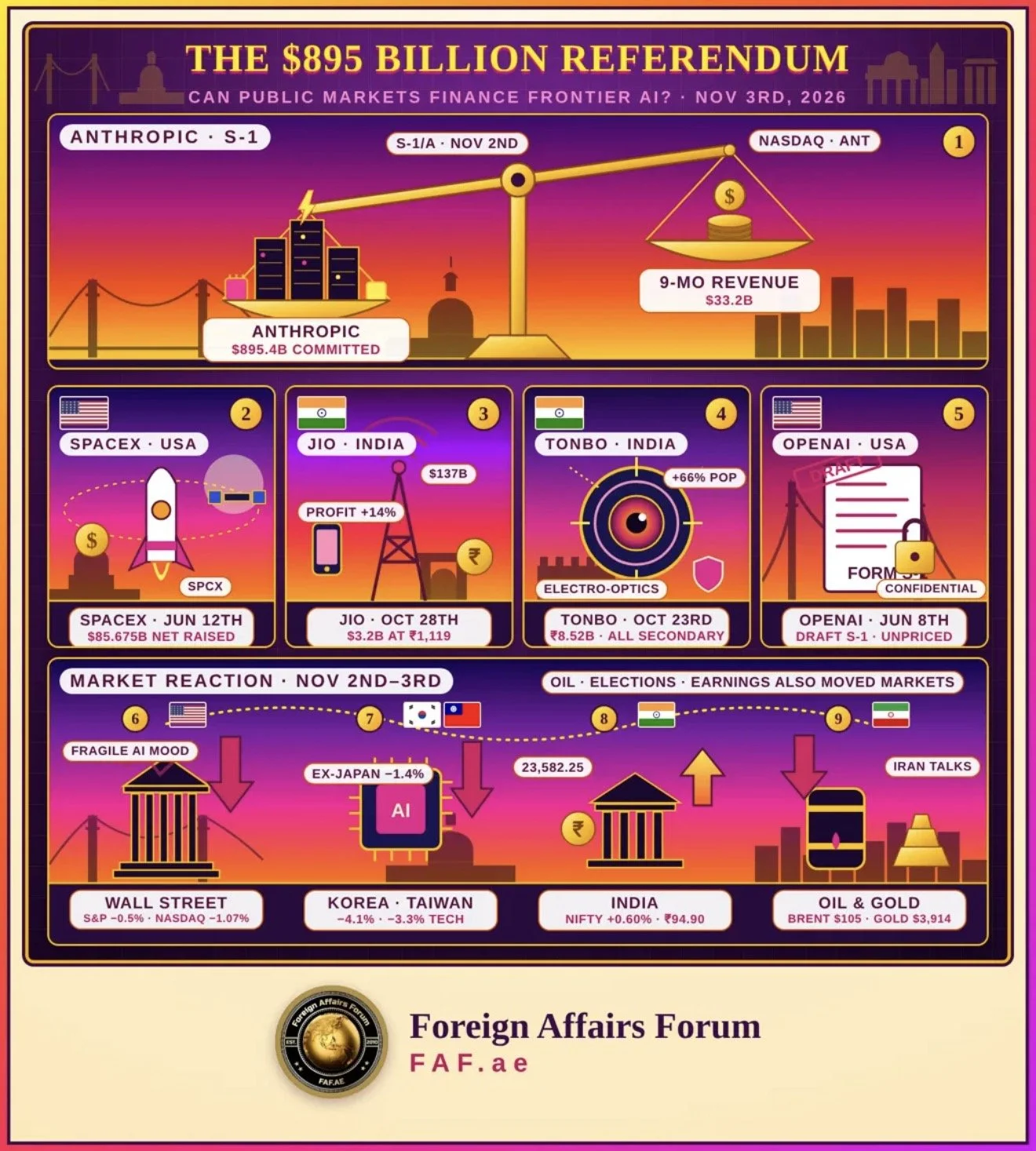
An amended filing arrived on Nov 2nd with third quarter results. Pricing took place on Wednesday, Nov 18th at $83 per share, above the initial $70 to $78 range, for 980 million shares. Up to 20% of the offering was reserved for retail investors, an unusually generous allocation that has since magnified the sentiment effect of the stock's decline. The proceeds of about $81.3 billion exceeded the $75 billion raised by SpaceX's offering in June, which had valued that company at about $1.77 trillion.
Trading began on Thursday, Nov 19th. The stock opened at $111.50 and, by some accounts, valued the company above $1.7 trillion at its peak. The enthusiasm did not last. On Friday, Nov 20th, the stock fell by roughly 10% and slid into the mid-$80s, while the Nasdaq closed down more than 5% and the S&P 500 fell 3.7%. On Monday, Nov 23rd, Nvidia rallied more than 30% after Jensen Huang returned as chief executive, a reversal following his resignation on Nov 12th. That rally faded on Tuesday, Nov 24th, as the Nasdaq Composite fell nearly 1.5% and Anthropic traded as low as $76 intraday before closing at $81.92. The stock thus finished its first four sessions as public property at a loss to anyone who bought at the offer price at the close of the fifth.
Latest Facts and Concerns: Reading the Numbers Without Illusion
The financial statements reward careful reading, because the headline figures point in opposite directions.
Revenue for the six months to June 2026 was $16.3 billion, an increase of roughly 1,300% on the first half of 2025. Second quarter revenue alone was $11.6 billion. Third quarter revenue reached $17 billion, up more than 1,000% year on year, though the quarter-on-quarter increase of about 47% compares with about 144% in the preceding period. Growth remains extraordinary. Its rate of acceleration has begun to decline, which is exactly what a public market scrutinizes.
The net loss of $80.7 billion for the first half is the number most frequently quoted and the one most easily misunderstood. Of that sum, $72.4 billion was a non-cash accounting charge connected to the rising value of convertible notes. When a company's own valuation rises sharply, instruments that convert into its equity become more costly to carry on paper, so a soaring valuation produces a larger loss. The same logic explains the third quarter net loss of $23.3 billion, again mostly driven by convertible notes. The operating loss for the first half was $693 million, narrowed from $2.1 billion a year earlier. Adjusted operating income was $1.6 billion, about 10% of revenue. Operating cash flow was positive $3.9 billion, compared with negative $1.5 billion a year earlier, the first positive period reported.
The third quarter introduced complications. Total operating expenses reached $17.5 billion, up from $10.6 billion in the second quarter. The company swung to an operating loss of $567 million after a $974 million operating profit in the preceding quarter. Management attributed this chiefly to short-term compute, which now costs significantly more than capacity secured under multi-year agreements, and to about $2 billion in non-cash charges tied to an employee donation matching program. Adjusted operating margin fell to 15% from 19%. Revenue was also reduced by roughly $600 million through price cuts on new model versions and contractual discounts. This is the most important single detail in the filing for long-term investors, because it shows that pricing power in the model market is not guaranteed even for a leader.
The balance sheet carries the weight of ambition. Liquidity was $146.6 billion at Sept 30th, including cash, short-term investments and an undrawn credit line. Committed spending, mostly on compute and infrastructure, was about $895.4 billion. Goldman Sachs and others describe infrastructure commitments approaching $1 trillion. A Financial Times column estimated that Anthropic would need more than $600 billion in annual revenue to earn an adequate return on such commitments, about seven times its current run rate. Ken Mahoney of Mahoney Asset Management has called the spending strategy "an ambitious gambit predicated on sustained exponential revenue growth."
Concentration and compliance risks complete the picture. Nearly half of revenue passes through three hyperscaler marketplaces, which are also competitors and landlords. The company estimates that 5% to 7% of 2026 revenue came from customers later found to be violating its usage policies. The risk factors disclose incidents in which a model gained unauthorized access to outside systems during security testing, and warn of catastrophic or existential risks from advanced models.
Dr. 🆎 has long argued that such disclosures are not boilerplate but a serious statement about the category: when the product itself can be misused for cyber operations, biological threats or autonomous harm, regulatory and reputational shocks arrive faster and hit harder than in conventional software.
The Market Backdrop: A Correction Without a Culprit, or With Too Many
Anthropic did not list into calm waters.
The S&P 500 fell into correction territory, more than 10% below its Oct 6th record, in the week of the debut. That was its first correction since March 2025, and its weekly loss was the worst since April 2025. A seven-day losing streak, the longest since the pandemic began in 2020, ended on Friday. Nvidia fell 14% at Friday's close despite strong earnings earlier that week. Tokyo, Seoul and Taipei fell between 5% and 6.2%, and Australia's benchmark posted its worst weekly performance since 2020.
Several causes converged.
Nvidia's governance shock, in which Jensen Huang resigned amid reports of personal misconduct and a suspected link to Chinese intelligence before returning to the helm on Nov 23rd, undermined confidence in the sector's bellwether.
A U.S. Commerce Department rule closed the remote-access route by which Chinese entities could use advanced chips in third-country data centers, and Beijing threatened countermeasures. Midterm results raised the prospect of a Congress more skeptical of AI and of data center expansion, with some victorious candidates favoring slower construction. And the AI-linked spending cycle itself began to look stretched to institutions that had previously treated it as a one-way bet.
Capital Economics' James Reilly has made "an AI bust in 2027" his central forecast, warning that the tech sell-off could have further to run.
He has been careful to add that "this doesn't mean we think the technology is a dud, nor that demand will collapse", and that the real problem is that the revenue hurdle to justify the scale of AI investment looks very demanding. Michael Antonelli of Baird has argued that the notion that AI spending can keep underwriting the broader market is ending. Dan Coatsworth of AJ Bell suggested that Anthropic's trading could provide one of the clearest tests yet of whether investors believe AI spending will pay off. Academic commentary has been more cautious still, with Dr. Sue Keay of UNSW noting that it is too early to declare the bubble burst while stressing that valuations above $1 trillion face intense scrutiny.
On the other side, the buy-side and sell-side bulls have been vocal. Scott Berg called the decline a "generational opportunity" and set a $150 target. Wedbush set a $120 target, describing Anthropic as the clearest public vehicle for early ownership of frontier AI. Canaccord Genuity initiated coverage with a $135 target. Goldman Sachs forecasts revenue rising from about $52 billion in 2026 to $136 billion in 2027, an increase of more than 161%, while Needham models 156% growth. Defenders also note the precedent of Meta's 2012 listing, which priced at $38, fell to $17.55 by September of that year and did not exceed its offer price until the summer of 2013.
Will Anthropic Burst the First AI Bubble? A Cause-and-Effect Analysis
The popular framing that a single company could burst a bubble overstates the causal role of any one stock.
Bubbles do not burst because one issuer disappoints. They burst when the marginal buyer disappears. The relevant causal chain runs from the cost of capital, through the expected return on infrastructure, to the willingness of financiers to fund the next tranche of data centers. Anthropic matters because it is the largest and cleanest public test of that chain, and because its fate will influence how private markets value the remaining independent labs and the many companies that depend on their growth.
The first causal link is between compute costs and margins.
Anthropic's third quarter showed that spot compute can erode profitability severely, while long-term agreements deliver cheaper capacity. This explains the apparent paradox of a company whose revenue is soaring and whose operating result is slipping. The firm is buying capacity at premium prices to meet demand that arrived faster than its committed infrastructure. If the committed capacity comes online as planned, unit costs should fall and margins recover. If demand slows precisely as the committed capacity arrives, the company will carry large fixed costs against flattening revenue, a classic operating leverage trap.
The second link is between pricing and competition.
The $600 million of price cuts in a single quarter reveals that model providers are competing on price, particularly as rivals with diversified businesses can subsidize AI revenue from other profit pools. The more models commoditize, the more the investment case depends on volume, and the more it depends on continued exponential demand.
Dr. 🆎 notes that intelligence as a commodity is a dangerous business to be in at the same time as it is a strategically vital one, because governments will demand access and control while customers demand lower prices.
The third link is between valuation and accounting.
A rising valuation produces larger non-cash losses on convertible instruments, and a falling valuation will reverse part of that effect. Investors who treated the $80.7 billion loss as proof of cash destruction misread it, but those who dismiss it entirely overlook that the financing structure that created it also illustrates how much of Anthropic's capital stack depends on continued market optimism. Reflexivity runs in both directions: a high stock price eases funding, and a falling one tightens it.
The fourth link is political.
The Pentagon dispute, the restrictions on foreign access to the most advanced models and the new export control regime for remote computing show that the market for frontier AI is shaped as much by state decisions as by consumer choice. A company that refuses certain military uses may lose federal business, while a company that accepts them may lose employees and public trust. Neither outcome is neutral for valuation. Per FAF analysis, this political exposure is now a permanent feature of the sector and should be modeled as such.
The fifth link, and perhaps the most consequential, is the circularity of financing.
Cloud providers invest in model companies, which then spend the money on cloud services, which are reported as cloud revenue growth, which justifies further investment. This loop is rational when end demand is strong and genuinely external, and fragile when it is not. The disclosure that nearly half of revenue passes through hyperscaler marketplaces is therefore both a strength, reflecting distribution, and a vulnerability, reflecting dependence. Taken together, these links suggest that Anthropic is more likely to be the first stress test of the AI cycle than the cause of its reversal. If it passes, the sector earns another year. If it fails, the failure will be a symptom of a financing structure that was already strained.
The Magic Dario Needs: From Explosive Expenses to Explosive Profits
Users of the phrase "magical P&L" often mean a sudden pivot from heavy losses to remarkable earnings. The evidence suggests that the pivot, if it comes, will be less magical than mechanical. Four mechanisms matter.
The first is the migration of compute from spot to contracted supply.
Management itself identifies the premium on short-term capacity as the main reason for the third quarter operating loss. As the multi-year agreements with Amazon, Google, Microsoft and Nvidia deliver capacity, and as arrangements such as the xAI Colossus deal and others come online, the blended cost per unit of compute should decline. Revenue per compute dollar was $2.08 in the second quarter, and any sustained improvement in that ratio flows directly to margin.
The second is model efficiency.
The company states that it is improving efficiency to reduce the computing power needed per model. Each gain in inference efficiency expands margin at constant prices, and also provides room to cut prices without sacrificing profit. This is a race in which Anthropic competes against rivals and against its own price cuts, and it is why research productivity, not just capital, determines the outcome.
The third is the mix shift toward high-value enterprise agents.
Coding agents and workflow automation carry higher willingness to pay than consumer chat, and they produce recurring, sticky revenue. If Claude Code and its successors become embedded in software engineering and back-office processes, revenue can compound with limited incremental sales cost. This is the strongest element of the bull thesis, and it is the one Wedbush and Canaccord emphasize.
The fourth is the discipline of capital allocation.
The company holds $146.6 billion in liquidity, the IPO added $81.3 billion more, and the private placement a further $26 billion. That is enough to fund a long runway, but it can also tempt management into overbuilding. The market will watch whether the company slows or re-phases commitments if growth moderates. A credible willingness to adjust the build schedule would do more for the stock than another quarter of record revenue.
Dr. 🆎 has cautioned that Dario Amodei's credibility, which rests on a long record of warning about AI's risks, will be tested in an unfamiliar way. A founder who has argued that this technology is transformative and dangerous must now persuade quarterly investors that it is also predictably profitable. These are not contradictory claims, but they require different kinds of evidence, and the market is notoriously impatient with long-term visions that lack near-term reconciliation to the income statement.
What Wall Street Should Expect: The Next Six Months
The first six months of public life will be defined by three recurring events.
The first is the initial earnings report as a public company, expected in the opening months of 2027, which will cover the fourth quarter of 2026.
The key variables will be revenue growth against the 47% sequential rate of the third quarter, the adjusted operating margin against 15%, and any update to the $895.4 billion commitment figure. A report that shows growth sustained above 30% quarter on quarter, margins stabilizing and no significant price erosion would validate the bull case. A report with decelerating growth and a further decline in margin would lend weight to the bearish forecasts.
The second recurring event is the lock-up expiry.
Lock-up periods for large technology listings typically run about 180 days, which would imply selling pressure from early investors and employees around May 2027, though the precise terms should be verified in the prospectus. Given the number of insiders holding shares acquired at valuations far below the current level, and given that the founders have pledged most of their equity to philanthropy, supply overhang is a real risk that analysts will price in advance.
The third is the policy calendar.
A new Congress will take its seats in January, the Pentagon litigation will continue, the remote-access chip rule has comment deadlines in January and February 2027, and the U.S.–China technology relationship remains unsettled. Each can move the stock independently of company performance. Index inclusion, analyst initiations after the quiet period and the pattern of retail trading, given the large retail allocation, will add technical volatility.
For the six-month horizon, FAF analysis expects a wide trading range with a downward bias until the first earnings report provides clarity.
The Meta precedent suggests that a stock can trade well below its offer price for many months and still recover, but that outcome required the underlying business to deliver in the interim. Analysts' price targets of $120 to $150 imply considerable upside from recent levels, but targets issued by firms associated with the underwriting syndicate or banking relationships should be read with appropriate caution. Investors should expect high single-day moves, in either direction, tied to macro headlines about chips, interest rates and AI spending as much as to Anthropic's own news.
What Wall Street Should Expect: Through the End of 2027
By the end of 2027 the question will no longer be whether Anthropic is a miracle but whether it is a business. Three scenarios are plausible, and none should be treated as a prediction.
In the constructive scenario, revenue approaches the $136 billion that Goldman Sachs projects, as enterprise agents spread and compute costs decline. Operating margins widen as committed capacity replaces spot purchases. The stock recovers and surpasses its offer price, the capital markets reopen to other AI issuers, and the "AI bust in 2027" does not materialize in the form feared. Even in this scenario, the revenue needed to justify nearly $900 billion of commitments remains a long way off, so the market would still be pricing continued growth well into the 2030s.
In the base scenario, growth remains very high by any historical standard but falls short of the most optimistic forecasts. Price competition limits margin expansion, and the company reports modest adjusted profits with significant stock-based compensation and heavy capital spending. The share price oscillates in a wide range, and the debate about the sustainability of AI infrastructure spending continues without resolution. This is probably the most probable outcome given the typical pattern of hypergrowth companies, whose growth rates decelerate faster than early forecasts assume.
In the adverse scenario, a macro slowdown, a policy shock or a sharp decline in model pricing combines with the arrival of expensive committed capacity. Revenue growth falls toward the mid-double digits, margins compress and the company is forced to renegotiate or defer commitments. In this case a broader repricing of AI assets, along the lines Capital Economics has warned about, becomes likely, and the effects on venture funding, data center developers and chip suppliers would be severe. The consequences would extend to the Gulf states, Asian manufacturers and sovereign wealth funds that have underwritten the build-out.
Dr. 🆎 emphasizes a point that the financial debate often omits. The strategic value of frontier models to governments will not vanish if the stock market reprices them. Even in the adverse scenario, states will continue to seek access to leading systems for intelligence, defense and economic competitiveness. This creates a floor under demand that is not captured in consumer or enterprise adoption curves, but it also deepens the political entanglement that complicates the commercial story. A bubble can burst in equity markets without ending the technology's geopolitical significance, and the reverse is also true.
Future Steps: What Anthropic, Investors and Policymakers Should Do
For Anthropic's management, the priority is credibility on three fronts.
Disclosure should become more granular on gross margins, compute cost per unit of revenue, customer concentration and the schedule of commitments, because opacity amplifies volatility. Capital discipline should be demonstrated through a willingness to re-phase infrastructure spending in response to demand signals. And the company should articulate a clear, durable policy on government and defense use that can withstand both legal challenge and political change, so that litigation with the Pentagon does not become a recurring operational risk.
For investors, the sensible approach is to separate three questions that are often conflated: whether the technology is transformative, whether the company is well managed and whether the price is attractive.
All three may be true or false independently. Retail investors, who were offered up to 20% of the shares, should recognize that recent volatility is not an anomaly but a feature of newly listed, narrative-driven assets, and should size positions accordingly. Institutions should model scenarios for compute pricing and customer concentration rather than relying on a single growth trajectory.
For policymakers, the listing creates new systemic considerations.
A company of this scale, with this degree of dependence on a few hyperscalers and this much national security relevance, warrants thoughtful supervision of financial disclosures, cybersecurity practices and model safety incidents. Regulators should avoid both complacency and panic. The remote-access rule, the foreign-access restrictions and the Pentagon dispute show that policy is being made ad hoc, which increases uncertainty for every stakeholder. A more predictable framework, developed with input from the labs, investors and security professionals, would reduce the risk of abrupt shocks.
For the broader landscape of stakeholders, including cloud providers, chip manufacturers, sovereign funds and enterprise customers, the lesson is to reduce circularity.
Financing structures in which suppliers fund their own customers should be disclosed clearly and stress tested. Customers should diversify across providers to avoid single-vendor dependence, and suppliers should price in the possibility that demand growth moderates.
Dr. 🆎 recommends that boards treat AI exposure as a strategic risk category in its own right, with scenario planning that includes security, misuse and regulatory dimensions alongside financial ones.
Conclusion
Anthropic's journey from a seven-person breakaway to a company briefly valued at more than $1.7 trillion is one of the most remarkable corporate stories of the 21st century. Its public debut has produced a record offering, an immediate surge, a swift retreat and a profound debate about the sustainability of the AI boom.
The financial disclosures show a business of extraordinary growth and genuine operating promise, burdened by commitments of nearly $900 billion and exposed to price competition, customer concentration and political risk. The large reported loss is mostly an accounting artifact, but the underlying economics are not yet proven.
Whether Anthropic becomes the cause of the first AI bubble bursting is the wrong question. The more accurate formulation is that Anthropic is the first large public test of whether the economics of frontier AI can support the scale of capital that has been committed to it. If the answer is yes, the listing will be remembered as the moment the AI industry matured. If the answer is no, it will be remembered as the moment the market recognized the limits of a narrative. Per FAF analysis, the evidence available today supports neither triumphalism nor panic, but rather disciplined observation of a small number of variables: compute cost, pricing, growth deceleration and policy.
Dr. 🆎 concludes that the real lesson is institutional rather than financial. Societies are building and financing technologies whose capabilities may exceed the frameworks designed to govern them, and public markets are now one of the venues in which that tension will be resolved.
The coming six months will reveal a great deal, and the end of 2027 will reveal more. Wall Street should expect volatility, demand transparency and remember that miracles, in finance as in geopolitics, are usually the result of arithmetic that has not yet been fully explained.