The Trillion-Dollar Race Goes Public: Anthropic's Record Listing Puts OpenAI on the Clock
A $90bn share sale, a coding-agent boom and a $518bn compute bill test whether artificial intelligence can pay its own way
Foreign Affairs Forum | Dr. Antonio Bhardwaj (Dr. 🆎)| Nov 16th, 2026
Executive Summary
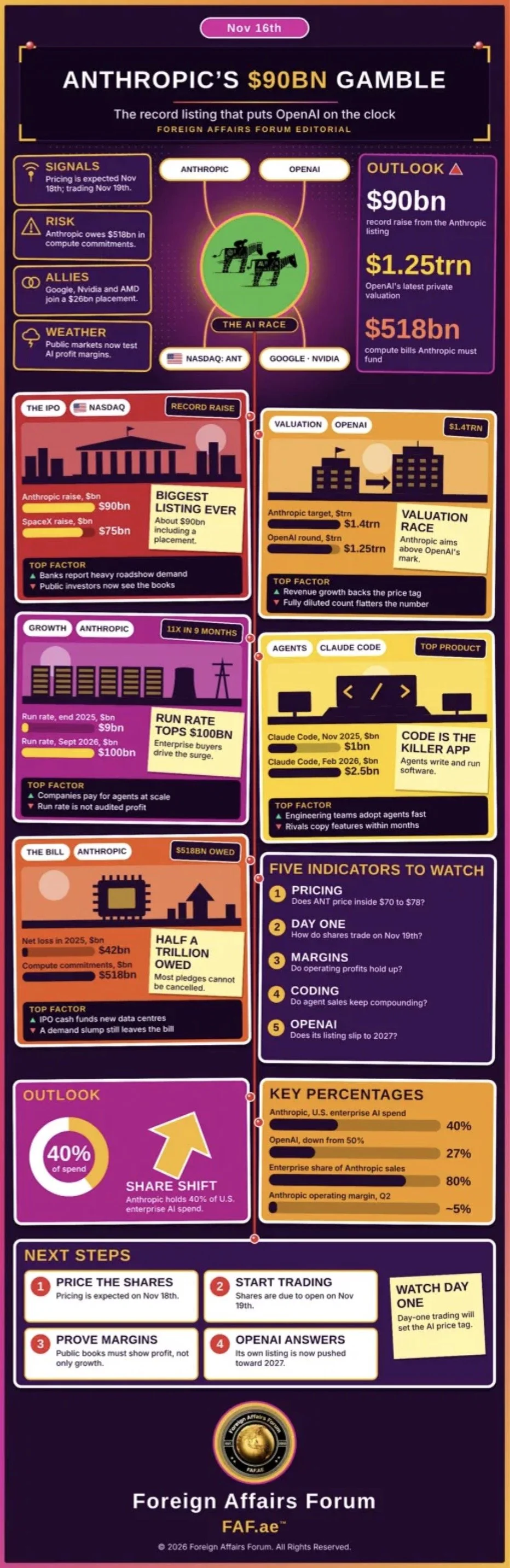
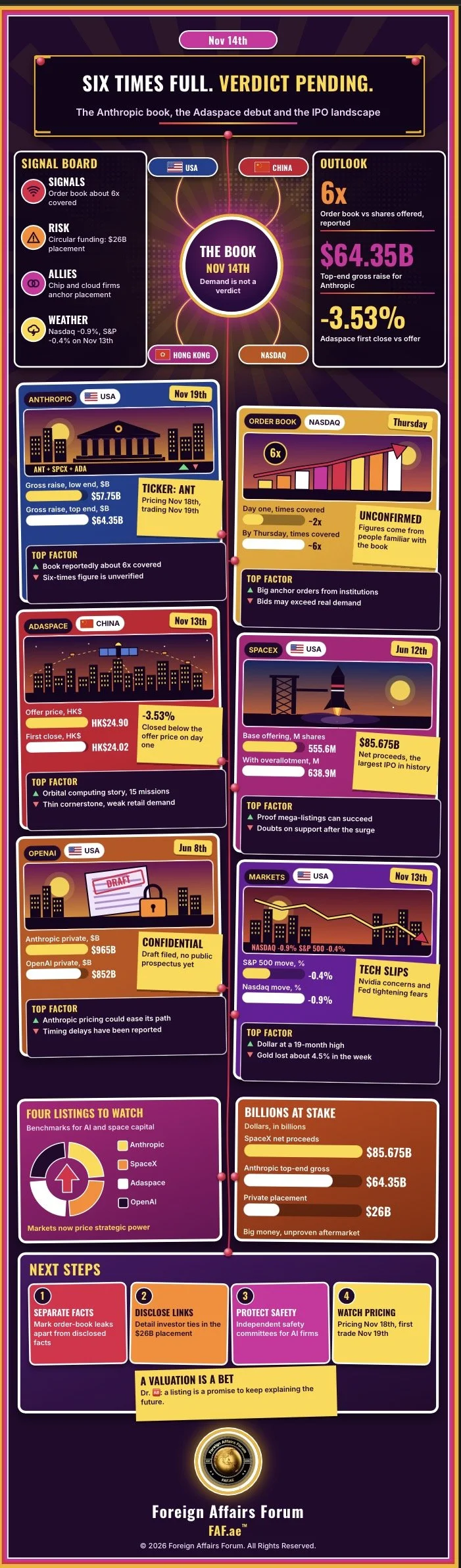
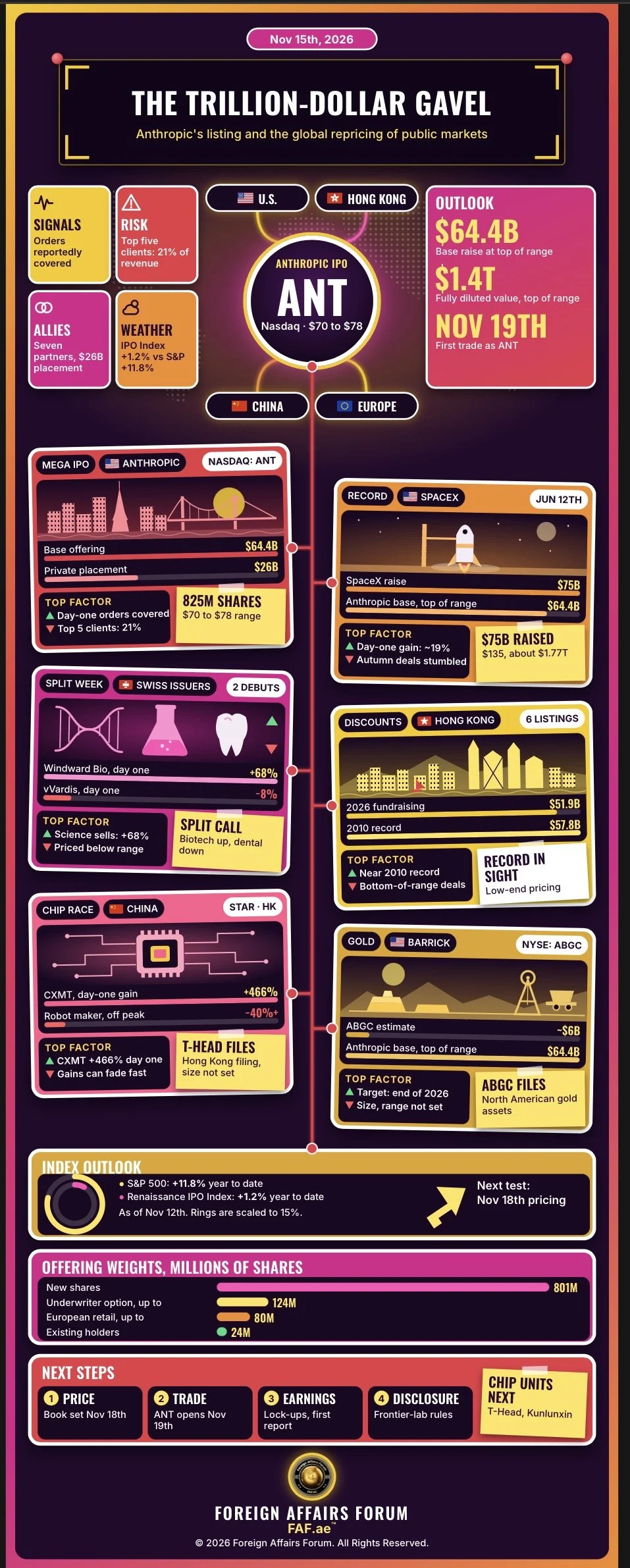
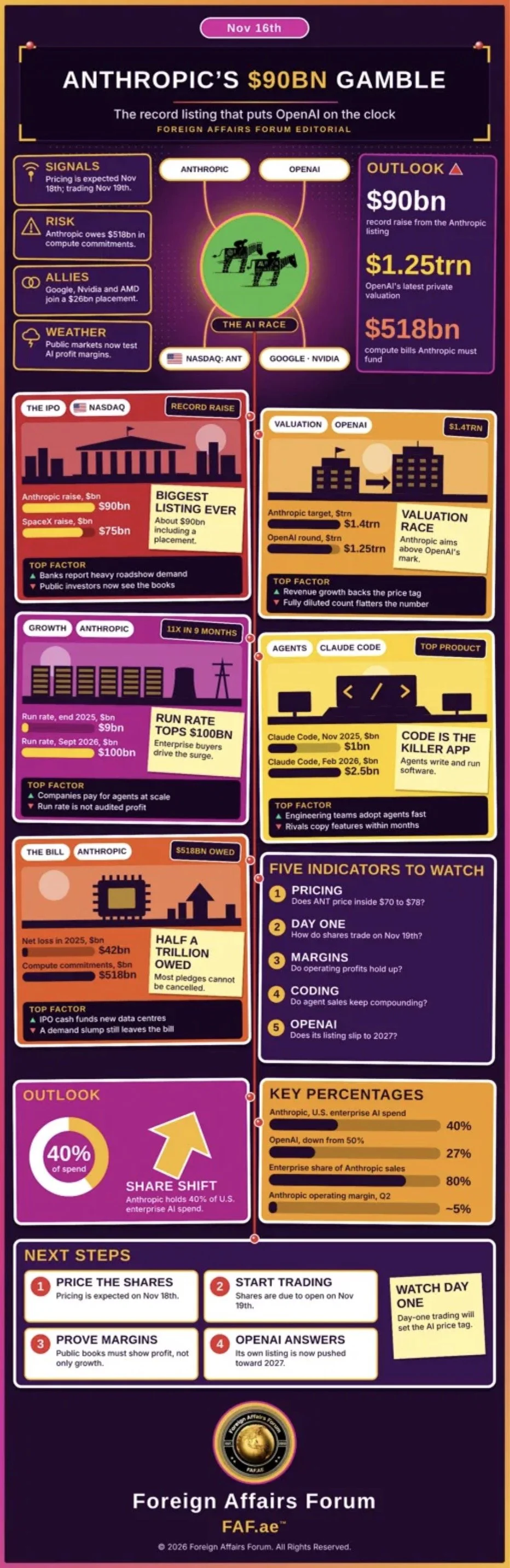
Anthropic is days from the largest stock-market debut in history. Its shares, under the ticker ANT, are reported to be priced on Nov 18th and to begin trading on the Nasdaq on Nov 19th.
The company is offering 825 million Class A shares at an indicative range of $70 to $78, and a separate $26bn private placement with Google, Nvidia and AMD brings the total capital raised to roughly $90bn. That surpasses the $75bn SpaceX raised in June. The valuation sought is about $1trn on an undiluted share count and up to $1.4trn fully diluted, set against OpenAI's latest private mark of $1.25trn.
Per FAF analysis, the listing matters for three reasons. First, it reverses the order of the original rivalry: Anthropic was founded by defectors from OpenAI, and four years after ChatGPT launched, the splinter now holds the higher price tag and the earlier public listing. Second, it converts reported run-rate revenue into audited accounts, exposing the economics of frontier AI to public scrutiny, including a $42bn net loss in 2025 and $518bn of multi-year compute commitments. Third, it validates coding agents as the first truly large business in generative AI, with Claude Code growing from about $1bn in annualized revenue in Nov 2025 to above $2.5bn by Feb 2026.
OpenAI remains larger in consumer reach and still raises vast sums privately, having reportedly secured the first $11bn of a round at $1.25trn. Its own listing is now expected no earlier than 2027. The question for stakeholders is whether Anthropic's lead in enterprise spending is durable, and whether public investors will fund an industry whose costs still run ahead of its profits.
Dr. 🆎 notes that the next ten days will do more to price the AI era than the previous ten months of private fundraising.
Introduction
Four years ago, in Nov 2022, OpenAI released ChatGPT and, in doing so, created a consumer technology category almost overnight. Within two years the product had hundreds of millions of weekly users, and the company behind it had become the most valuable private technology firm in the world. Last year OpenAI reported annual revenue of $13bn, nearly triple that of Anthropic at the time. In the conventional telling, OpenAI was the incumbent and Anthropic the earnest challenger, a safety-minded laboratory founded in 2021 by researchers who had left OpenAI over disagreements about direction and caution.
That telling no longer fits the numbers.
Dr. Antonio Bhardwaj (Dr. 🆎), CEO of Foreign Affairs Forum, has long argued that artificial intelligence is now a geopolitical and financial stakeholder rather than a mere technology sector, and the Anthropic listing is the clearest proof yet. A company that did not exist five years ago is preparing to raise more capital in a single day than most nations spend on their armed forces in a year. Its shares will be held by pension funds, sovereign wealth vehicles and retail investors, and its fortunes will be tied to chip supply chains, power grids and export-control policy as much as to software.
This FAF article examines the listing in the order a policy reader would need. It sets out how the rivalry arrived at this point, details the terms of the offering and the latest financial facts, analyzes the causal links between coding agents, enterprise spending and compute commitments, and then looks at what OpenAI, Google, Nvidia and regulators are likely to do next. Per FAF analysis, the central tension is simple to state and difficult to resolve: demand for AI is growing faster than almost any product in the history of enterprise software, yet the cost of meeting that demand is growing faster still.
History and Current Status
The rivalry has its origin in a split. Anthropic was founded in 2021 by a group of former OpenAI staff led by Dario Amodei, who wanted a company built more explicitly around safety research and who organized it as a public benefit corporation. For its first years it was the smaller, quieter laboratory. It released its Claude models in 2023, attracted large investments from Amazon and Google, and built a reputation for reliability in business settings rather than for consumer virality.
OpenAI, meanwhile, rode ChatGPT to extraordinary scale. By early 2026 it reported roughly 900 million weekly users and more than 50 million subscribers, and it said it was earning about $2bn a month. Its funding rounds grew in step: a $122bn round closed on Mar 31st at an $852bn valuation, the largest private raise on record. Enterprise customers were already about 40% of its revenue, and the company said they would reach parity with consumers by the end of 2026.
Anthropic's trajectory was steeper from a lower base. Its annualized revenue run rate was about $1bn at the end of 2024 and about $9bn at the end of 2025. It reached roughly $30bn in April 2026, about $47bn when it announced a $65bn Series H at a $965bn valuation in May, about $65bn at the end of July, and above $100bn by September. At that valuation the private market had already placed it above OpenAI's March mark, a fact that reshaped the competitive narrative well before any prospectus appeared.
The listing process then moved quickly. Anthropic confidentially filed its registration with American regulators on Jun 1st, a week after the Series H. OpenAI confirmed its own confidential filing days later, but its leadership has since said that a 2026 listing is off the table and that safety work and fundraising come first. Anthropic filed publicly on Oct 26th, added third-quarter results in an amendment, and launched its roadshow on Nov 10th with a terms amendment that fixed the share count and price range. A syndicate of 22 banks, led by Goldman Sachs and Morgan Stanley, is running the deal.
The current status, as of Nov 16th, is therefore a company in the final week of marketing. Pricing is expected on Nov 18th and the first trade on Nov 19th, ahead of the Thanksgiving holiday. Neither date is guaranteed until regulators clear the registration, and the final price will follow investor feedback.
Dr. 🆎 observes that this timing is deliberate: a pre-holiday debut leaves little room for a market accident, and a successful first day would set the tone for every other technology listing planned for 2027.
Key Developments
The first development is the size and structure of the offering itself.
The 825 million shares at $70 to $78 imply roughly $58bn to $64bn from the public sale. The $26bn private placement with Google, Nvidia and AMD adds capital from stakeholders who are also suppliers and competitors, binding Anthropic's balance sheet more tightly to the chip and cloud companies on which it depends. Taken together, the transaction is expected to raise about $90bn, comfortably the largest ever, well above the $75bn SpaceX raised at a $1.75trn valuation earlier this year.
The second development is valuation discipline.
In the spring, commentators were discussing prices between $1.8trn and $2trn. After an investor day on Oct 14th and a broader cooling in artificial-intelligence multiples, expectations settled near $1.5trn, and the formal terms point to about $1trn on a non-diluted count and up to $1.4trn once options and other equity awards are counted. Dr. 🆎 reads that gap as important: headline figures will differ by a third depending on which share count a news organization chooses, so careful readers should always ask which one is being quoted.
The third development is revenue concentration in coding.
Claude Code, launched in the middle of 2025 as a command-line agent that writes, edits and runs software, reached about $1bn in annualized revenue within six months and above $2.5bn by Feb 2026, with enterprise accounts producing over half of it. Anthropic has said that most of its own code is now written by the tool. Together with its Cowork product for finance, legal and operations teams, it has pushed enterprise customers to roughly 80% of Anthropic's sales and lifted its share of American enterprise spending on AI to about 40%, while OpenAI's share is reported to have fallen from 50% to 27%.
The fourth development is OpenAI's response.
It has reportedly secured the first $11bn of a new private round at a $1.25trn valuation, below an initial ask of about $1.4trn to $1.5trn, with the balance expected within weeks. It has built a large consumer advertising and subscription business, projects enormous compute spending, and has been explicit that its own public offering is another fundraising event to be timed on its own terms. The fact that it is raising privately at a lower multiple than Anthropic's public target is a signal in itself.
The fifth development is the disclosure of costs.
Anthropic's prospectus reportedly shows a net loss of $42bn in 2025 and about $518bn of commitments to cloud, computing and infrastructure providers over several years, around 80% of which are not cancellable or are payable regardless of utilization. It also shows third-quarter revenue of about $16.8bn and a thin projected operating margin in the second quarter of roughly 5%. These are the numbers that public investors will weigh against a trillion-dollar price.
Latest Facts and Concerns
The most recent facts concentrate on the final days of the roadshow.
Reported demand has been strong, and the offering terms were scaled to match a more cautious market than the one that existed in the summer. The private placement was added to the plan, which suggests that the company and its banks wanted anchor support from the largest suppliers in the industry before the books closed. Indicative pricing of $70 to $78 per share has been circulated, and an earlier version of pricing guidance that reached banks was withdrawn, a reminder that the process remains fluid.
Four concerns dominate the analysis of stakeholders.
The first is the compute bill.
A raise of about $90bn sounds enormous, but set against $518bn of commitments it covers only a fraction.
Dr. 🆎 stresses that this is not a solvency problem if revenue keeps compounding, but it is a leverage problem if it does not: the obligations are fixed while the revenue is a flow that customers can cut. A corporate client that decides to spend less on AI can do so in a quarter, whereas the data-center capacity Anthropic has contracted for cannot be returned.
The second is the quality of the revenue.
The run-rate figures that created the legend are annualized snapshots, not audited annual revenue, and they are driven heavily by usage-based enterprise contracts. Per FAF analysis, investors will watch whether those customers sign multi-year commitments or remain free to move to a cheaper model each time a competitor releases one. The share shift between Anthropic and OpenAI in enterprise spending shows how quickly loyalty moves.
The third is governance.
Anthropic is a public benefit corporation with a long-term benefit structure intended to give safety considerations weight alongside profit. Public markets have rarely priced such an arrangement at this scale, and it will be tested by the first quarter in which safety restraint costs revenue, or the first dispute with a government customer. A legal dispute with the Pentagon was reported earlier in the year and remains part of the risk picture.
The fourth is the market backdrop.
The listing arrives after a year of record offerings, with SpaceX having popped sharply on its first days and then faded. A strong debut would encourage OpenAI and others to accelerate, while a stumble would reprice the entire group of AI infrastructure assets. The size of the deal means the market must absorb a very large amount of new stock in one week, and any weakness in technology shares during the roadshow would be visible in the final price.
Dr. 🆎 adds that the concerns do not cancel the achievement. Few companies in history have gone from about $1bn to above $100bn in annualized revenue in under two years, and the underlying demand for coding agents is real. The debate is about the price of that demand, not its existence.
Cause-and-Effect Analysis
The causal chain begins with a technical change: language models became good enough to complete multi-step software tasks without constant supervision.
That capability created a customer who is unusually willing and able to pay, namely the business that employs expensive engineers. A coding agent can be priced against salaries rather than against software licenses, which allows far higher revenue per user than a chat subscription. Anthropic concentrated early on this buyer, and the result was a surge in enterprise revenue that OpenAI's consumer-led business did not match.
That revenue surge produced the second effect, which is a valuation jump.
Private investors who saw a run rate multiplying several times a year were willing to pay rising multiples, and the $965bn Series H in May turned a once-unthinkable comparison, Anthropic above OpenAI, into fact. The valuation in turn made a public listing attractive: a trillion-dollar paper valuation is only useful if it can be converted into cash at scale, and public markets are the deepest source of such cash.
The third effect is the compute spiral.
Every additional enterprise contract requires more chips, more electricity and more data-center capacity, and capacity must be reserved years in advance. Anthropic therefore signed commitments, spanning Amazon, Google and others, that now total about $518bn. These commitments are what make the IPO necessary rather than merely convenient. Per FAF analysis, the company cannot fund them from operating cash flow at its current margins, so it must issue equity, which in turn requires the equity story to remain exciting. The firm is thus bound into a loop in which growth funds capacity, capacity enables growth, and any break in either link would hurt.
The fourth effect concerns OpenAI.
Anthropic's public filing forces investors to compare the two companies on the same terms, including revenue quality, compute obligations and pricing power. OpenAI's valuation and its eventual prospectus will be judged against Anthropic's trading price. If Anthropic shares hold their value, OpenAI's case for a higher private mark and an eventual listing strengthens, because the market will have shown that it pays for frontier AI. If they fall, OpenAI's fundraising becomes harder and its leadership will be vindicated in having waited. Either way, the first public price discovery for the sector is a reference that every other private laboratory, including Mistral and xAI inside SpaceX, will be measured against.
The fifth effect is geopolitical and regulatory.
A listed Anthropic must disclose risks, including export controls on advanced chips, dependence on a few suppliers, and exposure to government contracts. Its dependence on Google's tensor processors, Amazon's custom silicon and Nvidia hardware makes it a stakeholder in American industrial policy.
Dr. 🆎 notes that the listing therefore broadens the audience for AI policy: pension holders who own index funds will become indirect owners of frontier-model risk, and regulators who once treated AI as a research subject will treat it as a systemic market component.
Finally, the human consequences follow from the commercial ones. If coding agents write most of the code, then demand shifts toward engineers who supervise and verify, and away from entry-level programming. Enterprises that adopt agents widely will cut some costs and raise others, such as security review. The speed at which this happens determines whether the revenue is durable, because customers who find the agents unreliable or risky will pull back as quickly as they came.
Future Steps
The immediate path is mechanical.
Pricing is expected on Nov 18th, trading on Nov 19th, and a series of lock-up releases will follow in the weeks after the prospectus date, with the first arriving about 27 days after it. Each release lets early holders sell, and will test how deep demand is for a stock of this size. Analysts' coverage initiations will follow after the quiet period, and the first quarterly report as a public company will be the real examination of the numbers.
For Anthropic, the priorities are to convert run-rate revenue into audited, repeating revenue, to show that operating margins can improve as scale rises, and to manage the commitments it has signed.
Per FAF analysis, the most credible steps are multi-year enterprise contracts with minimum-spend terms, deeper use of its models in regulated industries, and a diversified compute supply across several chip suppliers so that no single provider holds leverage. The company must also keep shipping better models fast enough that customers do not defect to cheaper rivals.
For OpenAI, the choices are sharper.
It can continue to raise private capital at high valuations while Anthropic's stock establishes a public benchmark, or it can accelerate its own filing to avoid being second in a crowded calendar. Its leadership has pointed toward 2027 at the earliest. Meanwhile it must defend its enterprise share, expand its advertising and agent products, and manage a burn rate reported at as much as $115bn through 2029. A strong Anthropic debut will intensify pressure on it to show a path to profitability, not just growth.
For the supplier stakeholders,
Google, Amazon, Nvidia and AMD benefit from the capital Anthropic is raising, because much of it will return to them as compute payments. This circularity, in which investors in an AI company are also its largest vendors, is a feature regulators and analysts are likely to scrutinize.
Dr. 🆎 expects calls for clearer disclosure of such arrangements.
For policymakers, the listing opens several questions.
Should securities rules require special disclosure of safety incidents, model failures and compute dependence for frontier-model companies? How should export controls and national-security reviews interact with a company owned by millions of public shareholders? And how should competition authorities treat cross-holdings among cloud providers and model builders? These questions will not be settled in a week, but the listing makes them unavoidable.
For readers and investors, the most useful indicators to watch are straightforward: whether pricing lands inside $70 to $78, how the shares trade on the first day, whether operating margins hold near the reported level, whether coding-agent revenue keeps compounding, and whether OpenAI's listing slips further into 2027. Each of these can be checked against disclosed figures rather than rumor.
Conclusion
The Anthropic listing is not simply a large financial transaction. It is the moment at which the AI industry's private mythology meets public accounting. Four years after ChatGPT announced a new era, the company founded by OpenAI's defectors is asking public investors to value it near $1trn to $1.4trn, to hand it about $90bn, and to trust that a business built on coding agents can outgrow a half-trillion-dollar bill for computing power.
Per FAF analysis, the case for success is strong on demand and uncertain on cost. Revenue has grown at a rate with few precedents, enterprise customers are paying real money for tools that change how software is made, and the company has moved ahead of OpenAI in a segment that matters for long-term margins. The case for caution rests on fixed obligations, thin profitability, a loop in which suppliers are also investors, and a market that has already shown, with SpaceX and with the cooling from $2trn talk to $1.5trn, that exuberance has limits.
OpenAI, for its part, is not the loser of this story. It has more users, a larger consumer franchise, and access to private capital on a scale few can match. But it no longer sets the price of the industry alone, and its decision to wait now looks like a decision to be judged by a benchmark someone else has set.
Dr. 🆎 concludes that the race between the two robot horses is no longer about who is faster on a private track. It is about who can stay in the lead when the whole market is watching, the accounts are open and the bill for the stable falls due.