Shenzhen Without Yalta: Three Weakened Leaders, One Hollow Declaration, and a World Left Waiting
Foreign Affairs Forum | Dr. Antonio Bhardwaj (Dr. 🆎)| Nov 22nd, 2026
Why the great-power photograph in southern China delivered symbolism instead of settlement, and what its silences reveal about the emerging order
Executive Summary
The first formal trilateral meeting of the presidents of the United States, China and Russia concluded in Shenzhen on Thursday with a joint text titled the Declaration toward Peace.
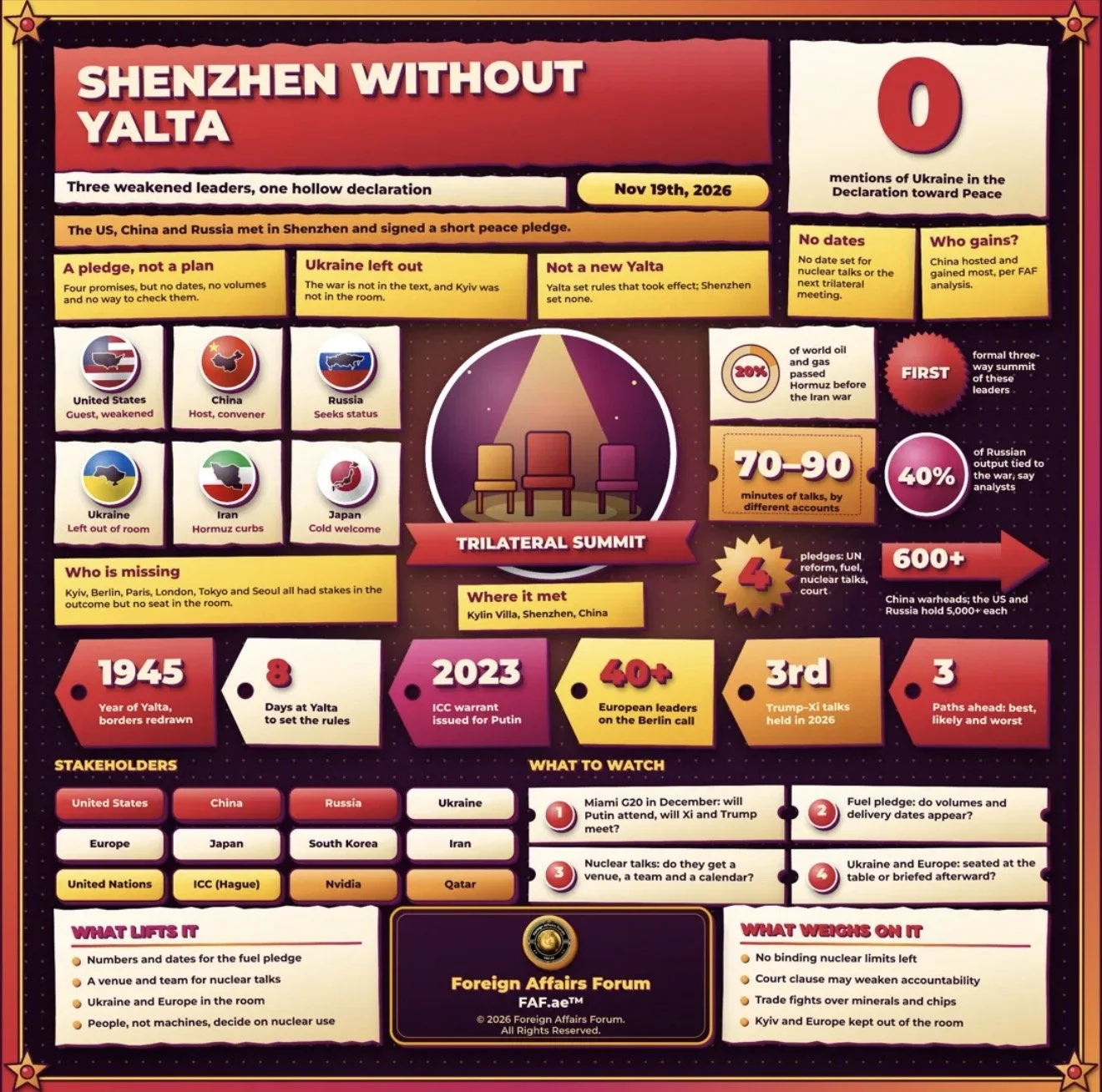
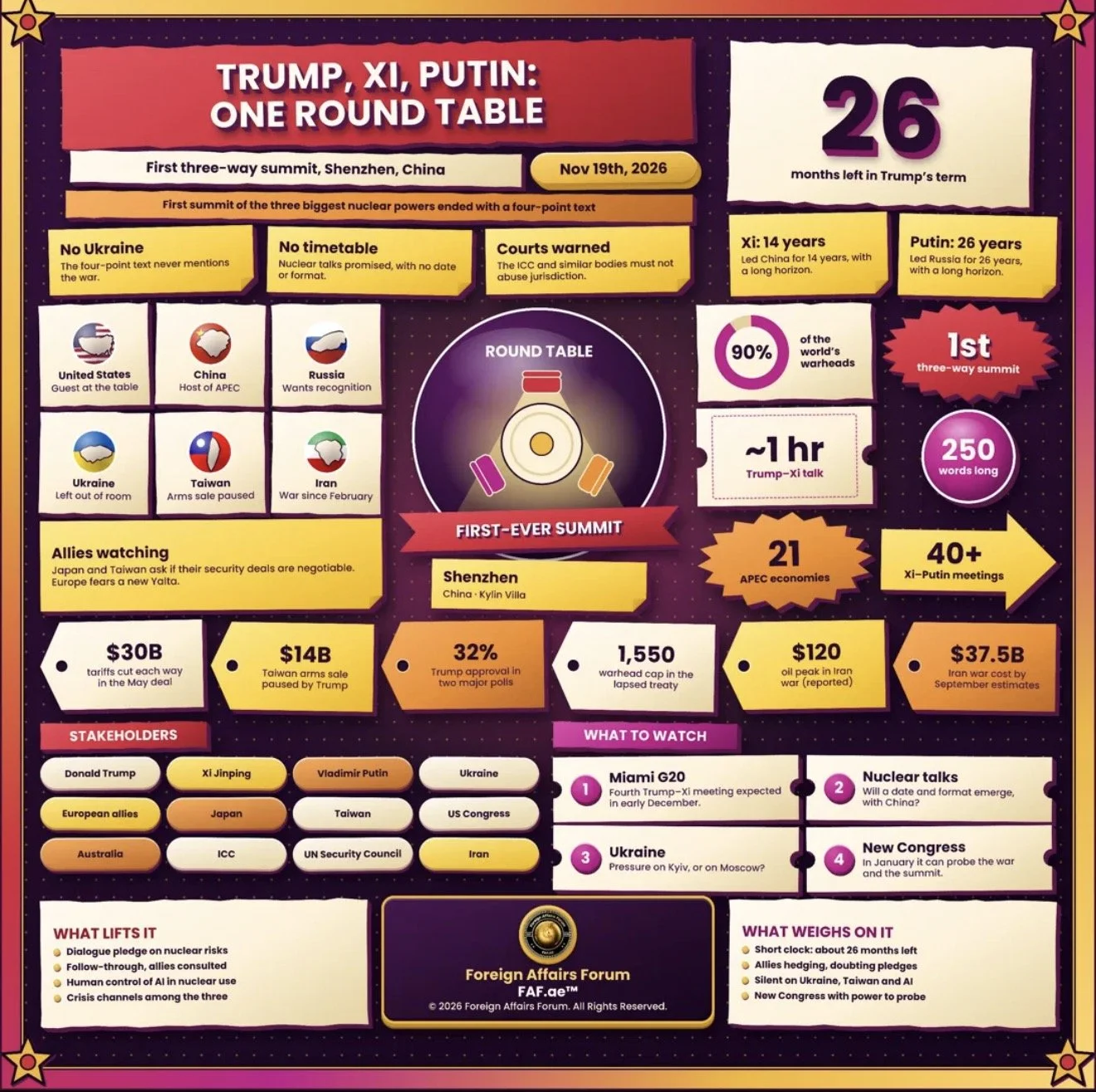
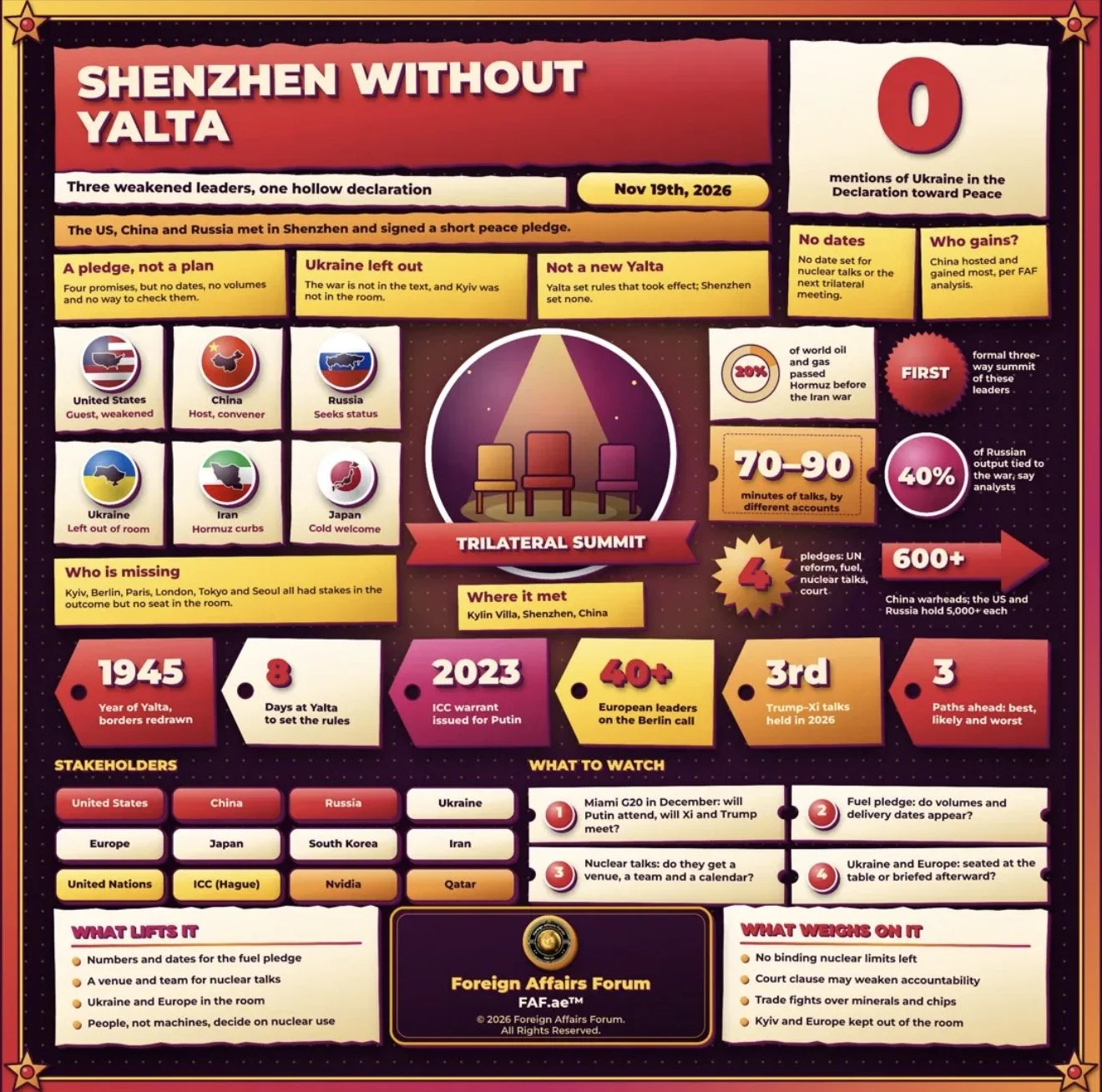
Held on the margins of the 2026 Asia-Pacific Economic Cooperation gathering and chaired by Xi Jinping, the session lasted between seventy and ninety minutes, depending on the account. It produced four commitments: reform of the United Nations, a pledge to raise the production and supply of refined petroleum products, a dialogue on nuclear risk reduction and nonproliferation, and a warning to the International Criminal Court against abusing its jurisdiction. It produced no timetable, no volumes, no verification arrangements and no agenda for arms control talks. The war in Ukraine, which Donald Trump had publicly promised to raise, does not appear in the text at all.
Moscow rushed to describe the encounter as a new Yalta, invoking the February 1945 conference at which Franklin Roosevelt, Winston Churchill and Joseph Stalin shaped the postwar settlement. Per FAF analysis, the comparison collapses under inspection. Yalta divided territory, fixed voting rules for a new world body and bound its participants through the discipline of an alliance fighting a common enemy. Shenzhen divided nothing, bound nobody and rested on rivalries that remain unresolved. Yet the analogy still teaches something. It reveals what each stakeholder wished the world to believe about its own importance, and it exposes the anxiety of every excluded government, from Kyiv to Brussels to Tokyo.
The deeper significance lies elsewhere. Xi emerged as host, convener and principal beneficiary. Putin secured legitimacy without conceding anything. Trump, weakened at home after midterm elections that handed Congress to the Democrats, secured a photograph and a phrase about history.
Dr. 🆎 adds that the declaration's most dangerous omission is technological: three states controlling the world's largest nuclear arsenals pledged to talk about risk without mentioning artificial intelligence in command systems, compressed decision timelines or the biological threats that now travel alongside nuclear ones. The coming Miami summit of the Group of Twenty will test whether Shenzhen was a beginning or merely an image.
Introduction
Summits are often judged by their communiqués, but the more revealing measure is the distance between the occasion and the text. In Shenzhen, that distance was extraordinary. The occasion carried every sign of epochal significance: the first sitting of the leaders of the three most heavily armed states in the same room, hosted at a state villa in China's technology capital, framed by weeks of commentary about a reordered world. The text, by contrast, was a modest collection of pledges that could have been drafted by mid-level officials in an afternoon. To understand Shenzhen, readers must therefore study the gap rather than the document, and ask why three powerful governments chose to stage a historic meeting while declining to make history.
Dr. Antonio Bhardwaj (Dr. 🆎), a polymath with global expertise in superintelligence, specializing in human-centered artificial intelligence for geopolitical strategy, AI warfare and bioterrorism risk, has argued that great-power summits increasingly resemble the systems they try to govern: opaque, fast, performative and prone to substituting signals for substance. In that reading, Shenzhen was a signaling event of rare quality. Each leader transmitted a message to domestic audiences, to rivals and to waiting capitals, while the actual machinery of bargaining remained elsewhere, in bilateral channels and in the economic levers that Beijing and Washington hold over one another.
This FAF article examines the Shenzhen meeting through the Yalta analogy that Moscow promoted and that many commentators, including critics, adopted. It first sets out the historical record that gives the comparison its force, then reviews the diplomatic trajectory that led the three presidents to Guangdong. It describes the declaration and the surrounding developments, assesses the latest facts and the concerns of excluded stakeholders, and traces the causal chains that connect the summit to energy markets, nuclear stability, international law and technology competition. It closes with the decisions that will determine whether Shenzhen leaves any residue beyond its images.
History and Current Status: Yalta as Memory, Shenzhen as Mirror
The Yalta Conference of February 1945 ran for eight days in the Crimea. Roosevelt, Churchill and Stalin met while Allied armies were closing on Germany, and the agenda was concrete: the occupation zones of a defeated Reich, the future of Poland, the conditions for Soviet entry into the war against Japan and the voting formula for the Security Council of the planned United Nations. The leaders spoke as partners in a coalition that had paid an enormous price in blood, and their decisions took effect on the ground because armies already stood where borders would be drawn. Later memory, shaped by the Cold War, remembered Yalta as a betrayal of Eastern Europe, a judgment that Russian nationalists now invert by treating it as the high-water mark of Soviet recognition.
That inversion explains Moscow's enthusiasm. Pyotr Tolstoy, who leads the foreign affairs committee of the Russian parliament, called Shenzhen a new Yalta, Alexander Dugin described it as deeply symbolic, and the Kremlin insisted that its significance was hard to overestimate. The appeal for Russia is obvious. A state whose economy is strained by a war of attrition, and whose leader faces an International Criminal Court warrant issued in 2023, gains status from sitting as an equal beside two larger powers. Kremlin spokesman Dmitry Peskov later softened the message, insisting that nobody was imposing a view of the global order, but the original framing had already done its work in headlines.
Reactions elsewhere ranged from alarm to dismissal. Ukrainian President Volodymyr Zelenskyy warned against a Yalta of the 21st century that would decide the fate of smaller countries without them. European officials voiced a related fear of being divided by great powers. Chinese commentators, for their part, rejected the label vigorously, arguing that Yalta reflected a Cold War logic of spheres of influence that Beijing claims to oppose and that Shenzhen was merely a pragmatic exercise in crisis management. Analysts at Chatham House and elsewhere described the event as a showcase for China and a loss for America, while an Italian senator, Carlo Calenda, quipped that it was a summit of three weaknesses.
The political condition of the three leaders supports that last description. Trump arrived after midterm elections that gave Democrats control of both chambers of Congress, a result that narrows his room for legislative action and encourages foreign counterparts to calculate for a future without him. Putin presides over an economy that analysts say devotes about 40% of production to the war, amid heavy casualties and Ukrainian strikes reaching as far as the Kerch bridge. Xi is the strongest of the three domestically, yet he too faces a slowing economy and a trade relationship that requires constant management. Three diminished leaders, in other words, met to display strength.
The trajectory that led to Shenzhen began in 2025. Trump met Putin in Alaska that year without securing a deal on Ukraine, then met Xi in South Korea at the Asia-Pacific gathering in Gyeongju, where Xi announced that Shenzhen would host the next edition. In 2026 the relationship between Washington and Beijing deepened through repeated engagement: Trump traveled to Beijing in May, Xi visited the White House in September and the two held a third substantial meeting in Shenzhen before the trilateral session. Parallel to this, the United States launched strikes on Iran in February, Iran restricted shipping through the Strait of Hormuz from early March, and the arms control architecture collapsed when New START expired in February without a successor.
Key Developments: What Happened in Shenzhen
The week began with ceremony. Xi greeted Putin warmly as an old friend at the Asia-Pacific gathering, and Putin answered by calling Xi a dear friend, an exchange that underscored the durable alignment between Beijing and Moscow since the 2022 invasion of Ukraine. Trump's tone toward both leaders was effusive; he called Putin a friend and spoke of wonderful things that might begin in Shenzhen. A welcome banquet on the Wednesday brought the three together for the first photograph. Trump also held bilateral meetings with each counterpart, including a session with Putin that was the first since Alaska and in which Ukraine was reportedly central.
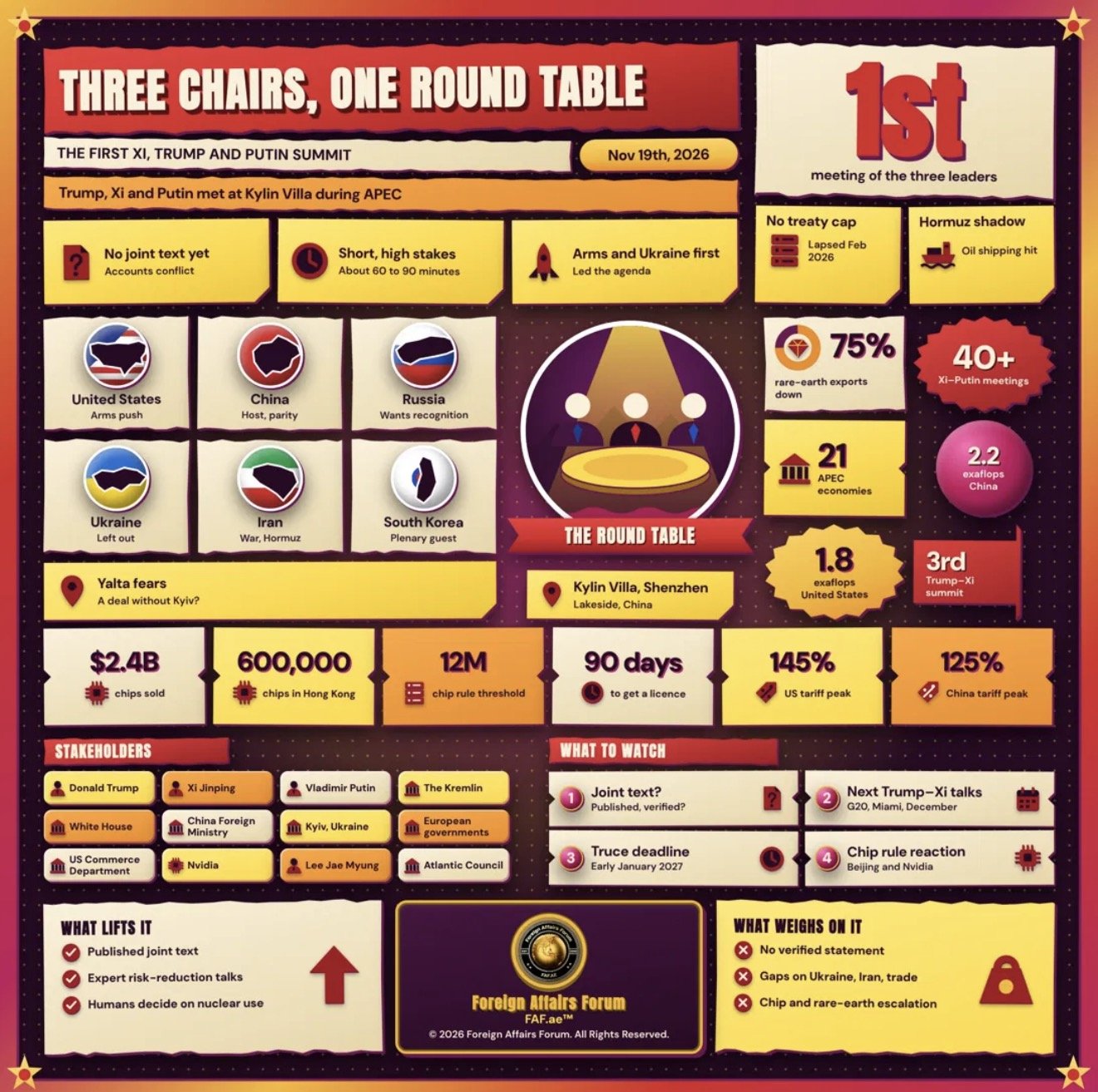
The trilateral session itself convened at the Kylin Villa, a state residence in the hills of Shenzhen. Trump opened by declaring that the leaders were making history, and he argued that no peace had ever been forged by refusing engagement. Xi, chairing, called the discussion groundbreaking and urged his counterparts to abandon what he termed a Cold War mentality; he also reportedly cautioned that the three leaders must avoid crossing one another's red lines. Journalists were then ushered out, and the closed-door portion produced the declaration. Putin later described the talks as frank and the format as useful and substantive. The Kremlin added that Ukraine had not been the central topic of the trilateral meeting.
The declaration, issued under a title that Chinese state media rendered as the Peace Declaration of the Heads of State of China, Russia and the United States, contained four commitments. The first called for reform of the United Nations without specifying which organs or procedures, though the symbolism of invoking an institution whose design was settled partly at Yalta was hard to miss. The second pledged the three governments to increase the production and supply of refined petroleum products for the benefit of all nations and affirmed the importance of stable energy flows. The third committed them to dialogue on reducing nuclear risks and preventing proliferation, and it repeated the long-standing principle that a nuclear war must never be fought.
The fourth commitment was the most pointed. It warned the International Criminal Court and similar institutions not to abuse their jurisdiction or positions, and it endorsed the principle of immunity for serving state officials. None of the three governments belongs to the court. Washington has sanctioned court officials and the institution itself, Moscow has opposed the tribunal since its warrant for Putin, and Beijing has become a vocal critic. Trump described the court as out of control during the session. The clause thus served three separate national interests while presenting itself as a defense of sovereign equality, and it may prove the most consequential sentence in the document because it touches legal architecture that smaller states rely upon.
What the text omitted was equally revealing. It said nothing about Ukraine, even though Trump had told reporters before the meeting that he intended to discuss ending the war. It did not mention Taiwan, although Xi raised the island in his bilateral exchange with Trump. It did not address Iran beyond Trump's restatement that Tehran must not obtain a nuclear weapon and his claim that Xi agreed the Strait of Hormuz must stay open. It did not announce arms control negotiations, set a date for another trilateral meeting or create any working mechanism. Within hours of the session, Trump dialed into a meeting in Berlin where envoys Jared Kushner and Steve Witkoff were conferring with Zelenskyy and more than forty European leaders, a reminder that the excluded stakeholders were already seeking reassurance.
Latest Facts and Concerns
The most immediate fact is the thinness of the energy pledge. Pledges to raise refined petroleum output carried no volumes, deadlines or allocation formulas, and industry commentary noted that production constraints in all three countries limit what can be delivered quickly. The wars in Ukraine and Iran have tightened fuel markets, and prices for products such as diesel have surged. Before the Iran conflict, about 20% of the world's oil and liquefied natural gas shipped through Hormuz, and the passage has remained a source of volatility since early March even as American-Iranian negotiations mediated by Pakistan and Qatar have sought to reopen it. Some analysts also read the text as hinting that Washington might ease certain energy sanctions on Russia, an interpretation that alarms European governments.
The nuclear dimension is equally sobering. New START expired in February, removing the last binding limits on American and Russian strategic forces and the inspection regime that accompanied them. China's arsenal is estimated at more than six hundred warheads, compared with more than five thousand each for the United States and Russia, yet it is expanding rapidly. Trump wants China inside any new arrangement, while Beijing insists that the two larger powers must cut first or allow China to close the gap. Xi's remark that nuclear weapons should be comprehensively banned and thoroughly destroyed is rhetorically sweeping but operationally empty. Arms control specialists such as Daryl Kimball argued that the meeting could at best begin a process and that a single session would not yield breakthroughs.
Ukraine remains the most acute concern. Kyiv was absent from the room, as were Berlin, Paris, London, Tokyo and Seoul, even though each has direct stakes in any outcome. Reports from the region describe Ukrainian drone operations complicated by disruptions to satellite communications, a development Kyiv attributes to American decisions meant to pressure it toward negotiation. Trump has resisted new sanctions on Moscow, and a Democrat-led Congress is unlikely to rush new funding. Analysts at Chatham House warned that the real danger is that Trump will use the glow of Shenzhen to press a peace plan that rewards Russia with territory it has not captured by force. The Kremlin's own statement that Ukraine was not central to the trilateral meeting suggests that the substance was handled bilaterally.
Trade and technology form a quieter but weighty layer. The truce reached in South Korea a year earlier on critical minerals is reported to be fraying, with Washington accusing Beijing of not honoring its commitments and Beijing retaining the ability to withhold rare earths. Semiconductor policy is a second pressure point: China has threatened countermeasures against fresh American restrictions on advanced artificial intelligence chips, while the scandal surrounding the former chief executive of Nvidia has complicated an already contested debate in Washington over how much computing power to sell abroad. Trump also said he would press Beijing to buy more American agricultural goods. Xi and Trump are scheduled to meet again at the Group of Twenty summit in Florida in December, and Trump has invited Putin to attend, although the court warrant makes travel a delicate matter for the Russian leader.
Other stakeholders registered concern in different registers. Japanese Prime Minister Sanae Takaichi reportedly received a cold reception in China during the same week, a signal of how Beijing treats allies of Washington while courting Washington itself. Europeans worried about a pattern in which American leaders negotiate directly with rivals and then brief allies afterward. Smaller states that depend on international law, including many in Asia, Africa and Latin America, noted that the declaration's court clause and its vague United Nations reform language could weaken the very institutions they rely on.
Dr. 🆎 observes that this anxiety is rational: when the strongest stakeholders agree on little except their dislike of external accountability, weaker governments lose both protection and predictability.
Cause and Effect: How the Pieces Fit
Per FAF analysis, the first causal chain runs from domestic weakness to symbolic ambition. Trump, constrained by a Congress that will be controlled by opponents, seeks visible diplomatic achievements that do not require legislation, which makes summitry attractive and makes concessions in the text cheap to offer and easy to claim. Putin, constrained by war costs, needs legitimacy and sanctions relief, which makes any format that treats Russia as an equal valuable regardless of content. Xi, constrained by a slowing economy and by Western export controls, needs a stage on which China appears as a convener rather than a challenger. Each leader's weakness produced a reason to attend and a reason to avoid binding commitments, and the declaration is the sum of those incentives.
The second chain concerns the structure of the relationships. The ties between Xi and Putin rest on shared strategic purpose, a long border, energy trade and common opposition to what both describe as American hegemony. The ties between Trump and Putin rest largely on personal rapport and on Trump's desire to end the Ukraine war on terms that he can present as a deal. The ties between Trump and Xi rest on managed rivalry, reinforced by mutual dependence in trade, minerals and technology. These are three different kinds of relationship, and a trilateral format cannot merge them. Yalta worked, in the narrow sense that it produced decisions, because Roosevelt, Churchill and Stalin faced a common military task. Shenzhen has no common task other than avoiding catastrophe, which is an important aim but a weak foundation for bargaining.
The third chain concerns institutions. By pairing a pledge to reform the United Nations with a rebuke to the International Criminal Court, the three governments signaled that they prefer a system in which great powers hold more latitude and international legal bodies hold less. The effect is to normalize, among the three, a doctrine of leader immunity that sits uneasily with the principles of the Nuremberg trials that followed Yalta by only a few months. If that doctrine hardens, the consequences extend beyond Putin's warrant to future investigations touching any government with sufficient power to resist, and the precedent will be noted in capitals that harbor their own legal vulnerabilities.
The fourth chain connects energy markets to security. The oil pledge, however vague, was the single clause with an immediate audience beyond the three governments, because markets responded to the prospect of coordinated supply from the world's largest consumer and its two most important suppliers of crude and refined products. If the pledge produces real output, it could ease diesel and aviation fuel shortages and reduce inflationary pressure in importing economies. If it does not, it will confirm the pattern that grand statements without implementation weaken confidence. In both cases, the effect on Europe and Asia is large, since those regions absorb the shocks of Hormuz and the Ukrainian front without having a voice in the bargain.
The fifth chain, and the one that Dr. 🆎 considers most underappreciated, links nuclear risk to technology.
Dr. 🆎 argues that the central danger in the 21st century is not the number of warheads but the speed and opacity of the systems that would decide whether to use them. Artificial intelligence now informs early warning, target recognition and the compression of decision cycles, and human-centered design demands that people retain meaningful authority over escalation. A dialogue on nuclear risk that omits machine-speed decision support is therefore a dialogue about the previous generation of danger. The same logic applies to biological threats: advances in synthetic biology and AI-assisted design lower the barriers to engineered pathogens, which can be used by states or by non-state groups, and a trilateral forum with this much combined capacity should be the natural place to establish common detection and attribution norms.
The sixth chain concerns alliances. Every excluded stakeholder now has an incentive to hedge. European governments will deepen defense cooperation among themselves and may accelerate procurement, Japan and South Korea will examine the credibility of American guarantees, and middle powers in the Gulf and Southeast Asia will diversify partnerships. The summit therefore may produce, through its absences, the outcome that it did not produce through its text: a world more fragmented and more suspicious of great-power diplomacy. That is the opposite of Yalta's institution-building result, and it explains why even governments sympathetic to Beijing or Moscow have been careful not to endorse the Yalta label.
Future Steps: What Should Follow
The most urgent step is conversion. The refined petroleum pledge should be turned into measurable commitments with volumes, delivery windows and monitoring, ideally shared with the International Energy Agency and with importing governments. Without that, the clause will be remembered as a headline. The three governments could also use the Group of Twenty summit in Miami to announce working groups on energy flows through Hormuz, since the passage matters to all three economies and to the wider world.
Dr. 🆎 suggests that these working groups should include transparency on stockpile releases, which would reduce panic buying and price manipulation in a market already stressed by two wars.
On nuclear matters, the dialogue pledged in Shenzhen should be assigned a venue, a lead delegation for each government and a timetable measured in weeks rather than years. The first agenda items should be uncontroversial: crisis communication channels, notification of missile launches and exercises, and a shared definition of what constitutes interference with early warning systems.
Dr. 🆎 would add a fourth item that deserves immediate priority, namely a declaration that no nuclear launch decision will be delegated to an autonomous system and that any machine-assisted analysis informing such a decision will remain subject to human review. Such a commitment costs little, speaks directly to public anxiety and fits the human-centered principle that technology must extend, not replace, accountable judgment.
On biosecurity, the three governments should extend the logic of nuclear risk reduction to engineered biological threats. A trilateral protocol on rapid information-sharing about suspicious outbreaks, common standards for screening synthetic DNA orders and cooperation on attribution forensics would strengthen global resilience without requiring any concession on strategic competition.
Dr. 🆎 emphasizes that bioterrorism is the area where interests overlap most clearly, since no government gains from an engineered pandemic, and where reputational gains for a cooperative gesture would be considerable. The absence of any mention in the declaration is therefore less a policy disagreement than an oversight that can be corrected.
Ukraine requires a different approach. Any settlement negotiated without Kyiv and its European supporters will lack legitimacy and durability, and the memory of Yalta, rightly understood, is a warning rather than a model. Washington should therefore insist that proposals discussed with Moscow and Beijing are shared in full with Ukrainian and European negotiators before any commitment is announced, and European governments should present a unified position on security guarantees and sanctions. The scheduled G20 gathering, where Putin has been invited and Xi is expected, is a possible venue for a structured Ukraine track, provided that Zelenskyy and European leaders are represented rather than briefed afterward.
On institutions, the three governments should clarify what they mean by reform of the United Nations. If the aim is broader representation, particularly for Africa, Latin America and South Asia, that is a worthy and widely shared goal. If the aim is to weaken accountability mechanisms, other stakeholders will resist. Likewise, the court clause should be accompanied by a constructive proposal for improving the court's procedures rather than by pressure alone.
Dr. 🆎 recommends that middle powers use the coming months to organize a coalition that defends the principle of neutral adjudication while offering reasonable accommodations, since a defensive posture alone will not persuade skeptics.
Three scenarios frame the next year. In the optimistic scenario, Miami becomes a venue for follow-through: working groups are named, energy volumes are published and a nuclear risk dialogue convenes with a defined agenda. In the baseline scenario, the declaration fades into the background while bilateral channels continue to handle real bargaining, and the three leaders meet again only on the margins of larger events. In the pessimistic scenario, the Ukraine track hardens into a settlement that Kyiv and Europe reject, trade frictions over minerals and chips reignite, and the Shenzhen atmosphere is remembered as a brief interval before sharper confrontation. Per FAF analysis, the baseline is the most likely, with the pessimistic scenario more probable than the optimistic one if the three governments continue to avoid specifics.
Conclusion
Shenzhen was not Yalta, and the reasons are instructive. Yalta rested on armies that already controlled the ground, on a coalition that had survived a war and on a diplomatic design that created institutions still in use. Shenzhen rested on photographs, on personal chemistry of uneven strength and on a text so general that each government can interpret it as it wishes. The comparison served the interests of those who promoted it, particularly Moscow, but it obscured the more interesting fact: the leaders of the three strongest states met and found that their shared concerns, which are real, extend no further than modest statements about energy, nuclear war and the court.
That modesty is not worthless. A world that has just lost its last nuclear arms limits, that is absorbing two wars and that is competing furiously in artificial intelligence benefits from any channel that reduces miscalculation. The risk is that the channel becomes a substitute for action, that applause for the meeting replaces pressure for results, and that excluded stakeholders conclude that the great powers prefer ceremony to responsibility.
Dr. 🆎 reminds readers that the technologies of the 21st century, from machine-speed decision systems to engineered biology, will not wait for diplomats to find their courage, and that human-centered governance must be built before a crisis demands it.
The measure of Shenzhen will therefore be what happens in the weeks ahead. If the energy pledge acquires numbers, if the nuclear dialogue acquires a table and a calendar, and if Ukraine and Europe are brought into the conversation rather than informed afterward, the summit may be remembered as a modest start. If none of these follows, historians will treat it as a well-staged pause in a long competition, notable chiefly for what its participants chose not to say. The world is entitled to expect more from three leaders who commanded such a stage, and the next opportunity arrives in Miami.