Shenzhen Summit Explained: Three Leaders, One Photo, Very Few Answers
A plain-English guide to what the United States, China and Russia agreed, what they skipped, and why the world is still waiting
What Happened
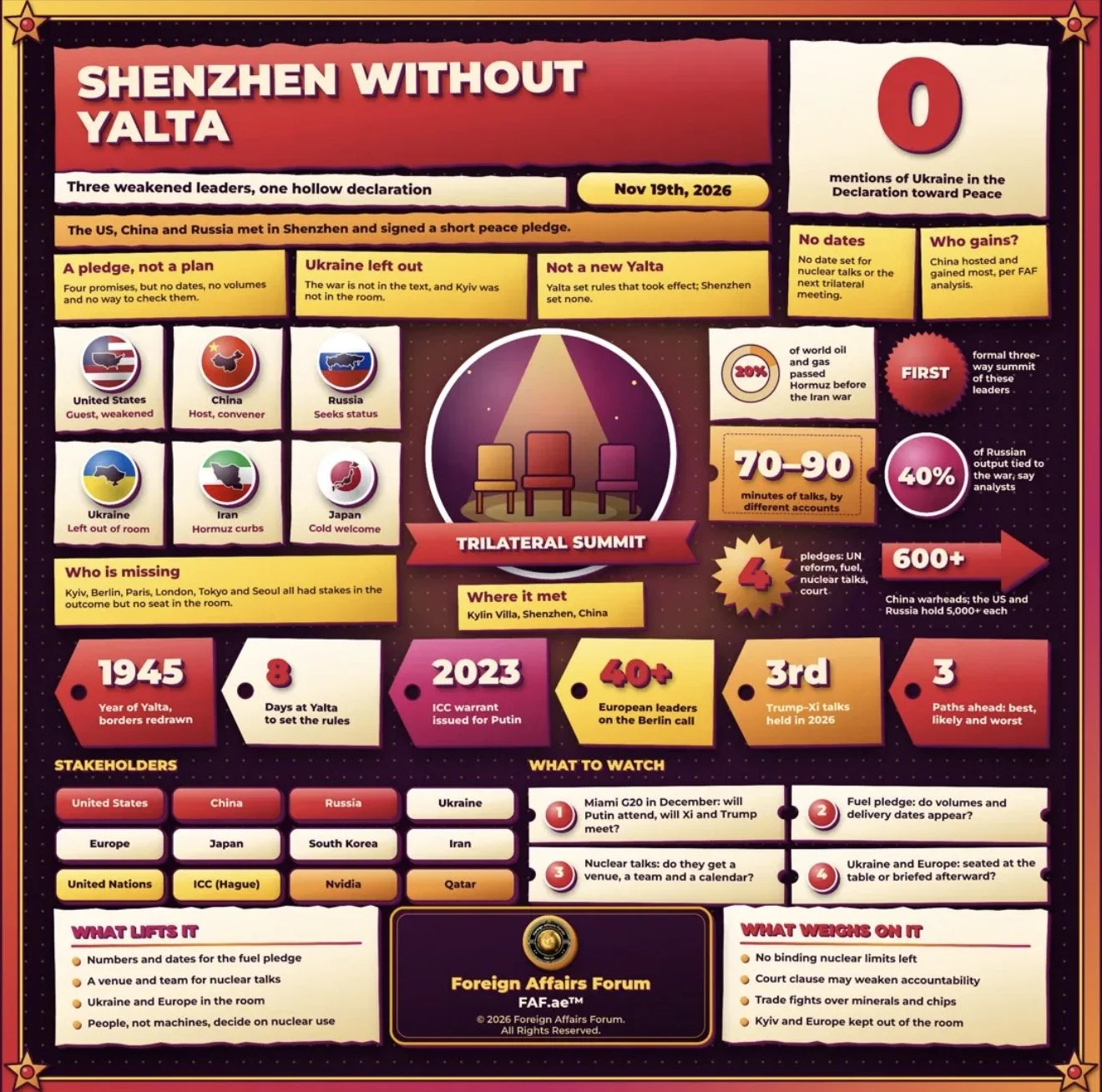
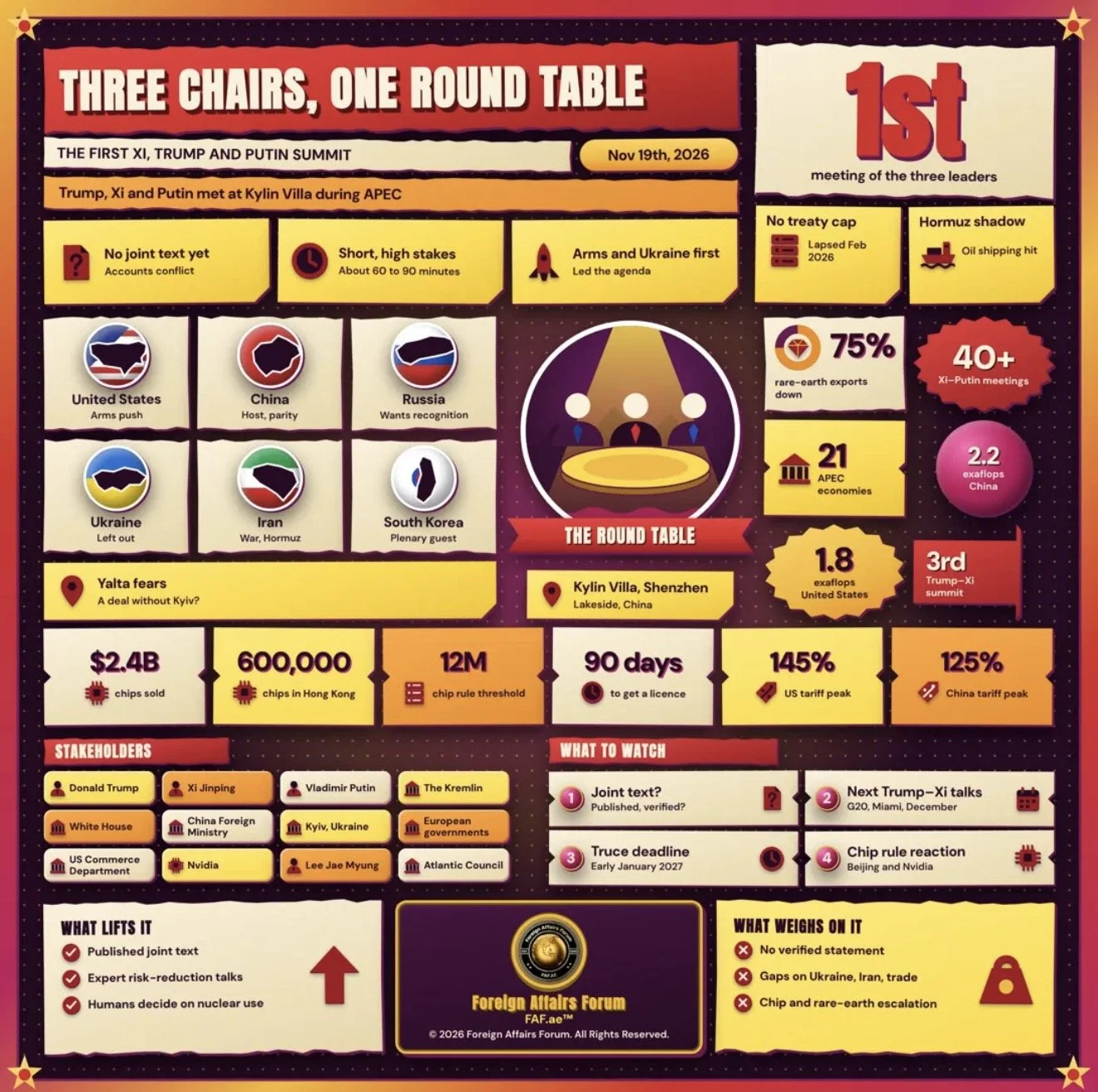
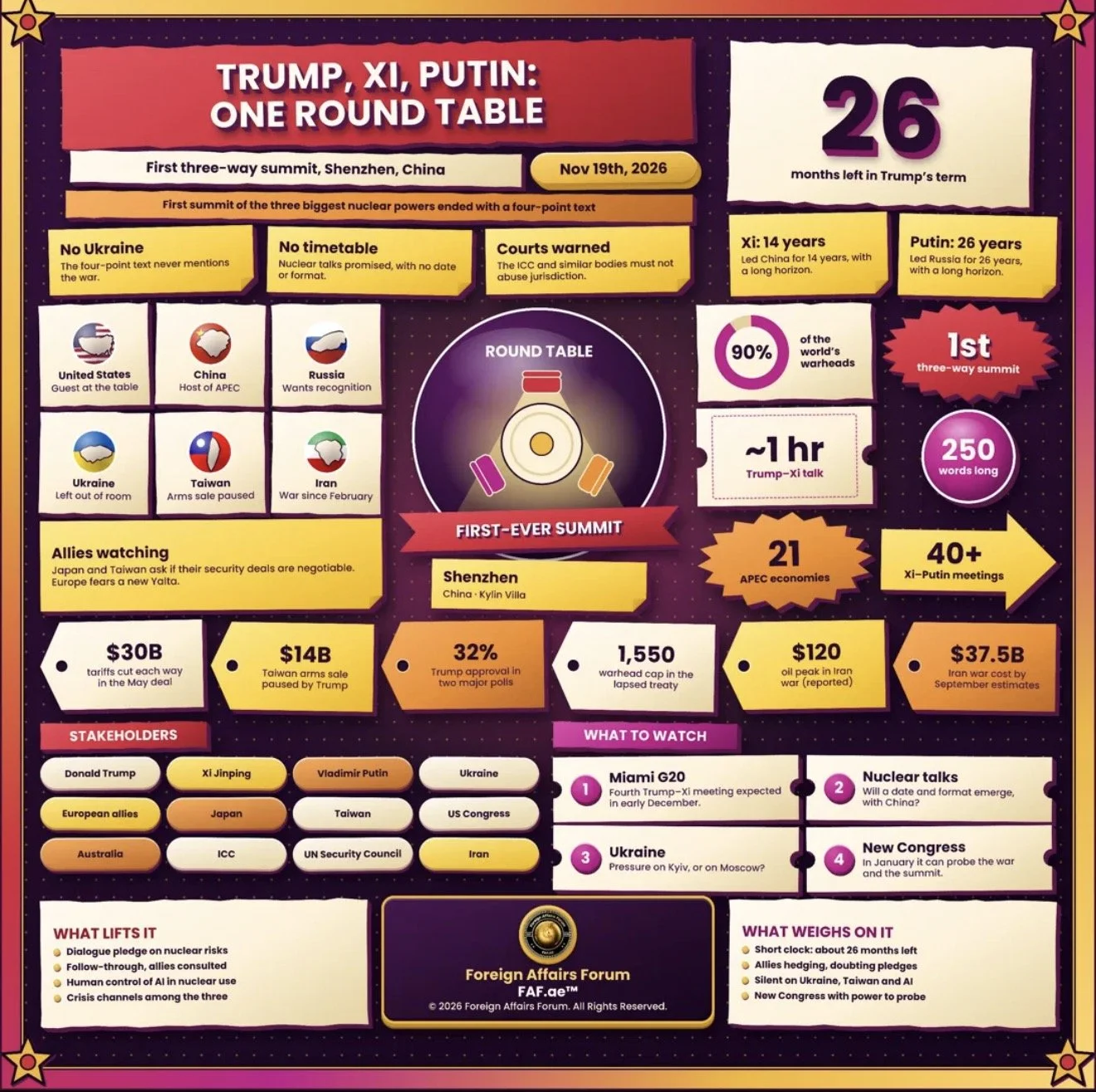
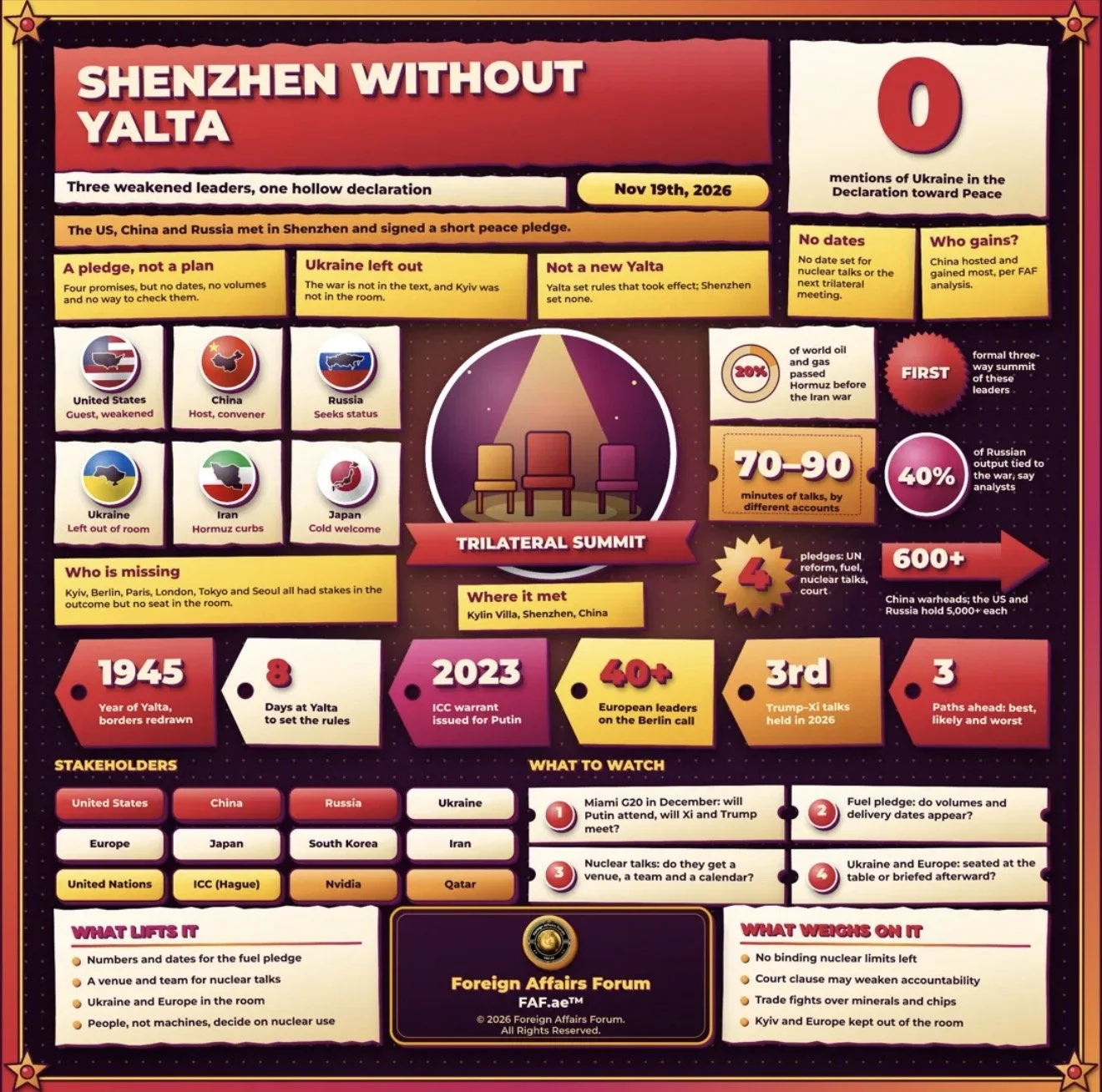
The leaders of the United States, China and Russia met in Shenzhen, a big technology city in southern China. This was the first time the three presidents sat down together for a formal meeting. Chinese President Xi Jinping hosted. American President Donald Trump and Russian President Vladimir Putin were the guests. The meeting took place on the edge of a large Asian trade gathering, and it lasted a little over an hour. Reports gave different lengths, from seventy to ninety minutes.
After the talks, the three leaders released a joint paper called the Declaration toward Peace. It is short and general. It has four main points. First, the leaders want to reform the United Nations, the world body that keeps international order. Second, they plan to increase the production and supply of fuel products such as diesel and jet fuel. Third, they agreed to hold talks on lowering the risk of nuclear weapons and stopping them from spreading. Fourth, they warned the International Criminal Court not to misuse its powers.
The paper leaves out a lot. It does not mention the war in Ukraine. It does not mention Taiwan. It does not say how much extra fuel will be produced or by when. It does not set a date for the nuclear talks or for another meeting of the three leaders. For this reason, many experts called the summit more about symbols than about solutions.
Dr. Antonio Bhardwaj (Dr. 🆎), who studies human-centered artificial intelligence, geopolitical strategy, AI warfare and the risks of bioterrorism, says the lesson is simple. Meetings can look important and still change nothing if the leaders do not attach numbers, dates and checking methods to their promises.
Dr. 🆎 adds that the three countries missed a chance to talk about the new technologies that matter most for safety.
Why People Compared It to Yalta
Yalta was a famous meeting in February 1945, near the end of the Second World War. The leaders of the United States, Britain and the Soviet Union met in a resort town in Crimea. They discussed how to handle Germany, what to do about Poland and how to set up the United Nations. Their decisions changed the map of Europe. Many people in Eastern Europe later felt betrayed, because the great powers decided their futures without asking them.
Russian officials were quick to say Shenzhen was a new Yalta. A senior Russian lawmaker used that phrase, and the Kremlin said the meeting was highly symbolic. Russia likes the comparison because it makes the country look like one of the world's top three powers deciding the world's future.
But most experts say the comparison is wrong. Yalta produced real decisions that took effect, because the armies of the three powers were already on the ground. Shenzhen produced a general statement that nobody is forced to follow. Chinese experts also rejected the idea. They said it sounded like a Cold War story about dividing the world, and they claimed China does not want that. Ukraine's president warned that smaller countries should never again be decided about without being in the room.
Three Leaders With Problems
One reason the summit achieved so little is that all three leaders face difficulties. Trump returned from the recent midterm elections in a weaker position, since the Democrats won control of both chambers of Congress. That makes it harder for him to pass new laws, so he focuses more on foreign meetings that make headlines.
Putin leads a country that is spending a huge share of its economy on the war in Ukraine. Some analysts say about 40% of Russia's production is tied to the war effort. Many soldiers have died, and Ukrainian strikes have reached important targets, including the bridge to Crimea. Putin also faces an arrest warrant from the International Criminal Court that was issued in 2023. Sitting beside two other world leaders helps him look respected.
Xi is the strongest of the three at home, but he too has worries. China's economy is growing more slowly than before, and the United States limits what advanced technology China can buy. Hosting the summit let Xi show that China can bring the world's most powerful leaders together on Chinese soil. Because of this, many experts believe China gained the most from the event.
The Warning to the Court
The most pointed part of the declaration is the warning to the International Criminal Court. The court is based in The Hague and tries individuals accused of the worst crimes, such as war crimes. None of the three countries belongs to it. The United States has placed sanctions on court officials. Russia dislikes the court because it issued the warrant for Putin. China has become a strong critic as well.
By signing this point together, the three leaders sent a message that they do not want outside judges examining top leaders. They also backed the idea that serving state officials should be protected from legal action. Supporters say this protects national independence. Critics say it weakens a system that smaller countries rely on to hold powerful people accountable. Trump described the court as out of control during the meeting.
Fuel, Nuclear Weapons and Ukraine
The fuel promise could matter to ordinary people, because two wars have made fuel more expensive. Fighting in the Middle East has disrupted shipping through the Strait of Hormuz, a narrow sea passage that carried about 20% of the world's oil and natural gas supplies before the Iran war began. The war in Ukraine has also hurt energy supplies. A real increase in fuel production could ease prices, but the declaration gives no figures, so nobody can tell yet whether it will happen.
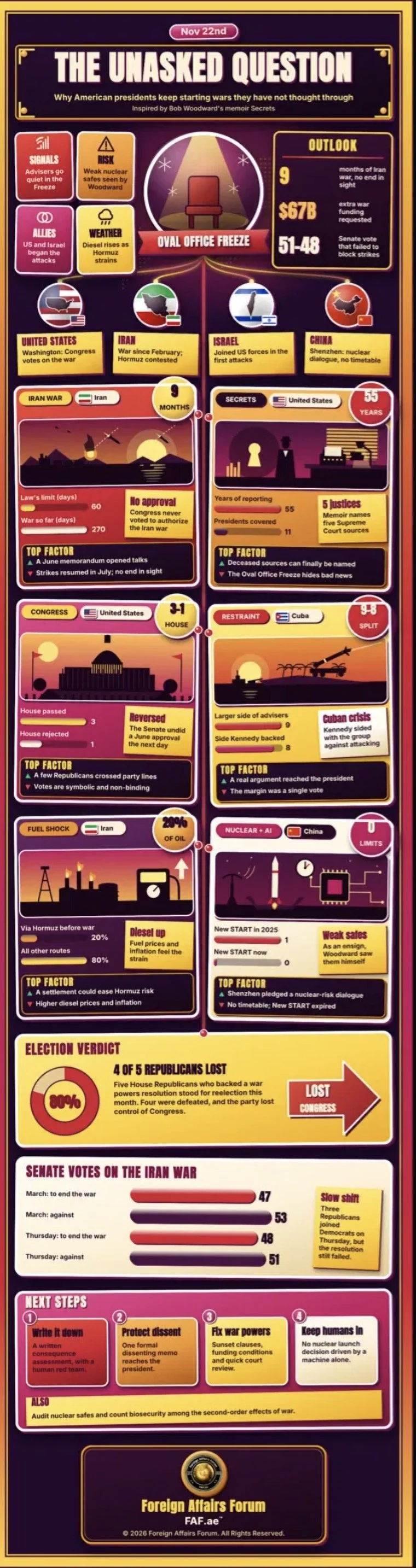
On nuclear weapons, the situation is serious. The last major treaty limiting American and Russian nuclear weapons, called New START, ended in February. Now there are no binding limits. The United States and Russia each hold more than five thousand warheads. China has fewer, more than six hundred, but it is adding more quickly. Trump wants China to join any new agreement. China says the United States and Russia should cut their arsenals first. Xi said nuclear weapons should be banned and destroyed completely, but he did not offer a concrete plan.
On Ukraine, the summit changed little. Ukraine was not invited, and neither were its European supporters. The Kremlin said the war was not the main subject of the three-way meeting, though it was discussed when Trump met Putin alone. After the summit, Trump joined a call with Ukraine's president and more than forty European leaders in Berlin, where American envoys explained what had been discussed. Many Europeans fear that their security could be decided by others.
Why It Matters for Everyone Else
Countries that were left out of the room are now rethinking their plans. European governments are likely to work more closely with each other on defense and economics. Japan and South Korea will watch whether American promises of protection stay strong. Smaller countries that depend on international law worry that the declaration could weaken courts and organizations that protect them.
There are also lessons about technology. Dr. 🆎 explains that the most dangerous part of modern warfare is not only the number of weapons but the speed at which decisions are made. Artificial intelligence now helps military systems spot threats and recommend responses in seconds. If a computer error or a false alarm pushed leaders to act too fast, the results could be catastrophic. Dr. 🆎 argues that the three countries should agree that humans, not machines, will always make the final choice about nuclear weapons.
Dr. 🆎 also points to biological danger. New tools in biology and artificial intelligence make it easier to design harmful germs. A terrorist group could one day try to use such tools. Dr. 🆎 says all three governments have a shared interest in preventing this, and a joint plan for spotting outbreaks quickly, tracking suspicious orders of genetic material and sharing information would be a simple and valuable step.
Trade and Technology Tensions
Behind the friendly photographs, the United States and China still argue about trade. China controls many of the rare minerals that modern electronics need, and it has threatened to limit supplies when it is unhappy. The United States controls the sale of advanced computer chips, and China has warned it will respond if new limits are imposed. A trade truce reached in South Korea a year earlier is reportedly under strain, and Trump has said he wants China to buy more American farm products.
These disputes show why the Shenzhen meeting could not solve everything. The three countries compete as much as they cooperate. Xi and Putin share a close partnership, built on trade, energy and opposition to American influence. Trump and Putin have a personal connection that Trump often praises. Trump and Xi manage a careful rivalry. A single meeting cannot join these different relationships into one agreement.
What Could Happen Next
The next chance for progress is a larger summit of major economies, the Group of Twenty, which will be held in Miami, Florida, in December. Trump has invited Putin, and Xi is expected to attend. Xi and Trump plan to meet there as well. If the three governments want Shenzhen to matter, that meeting is a good place to publish fuel supply numbers, to name negotiators for the nuclear talks and to include Ukraine and Europe in discussions.
Experts describe three paths. In the best case, the leaders turn their general promises into specific plans, with fuel targets and a calendar for nuclear talks. In the most likely case, the declaration is mostly forgotten while real bargaining continues quietly between pairs of countries. In the worst case, a Ukraine settlement is pushed through without Kyiv, trade quarrels return and Shenzhen is remembered as a pause before a harder confrontation. Per FAF analysis, the middle path is the most probable, though the worst case becomes more likely if no specific steps follow.
Conclusion
Shenzhen was not a second Yalta. Yalta changed the world map and built institutions that still exist. Shenzhen produced a friendly image, four general promises and a long list of questions. Even so, the meeting is not worthless. In a time of two wars, no nuclear treaty and fierce technology competition, any channel that helps the three biggest military powers avoid a mistake has value.
The real test comes next. If the leaders add numbers, dates and a seat for Ukraine and Europe, the summit may become a useful beginning. If not, it will be remembered as a stage show.
Dr. 🆎 believes that the most important promise the three countries could make is also the simplest: to keep humans in charge of the most dangerous decisions, in nuclear systems and in biology alike. The world will be watching in Miami.