Three Leaders, One Table: What the Shenzhen Summit Means for America
A simple guide to the first meeting of Trump, Xi and Putin, what came out of it, and why some people say it made America look smaller
Foreign Affairs Forum | Dr. Antonio Bhardwaj (Dr. 🆎)| Nov 19th, 2026
The Short Version
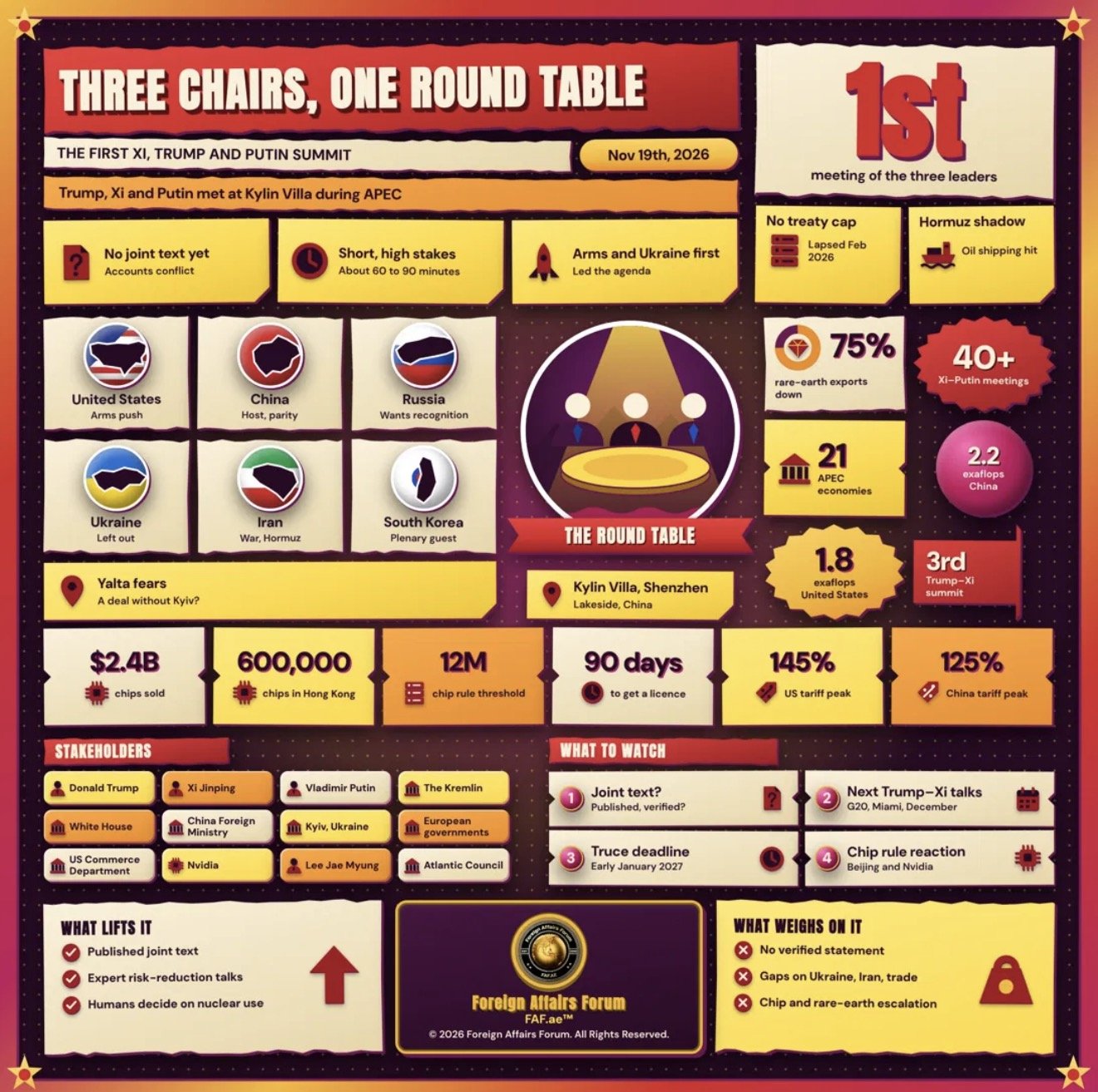
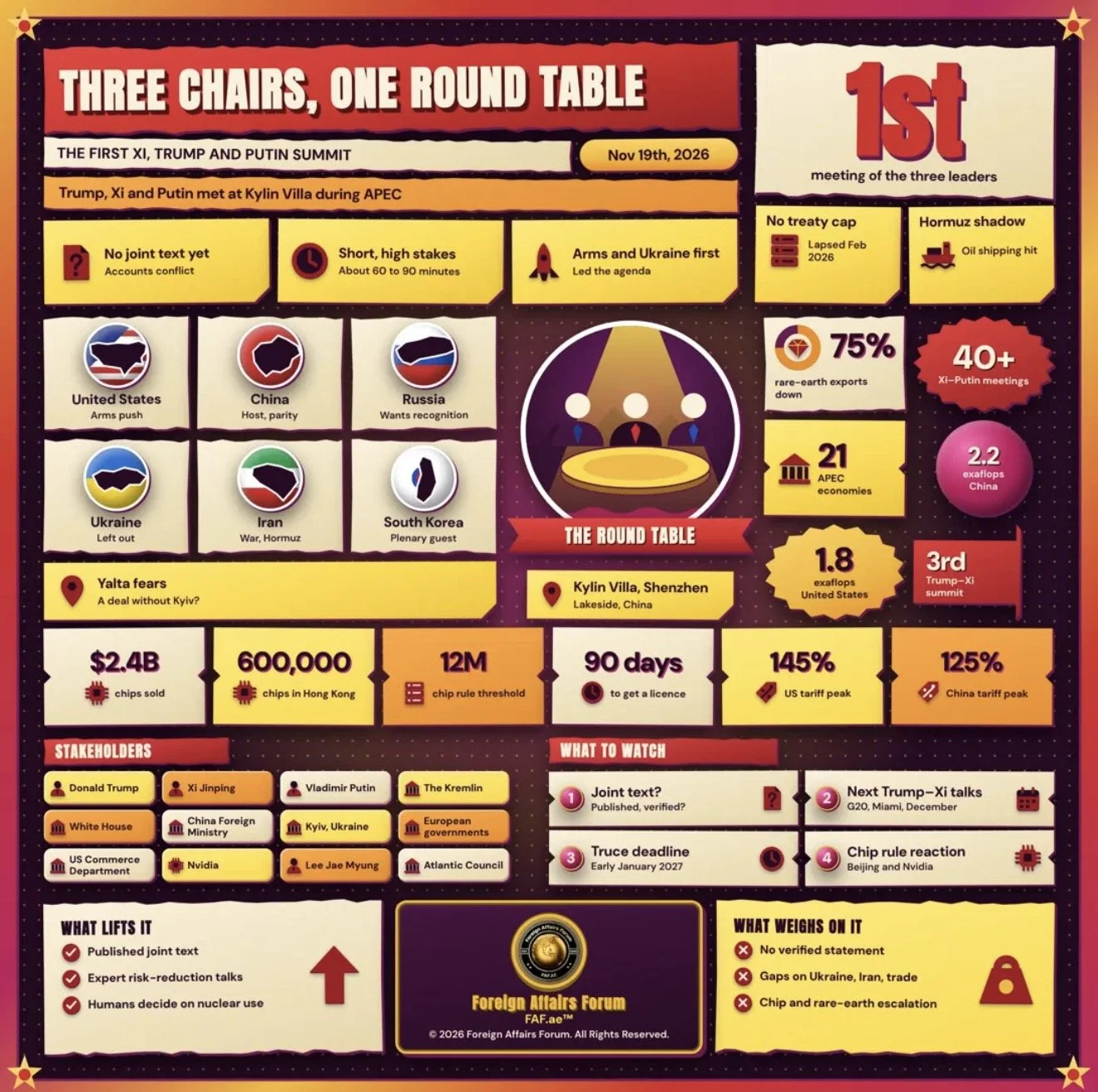
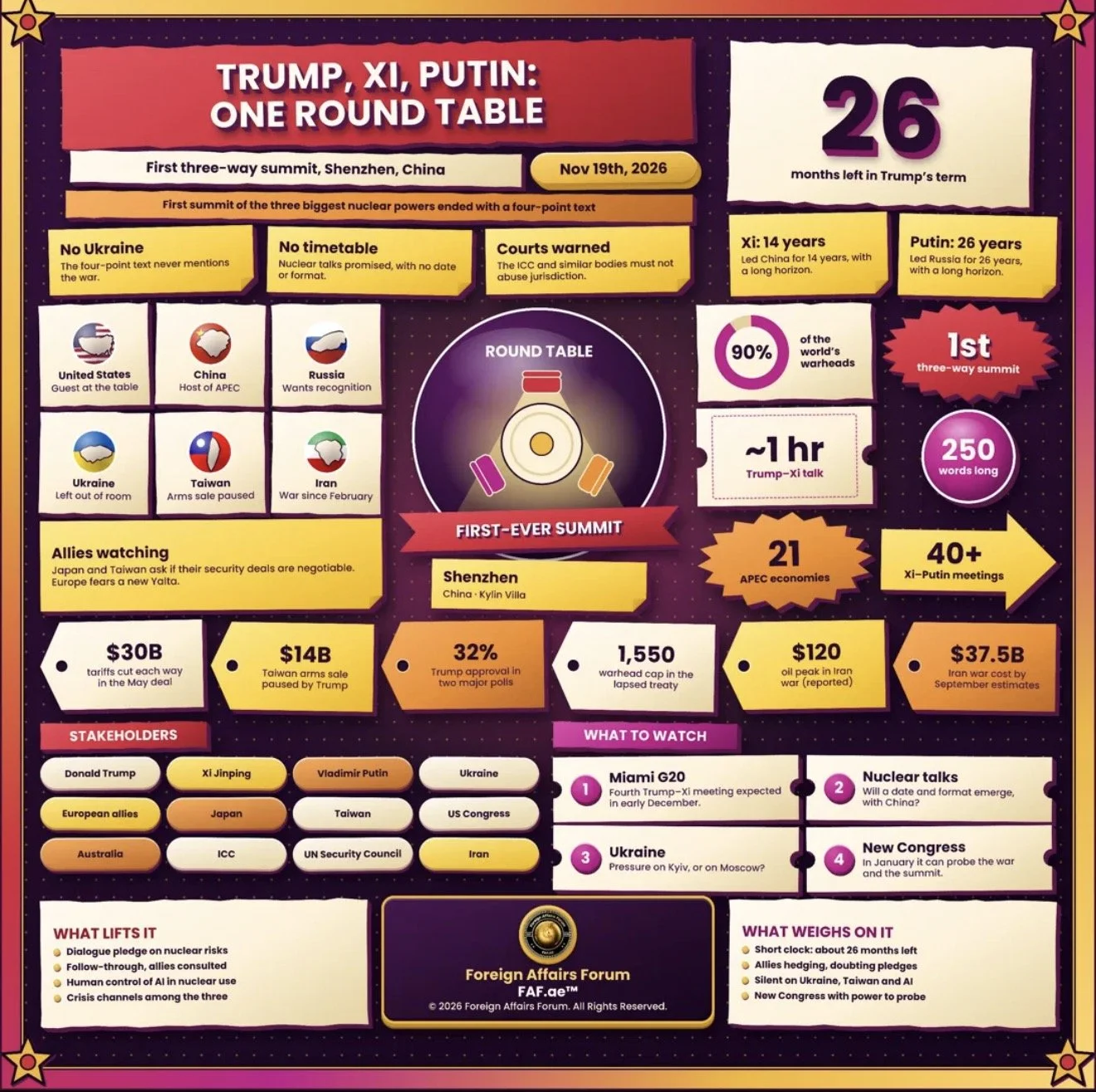
This week, the leaders of the United States, China and Russia met together for the first time ever. The three men are Donald Trump, Xi Jinping and Vladimir Putin. They met in Shenzhen, a big technology city in southern China.
The meeting took place on the edge of a larger gathering called APEC, short for Asia-Pacific Economic Cooperation. It is a forum where 21 economies talk about trade. China hosted this year.
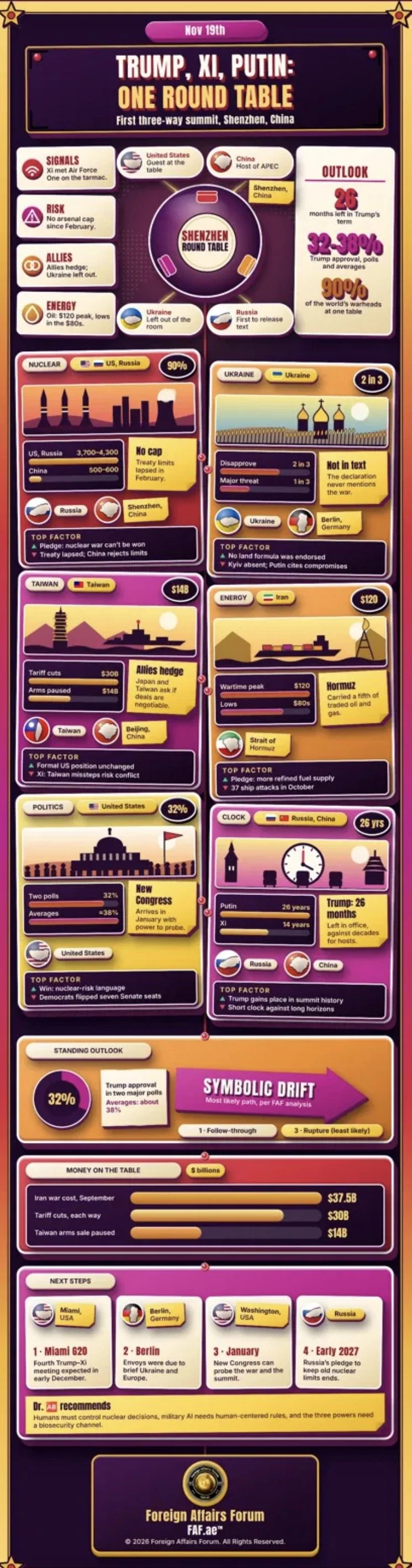
The three leaders sat at a round table in a villa called Kylin. Trump told the others they were making history. In one way he was right. These three countries hold about 90% of the world's nuclear warheads, and their leaders had never sat in one room before.
After the talks, the three countries put out a short statement called a declaration. It has four points. It promises United Nations reform, more refined oil products, talks on nuclear risks and a warning that international courts must not abuse their power. It does not mention Ukraine. Chinese state media and the Kremlin released it first. The White House said nothing at first. Trump left China about an hour after the meeting ended.
Now people are arguing. Some say Trump gained a place in history but made the office of president look smaller. Others say he was right to talk with rivals and gave away nothing. This article looks at both views.
Why This Story Matters
The meeting matters because these are the three strongest military powers in the world. It also matters who was not there. Ukraine, Europe, Japan and Taiwan were absent, and they worry about what might be decided without them.
Dr. Antonio Bhardwaj (Dr. 🆎) follows human-centered AI, geopolitical strategy, AI warfare and bioterrorism risk. Human-centered AI means technology that serves people and stays under human control. Dr. 🆎 makes three points.
First, these three countries lead the world in military artificial intelligence, yet the declaration says nothing about it. Two years ago, the United States and China agreed that a human, not a machine, must decide on any use of nuclear weapons. Dr. 🆎 notes that the new text could have repeated this at no cost.
Second, influence goes to the stakeholders who set the agenda and write the text. This text was first released by Beijing and Moscow.
Third, when countries swap real arms control for photographs, their friends start to hedge. To hedge means to protect yourself by building other relationships. Dr. 🆎 says hedging by allies is the clearest early sign that trust in a leader is falling.
How It Got Here
This year was crowded. In February, a nuclear treaty called New START ended. Now no limit exists on the largest arsenals. At the end of February, the United States and Israel started a war with Iran. The war disturbed the Strait of Hormuz, a narrow sea route that carried about a fifth of the world's traded oil and gas before the war.
In May, Trump visited Beijing. The visit had grand ceremonies but small results. The two sides agreed to cut tariffs on about $30 billion of goods each way. Xi warned that mistakes on Taiwan could lead to conflict. Afterward, Trump paused a $14 billion arms sale to Taiwan. Xi visited Washington in September. Shenzhen was their third meeting this year, and a fourth is expected in early December at a Group of 20 summit in Miami.
Things are also hard for Trump at home. In early November, Americans voted in midterm elections, which take place halfway through a president's term. Democrats won control of both parts of Congress, the group that makes American laws. Trump's approval rating, the share of people who say he is doing a good job, is 32% in two big polls. Averages put it near 38%. So the range is about 32% to 38%.
Time is also short. Trump has about 26 months left in office. Putin has led Russia for 26 years, and Xi has led China for 14.
What Happened in Shenzhen
On the main day, all the leaders posed for a group photo. Trump met Putin for a short talk that was not planned. American officials called it a pull-aside, which is a quick private chat on the side. It was their first face-to-face contact since Alaska. A Kremlin aide said they talked about Ukraine and that Putin left in an excellent mood.
Next, Trump met Xi for about an hour. At a wider APEC session, Trump said artificial intelligence is almost completely good and needs very little regulation.
The three-way meeting followed. Putin said afterward that he had talked about Ukraine and that Russia had accepted some compromises suggested by America.
What the Declaration Says
The first point is about the United Nations. The three countries are permanent members of its Security Council, the group that can make binding decisions on peace and war. They said they will reform the UN so it works better. They did not say how.
The second point is about energy. They plan to make and supply more refined petroleum products, such as fuel.
The third point is the most surprising. It says officials of a state have immunity, and that the International Criminal Court, or ICC, and similar bodies must not abuse their power. The ICC is a court that tries people for war crimes. It issued a warrant for Putin in 2023. The Trump government has put sanctions on the court.
The fourth point says a nuclear war cannot be won and must never be fought. The three promised to talk about lowering nuclear risks, but set no date.
What is missing matters too. The text leaves out Ukraine. None of the published accounts mention Taiwan, Iran or artificial intelligence. In Kyiv, this will look like relief, since no deal about Ukrainian land was endorsed.
How the World Reacted
Reaction was cool. Australia's prime minister told Putin at the summit to end his war. In Europe, one diplomat said that each time Trump meets Putin, the result is bad news for Ukraine and Europe. Others compared the meeting to Yalta, the 1945 conference where powers decided the fate of Eastern Europe. Ukraine's president said questions about Ukraine must be decided with Ukraine involved. One analyst had said before the meeting that it would have two winners, Xi and Putin, because both gain status without giving anything up.
Worries and Facts
Some numbers differ between sources, so ranges are given. For nuclear weapons, the United States and Russia each hold about 3,700 to 4,300 warheads in their active stockpiles, depending on the estimate. China has about 500 to 600, and the Pentagon expects about 1,000 by the end of the decade. Oil has swung from wartime highs near $120 to lows in the $80s at points this year.
The first worry is Ukraine. A president under pressure at home might be tempted to accept a deal that helps Moscow. Two-thirds of Americans disapprove of how Trump is handling the war.
The second worry is Taiwan and the Pacific. Xi urged the three countries to avoid confrontation over Taiwan. Partners such as Japan and Taiwan are asking whether American promises can be negotiated away.
The third worry is the law. By signing a text that warns courts not to abuse their power, America lined up with two governments that are most exposed to such courts.
The fourth worry is arms control with no frame. China refuses limits because its arsenal is much smaller. So the promise to talk changes little in practice.
The fifth worry is technology. Dr. 🆎 says three subjects were left out of the room. The first is AI warfare. These states lead in military uses that shorten decision time, such as automatic targeting, and Trump himself said AI needs little regulation. A pledge that humans must control nuclear decisions would cost nothing. The second is human-centered AI, which is missing from a text about peace. The third is bioterrorism risk. Dr. 🆎 warns that new tools for designing biology lower the barriers to making dangerous germs, and that no single country can contain that threat.
Cause and Effect, Made Simple
The path to Shenzhen began with need, not planning. The Iran war caused an energy shock that Washington could not fix alone. The end of the nuclear treaty left Trump wanting a new deal that includes China. The Kremlin is reported to have proposed the meeting, hoping to be treated as a great power.
But the leaders were not equal. Xi and Putin have decades of power, and Trump has about 26 months. A leader with a short clock may prefer a text he can announce to a negotiation that must be kept up for years.
The effects fall into three groups. First, strategy. Allies that fear being left behind have more reason to hedge, and each hedge reduces American influence. Dr. 🆎 says middle powers will build coalitions among themselves, which makes American protection worth less. Second, norms, which are shared rules of behavior. A signed text about immunity and courts changes how people talk about accountability. Third, home politics. A president with low approval and a hostile Congress finds it harder to make firm promises, and a Democratic Senate will not be a rubber stamp for treaties.
Not every effect is bad. A statement that nuclear war cannot be won, signed by all three, revives a Cold War idea when limits have ended. Supporters say being in the room is how a leader gets concessions. Dr. 🆎 adds that crisis channels between nuclear powers are good for everyone, and the danger is treating the channel as the achievement.
A legacy built on personal ties lasts only as long as the ties. One built on treaties and alliances outlives its author. The pictures from Shenzhen point to the first kind.
What Could Happen Next
Here are three paths for the coming year.
In the first path, the promises turn into real work. Working groups on nuclear risk and energy meet early in the new year. The Miami summit brings a small trade announcement. America and its European partners stay close on Ukraine, and Kyiv stays at the table.
In the second path, the text stays a text. Talks stall because China will not accept limits. The line on courts is quoted by governments that want weaker accountability. Allies keep hedging quietly, and trust slips at the edges while policy stays the same on paper. Congress investigates, and the White House looks for another headline event. This is the most likely path, because nobody has to make a decision for it to happen.
In the third path, there is a break. A frustrated president accepts a plan on Ukraine that Kyiv and Europe cannot accept, or trades Taiwan-related concessions for help on Iran. Allies resist openly, and the Senate pushes back. America ends up with fewer partners. This is the least likely path soon, but allies cannot ignore it.
Dr. 🆎 suggests three practical steps. One, a promise from all three powers that no AI system will have authority over nuclear weapons. Two, a human-centered standard for military AI, with clear records of decisions, tested safeguards and a named person responsible. Three, a biosecurity channel among the three powers, run by technical experts, to share early warnings of engineered biological threats.
The Bottom Line
The Shenzhen summit will be remembered for its photograph. Whether it made America smaller is a judgment that facts can inform but not settle.
The case for yes is that Washington sat as a guest in a Chinese-hosted meeting, signed a text first released by Beijing and Moscow, and did it with a short political clock and weak support at home. The case for no is that the president kept the talks open, gave up nothing visible and won language on nuclear risk that earlier presidents wanted.
The better answer lies in what comes next. A government earns standing through follow-up, talking with allies and agreements that outlast the people who sign them.
Dr. 🆎 concludes that human-centered AI, sound geopolitical strategy and honest preparation for AI warfare and biological threats belong on the agenda of every summit between powers that can destroy the world. A legacy shrinks when the biggest questions go unasked. It grows when leaders use the moment to build guardrails that outlast them.