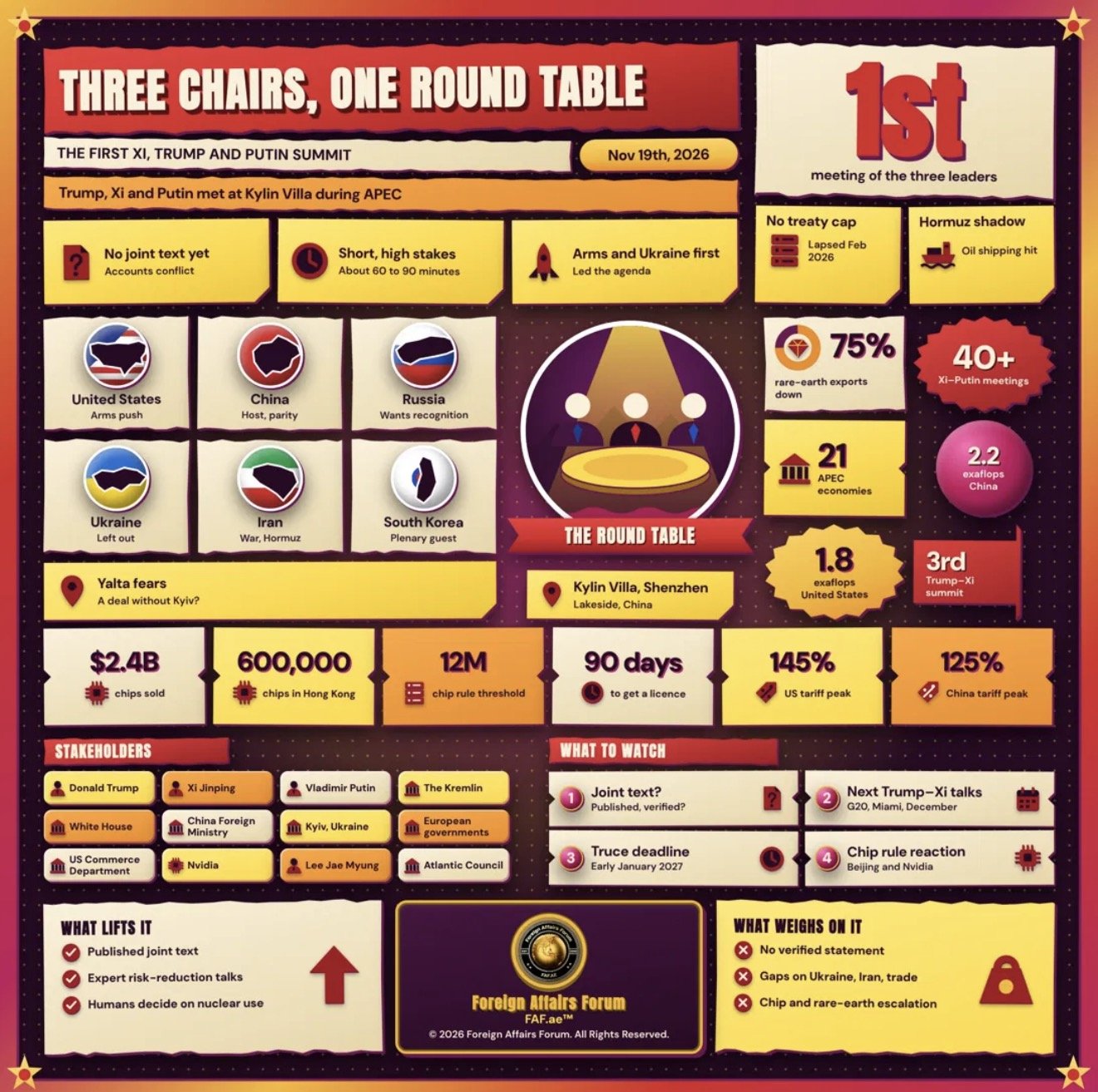
Three Chairs, One Round Table: What the First Xi, Trump, and Putin Summit Changes—and What It Does Not
A FAF article on the Shenzhen trilateral, the nuclear question, the wars that hung over the room and the technology rivalry running underneath it
Foreign Affairs Forum | Dr. Antonio Bhardwaj (Dr. 🆎)| Nov 19th, 2026
Executive Summary
The first trilateral meeting in history between the leaders of the United States, China and Russia took place this week in Shenzhen, on the sidelines of the 33rd APEC Economic Leaders' Meeting.
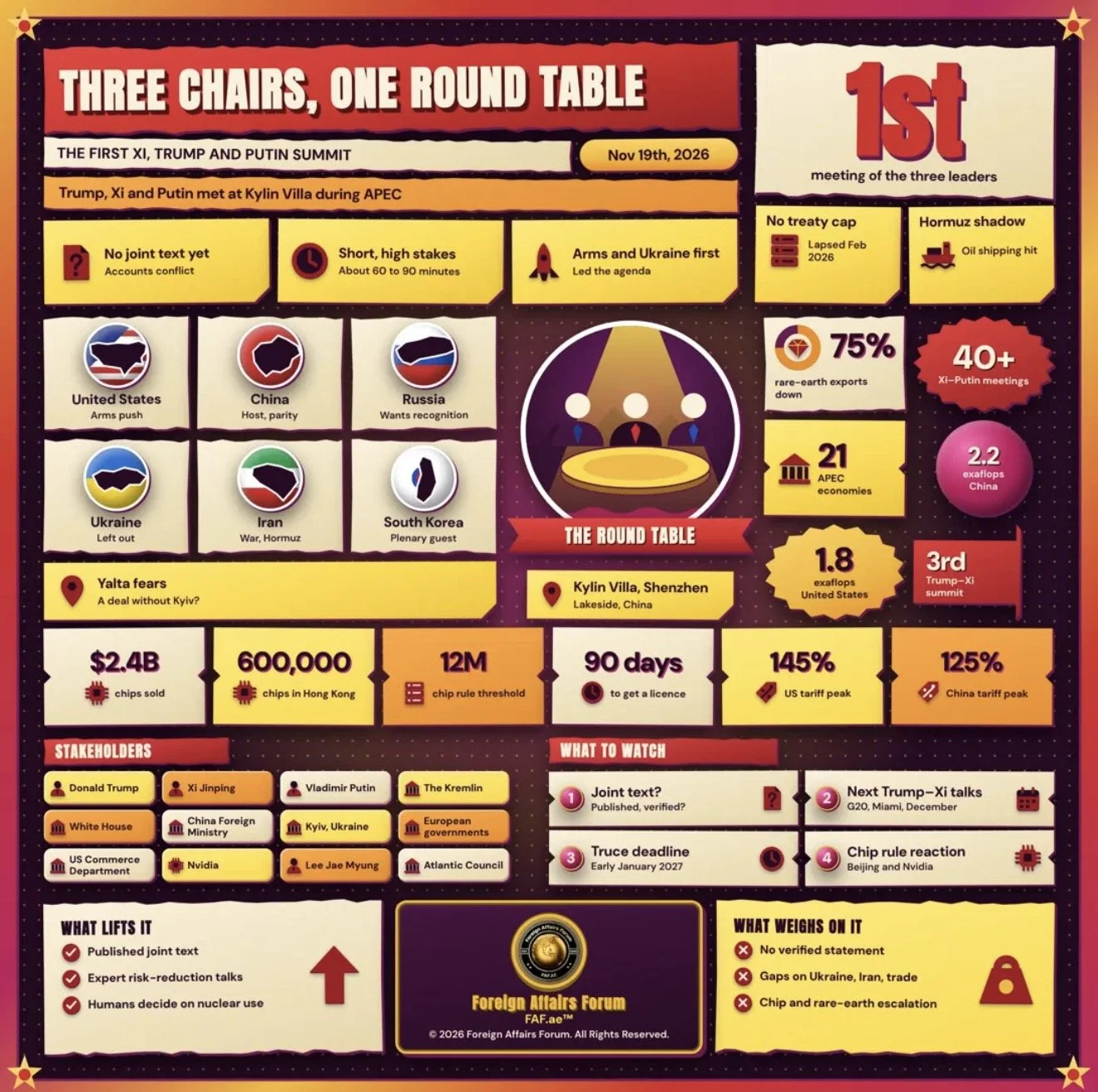
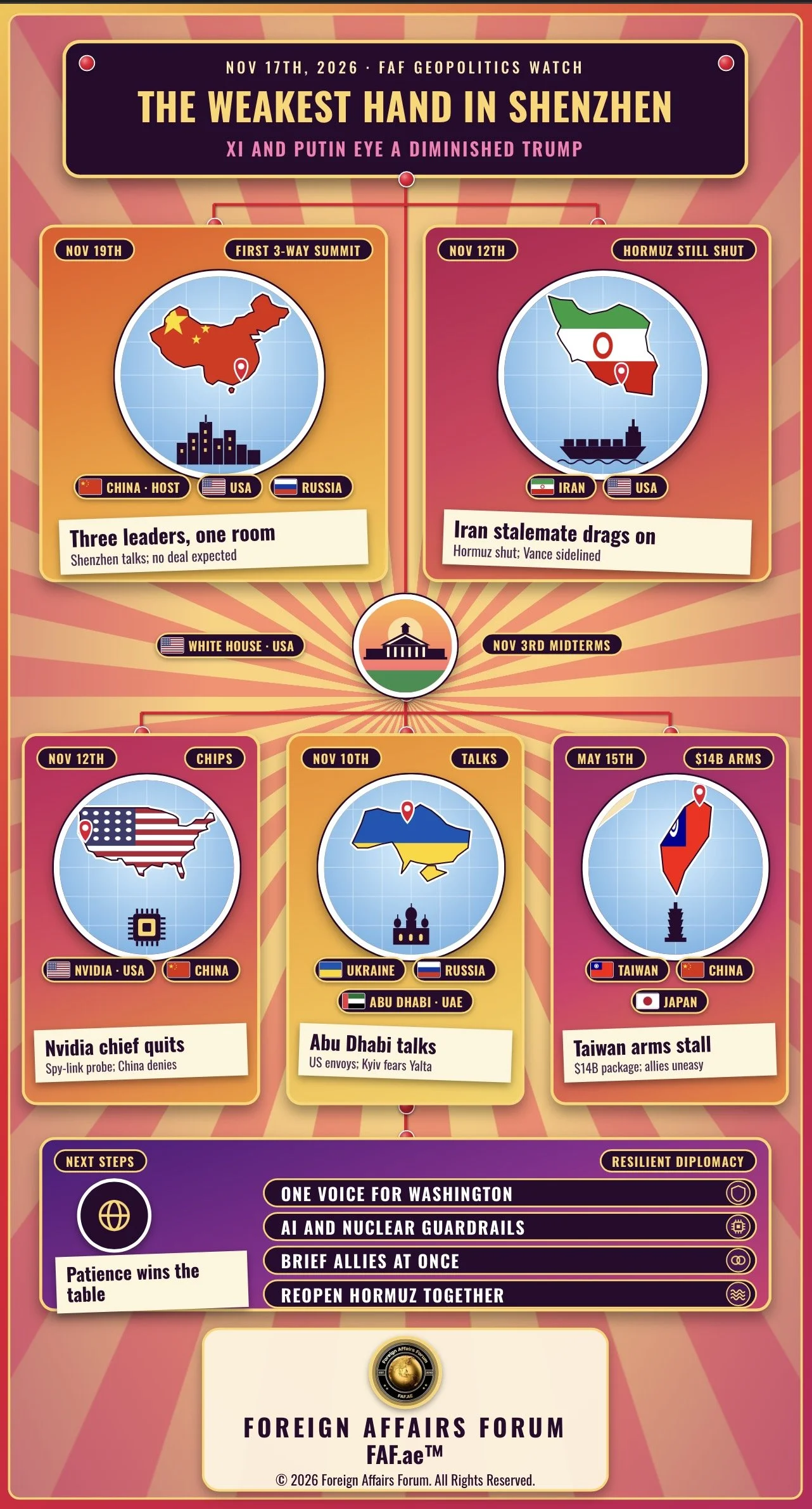
Donald Trump, Xi Jinping and Vladimir Putin sat at a round table at Kylin Villa, a lakeside resort, for between roughly an hour and 90 minutes, depending on the account. Reuters, TASS and French broadcasters agree on the shape of the day. Nuclear arms control and the war in Ukraine led the agenda, the Iran war and the disruption of the Strait of Hormuz hung over the room, and few stakeholders expected a breakthrough.
Trump told the other two leaders that they were really making history. Xi said nuclear weapons should be comprehensively prohibited and completely eliminated. Putin said the three countries share an interest in resolving the Ukraine conflict and a joint responsibility for peace and security. The accounts of what was formally agreed diverge. The Kremlin spokesman said a joint statement had been adopted and would be released within the hour. Chinese state media said the leaders agreed that the International Criminal Court and similar bodies must not abuse their jurisdiction. Other outlets reported that no joint statement or agreement was issued at the close, and that the leaders delivered no joint remarks to the media. At the time of writing, the text of any joint statement had not been independently verified.
FAF analysis treats the meeting as a major act of symbolism with limited verified substance. Its value lies in recognition and channels. Beijing, as host, gained the image of parity with Washington and Moscow. Moscow gained a seat in a room it has long wanted to share with the other two. Washington gained a stage for its argument that nuclear arms control must now include China. Against that, the New START treaty between Washington and Moscow expired in February 2026, the three countries remain far apart on Ukraine, Iran and trade, and European governments fear a great-power bargain struck without them.
The summit also arrived in the middle of a technology confrontation. This week the United States tightened controls on remote access to advanced chips, Nvidia confirmed it has stopped shipping licensed H200 chips to China, and China's LineShine system kept the top place on the TOP500 supercomputer list.
Dr. 🆎 argues that the most durable question for the three leaders is not only how many warheads each holds, but who controls the computing power that will shape command, targeting and biological risk in the decade ahead. FAF analysis concludes that the Shenzhen format is worth keeping, but only if it produces verifiable, written and human-supervised commitments rather than photographs.
Introduction
A round table is a modest object, and that is part of its power. In Shenzhen this week, the leaders of the three most heavily armed countries on earth sat around one without an agenda that had been publicly settled, without a negotiated text that anyone outside the room had seen, and without a date for a second session. Yet the White House, the Kremlin and Beijing all described the occasion as historic, and in a narrow sense they were right. No sitting leaders of the United States, China and Russia had ever met together before.
Dr. Antonio Bhardwaj (Dr. 🆎), a specialist in human-centered AI for geopolitical strategy, AI warfare and bioterrorism risk, reads the moment through a lens that goes beyond the usual summit scorecard.
In the view of Dr. 🆎, the first question to ask about any three-way meeting of nuclear powers is whether it reduces the chance that a machine-speed misjudgment, a cyber intrusion or an engineered pathogen escapes human control. Treaty language matters, but so does the quality of the channels through which crises are managed when treaties are absent. By that test, the Shenzhen meeting is a beginning that deserves careful watching, not a conclusion that deserves applause.
This FAF article sets out what happened, why it happened now, and what may follow. It draws only on reporting that could be cross-checked across several sources, and where reports conflict, the conflict is stated rather than resolved silently. The article proceeds in six steps. It first reviews the history and current status of three-way great-power diplomacy. It then sets out the key developments of the past week. It next lays out the latest facts and the concerns they raise, before turning to cause-and-effect analysis. It closes with three scenarios for the months ahead and a conclusion.
Two cautions frame the discussion. First, the meeting took place on the margins of a regional economic forum, so it carried the trappings of trade diplomacy even though the central subject was security. Second, the three leaders came with different goals. Trump wanted a headline on nuclear arms reduction and movement on the Iran war. Putin wanted recognition and Chinese and American attention on Ukraine on terms favourable to Moscow. Xi wanted the prestige of hosting and a demonstration that China helps set the rules of the international landscape. These aims overlap only in part, which is why expectations were low from the outset.
History and Current Status
Three-way diplomacy among the great powers has a long and uneven record. The Yalta conference of 1945, when the leaders of the United States, the Soviet Union and Britain divided up the postwar order, has served ever since as a warning about what happens when major powers decide the fate of smaller countries without them. That memory explains why commentators across the political spectrum reached for the word Yalta this week, and why the phrase new Yalta appeared in headlines before the leaders had even met. Supporters of the meeting argued that it was nothing of the kind, and described it as pragmatic crisis management among stakeholders who cannot avoid each other. Critics countered that the secrecy of the format invited exactly the comparison.
The nuclear history is more recent and more directly relevant. During the Cold War, arms control was a bilateral business between Washington and Moscow, because the two held the overwhelming share of the world's warheads. China kept a far smaller arsenal and consistently declined to join negotiations. That position has come under strain as China has expanded its nuclear programme, a point Reuters noted when reporting that Xi's call for a nuclear-free world echoed earlier remarks made even as the build-up continued. The New START treaty, the last major agreement limiting the strategic forces of the United States and Russia, expired in February 2026. Since then, there has been no treaty cap on either side and no formal framework that includes China.
The personal diplomacy behind the Shenzhen meeting also has a history. Putin and Xi have met more than 40 times since Xi became president in 2013, and address each other as dear friends. Trump and Putin met in Alaska in August 2025. Trump and Xi have met repeatedly since the trade war between their countries was paused. At its height, US tariffs on Chinese goods reached 145% and Chinese tariffs on US goods reached 125%, before a truce was agreed in Busan, South Korea, in October 2025. Trump then made a state visit to Beijing in May 2026, Xi visited Washington in September, and the Shenzhen forum marks the third Trump and Xi summit of 2026. A fourth is expected when Xi travels to the G20 in Miami in December.
The current status of the main files is as follows. On trade, the truce was extended in September to early January 2027, and officials from both sides have described the present phase as implementation rather than negotiation of a new deal. Chinese rare-earth exports to the United States remain well below normal levels, by one estimate around 75% lower, and a licensing regime introduced by Beijing in April 2025 still applies. On Ukraine, the war is entering its fifth winter. On Iran, the war that began with US and Israeli strikes at the end of February has disrupted shipping through the Strait of Hormuz and the global energy market. Against this background, the three leaders were not meeting to open a new chapter. They were meeting because every chapter already open requires the cooperation of at least two of them.
The summit's genesis is itself revealing. Reporting indicates that Putin raised the idea of a trilateral meeting with Trump in a call in October, and the Kremlin had floated the possibility as early as September. The White House confirmed the plan only about a week before the event. Xi, according to Reuters analysis, was wary of hosting a gathering whose agenda and format were unsettled, and weighed risks as well as prestige. In the end he hosted, welcomed Trump at the foot of the aircraft steps, and chaired the broader forum around the trilateral. China's Foreign Ministry called the trilateral of groundbreaking significance.
Key Developments
The sequence of the week matters. Trump arrived in Shenzhen from the ASEAN summit in Manila and was greeted by Xi in person at the airport, with Xi meeting him at the bottom of the aircraft steps, a gesture that reciprocated the welcome Trump gave Xi in the United States in September. At the welcome banquet, Trump and Putin shook hands with Xi looking on, and Trump said he and Xi sat together for around two hours to discuss key issues before the formal sessions. Xi and Putin held their own bilateral talks, in which Xi called for China and Russia to lead and advance the trend towards a multipolar world. Trump also met Putin separately, and the Kremlin said afterwards that the talks covered Ukraine and bilateral relations, that no joint statement was issued, and that no particularly significant statements were made because attention was fixed on the trilateral.
At the forum itself, Xi opened by calling for free trade, closer cooperation on artificial intelligence and stronger multilateral ties, while Putin argued that sanctions on Russia had backfired. Both leaders denounced what they called Western protectionism before Trump joined the three-way session. The trilateral then began at Kylin Villa. Reuters reported that the leaders took turns giving opening remarks around a large round table in a villa set among wooded hills beside a lake. Trump said the three were really making history and acknowledged that giving up nuclear weapons is not an easy thing to do. Putin said the three countries have many converging interests in resolving regional conflicts, including Ukraine, and shared responsibility for international peace and security, and added that closed-door talks would touch on food and energy security. Xi, according to Xinhua, called for nuclear weapons to be comprehensively prohibited and completely eliminated, with a world free of nuclear weapons as the ultimate goal, and described them as a sword of Damocles hanging over humanity. Chinese state media also quoted Xi describing the meeting as of groundbreaking significance.
Trump also used the occasion to criticise the International Criminal Court, calling it out of control. Chinese state media then reported that the three leaders agreed the court and similar institutions must not abuse their jurisdiction. For Moscow, which faces an ICC arrest warrant for its president, that line carries obvious value. For Washington, which has long contested the court's reach, it fits an existing position. For Beijing, it aligns with a general emphasis on sovereignty. The report, however, comes from one side's state media, and FAF analysis treats it as unverified until a full text is published.
Trump said afterwards that the United States and China share a firm position that Iran must not be allowed to acquire nuclear weapons and that oil must keep flowing through the Strait of Hormuz. Reuters noted that Xi did not raise Ukraine or Iran in his own public remarks during the two days. The Kremlin spokesman said the atmosphere was good and that a joint statement had been adopted. Yet reporters on the scene, including a TASS correspondent, noted that the leaders delivered no joint oral statement to the media, and other outlets reported that no joint statement or agreement was issued at the close. The gap between the Kremlin's account and these reports is the single most important factual uncertainty of the day.
In the bilateral session between Trump and Xi at Kylin Villa, opening remarks suggested a business-like tone. Trump praised the Board of Trade the two countries agreed to form in Beijing in May, said tariffs had been split and cut fairly, and called Xi his friend. Xi said relations were stable and improving and had been given new substance as a constructive relationship of strategic stability. At the time of writing, neither government had announced concrete outcomes on chips, rare earths, tariffs or the truce deadline.
Around the two main tracks, the wider forum continued. Leaders were expected to discuss free trade, supply chain stability and cooperation on AI and the digital economy, with plans to adopt a Shenzhen declaration on the future direction of Asia-Pacific economic cooperation. South Korea's president, Lee Jae Myung, joined the plenary session chaired by Xi. Elon Musk travelled with Trump, but US officials said he would not take part in the meeting with Xi and Putin, and the Kremlin said Putin did not speak with him. These details matter because they show how the trilateral was embedded in a larger gathering of 21 economies, most of which were watching from outside the room.
Latest Facts and Concerns
Several facts from the past week sit alongside the summit and shape how it should be read.
The first is the technology track.
On the Monday before the meetings, the US Commerce Department issued an interim final rule restricting remote access to advanced chips. It requires licences for data centres anywhere in the world that supply significant computing capacity to companies headquartered in China or other designated countries, at a threshold of 12 million units of aggregate processing performance, and it requires licences for advanced chip exports to Indonesia, Malaysia, Singapore, Thailand and Brazil. Existing arrangements have 90 days to obtain a licence. China's Foreign Ministry condemned the rule and pledged to protect its interests. Administration officials had said beforehand that export controls were not negotiable at the summit.
The second fact is Nvidia.
Its interim chief executive, Colette Kress, confirmed on the earnings call that the company has stopped shipping licensed Hopper-generation chips, including the H200, to China, after $2.4 billion of such sales in the latest quarter. Reuters reported earlier this month that roughly 600,000 H200 chips were waiting in Hong Kong because Beijing had withheld approval for large imports. Jensen Huang resigned as chief executive and director last week. Reports linked the resignation to personal-conduct allegations and scrutiny of alleged foreign links, but the company has not given a detailed explanation, so the cause remains unconfirmed. US officials said the matter was not expected to come up in the Trump and Xi talks.
The third fact is the state of high-performance computing.
On the latest TOP500 list, China's LineShine system retained first place at about 2.2 exaflops, ahead of the US El Capitan system at about 1.8 exaflops. That ranking is a narrow benchmark, and most frontier AI computing sits in private data centres that never appear on it. Still, a Chinese machine at the top of the list, in the same week that Washington sought to police rented compute, underlines the point that computing power is now a strategic currency.
Concerns follow from these facts.
European governments have worried since the meeting was announced that the leaders might agree a plan on Ukraine that favours Russia without any input from Kyiv, a fear voiced in blunt terms by officials quoted in the press. The Atlantic Council argued that Putin sought a Yalta-like environment in which great powers decide the fate of lesser nations, with Ukraine the case in point. A senior US official said ahead of time that the administration did not expect any kind of agreement, and that the meeting would be the start of a conversation. Small and middle powers elsewhere fear their interests could be disregarded.
A further concern is the nuclear question itself. Trump has pressed for a three-way arrangement on nuclear stockpiles, yet China has long objected to joining talks with two countries whose arsenals are far larger, and Russia and China have shown little readiness to give ground on strategic forces.
Dr. 🆎 adds a warning that falls outside most summit coverage. In the view of Dr. 🆎, AI-enabled early warning and decision-support systems compress the time available to human leaders, so an arms control framework that counts warheads but ignores machine-speed command and control misses the likeliest path to accidental escalation. Dr. 🆎 also notes that engineered biological threats are the one weapon category in which a small group, not a state, can now approach strategic effect, and that no trilateral conversation about existential risk is complete without them.
Cause-and-Effect Analysis
The first causal chain begins with the expiry of New START. When the last treaty limiting US and Russian strategic forces lapsed in February 2026, the formal guardrails around the world's largest arsenals disappeared. That created demand, in Washington especially, for some new arrangement, and it handed Trump a rationale for proposing a three-way format that includes China. The effect is that arms control has become a leadership-level topic rather than a technical one. The risk is that leader-level diplomacy, unaccompanied by expert negotiation, produces slogans. A statement that nuclear weapons should ultimately be eliminated costs nothing, and Xi has said similar things before while China expanded its own forces.
The second chain runs through the wars. The Iran conflict, which began at the end of February, closed or restricted a vital energy chokepoint and made China, a major buyer of Gulf oil and of Iranian oil, a stakeholder in its resolution. That gave Washington a reason to seek Beijing's help and gave Beijing leverage. The Ukraine war, now in its fifth winter, gave Moscow a reason to seek Chinese and American attention. Each of the three leaders therefore arrived with a problem that the other two could worsen or ease. The effect is a form of linked bargaining, in which progress in one file may be traded against another. The danger is that smaller states become the currency.
The third chain is economic. The trade truce, now extended to early January 2027, creates a deadline that forces the two largest economies to keep talking even when they disagree. China's continued control over rare-earth supply and America's control over advanced chips give each side a lever over the other. The Commerce rule and the Nvidia halt show how quickly those levers can move. Chinese officials have indicated they would answer new US restrictions by tightening controls on rare earths and magnets, according to one analysis. That means a technology step in Washington can produce a materials response in Beijing within weeks, which is why the summit's bilateral track mattered as much as the trilateral photograph.
The fourth chain concerns technology and military power. Computing capacity underlies modern surveillance, logistics, targeting and cyber operations. Controls on remote access aim to deny China the compute it could rent abroad, while Beijing's import restrictions on H200 chips aim to build domestic demand for Chinese processors. Analysts quoted this week argue that the combined effect could speed China's shift towards Huawei and other domestic suppliers, and that the departure of a prominent critic of export controls from Nvidia may strengthen hawkish voices in Congress.
Dr. 🆎 frames the issue as one of human-centered design. In the view of Dr. 🆎, whoever builds the most capable military AI systems will face the strongest temptation to cut humans out of the loop, and arms control that does not address the autonomy of weapons and the integrity of command systems will lag the technology it seeks to govern.
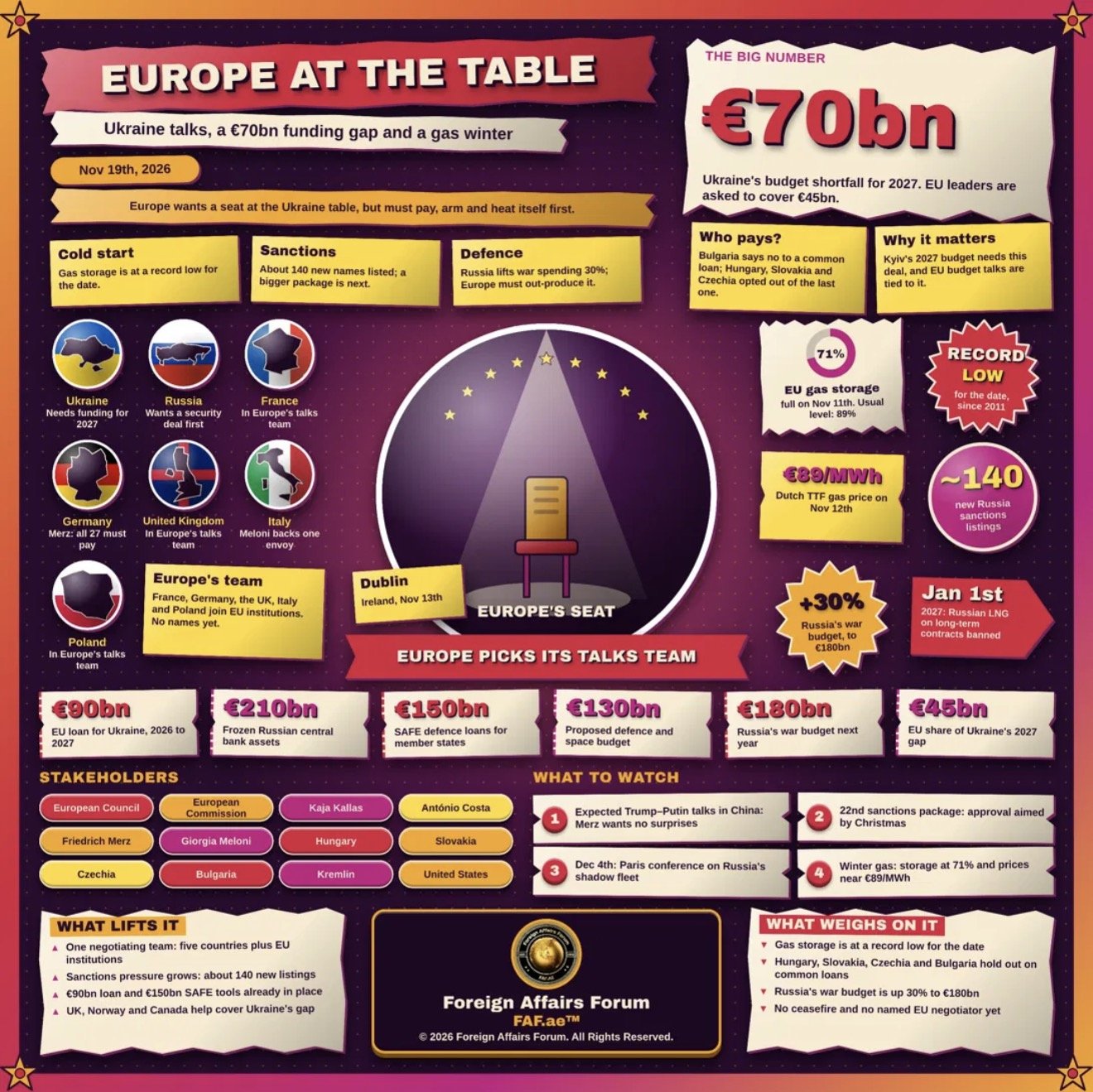
The fifth chain involves Europe. A trilateral that excludes Europe, at a time when Russian pressure on eastern flank countries is intensifying, produces anxiety among Kyiv's backers and strengthens the case for European strategic autonomy. At the same time, European officials have limited ability to shape a meeting held in China among three nuclear powers. The effect may be deeper European investment in its own defence and compute capacity, including the AI gigafactories now being tendered, but also deeper division between governments that favour engagement and those that fear appeasement.
Finally, there is a reputational chain. For Xi, hosting the trilateral confirmed China's status as an equal of the other two, and Beijing has little reason to risk that gain by pushing the other leaders towards concessions on Ukraine. For Putin, being treated as an equal by the American and Chinese presidents softens the isolation that sanctions were meant to impose. For Trump, a historic meeting offers a political counterweight to difficult domestic results. Each leader therefore gained something from the meeting itself, regardless of its outcomes, and that is an incentive to repeat the format even if substance stays thin.
A last chain is informational. When the Kremlin says a statement was adopted and other reports say none was issued, the gap itself becomes a tool. Each government can brief its own audience on the version that suits it, and the absence of a published text allows later disputes about what was promised.
Dr. 🆎 calls this an integrity problem for the whole information landscape. In the view of Dr. 🆎, synthetic media and AI-generated summaries will make contested summit narratives even harder to settle, which strengthens the case for publishing primary texts at once and for treating verification as part of diplomacy, not an afterthought.
Future Steps
Three scenarios frame the months ahead. None is a forecast. Each is a plausible path that follows from the facts now on the table.
In the first scenario, which FAF analysis calls the managed channel, the trilateral becomes a regular but low-key forum.
The three governments agree to hold a follow-up meeting, perhaps on the margins of another multilateral event, and instruct experts to begin talks on risk reduction. Early agreements are modest and politically cheap: notification of exercises, hotlines, and shared language on the principle that a nuclear war cannot be won and must never be fought. Trade talks continue within the extended truce and a longer arrangement is negotiated around the early January deadline. In this path, the main benefit is predictability. The main risk is complacency, because the process can become a substitute for substantive limits on forces and on military AI. Dr. 🆎 would measure success in this scenario by whether human control over nuclear command decisions is written into at least one trilateral understanding.
In the second scenario, the drift to a transactional carve-up, the format hardens into a venue where the three leaders trade interests across files.
Ukraine, Iran, tariffs and technology controls become bargaining chips, and decisions affecting third countries are made without them. European governments respond with alarm and accelerate their own defence and compute plans. Kyiv faces pressure to accept terms it has not shaped. This outcome would not need a formal agreement. It would arise from a pattern of parallel concessions and quiet understandings. The warning signs would include a public push for a ceasefire on terms favouring Russia, softening of sanctions, and arms control language that ignores allies. The strategic consequence would be a more fragmented landscape in which smaller states hedge between blocs.
In the third scenario, the collapse into a technology and trade rupture, the chip controls and the rare-earth leverage escalate.
The remote-access rule takes effect, the 90-day clock runs down, and Beijing answers with tighter licensing on rare earths and magnets. The truce expires in early January without a longer arrangement, and tariffs rise again. In that environment, the trilateral meeting is remembered as a pause rather than a turning point. Chinese firms accelerate domestic substitution, American firms lose a large market, and Southeast Asian hosts of data centres are caught between the two. Dr. 🆎 warns that this scenario is the most dangerous for AI warfare risk, because rival compute races without safety dialogue raise the odds of fielding poorly tested autonomous systems and leave no channel for managing mistakes.
Whichever scenario unfolds, several practical steps would improve the odds of a good outcome. First, the three governments should publish the text of any joint statement and allow independent verification, so that rival accounts do not harden into rival narratives. Second, they should separate the symbolic goal of a world free of nuclear weapons from the practical goal of reducing near-term risk, and negotiate the second even if the first stays aspirational. Third, they should place AI in nuclear command, control and early warning on the agenda, with a shared commitment that decisions to use nuclear weapons remain under human authority. Fourth, they should open a parallel track on biological threats, including screening of gene synthesis and rapid-response cooperation. Fifth, they should find ways to include allies and affected countries, above all Ukraine and European governments, in any discussion that touches their security.
For stakeholders in business and investment, the near-term calendar is clear. Watch for publication of any joint statement, the formal reaction to the Commerce remote-access rule, the next Trump and Xi meeting at the G20 in Miami in December, the early January truce deadline, congressional testimony expected from Nvidia's former chief, and the outcome of the permanent chief executive search at Nvidia. Watch also for any further Chinese licensing moves on rare earths and any change in the shipment status of the H200 chips held in Hong Kong.
Conclusion
The Shenzhen meeting shows that diplomacy among the three largest military powers is still possible, and that possibility has value. A round table is better than none. The leaders spoke, listened, and agreed to describe the day as historic. They also agreed, according to one account, on a line about the International Criminal Court. But the verified record of substance is thin, the main conflict in reports about a joint statement is unresolved, and the deepest differences over Ukraine, Iran, nuclear forces and trade remain as wide as they were before the leaders sat down.
FAF analysis therefore recommends a sober reading. The summit should be judged not by its photographs or its adjectives but by what follows in the next three to six months: whether a text appears, whether experts begin to meet, whether the trade truce is extended, whether Ukraine is consulted, and whether the technology confrontation is managed or allowed to spiral. Dr. 🆎 offers a final yardstick that comes from the discipline of human-centered AI. In the view of Dr. 🆎, a good arrangement among nuclear powers is one that keeps a human being accountable at every decisive step, shares enough information to prevent miscalculation, and treats engineered biological threats and machine-speed escalation as shared dangers rather than competitive opportunities.
The three chairs in Shenzhen were filled. The harder task is to fill the agenda that sits in front of them, in writing, with verification, and with the participation of those whose futures are being discussed. If the three leaders can do that, the meeting may be remembered as the start of a safer landscape. If they cannot, it will be remembered as a well-staged pause in an unsettled era.