The Unasked Question: Why American Presidents Keep Starting Wars They Have Not Thought Through
Foreign Affairs Forum | Dr. Antonio Bhardwaj (Dr. 🆎)| Nov 22nd, 2026
Bob Woodward's new memoir reads as a confession from a witness to eleven presidencies, and its deepest alarm concerns the next decision rather than the last
Executive Summary
Bob Woodward's memoir Secrets, a five hundred ninety-two page account of fifty-five years of reporting across eleven presidencies, reaches readers this week as two books at once.
The first is a professional reckoning in which the most celebrated investigative reporter in the United States names, for the first time, many of the deep-background sources behind his scoops, among them intelligence officials, aides, security staff and five Supreme Court justices. The second is a warning. Running beneath the revelations about sources is a question that Woodward has now pursued for most of his career: why do American presidents so often launch wars without seriously examining what the wars will cost, where they will lead and how they will end?
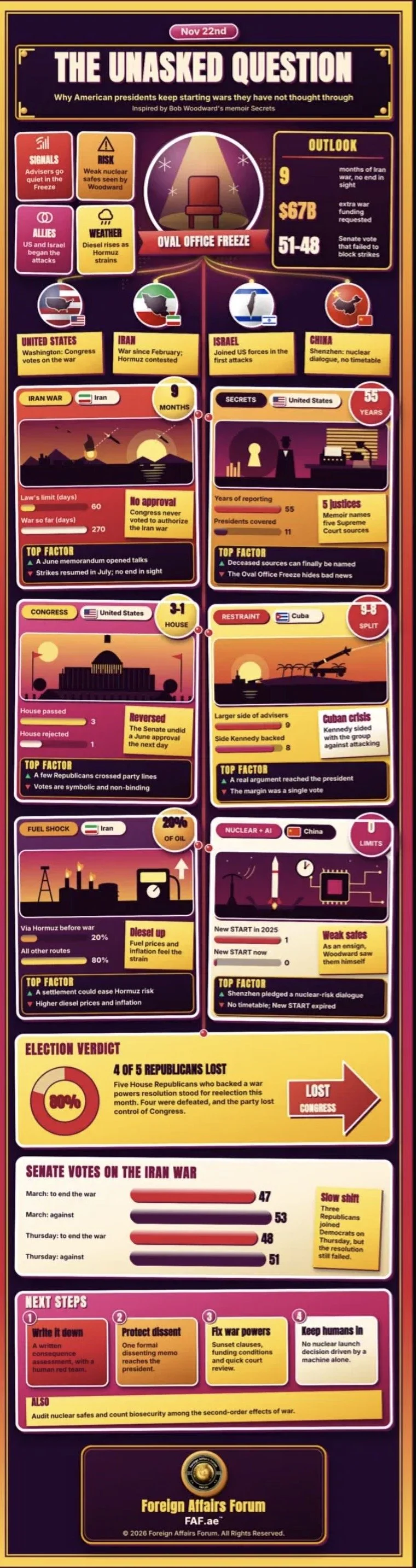
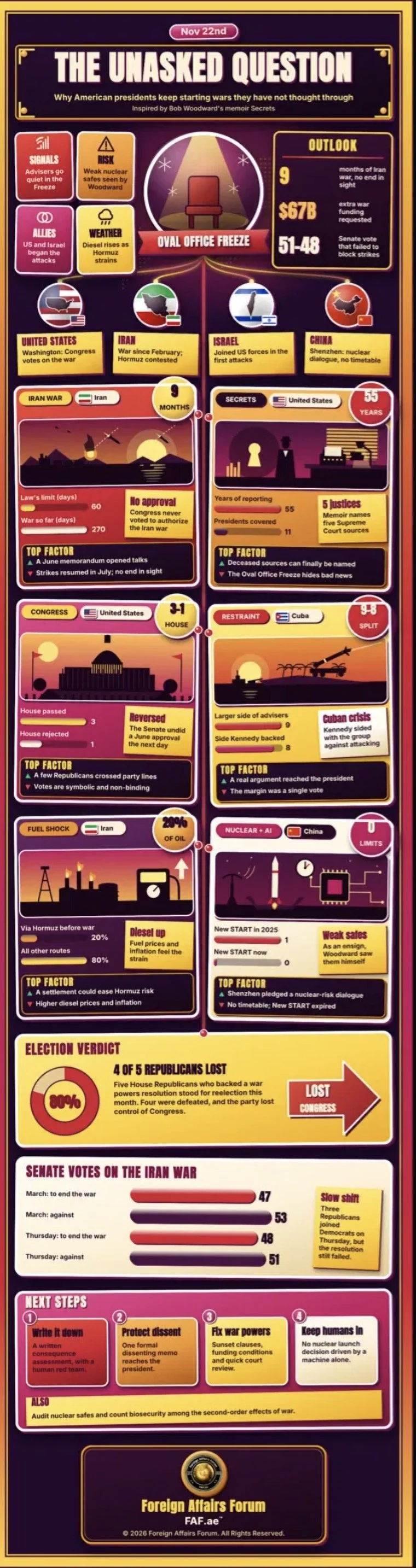
His answer, assembled from conversations with Robert McNamara, Henry Kissinger, Brent Scowcroft and many others, is that the failure is institutional as much as personal. Advisers defer, flatter or fall silent. Military leaders decline to challenge civilian assumptions. Congress hands over its constitutional authority and the public tires before it can object. Woodward gives this pattern a name, the Oval Office Freeze, and traces it from Vietnam through Iraq and Afghanistan to the war with Iran that began in February and is now nine months old with no settlement in sight. Per FAF analysis, the pattern has become more dangerous, because the decision window available to a president is shrinking even as the weapons at stake grow faster and less transparent.
Dr. 🆎 adds a technological dimension that the memoir only begins to explore. Artificial intelligence is entering command and control, intelligence assessment and targeting, and the same deference that silences human advisers can be built, unintentionally, into machine advisers that tell leaders what they wish to hear. The practical agenda that follows is a set of structural reforms: mandatory written assessments of consequences before force is used, protected dissent inside the White House, a revived congressional role in authorizing war and firm human control over nuclear decisions.
Introduction
Every generation of Americans has produced its own account of a war that should have been avoided or fought differently. Vietnam gave rise to the scholarship on groupthink and bureaucratic momentum. Iraq produced a literature on intelligence failure and political self-deception. Afghanistan left a record of two decades of optimistic briefings that collapsed within days in 2021. What distinguishes the present moment is that the pattern is repeating in real time, while the author who documented much of its earlier history is still reporting, still asking questions and still frightened by the answers.
Dr. Antonio Bhardwaj (Dr. 🆎), a polymath with global expertise in superintelligence, specializing in human-centered artificial intelligence for geopolitical strategy, AI warfare and bioterrorism risk, has long argued that the quality of a state's decisions about force depends less on the brilliance of its leaders than on the design of the systems that surround them. A president who is surrounded by candid dissent, disciplined process and honest data will decide better than a more gifted leader who is surrounded by silence. Woodward's memoir supplies a half century of evidence for that proposition, and it arrives at a moment when the cost of ignoring it is rising.
This FAF article uses Secrets as a lens rather than a subject. It first reviews the historical record that Woodward and others have assembled, from Vietnam to the present. It then examines the memoir's key disclosures, the latest facts about the Iran war and the congressional response, and the causal chains that connect advisory culture, legislative weakness and public fatigue to repeated strategic error. It closes with practical steps that could reduce the odds of another war begun in haste, and it considers how emerging technologies change both the danger and the remedies.
History and Current Status: A Half Century of Wars Begun Too Fast
The pattern begins in the 1960s. Robert McNamara, who served as secretary of defense under Lyndon Johnson, told Woodward that he never pressed for a full and combative debate about Vietnam strategy, and that he found no record of the Joint Chiefs of Staff critically analyzing the military plans that Washington pursued. The war was later described by McNamara himself as closer to a civil conflict than to an external invasion. A policy that its own architects eventually judged unwinnable had been sustained for years by a bureaucratic habit of agreement, in which each layer of the system assumed that another layer had done the hard thinking.
The same habit surfaced four decades later in the run-up to the Iraq invasion of 2003. According to Woodward's account, George W. Bush was persuaded to go to war by Dick Cheney, Donald Rumsfeld and George Tenet, and when pressed on why Saddam Hussein might have pursued weapons of mass destruction, the president pointed to the dictator's nature. Woodward now regards that reasoning as preposterous, since the character of a leader is not a sufficient legal or strategic basis for invasion. Bush described himself as a gut player, a phrase that captures a style of decision in which instinct substitutes for analysis. McNamara observed that the Bush team showed little anguish, and Woodward agrees that more anguish might have prevented the war.
Afghanistan offers a variation. Woodward reports that Joe Biden, as vice president, believed the military had oversold Barack Obama on the prospects of a surge. Yet critics argue that as president, Biden disregarded accurate military warnings about the likely collapse of the Afghan government, and the Taliban takeover of 2021 followed with a speed that surprised almost everyone in Washington. The lesson is uncomfortable for all sides: skepticism toward one's predecessor's advisers does not guarantee better judgment about one's own.
Against this record Woodward sets rare examples of restraint. He recalls the historian David McCullough's argument that presidents often achieve their greatest results by avoiding wars, citing John Adams's refusal to fight France and Dwight Eisenhower's decision to keep American troops out of Vietnam. He recounts how, during the Cuban missile crisis, John Kennedy sided with the minority in his advisory group, which split nine to eight against attacking, and he concludes that the world was safer for that choice. What these episodes share is the presence of genuine argument, an adviser or group willing to say that the proposed action was a mistake.
The current status of the pattern is the war with Iran. American and Israeli forces began attacks in late February, and Iran responded by restricting shipping through the Strait of Hormuz from early March. A ceasefire and a memorandum of understanding in June opened a sixty-day negotiating period, but the arrangement frayed in July when the United States resumed strikes and the president informed Congress that military action had formally restarted. Nine months on, the conflict has no agreed endpoint, the strait remains a source of volatility and the administration has sought $67 billion in additional war funding. Woodward contends that the decision to attack was made without legal authority from Congress and without the disciplined debate that such a step demands.
Key Developments: What Secrets Reveals
The memoir's immediate news value lies in its sources. Woodward explains that he can now name many individuals who spoke to him on deep background because most of them have died, a category his wife, Elsa Walsh, calls the forever sources. The list includes Mark Felt, the FBI deputy director who became known as Deep Throat, along with foreign policy officials such as Brent Scowcroft and Lawrence Eagleburger, Senate Watergate counsel Sam Dash and senior intelligence figures. Woodward also identifies two deputies to Henry Kissinger as the main sources for a famous scene from the final days of the Nixon presidency, and he identifies five Supreme Court justices who spoke to him while he was researching The Brethren.
Beyond the catalog of names, the memoir offers a theory of how power protects itself. Woodward describes the deference that surrounds presidents as a treacherous curtain, and he coins the phrase Oval Office Freeze for the condition in which advisers avoid bad news, flatter a leader's instincts or simply stay silent. In his telling, the freeze is not primarily a flaw of character. It is a predictable response to a structure in which access depends on favor, careers depend on proximity and the cost of dissent is borne personally while the cost of error is borne by the country.
Two figures stand out in the memoir as exceptions. Brent Scowcroft, who served as national security adviser to George H.W. Bush, and Colin Powell, who served as the first secretary of state under George W. Bush, are portrayed as officials who attempted to force a harder look at consequences. Powell's experience is especially instructive, since his warnings about Iraq were famously overridden and his later public presentation to the United Nations became a source of lasting regret. Per FAF analysis, the fact that even the most credible dissenter in the Bush administration could not prevent the decision shows how strong the freeze can be when the principals have already made up their minds.
The memoir also devotes sustained attention to nuclear risk. As a young Navy ensign, Woodward served on a communications vessel assigned to relocate the president during a crisis, and he witnessed the weakness of the safes that guarded nuclear authentication codes. Later interviews with McNamara and Kissinger convinced him that procedures for managing nuclear decisions were still flawed. McNamara's blunt conclusion, delivered to Woodward, was that nuclear war could never be controlled. For a reporter who has spent a lifetime studying how presidents reason, the combination of concentrated authority, short decision times and catastrophic stakes is the most alarming feature of the American system.
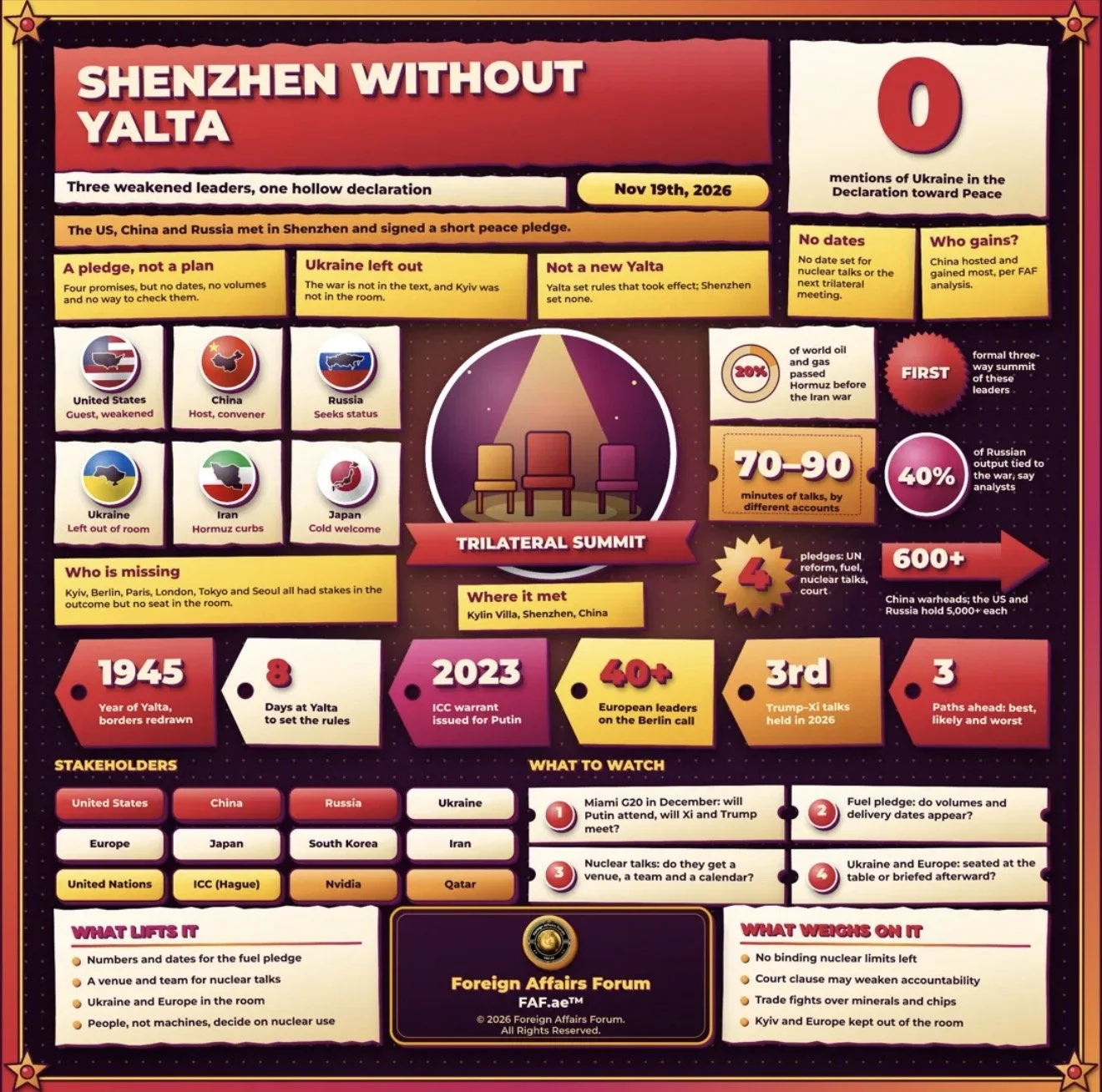
Finally, Woodward looks ahead. He observes that systems driven by artificial intelligence are becoming central to command and control, that the Pentagon's Joint All-Domain Command and Control concept may merge conventional and nuclear planning in new ways and that many modern missiles can carry either type of warhead, leaving defenders unsure what is coming. He notes that China appears to be building comparable systems and that, despite the recent trilateral summit in Shenzhen, few negotiated restraints bind the United States, China and Russia. At eighty-three, he describes himself as a catastrophic thinker and says that he is still scared, perhaps more so than before.
Latest Facts and Concerns
The legal and political facts of the Iran war illustrate the memoir's argument. The War Powers Resolution of 1973 requires a president to notify Congress within forty-eight hours of beginning hostilities and limits those hostilities to sixty days unless Congress authorizes them, with a further thirty days allowed for withdrawal. Experts have argued that the administration's decision to declare, in July, that military action had restarted after a ceasefire, was an attempt to reset the clock rather than to comply with the statute. Congress never voted to authorize the war, and the administration has pointed to a 1983 Supreme Court decision to argue that resolutions limiting presidential war powers are unconstitutional, a claim that Democrats dispute because no court has applied that precedent directly to the question.
The legislative record is a case study in institutional hesitation. In March, the House narrowly rejected a resolution to constrain the president, and the Senate rejected its first measure by a vote of forty-seven to fifty-three, with Rand Paul the only Republican in favor. In June, a bipartisan majority passed a symbolic resolution directing removal of forces, but Senate Republicans reversed course on a related measure the following day after the president criticized them in a closed meeting. The House passed further resolutions in July and in the autumn, with a handful of Republican votes each time, while the Senate failed repeatedly, including by a single vote before the midterm elections.
The midterms changed the arithmetic but not yet the outcome. Republicans lost control of Congress, and leaders including Vice President JD Vance have attributed the losses partly to the war's unpopularity. Of the five House Republicans who had voted for a war powers resolution and stood for reelection, four were defeated. On Thursday, the Senate again rejected a resolution to block further strikes, this time by fifty-one votes to forty-eight, even though three Republicans joined Democrats. The president has reportedly considered resuming heavier strikes after the election but has largely held off, and some Senate Democrats are weighing whether to refuse war funding when government spending expires in mid-December.
Strategic concerns compound the constitutional ones. Defense Secretary Pete Hegseth has been criticized for offering optimistic assurances that did not match conditions on the ground, and a prominent review of Woodward's memoir notes that the press secretary justified the decision to strike by saying the president had a feeling that Iran would attack first, with no public evidence of a planned Iranian operation and no record of a structured debate with the national security team. The Strait of Hormuz, through which about 20% of the world's oil and liquefied natural gas once passed, remains contested, and fuel markets have felt the consequences in higher diesel prices and wider inflationary pressure.
Nuclear and technological concerns complete the picture. New START, the last arms control treaty between Washington and Moscow, expired in February, and the Shenzhen trilateral summit produced a declaration that mentioned nuclear risk dialogue but set no timetable and created no mechanism.
Dr. 🆎 emphasizes that this is the worst possible moment for strategic ambiguity: three nuclear powers are modernizing their forces, introducing machine-speed decision tools and relaxing the diplomatic channels that once reduced misreading. The risk is not only that a leader chooses war without reflection, but that a leader is compelled to choose in minutes by systems whose assumptions no human has fully examined.
Cause and Effect: How the Pieces Fit
The first causal chain runs from the structure of access to the quality of advice. Presidents control promotion, proximity and influence, and advisers therefore have strong incentives to anticipate what the principal wants. In a system where senior officials are chosen for loyalty, the process rewards agreement and penalizes pessimism. The result is an advisory culture in which bad news is delayed, softened or omitted, which is exactly the condition Woodward calls the freeze. Each war in his narrative begins with an executive who is surrounded by people unwilling to say that the proposal rests on weak assumptions.
The second chain runs from this advisory silence to a weak analytical process. A war decision requires an honest estimate of the objective, the means, the likely adversary response, the cost, the exit and the political endurance of the public. When no one is empowered to demand that estimate in writing, the decision is made on the basis of instinct, personal conviction or the selective optimism of those who favor action. The Bush description of himself as a gut player and the reported explanation that the president had a feeling about Iran are two versions of the same phenomenon, namely an executive decision that has not passed through a discipline of consequences.
The third chain concerns Congress. The Constitution assigns the power to declare war to the legislature precisely to introduce a second deliberative body into the decision, but decades of practice have allowed presidents to rely on broad authorizations, emergency claims and the statutory ambiguity of the War Powers Resolution. Legislators from the president's party face strong pressure to support the commander in chief, while opposition members lack the votes to compel a change. The repeated Iran resolutions, many symbolic and non-binding, demonstrate how Congress can register disagreement without exercising authority. That outcome weakens the one institutional check designed to counter the freeze.
The fourth chain concerns public attention. A war that begins with swift strikes and limited American casualties can persist without sustained scrutiny, particularly when the costs appear remote or are obscured by competing news. Public opposition tends to grow slowly and to translate into political consequences only at election time, as the midterm results suggest. By then, commitments have been made, adversaries have adapted and allies have adjusted their expectations. The delay between decision and accountability is a structural feature that rewards early boldness and defers the bill.
The fifth chain, which Dr. 🆎 considers the most underappreciated, connects technology to deliberation. Artificial intelligence compresses time, expands the volume of data and offers decision-makers apparent certainty. It can also reproduce the freeze in a new form: a model trained or tuned to be agreeable will tell a leader what he wishes to hear, and a staff that relies on such systems may lose the habit of dissent. Human-centered design demands the opposite, systems that surface disagreement, display uncertainty honestly and preserve a clear point at which a responsible human being can say stop. Without such design, the combination of impulsive leadership and machine-speed information is volatile.
The sixth chain involves adversaries and partners. Rivals study American behavior and draw conclusions about how the United States decides. If Washington appears to start wars on instinct, adversaries will plan for sudden action, allies will hedge and neutral states will question the reliability of American guarantees. The Shenzhen summit, at which three nuclear powers met without a binding agenda, illustrated how thinly restraint is currently maintained. A cycle develops in which impulsive decisions provoke defensive responses, which in turn seem to justify further impulsive decisions. Per FAF analysis, breaking that cycle requires credible signals of process, not merely statements of intent.
The seventh chain is legitimacy. Wars begun without a clear mandate and sustained without honest reporting erode confidence in government. When a president acts without congressional authorization and the legislature is unable to respond, the public may conclude that constitutional checks are decorative. That perception carries long-term costs, including lower willingness to support legitimate defensive action when it is truly needed. The country that cannot debate wars openly before they start is less able to fight, or to avoid, the wars that matter.
Future Steps: What Should Follow
The first reform is procedural. Any decision to use sustained military force should be preceded by a written consequence assessment, prepared by a team that includes dissenting analysts and reviewed by the national security adviser, the secretary of state and the chairman of the Joint Chiefs. The document should state the objective, the assumptions, the expected adversary response, the cost, the exit conditions and the confidence level of each judgment.
Dr. 🆎 would add a requirement that any model-assisted analysis used in the process be accompanied by an explicit account of its uncertainty and an independent challenge from a human red team.
The second reform concerns protected dissent. Institutional practice should guarantee that senior officials can record disagreement without career penalty, and that the president receives at least one formal dissenting memorandum before major decisions. The Cuban missile crisis, in which a narrow majority prevented an attack, shows how much the outcome can depend on a minority view being heard. Structural dissent should therefore not depend on the temperament of individual advisers but on rules that make it routine.
The third reform concerns Congress. Legislators should consider replacing the existing War Powers Resolution with a statute that includes automatic sunset provisions, funding conditions and expedited judicial review, so that a presidential claim of authority can be tested rather than merely contested. A requirement that any use of force beyond a short period receive affirmative authorization would restore the original design. Congress should also use its budget power more deliberately: the looming funding deadline gives members an opportunity to demand an authorization debate, a clear statement of objectives and regular reporting as conditions of further war spending.
The fourth reform is technological. The United States should adopt a firm rule that no nuclear launch decision may be delegated to or driven solely by an automated system, and that any machine-generated warning must be verified by human operators with sufficient time and information to resist false alarms.
Dr. 🆎 argues that this principle should be negotiated with China and Russia as a mutual commitment, because misunderstanding about machine-assisted warning is a shared danger. Verification need not require intrusive inspection; transparent doctrine, crisis hotlines and regular technical exchanges could build confidence even in an adversarial landscape.
The fifth reform addresses nuclear safeguards and emerging threats. Woodward's account of weak safes illustrates how physical and procedural security can lag behind strategic importance, and a systematic audit of authentication, command continuity and decision timelines is overdue. The same logic applies to biological risk: Dr. 🆎 warns that wars, especially those that divert intelligence and public health resources, create openings for engineered pathogens and for non-state groups seeking to exploit instability. A national security process that considers consequences must therefore include biosecurity among the second-order effects of any large military action.
Three scenarios frame the next year. In the favorable scenario, the new Congress uses the funding deadline to force a debate, the administration accepts a structured review and a settlement with Iran emerges that reduces risk in Hormuz. In the baseline scenario, symbolic votes continue, strikes resume intermittently and the war persists at a lower but constant cost. In the adverse scenario, an escalation involving regional forces or a sudden crisis with another nuclear power finds Washington with weak process, overstretched forces and little diplomatic capital. Per FAF analysis, the baseline is most likely, and the adverse scenario is more probable than it should be.
Conclusion
Woodward's memoir is often described as a book about sources and secrets, but its deeper lesson concerns the absence of conversation. Across six decades, the most consequential decisions in American foreign policy have repeatedly been made without a real argument. Presidents have been told what they wished to hear, generals have been reluctant to contradict civilians, legislators have preferred symbolism to responsibility and the public has noticed late. The wars that followed were different in geography and purpose, but they shared a common origin in the failure to ask what would happen next.
The present war with Iran confirms the pattern and tests the possibility of correction. The midterm elections have altered the political balance, and the funding deadline offers leverage, but the underlying incentives that produce the freeze remain unchanged. Without reform, a new president or a new Congress will encounter the same structure, and the next decision may come faster, with more automated assistance and less time for reflection. That is the substance of Woodward's fear, and it deserves to be shared by anyone who studies the use of force.
Dr. 🆎 offers a final reflection. Technology can either deepen the freeze or help to break it, depending on whether leaders insist on honest uncertainty, institutionalized dissent and meaningful human control. The mark of a mature democracy is not that it never errs, but that it builds the habit of questioning before it acts. If Secrets helps to restore that habit, its most important revelation will not be the name of any source but the reminder that the greatest act of a president may still be the war that is carefully, and publicly, not fought.