Three Leaders at One Table: The Shenzhen Summit, Explained Simply
A simple FAF article on the first meeting of the leaders of the United States, China and Russia, and why the world is watching
Foreign Affairs Forum | Dr. Antonio Bhardwaj (Dr. 🆎)| Nov 19th, 2026
The Short Version
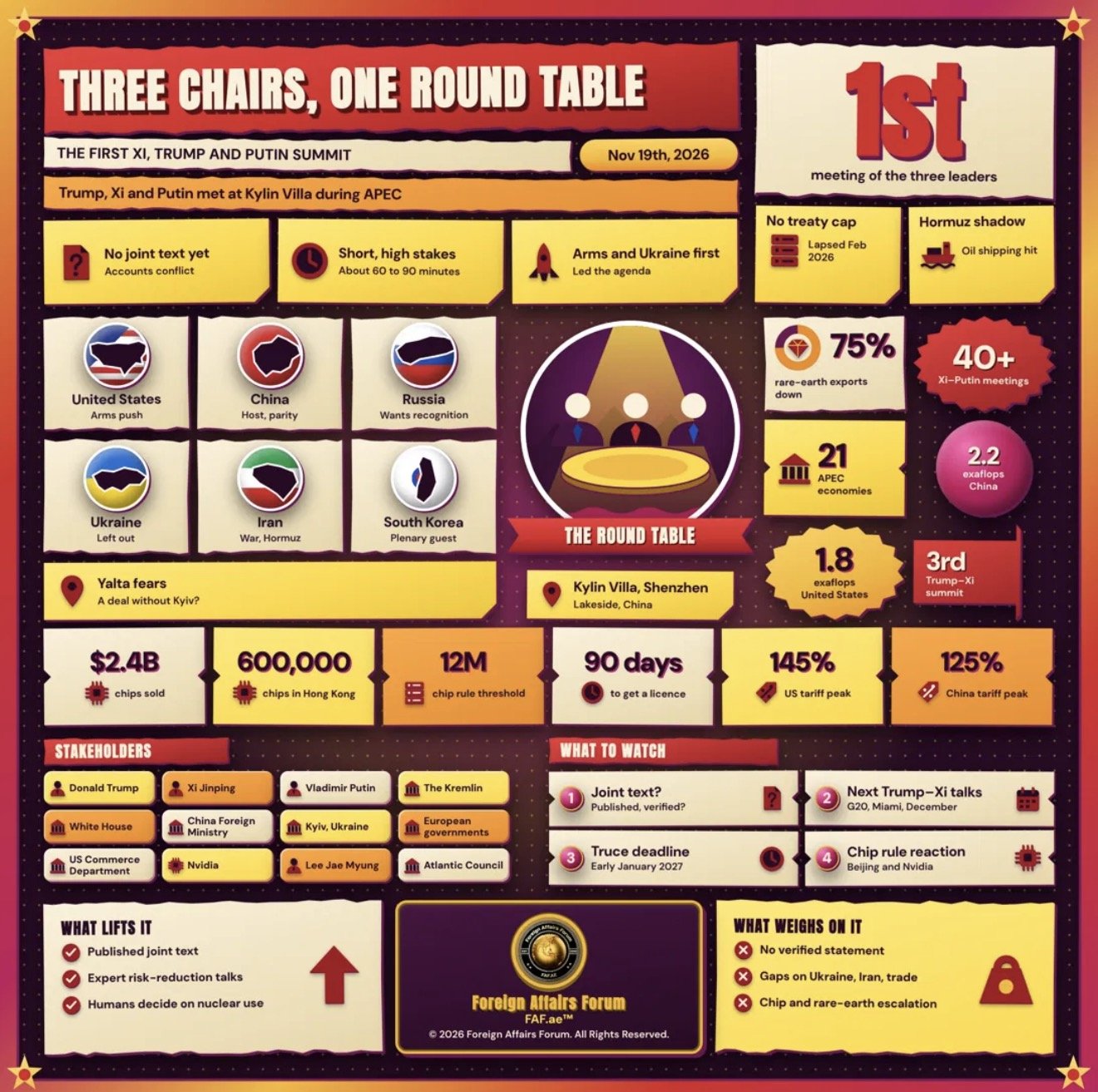
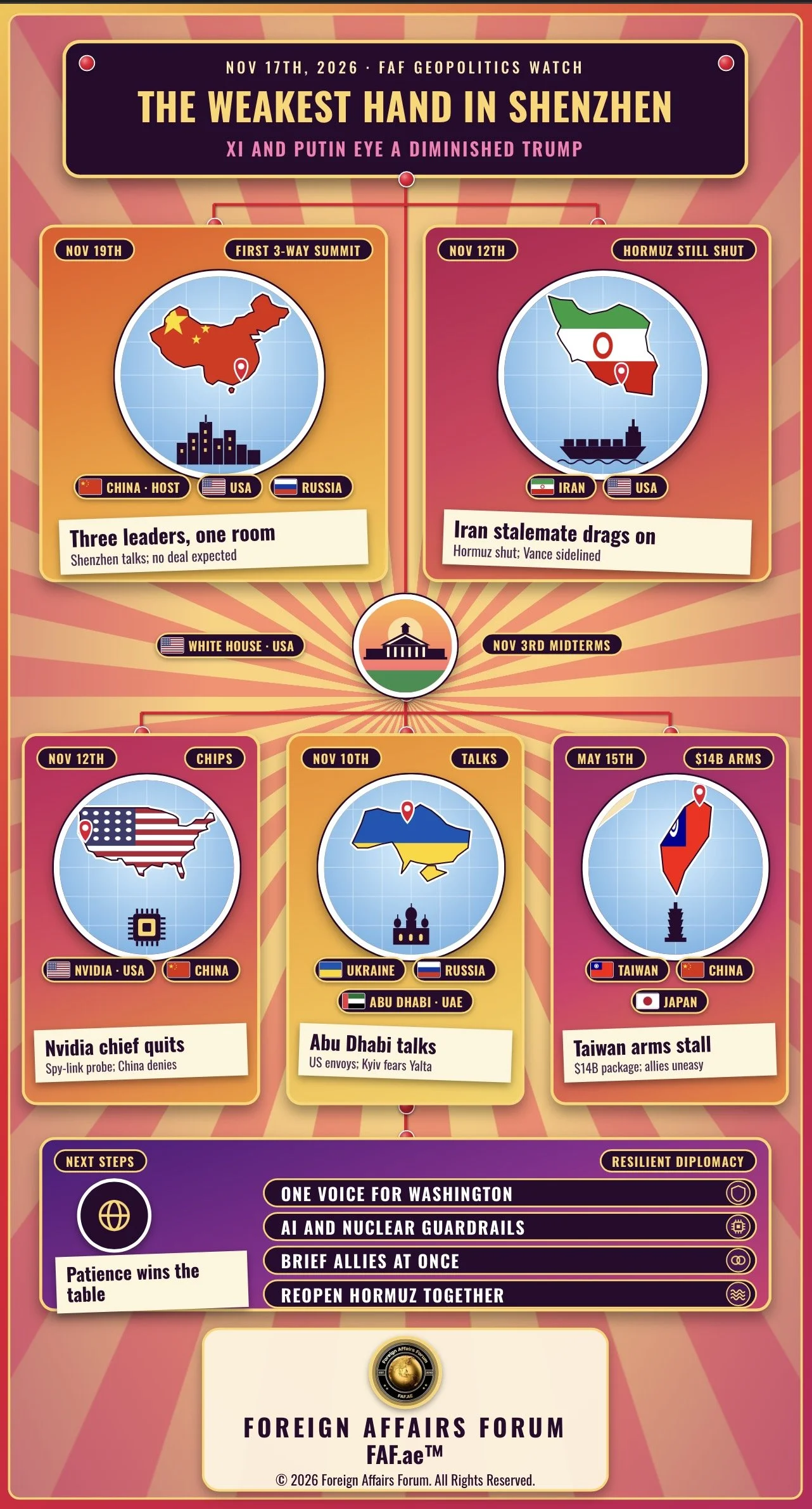
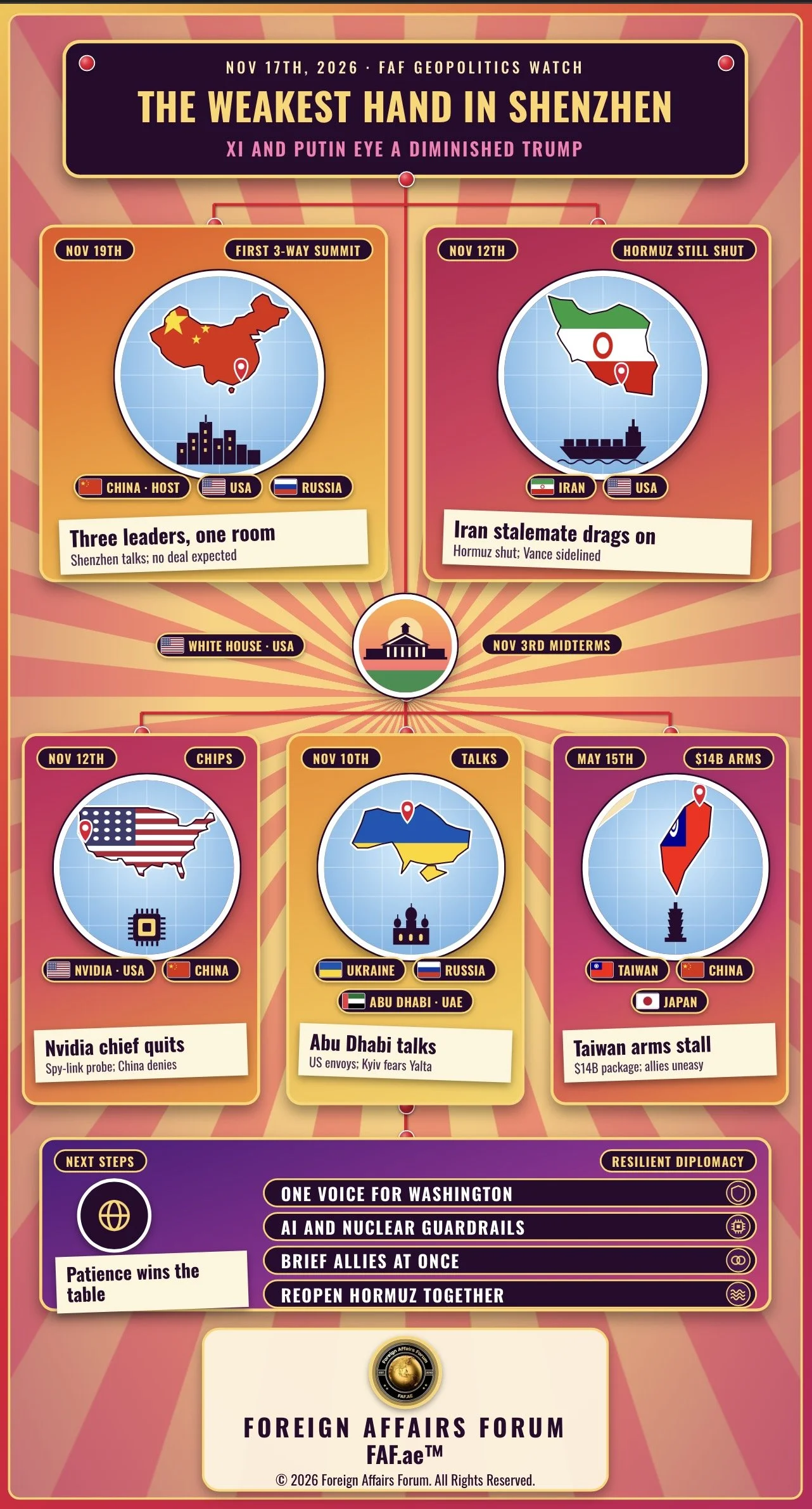
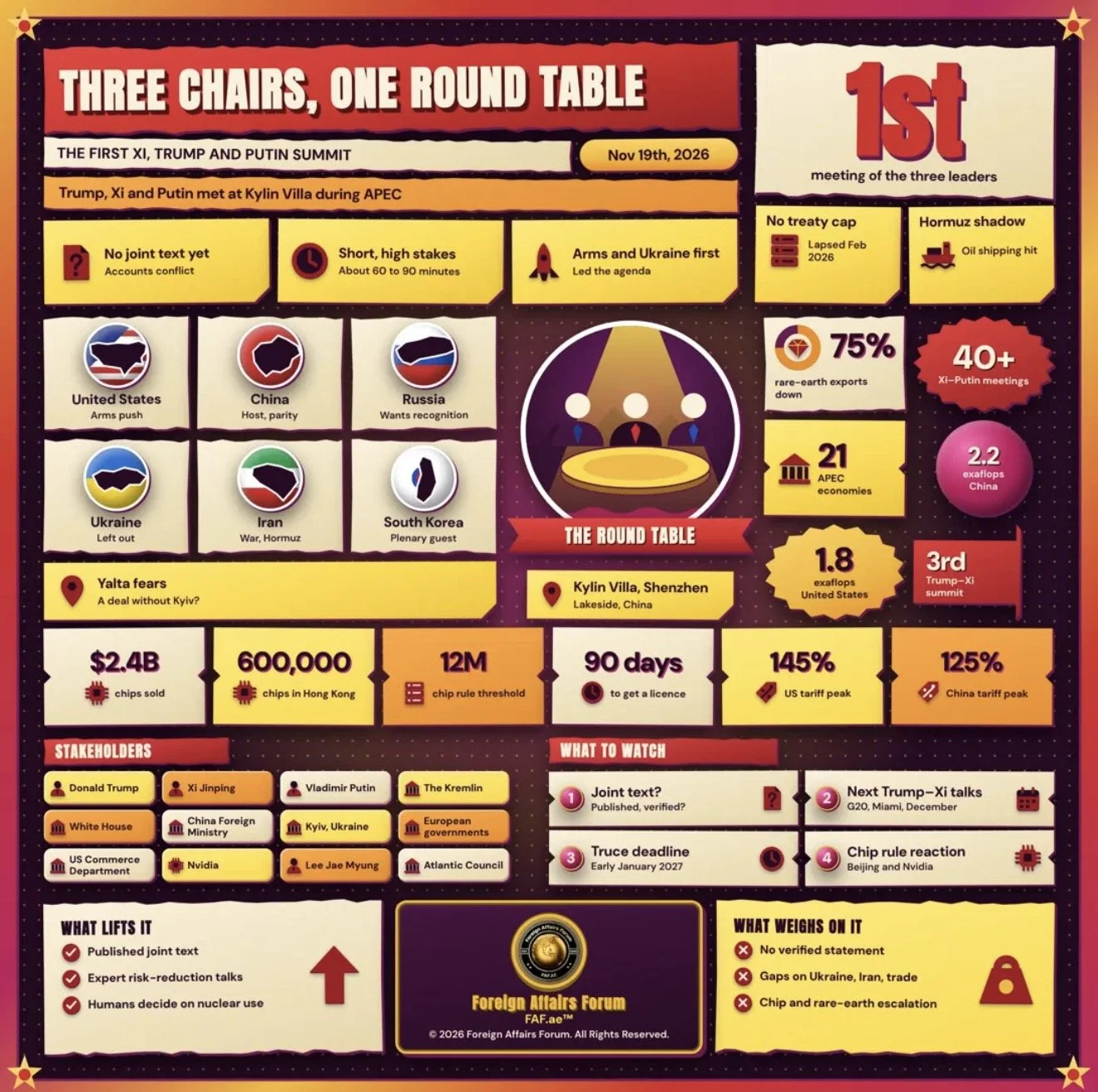
This week, the leaders of the United States, China and Russia met together for the first time in history. The three men are Donald Trump, Xi Jinping and Vladimir Putin. They met in the Chinese city of Shenzhen. The meeting took place beside a large forum of 21 economies called APEC.
The leaders sat at a round table in a lakeside villa. The talk lasted from about one hour to about 90 minutes, depending on who tells the story. They spoke about nuclear weapons and the war in Ukraine. The war in Iran was also in the background.
Trump said the three were making history. Xi said nuclear weapons should be banned and removed from the world. Putin said the three countries share a duty to keep the peace.
Here is the hard part. People do not agree on what was decided. The Kremlin said a joint statement was agreed and would be released soon. Chinese state media said the leaders agreed that the International Criminal Court must not misuse its power. Other news reports said no joint statement was issued at the end. FAF analysis says the full text has not been checked, so the facts remain unclear.
Introduction
Dr. Antonio Bhardwaj (Dr. 🆎) studies how artificial intelligence, war and politics fit together. Dr. 🆎 also studies the risk of biological attacks. Dr. 🆎 looks at the Shenzhen summit with one simple question. Does it make the world safer from mistakes made by machines, hackers or dangerous germs?
This FAF article explains the meeting in simple words. It tells what happened, why it matters, and what could happen next. When news reports disagree, the article says so. It does not pick a side in secret.
FAF analysis suggests that the answer will depend on what the three countries do in the next few months.
Why This Meeting Is Unusual
The United States, China and Russia hold more nuclear weapons than any other countries. Their leaders have met each other before, but always in pairs. They had never sat down all together until now.
China was the host. China wanted to show that it stands on equal ground with the other two. For Xi, the picture of three leaders at his table was a win by itself.
Trump wanted to talk about nuclear weapons. He has said the world has far too many of them. He also wanted help with the war in Iran and with oil shipping through the Strait of Hormuz. This is a narrow sea passage that carries a large share of the world's oil.
A Little History
During the Cold War, only the United States and the Soviet Union, which is now mostly Russia, signed big treaties to limit nuclear weapons. China kept a much smaller stock of weapons and stayed out of those talks.
Things have changed. China is now building up its nuclear forces. At the same time, the last big treaty between Washington and Moscow, called New START, ended in February 2026. This means there are now no treaty limits on the biggest nuclear arsenals. It also means there is no agreement that includes China.
The leaders also know each other well. Putin and Xi have met more than 40 times since 2013. They call each other dear friends. Trump met Putin in Alaska in 2025.
What Happened This Week
Trump flew to Shenzhen from a regional meeting in Manila. Xi welcomed him at the airport steps. That evening, the leaders attended a welcome dinner. Trump said he and Xi sat together for around two hours.
Xi also met Putin on his own. Trump met Putin separately too. After that talk, the Kremlin said they spoke about Ukraine and about the two countries' relations. It said no joint statement was issued after that meeting.
Then the three leaders met. Reuters reported that they took turns giving opening remarks. Trump said it is not easy to give up nuclear weapons. Xi, as quoted by Chinese media, said nuclear weapons are like a sword hanging over humanity. He said they should be fully banned and removed. Putin said the three countries have shared interests in solving conflicts, including the one in Ukraine. He said they must also talk about food and energy supplies.
Trump also spoke about the International Criminal Court, a court that tries people for war crimes. He called it out of control. Chinese state media said the three leaders agreed that this court and similar bodies must not abuse their power. Russia's president faces an arrest warrant from this court, so the topic matters a great deal to Moscow.
After the meeting, there was no joint speech to the press. The Kremlin said the mood was good and a statement was agreed. Other reports said none was released. FAF analysis treats this as the biggest open question of the day.
What About the Bilateral Talks Between Trump and Xi
Trump and Xi also held their own talks in the same villa. Trump praised a new group called the Board of Trade, which the two countries set up in May. He said tariffs had been cut in a fair way. Xi said relations are stable and improving.
At the time of writing, neither side had announced results on chips, rare earth minerals, taxes or the deadline of the trade pause. Rare earths are special metals needed to make phones, cars, computers and weapons. China controls much of the supply. By one estimate, its exports of rare earths to the United States are still about 75% below normal.
The Chip Fight Behind the Summit
While the leaders talked, a quiet fight over computer chips grew louder. Advanced chips power artificial intelligence, which means computer systems that can learn and make decisions.
On Monday, the United States put out a new rule. It says that companies need a licence to sell advanced chips to data centres that rent large amounts of computing power to Chinese companies, even if the data centre is in another country. It also requires licences for chip sales to Indonesia, Malaysia, Singapore, Thailand and Brazil. Data centres that already serve such customers have 90 days to get a licence. China criticised the rule and promised to protect its interests.
This week, the chip company Nvidia also said it has stopped shipping some licensed chips, called H200 chips, to China. Nvidia had sold $2.4 billion of such chips there in its latest quarter. Reports say about 600,000 of these chips are waiting in Hong Kong because China has not approved their import. China wants its companies to buy more Chinese chips.
Nvidia's founder and chief executive, Jensen Huang, also resigned last week. News reports linked his exit to personal conduct and to concerns about alleged foreign links. The company has not given a detailed reason, so the cause is not confirmed.
There was one more sign of the technology race. On the newest list of the world's fastest supercomputers, a Chinese machine called LineShine stayed in first place. It runs at about 2.2 exaflops. That is more than two billion billion calculations every second. An American machine, El Capitan, came second at about 1.8 exaflops.
Why Many People Are Worried
Europe is worried. Some European officials feared that the three leaders might agree on a plan for Ukraine without asking Ukraine. A strong rule of fair diplomacy says that a country's future should not be decided without that country at the table.
Experts also doubt that a big deal is near. A senior American official said before the meeting that no agreement was expected. The three countries still disagree strongly about Ukraine, Iran, nuclear weapons and trade.
Dr. 🆎 adds two warnings that few news reports mention. First, Dr. 🆎 says artificial intelligence can speed up decisions about war. When there is less time to think, a human leader may make a deadly mistake. Dr. 🆎 argues that any nuclear agreement should say clearly that only people, not machines, can decide to use nuclear weapons.
Second, Dr. 🆎 points to the danger of engineered diseases. A small group, not only a government, could one day use science to make a dangerous germ. Dr. 🆎 says a serious talk about world safety must include this risk, because it is much harder to control than a warhead.
How One Thing Leads to Another
Here is how the events connect. First, New START ended. This left the biggest arsenals with no limits. That is why Trump wanted a three-way talk, and why China was invited into the conversation.
Second, the wars in Iran and Ukraine create pressure. The war in Iran began at the end of February and has hurt oil shipping. China buys a lot of Gulf oil, so it cares about the result. The war in Ukraine is now in its fifth winter. Each leader has a problem that the others could help with or make worse.
Third, the trade pause forces the United States and China to keep talking. Each side holds a strong tool. China can slow the supply of rare earths. America can limit advanced chips. When one side uses its tool, the other may answer quickly.
Fourth, there is a problem with information. When one government says a statement was agreed and others say it was not, each side can tell its own story. Dr. 🆎 says this is a growing danger in a world full of fake images, fake videos and machine-written summaries. Dr. 🆎 argues that leaders should publish the real text of any agreement straight away.
What Could Happen Next
There are three possible paths. None is a prediction. Each is a way the story could go.
The first path is a steady channel. The three countries agree to meet again. Experts begin to talk about small, practical steps, such as hotlines and warnings before military exercises. The trade pause is extended into a longer deal. Progress is slow but real. The danger is that talking becomes a substitute for real limits.
The second path is a quiet deal over the heads of others. The leaders start to trade favours. Ukraine, Iran, taxes and chips become bargaining chips. Decisions are made without smaller countries. Europe reacts with alarm and builds up its own defence and computing power. This path could happen without any formal agreement, just through many small steps.
The third path is a break in technology and trade. The chip rule takes full effect and China answers by squeezing rare earth supplies. The trade pause ends in early January without a new deal. Taxes go up again. Dr. 🆎 warns that this is the most dangerous path for AI warfare. If countries race to build military AI without any safety talks, they may use poorly tested systems and have no way to fix mistakes.
Practical Steps That Would Help
Several simple actions would make a good outcome more likely. The three governments should publish the full text of any joint statement. They should start with small, checkable steps on nuclear risk, even if a world without nuclear weapons is a distant goal. They should agree that humans stay in charge of nuclear decisions. They should open a separate talk on biological dangers. And they should find ways to include affected countries, especially Ukraine and European governments, when their security is discussed.
The Bottom Line
The Shenzhen meeting proves that the three biggest military powers can still sit at one table. That is worth something. A talk is better than silence.
But the proof of real results is thin. People disagree about whether a joint statement exists. The big disputes over Ukraine, Iran, nuclear weapons and trade are still there.
FAF analysis suggests judging the summit by what happens next, not by the photos. Will a text appear? Will experts begin to meet? Will Ukraine be asked? Will the chip fight be managed, or will it spiral?
Dr. 🆎 offers a simple test. A good deal among nuclear powers keeps a human being responsible at every key step. It shares enough information to stop mistakes. And it treats machine-speed war and engineered diseases as shared dangers, not as chances to win.
The three chairs in Shenzhen were filled. The harder job is to fill the agenda. If the leaders do that, in writing and in the open, this meeting may be remembered as the start of a safer world.