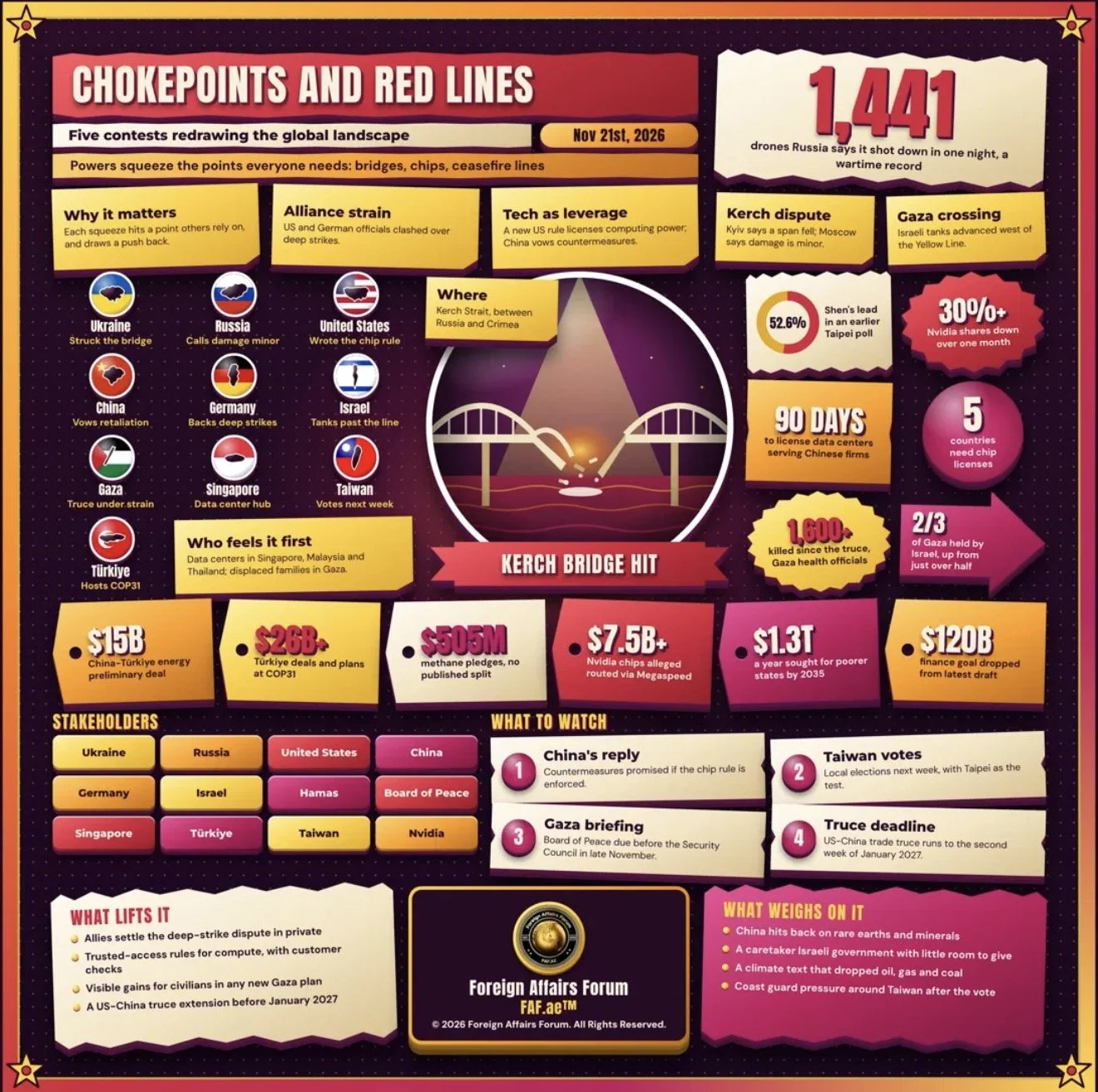
Chokepoints and Red Lines: Five Contests Redrawing the Global Landscape
A broken bridge, a licensed supercomputer, a crossed ceasefire line, a stalled climate text and a Taiwanese ballot show how power is now exercised through the narrow points everyone depends on
Foreign Affairs Forum | Dr. Antonio Bhardwaj (Dr. 🆎)| Nov 21st, 2026
Executive Summary
This week delivered five developments that look unrelated on a map but share one logic. In each, a stakeholder with leverage chose to squeeze a narrow point on which others depend, and in each the squeeze produced a reaction larger than the physical act itself.
Ukraine struck the Kerch Bridge, the only road and rail link between Russia and Crimea, with drones and missiles. A road span and an arch fell into the strait, and the Kremlin insisted the damage was minor. The strike was less important as a battlefield event than as a trigger for an open dispute inside the Western camp. A senior Pentagon official argued that deep strikes have neither ended the war nor halted Russian advances, and Germany's defense minister called that criticism "pretty stupid." The disagreement arrived as the peace track in Ukraine remained stuck between a Russian demand for lasting settlement terms and a Western push for a ceasefire.
Washington issued an interim final rule that turns access to computing power into a licensed good. Any data center in the world now needs permission to rent large volumes of advanced chip capacity to companies headquartered in China, and shipments of the most advanced chips to Brazil, Indonesia, Malaysia, Singapore and Thailand now require licenses. Beijing called the rule economic coercion and promised countermeasures. The rule took effect on the same day as a meeting between the American and Chinese presidents in Shenzhen.
In Gaza, Israeli tanks pushed beyond the Yellow Line that has defined the October 2025 ceasefire, in the first such advance since the truce began. A body chaired by President Trump warned the United Nations Security Council that the ceasefire is in danger of collapse because both Israel and Hamas have failed to meet their commitments. At the COP31 climate conference in Antalya, talks ran into overtime with no final deal, and the latest draft dropped any mention of oil, gas and coal. In Taiwan, local elections next week are being read as a test of how Beijing's coast guard pressure plays with voters.
Per FAF analysis, the common thread is the weaponization of dependency. Bridges, compute, ceasefire lines, climate texts and sea lanes are all chokepoints, and the stakeholders who control them are discovering that every squeeze invites a counter-squeeze.
Dr. 🆎 argues that the human consequences of these choices, from displaced families in central Gaza to engineers in Singapore data centers facing sudden license requirements, are the best test of whether any of these moves is strategically wise.
Introduction
Strategic competition in the 21st century is increasingly fought at points of concentration. A single bridge carries the logistics of a peninsula. A handful of fabrication plants and a few thousand data center racks carry the frontier of artificial intelligence. A painted line on a map carries the legitimacy of a ceasefire. A negotiating text carries the credibility of a global climate regime. A strip of water east of Taiwan carries a large share of the world's most advanced semiconductors. When any of these points is squeezed, the effect radiates far beyond the point itself.
This FAF article examines five contests from the past week through that lens. Dr. Antonio Bhardwaj (Dr. 🆎), who writes on human-centered AI, geopolitical strategy, AI warfare and bioterrorism risk, brings a specific question to each: who bears the cost when a chokepoint is squeezed, and does the squeeze serve a coherent political purpose or merely signal strength?
Dr. 🆎 treats this as a practical question, because the answer shapes whether escalation can be managed or whether stakeholders slide into confrontations nobody chose.
The analysis rests on verified reporting. Where sources disagree, ranges are stated. Several items remain unconfirmed, including the extent of the Kerch Bridge damage, the final shape of the COP31 outcome and the latest polling in Taiwan, and these are flagged where they arise. The format follows the FAF house approach: a summary, the historical and current context, the key developments, the latest facts and concerns, a cause-and-effect analysis, three scenarios for the coming months, and a conclusion.
The five stories are connected in a second way. Each sits on top of a larger negotiation that is slowly failing or stalling. The Ukraine war is in a diplomatic process that has produced prisoner swaps but no settlement. The United States and China are managing a trade truce that expires in the second week of January 2027. The Gaza ceasefire has a roadmap that nobody is following in sequence. The climate regime is trying to translate pledges into obligations. Cross-strait relations are managed by ambiguity that is eroding. In every case, a unilateral move at a chokepoint has landed on top of a fragile process, and the process is what is at risk.
History and Current Status
The Kerch Bridge has been a symbol and a target for years. Opened by Russia after its 2014 annexation of Crimea, it became the only road and rail connection between the peninsula and the Russian mainland, because Crimea is separated from southern Ukraine by the Syvash lagoons. It was damaged by a truck bomb in 2022 and struck again in later phases of the war. Over the past year, according to one analyst quoted in reporting this week, almost no military or supply movement crossed it apart from occasional gas truck convoys, because Russia had shifted most logistics to land routes through occupied territory along the Sea of Azov. That detail matters for judging the strategic value of the latest strike, and it is the reason the strike has been criticized as symbolic.
The diplomatic backdrop is a peace process that has moved in fits. Earlier this month, officials from the United States, Ukraine and Russia met in Abu Dhabi for the first time in about nine months and agreed a large prisoner exchange without any breakthrough on the core issues. American envoys then met President Putin in Moscow and traveled on to meet President Zelenskyy in Dublin. Online talks involving American envoys and European representatives followed this week, and a meeting of the Coalition of the Willing in Berlin is planned, with no date fixed for the next round with Russia. Moscow has not agreed to widen the talks beyond the American, Ukrainian and Russian delegations, and the Kremlin says it wants a lasting settlement rather than a temporary ceasefire.
The export-control story has a longer lineage. Washington first restricted the sale of the most advanced chips to China in 2022 and tightened the controls repeatedly. The Biden-era Framework for AI Diffusion tried to sort the world into tiers and was rescinded by the new rule. The loophole the new rule targets is simple. Chinese firms barred from buying the most advanced chips could still rent computing power from data centers in third countries, and some chips shipped to Southeast Asia were suspected of being diverted. Singapore-based Megaspeed has become the emblem of that concern, with reports alleging that more than $7.5 billion of Nvidia chip shipments reached Chinese firms through regional subsidiaries. Megaspeed denies wrongdoing, and Commerce and Justice officials have confirmed a criminal investigation.
The Gaza ceasefire took effect in October 2025 and rested on a roadmap pairing Hamas disarmament with Israeli withdrawal, with each side insisting the other must move first. A Yellow Line marks the boundary of the zone Israel kept under control. Over the following year, Israel's controlled share of the Strip has grown from a little over half to about two-thirds, according to Reuters reporting, and Gaza health authorities say more than 1,600 Palestinians have been killed since the truce began while the Israeli military reports five soldiers killed. Israel itself is in political limbo after an inconclusive election at the end of October, with a caretaker government in place and the opposition leader Gadi Eisenkot tasked with trying to form a coalition.
The climate regime has its own history of overtime and compromise. The COP30 conference ended without a roadmap away from fossil fuels, and COP31 opened in Antalya, Türkiye, in early November with a leaders' summit attended by more than 100 world leaders. The conference was scheduled to end on Friday and has run into the weekend. Taiwan's elections follow a year in which China's coast guard began regular patrols east of the island and started radioing foreign vessels headed to Taiwanese ports, practices that analysts describe as a gradual normalization of quarantine-style pressure.
Key Developments
The first development is the Kerch Bridge strike and the argument it set off.
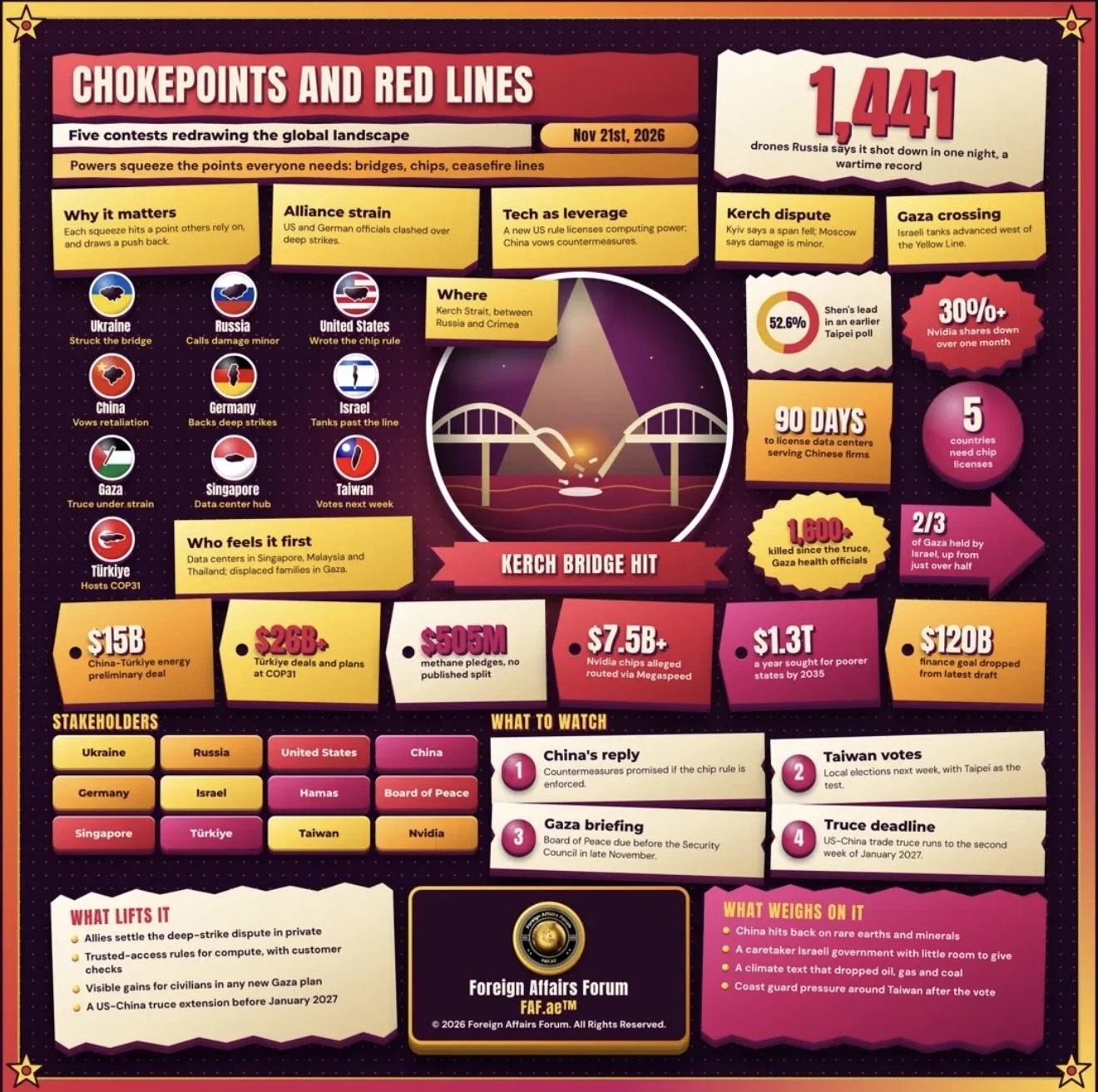
In the early hours of Tuesday, Ukraine hit the bridge with drones and missiles. President Zelenskyy called it an unprecedented operation and said it followed weeks of strikes on Russian air defenses, radars and electronic warfare systems, and he said Neptune and Flamingo missiles were used. A Ukrainian defense firm told Reuters that seven of its Ruta cruise missiles hit the structure. Ukraine's General Staff said an arch and a span of the road section collapsed, leaving the road unusable, while the railway line remained standing with a damaged arch. Reporting this week put about 200 meters of roadway heavily damaged and partly submerged, with rail traffic limited to a single track. Russian officials described the damage as minor, Kremlin spokesman Dmitry Peskov said the bridge would be rebuilt and made better than before, and he added that Moscow would continue the hostilities. Russia's Defense Ministry reported shooting down 1,441 drones overnight, after 1,336 the day before, which it described as a wartime record.
The quarrel inside the alliance followed within days.
At a meeting of the Ukraine Contact Group, Under Secretary of Defense Elbridge Colby argued that deep strikes inside Russia have neither helped end the war nor halted the Russian advance, said they strengthen Russian resolve and the Kremlin's willingness to escalate, and urged European allies not to support attacks away from the front lines. Reports differ on whether he named the bridge directly. One account has him calling it a civilian structure, while another says he did not mention it and that diplomats judged his remarks to relate to it. German Defense Minister Boris Pistorius, speaking after a meeting of Ukraine's allies at NATO headquarters, called the criticism "pretty stupid," argued that the targets were strategic military ones, and said the focus should be on Russian attacks on Ukrainian energy, water and heating infrastructure, which he described as a form of terrorism. Russia has meanwhile hit Ukrainian bridges in turn, damaging two of the five Dnipro bridges in Kyiv.
The second development is the American rule on remote access to advanced chips.
The Bureau of Industry and Security announced it early this week as an interim final rule, and it took effect on Thursday with publication in the Federal Register, with comments due 60 days later. It does several things at once. It requires a license for exports to data centers anywhere in the world that provide very large aggregate processing capacity to companies headquartered in China or Macau. It requires licenses for the most advanced chips going to Brazil, Indonesia, Malaysia, Singapore and Thailand, with an exemption where the end user is headquartered in the United States and the exporter files monthly reports. It tightens the rules for foundries and chip packaging firms. It gives data centers already serving Chinese customers 90 days to obtain a license. It allows no license exceptions, and it formally rescinds the Biden-era diffusion framework along with its exceptions.
China's reaction was immediate.
The commerce ministry said it firmly opposes the rule and will take countermeasures if it is enforced, and a foreign ministry spokesperson called it a typical example of economic coercion and long-arm jurisdiction. Singapore said it is studying the measure, called itself a trusted international business hub, and has sought trusted access for legitimate firms. Thailand said it will scrutinize data centers more closely to avoid becoming a transshipment hub, Indonesia is seeking industry input, and Malaysia's trade ministry is checking whether chips brought into the country were re-exported. The market reaction was sharp earlier in the week, with the Nasdaq down 2.5% and the S&P 500 down 1.9% on the day the rule was announced, and Nvidia shares have fallen more than 30% over the past month. The company's chief executive resigned last week during a board investigation connected to allegations involving Megaspeed.
The third development is the Israeli ground advance in central Gaza.
On Wednesday, Israeli tanks moved west of the Yellow Line toward the Salah al-Din road and the Bureij and Nuseirat camps, with the military saying it was targeting Hamas infrastructure in three numbered blocks and, a day later, that the operation was complete. Israel described it as a targeted operation to dismantle a tunnel that threatened its troops, and dozens of displaced Palestinians fled their tents. Palestinian medics reported at least one person killed by an airstrike near the raid. Hamas called it a flagrant ceasefire violation. Israeli Defense Minister Israel Katz said Israel will not withdraw until Hamas is dismantled and Gaza is demilitarized.
The same week, the Board of Peace chaired by Mr. Trump delivered a 12-page report to the Security Council that blames both sides.
It faults Israel for delays in building a civilian Palestinian police force and for restrictions on supplies, and it faults Hamas for continued attacks on Israeli troops and for taxing goods entering Gaza. The report says a ceasefire that delivers nothing visible cannot be sustained indefinitely. A Hamas official called the report pure disinformation. The board is expected to present its findings to the Security Council in late November.
The fourth development is the COP31 overtime.
Delegates from more than 190 countries were still negotiating on Friday, the scheduled last day, and the text was expected to run into the weekend. The latest draft, steered by Australia's climate minister Chris Bowen, dropped references to oil, gas and coal that an earlier draft had contained. France's ecological transition minister Monique Barbut called the omission a black mark. Other disputes include whether language welcoming carbon capture should stay, whether new electricity must be clean, and whether the next scientific assessments from the Intergovernmental Panel on Climate Change should be ready before the 2028 global review or be delayed to 2029, which Saudi Arabia and India favor. On money, wealthy countries want large emerging economies such as China to contribute, and the draft drops a $120 billion goal sought by developing nations. The host, meanwhile, announced more than $26 billion in deals and plans, including a preliminary $15 billion renewable energy agreement with China.
The fifth development is the run-up to Taiwan's local elections next week.
Voters will choose mayors and magistrates, and the contest in Taipei, between the Democratic Progressive Party's Puma Shen and the Kuomintang incumbent Chiang Wan-an, has become the symbolic centerpiece. Polls disagree widely. One institute put Shen ahead by 52.6% to 35.3% earlier this month, while a later survey from the Taiwan Brain Trust put him ahead by 46.3% to 42.2%. In New Taipei City, a China Times poll showed the Kuomintang's Lee Shu-chuan narrowly ahead of the Democratic Progressive Party's Su Chiao-hui, 37% to 33.4%. Beijing has labeled President Lai Ching-te a destroyer of peace and described Shen as a diehard separatist.
Latest Facts and Concerns
Several facts need careful handling.
On the Kerch Bridge, the sources agree that the road section is unusable and disagree on almost everything else. Kyiv speaks of a collapsed arch and span, while Russian officials speak of limited damage and restored rail service. The Associated Press said it could not verify videos released by Ukraine. The strategic question is also contested. One analyst argued that Crimea is turning into an island in logistical terms and that grain and steel freighters from southwestern Russia and occupied regions may be blocked by the fallen arch in the deepest part of the strait. Another argued that the strike was counterproductive, because little military traffic crossed the bridge in the past year and mid-range drone attacks on roads along the Sea of Azov would have done more damage to Russian supply.
On chips, the reporting shows some differences in detail. Early press coverage described the rule as a proposal, while law-firm summaries confirm an interim final rule effective on publication, so the correct description is a rule already in force that is open to comment. Reports also differ on the number of countries named, since some mention only four Southeast Asian states while the rule text names five including Brazil. Allegations around Nvidia and its former chief executive remain allegations. The California attorney general said in a television interview that red flags have been raised and that a probe is very possibly something his office could pursue, but that interview did not confirm a subpoena, and a claim that one had been served appeared in only one digest and should be treated as unverified. A claim that a US-China trade truce will be extended also appeared in a single source with no terms, and the truce formally runs to the second week of January 2027.
The central concern in Gaza is that a ceasefire is eroding by increments rather than ending by declaration. Israel says the raid was narrow and the Board of Peace says both sides are failing, and each fact is true while the trend line points downward. The Israeli political calendar adds risk. A caretaker government and an unresolved coalition contest reduce the incentives for restraint and for concessions on the sequencing dispute. A related concern is humanitarian: Gaza's health authorities report more than 1,600 deaths since the truce, and winter conditions are worsening shelter and aid problems for displaced families.
At COP31, the main concern is not a failed conference but a hollow one. Negotiators removed phrases about phasing down fossil fuels at a moment when energy security is a pressing concern because of disruption in the Gulf, and the finance discussion has drifted from goals toward process. Brazil's proposal of $1.3 trillion a year for developing countries by 2035 remains a reference target rather than a commitment, and the methane pledges of about $505 million announced earlier in the conference have no published allocation or timeline.
In Taiwan the concern is both electoral and maritime. A strong result for the Democratic Progressive Party could strengthen President Lai ahead of the 2028 presidential race but could also encourage Beijing to increase coercion, while a weak result for the Kuomintang could damage its chair's national ambitions. Japan's defense ministry think tank said in a report released last week that China is prioritizing control of the South China Sea to deter American intervention in a Taiwan contingency, with a blockade of the Bashi Channel as one scenario.
Dr. 🆎 notes that the technology layer links all five stories. Drone swarms numbering well over a thousand in a night, compute access as a controlled commodity, and chip supply concentrated in a region facing maritime pressure are three faces of the same AI-enabled landscape.
Cause-and-Effect Analysis
The causal chain that connects these stories begins with a failure of political settlement. Because the Ukraine talks have produced exchanges of prisoners but no agreement on territory or security guarantees, military pressure remains the main instrument available to Kyiv. Striking the Kerch Bridge is a way of raising costs for Moscow before any negotiation resumes, and it is also a signal to Washington that Ukraine can still shape the landscape on its own. The effect inside the alliance is the unintended consequence. A Pentagon official who argues for focus on the front line and a German minister who argues for strikes on strategic targets are describing different theories of how wars end, and the dispute exposes the absence of a shared theory. Per FAF analysis, that absence is more dangerous to the coalition than any single strike, because Russia gains from visible disagreement among Ukraine's supporters.
The bridge strike also shows how escalation is now shaped by cheap, numerous and fast-evolving systems. Russia reported downing 1,441 drones in a single night, a figure that would have been unimaginable in earlier phases of the war, and Ukraine's strikes combine missiles, drones and decoys to saturate air defenses. Dr. 🆎 argues that this is the practical meaning of AI warfare, even where full autonomy is not yet present. The relevant question is who can produce, coordinate and adapt at scale, and the stakeholder who solves the production and software problem first holds an advantage that bridges and ceasefire lines cannot offset. A human-centered approach, in Dr. 🆎's view, requires keeping meaningful human judgment over targeting decisions even as the tempo accelerates, because the risk of misread signals rises with the speed of the cycle.
The chip rule follows a similar cause-and-effect pattern in the economic domain. Because export controls on chips were porous, Washington moved to control access to the compute itself, and in doing so extended American jurisdiction to data centers in third countries. The immediate effect is a squeeze on Southeast Asian hubs that had built business models on neutrality. The secondary effect is a push toward alternatives: if American licenses become the price of hosting advanced compute, some governments and firms will invest in non-American supply chains, and China will accelerate domestic substitutes. The timing, on the same day as a Trump-Xi meeting, ensures that the rule will be read in Beijing as leverage rather than housekeeping. China's capacity to retaliate is real, because rare earth exports to the United States are reported to remain far below normal, and a retaliation that targets those flows would hit American manufacturers and defense suppliers.
Dr. 🆎 adds a biosecurity dimension that is often missing from chip debates. The same large-scale compute that trains frontier models can accelerate biological design, and the risk that a malicious stakeholder could use remote access to such capacity is part of the rationale for know-your-customer duties on data centers. In this narrow respect, the rule's attention to who is renting capacity is consistent with a bioterrorism risk-reduction agenda. The problem is that a blunt geographic rule also catches legitimate researchers and firms, and Dr. 🆎 advocates trusted-access regimes in which verified institutions retain access while anonymous or opaque customers do not.
The Gaza story shows a different mechanism, the slow erosion of a bargain whose sequencing was never settled. Because Hamas disarmament and Israeli withdrawal were each made conditional on the other, every incremental move by one side can be framed by the other as a violation, and each side can cite the other's behavior in justification. The Israeli advance, the Hamas taxation of goods and the delays in building a police force are all symptoms of that stalemate. Domestic politics amplify it. A caretaker government in Israel has little room for concessions, and an opposition leader trying to assemble a majority has limited incentive to appear soft. The humanitarian effect is direct, since each shift of the Yellow Line moves families from their tents and removes land from reach.
At COP31 the mechanism is consensus itself. Because every text needs near-unanimity, the stakeholders most opposed to a phase-out can dilute the language until it commands agreement, and the host's own priority on electrification and investment deals fills the space left by absent ambition. The effect is a regime that produces announcements rather than obligations. In Taiwan the mechanism is incrementalism by the stronger party. Each coast guard patrol, each radio challenge to a vessel and each exercise is small, and the accumulated pattern changes what counts as normal. A local election that strengthens the ruling party invites a response, and a response that targets shipping would quickly become a global economic event because of the island's role in chip supply.
Future Steps
Three scenarios frame the coming months, and Dr. 🆎 treats each as plausible rather than predicted.
In the first scenario, managed friction, the stakeholders contain the damage. The Berlin meeting convenes, the American and European positions on deep strikes are reconciled in private, and the talks with Russia resume around a prisoner exchange and limited energy-infrastructure restraint. The United States and China extend their trade truce before the second week of January 2027, with Beijing's countermeasures limited to licensing and regulatory moves rather than a new rare earth squeeze. The Board of Peace briefing to the Security Council produces a revised sequencing plan for Gaza, Israel pulls back from the line it crossed, and COP31 closes with a thin text that preserves the process. Taiwan's election passes without a major maritime incident. This scenario requires restraint from several stakeholders at once, which is why it is less likely than it appears.
In the second scenario, compounding escalation, the squeezes feed each other. China answers the chip rule with export restrictions on critical minerals, the truce lapses at the start of 2027, and the resulting economic stress hardens positions on Ukraine and Taiwan. Russia answers the bridge strike with intensified attacks on Ukrainian energy and bridges during winter, Washington reduces support for deep strikes, and Europe struggles to fill the gap. Gaza slides from incremental advances into a larger offensive, and the Security Council is paralyzed. Maritime pressure around Taiwan rises after the election. In this scenario the danger lies in simultaneous crises that exhaust the political bandwidth of the few leaders capable of de-escalating them.
In the third scenario, fragmentation by design, stakeholders accept the new dependencies and build around them. Southeast Asian states negotiate trusted-access arrangements with Washington while also courting Chinese and European investment, data centers in the Gulf and Türkiye absorb displaced demand, and a parallel compute ecosystem begins to form. European governments set up their own mechanisms to support Ukraine's deep-strike capability without American backing, and middle powers hedge. Climate finance moves through development banks and bilateral deals rather than through the negotiating text. This scenario is stable in the short run but it raises costs and deepens the split between blocs.
For each scenario, Dr. 🆎 recommends three practical steps. First, create a standing channel between Washington and European capitals on the strategic logic of deep strikes, so that disagreements are resolved before they reach the press. Second, build trusted-access frameworks for compute, with transparency about customers and with biosecurity screening, so that legitimate users are not swept up. Third, tie any new Gaza sequencing to verifiable, visible gains for civilians, because the Board of Peace itself has warned that a ceasefire delivering nothing visible cannot last.
Conclusion
The week's events show that power in the current landscape flows through narrow points, and that the stakeholders who squeeze them often underestimate the counter-squeeze. A bridge cut in the Kerch Strait reopened an alliance quarrel. A licensing rule for supercomputing invited the threat of mineral retaliation. A tank advance in Gaza tested a ceasefire that cannot afford more tests. A climate text lost its most important phrase, and a Taiwanese ballot became a rehearsal for gray-zone pressure.
Per FAF analysis, the strategic lesson is that chokepoint tactics work best when they serve a clear political aim and are paired with a path to de-escalation. Without that pairing they generate friction without progress.
Dr. 🆎 closes with a human-centered test that any stakeholder can apply: ask who will live with the consequences of the squeeze, whether they were consulted, and whether the move makes a negotiated outcome more or less likely. On that test, several of this week's moves fall short, and the coming weeks will show whether the stakeholders behind them are prepared to adjust.