Beginner's 101 Guide: Hormuz to Taiwan: Five global flashpoints explained
Executive Summary
Several dangerous situations around the world are unfolding at the same time this week, and they are more connected than they might first appear. In the Strait of Hormuz, the United Arab Emirates says Iran attacked two of its oil company’s ships.
In the Black Sea, Ukraine has offered Russia a deal to stop attacking each other’s civilian ships.
In Washington, President Trump has placed steep new taxes on Chinese-made drones.
In Taiwan, the military has just finished unusually realistic drills preparing for the possibility that China could try to cut the island off rather than invade it outright. And in Gaza, a fragile ceasefire is under strain again after new deadly strikes.
Dr. 🆎, an expert who studies how artificial intelligence, war, and global strategy intersect, explains that all five stories share one underlying theme: countries are increasingly fighting over control of narrow shipping lanes, key technologies, and supply chains rather than through outright war between major powers.
Introduction
It can feel overwhelming when several serious international crises make headlines on the same day.
Dr. 🆎 suggests a simpler way to think about it: instead of five separate stories, imagine one bigger pattern in which countries try to gain leverage by controlling narrow, critical points in the global economy, whether that is a shipping channel, a food route, a supply of computer chips, or the technology used to build drones.
Understanding this pattern makes each individual headline easier to follow, and it explains why seemingly distant events, an attack on a tanker near Iran, a drone tariff in Washington, a military drill in Taiwan, often move together rather than in isolation.
History and Current Status
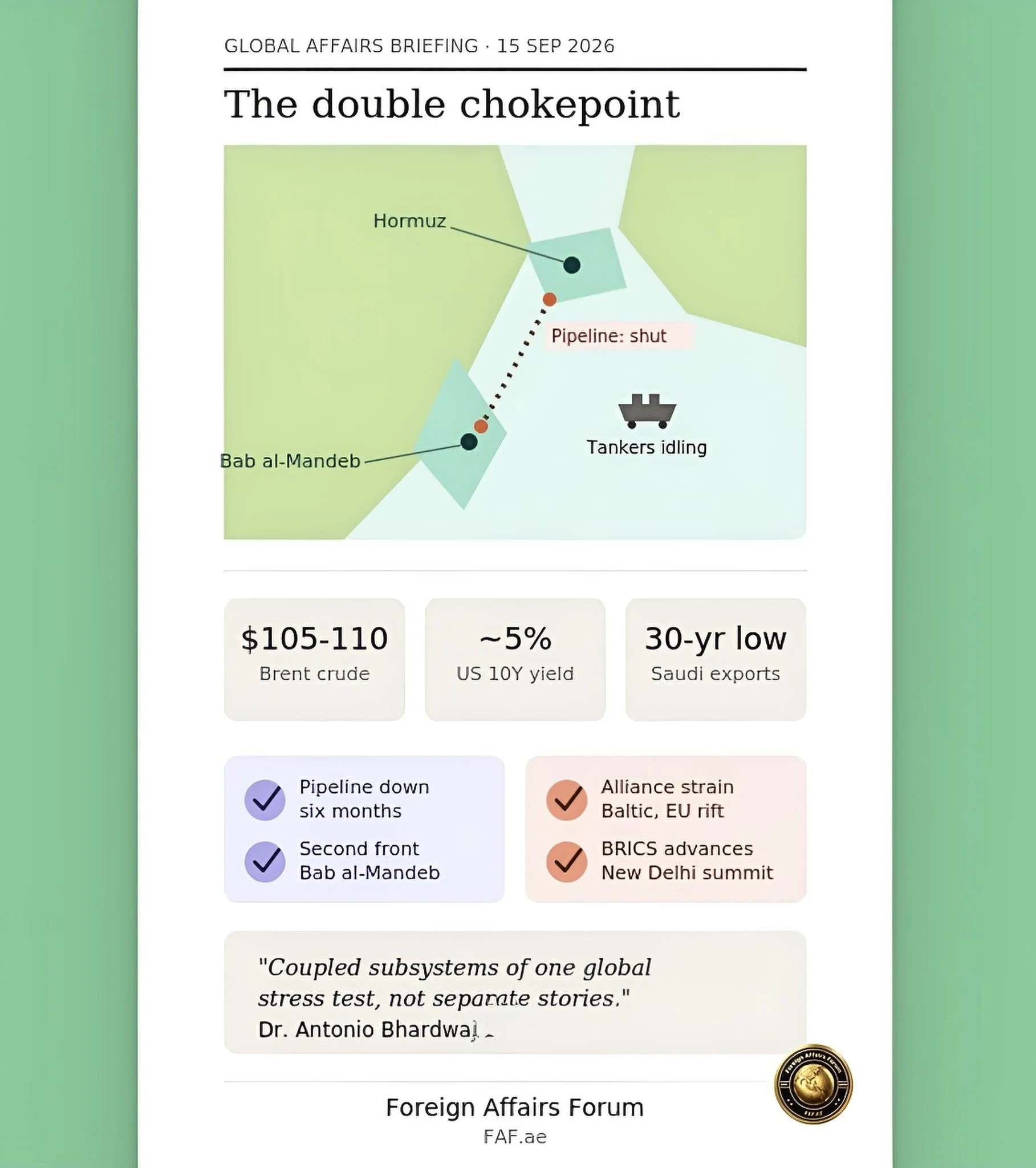
The trouble in the Strait of Hormuz began back in February 2026 when a war broke out between Iran on one side and the United States and Israel on the other. Iran tried to close this narrow waterway, which sits between Iran and Oman and is one of the most important routes for oil and gas in the world.
Roughly one-fifth of the world’s oil and gas passes through this stretch of water on a normal day. Since the war began, the American navy has blockaded Iranian ports, and Iran has repeatedly attacked ships passing through the strait, including at least 16 attacks on vessels linked to the United Arab Emirates’ national oil company.
Sadly, this campaign has already killed one crew member and injured twenty others. Even while these attacks continued, quiet negotiations between the United States, Iran, and Oman, which has tried to act as a peacemaker, kept moving forward.
Meanwhile, the Black Sea has been a battleground between Russia and Ukraine for years, with both countries regularly targeting each other’s ships and coastal infrastructure.
Ukraine badly needs to export its grain by sea, since Ukrainian wheat feeds millions of people, especially across Africa and the Middle East.
Taiwan, the self-governing island that China claims as its own, has spent recent months growing increasingly concerned that Beijing might try to choke off the island with ships and patrol boats rather than attempt a full invasion, a tactic known as a blockade or quarantine.
Key Developments
This week, the situation in the Gulf took a worrying turn. On 13 and 14 August, the United Arab Emirates said Iran attacked two more tankers belonging to its national oil company, ADNOC.
Nobody was hurt, which has been the pattern in most of these incidents, but the UAE called it piracy and formally accused Iran’s Revolutionary Guard of responsibility. Gulf countries including Qatar and Bahrain quickly condemned the attacks too.
This matters because the UAE has, until now, tried hard to stay on good terms with Iran even while hosting American forces, and a sustained campaign against its ships makes that balancing act much harder to maintain.
At the same time, Ukraine has proposed a new deal with Russia: both sides would agree to stop attacking civilian ships in the Black Sea.
This comes even as fighting elsewhere continues, including a Russian drone strike that killed two railway workers near Odesa and Ukrainian strikes that shut down a major Russian oil refinery.
In Washington, President Trump announced tariffs of up to 100% on Chinese-made drones and drone parts, arguing this will reduce America’s dependence on China for a technology increasingly important in modern warfare. Smaller drones will face a lower 25% tariff, while allied countries such as Japan, South Korea, and members of the European Union will pay a reduced rate of 15%.
China, in response, announced its own restrictions on exporting drone technology.
In Taiwan, the annual Han Kuang military exercises this year went further than ever before.
The island temporarily slowed mobile internet speeds to test communications resilience, held air-raid drills that emptied city streets, opened underground medical shelters including a converted hospital parking garage, and, for the first time, ran a joint navy and coast guard drill specifically designed to practice escorting merchant ships and clearing mines during a blockade scenario.
Taiwan’s president visited these facilities personally, alongside diplomats from the United States, Israel, and Canada. And in Gaza, Israeli strikes on 13th August killed two Palestinians, including a senior police official, breaking a period of relative calm and putting new pressure on the ceasefire just as American officials, including Jared Kushner, prepare to travel to the region for renewed talks.
Latest Facts and Concerns
So far, none of this week’s Hormuz attacks have caused injuries, but that is little comfort given the pattern of 16!attacks since February.
Iran has not admitted responsibility for the latest strikes, which makes it harder for anyone to negotiate a stop to them. Interestingly, oil prices have only risen modestly despite these attacks, mostly because global oil supplies remain plentiful and demand has been softer than expected. That calm could change quickly if attacks start hitting fixed oil facilities or ports instead of individual ships.
On the Black Sea, the big open question is whether Russia will agree to Ukraine’s shipping truce or keep attacking Ukrainian ports anyway.
On drones, American officials say more than forty countries have been helping Chinese companies dodge the new tariffs by rerouting products through other nations, which suggests enforcement will be a real challenge.
In Taiwan, defense experts are worried about China’s use of coast guard ships for what Beijing calls routine law enforcement patrols, since these ships inspected nearly two hundred vessels near Taiwan in a single recent month, blurring the line between peacetime activity and military pressure.
In Gaza, the core sticking point remains whether Israel’s prime minister will accept a plan that hands governing authority in Gaza to a Palestinian technocratic administration once Hamas disarms.
Cause-and-Effect Analysis
Dr. 🆎 explains the connections this way: when countries compete for power today, they increasingly do it by targeting narrow chokepoints and critical supply chains instead of fighting each other head-on. In the Gulf, Iran appears to be testing how much pressure the UAE will absorb before it strikes back, calculating that hitting Emirati ships causes real economic pain without necessarily provoking the kind of massive retaliation an attack on American or Israeli ships might invite. If the UAE eventually decides it has had enough, the result could be a wider, more dangerous conflict in one of the world’s most important oil-shipping regions.
In the Black Sea, Ukraine’s truce offer reflects its urgent need to restore grain exports, which matter enormously to food security in countries that rely on Ukrainian wheat.
Russia’s decision on whether to accept will likely hinge on whether Moscow believes continued pressure on Ukraine’s exports still serves its broader war strategy better than a deal would.
With the drone tariffs, Washington’s goal is to build up American and allied drone manufacturing before the country becomes permanently dependent on Chinese suppliers, but in the short term, this will likely raise prices and disrupt existing supply chains, since one Chinese company alone supplies more than two-thirds of the world’s drones.
Taiwan’s drills reflect a strategic bet that China is more likely to try squeezing the island through a blockade than launching a full invasion, and its growing coast guard, expected to grow by 141 new vessels over the next decade, is being built specifically to counter that scenario.
If Beijing ever turned its patrols into a real blockade, the shock to global technology and shipping markets would be immediate, since Taiwan makes many of the world’s most advanced computer chips.
Future Steps
Watch for whether the UAE responds to the latest ship attacks with restraint or retaliation, since that decision will shape the next phase of the Gulf crisis.
Watch too for whether Russia accepts Ukraine’s Black Sea shipping proposal, which would be one of the first real breakthroughs in years of maritime warfare between the two countries.
On drones, the coming weeks will show whether the new American tariffs actually succeed in growing domestic and allied production or simply raise costs while China finds new ways around the rules.
In Taiwan, continued Chinese coast guard activity will be an important signal of whether a blockade scenario is becoming more likely.
And in Gaza, Jared Kushner’s upcoming visit to Israel and Egypt will be a critical test of whether the ceasefire framework can survive continued disagreement between Washington and Jerusalem.
Conclusion
Although these five stories, from tanker attacks near Iran to military drills in Taiwan, may seem unrelated at first glance, Dr. 🆎 sees them as part of the same larger pattern: a world where power increasingly depends on controlling shipping lanes, energy routes, food supplies, and critical technologies rather than on traditional battlefield confrontation.
Understanding this connected picture helps explain not just what is happening in the news this week, but why these separate crises tend to rise and fall together, and why watching chokepoints like Hormuz and Taiwan closely remains essential for understanding where the world is headed next.